
AI phone assistant failure: 5 go-live lessons for chatbots
Kinney Drugs scaled back its AI phone assistant after press-reported customer complaints. Five go-live mistakes to avoid on WhatsApp and voice bots.

Updated

AI phone assistant failure: 5 go-live lessons for chatbots
A voice bot can be compliant on paper and catastrophic in the customer's ear. Kinney Drugs reminds us: technical security does not replace customer experience.
In early August 2026, local U.S. press — notably WCAX — reported that Kinney Drugs was sharply reducing use of its AI phone assistant after numerous customer complaints reported by the press. The chain's president made a crucial point: getting privacy and security right does not mean getting the experience right.
For a francophone SME rolling out a WhatsApp bot, a smart IVR, or a voice agent, this is not a distant U.S. anecdote. It is a textbook failed go-live. Here are five mistakes to avoid, a human-fallback pattern, and a CSAT grid before you put the bot in production.
What the press actually described
According to reporting (WCAX, KWQC / WWNY pickups, and local investigations such as VTDigger):
- Kinney Drugs had launched an assistant named Burt (after the founder) to handle prescription and refill communications.
- Customers reported incoherent calls, wrong or delayed information, and a loss of human contact.
- Privacy concerns circulated; leadership affirmed HIPAA compliance while admitting the experience failure.
- Decision: return to touch-tone for inbound patient calls; AI may remain for some outbound texts with explicit opt-in.
We do not reproduce unverified internal complaint tallies here. The useful product signal is elsewhere: a broad rollout without a human safety net destroys trust faster than the bot creates savings.
The 5 go-live mistakes (voice and WhatsApp)
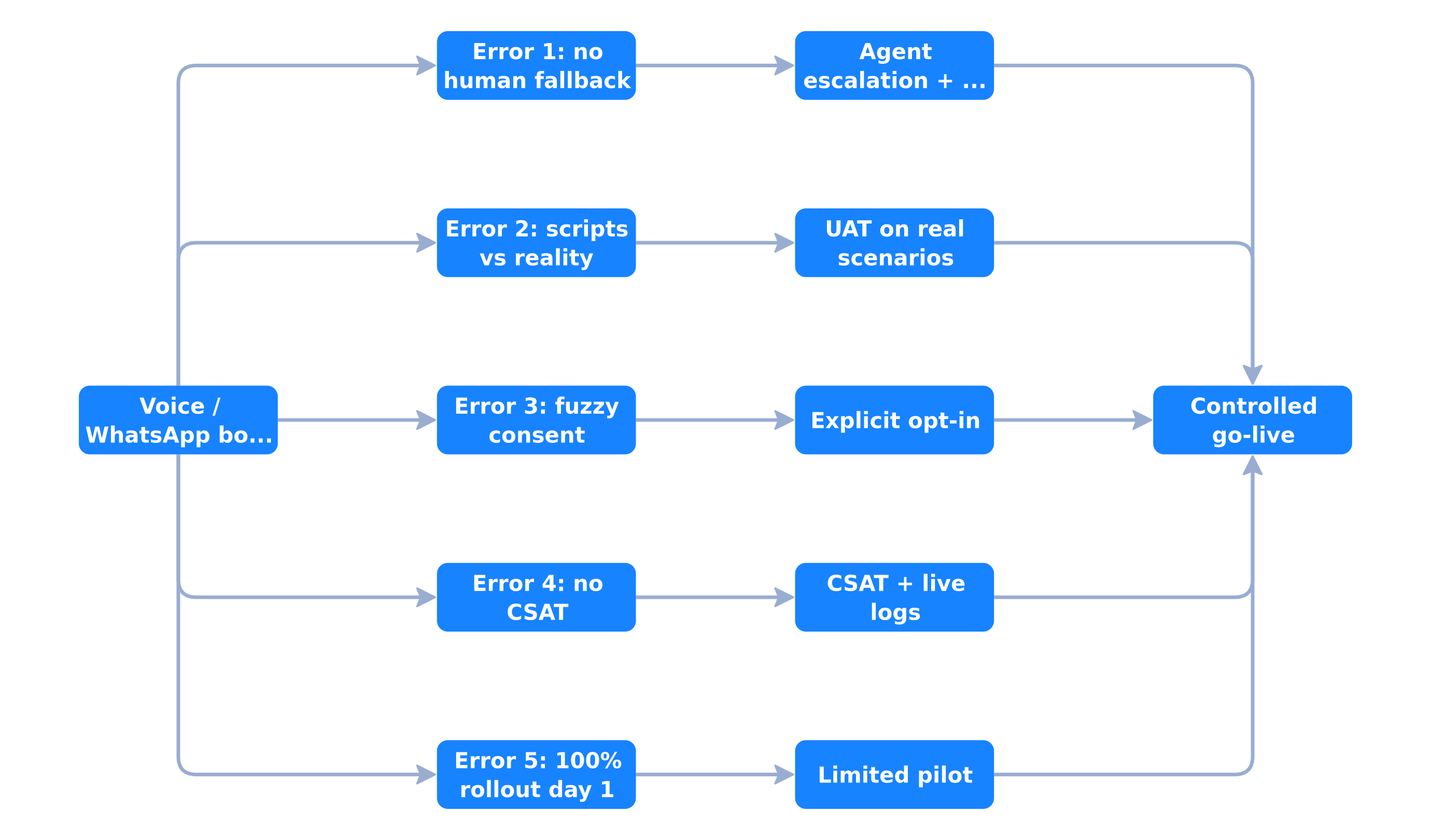 From each classic mistake to the fix: fallback, UAT, opt-in, CSAT, pilot
Mistake 1 — No human fallback (or a hidden one)
A customer who cannot escape an AI maze experiences a block, not “innovation.” On WhatsApp and phone alike, the “human agent” intent must be:
- always reachable (keyword, keypress, button);
- honored under a short SLA (e.g. pickup within X minutes during business hours);
- enriched with context (summary + history) so people do not start over.
Without that, every model failure becomes a public complaint.
Mistake 2 — Scripts trained on FAQs, not reality
Bots fail where the journey is ambiguous: dosage, stock, exceptions, stressed callers, accents, background noise. Before go-live:
- Collect 50–100 real conversations (anonymized).
- Run edge cases in UAT (double orders, refusals, urgency, out-of-scope).
- Define what the bot must never assert (health claims, final pricing, legal commitments).
An overconfident bot in a sensitive domain (health, money, legal) is an immediate reputation risk.
Mistake 3 — Fuzzy consent and transparency
In the Kinney case, press coverage also highlighted implicit consent: giving a phone number should not silently mean accepting an AI agent. For an EU / francophone African SME:
- clearly announce “you are speaking with an automated assistant”;
- offer opt-out / a human on the first message;
- document the purpose (support, appointment reminder, cart recovery) in your policy.
Trust is an asset. Surprise is a liability.
Mistake 4 — No CSAT or alerts in week one
Many teams watch cost per conversation… and ignore satisfaction. From the pilot onward, track:
| Metric | Typical alert |
|---|---|
| Post-bot CSAT | sharp drop vs human baseline |
| Escalation rate | sudden spike or above target |
| Abandons / hang-ups | peak on days 1–3 |
| Recurring complaints | same motif > N times / day |
If you do not measure, you will discover the problem on social reviews — too late.
Mistake 5 — Full traffic on day one
Putting 100% of inbound traffic on a brand-new bot is a commercial decision, not a technical one. Prefer:
- a pilot on one site / queue / time window;
- opt-in for sensitive channels;
- staged expansion (20% → 50% → 100%) if metrics hold.
Kinney shows the cost of a broad rollout followed by a public retreat. A quiet pilot beats a crisis statement.
Human fallback: the design that protects the brand
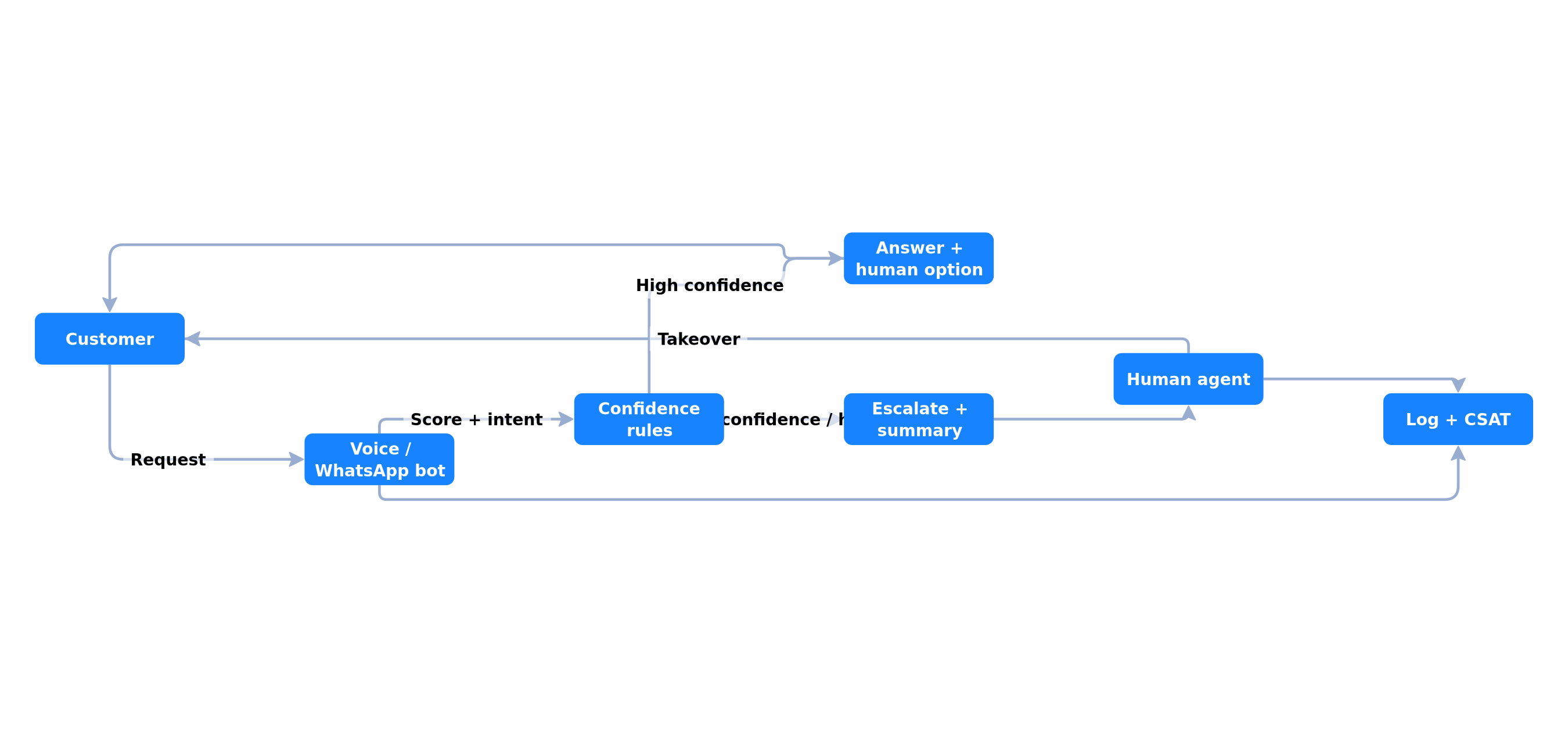 Confidence score, auto answer, or escalate with summary to a human agent
Three non-negotiable rules:
- The customer can choose a human without friction.
- The system forces escalation when confidence is low or the topic is out of scope.
- The human receives context — otherwise escalation makes the experience worse.
For a concrete WhatsApp + orchestration architecture, see our WhatsApp chatbot tutorial with n8n + Claude in 30 minutes and the AI chatbot agency page.
CSAT: what to watch before you expand
CSAT does not replace business judgment, but it detects Kinney-style failures early.
Baseline: measure two weeks of human support (same channel) before the bot.
During the pilot: bot CSAT vs human, by intent.
After expansion: Slack / email alert if CSAT slides three days in a row.
Add two open questions:
- “What blocked you?”
- “Would you have preferred a human earlier?”
Qualitative answers often beat a score alone.
Go-live checklist (paste into your project ticket)
- Written scope: 3–5 intents max at start
- Forbidden topics list (sensitive assertions)
- “Human agent” button / keyword tested
- Escalation SLA documented
- Explicit AI announcement / opt-in
- CSAT + live dashboard
- Pilot ≤ 20% of traffic or a single site
- Weekly review of failure transcripts
- Rollback plan (back to IVR / human queue) ready
If any box is red, you are not in go-live — you are in a public demo.
What francophone SMEs should take away
The Kinney Drugs signal is not “voice AI is dead.” It is: customer experience beats tech storytelling. Compliant privacy + a frustrating bot = failure. A useful bot + clear fallback + tracked CSAT = a defensible rollout.
On WhatsApp, the same pattern applies: endless loops and no human path destroy ROI. On the phone, voice amplifies every friction.
If you are building or fixing a conversational assistant, start from the customer journey, not the model. Orchestration (n8n, business rules, HITL) often matters more than swapping LLMs.
Voice vs WhatsApp: same mistakes, different friction
Phone and WhatsApp do not behave the same, even though the five go-live mistakes still apply.
On voice, the customer usually has no visible history. They cannot re-read the last answer. Ambiguous wording often means an immediate hang-up. Accents, store noise, and interruptions (“wait, I’m looking for my prescription”) break linear scripts. Plan short confirmations for critical data, and a “0” key or magic phrase for a human.
On WhatsApp, customers can scroll, but they expect a fast reply and hate six-level menus. Long “email-style” messages read poorly on mobile. Prefer one question at a time, buttons / lists when the API allows, and a summary before any irreversible action (booking confirmation, cancellation, payment).
In both channels, document the out-of-scope perimeter: “I cannot change a prescription / contract; I will transfer you.” A bot that invents to “be helpful” is more dangerous than a bot that says no.
For teams starting without a complex voice stack, WhatsApp is often the better first channel: lower entry cost, written transcripts for CSAT analysis, and the same escalation logic. Voice can follow once intents are under control.
RACI matrix before day one
Many failures come from organizational blur: the bot is “launched by marketing,” owned by nobody, and criticized by everyone.
| Role | Responsibility |
|---|---|
| Business sponsor | Approves scope and rollback |
| Ops / support | Owns escalation and SLA |
| Engineering | Logs, intents, integrations |
| Compliance / DPO | Consent, purposes, retention |
| Leadership | Reads week-1 CSAT, decides expansion |
Without a sponsor and an ops owner, the bot becomes orphaned at the first complaint wave. Kinney also shows the value of a clear message when scaling AI back: better to explain a return to touch-tone than let customers discover the change alone.
Conclusion
Kinney Drugs showed in August 2026 that an AI phone assistant can be pulled back under complaint pressure — even when the company says privacy and security were handled. For your WhatsApp and voice chatbots: limit scope, force human fallback, measure CSAT, and avoid the big bang.
Need framing or a pre-go-live audit? Our AI chatbot agency helps SMEs on WhatsApp, web, and hybrid journeys — and the WhatsApp n8n + Claude tutorial shows a sound technical base.
Tags
FAQ
What happened with Kinney Drugs' AI phone assistant?
In early August 2026, local U.S. press (notably WCAX) reported that Kinney Drugs was scaling back its AI phone assistant “Burt” after numerous customer complaints. The chain returned to a touch-tone system for inbound calls while keeping AI for some outbound messages on an opt-in basis.
Should we abandon voice or WhatsApp bots after this failure?
No. The failure is mainly a go-live problem: too broad a rollout, a poor experience, and eroded trust. A limited pilot, a clear human fallback, and continuous CSAT measurement let you ship without burning the brand.
What does a good human fallback look like for a chatbot?
An explicit “talk to a human” path, a confidence threshold that auto- transfers, a recovery SLA, and conversation history handed to the agent. Without that, the bot becomes a wall.
How do you measure CSAT for a voice or WhatsApp bot?
Post-conversation score (1–5), escalation rate, first-contact resolution, and recurring complaint volume. Watch the trend especially in the first week after go-live.
Where should an SME start with a WhatsApp chatbot?
Start with a narrow scenario (hours, stock, booking), with opt-in and escalation. Our WhatsApp + n8n + Claude tutorial and AI chatbot agency page outline a concrete path.
We scope one workflow — not a generic demo
You describe a repeated task. We tell you what n8n would ship, the timeline, and what stays out of scope.
- 30 min
- 1 scoped workflow
- No commitment
William Aklamavo
Web development and automation expert, passionate about technological innovation and digital entrepreneurship.


