
Google AI marketing tools 2026: what should SMEs test?
Google announced new AI marketing tools on blog.google (August 2026). An SME evaluation framework, brand risk, and CRM/WhatsApp integration.

Updated

Google AI marketing tools 2026: what should SMEs test?
Google is accelerating AI in Ads and Analytics. For a francophone SME, the question is not “how many tools?” but “which ones to test without damaging the brand.”
On August 10, 2026, blog.google published Evolve your marketing with new AI tools. Google describes new AI marketing tools across the Ads / Analytics ecosystem: more agentic experiences, performance summaries, natural-language reporting, benchmark comparisons, and notifications.
Most “best AI tools 2026” roundups list ChatGPT, Canva, and a dozen SaaS apps. Few help an SME evaluate Google’s wave without drowning. This article offers a frame: what to test, which brand risks matter, and how to wire it to CRM + WhatsApp.
What the announcement says (without inventing)
We stay with capabilities described publicly on blog.google and specialist coverage (e.g. Search Engine Land):
- Summaries and insight cards on Ads / Analytics dashboards to speed up “what happened?”
- Conversational reporting / dashboards generated from text prompts, with summaries explaining trends.
- Benchmarking (comparison to anonymized averages from similar accounts) in Analytics.
- Optional notifications (email / phone per the announcement) for significant shifts.
- An in-product AI agent experience already presented by Google in its marketing family (e.g. Ask Advisor in Google Ads/Commerce posts) — treat it as an assistance layer, not a marketing director.
If exact labels vary by account language or beta stage, trust your account UI over any invented catalog here.
Content gap: why this is not “another top-10 tools list”
Competing SME guides for 2026 tend to saturate on:
- generic multi-vendor lists;
- ROI promises without a test protocol;
- ignoring brand risk and the CRM / messaging link.
Our angle: an evaluation framework for Google’s August 2026 wave, aimed at francophone SMEs (France, Belgium, francophone Africa) that often run Ads + WhatsApp + a light CRM.
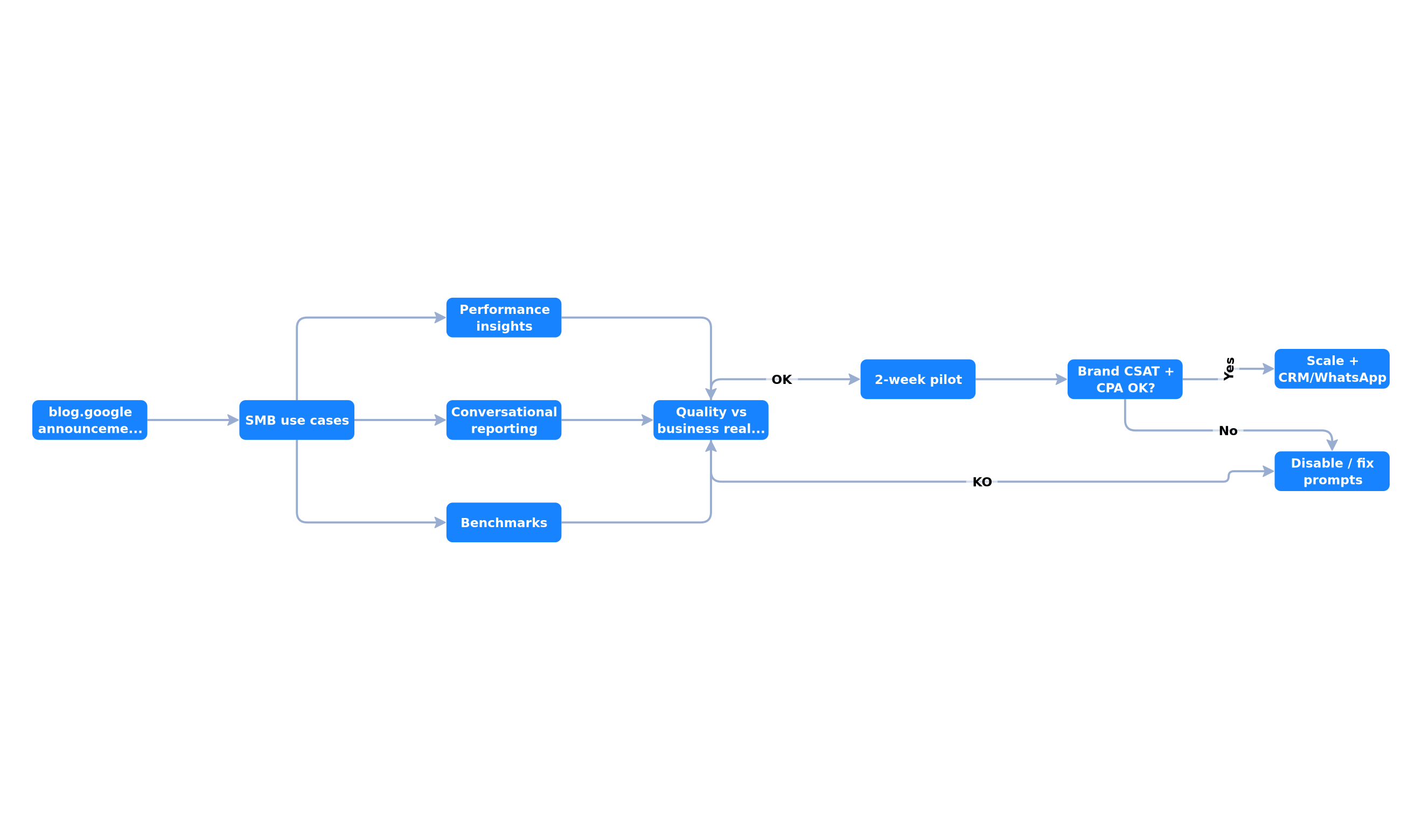 From SMB use case to pilot, with CSAT and CPA guardrails
Who inside the SME is concerned (and who is not)
These capabilities mainly help:
- the solo marketer who spends too much time in reports;
- the founder who wants a clear brief without jargon;
- the agency / freelancer managing multiple accounts and needing industrialized reporting.
They help less (at first):
- a team without reliable tracking (bad conversion tags → decorative insights);
- a fully relationship-driven business outside Ads (Google AI will not replace your network);
- a chaotic catalog (undated promos, unsynced stock).
In other words: fix measurement before you automate interpretation. Otherwise you will accelerate bad decisions.
Which use cases an SME should test first
1) Weekly performance summary (high priority)
Why: immediate time savings for a solo marketer.
Protocol: every Monday, read the AI summary, then verify three numbers in classic reports (CPA, conversions, rate).
Success: under 15 minutes for an actionable brief, without major factual errors.
2) Conversational reporting for a leadership update
Why: replace an unreadable spreadsheet export.
Protocol: a fixed prompt (“14-day summary, top campaigns, anomalies, 3 actions”); human review before sending to the founder.
Risk: overly optimistic summaries — require a re-read.
3) Benchmarks as hypotheses, not truth
Why: useful for positioning, dangerous if taken literally (misclassified sector, local seasonality, different AOV).
Protocol: note the gap vs benchmark; change budget only if an internal signal confirms (stock, margin, delivery capacity).
4) Anomaly notifications
Why: catch a weekend conversion drop.
Protocol: enable only for a critical threshold; avoid alert fatigue.
What not to test first: letting AI rewrite all brand creative or reallocate 100% of budget without guardrails.
Brand risk: the checklist before you expand
Google’s AI optimizes for performance measurable inside Google. Your brand also lives outside Google: WhatsApp, the store, word of mouth.
| Risk | Symptom | Guardrail |
|---|---|---|
| Off-brand tone | Generic copy, over-promises | Approved example library + review |
| Wrong offer | Expired promo pushed by AI | Catalog / offer-date sync |
| Over-automation | Budget “runs” without control | Daily caps + human approval |
| Misleading data | Insight true in Ads, false in ops | Cross-check CRM (qualified leads, no-shows) |
For an SME, the cost of bad creative is not only CPA: it is trust in a local market where everyone knows everyone.
CRM and WhatsApp integration: the missing link
Google’s new AI marketing tools excel at in-platform acquisition and measurement. They do not replace customer relationships.
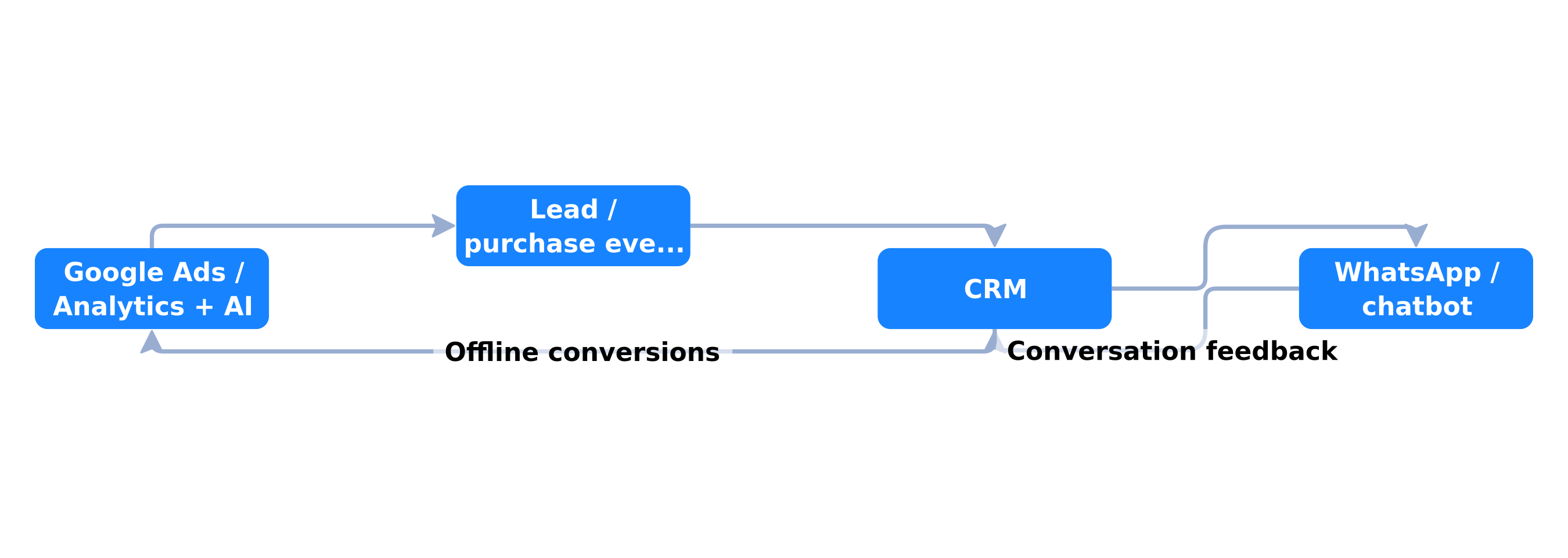 Google insights must close the loop with CRM and WhatsApp, not stay siloed
Simple rules:
- One customer source of truth: the CRM (or equivalent), not the latest Ads insight.
- Aligned events: an Ads “lead” must map to a qualified CRM contact — otherwise AI optimizes the wrong objective.
- WhatsApp downstream: appointment confirmation, cart recovery, support — with opt-in and human fallback.
- Orchestration: n8n or equivalent to sync without copy-paste.
If you are building this chain with a local team, our digital agency France and chatbot agency France pages describe how BOVO Digital connects acquisition, conversation, and ops.
14-day evaluation framework (SME template)
Days 1–2 — Inventory: Ads/Analytics accounts, language, access, business goals (not vanity metrics).
Days 3–5 — Enable only summaries + one conversational dashboard; keep an AI error journal.
Days 6–8 — Cross-check 10 insights against the CRM (leads actually contacted / sold).
Days 9–11 — Test one anomaly notification; measure noise.
Days 12–14 — Decision: keep / restrict / automate via workflow.
Score each capability:
- Usefulness (1–5)
- Factual reliability (1–5)
- Brand risk (1–5, 5 = dangerous)
- Ops effort (1–5)
Keep only what scores high on usefulness + reliability, and low on risk.
Francophone SME specifics
- Language / beta: some Google AI experiences start in English; check availability on your account before promising a process to your team.
- Francophone African markets: lower Ads volume → “similar” benchmarks can be noisy; prefer your internal time series.
- WhatsApp-first: many sales close in messaging. If Google says “scale,” make sure support can follow.
- GDPR / consent: AI does not waive the legal basis for cookies, leads, and messages.
Budget and governance: who decides what
In an SME, the classic failure is not technical: nobody owns the decision. Google’s new AI marketing tools accelerate suggestions; they do not clarify governance.
Define before the pilot:
- Who may activate a budget recommendation (daily cap, max % change).
- Who approves a creative or landing change.
- Who kills a campaign if CPA or lead quality slips for 48 hours.
- Where evidence lives: screenshot + report link + CRM note.
Without those rules, the team follows AI on Monday, contradicts the CRM on Tuesday, and blames “Google” on Friday.
On budget, separate a small experimentation pot (e.g. a limited share of monthly media) from core business spend. Insight and conversational-reporting tests mostly cost time; automated optimization tests can cost cash. Do not mix the two.
Warning signals during the pilot
Stop or slow down if you see:
- insights citing campaigns already paused;
- recommendations that ignore margin or stock;
- rising lead volume and falling CRM qualification rate;
- ad tone drifting off-brand after chained “suggestions”;
- dependence: nobody on the team can still read a classic report.
These signals do not condemn Google’s wave. They show the evaluation framework is not mature yet. Return to a single use case (weekly summary) until things stabilize.
A practical weekly ritual (keep it boring)
Once the pilot works, institutionalize a short ritual:
- Monday — AI summary: read the in-product summary; write three bullets in your own words.
- Tuesday — CRM check: do those bullets match qualified pipeline, not vanity clicks?
- Wednesday — one action: change one campaign or one creative, never five.
- Friday — scorecard: usefulness / reliability / brand risk for that week.
Boring beats brilliant when you are a three-person SME. The ritual also trains the team to challenge the AI instead of worshipping it. If a Friday scorecard stays red two weeks in a row, shrink the scope again.
Conclusion
Google’s new AI marketing tools announced on blog.google (August 10, 2026) are a real opportunity for SMEs: less time in reports, more focus on decisions. But this is not autopilot. Test narrow use cases, protect the brand, and connect Ads/Analytics to your CRM and WhatsApp.
For structured support (site, acquisition, chatbot), explore digital agency France and chatbot agency France. Google’s AI accelerates — your process decides.
Tags
FAQ
What did Google announce in August 2026 for AI marketing tools?
On August 10, 2026, blog.google published “Evolve your marketing with new AI tools,” describing new AI and agentic capabilities in Google Ads and Google Analytics (summaries, conversational reporting, benchmarks, notifications). We stick to that public announcement and do not invent unconfirmed product names.
Should a francophone SME turn everything on immediately?
No. Test a narrow use case (e.g. weekly performance summary), validate insight quality against your business reality, then expand. Google’s marketing AI is an accelerator — not an autonomous strategist.
What is the main brand risk?
Publishing or optimizing messages off-tone / off-offer, or following automated recommendations without human review. Keep creative review and CRM alignment before any broad activation.
How do you connect these tools to a CRM and WhatsApp?
Treat Google Ads/Analytics as the acquisition and measurement layer; the CRM as the customer source of truth; WhatsApp as the relational channel. Connect them with consistent events (lead, purchase, no-show) and n8n workflows if needed.
Where should a small marketing team start?
One hour per week: read AI summaries, note three actions, execute one, measure. Document what is wrong or out of context. Then decide whether to automate.
Free audit: we check the impact on your site and workflows
Next.js CVE, new agent, MCP… We tell you what actually applies, and what to patch or ignore.
- 30 min
- Stack reviewed
- No commitment
William Aklamavo
Web development and automation expert, passionate about technological innovation and digital entrepreneurship.


