
Local vs cloud AI models for SMEs in 2026: the real tradeoff
Local vs cloud in 2026: GDPR privacy, Africa 3G, cost, quality, and ops. An honest counterpoint to “local will not win,” with cases where local truly wins.

Local vs cloud AI models for SMEs in 2026: the real tradeoff
The Lobsters debate around “No, local models will not win” (Sean Goedecke) leans hard toward the cloud. The Muse Glimmer wave shows local is accelerating. For a francophone SME, the right answer is more nuanced.
Local vs cloud AI models: in 2026, every open-weight release restarts the same refrain — “soon everyone will run AI on a laptop.” On the other side, Sean Goedecke argues on seangoedecke.com that most inference will stay in datacenters. Both camps have solid points. Neither fully describes an SME in France, Benin, or Senegal.
This article rejects absolute verdicts. It compares privacy/GDPR, offline/3G, cost, quality, and ops load — then shows when local truly wins, without claiming it always wins.
What the “local will not win” camp gets right
Sean Goedecke’s essay (debated on Lobsters) rests on three strong ideas:
- Local models stay behind the frontier: when a mid-size model becomes “good enough,” the market already expects the next one.
- Datacenters are more efficient: multi-user batching + specialized GPUs → unit cost often below an underused GPU box.
- Local remains a niche: privacy, control, unreliable Internet — not the majority scenario.
These arguments are useful against hype. They do not say an SME should ignore Ollama, Unsloth, or a local 30B agent. They say most global volume will stay cloud — which can be true without invalidating your use cases.
What the local wave changes (Muse Glimmer and peers)
In parallel, the wave of agents and models designed for local use (including discussion around Meta Muse Glimmer, ~30B always-on models on consumer GPUs) shows another reality: the “good enough for an SME” bar is falling. A model that summarizes quotes, tags tickets, or answers in French on WhatsApp does not need to match the latest frontier to create ROI.
We cover that dynamic in Muse Glimmer: local 30B agent for SMEs. On the concrete stack side, the guide Unsloth Studio & GLM-5.2 shows how far local inference can go — and at what hardware cost.
The honest point: local wins on accessibility, not on universal coronation.
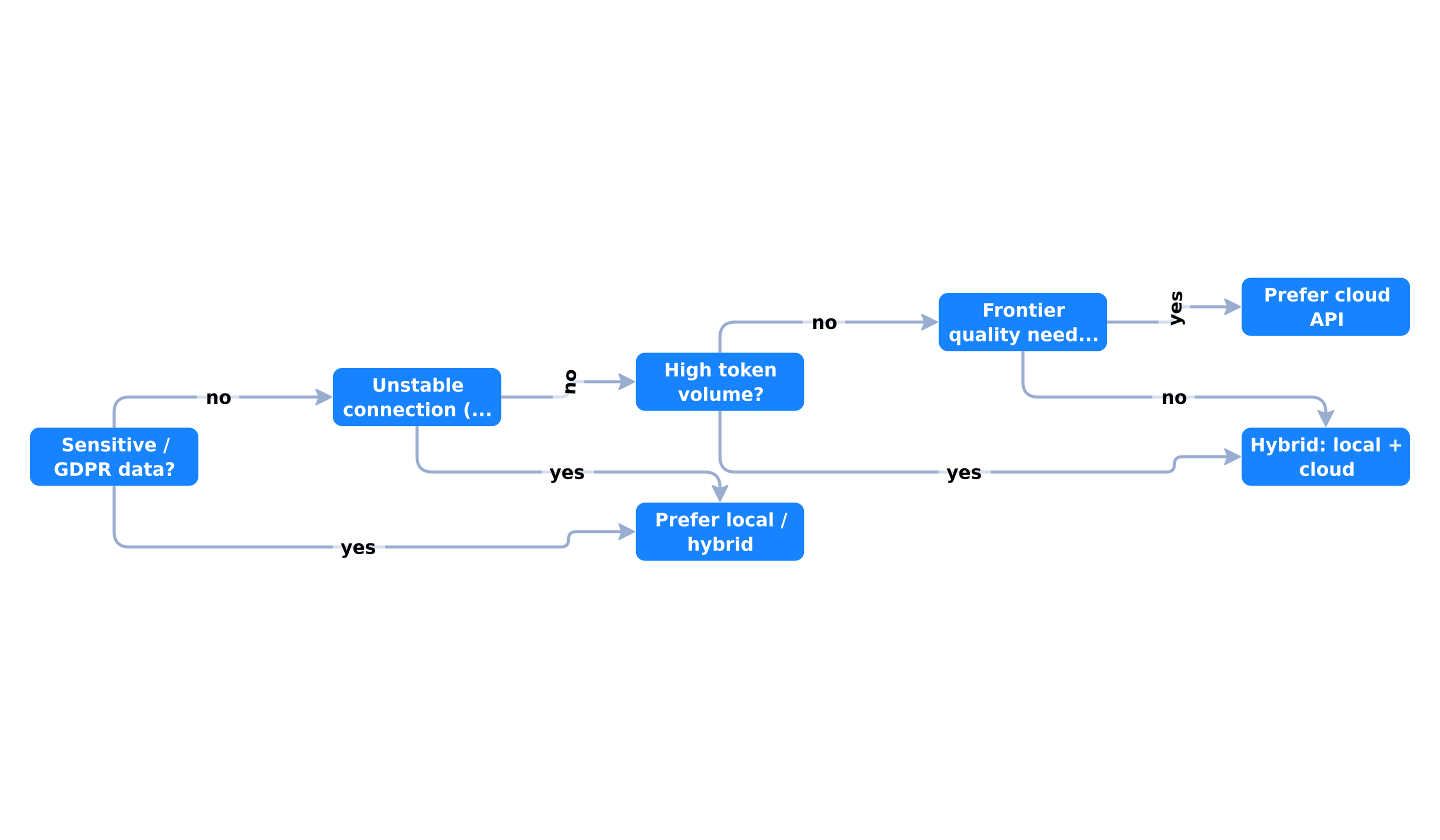 Privacy, connectivity, token volume, and frontier need: four questions to decide without dogma
Criterion 1 — Privacy and GDPR
Local advantage when:
- you process personal data (HR, health, legal, finance);
- clients require a clear data residency story;
- you want to minimize transfers outside the EU / contractual perimeter.
Cloud nuance: providers offer controls (ZDR, EU regions, DPAs). It is not “cloud = illegal.” It is “cloud = contractual dependency + subprocessor surface.” For many SMEs, local (or a private VPC) remains the easiest path to explain to a DPO.
Criterion 2 — Offline and 3G in Africa
In several francophone markets, the constraint is not an MMLU benchmark: it is connectivity.
- Store / warehouse on unstable 3G → a local model on a mini-PC holds when the cloud API times out.
- Field teams without fiber → latency and outages kill the agent experience.
- Mobile data cost → every cloud round-trip has a real price.
Here, Goedecke’s “unreliable Internet” niche becomes, for some SMEs, the main case. Local does not “win the world”; it wins your coverage area.
Criterion 3 — Cost (without lying to yourself)
Two common mistakes:
| Mistake | Reality |
|---|---|
| “Local = free” | GPU, RAM, electricity, maintenance, ops time |
| “Cloud = always more expensive” | Subscriptions / tokens can stay cheaper than a poorly used box |
BOVO practical rule:
- Low volume, complexity spikes → frontier cloud.
- High volume, repetitive tasks → local or small-model API.
- Mixed PII + complexity → hybrid (see diagram below).
Never compare a ChatGPT subscription only to the purchase price of a GPU. Compare over 12–24 months, including the salary cost of maintaining the stack.
Criterion 4 — Quality and agenticity
Cloud still often wins for:
- large refactors / long coding agents;
- fragile multi-step reasoning;
- frontier multimodality and proprietary tools.
Local often suffices for:
- classification, extraction, internal FAQ;
- assisted writing under human control;
- WhatsApp / CRM bots with short prompts and limited tools.
If your product requires “the best model of the moment,” local alone will frustrate you. If your product requires reliability + internal data, a poorly governed frontier cloud will expose you.
Criterion 5 — Ops and cognitive load
Local imposes: quant updates, VRAM monitoring, backups, server security, version management. Cloud imposes: rate limits, price changes, vendor dependency, data-policy reviews.
A 5-person SME with no ops profile will pay dearly for “badly self-hosted” local. An SME that already sells automation (or works with an AI chatbot agency) can absorb that load.
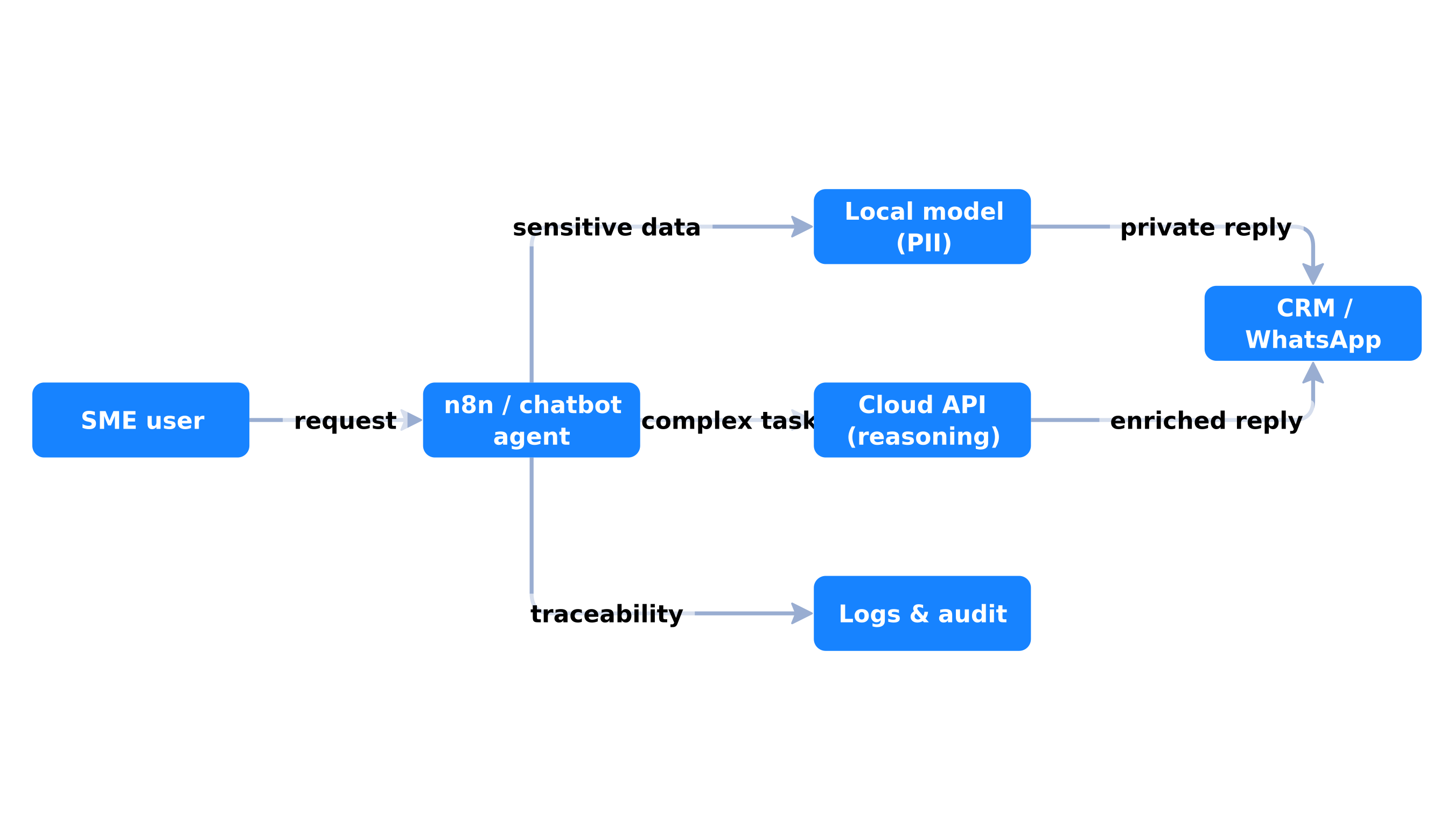 n8n routes sensitive data to a local model and complex tasks to a cloud API, with audit logs
Francophone SME counterpoint: when local wins
Without contradicting Goedecke on the macro market, here are cases where we recommend local (or local-first):
- Firm / clinic / HR — non-negotiable PII, moderate volume.
- Call center or WhatsApp support — stable templates, predictable latency.
- Multi-country West Africa sites — 3G, outages, data cost.
- High-volume n8n automation — summaries, tagging, scoring: a local 7B–30B is enough.
- Commercial sovereignty — reduce lock-in before a vendor changes terms.
In those cases, “local will not win” is true globally and false locally (pun intended).
Quick decision matrix
| Situation | Default choice | Why |
|---|---|---|
| Sensitive client data | Local / VPC | GDPR and trust |
| Unstable connectivity | Local | Availability |
| Advanced coding agent | Frontier cloud | Quality |
| FAQ + repetitive CRM | Local or small API | Cost / volume |
| Peaks + routines | Hybrid | Best TCO |
| Team without ops | Managed cloud | Cognitive load |
SME scenarios (realistic, non-normative)
Scenario A — 8-person digital agency (Paris / Cotonou).
Moderate API volume, need for coding agents and writing. Choice: frontier cloud for creative production, small local model to anonymize / summarize client briefs before any optional cloud send. Light hybrid, low CAPEX.
Scenario B — clinic or professional firm (health / legal data).
High conversational volume, strict PII. Choice: local-first for the internal assistant; cloud only for non-identifying tasks after pseudonymization. Here local “wins” because legal risk outweighs the quality gap.
Scenario C — multi-country West Africa e-commerce.
3G, WhatsApp peaks at night, small support team. Choice: local 7B–14B for FAQ and order status; human or cloud escalation for complex disputes. Availability beats the benchmark.
These scenarios do not “prove” local dominance. They show that the decision criterion is not the same as that of an essayist reasoning at the level of the global inference market.
What to measure before you decide
Before buying a GPU or signing a token plan, measure four weeks:
- Tokens / day by task type (FAQ, writing, coding, extraction).
- Share of requests containing PII (even approximate).
- Network failure rate (timeouts, retries) on your real sites.
- Human time spent correcting AI outputs (hidden quality cost).
Without those numbers, the local vs cloud debate stays ideological. With them, an SME can approximate TCO and choose — sometimes cloud, sometimes local, often hybrid.
Also track failure modes, not only averages: a cloud model that is brilliant 90% of the time but unavailable during your peak WhatsApp hour may be worse for CSAT than a weaker local model that answers every time. Reliability is a product feature for SMEs; benchmarks alone do not capture it.
A pragmatic 30-day path (no dogma)
Week 1 — Map data classes (public / internal / PII) and list every AI touchpoint.
Week 2 — Pilot one local mid-size model on a non-critical FAQ or tagging flow; keep cloud for coding.
Week 3 — Add routing rules (n8n or your chatbot layer): PII → local, complex → cloud.
Week 4 — Review cost, quality corrections, and uptime; keep, expand, or roll back.
This path does not assume local wins. It forces evidence before CAPEX or a long cloud contract.
Conclusion — neither local fanaticism nor cloud naivety
Sean Goedecke is right to attack the myth that “everything will be local.” The Muse Glimmer / open-weight wave is right to show that useful self-hosting is no longer lab-only. For a francophone SME in 2026, the tradeoff turns on privacy, network, volume, required quality, and ops skill — not on a slogan.
Start by mapping your data flows. Route sensitive work locally. Keep frontier models for what deserves them. If you are building a chatbot or business agent, BOVO Digital helps you decide without dogma.
Go deeper: Muse Glimmer local 30B · Unsloth Studio & GLM-5.2 · AI chatbot agency.
Tags
FAQ
Will local models “win” against the cloud in 2026?
Not in the sense that most global inference will leave datacenters. Sean Goedecke’s “No, local models will not win” highlights batching, GPU efficiency, and preference for the strongest models. Still, local already wins SME niches: PII, offline use, and high recurring token loads.
When should a francophone SME choose local?
When data is sensitive (GDPR, health, legal), when connectivity is unstable (3G sites / underserved areas), or when token volume makes APIs too expensive for repetitive tasks. A well-orchestrated mid-size model often beats an underused frontier model.
Is the cloud still better for quality?
Usually yes for frontier reasoning, long agentic coding, and tasks where API latency is acceptable. Local models are improving fast (Muse Glimmer wave, Unsloth/GLM, Gemma, etc.), but the capability gap is not “solved” for every use case.
Must we choose exclusively local or cloud?
No. A hybrid architecture is often the most rational: local for PII and routines, cloud for complexity spikes. n8n or a chatbot agent can route by sensitivity and task type.
What is the hidden cost of local?
Hardware (GPU/RAM), electricity, maintenance, model updates, monitoring, and ops skill. As the Lobsters / Goedecke debate notes, ignoring those costs leads to believing “local = free” — which is false.
Free audit: we check the impact on your site and workflows
Next.js CVE, new agent, MCP… We tell you what actually applies, and what to patch or ignore.
- 30 min
- Stack reviewed
- No commitment

William Aklamavo
Web development and automation expert, passionate about technological innovation and digital entrepreneurship.


