
AI-Native Agency in 2026: Restructuring Your Digital Agency ($1.5M ARR Case Study)
Y Combinator is betting on "AI-Native Agencies." One B2B agency went from $800K to $1.5M ARR in 6 months by removing its junior layer. A practical guide to restructuring your digital agency in 2026.

AI-Native Agency in 2026: Restructuring Your Digital Agency ($1.5M ARR Case Study)
Y Combinator, the accelerator that propelled Airbnb and Stripe, has explicitly identified "AI-Native Agencies" as a major strategic trend in consulting for 2026. On Hacker News, the founder of a B2B marketing agency describes how he went from a two-year growth plateau to $1.5 million in annual recurring revenue in six months — by dismantling his traditional senior/junior pyramid. Here's what this transformation concretely means for a French-speaking digital agency.
Since early 2026, one phrase keeps coming up more and more in consulting and digital creation circles: AI-Native Agency. The idea isn't simply using AI tools around the edges of existing operations — a chatbot here, a content generator there — but rebuilding the agency's operating model around AI, from the ground up. Y Combinator, whose weight in the startup ecosystem needs no introduction, has explicitly taken a position on this category, signaling that it's a structural shift in the sector rather than a passing fad.
The most concrete publicly documented case comes from a testimonial published on Hacker News by the founder of GrowthSpree, a B2B SaaS marketing agency working with over 300 client companies across the US and Europe. After two years stuck between $500,000 and $800,000 in annual recurring revenue (ARR), the agency completely rebuilt its operating model. The result after six months: $1.5 million in ARR, with clients including Datahub, PriceLabs, Hasura, and Proton AG.
At BOVO Digital, this testimonial resonates in particular: we are ourselves an agency that integrates AI into its daily operations, and this case study offers a concrete framework for assessing where our own transformation stands — and that of our agency clients. This article breaks down what actually changed at GrowthSpree, and offers a decision framework for whether a similar transformation makes sense for your business.
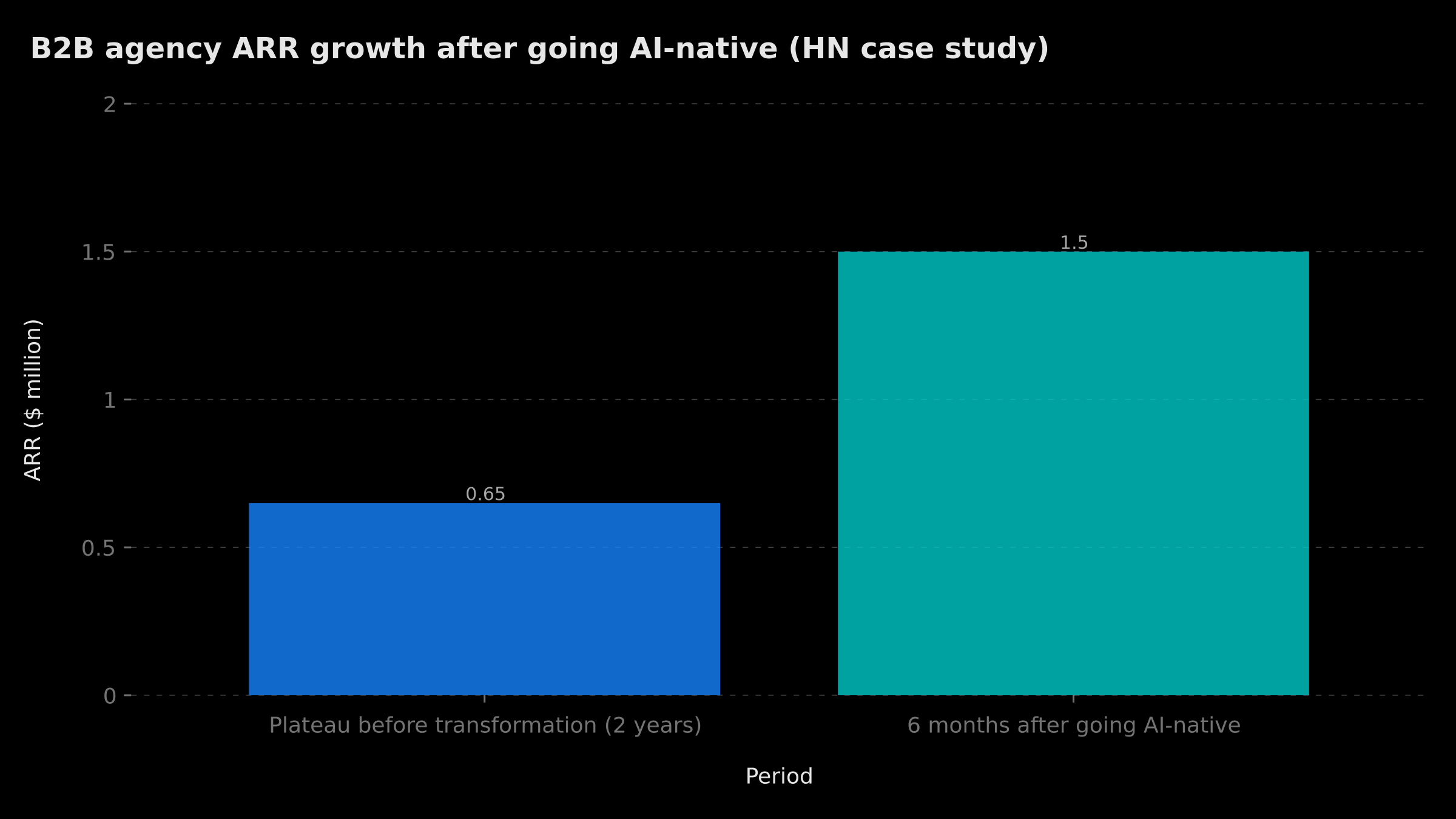 Growth: plateau at $0.65M ARR for two years before the transformation, then $1.5M ARR six months after moving to an agent-native model
What Y Combinator identified as a strategic trend
A validation that goes beyond an individual anecdote
The fact that Y Combinator, a major player having helped launch companies like Airbnb and Stripe, is explicitly interested in the AI-Native Agency category is a strong signal. This isn't the isolated observation of one individual success story, but the recognition of a broader movement affecting the consulting and creative sector as a whole. The distinction the accelerator emphasizes is precise: an AI-Native Agency doesn't just use AI tools, it places AI at the core of its value proposition, its processes, and its organization — a fundamental redefinition rather than a marginal optimization.
Why the traditional agency model is structurally fragile in the face of this transition
The traditional agency model largely relies on a pyramid: seniors who sell, scope, and supervise, and juniors who execute repetitive work under their direction. This model works, but it mechanically caps margin and growth at a fixed ratio between headcount and revenue generated. When a substantial portion of repetitive execution work can be absorbed by properly supervised AI agents, that mechanical ceiling disappears — provided the organization is genuinely restructured around this new reality, rather than simply bolting an AI tool onto the margins without touching the structure.
The GrowthSpree case study: what actually changed
The starting diagnosis
GrowthSpree's founder describes a classic growth plateau: two years stuck between $500,000 and $800,000 in ARR, despite a portfolio of over 300 B2B SaaS clients. His diagnosis is direct: the agency model itself was broken for the AI era. Not the team, not the market positioning, but the agency's operational architecture.
The bet: rebuild the entire model, not add a tool
The distinction the founder emphasizes is crucial: becoming "the first truly AI-native marketing agency. Not an agency that 'uses AI tools' by bolting ChatGPT onto a 2015 workflow, but one where AI is wired into how we find demand, win clients, and run delivery." This phrasing precisely captures the difference between a cosmetic transformation and a structural one.
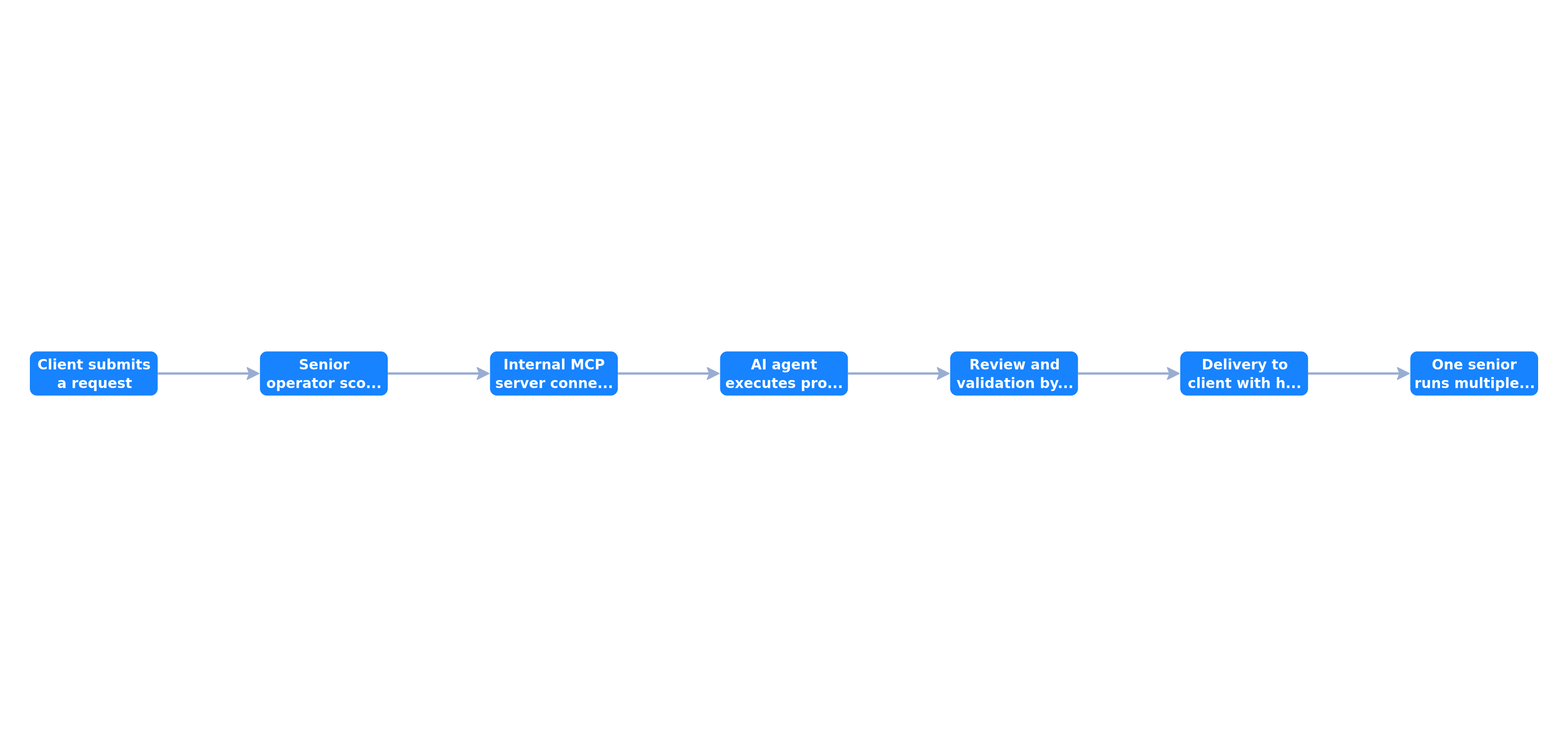 Model: the client submits a request, a senior operator scopes it with an AI agent, an internal MCP server connects agency data and tools, the agent executes prospecting or delivery, the senior operator validates, delivery happens with human accountability, one senior runs multiple clients in parallel with no junior layer
The two tools doing the heavy lifting
Specifically, GrowthSpree built two pieces of core tooling. The first is an MCP server dedicated to B2B marketing, letting AI agents act directly on the agency's tech stack and data — pulling live numbers and triggering actions, rather than guessing from static information. The second is an internal tool called OLA AI, a LinkedIn ads optimization layer that manages bidding, audiences, and creative iteration at a cadence no human team can match. The key point, according to the founder: it's not the technical demo that matters, it's that the same headcount now covers far more surface area, well.
Restructuring the teams: seniors only
The most radical aspect of the transformation concerns the human organization: GrowthSpree now runs in closed cohorts made up solely of seniors, each amplified by the AI tooling, with no junior layer tasked with "babysitting the AI." The founder notes that quality and delivery speed, which traditionally traded off against each other in a model with junior/senior relay (the "telephone game" that degrades information at each step), stopped fighting each other with this flattened structure — they started compounding instead.
The testimonial's honesty about the cost of the transition
The testimonial doesn't hide the difficulties: "we killed processes we were proud of and retrained the team on a workflow that felt backwards at first." This candor is valuable for any agency considering a similar transformation — the final gain didn't materialize without a real transition cost in terms of organization and team adaptation.
What the rest of the ecosystem says about this movement
An emerging consensus, with important nuances
Hacker News discussions around this topic reveal an emerging but nuanced consensus. In a thread about building a dev or design agency alongside the rise of AI, several experienced contributors point to a less glamorous reality than the GrowthSpree testimonial: agency life remains roughly 80% sales and 20% delivery, regardless of how sophisticated the AI tooling deployed on the production side is. AI radically changes the delivery ratio, but doesn't solve every agency's fundamental commercial problem — finding and convincing clients. An agency that invests heavily in delivery tooling without proportionally strengthening its sales engine risks ending up with excess production capacity and nowhere to sell it.
The "agency of one" model
Another, older but still relevant thread discusses the rise of "agencies of one" — freelancers operating with the pricing structure and sophistication of an agency without the headcount. AI amplification makes this individual model more viable than before: a senior consultant equipped with properly configured AI agents can now absorb a workload that would have required a small team just two years ago. For a French-speaking freelancer in automation or development, this evolution is worth weighing against our analysis of the hybrid AI agent or freelance model, which explores this same tension between individual autonomy and technological amplification.
The caution of experienced practitioners
It would be incomplete to present only the success story. Other contributors in these same discussions warn against the temptation to turn a services business into a product too quickly, or conversely to sacrifice promising product work for short-term services revenue made easier to obtain thanks to AI. The shift to an AI-native model shouldn't become an excuse to indefinitely postpone broader strategic decisions about the company's direction.
Traditional agency vs AI-native agency: the comparison
To make the trade-offs at play objective, we compared a typical traditional agency and a typical AI-native agency across five operational dimensions.
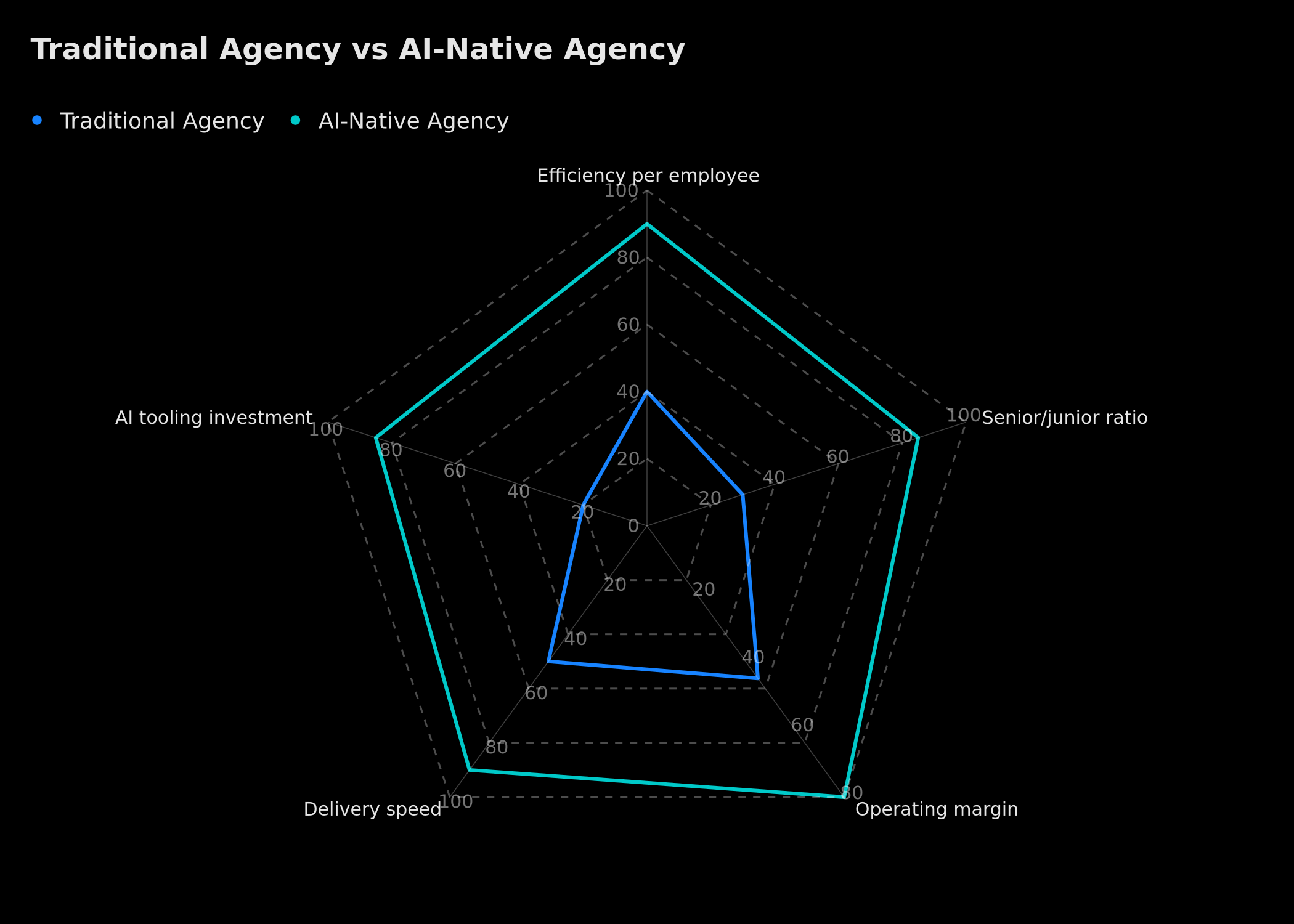 Comparison: the AI-native agency leads on efficiency per employee (90), senior/junior ratio (85), and delivery speed (90), at the cost of significantly higher AI tooling investment (85 vs. 20)
This chart illustrates the central trade-off: the AI-native agency invests heavily in tooling to unlock far greater per-employee efficiency and delivery speed — but this upfront investment in tooling and training is a real barrier, which explains why this transformation isn't something to improvise casually.
The components of an AI-native agency
Synthesizing GrowthSpree's testimonial and broader analyses from the consulting ecosystem, four components consistently structure a functioning AI-native agency.
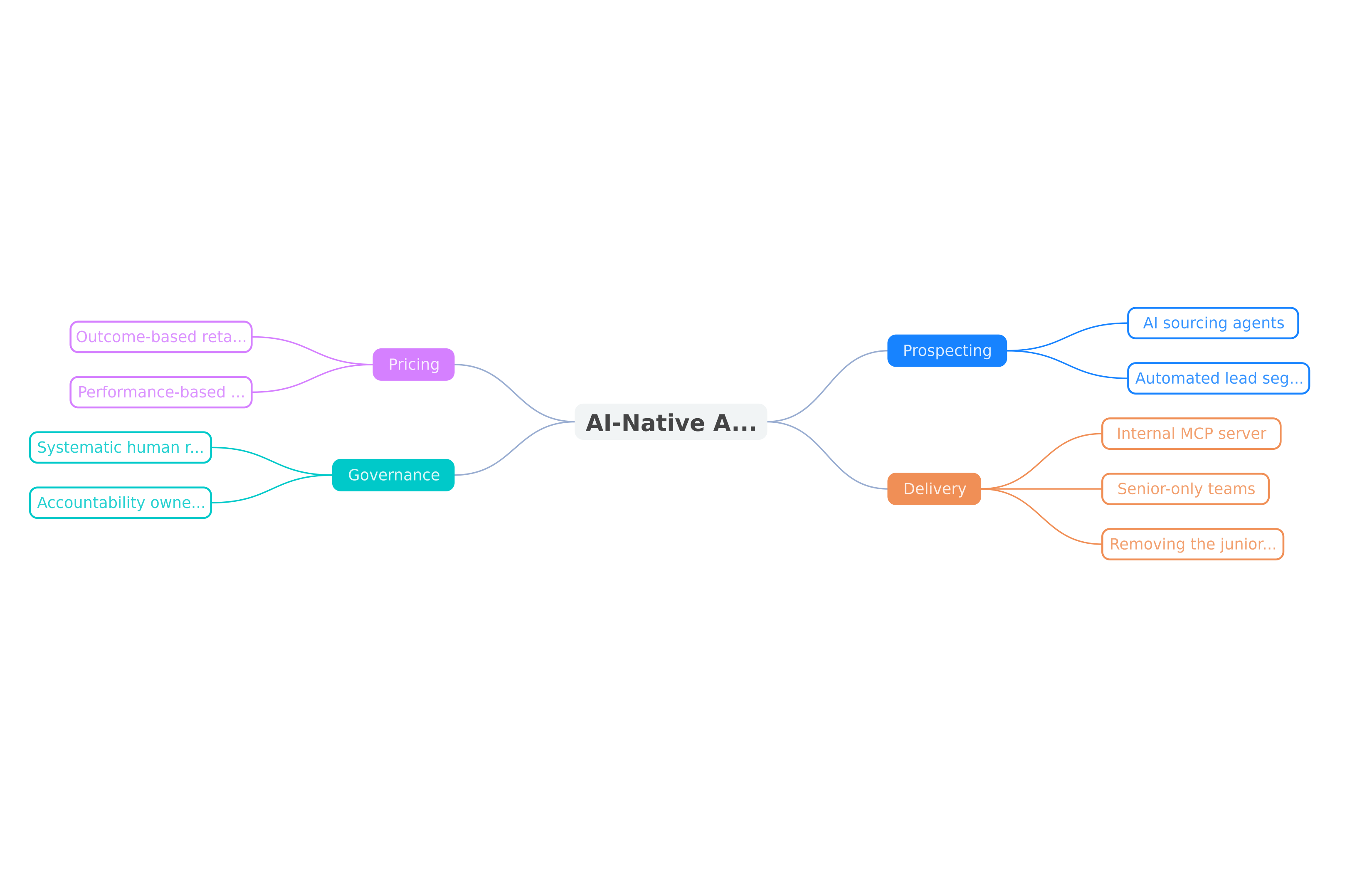 Components: prospecting via AI sourcing agents and automated segmentation, delivery via internal MCP server and senior-only teams, pricing via outcome-based retainers, governance via systematic human review and senior accountability
Prospecting relies on AI sourcing agents and automated lead segmentation, replacing manual qualification work traditionally assigned to junior sales reps. Delivery rests on an internal MCP server connected to the agency's own tools, operated by senior-only teams. Pricing naturally shifts toward outcome-based retainers rather than billed time, since human time is no longer the limiting factor on production capacity. Governance remains grounded in systematic human review, with accountability clearly owned by the senior operator — never fully delegated to the AI agent itself.
Should you restructure your agency into an AI-native model?
Three signals worth honestly assessing
This transformation isn't universally relevant at any given moment. We recommend honestly evaluating three signals before diving in.
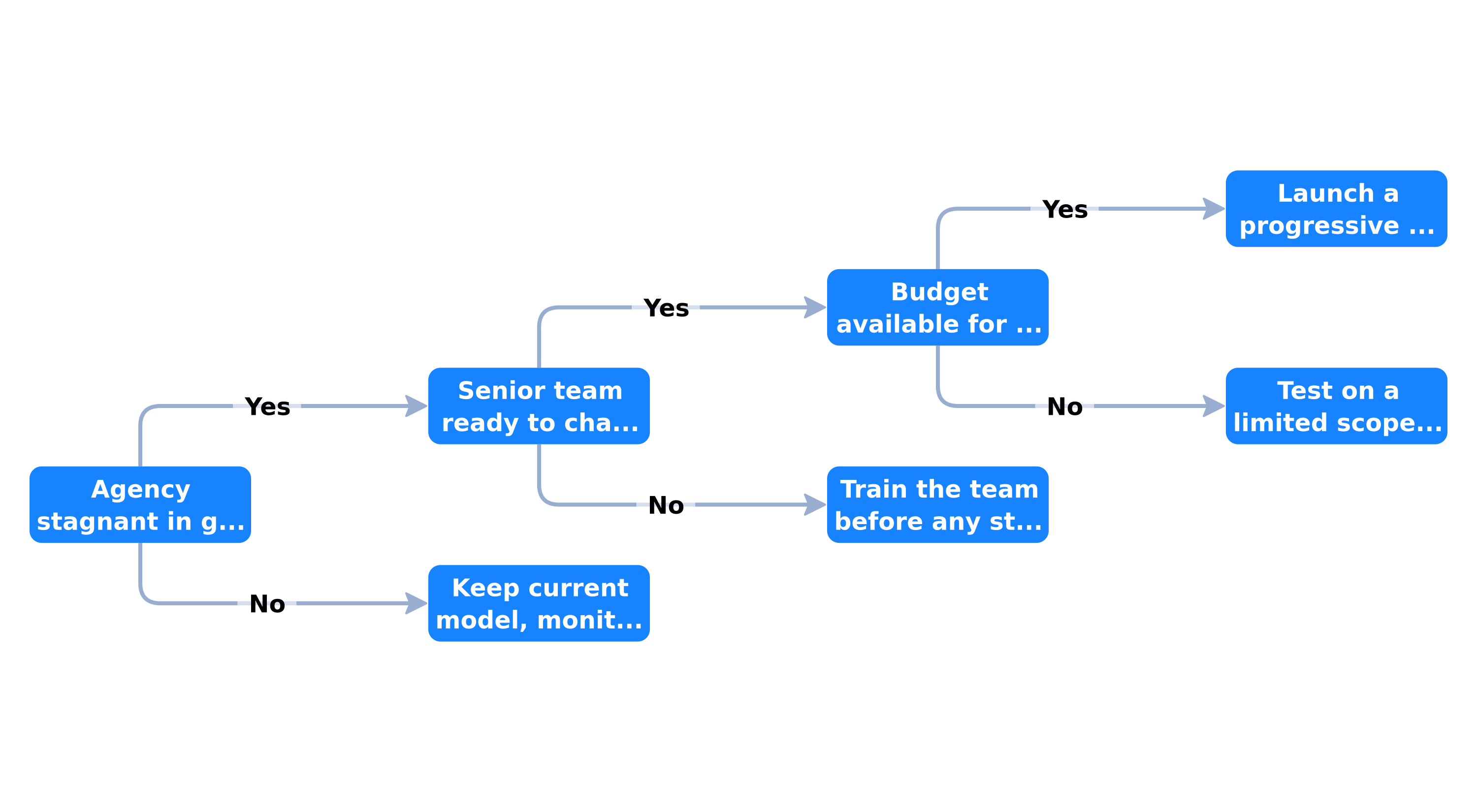 Decision: agency stagnant for 12+ months → senior team willing to change how it works → budget available for internal AI tooling → launch a progressive overhaul, otherwise train the team or test on a limited pilot scope
First signal: has your agency been stagnant in growth for twelve months or more, despite sustained sales efforts? A healthily growing agency under its current model doesn't necessarily have an urgent reason to rebuild everything.
Second signal: is your senior team explicitly willing to change how it works, rather than having a change imposed from leadership? GrowthSpree's testimonial highlights that the transition was difficult even with founding team buy-in; imposing the same transition on a reluctant team multiplies the risk of failure.
Third signal: do you have a genuinely dedicated budget for internal AI tooling — building a custom MCP server, training the team, iterating over several months — rather than a one-off, non-recurring investment? GrowthSpree's transformation wasn't free or instant.
Our recommendation for French-speaking agencies
If all three signals are positive, a progressive shift toward an agent-native model makes sense, starting with a limited scope (one pilot client, one recurring type of engagement) before generalizing. If the senior team isn't ready yet, investing in training first, before any structural overhaul, avoids a costly failure. If the budget isn't available, testing on a narrow scope with existing tools rather than building a custom MCP server lets you validate the approach at lower cost before a heavier investment.
Risks not to underestimate
Quality risk
Reducing human verification faster than the real reliability of the AI tooling allows is the most immediate and damaging risk to the client relationship. The GrowthSpree model doesn't remove human oversight — it shifts it to seniors rather than juniors, and maintains systematic review before delivery. An agency that interprets "AI-native" as "no human oversight" takes on a risk the source testimonial doesn't endorse.
Social and retention risk
A transformation that removes the traditional junior layer raises a real social question: what happens to the classic career path that led a junior to a senior role through accumulated experience on execution tasks? Agencies that successfully navigate this transition seem to redefine that path rather than simply eliminating it — training new hires earlier on AI agent supervision and strategic judgment, rather than on the repetitive execution that historically served as their rite of passage.
Technical dependency risk
Building a competitive advantage on sophisticated internal tooling (proprietary MCP server, custom-configured agents) creates a dependency on the knowledge of the people who designed and maintain that tooling. If those key people leave the agency without organized documentation or knowledge transfer, the competitive advantage built over several months can collapse quickly. Systematically documenting this tooling's architecture, the same way you would any other strategic company asset, reduces this risk without eliminating it.
Risk of imbalance between production capacity and sales engine
As mentioned above regarding community discussions on this topic, a common pitfall is investing heavily in delivery tooling without proportionally strengthening the agency's sales capacity. An AI-native agency that triples or quadruples its production capacity without increasing its prospecting and closing volume ends up with underutilized seniors and a tooling investment that doesn't generate the expected return. The operational transformation must come with a sales plan sized to the new delivery capacity, not just a technical plan.
Risk of over-promising to clients
A final, more subtle risk concerns communication with existing and prospective clients. Presenting an AI-native transformation as a guarantee of instant, flawless results exposes the agency to client disappointment if the actual execution, even excellent, doesn't match expectations inflated by overly enthusiastic sales talk. GrowthSpree's own testimonial stays measured on this point, insisting the transition was difficult and gradual rather than instant — an honesty worth replicating in the sales communication of any agency embarking on this path.
A note on measuring what actually improved
One aspect worth flagging for any agency tempted to copy this model wholesale: ARR growth alone doesn't tell the whole story of whether a transformation succeeded. A rigorous self-assessment should also track client retention rates before and after the transformation, the actual margin per client rather than just top-line revenue, and employee satisfaction and turnover among the senior operators now carrying a heavier and more varied workload. It's entirely possible for an agency to grow ARR while quietly eroding client satisfaction or burning out its senior staff, and neither of those problems shows up in a revenue chart until it's already too late to correct cheaply, at which point the fix tends to be far more expensive than the vigilance that would have caught it early. Building these secondary metrics into your own transformation plan from day one, rather than treating ARR as the sole scoreboard, gives a much more honest picture of whether the new model is genuinely sustainable.
Our position at BOVO Digital
This case study resonates directly with our own trajectory at BOVO Digital. We built our agency practice by progressively integrating automation and AI agents into our own internal processes, before offering that same expertise to our clients. Our n8n automation agency offering and our AI agent creation expertise rest on this conviction: the most credible transformation to offer a client is one you've first tested and validated on your own operations. For French-speaking agencies considering a transformation similar to GrowthSpree's, our automation audit offering provides an honest initial diagnosis, before any commitment to a heavy structural overhaul.
The talent implications for hiring and career design
Agencies weighing this transformation should also think through what it means for how they hire and develop talent going forward, not just how they restructure existing teams. If the traditional junior-to-senior pipeline built on years of repetitive execution shrinks, agencies need a deliberate replacement: structured mentorship programs where new hires learn strategic judgment and client communication directly from seniors, shadowing real engagements rather than practicing on low-stakes busywork. Some agencies experimenting with this model report hiring fewer, more experienced people earlier — effectively skipping the traditional junior tier altogether and instead recruiting mid-level operators who already have enough judgment to work productively alongside AI agents from day one. This has real implications for compensation structure too: if the agency needs fewer but more skilled people, it can typically afford to pay each of them more, which in turn changes the kind of candidate the role attracts and, over time, reshapes the agency's reputation as an employer within its specific niche of the market.
What to watch in the coming months
Three indicators seem particularly useful for assessing whether this movement durably generalizes beyond a handful of emblematic cases. First, the number of testimonials similar to GrowthSpree's that emerge in the coming months, with verifiable figures rather than a single isolated anecdote — one success story doesn't constitute proof of a generalizable model, several independent cases start to. Second, how Y Combinator's and other accelerators' rhetoric on this category evolves: if they continue to explicitly fund and support AI-Native Agencies in upcoming startup batches, that will confirm the interest goes beyond mere trend-watching to become a structuring investment thesis. Third, how the digital hiring market reacts to this movement — if traditional junior agency profiles genuinely struggle to find positions while demand for seniors capable of supervising AI agents explodes, that will be the most tangible signal of a structural shift rather than a simple media fad. Watching all three together, rather than any single one in isolation, gives the clearest read on where this trend is actually headed.
Conclusion
Y Combinator's explicit interest in AI-Native Agencies, confirmed by a concrete testimonial of growth from $800,000 to $1.5 million in ARR in six months, indicates that this movement goes beyond an individual anecdote to become a structural trend in the consulting and creative sector. But the transformation documented by GrowthSpree is neither free, nor instant, nor universally relevant: it requires sophisticated internal tooling (MCP server, custom-configured agents), a senior team willing to change how it works, and a real tolerance for an uncomfortable transition phase before the benefits materialize. For French-speaking digital agencies that recognize the three signals described in this article — growth stagnation, a team ready for change, budget available for tooling — 2026 is probably the right time to begin this transformation, starting with a pilot scope rather than an immediate full-scale overhaul, and measuring success on more than revenue growth alone.
Tags
FAQ
What is an "AI-Native Agency"?
An AI-Native Agency doesn't just use AI tools around the edges of its existing operations — it rebuilds its operating model around AI: agent-driven prospecting, an internal MCP server connected to the agency's data and tools, and teams made up solely of senior operators amplified by AI rather than a classic senior/junior pyramid. Y Combinator has explicitly identified this category as a major strategic trend in the consulting and creative sector in 2026.
How did the case study agency grow from $800K to $1.5M ARR?
According to a testimonial published on Hacker News, a B2B SaaS marketing agency, stagnant between $500K and $800K ARR for two years, rebuilt its operating model around AI rather than adding AI tools to its existing operations. It built an internal MCP server letting AI agents act directly on its data and marketing tools, restructured its teams into senior-only cohorts (removing the junior layer), and reached $1.5M ARR in six months with the same headcount.
Does the AI-native model mean the end of junior agency roles?
The case study testimonial effectively removes the junior layer of repetitive execution, replaced by AI-amplified seniors. This doesn't mean the disappearance of all junior hiring outright, but a shift: mechanical execution tasks historically assigned to juniors are increasingly handled by supervised AI agents, while human value concentrates on strategic judgment, client relationships, and verification — skills acquired differently than by repeating execution tasks.
What are the main risks of an AI-native transformation?
Three main risks: a quality risk if human verification is reduced faster than the real reliability of the AI tooling allows; a social and retention risk if the existing team perceives the transformation as a threat rather than an opportunity to upskill; and a technical dependency risk if the agency builds its competitive advantage on proprietary tooling that's difficult to evolve or transfer if a key contributor leaves the company.
How do I know if my agency is ready for an AI-native transformation?
Three favorable signals to watch for: growth stagnation for twelve months or more despite sustained sales efforts, a senior team explicitly willing to change how it works rather than a change imposed from leadership, and a budget dedicated to internal AI tooling rather than a one-off, non-recurring investment. Without all three conditions in place, it's generally better to start with a transformation limited to a pilot scope before any full structural overhaul.
Budget, process, priorities — decided together
Website, chatbot, or automation? We pick the next job that unlocks cash, not the trendy stack.
- 30 min
- Clear priorities
- No commitment

William Aklamavo
Web development and automation expert, passionate about technological innovation and digital entrepreneurship.


