
AI Agent or Human Freelancer: The Right Hybrid Model in 2026
When to hand a task to an AI agent and when to prefer a human? The hybrid model has become the standard in 2026. Full comparison, 8-criteria matrix, decision framework and concrete use cases per vertical.

Updated

AI Agent or Human Freelancer: The Right Hybrid Model in 2026
In 2026, the question "AI agent vs freelance" has become central to every conversation about work organization. The honest answer is not a binary choice — it's a reasoned trade-off that depends on the type of mission, the volume, the risk level and legal constraints. The AI + human hybrid model is becoming the operational standard for companies that have seriously adopted automation tools.
This guide presents the full comparison across 8 criteria, a field-tested decision framework and concrete illustrations of the hybrid model across several verticals. Before deciding whether your next need calls for an AI agent or a human freelancer, read what follows.
One important clarification upfront: this comparison is not about whether AI will replace freelancers. The more useful frame is how the availability of capable AI agents changes the economics and composition of work — and how smart organizations are exploiting that shift. The companies winning in 2026 are not those that replaced all their human contractors with AI, nor those that ignored AI entirely. They are those that mapped their workflows clearly, automated what could be automated, and redirected human effort toward the tasks where it creates disproportionate value.
AI Agent vs Freelance: The Comparison Across 8 Criteria
The "AI agent vs freelance 2026" debate doesn't reduce to cost alone. Here are the 8 dimensions that truly matter in the decision:
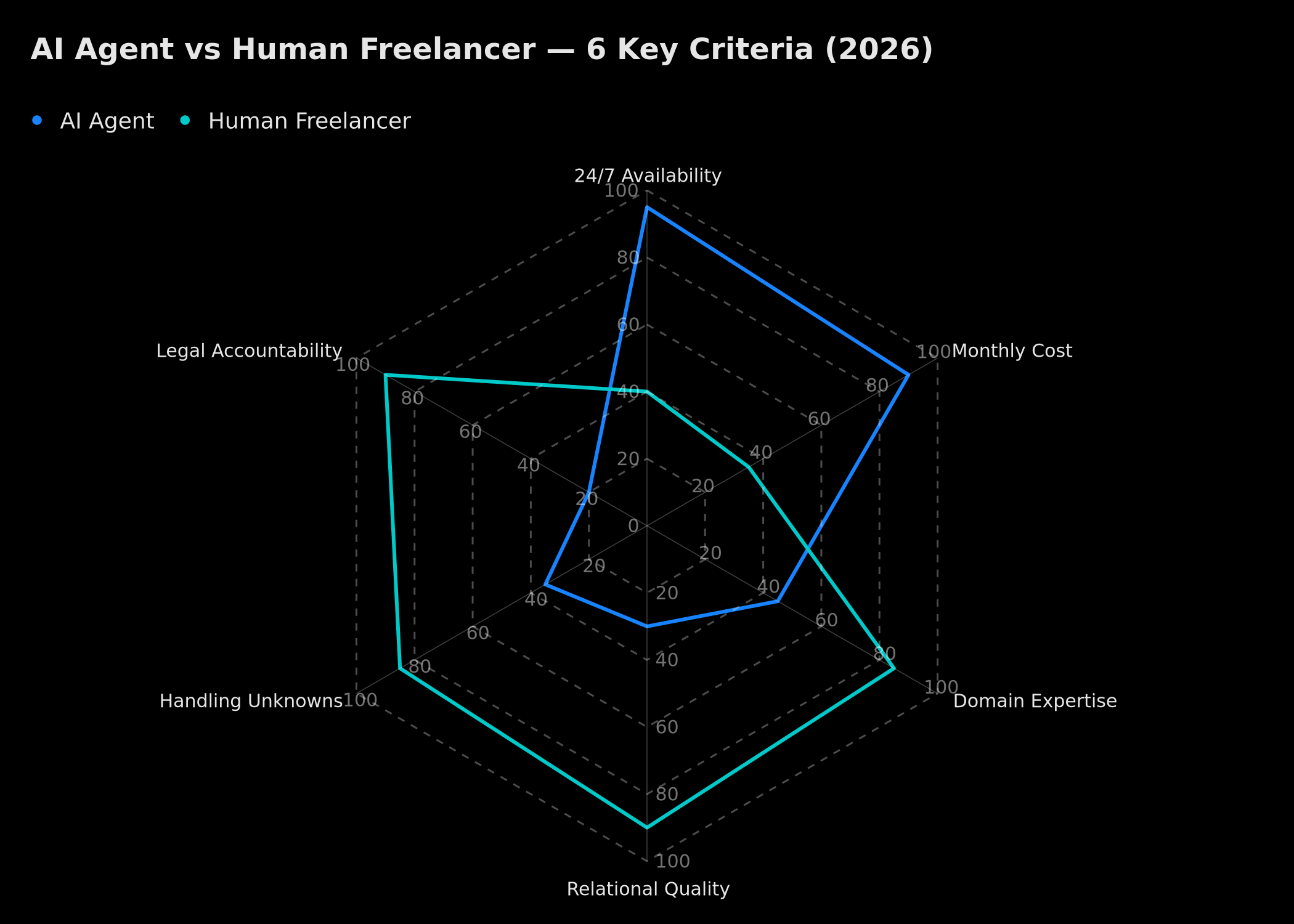 Comparative radar: AI agent dominates on availability and cost, human freelancer on domain expertise, client relationship and legal accountability
1. Availability and Responsiveness
An AI agent is available 24/7, without vacations, without start-up delays and without timezone dependency. It can process 500 simultaneous requests. A human freelancer averages 40h/week, with availability constraints that can delay urgent projects. For processes requiring a response within 5 minutes — incoming lead qualification, first-level support, system alerts — the AI agent is structurally superior.
2. Total Cost of Ownership
On an annual basis at constant volume, the cost differential between an AI agent and a freelancer is significant. An AI agent handling 1,000 requests/month typically costs €50-200/month all-in (VPS hosting + LLM API) depending on complexity. An equivalent human freelancer for the same volume often represents €1,500 to €4,000/month. The AI agent's advantage grows mechanically with volume. These are indicative ranges — each deployment deserves its own calculation.
3. Domain Expertise and Depth
This is the human freelancer's most durable advantage. An expert accountant, a senior developer or a specialist writer brings an understanding of nuances, unspoken context and sector-specific risks that an AI agent does not faithfully replicate — especially on high-value missions. Specialized 2026 agents (models fine-tuned on law, finance or code) close part of this gap, but remain inferior to a human expert with 5+ years of experience on complex and nuanced cases.
4. Relational Quality and Empathy
Client relationships — particularly during first interactions with qualified prospects — still clearly benefit from a human presence. B2B conversion data shows that discovery meetings, commercial negotiations and conflict management obtain better results with a human. AI excels in nurturing, confirmations and follow-ups — not in emotional closing.
5. Handling Unknowns and Adaptation
Faced with a genuinely new situation — a client who reformulates their request mid-exchange, a recently changed regulatory constraint, a cultural nuance in an international negotiation — the human freelancer adapts spontaneously. The AI agent works on the cases it was designed to handle. Outside that window, it will either refuse or produce an inappropriate response. Robustness in the face of the unexpected remains an indisputable human advantage.
6. Legal Responsibility and Traceability
In regulated sectors (healthcare, finance, legal, HR), the final decision must be made by an identifiable human, accountable under the law. An AI agent can prepare a file, analyze a situation and propose options — but it cannot sign, certify or engage its professional responsibility. This constraint is not a temporary technical limitation: it's a structural legal framework that will persist.
7. Scalability and Capacity Handling
This is the AI agent's most tangible long-term advantage. Doubling the volume of requests requires no recruitment, no training and only a marginal additional cost (extra API calls). Doubling a freelance team requires sourcing, onboarding and management coordination. For activities with rapid growth or variable volume, AI agent scalability is a strong operational argument.
8. Supervision and Maintenance
An AI agent is never "shipped and forgotten." Its performance must be monitored, its knowledge base updated, its prompts refined as cases evolve. A human freelancer naturally adapts their approach. Maintaining an AI agent typically requires 2 to 5 hours/month for a well-designed system — a factor to account for in the real ROI calculation. For documented production returns, see our article on AI agent ROI in production.
Why the "100% AI" Model Doesn't Work (Yet)
2026 AI agents are remarkably capable on structured and repetitive tasks. But they have real limits that must be understood before deploying them at scale.
Complex contextual judgment remains human. An AI agent can analyze 1,000 applications in an hour and score each profile against defined criteria. But it cannot evaluate whether a person will have "cultural fit" with a specific team. This holistic judgment, which integrates non-verbal signals, subtext and a reading of group dynamics, remains human.
Initial client relationships are more effective with a human. First commercial interactions with qualified prospects have a higher conversion rate when they involve a human. AI excels in follow-up, preliminary qualification and nurturing — not in high-level closing. Our guide on automating 40 hours of work per week details precisely where to draw this boundary.
Handling unforeseen situations. An AI agent works on the cases it was taught. Faced with a genuinely new situation, it will either refuse, or produce an inappropriate response. Humans adapt.
Regulated sectors require human accountability. In healthcare, finance, legal — the final decision must be made by an identifiable human who is legally responsible. AI can prepare, analyze, recommend. Not decide in full autonomy.
By Mission Type: AI Agent or Freelancer?
The question deserves an answer by task category, as strengths and weaknesses redistribute depending on context.
Writing and Content
For standardized content — transactional emails, product descriptions, meeting minutes, recurring newsletters — the AI agent offers an excellent quality/cost ratio. For high editorial value content — market studies, long-form articles, strategic thought leadership for executives — the human perspective remains necessary for voice consistency and factual accuracy. The optimal hybrid model: AI produces a structured first draft, a human writer refines the voice and validates the facts.
The key distinction is not the format but the intent. When the goal is to inform or confirm (a transactional email, a FAQ answer, a status update), an AI agent handles it well. When the goal is to persuade, to build trust or to convey a unique brand voice, human involvement adds measurable value. Many content teams in 2026 have adopted a "AI writes, human edits" model for blog posts, saving 50-60% of writing time while maintaining quality standards.
Development and Code
AI coding agents (GitHub Copilot, Cursor, Claude Code) effectively assist on repetitive tasks: test generation, automatic documentation, refactoring of well-scoped code. A senior freelance developer remains essential for system architecture, advanced security and high-impact technical decisions. For a concrete view of what AI tooling changes in practice, our guide on building an n8n AI agent from scratch illustrates the value.
Data Analysis and Reporting
AI agents excel at extracting, transforming and visualizing structured data. An automated reporting pipeline — database extraction → KPI calculation → PDF report generation → email sending — effectively replaces a junior analyst for recurring reports. The strategic interpretation of data (why sales dropped, what decisions to make) remains human added value.
Customer Relations and Support
This is the most documented vertical. Field data in 2026 converges: a well-calibrated AI agent resolves 60 to 75% of level-1 support tickets without human intervention, with response times under 2 minutes. Customer satisfaction (CSAT) on AI-handled cases often exceeds human cases on level-1 support, primarily due to speed. Complex client relationships — emotional complaints, VIP clients, crisis situations — remain human.
Three Real Case Studies
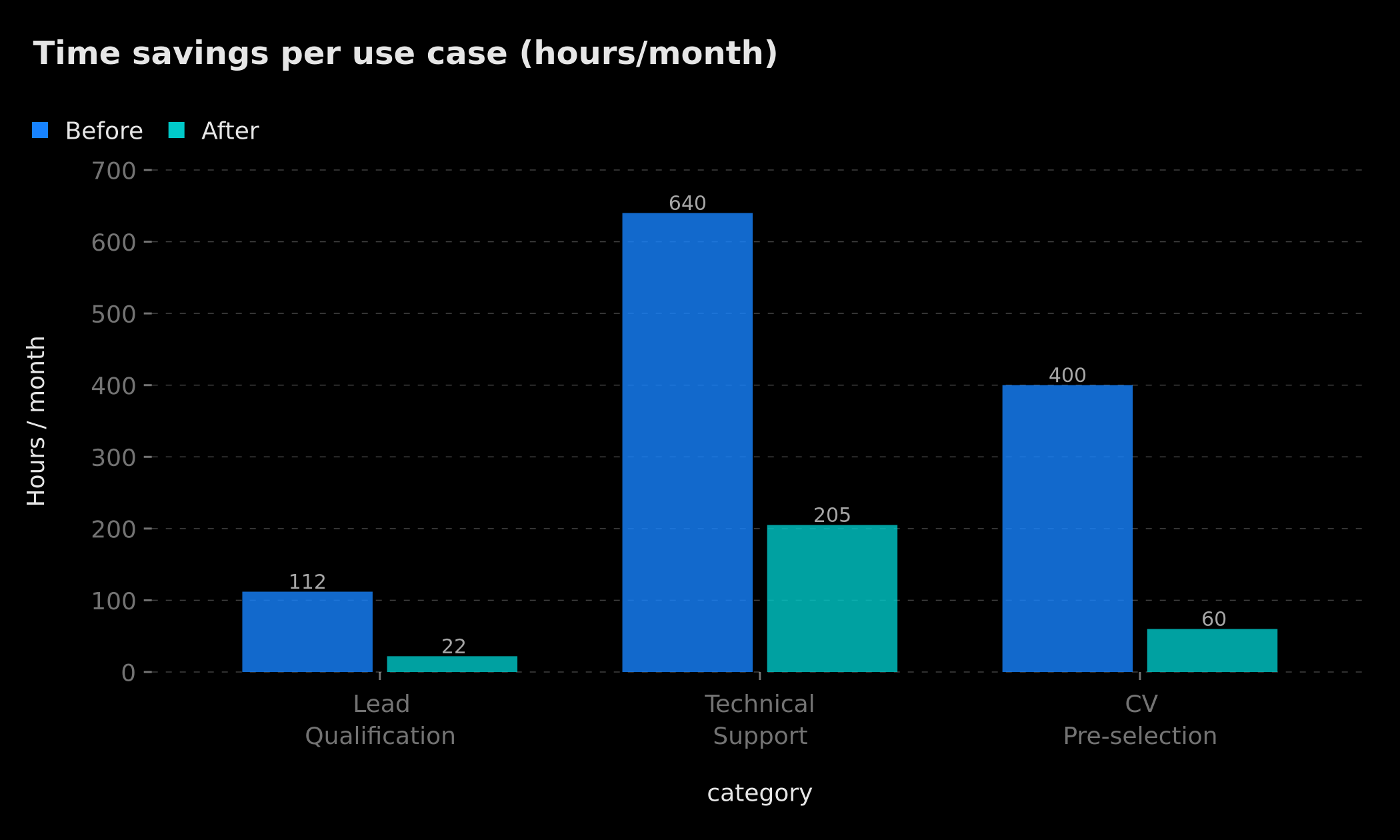 Time savings per use case: -80% lead qualification, -68% support tickets, -85% CV pre-selection
Case 1: Real estate agency — Incoming lead qualification (150 leads/month)
The 3-agent team spent an average of 45 minutes qualifying each incoming lead. That's 112 hours/month of pure qualification.
Hybrid solution implemented:
- AI agent: receives the lead, sends an automatic qualification questionnaire, retrieves responses, classifies the lead (hot/warm/cold) and generates a pre-filled summary sheet
- Human: receives only "hot" leads with their pre-filled sheet, contacts within 2 hours
Results after 60 days:
- Human qualification time: 112h/month → 22h/month (-80%)
- Hot lead conversion rate: +35% (better reactivity)
- Monthly AI agent cost: €85/month (n8n VPS + OpenAI API)
- Calculated ROI: €3,200/month in time savings across 3 agents
Case 2: SaaS Startup — Level 1 technical support (800 tickets/month)
70% of tickets were identical (password reset, known configuration errors, documented billing issues).
Hybrid solution:
- AI agent: automatic ticket triage, autonomous resolution of 70% standard cases, escalation with full context for 30% complex cases
- Human: handles only complex tickets, enriches the knowledge base when a new type of problem appears
Results after 90 days:
- Tickets resolved by AI without human intervention: 68%
- Average resolution time: from 8h to 12 minutes for standard cases
- Customer satisfaction (CSAT): 3.8/5 → 4.4/5
Case 3: HR consulting firm — Candidate pre-selection (200 CVs/month)
Consultants spent 2h reading and scoring each batch of CVs. That's 400h/month of manual reading.
Hybrid solution:
- AI agent: extracts key information from each CV, scores according to client-defined criteria, generates a pre-selection report with the top 20% most relevant
- Human consultant: reviews only the 40 pre-selected candidates, adds judgment on cultural fit
Results: Human pre-selection time from 400h → 60h (-85%).
The Architecture of the Hybrid Model
Understanding the hybrid model requires visualizing how the two layers — AI agent and human supervision — interact in a real system.
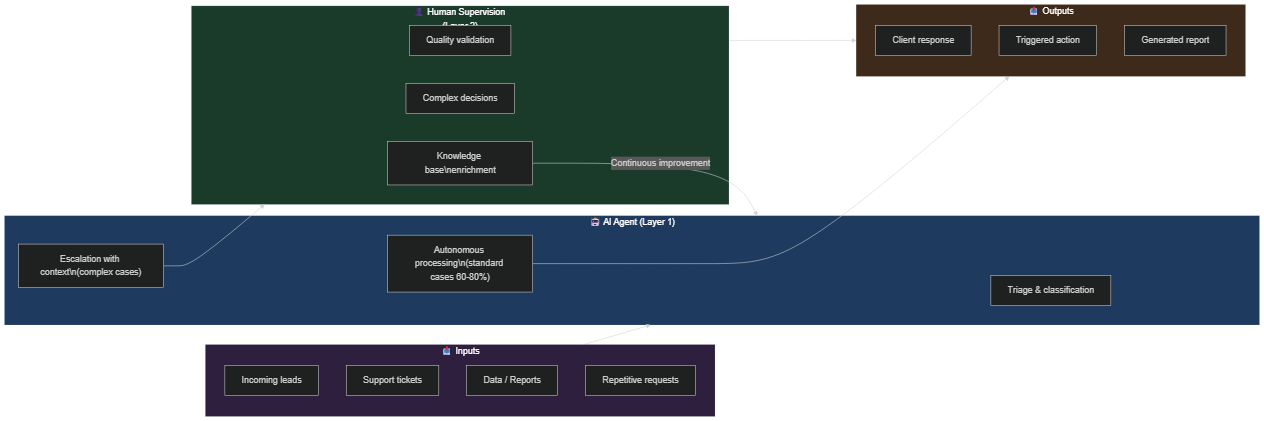 Two-layer hybrid architecture: the AI agent autonomously handles 60-80% of cases and escalates complex cases to human supervision, which in turn enriches the knowledge base
The hybrid model doesn't reduce to "AI does simple work, humans do the rest." It's a loop system where both layers feed each other.
Layer 1 — AI Agent (automatic processing): It receives inputs (leads, tickets, data, requests), triages and classifies them, and autonomously handles 60 to 80% of standard cases. For out-of-scope cases, it prepares a complete context file before escalating — which is crucial so the human doesn't have to start from scratch.
Layer 2 — Human Supervision (strategic processing): Humans handle complex cases, make high-stakes decisions and — an often overlooked point — enrich the agent's knowledge base when a new type of case appears. This feedback loop is what allows the agent to improve and progressively extend its autonomy perimeter.
The transition between the two layers must be seamless from the client's perspective. When an escalation is clumsy — the client has to re-explain their problem, or there's a long silence — the experience degrades sharply. The best implementations use handoff protocols that carry the full conversation context, client history and the agent's preliminary analysis directly into the human's interface. The goal is zero information loss at the handoff point.
The Decision Framework: When to Choose AI, When to Choose Human
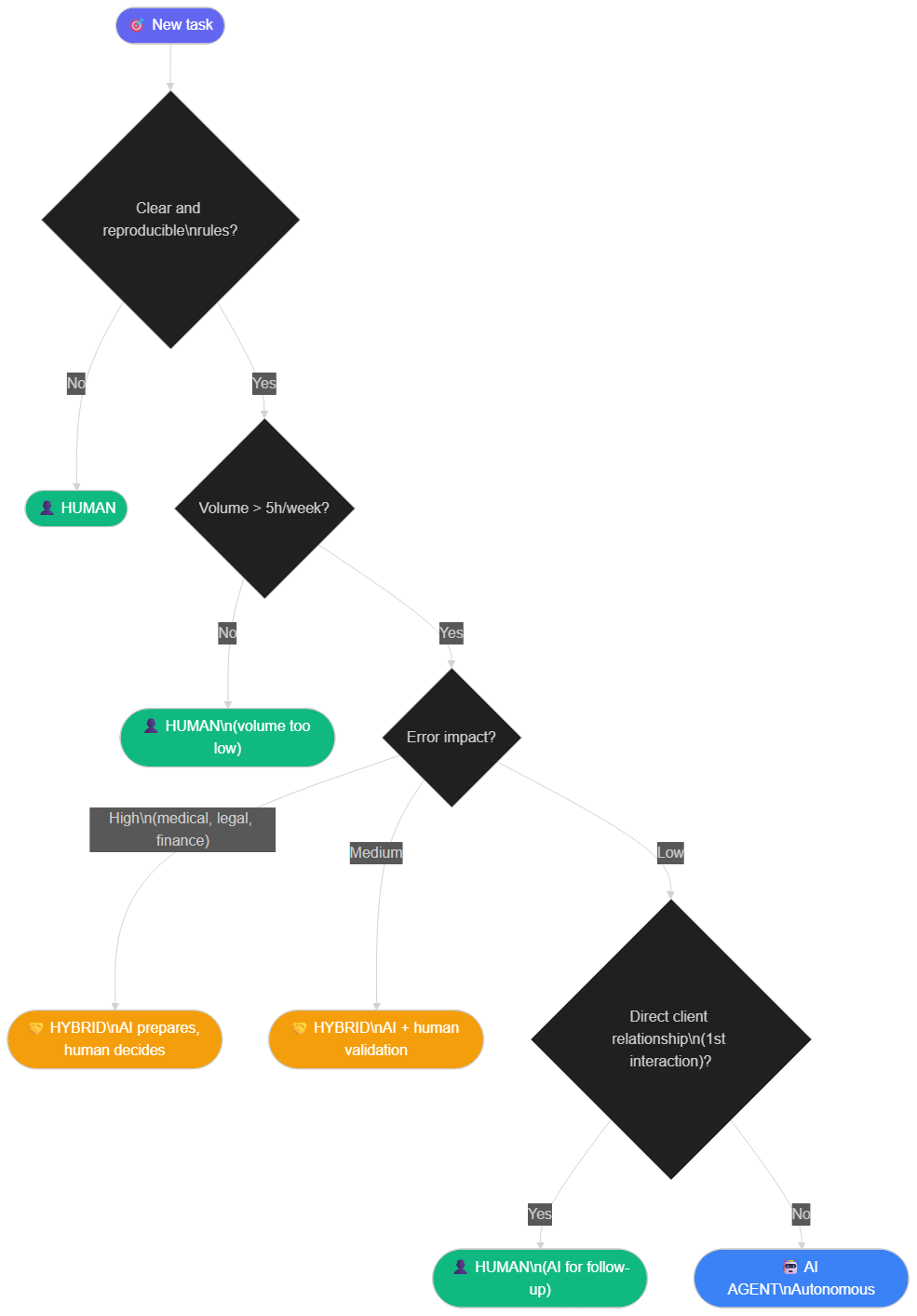 4-question decision framework for choosing between AI automation and human intervention
Question 1: Does the task have clear and reproducible rules? If yes → candidate for AI automation. If not (subjective judgment, unique context) → human.
Question 2: Does the volume justify automation? General rule: if the task takes > 5h/week, automation is profitable within 3 months.
Question 3: What is the consequence of an error?
- Error with low impact → autonomous AI acceptable
- Error with medium impact → AI with periodic human validation
- Error with high impact (accounting error, medical decision) → AI in support only, human decision mandatory
Question 4: Is there a direct client relationship (first interaction)? The first interaction with an important prospect or client stays human. AI handles follow-ups, confirmations, FAQ responses.
Impact on Internal Teams
Adopting a hybrid model isn't just about the "AI vs human" trade-off on isolated tasks. It structurally transforms the role of internal employees.
The most impacted profiles in 2026 are repetitive process operators — qualification agents, level-1 support operators, administrative assistants. Their role evolves from execution toward supervision and enrichment. Concretely, a support agent who processed 80 tickets/day becomes the "quality guardian" of the AI agent: auditing handled cases, identifying systematic errors and updating processing rules.
For managers, the change is equally significant. Managing a hybrid system requires new skills: reading an AI agent performance dashboard, interpreting a rising escalation rate, deciding to extend or restrict the agent's autonomy perimeter. These skills are not yet formalized in standard HR development paths — a gap to anticipate.
The teams that navigate the transition most successfully are those that involve employees in the design of the hybrid system from the start. When a support agent participates in defining the AI agent's triage rules, they are less in change resistance mode and more in tool ownership mode.
Beyond individual roles, hybrid model adoption also changes team composition. The profile of a "prompt engineer" — someone who designs, tests and maintains the AI agent's instructions and workflows — is becoming a de facto role in operations teams, even without the formal title. Organizations that anticipate this competency gap by training existing staff rather than hiring new profiles tend to deploy faster and with higher buy-in. The investment in internal upskilling is typically recovered within two quarters through reduced external vendor dependency.
Risks and Safeguards to Put in Place
A well-designed hybrid model performs well. Poorly designed, it can create serious operational risks.
Risk 1: Supervision debt. If the AI resolution rate climbs too high (>85%) without periodic quality validation, silent drift can set in. An agent giving wrong answers on 5% of cases is not detected if no one is watching the logs. Implementing a monthly random quality audit (reviewing 50 AI-handled cases) is a minimum practice.
Risk 2: Over-automating sensitive cases. Performance pressure sometimes leads to extending the AI agent's scope beyond what is reasonable. Explicitly defining the types of cases that remain exclusively human — a fixed list, reviewed quarterly — protects against this drift.
Risk 3: Single-provider LLM dependency. If your entire hybrid system relies on a single provider's API (OpenAI, Anthropic, Google), a pricing change or service interruption can paralyze your operations. Planning a multi-provider strategy or fallback option is a prudent operational precaution.
Risk 4: Knowledge base obsolescence. An AI agent operating on a knowledge base that hasn't been updated in 3 months is an agent giving increasingly incorrect answers. The update process must be scheduled and assigned to a responsible person — not left to "whenever we have time." For budget context on these systems, our article on n8n and Make automation pricing in 2026 provides useful benchmarks.
2026 Trends: Agent Specialization Changes Everything
The main evolution of 2026 compared to previous years isn't raw model power — it's specialization. The generalist agents of 2024-2025 are giving way to vertically specialized agents that change the terms of the debate.
Law-specialized agents (Harvey, Lexis+AI, etc.) reach performance levels close to a qualified junior on case law research and standard clause drafting. They don't replace the senior attorney, but they can replace the 3 to 4 hours of document research that a firm used to bill its clients for.
Finance-specialized agents analyze financial statements, detect accounting anomalies and generate due diligence reports at a fraction of the cost of an analyst team. On regulatory compliance tasks — KYC verification, transaction screening — specialized agents already outperform manual processes in speed and thoroughness.
Code-specialized agents (GitHub Copilot Enterprise, Cursor, Devin) increasingly handle development tasks that previously fell to juniors or interns: unit test generation, fixing documented bugs, framework migrations.
This specialization mechanically shifts competition upward. It's no longer the junior freelancer who is in direct competition with the AI agent — it's the intermediate freelancer on the standardized tasks of their domain. The freelancers who thrive in 2026 are those who have moved upmarket toward strategy, creativity and complex relational missions.
Metrics to Monitor in a Hybrid System
AI resolution rate: What proportion of cases is handled without human intervention? Target: 60-80% depending on domain. Below 60%, the agent lacks context or its instructions are too vague. Above 85%, you can extend its scope.
Escalation rate: What proportion is escalated to humans? If this rate suddenly increases, it's often a sign of a change in the types of incoming requests — investigate.
Customer satisfaction on AI cases vs human cases: Measuring CSAT separately for AI-handled and human-handled interactions identifies areas where AI still needs to progress.
Cost per interaction: Monthly tracking. A well-optimized hybrid system should see this cost decrease progressively with prompt optimization and architecture improvements.
Average escalation time: How long elapses between when the agent escalates and when the human takes over? A high escalation time degrades the customer experience. Target: < 30 minutes during business hours.
The Traps of the Hybrid Model
Trap 1: Automating high-stakes tasks too quickly. The desire to automate as much as possible sometimes leads to delegating to the AI agent decisions that should have remained human. Start with low-stakes tasks, validate results, extend progressively.
Trap 2: Not measuring AI agent results. If you have no metrics, you don't know if the agent is working well or silently degrading quality. Set up a dashboard from day one.
Trap 3: Forgetting to maintain the agent's knowledge base. An AI agent based on an outdated knowledge base will give bad answers. Plan a monthly update process for the documentation the agent consults.
Do you want to set up an AI + human hybrid model on your customer service, leads or operations? BOVO Digital designs the architecture and delivers the production system.
Tags
FAQ
Where do I start to set up an AI + human hybrid model?
Start by identifying your most repetitive and time-consuming process. Calculate how many hours it costs per month. If it's more than 20h/month, it's an ideal candidate for partial automation. BOVO Digital offers 30-minute scoping sessions to identify potential gains.
What budget should I plan for an AI + human hybrid system?
A simple hybrid system (one agent with 3-5 tools, connected to your CRM and email) typically costs €1,000 to €3,000 in initial development and €50 to €150/month in operation (VPS + LLM API). ROI is generally achieved within 2 to 4 months.
How do I measure if my AI agent is working well?
Key metrics: AI resolution rate (target 60-80%), escalation rate to humans (target < 30%), customer satisfaction on AI cases (must be equivalent to human cases), and cost per interaction (should decrease with optimization). BOVO Digital integrates these dashboards into every deployment.
What tasks should never be delegated to an AI agent in 2026?
Tasks involving direct legal responsibility (contract signing, medical prescriptions, judicial decisions), emotionally sensitive situations requiring authentic empathy, and contexts where an error can cause irreversible damage remain exclusively human. AI can prepare and analyze, but should never decide alone in these cases.
How do specialized AI agents change the game in 2026?
2026 AI agents are no longer generalists: specialized models in law, finance, code or medicine reach expertise levels close to qualified juniors in their domain. This shifts competition from standardized tasks toward creative, relational and strategic missions — where humans maintain a clear advantage.
Budget, process, priorities — decided together
Website, chatbot, or automation? We pick the next job that unlocks cash, not the trendy stack.
- 30 min
- Clear priorities
- No commitment
Vicentia Bonou
Full Stack Developer & Web/Mobile Specialist. Committed to transforming your ideas into intuitive applications and custom websites.


