
Weekly Tech Recap: Google 75%, Pentagon AI, Next.js 16.2 and Nemotron 3
May 2026 tech news in 4 major events: Google at 75% AI code, Pentagon signs with 7 players, Next.js 16.2 stabilizes Turbopack, and NVIDIA launches Nemotron 3 Nano Omni. In-depth analysis, implications and action plan.

Updated

Weekly Tech Recap: Google 75%, Pentagon AI, Next.js 16.2 and Nemotron 3
The May 2026 tech news cycle opened with an exceptionally dense week. From April 26 to May 2, 2026, four major events unfolded in quick succession — Google, the US Pentagon, Vercel, and NVIDIA — each carrying a strong signal about the direction the industry is taking. Taken together, they don't tell four separate stories: they tell one story, that of a tech industry definitively transitioning into the age of operational AI.
This recap offers more than a summary. Each event is analyzed in context, placed in historical perspective, and translated into concrete implications — for developers, entrepreneurs, and tech decision-makers who need to navigate this pivotal moment.
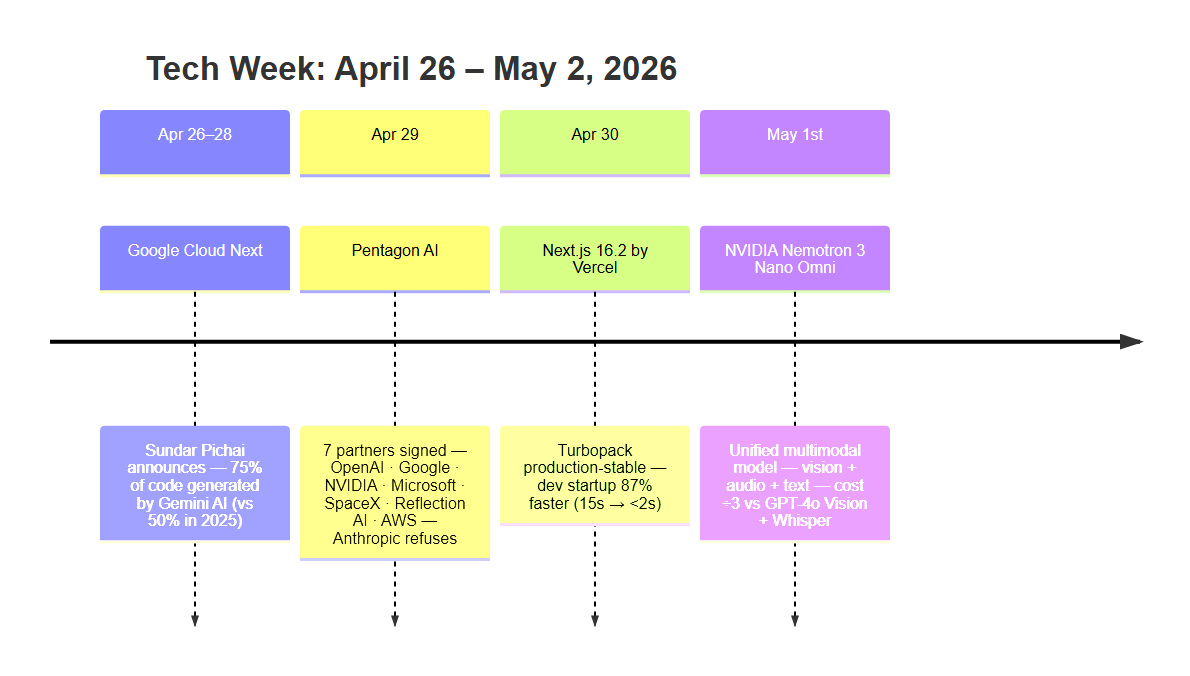 Tech Week April 26 – May 2, 2026: Google 75% AI, Pentagon, Next.js 16.2 and Nemotron 3 Nano Omni
1. Google: 75% of Code Written by AI — What It Really Means
At Google Cloud Next, Sundar Pichai confirmed that 75% of Google's new code is now generated by Gemini AI, up from 50% a year earlier and roughly 25% in 2024. That's a 25-point annual increase — steady, predictable, and showing that AI adoption in software development is not an enthusiasm spike but a structural curve.
The Historical Context of This Announcement
To grasp the significance of this figure, consider the trajectory. In 2022, when GitHub Copilot launched publicly, industry analysts estimated that less than 5% of code produced across the industry was AI-assisted. In 2023, that number reached 15-20% among early adopters. In 2025, Google declared 50%. And in May 2026, it's 75% at the world's most influential tech company — one that hires among the most competitive engineers in the world and equips them with Gemini models trained on their own codebase.
What's remarkable is what this figure doesn't say. It doesn't say 75% of Google's engineers were replaced. It says that 75% of the code these engineers deliver is co-produced with AI. The distinction is crucial: Google engineers no longer code from scratch — they supervise, guide, validate, and refine AI-generated code. Their role has shifted from producers to editors.
Impact on Quality and Technical Debt
A legitimate question arises: is this AI-generated code actually high quality? Based on information available from Google Cloud Next, the answer appears to be yes for standardized tasks (tests, CRUD operations, documentation, refactoring), and nuanced for complex architectural tasks. Google has invested heavily in automated validation pipelines to filter generated code before it touches production. That's precisely what teams wanting to replicate this model should take away: AI doesn't replace code review, it changes what code review focuses on.
What It Means for You
- If you're a developer, your value no longer lies in typing speed but in the quality of your technical judgment and architecture. Knowing how to evaluate AI-generated code is now a distinct skill, separate from knowing how to write it.
- If you're a business that has development done, timeline and cost estimates need to be revised downward. Service providers who don't use AI are structurally disadvantaged on standard production tasks.
- If you're a tech agency, documenting your AI workflow has become a commercial requirement, not a differentiating advantage. Clients who understand this market are starting to ask questions about your tooling.
To go deeper on the impact of this shift for developers, see our full analysis: AI-First in 2026: Why 68% of Funded Startups Have AI at Their Core.
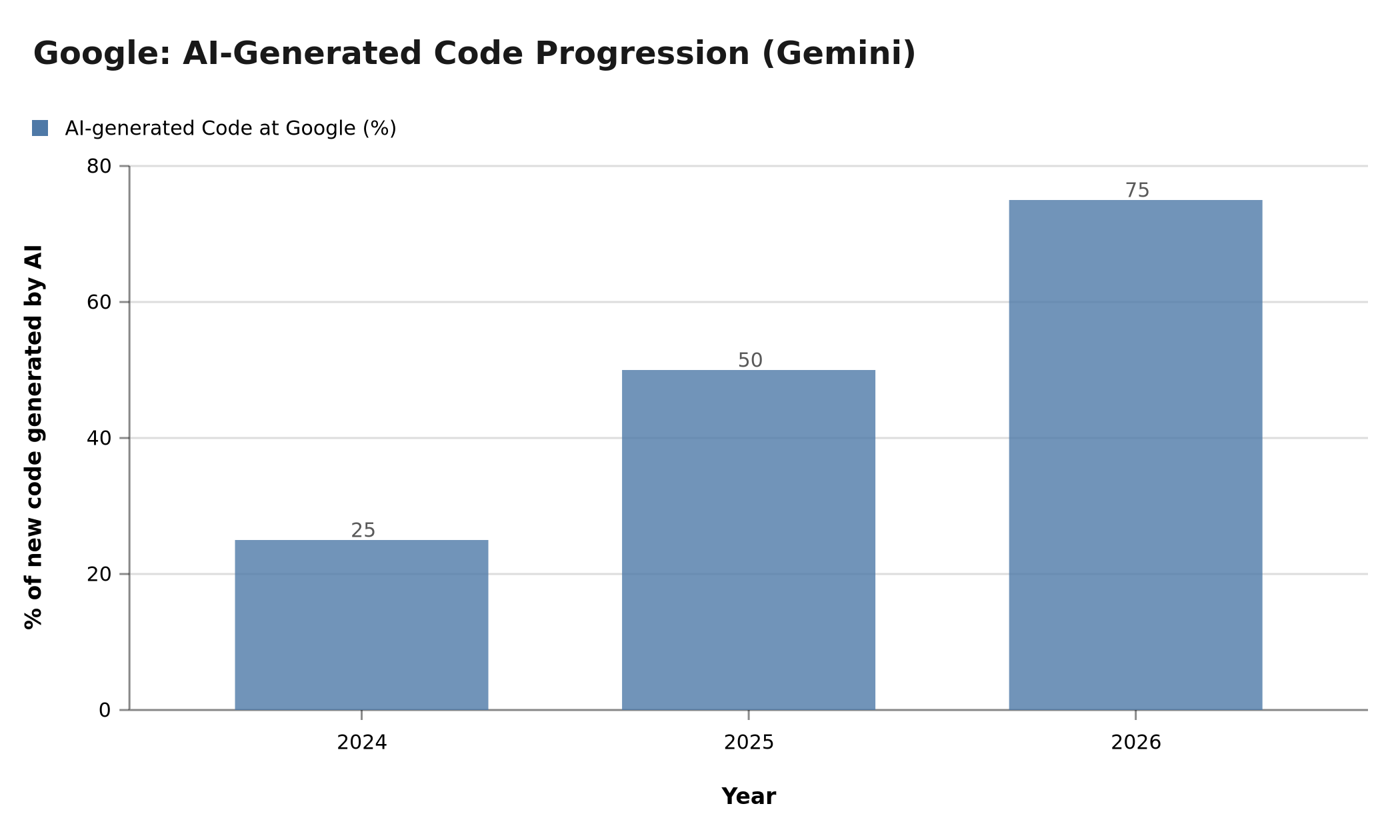 Google: share of new code generated by Gemini AI — 25% in 2024, 50% in 2025, 75% in 2026 (source: Google Cloud Next, Sundar Pichai)
2. Pentagon AI: 7 Partners, Anthropic Absent — A Fracture That Reshapes the Industry
The US Department of Defense officially announced 7 AI partners for its military technology acceleration program: OpenAI, Google DeepMind, NVIDIA, Microsoft, SpaceX, Reflection AI, and AWS. This list isn't a complete surprise — several of these actors already had contracts with US government agencies. What's new is the formalization of a structured program, with substantial resources and objectives explicitly tied to military technological superiority.
The History Behind This Decision: Project Maven Revisited
To understand why this is a turning point, we need to remember 2018. Google had signed Project Maven, a Pentagon contract for AI-powered drone image analysis. The internal reaction was fierce: thousands of employees signed a petition, more than a dozen resigned, and Google ultimately declined to renew. In May 2026, Google DeepMind signs again — this time without comparable internal protest. This speaks to a deep normalization of AI-defense collaboration within the American tech industry.
Why Anthropic Refused — and Why It Matters
Anthropic, the creator of Claude, refused. The publicly stated reason: the impossibility of guaranteeing that Claude would not be used for automated lethal decision-making processes. This is a foundational decision, perfectly consistent with Anthropic's declared mission since its founding: developing AI that is "beneficial and safe." Anthropic built Claude on the principles of what they call Constitutional AI — a framework in which the model is trained to refuse certain categories of requests based on an explicitly defined set of ethical principles. Engaging Claude in a military contract where these principles could be bypassed or redefined by the client would represent a fundamental contradiction with that framework.
This refusal has an obvious immediate commercial cost — the Pentagon contract potentially represents hundreds of millions of dollars over several years. But it also carries strategic value: Anthropic positions itself as the reference AI provider for actors with strong ethical constraints — European regulators, non-military public sector, NGOs, large companies subject to ESG requirements.
For the full analysis of how AI players position themselves vis-à-vis the Pentagon, read: The Pentagon and AI: Why Google and NVIDIA Said Yes, Anthropic No.
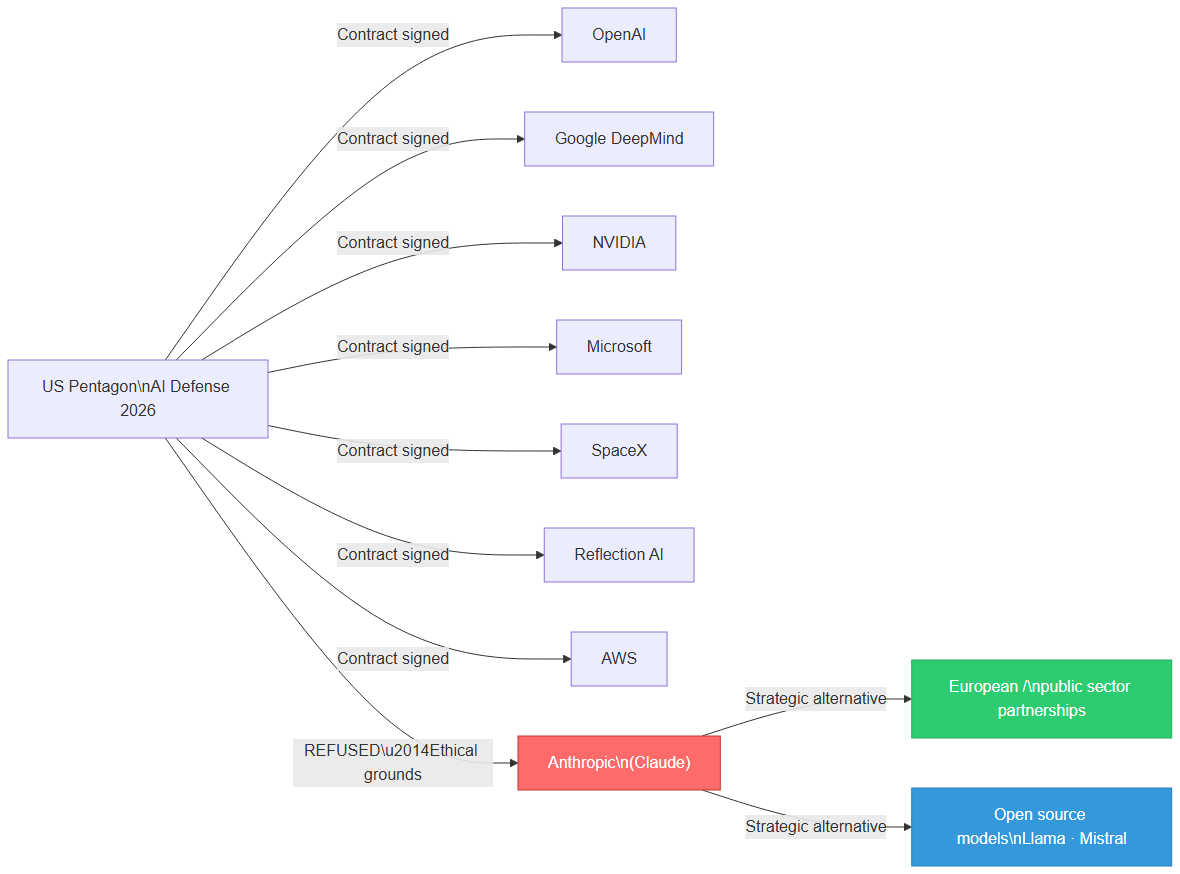 Pentagon AI 2026: 7 signed partners (OpenAI, Google DeepMind, NVIDIA, Microsoft, SpaceX, Reflection AI, AWS) — Anthropic refuses on ethical grounds and pivots toward European markets and open source
Practical Implications for Businesses
The AI industry is now explicitly divided into two camps: "universal" providers who accept military contracts, and "constrained" providers with strong ethical positioning. This bifurcation will deepen in the coming months.
For European companies, the choice of your LLM is becoming a procurement policy decision, not just a technical one. Procurement departments and CSR committees are starting to ask about potential military use of the models. In anticipation of the European AI Act that will fully enter into force in 2027, documenting your LLM selection policy is becoming a good governance practice.
Local models — Llama 3, Mistral via Ollama, Microsoft's Phi-3 in private mode — remain the only truly sovereign option, agnostic to these geopolitical stakes. For use cases that don't require frontier model capabilities, they represent an increasingly viable technical alternative with declining hosting costs.
3. Next.js 16.2: Dev Startup Divided by 9 — and What It Really Changes
Vercel published Next.js 16.2 with a standout figure: next dev startup is 87% faster, dropping from 15-20 seconds to under 2 seconds on an average project. That figure alone justifies the migration, but the implications of this release go well beyond performance.
The Story of Turbopack: Two Years of Integration
Turbopack isn't new to Next.js 16.2. It was announced in October 2022 at Next.js Conf as a successor to webpack, written in Rust for performance reasons. The initial promise was ambitious: up to 10x faster than webpack. Reality was more nuanced: a series of bugs, incompatibilities with certain webpack plugins, and a prolonged beta that lasted over three years.
With Next.js 16.2, Vercel declares Turbopack production-stable with over 200 fixes since the beta. This is the conclusion of a long but coherent maturation cycle. The stability declaration concretely means Vercel now commits to not introducing behavioral regressions between versions — which is the pragmatic definition of "production ready" in the JavaScript ecosystem.
The Four New Features Worth Knowing
Turbopack stable is obviously the headline. But the other three deserve your attention:
Hydration Diff Indicator solves a problem that has cost many React developers hours of debugging time. Hydration errors — when server-side generated HTML doesn't match what React generates client-side — are notoriously difficult to debug. The standard error message just says "hydration failed" without indicating precisely which part of the DOM differs. The Hydration Diff Indicator now displays a visual comparison of server-side vs client-side, drastically reducing debugging time.
AGENTS.md included by default is the most revealing new feature about the spirit of the moment. create-next-app now generates an AGENTS.md file at the project root, intended to document the architecture for AI agents (Cursor, Copilot, Claude) working on the codebase. It's the AI agent equivalent of a README. Vercel is betting that the majority of Next.js developers will work with AI agents, and is integrating this assumption into the default tooling.
Server Function Logging makes server calls (Server Actions, Server Functions) visible directly in the development terminal, with timing and errors. Before this release, debugging a Server Action often required inspecting deployment logs or adding manual console.log statements. This is now handled automatically.
For a detailed analysis of Next.js 16.2 and its impact on existing projects: Next.js 16.2: What Concretely Changes in 2026.
What It Means for Businesses with Next.js Apps
For businesses whose web applications run on Next.js 14 or 15, migration to 16.2 is not only feasible but recommended. The gain on the development cycle — less time waiting for startup, less time debugging hydration — translates directly into team productivity. On a medium-sized project with a 3-5 developer team, saving 30 to 60 seconds per development cycle can represent 1 to 2 hours of productivity per developer per day.
4. NVIDIA's Nemotron 3 Nano Omni: Unified Multimodality Changes the Rules
NVIDIA launched Nemotron 3 Nano Omni, a model that processes vision, audio and text simultaneously in a shared attention space — where current solutions use separate pipelines with data transfers between components.
The Architecture That Changes Everything
To understand why this matters, consider a typical multimodal pipeline. You send an image to GPT-4o Vision for description, an audio file to Whisper for transcription, and assemble both results as input to an LLM for the final response. Each step has its latency, its API cost, and its error risks. This pipeline works but is fragile and expensive.
Nemotron 3 Nano Omni works differently. Vision, audio and text enter simultaneously into a shared attention space: the model processes all three modalities as a single token stream. This eliminates intermediate transfers, reduces overall latency, and produces contextually more coherent responses because all three modalities are processed together rather than sequentially.
NVIDIA's announced figures at launch:
- 9x more efficient than equivalent separate architectures (in FLOPs per request)
- Latency of 0.8 to 2 seconds for complete multimodal processing
- Cost: approximately 30% of an equivalent GPT-4o Vision + Whisper pipeline
- Self-hosting possible via NVIDIA NIM on A100, H100 or L40S GPU
Use Cases That Become Economically Viable
The 70% cost reduction isn't anecdotal. It unlocks use cases that were previously reserved for large enterprises with significant AI budgets.
Automated visual quality control for industrial SMBs: analyzing photos of products at the end of a production line to detect defects, combining visual analysis with technical specifications in text. With a classic pipeline, the cost was prohibitive for medium production volumes. With Nemotron 3 Nano Omni, it's economically viable from a few hundred pieces per hour.
Multimodal customer service: allowing a customer to send a photo of their problem plus a voice message and receive a contextual response that integrates both sources of information. Without a complex pipeline and without perceptible delay.
Document auditing with embedded images: processing invoices, contracts, or reports that contain both text and tables or charts. Integrated analysis is significantly more accurate than text extraction alone.
For companies currently exploring AI investment opportunities and wanting to understand where the market is heading, our OpenAI analysis is illuminating: OpenAI Raises $110 Billion: A Historic Turning Point for AI.
 Impact of 4 May 2026 announcements on tech teams: recommended actions by event for developers and entrepreneurs
The Connections Between These Four Events
What's remarkable about this week is that these four events aren't independent. They form a coherent signal that paints a clear picture of the tech industry in May 2026.
Signal 1: Generative AI has moved into industrial deployment phase. Google's progression to 75%, Nemotron 3 Nano Omni for multimodal production, Next.js 16.2 for AI-assisted development — all point in the same direction: AI is no longer experimental, it's operational. The psychological threshold of "it doesn't really work in production yet" has been definitively crossed.
Signal 2: The ethical fracture will reshape the industry. Anthropic's refusal is a strong signal that not all AI players are heading in the same direction. This divergence will create differentiated markets with different purchasing criteria depending on the sector. European public buyers, ESG-constrained companies, and NGOs will seek providers aligned with their values — and Anthropic will be there.
Signal 3: Technology costs are collapsing. Nemotron 3 Nano Omni divides multimodal costs by 3. Turbopack divides dev startup time by 9. Google codes 75% by AI, mechanically reducing software production costs. These three facts share a common thread: making technology accessible to actors who previously lacked the resources to use it. This is structural democratization, not a trend.
Signal 4: AI tooling is standardizing. AGENTS.md integrated into create-next-app, Server Function Logging in Next.js, NIM as the standard interface for NVIDIA models — everywhere, you see standardization efforts that facilitate AI integration into existing workflows. The era of artisanal AI integration is ending.
May 2026 Tech Trends: What's Taking Shape
Stepping back across the full month of May 2026, three cross-cutting trends emerge from the tech news:
The convergence of tooling and AI. Whether it's Next.js 16.2 with AGENTS.md, NVIDIA with NIM, or Google with its internal Gemini pipelines, development tools now integrate AI as a first-class component, not an add-on module. This convergence will accelerate in the coming months.
The regionalization of AI choices. The Pentagon agreement creates a dividing line between "militarized American AI" and "civil-purpose AI." European companies will need to position themselves clearly over the next 12 to 24 months, under pressure from the AI Act and the procurement policies of their public sector clients.
The professionalization of the AI developer role. The Google 75% figure means that in large tech organizations, developers who don't know how to use AI effectively are now less productive than their peers. The skill of "AI-generated code supervision" is becoming as fundamental as code review.
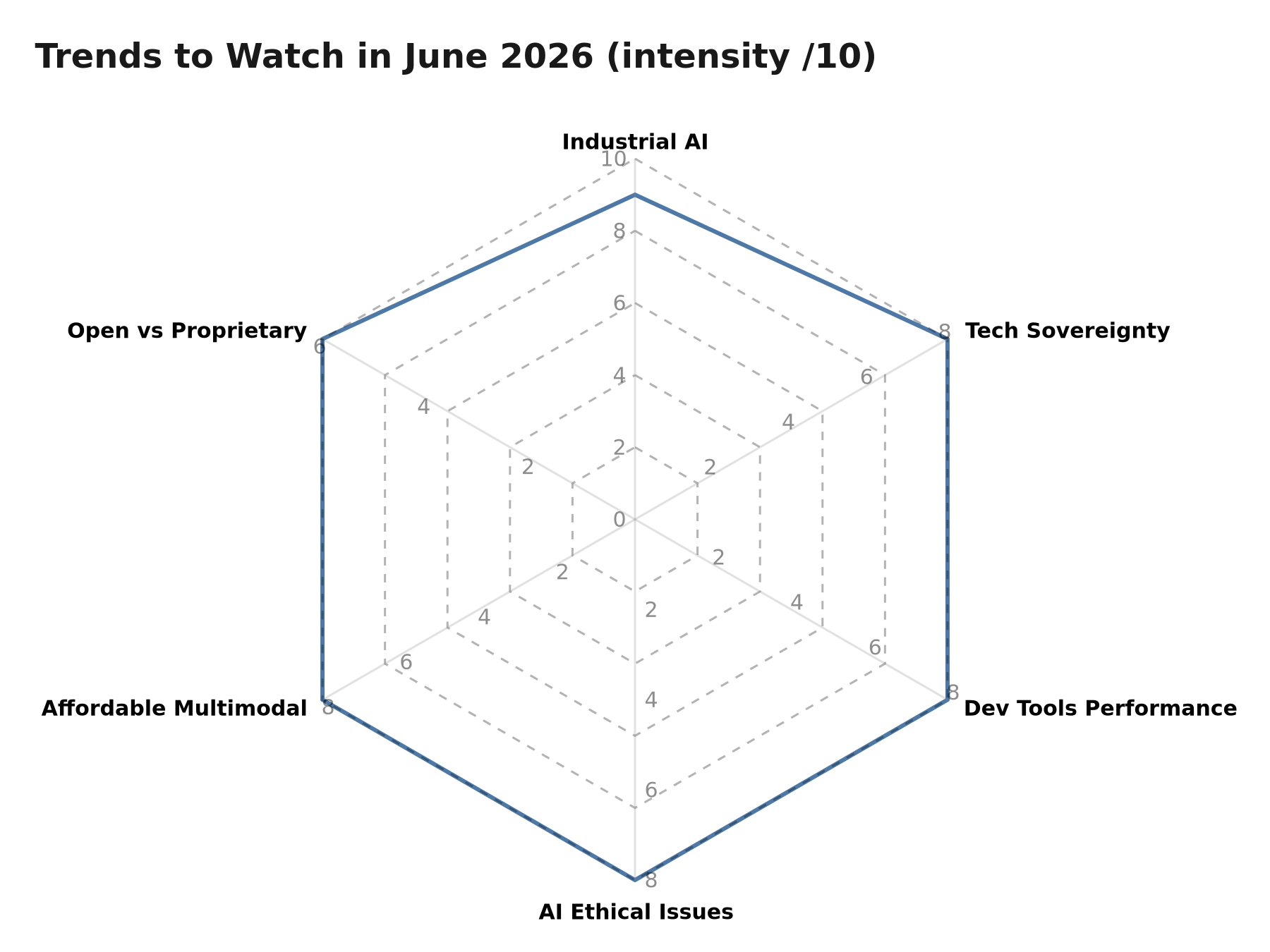 Tech trends to watch in June 2026: intensity of issues by category (industrial AI, tech sovereignty, dev tools performance, AI ethical issues, affordable multimodality)
What Entrepreneurs Must Take Away From This Week
If you lead an SMB, startup or agency, here's what these four events concretely change for your business:
Pressure on timelines and costs will increase. Clients who understand the Google 75% figure will mechanically have higher expectations on delivery speed and cost. If your current tech service provider can't explain how AI accelerates their process, that's a legitimate question to ask.
Your choice of AI tools has become a positioning signal. Using OpenAI vs Anthropic vs open source models is no longer just a technical decision — it's a positioning choice that can influence your clients and partners, especially in Europe. Document your policy and your reasons.
Multimodality is becoming accessible. If you have use cases combining image analysis, text, and audio — quality control, customer service, document auditing — Nemotron 3 Nano Omni makes these applications economically viable at SMB scale. This is a concrete automation opportunity within the next 6 months.
The Next.js migration is worth doing now. If your site or application runs on Next.js 14 or 15, planning the migration to 16.2 in the coming weeks will give you immediate dev productivity gains and prepare you for the Vercel ecosystem as it evolves in 2026.
To understand how these trends fit into a broader wave of AI transformation for businesses: AI-First in 2026: Why 68% of Funded Startups Have AI at Their Core.
What Will Happen in the Next 30 Days
Based on observed signals, the most likely developments for June 2026:
Anthropic vs the market: expect strong communication from Anthropic on its ethical positioning, probably accompanied by new partnerships with European public sector actors and NGOs. This will be as much a brand communication as a product one.
Next.js 16.3 preview: Vercel follows a monthly release rhythm. Version 16.3 should integrate the first feedback from weeks of 16.2 production usage — expect fixes on Turbopack edge cases and potentially improvements on Server Function Logging.
Nemotron 3 Nano Omni on Ollama: if NVIDIA follows its habits, an optimized version for self-hosting via Ollama will be available within 4 to 8 weeks. That will be the moment to test on your projects without having to manage an A100 GPU.
n8n 2.16: a minor release with bug fixes following the massive adoption of 2.15 is expected. MCP (Model Context Protocol) integrations will continue to improve.
New EU AI Act announcements: the compliance deadline for "general purpose model providers" is approaching. Expect regulatory clarifications that will force AI actors to specify their commitments.
Your Action Checklist for This Week
If you have a Next.js site:
- Check your current version and plan migration to 16.2 (even on a test environment)
- Enable Turbopack in dev mode (
next dev --turbo) and measure the startup gain - Create a minimal AGENTS.md for your project if you work with AI agents
If you automate workflows:
- Identify a workflow that processes both images AND text: it's a priority candidate for Nemotron 3 Nano Omni
- Evaluate your current Make or n8n cloud operation costs for the current month
- If you're on Make with more than 10,000 operations per month, calculate the n8n self-hosted cost comparison
If you use LLMs in production:
- Document which provider you use and why (for your GDPR and ESG assessment if relevant)
- Prepare a clear response if clients ask about military uses of LLMs
- Evaluate whether open source models (Llama 3, Mistral) cover your needs without dependency on major providers
If you're a freelancer or agency:
- Update your commercial proposals to include your AI workflow and quality validation process
- Identify an existing client for an upsell proposal based on Nemotron 3's new multimodal capabilities
- If you do web development, position your Next.js 16.2 expertise as a commercial argument
BOVO Digital helps you concretely integrate these new technologies into your projects. Web, automation, AI agents — we deliver in production.
Tags
FAQ
Where can I follow weekly tech AI news without getting overwhelmed?
BOVO Digital publishes a selective weekly tech recap on its blog, retaining only events with concrete impact on your business. Subscribe to our newsletter or check the Tech News section of our blog to stay updated without wasting time.
Do these events affect ongoing web and automation projects?
Directly for Next.js 16.2 (immediate migration opportunity) and Nemotron 3 Nano Omni (cost optimization opportunity on multimodal pipelines). The Pentagon agreement and Google's 75% figure have a more gradual impact on industry norms and client expectations — but they clearly signal where the market is heading over the next 18 months.
Can BOVO Digital help me integrate these new technologies quickly?
Yes. BOVO Digital offers applied technology watch sessions: analysis of your current stack, identification of concrete opportunities (Next.js migration, Nemotron integration, MCP setup) and a prioritized action plan. Contact us for a 30-minute session.
Does Anthropic's refusal of the Pentagon contract impact companies using Claude?
Not directly on features. Anthropic's refusal is a strategic positioning decision that reinforces its credibility with actors who have strong ethical requirements. For European companies subject to GDPR and the AI Act, this positioning may actually be an advantage: Claude remains one of the best-documented LLMs on its internal guardrails.
Is Next.js 16.2 compatible with existing Next.js 14 and 15 projects?
Migration from Next.js 14 or 15 to 16.2 is generally non-breaking on standard projects. Major changes concern Turbopack (the compiler, now stable) and Server Functions (new logging). BOVO Digital performs free migration audits to assess the actual effort on your specific project before you commit.
Can Nemotron 3 Nano Omni replace GPT-4o for all use cases?
No, not for all. Nemotron 3 Nano Omni excels on simultaneous multimodal use cases (vision + audio + text in the same request) and for self-hosting. For purely complex text tasks or long reasoning chains, GPT-4o or Claude 3.5 Sonnet remain competitive. The right strategy is to use it where multimodality truly matters, not as a universal replacement.
Free audit: we check the impact on your site and workflows
Next.js CVE, new agent, MCP… We tell you what actually applies, and what to patch or ignore.
- 30 min
- Stack reviewed
- No commitment
Vicentia Bonou
Full Stack Developer & Web/Mobile Specialist. Committed to transforming your ideas into intuitive applications and custom websites.


