
AI-First in 2026: Why 68% of Funded Startups Have AI at Their Core (and How to Join Them)
You 'use ChatGPT' in your business. But your competitors have built their entire offering around AI. That's a different category now. Here's the 4-step framework to reposition your business as AI-First — without being a developer.

Updated

A conversation I had with an entrepreneur three months ago
He reached out for a website redesign. Sharp, ambitious, with a solid HR consulting offer. During the call, he walked me through his tools: "We use ChatGPT to write our reports. We've got Notion AI for meeting summaries. And we're testing Midjourney for presentations."
I asked him a simple question: "If your AI goes down tomorrow, what changes in your offer?"
Silence. Then: "Well... we do the same thing, but slower."
That's exactly the problem. This conversation repeats itself every week across dozens of consulting firms, agencies, and small businesses that believe they've embraced AI transformation because they've subscribed their teams to a handful of SaaS tools. They're right to seek productivity gains — but they're fighting the wrong battle if their ambition is to differentiate themselves durably.
Using AI tools doesn't make you an AI-First company. It makes you a faster company. That's not the same thing. And in 2026, it's no longer enough to differentiate yourself, convince a serious investor, or create a competitive advantage that resists platform pressure.
This article gives you the complete framework: why the funding market has shifted, what VCs are really looking for, how to build an AI-First offering in your sector, the pitfalls to avoid, and the indicators that prove your transformation is real — not cosmetic.
The numbers that are redefining competition
Q1 2026 data is unambiguous:
- 68% of startups that raised seed or Series A funding have AI as a core component of their value proposition — up from 34% in 2024 (VC data Q1 2026)
- This figure is projected to reach 85% by end of 2026 according to major VC firms
- AI startups now capture 50-51% of global venture capital, up from 34% a year ago
- The cost of using AI models has dropped -90% in 3 years — what was reserved for large enterprises is now accessible to any small business
This isn't a trend. It's a structural recomposition of the market. These numbers don't mean that 68% of companies use AI — they mean that 68% of companies that raise funding have AI integrated into the very core of what they are paid for. The nuance is critical, and it determines who will still be competitive in eighteen months.
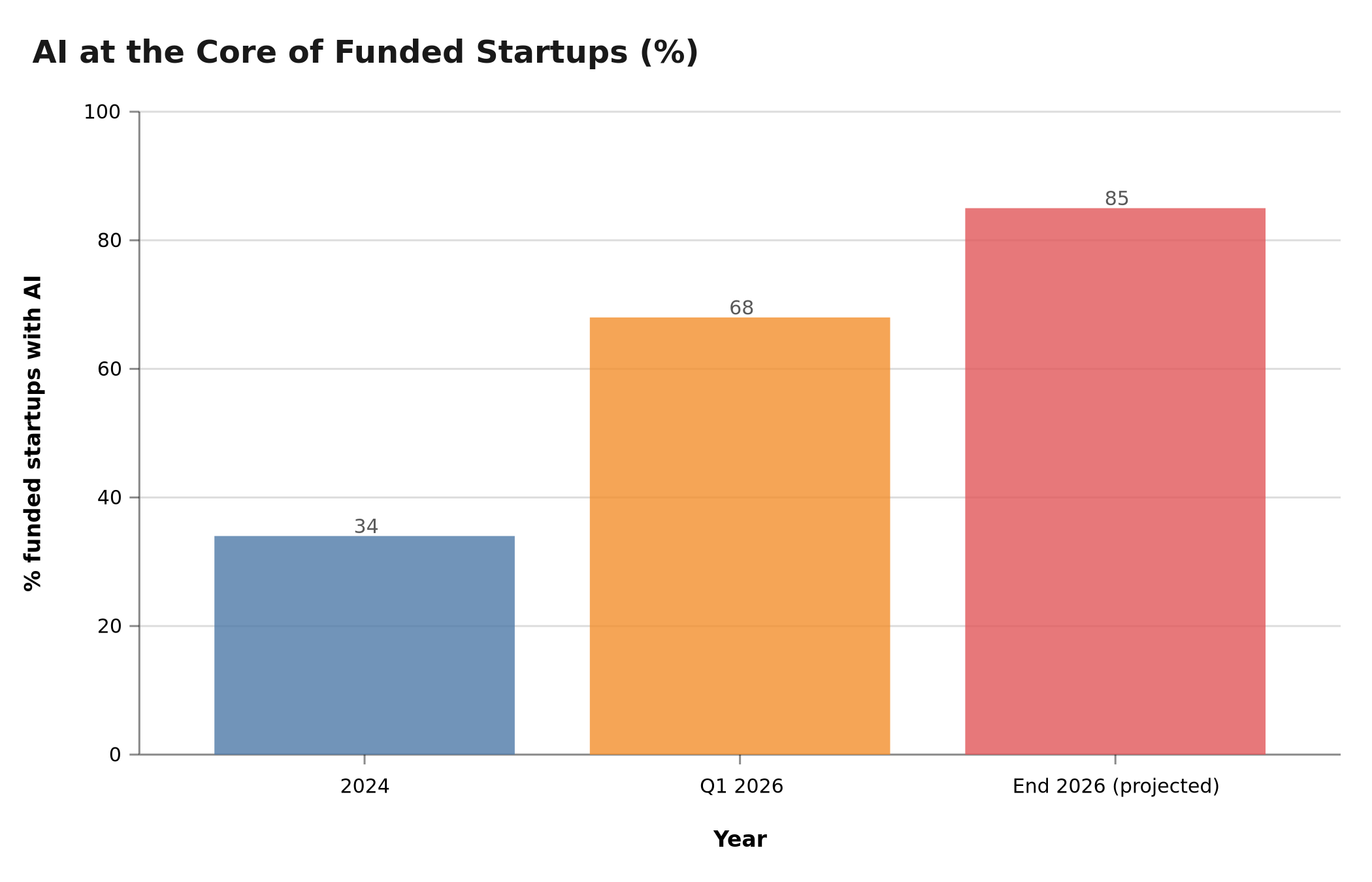 AI-First startup progression: from 34% in 2024 to 68% in Q1 2026, projected at 85% by end of 2026 — source: VC data Q1 2026
Investors are no longer looking for companies that "use AI." They're looking for companies where removing AI would destroy the offering. This cursor shift is not philosophical — it is directly tied to the financial metrics VCs monitor to maximize their returns.
Why investors now require AI at the core of the offering
To understand why 68% of funding deals now incorporate AI as a central criterion, you need to understand what VCs are optimizing for. They are not technology enthusiasts by principle: they are seeking three precise financial variables — defensible differentiation, non-linear scalability, and margin improvement.
Defensible differentiation is the first imperative. An AI-Enabled offering — one that uses ChatGPT, Copilot or generic tools — is easily replicable. Your competitor can subscribe to the same tools tomorrow morning. But an AI-First offering built on proprietary data, a unique client history, or a model fine-tuned on your sector takes months, sometimes years, to replicate. That's the competitive moat investors are funding: not access to AI, but the structural advantage conferred by your unique combination of data, domain expertise, and AI infrastructure.
Non-linear scalability is the second criterion. A human consulting agency cannot triple its revenue without tripling its headcount. An AI-First platform, however, can multiply the number of clients served without the marginal cost following the same curve. That's the promise VCs fund: a model where revenue growth progressively decouples from operational cost growth. This decoupling is only possible when AI itself delivers the value — not just handles support tasks.
Margin improvement is the third lever. AI-First companies report structurally higher gross margins than their traditional equivalents. According to data available at the time of publication, AI-First SaaS companies achieve gross margins of 70 to 85%, compared to 40 to 60% for traditional professional services. This difference stems from the fact that the "deliverable" — the prediction, the analysis, the automation — is produced by an agent whose marginal cost trends toward zero as iterations accumulate.
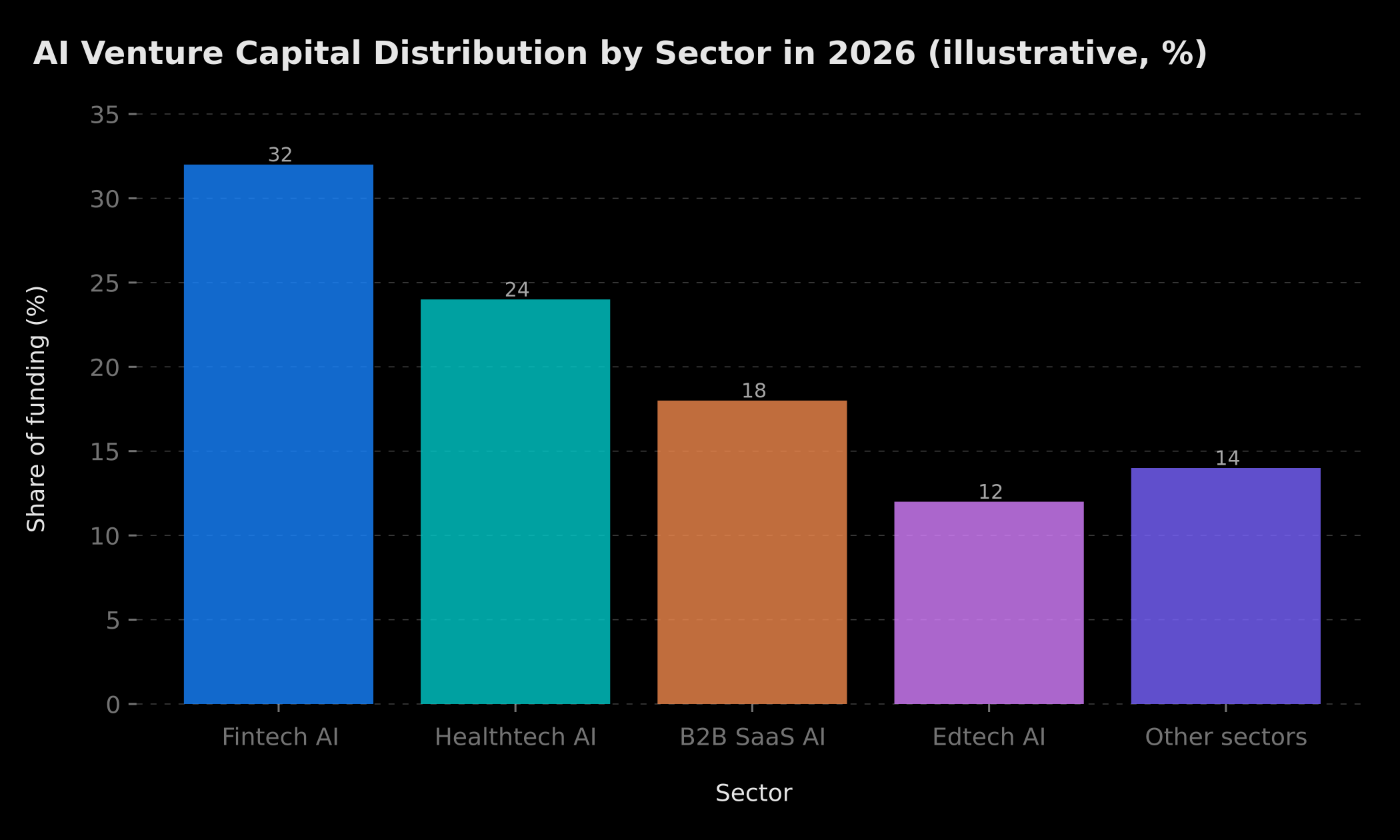 Illustrative distribution of AI VC funding by vertical in 2026: Fintech and Healthtech lead, followed by B2B SaaS — data for illustration purposes
Added to these three factors is a fourth that VCs are increasingly valuing explicitly: natural and benign lock-in. An AI-First offering improves with use — the more the client uses the system, the more the system learns from them, the more value increases. This mechanism creates structural retention that has nothing to do with punitive contract clauses: it's accumulated value the client would lose by leaving. For a VC, this is one of the most predictive indicators of strong LTV (client lifetime value).
What does being truly "AI-First" mean — and why using ChatGPT isn't enough?
The confusion comes from a poor definition, sometimes deliberately maintained by vendors who prefer to talk about AI without being too specific about what they mean.
AI-Enabled Company: You use AI tools to be more productive. AI is in your internal processes. If it disappears, you slow down but continue. Your clients don't notice a difference in the final deliverable — they just see that you're less slow.
AI-First Company: AI is in your value proposition. Your clients pay for what only your combination of data + AI + expertise can produce. If AI disappears, your offering disappears. This is a brutal distinction, but it's the only one that matters when the goal is to differentiate yourself, raise funding, or retain clients who have ample alternatives.
Concrete examples:
| AI-Enabled Offering | AI-First Offering |
|---|---|
| HR firm using ChatGPT for reports | Platform analyzing your team performance data and predicting turnover with 89% accuracy |
| Marketing agency generating posts with AI | System analyzing your last 3 years of content to identify patterns that convert in your specific audience |
| Accountant using Copilot | Service connecting your ERP, detecting anomalies in real time, and generating preventive alerts before difficult month-ends |
The difference isn't the level of technical sophistication. It's the locus of value: is AI in your backstage, or is it what your client is actually paying for? For the numbers: 1,114 French startups with AI at the heart of their model in 2026.
4-step framework to reposition your offering as AI-First
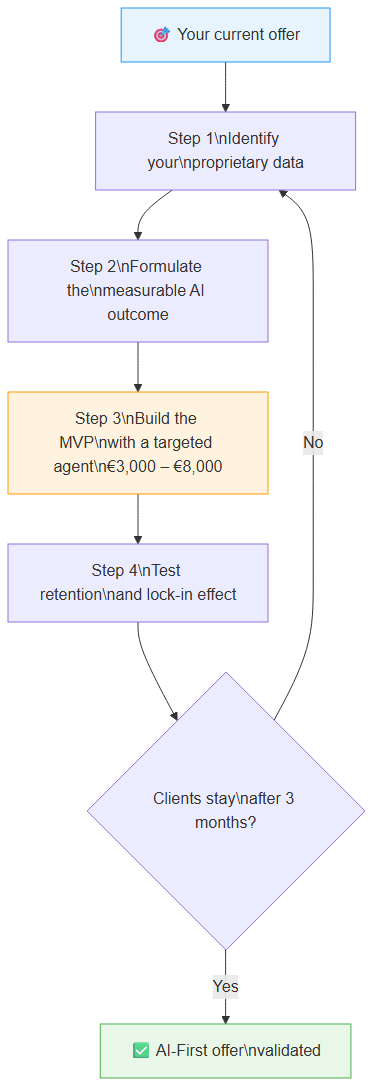 The 4 steps of AI-First repositioning: proprietary data → measurable outcome → MVP agent → lock-in validation
This framework comes from our experience on dozens of implementation projects. You don't need to be a developer to follow it — but you'll need a technical partner for steps 3 and 4.
Step 1: Identify your "proprietary data"
Every AI-First offering starts with data that only you possess or can obtain: customer history, product feedback, sector data, past interactions. This is your raw material. The classic trap at this stage is confusing "available data" with "proprietary data." Having access to the same data as your competitors via public APIs gives you no structural advantage. The data that counts is what your years of activity have accumulated, what your network provides exclusively, or what your position in the value chain allows you to capture before anyone else.
Question to ask yourself: "What do I know about my sector or clients that nobody else knows?"
Step 2: Formulate the measurable outcome that AI can predict or produce
AI doesn't sell. Results sell. Your repositioning must be formulated as: "We [measurable outcome] by using [your proprietary data] analyzed by our AI system." This formulation isn't a communication exercise — it's the backbone of your commercial offering, your fundraising slides, and your sales pitch.
Example: "We reduce your supplier invoice processing time by 73% by connecting your ERP to our automatic verification agent."
Step 3: Build the MVP with a targeted agent
Don't try to automate everything at once. An AI-First MVP is built around a single agent that demonstrates value on one specific case. Budget: €3,000 to €8,000 depending on data complexity. Timeline: 3 to 6 weeks. The mistake many entrepreneurs make at this stage is wanting to build a "complete system" from day one, which dilutes resources, extends timelines, and makes validation nearly impossible. Start with the use case where your proprietary data is most concentrated and where the result is most easily measurable.
Step 4: Test retention and the "natural lock-in" effect
An AI-First offering creates a benign lock-in effect: the more your client uses the system, the more the system learns about them, the more value increases. If your first clients don't want to leave after 3 months, you've validated the model. If churn remains identical to what it was before the AI integration, it means AI is not yet in the value proposition — it's still in the backstage.
Read our article on how 40 hours of weekly work can be automated with AI agents to see this framework in practice.
The 4 verticals concentrating AI-First transformation in 2026
While AI is penetrating every sector, four verticals concentrate the majority of the most advanced projects and most significant funding rounds. Understanding what's happening in these sectors allows you to draw cross-cutting lessons applicable to any business activity.
Fintech: prediction as the product
Fintech is arguably the sector where AI-First transformation is most advanced. The reason is simple: financial data is naturally structured, voluminous, and directly correlated to high-stakes decisions. AI-First fintech startups no longer merely facilitate payments or offer digital accounts — they sell prediction. Credit risk prediction for atypical profiles (freelancers, self-employed, people without long banking histories). Cash flow prediction at 30, 60, 90 days for SMBs. Anomaly detection in transaction flows before a fraudster has even completed their operation.
What's remarkable in AI-First fintech is that the delivered value is directly quantifiable in monetary terms. An SMB that avoids a €50,000 fraud thanks to a real-time detection system immediately understands the ROI. This clarity of return on investment is a massive sales and retention accelerator.
Healthtech: personalization at scale
In healthcare, AI cannot yet replace doctors — and that's not the objective. What it can do is personalize care at a scale no human team can achieve. AI-First healthtech startups build systems that continuously analyze patient health data (with consent), identify weak signals announcing complications, and alert care teams before situations become critical. Others position themselves on optimizing care pathways, reducing diagnostic delays, or therapeutic decision support based on thousands of similar cases.
Proprietary data in this sector is particularly valuable: once a startup has accumulated several years of patient history on a specific pathology, it possesses an asset its competitors cannot quickly replicate. That's the very definition of durable competitive advantage in an AI-First perspective.
Edtech: adaptive learning as a service
Edtech struggled with a real differentiation problem for years: too many platforms offered essentially the same thing under different packaging. AI structurally changes this situation. AI-First edtech startups build learning systems that adapt in real time to each learner's level, gaps, pace, and learning style. It's no longer a content catalog — it's a dynamically generated pathway that optimizes with each session.
What these startups sell is a result promise — "master this subject in X weeks" — made credible by a system that allocates the right content, at the right time, to the right learner. The difference with a classic MOOC platform is exactly the same as between a personal sports coach and a gym membership: one is AI-First, the other is AI-Enabled at best.
B2B SaaS: verticalization as the entry strategy
The generic SaaS market is increasingly saturated and compressed downward by players with massive economies of scale. The winning strategy for B2B SaaS startups in 2026 is verticalization: building an ultra-specialized AI-First product in a precise sector, with deep domain knowledge integrated into the model itself. A stock management SaaS for artisan bakeries that integrates demand predictions based on local weather, calendar events, and the historical sales data of each point of sale — that's AI-First. A generic stock management SaaS with an AI chatbot that answers questions — that's AI-Enabled.
Verticalization reduces the apparent addressable market but drastically increases conversion rates, retention, and willingness to pay more. VCs have clearly understood this mechanism, which is why vertical AI-First SaaS concentrates a growing share of seed deals.
AI Washing: the fatal mistake that kills funding rounds
A widespread pathology exists in the 2026 startup ecosystem: AI washing. It consists of incorporating AI mentions into commercial discourse, pitch slides, and press releases, without AI being structurally at the heart of what creates value for clients. It's the digital equivalent of greenwashing — a marketing posture that doesn't survive close scrutiny.
The problem with AI washing isn't just ethical. It's deeply strategic. Institutional investors — particularly Series A and B funds — have developed sophisticated technical due diligence processes to detect exactly this type of hollow positioning. They ask precise questions: what is your proprietary training data? What is your retention rate after the first renewal? What prevents a competitor from replicating your offering in six months with the same tools? If you can't answer with factual, verifiable elements, the term "AI-First" in your pitch deck becomes a warning signal rather than an argument.
Sophisticated B2B clients — CIOs, CFOs, operations directors — have also learned to distinguish AI washing from a real offering. They ask the same questions during qualification calls: "Show me a concrete example of what your AI produced for a similar client." "What's the implementation timeline and how many weeks before the system is useful?" "What happens if your model produces an error?" An AI washing offering collapses at the first slightly precise technical question.
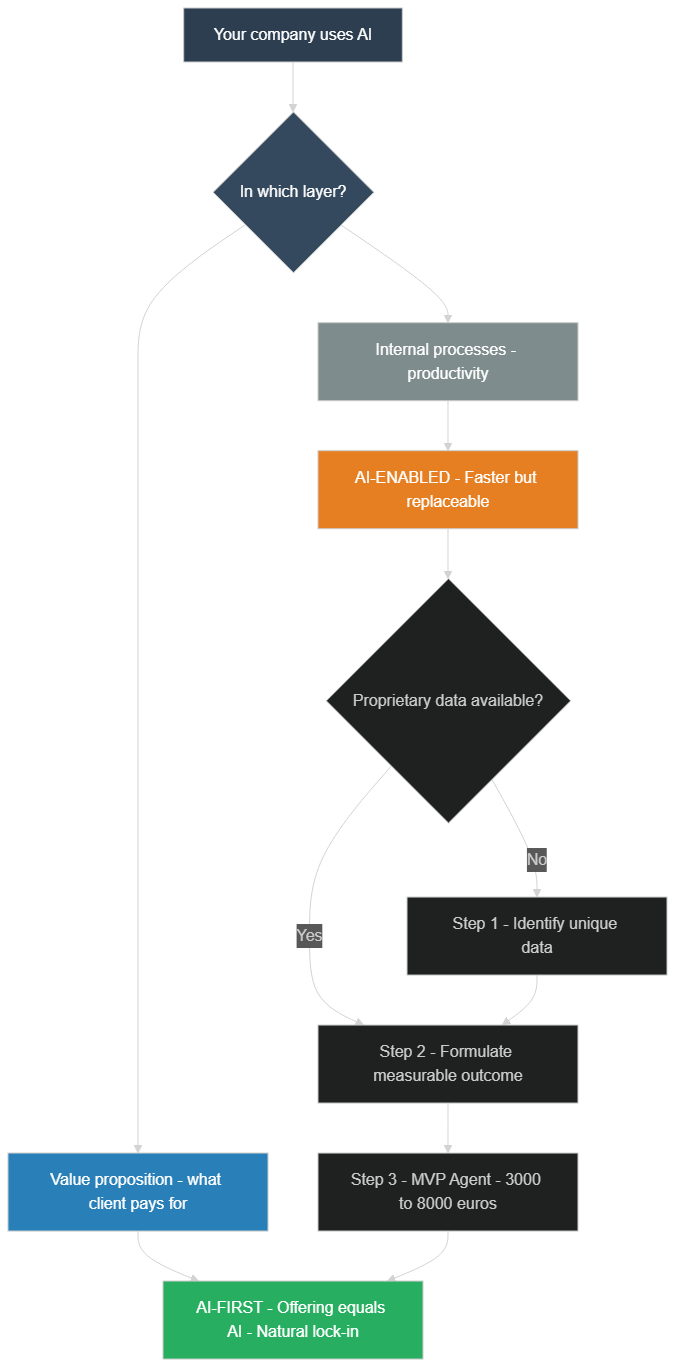 Diagnostic flowchart: how to determine whether your company is truly AI-First or simply AI-Enabled
The good news: avoiding AI washing isn't complicated. It simply requires honestly asking "if my AI stops tomorrow, does my offering stop?" If the answer is no, you're not yet AI-First — and that's a perfectly valid starting position. The problem isn't being AI-Enabled, it's claiming to be AI-First without being so.
How a non-tech SMB adopts an AI-First posture without rebuilding everything
Common perception holds that AI-First is reserved for tech startups, data-scientist-equipped scale-ups, or large corporations with comfortable R&D budgets. That's wrong. What we observe in the field — across sectors as diverse as legal consulting, construction, food distribution, and accounting services — is that SMBs of 10 to 50 people can build solid AI-First offerings within weeks, provided they follow the right method.
The key is not trying to "become a tech company." An SMB's AI-First transformation doesn't require hiring a developer team or setting up a complex data infrastructure. It requires three successive decisions, each accessible without deep technical skills.
First decision: identify a business process that generates structured, recurring data. All SMBs have processes that accumulate data without valorizing it: quotes and their conversion rates, client complaints and their typologies, delivery times by supplier, repurchase patterns. This raw data is the starting point for any AI-First offering. The work consists of identifying it, structuring it, and understanding what prediction or automation it would enable.
Second decision: formulate a measurable client outcome that AI can produce from this data. This isn't technical work — it's strategic and commercial work. An accounting firm that analyzes its last five years of client data can identify patterns that predict cash flow difficulties two months in advance. If that firm formulates its offering as "we detect cash flow risks before they become crises," it sells something its competitors don't offer — and for which its clients are willing to pay more.
Third decision: rely on a specialized technical partner rather than building everything in-house. An AI agent MVP targeted at a specific use case doesn't require six months of development or an internal team. With the right tools (n8n, LangChain, the major model APIs) and a partner who understands both the business domain and technical implementation, a first MVP can be operational in three to six weeks. Check our analysis of the ROI of AI agents in production in 2026 to calibrate your financial expectations.
The other challenge for non-tech SMBs is managing internal change. Introducing an AI agent into business processes can generate resistance — through fear of replacement, lack of trust in AI outputs, or simply habit with existing methods. The framing is crucial: the AI agent isn't there to replace employees, but to handle the volume of repetitive tasks that employees neither have time nor desire to do — freeing their capacity to focus on high-value decisions. Demonstrating with an example, starting with a first agent on a non-threatening case, is systematically more effective than a top-down announcement.
The indicators that prove your AI-First strategy is real
Once the MVP is deployed, how do you know whether you've genuinely built an AI-First offering or simply added an AI layer to your existing offering? There are six key indicators to monitor from the first weeks.
The first is client retention rate after three months. A well-built AI-First offering must achieve a retention rate above 90% after the third month of use. Below this threshold, perceived value doesn't justify the behavior change — meaning AI is probably not yet sufficiently integrated into what the client values.
The second is the measurable reduction in processing time on the targeted use case. If your AI agent is meant to accelerate a process, measure it before and after. A reduction of less than 40% on a repetitive process is generally insufficient to generate the client enthusiasm that leads to word-of-mouth and active recommendations.
The third is the NPS (Net Promoter Score) measured specifically on the AI feature. An NPS above 50 on a new feature is a strong signal that you've found something that genuinely resonates with your clients' needs.
The fourth is churn resistance during renewal negotiations. In a mature AI-First offering, clients who try to negotiate a price reduction spontaneously mention the risk of losing the data accumulated in the system. That's the sign the lock-in effect is working — not because you've made exit contractually difficult, but because the value accumulated over time is real.
The fifth is the reduction in client acquisition cost through word-of-mouth. Offerings that deliver differentiated value generate spontaneous recommendations. If your CAC (client acquisition cost) starts declining after 6 months without increasing your marketing budget, it means your clients are doing part of your sales work.
The sixth — and perhaps most important for validating the AI-First thesis — is the ability to identify and articulate your proprietary data. If your team cannot explain in two sentences what unique data your system exploits and why competitors cannot easily replicate it, your AI-First positioning isn't robust enough to survive serious due diligence.
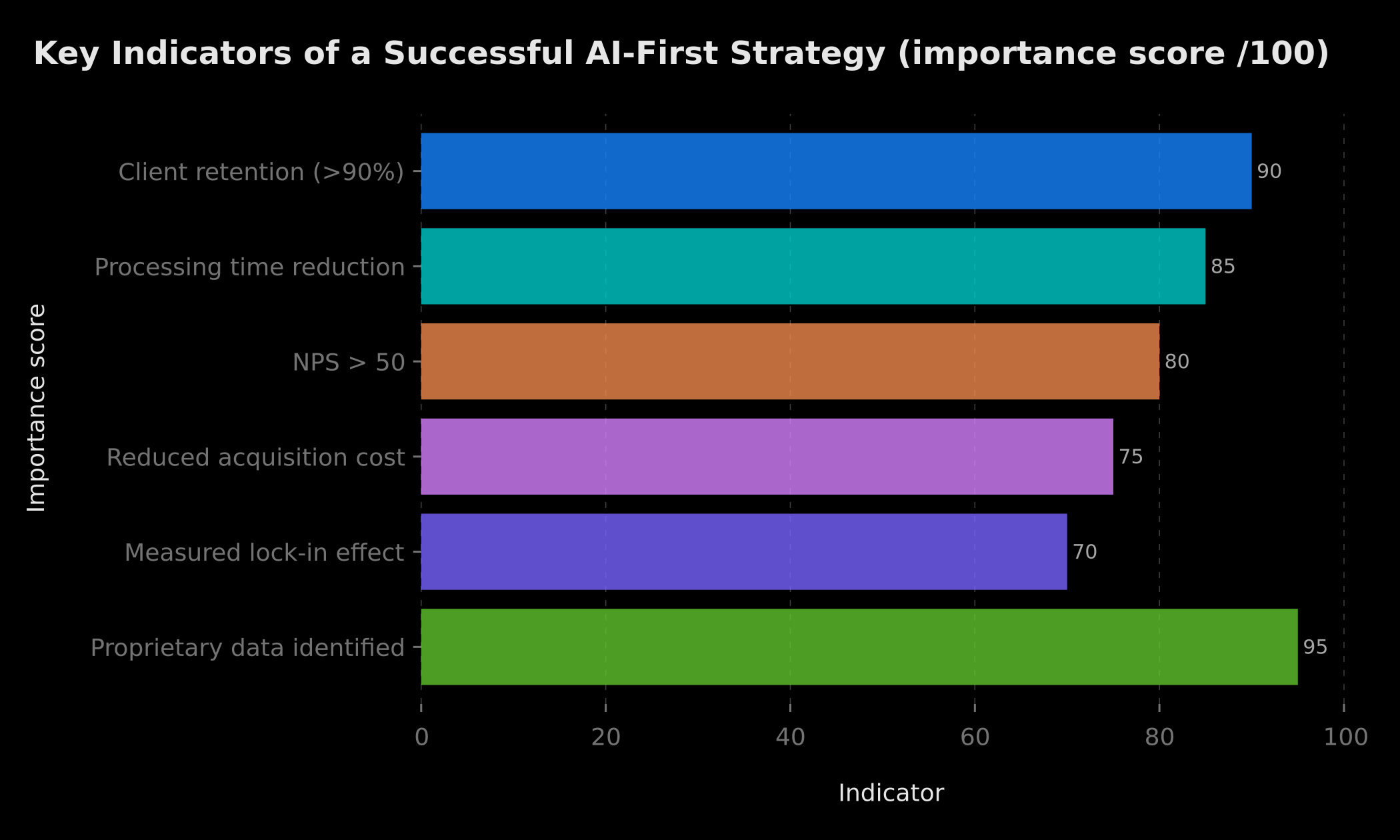 The 6 KPIs to monitor to validate an AI-First strategy: from proprietary data identification to client retention
The 3 niches exploding in 2026
If you're looking for where to position yourself, these three segments capture over 60% of new AI-First projects:
Predictive B2B AI: Churn prediction, demand forecasting, predictive maintenance. SMBs are realizing that the data they've been accumulating for years is gold if properly modeled. This segment is particularly attractive because ROI is directly quantifiable, which shortens sales cycles and facilitates adoption. For more on the economic model, read our analysis of the AI agent or freelance hybrid model.
Vertical Conversational AI: Not generic chatbots, but agents specialized in a precise domain (law, medicine, HR) with a proprietary document base. Sector precision is the differentiator. A conversational agent trained on five years of case law in a specific domain has nothing in common with a generic chatbot that hallucinates non-existent legal references.
Agentic Workflow Automation: Agents that don't just respond, but act — book, order, send, update. This segment benefits from the explosion of orchestration frameworks like n8n, which make implementation accessible to non-developer profiles. See our full article on how to transform your workflows with AI agents via n8n.
2027 Perspectives: where is the market heading
The trajectory traced by 2026 data points toward several predictable evolutions for 2027 and beyond. Understanding them now allows you to position your strategic investments with a head start.
The first underlying movement is the commoditization of generic agents. What is differentiating today — a conversational agent capable of answering client questions — will be a basic prerequisite in 18 months. Companies that haven't yet deployed this type of automation will be competitively behind. For those wanting to differentiate in 2027, the value frontier will be even further along the chain: agents that make autonomous decisions, not just those that answer questions.
The second movement is consolidation around proprietary data. The generic language model is becoming a commodity. What doesn't commoditize is the proprietary data on which it is fine-tuned or augmented. Companies that will have invested in structuring and enriching their data between 2026 and 2027 will be in a position of strength compared to those who waited.
The third movement is increasing regulation in Europe. The European AI Act is progressively entering into force, and its requirements for transparency, explainability, and traceability will weigh more heavily on players who built AI offerings without documentation or governance. AI-First companies that built rigorously — with logs, tests, human validation processes on high-stakes decisions — will naturally be compliant. Those who "added AI" opportunistically could face significant compliance costs.
How to concretely position your business in AI-First mode in 2026?
Repositioning your offering as AI-First isn't a 2-year project. It's a 6-to-12-week project if you have a technical partner who understands both strategy and implementation. What you've read in this article — VC criteria, sector patterns, validation indicators — forms the reading framework. What remains is applying it to your specific context, with your proprietary data, your sector, and your clients.
I help entrepreneurs make this transition — from offer formulation to the agent in production. Not to sell technology — to build something your clients won't be able to leave.
Want to evaluate whether your current offering can be repositioned as AI-First?
Discover our intelligent AI agent creation services — or explore Vicentia Bonou's profile to see how we combine the growth dimension with technical implementation. For the broader entrepreneurship vision, also read our article on digital entrepreneurship in 2025.
Tags
FAQ
What's the difference between an AI-Enabled and AI-First company?
An AI-Enabled company uses AI tools internally to be more productive (ChatGPT, Copilot, Notion AI). AI is in its processes. An AI-First company has AI in its value proposition — clients pay for what the AI produces or predicts. If AI stops, the offering stops.
Do you need to be a developer to build an AI-First offering?
No. The strategic steps (identifying your proprietary data, formulating the measurable outcome) require no technical skills. You need a technical partner for steps 3 and 4 (MVP agent building and integration). A targeted AI-First MVP budget is €3,000 to €8,000.
Why do 68% of funded startups in 2026 have AI at their core?
Because the cost of using AI has dropped 90% in 3 years, making these projects accessible to all business sizes. Simultaneously, investors understood that AI-First companies create natural lock-in effects that improve retention — translating to higher valuations.
How long does it take to reposition your offering as AI-First?
Between 6 and 12 weeks for a first functional MVP with a dedicated technical partner. Critical steps are defining the proprietary data (1 week), formulating the offering (1 week), and building the first agent (3-6 weeks depending on integration complexity).
Which sectors work best for an AI-First offering?
All sectors generating recurring data: e-commerce (purchase behavior), professional services (client history), healthcare (patient data), real estate (market data), HR (performance data). The key criterion isn't the sector but the availability of proprietary data your competitors don't have.
What is AI washing and how do you avoid it?
AI washing means adding AI mentions to your commercial discourse without AI being structurally at the core of your value creation. Experienced investors and clients detect it immediately during due diligence. To avoid it, ask yourself "if my AI stops tomorrow, does my offering stop?" If the answer is no, you are AI washing.
Can a traditional SMB become AI-First without rebuilding everything?
Yes. Repositioning doesn't require starting from scratch. It means identifying the business process that generates the most differentiating data, then building a first agent around that specific use case. The transformation happens in phases, with an MVP in 6 to 12 weeks, before progressively expanding the scope.
Which KPIs should you monitor to validate an AI-First strategy?
The six key indicators are: client retention rate above 90% after 3 months, measurable reduction in processing time, NPS above 50, reduced client acquisition cost, measured lock-in effect (clients resist switching), and clear identification of the proprietary data being exploited.
Budget, process, priorities — decided together
Website, chatbot, or automation? We pick the next job that unlocks cash, not the trendy stack.
- 30 min
- Clear priorities
- No commitment
Vicentia Bonou
Full Stack Developer & Web/Mobile Specialist. Committed to transforming your ideas into intuitive applications and custom websites.


