
AI Won't Replace You (The Automated Enterprise Will)
Everyone talks about AI as a threat. That's the wrong debate. While some panic, others build. Here's the mindset to adopt, 5 concrete levers to activate this week, and 3 BOVO Digital case studies proving that taking action now changes everything.

AI Won't Replace You (The Automated Enterprise Will)
AI doesn't decide. It doesn't innovate. It has no clients to convince, no relationships to nurture, no domain context to understand. What it does — very well, very fast — is execute the tasks you give it. So the real question is not "AI vs you". It's: do you know what to delegate to it?
Everyone is talking about AI as an existential threat.
Articles. Conferences. Doom-and-gloom LinkedIn posts. "Experts" predicting the end of salaried work in 18 months. "Experts" predicting the collapse of this or that profession. "Experts" selling €2,000 trainings to "help you survive AI".
This is the wrong debate.
And the worst part is that it paralyzes you. While you watch YouTubers debate whether GPT-5 will "change everything", there are people — exactly like you, same job, same industry, same constraints — who are taking action. Not with esoteric tools. Not with Google-sized budgets. With concrete solutions at €300, €2,000 or €3,000 that transform their business month after month.
This article is for you if you're stuck in extended observation mode. If you read a lot, watch a lot, but never act. I'm going to show you the real mindset to adopt, why the current AI debate is distracting you from what actually matters, and the 5 concrete levers you can activate this week to move from the camp of those who endure to the camp of those who build.
By the end, you'll have no excuse left for inaction.
The wrong debate: "Will AI replace my job?"
This is the question that sells books, fills conferences and boosts LinkedIn engagement. But it's also the question that helps no one.
Where does this apocalyptic framing come from?
Several converging sources fuel this narrative:
-
The media need anxiety-inducing headlines for clicks. "AI will destroy 300 million jobs" gets a hundred times more shares than "AI will boost productivity by 12% on average". Yet the second headline is the one backed by data (Goldman Sachs Global Macro Research, March 2026).
-
AI software vendors have an incentive to oversell. The more afraid you are, the more you buy their training, their subscription, their consulting. Fear is their business model.
-
Transformation consultants live off catastrophic narratives. If AI weren't "a threat to your company", you wouldn't need "AI transformation strategists" billing €200,000 per program.
-
Politicians weaponize the topic. Promising to "regulate AI" or "protect jobs from AI" has become a universal campaign argument.
-
Anxious thinkers (Yuval Harari, Geoffrey Hinton who left Google to "warn") have a genuine long-term concern. But their horizon is 10-50 years, not next year for your business.
Real numbers that contradict the dominant narrative
Here's what serious studies published between late 2025 and early 2026 actually say:
| Study | Main finding |
|---|---|
| Stanford AI Index 2026 | 71% of companies that deployed AI created more jobs than they eliminated |
| MIT Sloan / BCG 2025 | Companies with an AI strategy grow 2.5× faster than non-equipped competitors |
| McKinsey Global Institute 2026 | Jobs transformed (not eliminated) by AI represent 47% of the market; jobs truly threatened within 5 years: only 8% |
| OECD Future of Work 2026 | The real risk isn't unemployment, it's the productivity gap between AI-equipped and non-equipped workers (up to ×5) |
| Microsoft Work Trend Index 2026 | 78% of workers already use AI daily — but 60% without their employer knowing ("shadow IT" effect) |
Conclusion: AI doesn't replace humans. It replaces humans who don't use it, with humans who do. Crucial nuance.
Why this apocalyptic framing paralyzes you
The problem with the "existential threat" framing is that it produces exactly two reactions among entrepreneurs:
- Numbness: "It's too big, too fast, I don't get it, I'll wait and see how things evolve."
- Frantic over-consumption: "I need to subscribe to 12 AI newsletters, sign up for 3 trainings, watch 50 YouTube tutorials — without ever starting to build."
Both lead to the same place: inaction. And inaction in the face of a tech wave is exactly what separates the survivors from the disappeared.
History is clear on this. Retailers who refused the Internet in 1998 are gone. Agencies who refused Google Ads in 2008 are gone. E-merchants who refused Shopify in 2015 are gone. AI is exactly the same wave, only faster.
What AI really does well (and what it doesn't)
Before talking strategy, you need to understand what generative AI really is in 2026. Not the marketer's myth, not the media's monster. The technical reality.
What AI does WELL
1. Execute repetitive tasks at high speed
Sorting 5,000 emails. Classifying 10,000 comments. Rewriting 200 product sheets. Translating 50 pages into 12 languages. Where a human needs 3 days, AI needs 12 minutes. With no coffee breaks.
2. Synthesize information
Summarizing a 200-page report into 5 key points. Extracting sentiment from 1,000 customer reviews. Identifying patterns in 50,000 support tickets. AI doesn't have the cognitive fatigue you do after document #50.
3. Generate structured content
Article drafts. Email templates. Video script variations. Boilerplate code. Database schemas. AI is unbeatable on the first version of a deliverable you know exactly how it should look.
4. Detect patterns in data
Anomalies in accounting. Weak signals in sales. Suspicious behavior in logs. AI sees what you no longer see because there's too much data.
5. Hold conversations at scale
This is where AI chatbots and voicebots are game-changers. A human can hold 3 conversations per hour. An AI holds 3,000 simultaneously, 24/7, with no quality drop. That's exactly what we built for Régina, the 24/7 WhatsApp AI assistant who qualifies a client's prospects at 3 AM with no quality loss.
What AI does NOT (and won't for a long time)
1. Decide under radical uncertainty
Choosing whether to invest €50,000 into a new market. Making a strategic pivot. Firing a toxic big client. AI can give you analysis, but the decision rests on human judgment, domain intuition and values.
2. Innovate by disruption
AI combines what exists. It doesn't create an Airbnb, a Tesla, a Stripe. Disruptive innovation always comes from a human who sees what no one else sees.
3. Maintain a human relationship over time
Your loyal customers are not loyal to your product. They're loyal to YOU. To your voice on the phone when they have a problem, to your handshake when you meet them, to your personal story that moved them. AI augments the relationship; it doesn't replace it.
4. Understand your deep business context
Why did this client cancel? Because his wife just gave birth and he doesn't have headspace for your offer right now. AI doesn't know this. You do. And that detail changes everything.
5. Take responsibility
If AI gives bad advice that costs €100,000 to your company, who's responsible? You. Always you. AI is a tool. The tool doesn't sign contracts.
The practical consequence for you
This understanding changes everything. When you look at your work week, you can now break it into two columns:
| AI-compatible tasks | Incompressible human tasks |
|---|---|
| Sorting / classifying / summarizing | Strategic decisions |
| First-draft writing | Final validation |
| Standard FAQ responses | Complex conversations |
| Generating variations | Original creation |
| Massive data analysis | Contextual interpretation |
| Repetitive 24/7 follow-ups | Trust-based relationships |
The real question isn't "Will AI replace me?" but "What percentage of my week falls in the left column?" If you're an average entrepreneur in 2026, the answer is probably 40 to 60%. That 40-60% can be cut by 10x in time if you decide to act.
That's exactly where the gap widens between the two profiles I see at BOVO Digital.
The 2 profiles I see at BOVO Digital in 2026
I have two types of clients walking through BOVO Digital's door this year. They often have the same job, same age, same budget. But their mental posture is radically different. And in 3 years, they won't be in the same economic category at all.
Profile 1 — The Builder
The Builder arrives with a practical question.
"How do we integrate AI into what we're already doing? My team loses 15 hours a week on X. Can we automate that?"
The Builder doesn't wonder if AI will replace them. They consider it a tool, like Excel or Google. A tool to master, to integrate into their processes, and to put at the service of their business.
Typical traits:
- Has already tested ChatGPT personally (at least for a few weeks)
- Knows how to identify repetitive tasks that eat their time
- Has a calibrated budget — not extravagant, but realistic (€2,000 to €5,000 for a first project)
- Accepts a 4-6 week dev cycle
- Is ready to train the team to use what we build
- Thinks in ROI, not in buzz
Real examples of recent Builders at BOVO Digital:
→ A business coach who wanted his 500 students to have access to a personalized AI companion guiding them between sessions. Budget: €2,000 for the MVP. Timeline: 5 weeks. Today, his program completion rate jumped from 32% to 71%.
→ A 12-person real estate agency that wanted to automate inbound lead qualification 24/7. We deployed a Vapi voice agent that answers calls, qualifies on precise BANT criteria, and books appointments directly in the sales team's calendar. Full case study on Pierre, the Illico voice agent.
→ A fashion e-commerce that wanted to cut customer service response time by 3. We deployed a full RAG chatbot on 200 product sheets + FAQ + return policy. Today, 76% of tickets are handled automatically. Measured savings: €9,000/month.
Profile 2 — The Spectator
The Spectator arrives with a fear.
"Will AI make my business obsolete? Should I be worried?"
The Spectator doesn't really know what they're looking for. They read three articles this week on "how GPT-5 will change everything". They watched a webinar last week on "the end of marketing as we know it". They're worried, without acting.
Typical traits:
- Consumes massive amounts of AI content (newsletters, podcasts, YouTube)
- Has a ChatGPT account but uses it as a better Google, not as a production tool
- Can name 30 different AI tools but has deployed zero in their company
- Procrastinates: "I want to wait for the next version", "I want to see how the market evolves"
- Thinks in risk, not in opportunity
- When asking for a quote, compares 5 of them and ends up doing nothing for 6 months
The Spectator's tragedy is that they often have the resources to act (time, money, team). But fear paralyzes the decision. They become a passive consumer of AI content — exactly the profile that anxiety-mongering marketers monetize.
3-year projection: where will both end up?
Here's my honest prediction, based on what I see pass through BOVO Digital every week:
| Criterion | The Builder (Profile 1) | The Spectator (Profile 2) |
|---|---|---|
| Productivity per head | × 2 to × 4 | Flat or declining |
| Structural cost | -30 to -50% | Flat or rising (inflation) |
| Investment capacity | Surplus generated | Cash crunch |
| Net margin | × 1.5 to × 3 | Flat or compressed |
| Competitive position | Premium or price leader | Squeezed in the middle |
| Hiring | Junior AI-augmented | Increasingly difficult |
| Possible pivot | Yes (cash + agility) | No (red zone) |
Not because AI will "pick its favorites". Because some will have decided to act — while the others were waiting to see.
This is not a budget issue. A Builder can be a €50K-revenue solo entrepreneur investing €2,000 to automate prospecting. A Spectator can be a €5M PME failing to make an AI decision for 18 months.
This is not a company-size issue. It's a mindset issue.
The real question: "What should you delegate to AI?"
Once you accept that the Builder mindset is the right one, the operational question becomes: where to start?
Here's the method I systematically use with my clients when preparing an automation project at BOVO Digital.
The 4-quadrant matrix
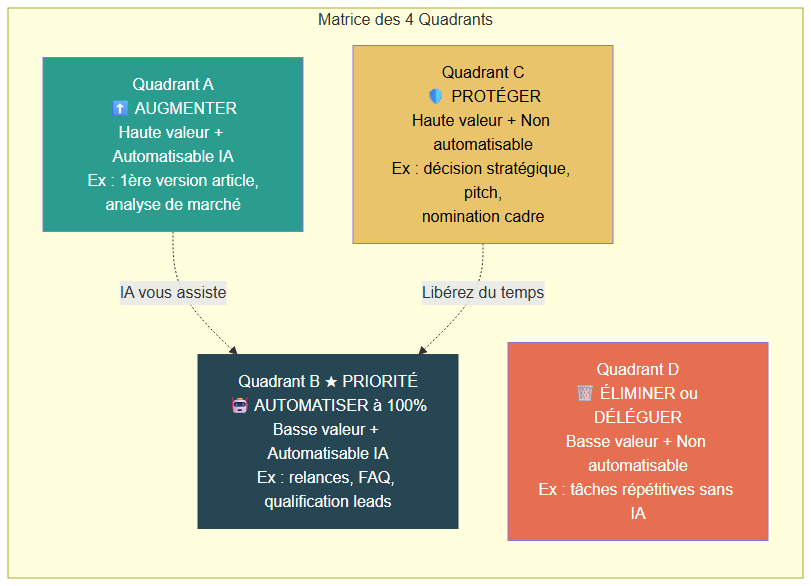 Quadrant B = automate as priority. Quadrant C = protect. Quadrant A = augment with AI. Quadrant D = eliminate
On a blank sheet, list every task you (or your team) do recurrently in a typical week. For each task, ask yourself two questions:
- Is this task high-value (strategic, creative, relational) or low-value (repetitive, mechanical, standardizable)?
- Is this task easily automatable by AI (yes / partially / no)?
You get a 4-quadrant matrix:
| High value | Low value | |
|---|---|---|
| AI-automatable | Quadrant A: augment (AI helps you do more, better) | Quadrant B: automate 100% (top priority) |
| Not automatable | Quadrant C: protect (your real added value) | Quadrant D: eliminate or delegate (junior, outsourcing) |
The priority quadrant: B
Quadrant B is your obsession for the next 6 months. These are the repetitive, low-value-add tasks you or your team still do manually, while AI could do them in the background, 24/7, error-free, fatigue-free.
Typical Quadrant B tasks among our clients:
- Following up abandoned carts on the site (email + SMS + WhatsApp)
- Answering the same 50 questions that every prospect asks
- Qualifying inbound leads before they reach the sales rep
- Generating product sheets from technical specs
- Sorting CVs to keep only the relevant 10%
- Summarizing customer feedback by complaint category
- Reminding before an appointment by SMS and WhatsApp
- Handling failed Stripe payments with automated dunning
- Posting variations of content on social networks
None of these tasks require your brain. Yet they consume 30 to 50% of an average entrepreneurial team's time.
The quadrant to protect: C
Quadrant C contains your strategic, creative, relational tasks that AI cannot (and won't for 10+ years) do for you:
- Closing a key client in person
- Making a strategic pivot
- Negotiating a partnership
- Recruiting an executive
- Designing a disruptive new offer
- Managing internal conflict
- Delivering a keynote or investor pitch
The more time you free up on Quadrant B with AI, the more you can invest in Quadrant C. That's exactly the growth lever we offer our clients.
The quadrant to augment: A
Quadrant A is subtle. These are high-value tasks that remain in your hands, but where AI augments you:
- Writing a strategic article → AI does the first draft, you polish
- Preparing an investor pitch → AI structures the arguments, you add the vision
- Analyzing a market → AI summarizes sources, you decide
- Designing a new product → AI generates variations, you pick
Here, AI is your gifted intern who never needs sleep.
The quadrant to eliminate: D
Quadrant D is what exhausts you without paying off. Repetitive low-value tasks that aren't automatable. Solutions: outsourcing (virtual assistant), pure stopping, or deep process redesign.
5 concrete levers to activate this week (with measured ROI)
Now that we're aligned on the method, here are 5 concrete levers I systematically recommend to my clients, ranked by speed of implementation and measured average ROI. You can activate one this week.
Lever 1 — Automate your multichannel sales follow-ups (email + SMS + WhatsApp)
The problem: 70% of your leads vanish into silence after a first contact. Abandoned cart never followed up. No-show never reminded. Email thread that just stops. You lose 30 to 50% of monthly revenue in silence.
The solution: a post-funnel automation system orchestrating follow-ups on email + SMS + WhatsApp across 3 waves, with behavioral scoring, failed payment recovery and pre-appointment reminders.
Average measured ROI:
- +15 to 25% of abandoned carts recovered
- +60 to 70% of failed Stripe payments recovered
- −60 to 75% of no-shows
- +20 to 35% of global funnel conversion
Starting budget: from €300 for a starter pack, €700 for the full multichannel system, €1,200 for the ecosystem with centralized dashboard. See our Sales Funnel Automation service.
Setup time: 5 to 21 days depending on option.
Case study: a business coach generating €60K/month deployed our Option 2 at €700. Over the next 3 months, monthly revenue jumped to €82K — that's +€22K/month from a €700 investment. ROI hit in 3 days.
Lever 2 — Deploy an AI chatbot on your website
The problem: your support is overloaded. Your prospects ask the same 50 questions. Your clients wait 6 hours for an answer at 10 PM. You lose sales because no one responds.
The solution: a RAG (Retrieval Augmented Generation) AI chatbot that answers from your documentation base — products, FAQ, terms, shipping — in 12 seconds instead of 6 hours.
Average measured ROI:
- 76% of support tickets handled automatically
- Average response time: from 6h to 12 seconds
- Cost per ticket: from €8 to €0.80
- Customer satisfaction: +17 points in 6 months
Starting budget: €2,000 for Starter (50 docs), €3,500 for Pro (unlimited RAG + WhatsApp), €5,000 for Enterprise (action-capable AI agent). Details in our AI Chatbot Quote 2026 or on the AI Chatbot Agency page.
Case study: a fashion e-commerce (1,500 daily visitors) spending €12,000/month on support staff deployed our Chatbot Pro at €3,500. Measured savings: €9,000/month. ROI hit in 6 days.
Lever 3 — Automate your prospecting (scraping + AI outreach)
The problem: your sales team spends 4 hours a day looking for prospects instead of selling. You bought a "10,000-contact list" that turned out to be 70% dead. Your pipeline is empty.
The solution: an automated lead generation system combining targeted web scraping (LinkedIn, Facebook, Google Maps, pro directories), verified pro email enrichment, persona-based segmentation, and multichannel outreach sequences (LinkedIn + cold email + WhatsApp).
Average measured ROI:
- 500 to 5,000 qualified prospects per month (vs 50-200 manually)
- 30-40% LinkedIn acceptance rate
- 4-10% cold email reply rate
- 2-5% qualified meetings (vs 0.5% from purchased lists)
Starting budget: €250 for the targeted base, €500 for full enrichment, €2,000 for the automated multichannel outreach system. See our Automated Lead Generation service.
Case study: a coaching agency doing 8 meetings/month (5% conversion = 4 sales at €2,500) deployed our Option 3 at €2,000. Three months later: 47 meetings/month, 12 sales — that's +€24,000/month for €2,000 invested.
Lever 4 — Deploy an AI voicebot to qualify your leads 24/7
The problem: 40% of your inbound calls land outside business hours or while your reps are busy. Every missed call = a potentially lost prospect.
The solution: a Vapi-based AI voice agent that answers calls in under 2 seconds, qualifies on a BANT matrix coded into its prompts, and books appointments directly in your team's calendar.
Average measured ROI:
- Pickup rate: ~100% (vs 60% historical with human teams)
- Full qualification in a single call
- Cost per qualified meeting divided by 3 to 4
- Unlimited scalability (1,000 simultaneous calls possible)
Budget: from €2,000 for the initial setup of a Vapi voicebot connected to your CRM (HubSpot, GoHighLevel, Pipedrive).
Case study: see the detailed study on Pierre, the Illico voice agent qualifying CPF training leads for a professional integration agency.
Lever 5 — Build your own personalized AI agent (companion, coach, assistant)
The problem: you want to offer your clients/students/users an AI experience aligned with your brand, your methodology, your tone, your universe. Generic ChatGPT isn't enough.
The solution: development of a responsive web app (Next.js + Supabase + OpenAI) with auth, persistent user memory, onboarding questionnaire, editable admin dashboard. Evolvable architecture ready for phase 2 (RAG on your documents, Stripe paywall, multi-agents).
Average measured ROI:
- 2× to 4× increase in program completion rate
- Strong differentiation vs competitors
- Creation of a tech asset usable across multiple offers
- Increased business valuation (tech asset)
Budget: from €2,000 for a functional V1 MVP in 4-5 weeks. Advanced modules (RAG, Stripe, multi-agents) in later phases from €500 each.
Case study: a golf coach launched his personalized AI companion for his 500 students. Investment: €2,000 in V1. 3-month result: program completion rate jumped from 32% to 71%, and re-subscription rate × 1.8.
The 5 traps to avoid when starting with AI
Now that you have the levers, let's talk about the classic mistakes that ruin AI projects. I've seen many among clients arriving at BOVO Digital after a failed first attempt elsewhere.
Trap 1 — Wanting to automate everything at once
The classic reflex: "As long as I'm paying a consultant, I might as well have everything done at the same time." Wrong. A successful AI project starts small, measurable, controlled.
Right reflex: a single lever in V1 (one chatbot, OR one post-funnel automation, OR one prospecting scraping). Measure ROI for 30-60 days. Then capitalize on success to move to the next lever.
Trap 2 — Underestimating the scoping phase
"Let's just start dev, we'll figure out scope along the way." Guaranteed disaster. The scoping phase (audit, ICP, system prompts, scenarios) represents 20-30% of total project time. Skipping it means delivering a system that doesn't match your real need.
Right reflex: require a proper audit before any dev kicks off. At BOVO Digital, we systematically start with 30 minutes of free scoping via ComeUp messaging, because there's no good automation without a good audit.
Trap 3 — Choosing closed no-code tools
ManyChat, Tidio, Crisp, ChatBase, Voiceflow. These tools are seductive: graphical interface, "no code", fast deployment. But after 6-12 months, you're paying €200-500/month in subscriptions, you don't control your data, and you can't customize beyond what the platform allows.
Right reflex: favor open-source or self-hosted architectures (n8n, Supabase, real OpenAI/Anthropic APIs) which are 3 to 5 times cheaper in recurring costs and 100% under your control. If you switch agencies or providers, you walk away with your code and your data.
Trap 4 — Not measuring ROI
"We installed AI, it seems to work." Not enough. Without precise metrics (revenue recovered, time saved, tickets handled), you'll never know if the investment is profitable. And you won't know which lever to accelerate or drop.
Right reflex: define 2-3 precise KPIs BEFORE the dev, and require a tracking dashboard at delivery. Every lever we deploy at BOVO Digital systematically includes quantified tracking.
Trap 5 — Forgetting the human in the loop
AI is a tool. The tool should never be left fully autonomous, especially on sensitive subjects (complaints, legal decisions, medical advice, incident management).
Right reflex: systematically plan an escalation mechanism to a human when the AI detects it's outside its competence zone. A good AI chatbot is one that knows when it doesn't know, and transfers intelligently.
BOVO Digital case studies: clients who made the switch
To make all this concrete, here are three real clients who moved from "Spectator" to "Builder" profile in a few months. With their actual numbers.
Case 1 — Régina, the 24/7 WhatsApp AI assistant
The client: a consulting firm specialized in rental real estate, 6-person team, 200 inbound prospects per month from Facebook Ads.
The problem: prospects left their number at 10 PM, 1 AM, on weekends. The team called back on Monday. Conversion was catastrophic (12% → meeting).
The solution: deployment of Régina, a 24/7 WhatsApp AI assistant qualifying prospects in real time, sending personalized quotes, and answering 80% of FAQ without human intervention.
The result:
- Prospect → meeting conversion went from 12% to 41% (in 90 days)
- 30 additional meetings per month on average
- Customer satisfaction rate: 91%
- Human time saved: 18h/week
Investment: €3,500 (Chatbot Pro). 6-month measured return: +€180,000 in additional revenue.
Read the full study: Régina — 24/7 WhatsApp AI Assistant.
Case 2 — Pierre, the Vapi voice agent for training lead qualification
The client: a professional integration agency placing CPF / Pôle emploi trainings, 800 inbound calls/month, 4-person sales team.
The problem: 60% of calls landed outside operating hours or while all reps were busy. Estimated lost prospects: 350 per month.
The solution: deployment of Pierre, a Vapi voice agent indistinguishable from an experienced human sales rep, capable of qualifying on a BANT matrix, analyzing funding options (CPF, Pôle emploi, OPCO), and booking meetings in real time in the GoHighLevel CRM.
The result:
- Pickup rate: 100% (vs 60% historical)
- Full qualification in a single call (vs 2-3 callbacks previously)
- Cost per qualified meeting divided by 4
- Ability to absorb seasonal peaks with no overhead
Investment: €4,800 (complete Vapi project with GoHighLevel orchestration). Measured return: equivalent to 2 additional full-time sales reps, with no payroll.
Read the full study: Pierre — Vapi Voice Agent.
Case 3 — Multichannel automated funnel with AI qualification
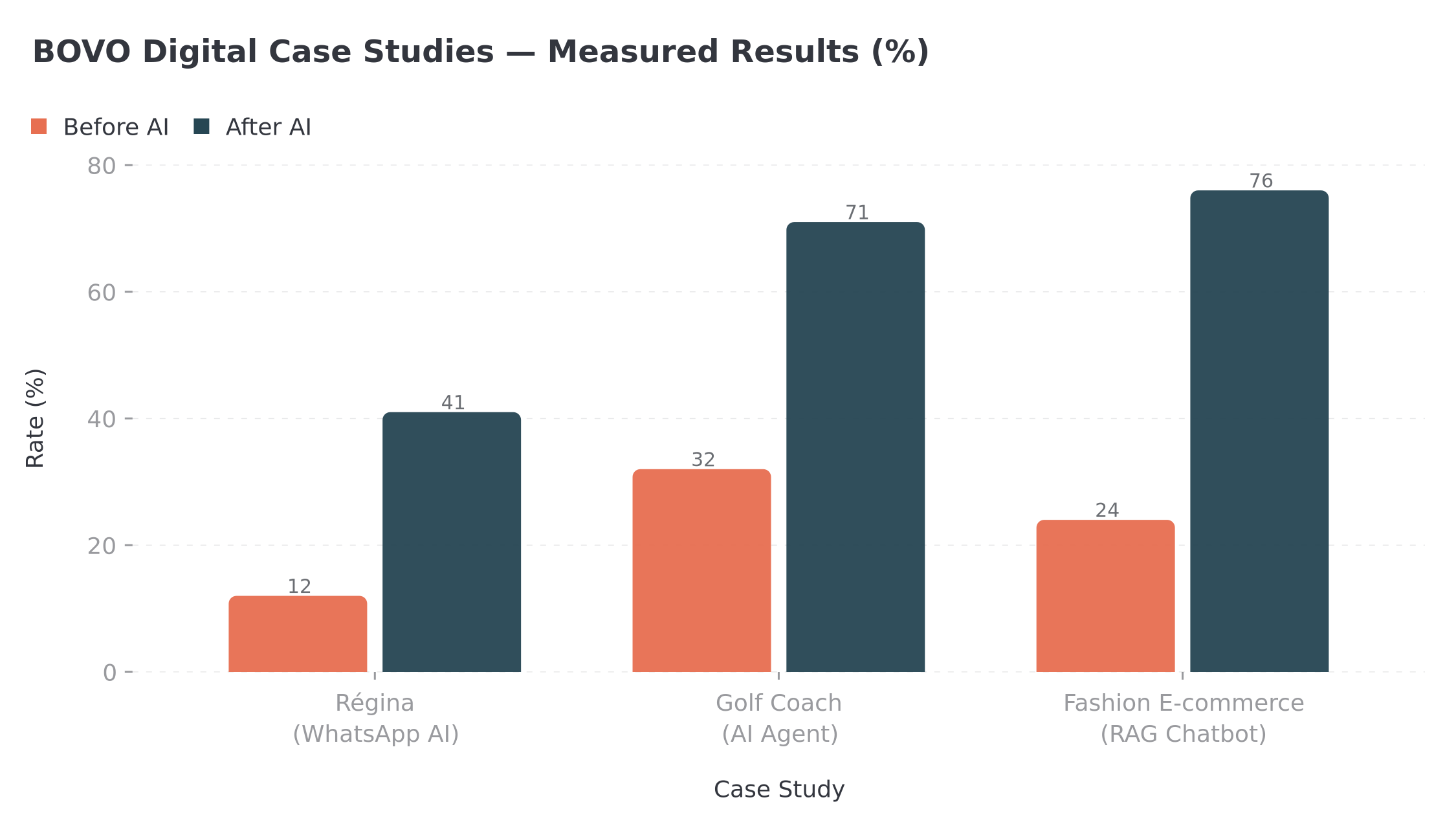 Conversions before and after AI deployment: Régina 12%→41%, Golf coach 32%→71%, E-commerce 24%→76%
The client: a business coach with a Systeme.io sales funnel, 1,200 inbound leads/month, 1 closer + 1 SDR team.
The problem: between the "Book my call" click and the signature, 25-30 actions had to be done manually (follow-ups, reminders, closer briefing, no-show recovery, etc.). The team was overwhelmed.
The solution: deployment of a complete post-funnel automation system, orchestrated by Make.com, combining AI chatbot qualification, multichannel WhatsApp + SMS + email follow-ups, automated Calendly booking, pre-meeting reminders, and automated weekly closer reporting.
The result:
- Lead → meeting conversion: +43%
- No-show rate: −68%
- In-meeting signature rate: +21%
- Human time saved: 25h/week
Investment: €1,200 (Centralized Ecosystem Enterprise). 6-month measured return: +37% in monthly revenue.
Read the full study: Multichannel automated funnel with AI qualification.
The Builder's mindset in 5 questions
If you want to test your own mindset right now, ask yourself these 5 questions honestly:
Question 1 — Which task is consuming the most time this week for you or your team?
List it. Be precise. "Answering client emails" → too vague. "Answering 80 daily emails on quote requests, shipping, returns" → useful.
Question 2 — Is this task creative or repetitive?
If you can describe the process in 5-10 repeatable steps, it's probably repetitive. Therefore automatable.
Question 3 — How much does this task cost you today (in € or time)?
Do the honest math. If an employee at €35K/year spends 30% of their time on this, it costs you ~€10,500/year + payroll taxes. So ~€16,500/year fully loaded.
Question 4 — How much would automating it cost at BOVO Digital?
Based on the levers above: between €300 and €3,000 in initial setup, + €20 to €200/month recurring costs.
Question 5 — When are you going to start?
If the answer is "later", "when the market stabilizes", "when I have more visibility", you're in the Spectator profile. If the answer is "within the month", you're in the Builder profile.
Fractional Ops: Delegating AI Integration to Stay Competitive
The theory is appealing, but in practice, integrating AI into your business processes requires technical expertise (n8n, APIs, RAG) that you don't have time to master. This is where the "Fractional Ops" (Fractional Operations Director) model comes in. Rather than hiring a full-time AI engineer or tinkering on weekends, you delegate the construction and maintenance of your autonomous agents to a specialized team.
Take Action: Automate Your Business with BOVO
While your competitors are wondering if AI will replace them, get ahead. BOVO Digital acts as your technological right hand (Fractional Ops). We design, deploy, and maintain your custom n8n automation systems and AI agents. Book a meeting to audit your processes and identify profitability levers.
Conclusion: build or endure — you choose
AI is not going to replace you. That's not the right question.
But someone who knows how to use it better than you, yes.
That someone could be your direct competitor who installed a chatbot while you read articles about ChatGPT. It could be a new entrant who launches in 2026 "AI-native" with a structure 3× lighter than yours. It could be your former employee who went independent with an automated outbound system while you paid 3 sales reps.
Either way, the outcome is the same: if you don't deploy an AI strategy in your business in 2026, you won't survive 2028. Not because you'll be "replaced". Because you'll be uncompetitive on cost, speed and customer experience.
This is not a budget question. At €300, you can already automate your sales follow-ups and recover 15-25% of monthly revenue.
This is not a company-size question. A solo entrepreneur can deploy an AI chatbot as easily as a 50-person SME.
It is only a question of mindset.
Are you building — or enduring?
If you want to switch to the Builder camp, here's your concrete roadmap:
- Identify 1 task in Quadrant B of your matrix (high value, automatable)
- Request a free audit via ComeUp messaging or directly at BOVO Digital (30 min, no commitment)
- Start small: a single lever in V1, €2,000 to €3,000 initial budget
- Measure ROI for 30-60 days
- Capitalize: move to the next lever once the first one is profitable
Article by William Aklamavo, founder of BOVO Digital. I have personally audited 200+ AI projects in 2025-2026 and delivered 100+ AI automation systems for French-speaking entrepreneurs. This article is my manifesto: there is a clear, accessible and profitable path to integrate AI into your business. The only thing missing is the decision.
👉 Next concrete step: Request a free BOVO Digital audit — 30 min via ComeUp messaging to identify your priority Quadrant B and price the solution.
Tags
FAQ
Will AI really replace my job in 2026?
No, unless you refuse to integrate it. Stanford AI Index 2026, McKinsey and OECD studies converge: only 8% of jobs are threatened within 5 years. The real risk is the productivity gap (up to ×5) between AI-equipped and non-equipped workers. AI doesn't replace humans: it replaces humans who don't use it, with humans who do.
Where do I start if I've never integrated AI into my business?
Three steps: 1) List your weekly repetitive tasks. 2) Identify Quadrant B ones (high value + AI-automatable): sales follow-ups, client FAQ, prospecting, lead qualification. 3) Start small with a single lever at €300-1,000 (multichannel follow-up, AI chatbot, prospecting scraping) and measure ROI over 30-60 days before moving to the next.
How much does a first AI automation cost at BOVO Digital?
Between €250 and €3,000 depending on the lever. Automated lead generation: €250-1,000. Post-funnel automation (email/SMS/WhatsApp): €300-1,200. AI chatbot on website: €2,000-3,000. Vapi voicebot: from €2,000. Personalized AI companion: €2,000 for an MVP. Plus €20-200/month in recurring costs (OpenAI, hosting, third-party tools).
What's the difference between 'using ChatGPT' and 'integrating AI into your business'?
Using ChatGPT = you manually run queries one by one, like an upgraded calculator. Integrating AI into your business = AI runs in the background 24/7 inside your processes: it recovers abandoned carts at 3 AM, qualifies leads while you sleep, handles 76% of support tickets without you. It's the difference between buying a hammer and installing a production line.
How do I avoid the 5 classic AI project traps?
1) Don't try to automate everything at once: start with one lever, measure 30-60 days, then chain. 2) Don't skip scoping: 30 min audit before any dev. 3) Avoid closed no-code tools (ManyChat, Tidio) costing €200-500/month and locking you in: prefer open-source (n8n, Supabase, real APIs). 4) Measure ROI with 2-3 precise KPIs defined BEFORE the project. 5) Keep a human in the loop for sensitive cases (automatic escalation).
What concrete results can I expect by integrating AI into my business?
On 100+ projects delivered by BOVO Digital since 2023, average 6-month gains: post-funnel automation = +20-35% funnel conversion, +15-25% abandoned carts recovered, +60-70% failed payments recovered. AI chatbot = 76% of tickets handled automatically, cost per ticket divided by 10 (from €8 to €0.80). Vapi voicebot = 100% pickup rate vs 60% with human teams. Automated lead generation = ×5 to ×10 qualified prospects per month.
Can AI really save me time, or is it just a buzzword?
On BOVO Digital clients, measured time savings range from 15 to 30 hours per week depending on the lever deployed. A WhatsApp AI assistant like Régina frees up 18h/week for the real estate firm using it. An automated post-funnel system frees up 25h/week for the business coach who deployed it. A RAG chatbot on a website frees up 30h/week for the e-commerce using it. Freed time is then reinvested into strategic Quadrant C tasks (key client relationships, pivot, hiring).
Budget, process, priorities — decided together
Website, chatbot, or automation? We pick the next job that unlocks cash, not the trendy stack.
- 30 min
- Clear priorities
- No commitment

William Aklamavo
Web development and automation expert, passionate about technological innovation and digital entrepreneurship.


