
AI Chatbot Quote 2026: The True Price of a Custom Agent (B2B)
How much does a custom AI chatbot really cost in 2026? Transparent breakdown: ChatGPT, Claude, RAG, hosting, integrations. With actual French agency prices.

Updated

AI Chatbot Quote 2026: The True Price of a Custom Agent (B2B)
Companion page. The 2026 pricing reference, with method and documented cases, is Custom AI chatbot pricing. This page is how to read a quote, line by line.
"How much does an AI chatbot cost?" — that's the first question we get every week at BOVO Digital. And when you ask for an AI chatbot quote, confusion is total: one vendor quotes €400, another €18,000, for what looks like the same need.
The honest answer: between €2,000 and €30,000. The range is wide because needs vary enormously. A FAQ chatbot for a brochure website has nothing in common with a conversational AI agent that takes orders and connects to your ERP.
In this article, I'll give you the exact cost breakdown of a 2026 AI chatbot, the real line items of a quote, and the traps to avoid when comparing proposals. Every figure quoted is an indicative range dated June 2026: it helps frame a decision, not lock a firm price.
By the end, you'll know if you're paying a fair price or getting ripped off.
The 4 levels of AI chatbots in 2026
Not all chatbots are equal. Before talking money, you need to understand what you're buying. An AI chatbot quote only makes sense relative to a precise complexity level. Here's the typology we use to qualify requests:
Level 1 — Simple FAQ chatbot (€300 - €1,500)
- Answers 20-50 predefined questions
- No memory, no RAG
- Website integration only
- Model: GPT-4o-mini or Claude Haiku
Use case: brochure sites, small e-commerces, associations. Limited but largely sufficient for 60% of sites. At this level, the risk isn't overpaying: it's buying a gadget that only answers half of your customers' real questions.
Level 2 — Enterprise RAG chatbot (€2,000 - €3,500)
- Answers from your document base (PDFs, web, FAQ, emails)
- Vector database (Pinecone, Qdrant, Weaviate)
- Multi-channel possible (website + WhatsApp or Telegram)
- Model: GPT-4o, Claude Sonnet 3.5
This is the most demanded level in 2026 — what we deliver in 70% of our chatbot projects. The major difference from level 1 is three letters: RAG. The chatbot no longer recites a script, it fetches the answer from your documents, which radically changes perceived quality.
Level 3 — Conversational AI agent with actions (€3,000 - €10,000)
- The bot can act: take an order, create a ticket, book an appointment
- ERP/CRM integration (HubSpot, Salesforce, Pipedrive)
- Per-user memory (persistent conversations)
- Multi-LLM with fallback (Claude + GPT-4 + open-source)
For serious companies that genuinely want to automate customer service. Here you no longer pay only for "conversation" but for integrations and reliability: every action triggered in a third-party system must be tested, secured and traced.
Level 4 — Voicebot or complete AI agent (€10,000 - €30,000)
- Real-time voice response (Vapi, Retell AI)
- Multi-language (FR, EN, ES, AR, etc.)
- Complete analytics dashboard
- Guaranteed SLA, 24/7 monitoring
Reserved for companies with >500 tickets/day and an actual call center to replace. At this level, the quote looks more like a software spec than a chatbot service.
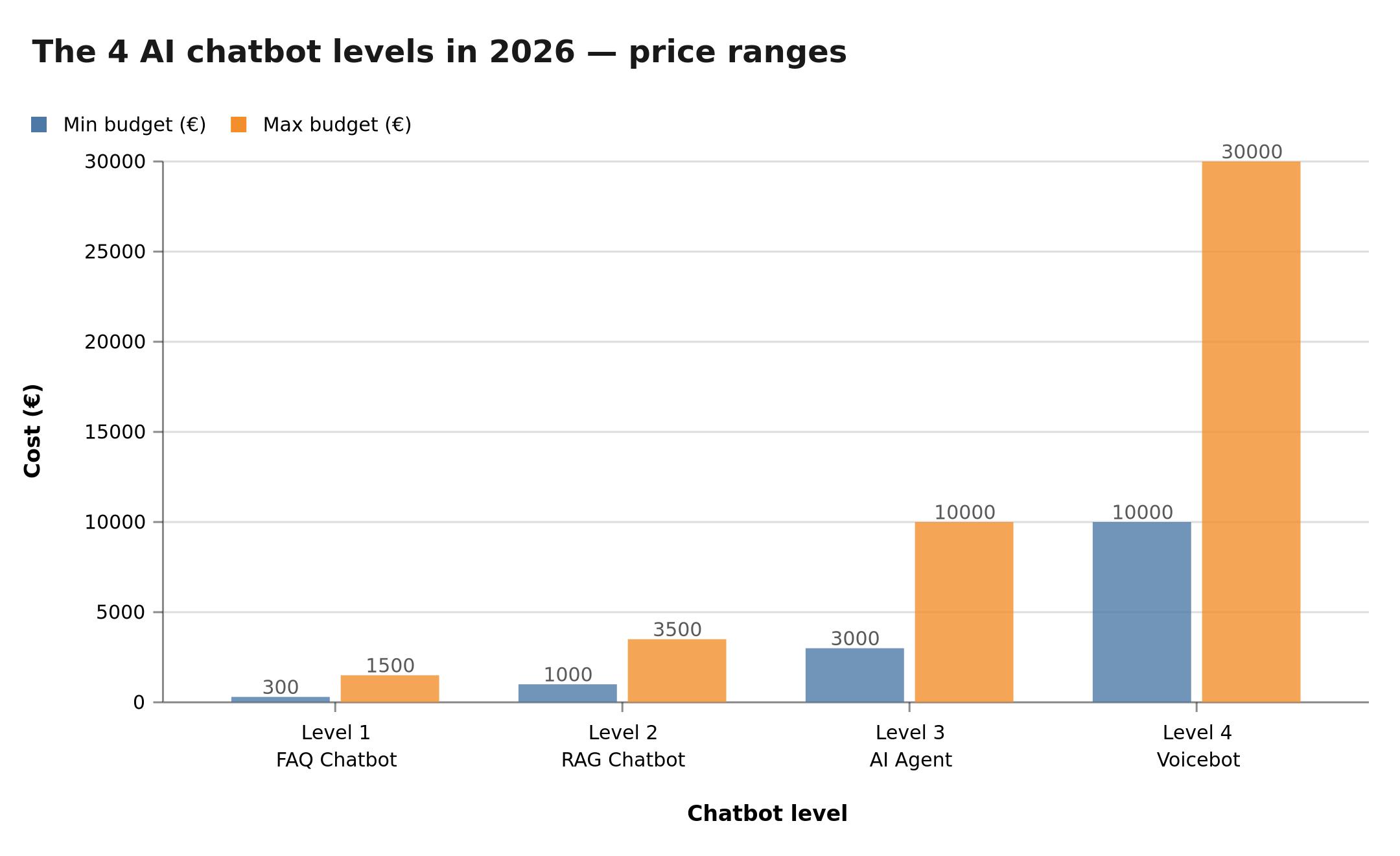 Comparison of 4 AI chatbot levels in 2026: simple FAQ, enterprise RAG, AI agent, and voicebot
The 8 line items of an AI chatbot quote, decoded
A good AI chatbot quote never boils down to one global price. It lists line items, each matching real work. If a proposal gives you a single number with no detail, that's already a red flag. Here are the eight line items that structure almost every project we run, from simplest to most complex.
1. Scoping and needs analysis
Before the first line of code, you have to understand who the bot talks to and what it must solve. We audit your FAQs, your support tickets, your conversion goals. This item feels intangible, but it's the one that prevents paying for the same project three times: a sloppy scope means a chatbot that answers off-target. Count 5 to 15% of the total budget.
2. Conversation design
Conversation design is writing the bot's behavior: brand tone, handling silences, phrasing of follow-ups, error messages, hand-off points to a human. A technically perfect but cold or clumsy chatbot drives people away. This item, often underestimated in low-cost quotes, makes all the difference between a bot people tolerate and one they enjoy.
3. Knowledge base and RAG
This is the heart of a business chatbot. We ingest your sources (product sheets, T&Cs, web pages, PDFs, template emails), chunk them, vectorize them and index them in a database (Pinecone, Qdrant, Weaviate). The bulkier and more heterogeneous the material, the heavier this item. It also drives the truthfulness of answers: without clean RAG, the bot improvises.
4. Integrations (site, messaging, CRM)
A widget on your site is quick. Connecting WhatsApp Business via Meta's Cloud API, Telegram, Slack or a CRM takes more effort. And if your internal tool has no standard API, the connector becomes custom development. Always ask for the precise list of included integrations: this is where price gaps between quotes widen the most.
5. Development and prompt engineering
This is the technical assembly: conversation logic, system prompts, guardrails, context management, response unit tests. Prompt engineering isn't "writing three sentences": it's iterative work to get a bot that stays in role, doesn't hallucinate and respects your business rules.
6. Testing and QA
We simulate dozens of real scenarios, hunt for wrong answers, measure resolution rate. An untested chatbot is a reputational time bomb. Beware of quotes where this item appears nowhere: it usually means QA will happen… on your customers in production.
7. Deployment and team training
Putting the bot live, configuring monitoring, and above all training your teams to supervise it: reading conversations, taking over, enriching the base. A chatbot lives with humans behind it. Half a day of training saves weeks of frustration.
8. Maintenance and recurring costs
The initial quote isn't the end of the story. Your catalog changes, prices move, LLM models evolve. Maintenance and inference costs (tokens) are a line item in their own right, detailed below. A good quote mentions it explicitly, even if billed separately.
 The 8 steps of building an AI chatbot quote: scoping, conversation design, knowledge base, integrations, development, testing, deployment and maintenance
AI chatbot quote breakdown — real example
Let's take a concrete case I handled recently: a fashion e-commerce with 200 products, 1,500 daily visitors, who wants a chatbot to answer size/delivery/returns questions.
This is a classic Level 2. Here's the breakdown of the BOVO Digital quote at €3,500 (Chatbot Pro):
| Item | Cost | Detail |
|---|---|---|
| Analysis & scoping | €400 | 2h audit of FAQs, support tickets, conversion goals |
| Document ingestion (RAG) | €600 | Site crawl + 200 product sheets + FAQ + T&Cs |
| Vector DB architecture | €400 | Pinecone (free tier) or self-hosted Qdrant |
| Prompt engineering | €800 | Optimized FR prompts, brand tone management |
| Site integration (widget) | €400 | Responsive JS widget, opened from floating button |
| WhatsApp Business integration | €450 | Meta Cloud API, client toll-free number |
| Analytics dashboard | €250 | Logged conversations, CTA clicks, human escalation |
| Team training + docs | €200 | 3h session + user manual |
| Total fixed package | €3,500 | Delivered in 2-3 weeks |
Visualized as bars, you immediately see where the budget goes: prompt engineering and document ingestion concentrate most of the effort, because they determine the bot's final quality. Integrations come next.
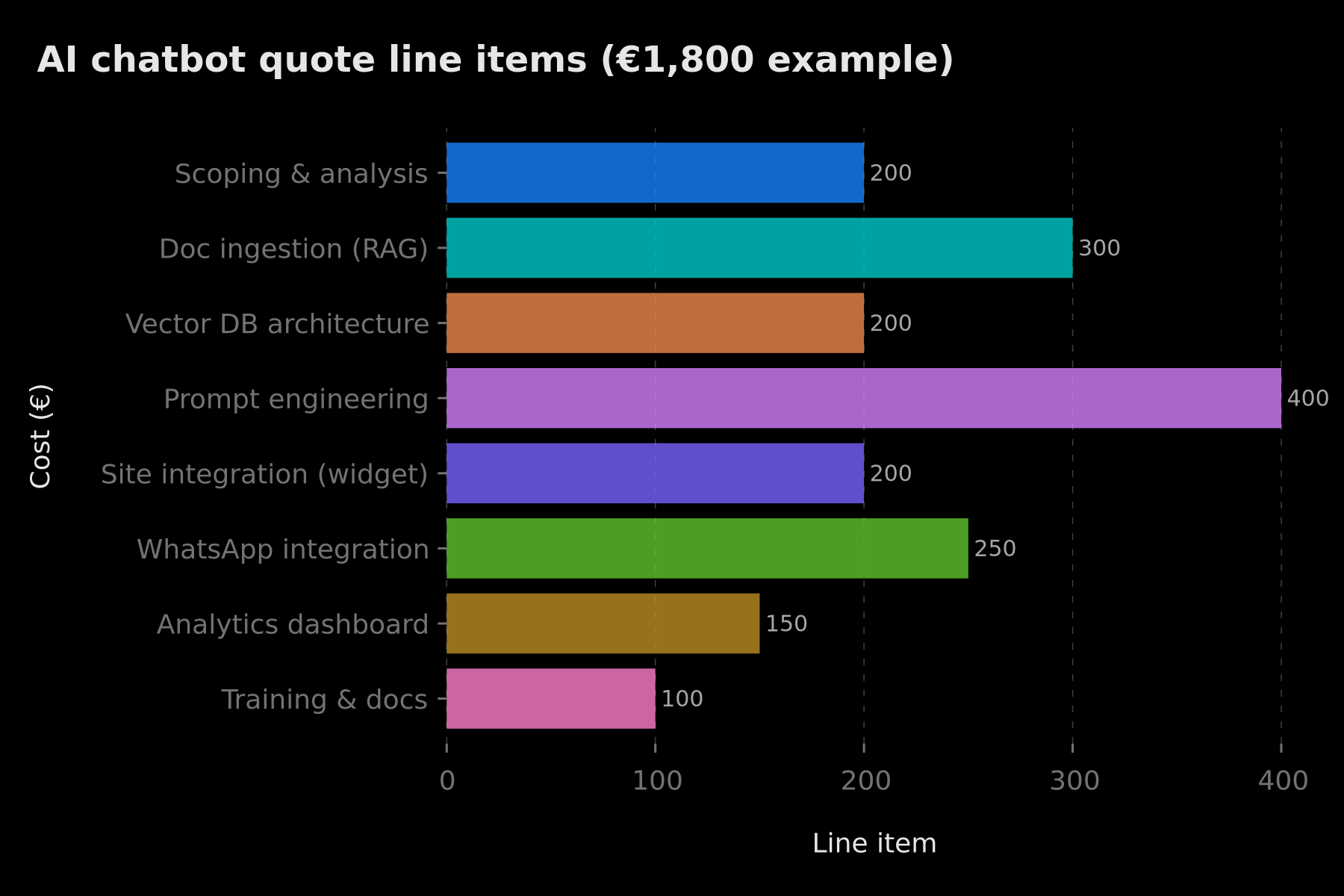 Euro breakdown of the 8 line items of an €3,500 AI chatbot quote: prompt engineering and RAG ingestion concentrate most of the budget
Alongside that, monthly recurring costs:
- OpenAI or Anthropic API: €20 to €80/month (depending on volume)
- Pinecone: €0 (free tier) to €70/month
- Widget hosting: €0 (Vercel free tier)
- Monthly total: €20 to €150/month depending on traffic
These orders of magnitude are dated June 2026 and depend on pricing that evolves. For a broader view of custom build prices, read our dedicated breakdown: the price of a custom AI chatbot in 2026.
ChatGPT or Claude: which model for which budget?
The question comes up constantly: do you need a ChatGPT chatbot or a Claude chatbot? The truth is there's no "best model" in absolute terms. There's a best model for your use case and your budget. And that choice directly impacts the recurring cost of your AI chatbot.
Model families and their pricing logic
At OpenAI as at Anthropic, you find the same three-tier logic:
- Light models (GPT-4o-mini, Claude Haiku): fast, very cheap per million tokens, perfect for high volumes of simple questions.
- Mid-tier models (GPT-4o, Claude Sonnet): the best quality/price compromise for an enterprise RAG chatbot. Our default choice.
- High-end models (Claude Opus, OpenAI reasoning models): excellent for complex reasoning and nuanced answers, but noticeably more expensive per token. Reserved for cases that justify it.
Price is counted per million tokens, separately for input (your question + context) and output (the answer). Output usually costs more than input. These rates change regularly: always refer to the official pages OpenAI Pricing and Anthropic Pricing before locking a budget.
How to decide in practice
Our decision rule holds in three questions: expected writing quality, monthly volume, and need for actions (tools, APIs). The diagram below summarizes the logic we apply during scoping.
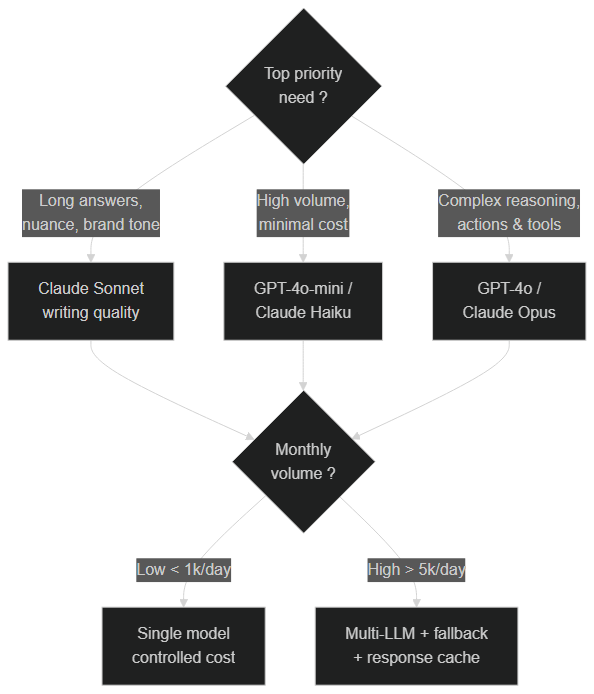 LLM model selection logic for a chatbot: Claude for nuance, mini models for volume, high-end models for reasoning, multi-LLM for high volumes
In practice, many of our serious chatbots run multi-LLM: a primary model, and a second as fallback if the first is unavailable or if the answer doesn't reach a confidence threshold. This improves availability without blowing up the bill, provided you cache recurring answers. To see this logic applied to a concrete channel, our WhatsApp chatbot tutorial with n8n and Claude in 30 minutes shows how to plug Claude into WhatsApp step by step.
Recurring costs: understanding the token bill
This is the point low-cost quotes systematically "forget". LLM inference cost is proportional to usage: the more your chatbot is used, the more it costs. And at high volumes, this bill can exceed the initial development cost within months.
An order-of-magnitude calculation
Take a chatbot processing 1,000 conversations/day with a GPT-4o model (not mini), estimating 4,000 input tokens and 600 output tokens per exchange, on an illustrative rate of $0.01/1k input tokens and $0.03/1k output tokens:
- Input: 1,000 × 4,000 × ($0.01/1k) = $40/day
- Output: 1,000 × 600 × ($0.03/1k) = $18/day
- Total: $58/day ≈ $1,740/month
Now, the same volume with a light model (GPT-4o-mini or Claude Haiku), far cheaper per token, drops this bill by a factor of 10 to 20. Hence the critical importance of model choice. These figures are orders of magnitude dated June 2026: always check the rates in effect.
The three levers to control the bill
- The right model for the right use: no need to pay for Opus to answer "what are your opening hours?".
- Caching frequent answers: 30% of questions are often the same; caching them avoids re-paying the LLM each time.
- The size of the context sent: a well-tuned RAG only sends the useful passages, not your entire catalog on every message.
At BOVO Digital, we systematically start by estimating this monthly cost and picking the right model based on your volume — before you sign.
The real hidden costs agencies don't mention
Beyond tokens, several items escape rushed quotes. Knowing them avoids nasty surprises in month two.
1. Evolutionary maintenance (~€150-300/month after delivery)
Your catalog changes, prices move, T&Cs evolve. The chatbot must follow. Without maintenance, in 6 months your bot becomes obsolete and gives wrong information.
Our approach: all our packages include 30 to 90 days of support correcting initial defects. For long-term evolutionary maintenance, we offer per-unit contracts at €150-300/month (separate order). It's a different order — not a mandatory "included" maintenance bloating the initial quote.
2. Stack integration costs
If your CRM is HubSpot, the connection is quick (n8n + native node). If it's a custom ERP built in 2014, count on +€500 to €2,000 of specific effort to build the connector. To grasp the power of n8n orchestration behind a chatbot, see how to turn your workflows into intelligent systems with an n8n AI agent.
Always ask which integrations are included in the quote.
3. Security, the item discovered too late
A chatbot connected to your data is also an attack surface. Prompt injection, leakage of sensitive data, uncontrolled access to internal tools: these risks cost dearly when handled after the fact. A poorly secured free template can cost you a fortune — we put a number on it in our analysis a free template that costs €24,700 in chatbot security. A serious quote covers, even briefly, the security question.
4. Post-delivery marketing additions
Want to add lead tracking in your CRM? Newsletter integration? Real-time shipping cost calculation? Every post-delivery feature = new quote.
Anticipate these needs in scoping phase.
5. Pricing volatility and model deprecation
The LLM market moves fast. Today's flagship model can be deprecated in twelve months, and a per-token price can drop — or rise — overnight. A chatbot built around a single "frozen" model becomes a risk: the day that model disappears, everything must be reconfigured. That's why we favor model-agnostic architectures, where switching LLM is a matter of changing a parameter, not redoing the project. Ask your vendor what happens if OpenAI or Anthropic changes pricing or retires a model: the answer says a lot about how solid the quote really is.
Fixed package or custom quote: which to choose?
Facing a chatbot need, two logics compete. The fixed package shows a clear price, a closed scope and a short lead time; it reassures and fits standard needs perfectly (FAQ, e-commerce RAG, first-level support). The custom quote starts from a scoping workshop and prices each item against your real context; it becomes necessary as soon as you have specific integrations, compliance constraints or atypical volume.
Our advice: always try first to fit into a package. If your need fits, you gain time and budget clarity. Only when an item truly falls outside the frame — an in-house ERP, a strong GDPR requirement, a multilingual voicebot — is a custom quote justified. A good vendor will tell you frankly, instead of selling you bespoke work when a package would do.
The opposite trap exists too: forcing a complex project into a package that's too small. The result is a cascade of change orders that ends up costing more than a custom quote assumed from the start. The golden rule: match the form of the quote to the real nature of the need, and demand that this match be spelled out in black and white.
The 5 price ranges in France in 2026
I analyzed 22 AI chatbot quotes requested by our clients from other agencies in the last 6 months. Here's the market reality (indicative ranges, June 2026):
"Low-cost" agencies (€200 - €800)
- Crocobot, BotPress on templates, Upwork freelancers
- Rule-based chatbot + light GPT layer
- Risk: no RAG, no memory, no integration. Often abandoned under 6 months.
"Mid-range" agencies (€2,000 - €3,500)
- BOVO Digital in this category
- Complete RAG chatbot + multi-channel + light CRM integration
- 70% of the market — best quality/price ratio
"Premium" agencies (€4,000 - €10,000)
- ChatBot Agency, Vulcain, Crocobot Pro
- AI agent with actions + light voicebot
- Often includes business consulting
"Enterprise" agencies (€10,000 - €30,000)
- Classic IT consulting firms (Capgemini Invent, Sopra, Onepoint)
- Complete voicebot + analytics + SLA + dataviz
- Often oversized for SMBs
AI strategy consultants (€30,000 - €100,000)
- McKinsey, BCG, Accenture
- Not a chatbot — a complete transformation program
- Relevant for big corps only
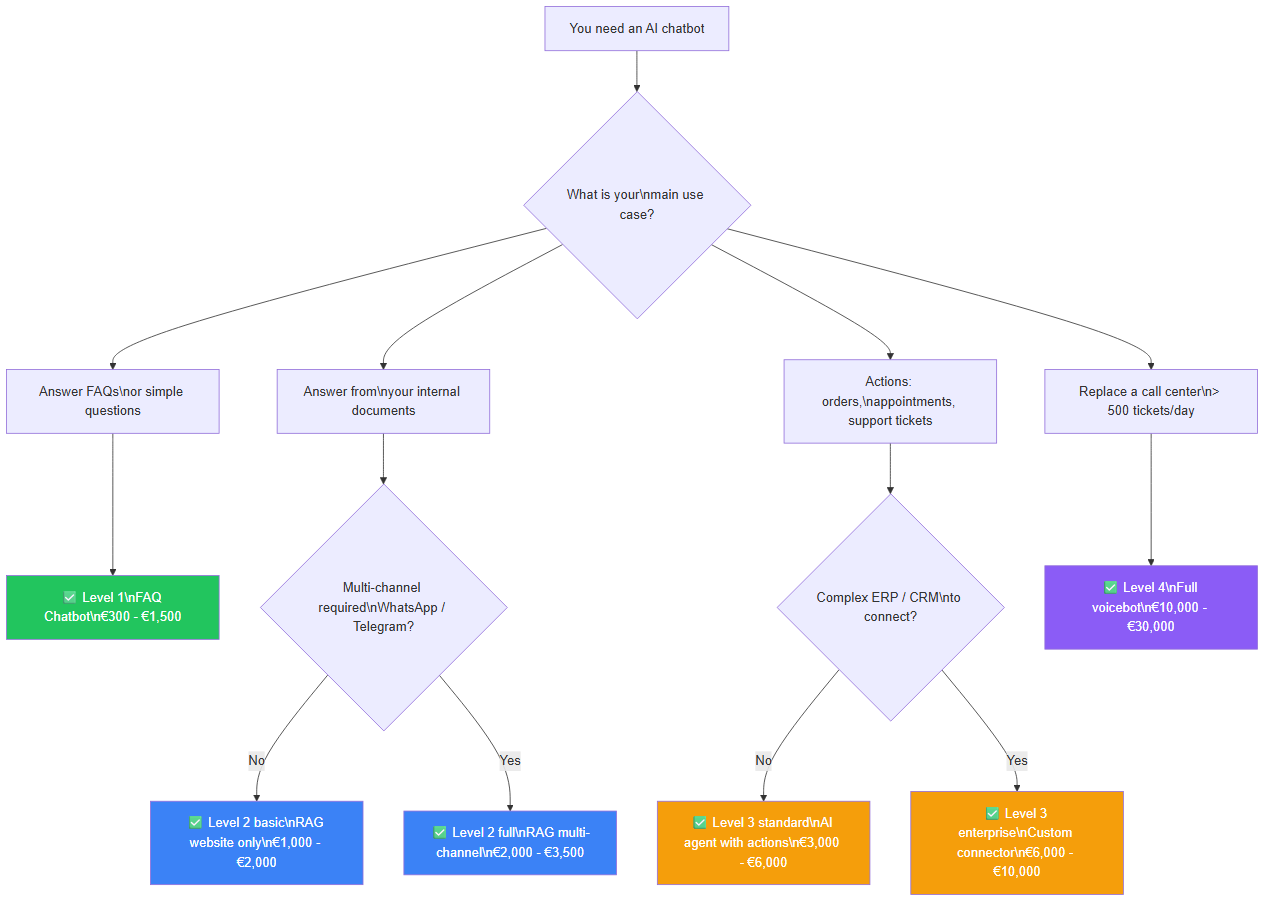 Guide to choosing the right AI chatbot level in 2026 based on use case and ticket volume
How to read and compare a chatbot quote
Receiving three quotes with three very different prices gets you nowhere if you don't know what each line covers. The right method isn't to compare totals, but to put every quote in the same grid: which chatbot level does it match? which items are included or missing? what recurring cost is anticipated?
Here's the checklist I give my clients:
✅ Is the LLM specified? (GPT-4o, Claude Sonnet 3.5, etc.) If vague, run away.
✅ Is the monthly API cost estimated? Otherwise you'll discover the bill in month 2.
✅ Is RAG included or optional? Without RAG, it's just a disguised rule-based chatbot.
✅ Are data sources listed? (PDFs, website, FAQ, emails — how many docs?)
✅ Is hosting your cloud (OpenAI/Anthropic) or self-hosted? Huge GDPR impact.
✅ Is post-delivery support included? For how many days? What does it cover exactly?
✅ Does the source code belong to you? Or is it a proprietary platform that locks you in?
✅ Are post-delivery evolutions priced clearly? Per-unit orders, or mandatory subscription?
✅ Are security and compliance addressed? Even one line tells you whether the vendor thought about it.
The cheapest quote is rarely the most economical. A bot abandoned after 6 months is 100% of the budget lost, whatever the sticker price. Conversely, a well-scoped bot that automates three quarters of your tickets pays for itself within weeks.
The quote we'll give you at BOVO Digital
To keep it simple, here are our 3 standard packages (full transparency):
Chatbot Starter — €2,000
- Custom GPT-4o-mini or Claude Haiku chatbot
- Knowledge base up to 50 docs
- Website integration (JS widget)
- Human escalation
- Conversation analytics
- 1.5h training + documentation
- 30 days of corrective support
Chatbot Pro — €3,500
- Multi-LLM chatbot (GPT-4o + Claude Sonnet)
- Unlimited knowledge base (vector RAG)
- Multi-channel: site + WhatsApp + Telegram
- Light CRM integration (HubSpot, Notion, Sheets)
- Per-user conversation memory
- Advanced analytics + dashboard
- 3h team training
- 60 days of priority support
Chatbot Enterprise — €5,000
- AI agent with actions (orders, bookings, tickets)
- Advanced RAG on custom vector databases
- ERP + CRM + internal tools integrations
- Voicebot optional (+€1,500)
- Multi-language (FR, EN, ES, AR)
- Complete analytics dashboard
- 90 days of VIP support
- Guaranteed SLA + 24/7 monitoring
Monthly costs: between €20 and €200 depending on volume (transparent, we give you the estimate before signature).
Beyond the Price: Security (GDPR) and Hidden Costs of an AI Chatbot
A chatbot quote should not be limited to initial development. Many providers omit the real costs of production: LLM drift (hallucinations), API maintenance (OpenAI/Anthropic frequently change their models), and above all, data security. If your chatbot ingests customer data, hosting must be sovereign (GDPR) and vector databases (Pinecone/Qdrant) must be secure. An abnormally low quote often hides a total absence of these B2B safeguards.
Price Your Secure AI Chatbot with BOVO Digital
Do you want a high-performing AI chatbot, but refuse to compromise your data security? BOVO Digital designs custom conversational agents for SMEs. We integrate LLMs (ChatGPT, Claude) with a robust RAG architecture, hosted in Europe, ensuring GDPR compliance. Request a transparent and secure quote for your AI chatbot.
How much will it actually save you?
A quote is never judged alone: it's measured against what it returns. On 14 chatbot clients we've delivered in the last 12 months, here are the average results at 6 months:
| Metric | Before chatbot | After 6 months |
|---|---|---|
| Support tickets automated | 0% | 76% |
| Average response time | 6h | 12 seconds |
| Customer satisfaction rate | 72% | 89% |
| Cost per support ticket | €8 | €0.80 |
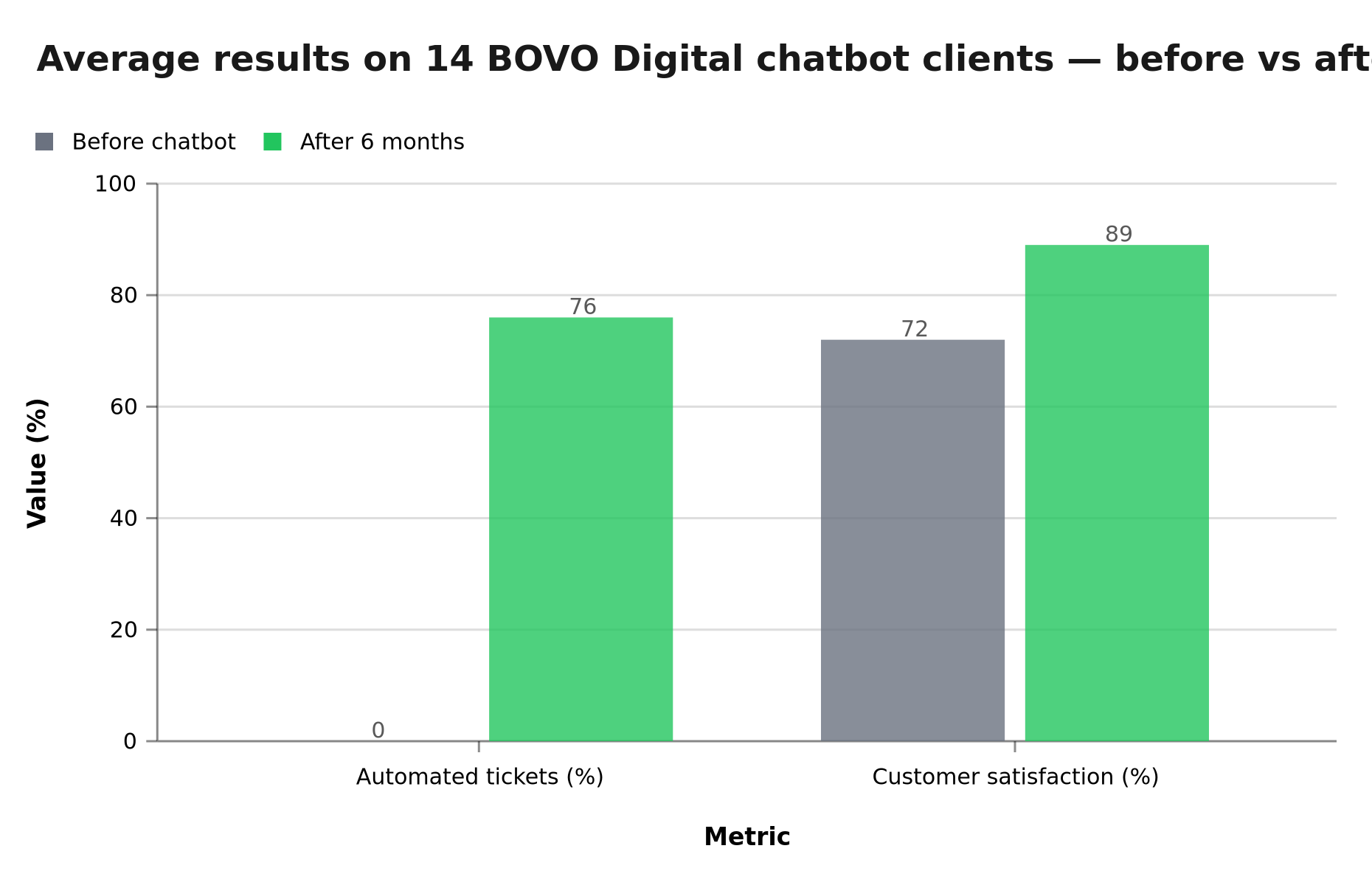 AI chatbot ROI: automated tickets (0% → 76%) and customer satisfaction (72% → 89%) across 14 BOVO Digital clients
On a site receiving 1,500 tickets/month paid €8 to a human (€12,000/month in-house), a Chatbot Pro at €3,500 delivery + €80/month recurring saves €9,000/month. ROI in less than 1 month.
These figures come from our own client base and are averages, not guarantees: your results depend on your ticket volume, the quality of your knowledge base and how well your team supervises the bot. But the underlying logic holds across every project we've delivered. A chatbot doesn't just cut cost per ticket — it also recovers sales lost to slow answers, frees your team for higher-value work, and runs nights and weekends without overtime. When you read a quote, mentally place its price next to these recurring savings rather than next to a competitor's lower sticker. A €3,500 bot that saves €9,000 a month is far cheaper than a €600 bot abandoned after two months.
That's why a "lowest price only" reasoning is a trap: the real question isn't how much the quote costs, but how much it saves you once in production.
Your next step
Want an honest and transparent chatbot quote for 2026?
- Describe your project in 5 minutes → Request a chatbot quote →
- See detailed packages → Our AI Chatbot Agency offer
- Talk to me directly → 15 min free video call
At BOVO Digital, we hate vague quotes and hidden costs. We tell you the price, what's included, what's not, and the estimated monthly API cost before you sign. That's the transparency of a real agency.
Article by William Aklamavo, founder of BOVO Digital. I've personally quoted and delivered 40+ AI chatbot projects since 2023.
Tags
FAQ
How much does an AI chatbot cost in 2026 in France?
Between €2,000 and €30,000 depending on complexity. A simple FAQ chatbot: €300-€1,500. An enterprise RAG chatbot (most demanded): €2,000-€3,500. An AI agent with actions: €3,000-€10,000. A complete voicebot: €10,000-€30,000. BOVO Digital offers 3 packages: Starter €2,000, Pro €3,500, Enterprise €5,000. These ranges are dated June 2026 and given as indicative estimates.
What's the monthly cost of an AI chatbot after delivery?
Recurring cost depends on volume: €20 to €80/month for 1,000 conversations/day with GPT-4o-mini or Claude Haiku, €200 to €500/month for 5,000 conversations/day with GPT-4o, up to €2,000/month for very high volumes with Claude Opus or GPT-5. Always check current orders of magnitude on the official OpenAI and Anthropic pricing pages, which change often. BOVO Digital estimates this cost before signature.
What's the difference between a rule-based chatbot and a ChatGPT or Claude chatbot?
A rule-based chatbot only answers what you've programmed (50% of questions at best). A ChatGPT or Claude chatbot understands natural language, reasons in context and answers 80%+ of questions. RAG (Retrieval Augmented Generation) additionally lets it answer from your own documents.
Can my chatbot work on WhatsApp and Telegram in addition to the website?
Yes, from the Chatbot Pro package at €3,500. We integrate your chatbot on website (widget), WhatsApp Business (Meta API), Telegram, Slack, Discord and any platform with webhook API. One knowledge base, multiple channels.
What traps should I avoid when asking for a chatbot quote?
Five traps: 1) No precision on the LLM used (GPT-4o, Claude, etc.), 2) No estimated monthly API costs, 3) RAG absent or optional (without RAG, it's just a disguised rule-based chatbot), 4) Proprietary platform locking you in, 5) No clear post-delivery support. Detailed checklist in the article.
Should I choose ChatGPT or Claude for a business chatbot?
It depends on the use case, not on an absolute ranking. Claude (Anthropic) is often preferred for long, nuanced answers faithful to brand tone. ChatGPT (OpenAI) shines on its tooling ecosystem and cost/latency ratio in the mini versions. Many serious chatbots use both in a multi-LLM setup with fallback. Compare the official pricing pages, they change regularly.
Stuck on a step? We take it to production
Tutorials stop where production starts: secrets, GDPR, no-shows, CRM. A 30-min call to scope the delivery.
- 30 min
- Scoped delivery
- No commitment
William Aklamavo
Web development and automation expert, passionate about technological innovation and digital entrepreneurship.


