
Custom AI Chatbot Cost in 2026: Real Prices and Monthly Fees
AI chatbot pricing in 2026: market ranges, offers from €2,000, and the monthly cost of the API, hosting and WhatsApp, with real worked budget examples.

Updated

Custom AI Chatbot Cost in 2026: Real Prices and Monthly Fees
An AI chatbot has two prices: the one-off cost of building it, and the monthly cost of running it. Quotes that only mention the first one hide half the bill.
The price of a custom AI chatbot in 2026 sits between €1,500 and €40,000 to build, depending on what it must do. A chatbot that answers the frequent questions on your website sits at the bottom of the range. An agent that reads your documents, replies on WhatsApp and acts in your CRM sits at the top. On top of that comes a monthly cost from €25 to several hundred euros: the model API (ChatGPT, Claude), hosting and, if you use it, WhatsApp.
This guide gives you market ranges, our public prices, a monthly-cost calculation built from the official OpenAI and Anthropic pricing pages, and the levers that push the bill up or down. It is written for SME owners who want a budget before they ask for quotes.
Already holding quotes and want to compare them? Read our guide on how to read and compare an AI chatbot quote.
How much does an AI chatbot cost in 2026?
The price depends first on the type of chatbot. Here are the orders of magnitude we see on the French market in autumn 2026. They are estimates, not official rates: they cross-check the ranges published by several French providers on their pricing pages (checked on 13 October 2026).
| Chatbot type | Build cost (estimate) | Typical monthly cost |
|---|---|---|
| Self-serve tool (no-code, subscription) | €0 | €0 to €300/month subscription |
| Custom FAQ chatbot for a website | €1,500 – €4,000 | €20 to €100/month |
| Chatbot that answers from your documents (RAG) | €4,000 – €12,000 | €100 to €300/month |
| Omnichannel chatbot (site + WhatsApp + email) | €8,000 – €20,000 | €200 to €500/month |
| AI agent with actions (CRM, payment, booking) | €15,000 – €40,000+ | €300 to €1,000/month |
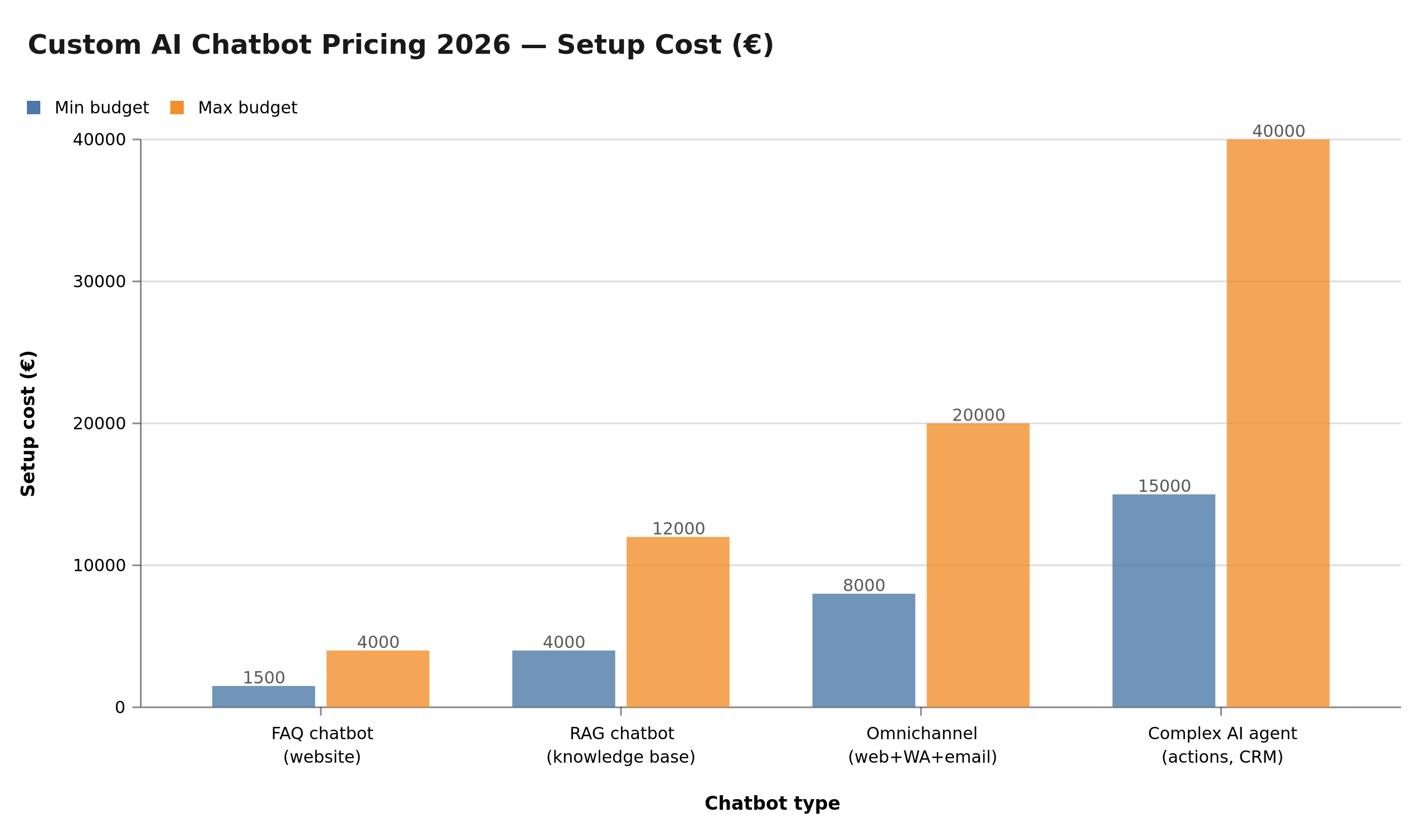 2026 market estimates: minimum and maximum build budget for an FAQ chatbot, RAG, omnichannel or an AI agent with actions
RAG (Retrieval-Augmented Generation) means a chatbot that looks up the answer in your content (PDFs, product sheets, terms of sale) before it replies. It is the level most often requested, because it stops the AI from inventing. Our article on why your AI is "dumb" and how RAG fixes it explains the mechanism.
How much does an AI chatbot on my website cost?
This is the most frequent question. For an AI chatbot on your site that answers visitors from your FAQ and your pages, budget €2,000 to €4,000 to build and €20 to €100 a month to run. The price rises if the chatbot must read a lot of documents, book meetings or pass prospects to your CRM.
How much does a WhatsApp chatbot cost?
A WhatsApp chatbot needs one extra step: access to Meta's WhatsApp Business API, account approval and message templates. Building starts around €2,000 for a single channel. The monthly cost also includes Meta's per-message fees, detailed below. For a full WhatsApp project (follow-ups, booking, qualification), see our page on WhatsApp Business automation.
What does BOVO Digital charge for an AI chatbot?
Our prices are public. They are starting prices for a defined scope; a wider project is quoted after a scoping call.
| Offer | Starting price | What is included | Timeline |
|---|---|---|---|
| Essential Chatbot | €2,000 | AI chatbot (ChatGPT or Claude) on 1 channel (website or WhatsApp), knowledge base up to 50 answers, basic CRM, dashboard, 30 days of corrective support | 2–3 weeks |
| Conversational Pro | €3,500 | Website + WhatsApp + Messenger, advanced knowledge base with memory, booking, full CRM, multilingual, 60 days of priority support | 3–5 weeks |
| Voice + Chatbot Enterprise | €5,000 | Omnichannel (website, WhatsApp, email, SMS), voice agent (Twilio, ElevenLabs), actions in your CRM or ERP, custom integrations, 90 days of support and an SLA | 6–8 weeks |
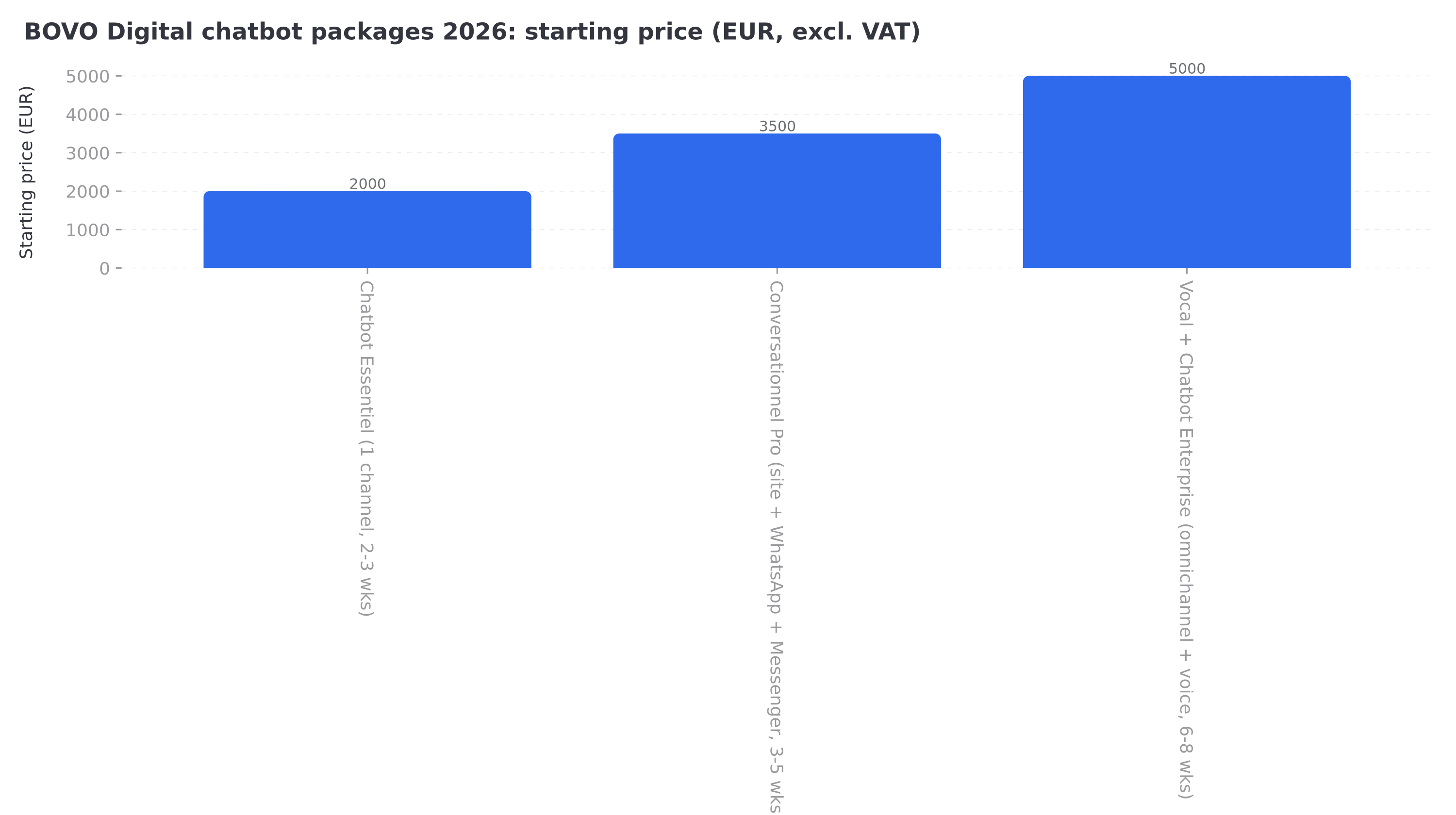 Essential Chatbot at €2,000, Conversational Pro at €3,500 and Voice + Chatbot Enterprise at €5,000: starting prices and delivery times
Why are our prices below the market average? Because we start from bricks we have already proven (n8n orchestration, WhatsApp and CRM connectors, guardrails) instead of rebuilding everything. An agent tied to a custom ERP, or one handling tens of thousands of conversations a day, sits outside these packages: we price it separately, line by line.
A few examples of what we have delivered: a WhatsApp assistant available around the clock that qualifies requests and books meetings outside opening hours (see the project), our own booking and FAQ chatbot built on n8n (see the project), and a voice agent connected to a CRM that checks the calendar in real time before it offers a slot.
What are the monthly costs of an AI chatbot?
This is the part many quotes forget. A chatbot consumes resources on every conversation. Here are the five items to budget.
How much do the ChatGPT or Claude APIs cost per month?
AI models are billed per token (a token is about 4 characters). Each conversation uses input tokens (the question, the history and excerpts from your documents) and output tokens (the reply). The table below uses the public rates shown on 13 October 2026 on the OpenAI API Pricing and Anthropic Pricing pages, per million tokens.
| Model | Input (1M tokens) | Output (1M tokens) | Suggested use |
|---|---|---|---|
| GPT-6 Luna (OpenAI) | $0.10 | $0.50 | Simple FAQ, high volume |
| Claude Haiku 5.5 (Anthropic) | $0.50 | $2.50 | FAQ and everyday support |
| GPT-6.1 Sol (OpenAI) | $2.00 | $10.00 | Nuanced replies, RAG |
| Claude Sonnet 5.5 (Anthropic) | $2.00 | $10.00 | Nuanced replies, RAG |
Take a typical support conversation: three exchanges, about 12,000 input tokens and 1,200 output tokens. The maths is simple: 12,000 × input price + 1,200 × output price.
- With Claude Sonnet 5.5: $0.024 + $0.012 = $0.036 per conversation, or $36 for 1,000 conversations.
- With Claude Haiku 5.5: $0.006 + $0.003 = $0.009, or $9 for 1,000 conversations.
- With GPT-6 Luna: $1.80 for 1,000 conversations.
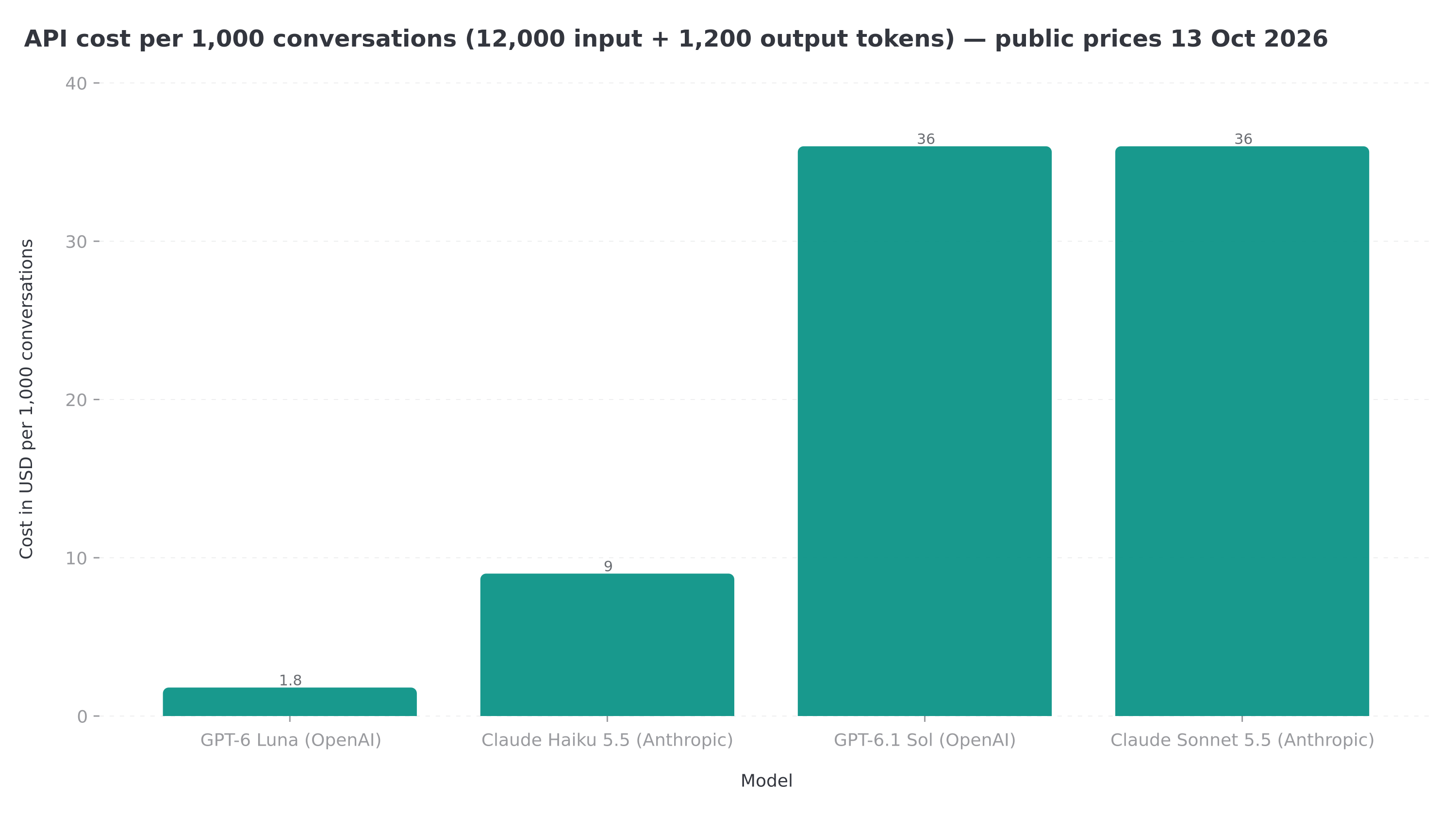 API cost calculated from public OpenAI and Anthropic rates on 13 October 2026, for 1,000 conversations of 12,000 input tokens and 1,200 output tokens
What we see with our clients: the first cost driver is not the model, it is the context you send. A poorly tuned chatbot that sends twenty document excerpts instead of three can multiply the bill by five. The second lever is routing: a small model for "what are your opening hours?", a finer model for complaints.
How much do WhatsApp messages cost?
Meta bills the WhatsApp Business API per delivered message. On the 2026 Meta rate cards for France, a marketing message costs €0.0712 and a utility or authentication message costs €0.0248. Service replies (within 24 hours of a customer's message) have been billed at the utility rate since 1 October 2026, with a free quota of about 1,000 messages per number per month. The access provider (BSP, such as Twilio or 360dialog) can add its own margin.
These rates move: check them on Meta's official pricing page. Our article on WhatsApp Business API pricing in 2026 details the categories and three budget scenarios.
Which other recurring costs should you plan for?
- Hosting of the app and the orchestration: €20 to €100/month.
- Document base (vector database for RAG): €0 with a free plan or pgvector, up to €300/month for large volumes.
- Quality monitoring (conversation log, alerts): €0 to €200/month depending on the tool.
- Maintenance: a few hours a month if your prices, products or terms change often. A chatbot that is never updated gives stale answers within a few months.
What monthly budget matches your volume?
Three typical profiles, calculated with the rates above (estimates, excluding maintenance):
| Profile | Volume | Model | API | Other items | Estimated total |
|---|---|---|---|---|---|
| Small brochure site | 500 conversations/month | Claude Haiku 5.5 | ≈ $5 | Hosting €20–40 | €25 to €50/month |
| SME, site + WhatsApp | 3,000 conversations/month, half on WhatsApp | Claude Sonnet 5.5 | ≈ $110 | Hosting €50, WhatsApp ≈ €120 (6,000 replies, quota deducted) | €150 to €350/month |
| High volume | 20,000 conversations/month | 80% Haiku, 20% Sonnet | ≈ $290 | Hosting and database €150–300, monitoring €100 | €500 to €900/month |
What changes the price of an AI chatbot?
The build price stacks layer by layer. You start from a base (answering an FAQ), then you add only what you actually need.
 An AI chatbot price adds up: FAQ base, then document base, channels, actions and security
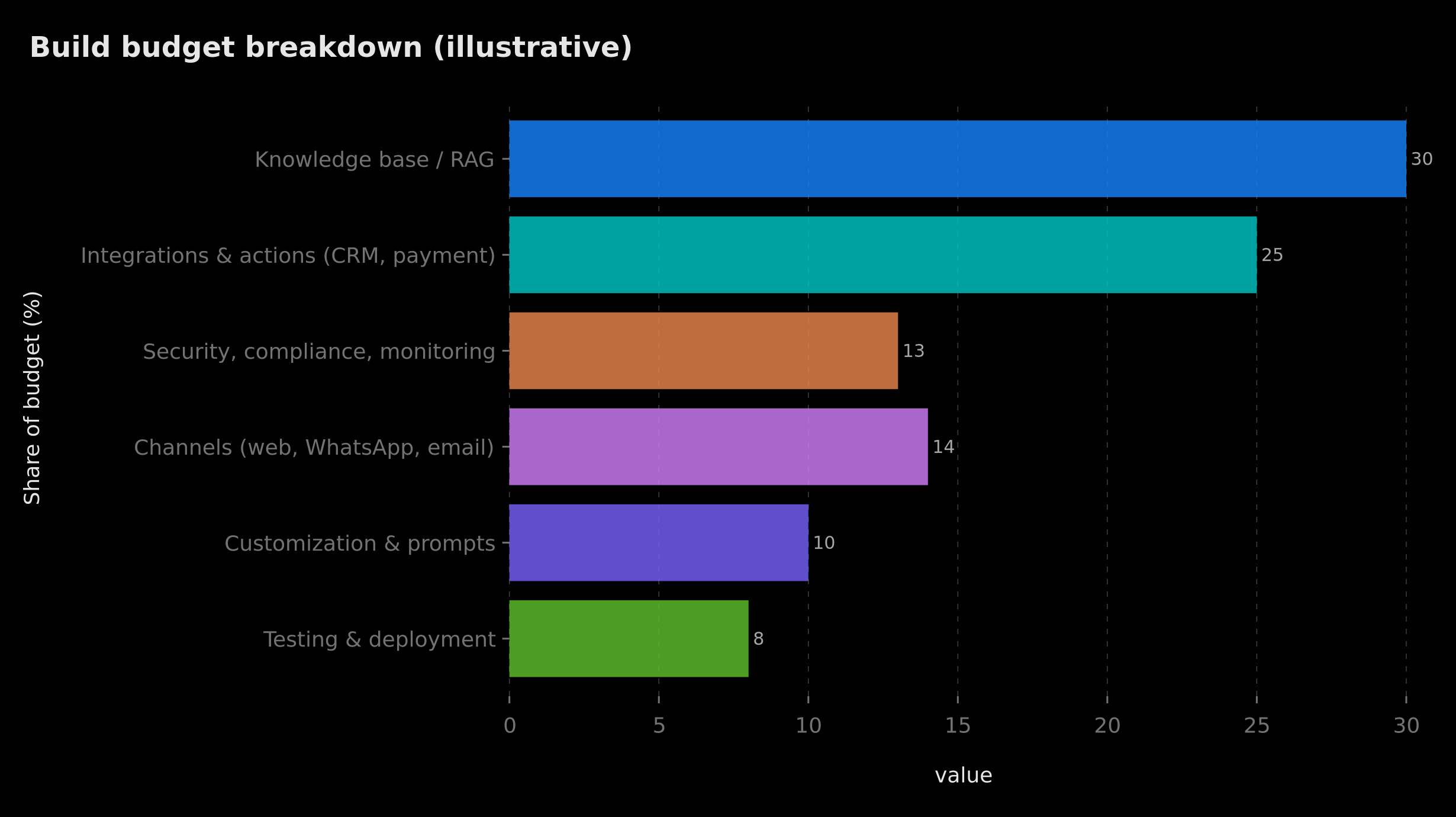 Indicative split of the build budget: the document base and integrations account for more than half the effort
Are your documents ready?
This is often the first item. Ten clean question-and-answer pairs can be connected in a few days. Five hundred pages of scattered PDFs, spreadsheets and emails need sorting, splitting and indexing. The mistake we see most: wanting a "smart" chatbot on contradictory content. The chatbot then repeats the contradictions.
How many channels?
The website is the simplest. WhatsApp adds Meta approval and message templates. Each extra channel (Messenger, Instagram, SMS) means adapting the reply format and how media are handled.
Does the chatbot need to act?
Answering costs less than acting. A chatbot that creates a ticket, books a meeting or updates your CRM needs one integration per action, plus tests and guardrails. A read action (checking an order status) is simpler than an irreversible action (issuing a refund), which needs a human check.
What level of reliability?
A professional chatbot must log its conversations, know how to hand over to a human and not invent an answer. That layer is a real share of the budget, and it is what separates a demo from a tool you can show your customers. Our guide on how to avoid AI hallucinations in a business details the methods.
Does an AI chatbot pay for itself?
The return is mostly the requests the chatbot handles instead of your team. A sample calculation, to redo with your own numbers: an SME receives 40 requests a day, each costing about €6 of staff time, or about €5,300 a month. If the chatbot handles half of those requests, the saving is about €2,500 a month, after monthly costs. A €3,500 project would then pay for itself in under two months.
That result is not guaranteed: it depends on how repetitive the requests are, on the quality of your content and on follow-up after launch. It does show that a chatbot is not reserved for large companies.
Should you use a no-code tool, an in-house build or an agency?
- Self-serve no-code tool: fast and cheap for testing an FAQ. Limits: little customisation, dependence on the vendor, cost that rises with volume.
- In-house build: full control if you have a technical team available. The risk: maintenance, and an orphaned project when the developer leaves.
- Agency: one counterpart responsible for the result, the guardrails and a short timeline. The upfront investment is higher than a subscription.
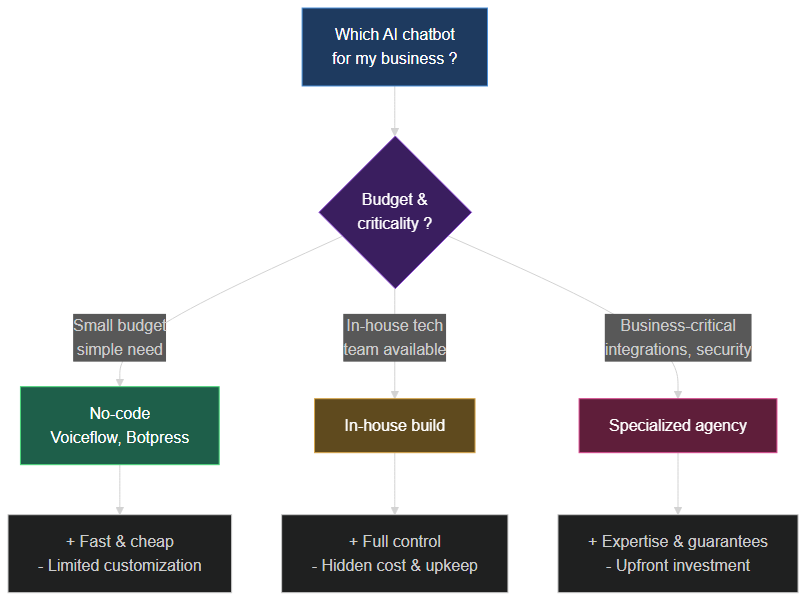 Choose between no-code, in-house development and an agency based on budget, criticality and the team you have
Your chatbot budget in 30 minutes
Tell us what you need (channels, volume, documents, tools to connect). We tell you which offer fits, or we price it line by line if your project sits outside the packages, with an estimate of the monthly costs. BOVO Digital has delivered 118 projects and holds 82 five-star reviews on ComeUp.
What to remember
- Build: €1,500 to €40,000+ on the market depending on the type; from €2,000 at BOVO Digital for one channel.
- Running cost: from €25 to several hundred euros a month. The model API is calculated from official rates; WhatsApp adds Meta's per-message fees.
- Levers: the state of your documents, the number of channels, the actions you need and the level of reliability.
Next step: gather your volumes and your content, then ask for two or three quotes. Our guide on how to read and compare a chatbot quote gives you the method, and you can contact us for a priced scope.
Methodology: how we built this guide
The market ranges are estimates by the BOVO Digital team, cross-checked on 13 October 2026 against the public pricing pages of several French providers. Our prices are those shown on our AI chatbot agency page. API costs are calculated from the official OpenAI and Anthropic pages consulted the same day; WhatsApp rates come from the 2026 Meta rate cards. Sample limits: our project examples show what was delivered, not an average price; we do not publish an average calculated from our quotes.
Tags
FAQ
How much does an AI chatbot for a website cost?
A custom AI chatbot for a website usually costs between €1,500 and €4,000 for a simple FAQ, and between €4,000 and €12,000 if it answers from your documents (RAG). At BOVO Digital, the Essential Chatbot starts at €2,000 (1 channel, delivered in 2 to 3 weeks). Add about €20 to €150 a month for the API and hosting on a typical SME volume.
How much does a WhatsApp chatbot cost?
Building a WhatsApp chatbot connected to an AI starts around €2,000 for a single channel. The monthly cost adds Meta's per-message fees (in France, €0.0712 per marketing message and €0.0248 per utility message on the 2026 Meta rate cards), any provider (BSP) fees and the AI model API. Always check the current Meta rate card.
What is the monthly cost of an AI chatbot?
Budget €25 to €50 a month for a small site (about 500 conversations), €150 to €350 for an active SME on web and WhatsApp (about 3,000 conversations), and €500 to €900 above 20,000 conversations. Those amounts cover the model API, hosting, the document base and WhatsApp messages. Maintenance is extra if your content changes often.
How much do the ChatGPT or Claude APIs cost for a chatbot?
At the public rates of 13 October 2026, 1,000 conversations (about 12,000 input tokens and 1,200 output tokens each) cost about $1.80 with GPT-6 Luna, $9 with Claude Haiku 5.5 and $36 with GPT-6.1 Sol or Claude Sonnet 5.5. Prices change often: check the official OpenAI and Anthropic pricing pages.
Is there a free AI chatbot?
Yes. Several self-serve tools offer a free plan or subscriptions of a few dozen euros a month. They are fine for testing an FAQ. They become limiting as soon as you need to connect your CRM, WhatsApp or internal documents, or to control where your data goes.
How long does it take to build an AI chatbot?
At BOVO Digital: 2 to 3 weeks for the Essential Chatbot (1 channel), 3 to 5 weeks for Conversational Pro (website, WhatsApp and Messenger) and 6 to 8 weeks for Voice + Chatbot Enterprise. Preparing your content (FAQ, documents, prices) is often what stretches the timeline.
We scope one workflow — not a generic demo
You describe a repeated task. We tell you what n8n would ship, the timeline, and what stays out of scope.
- 30 min
- 1 scoped workflow
- No commitment
Singbo Davy AGONMA
Fullstack Developer & AI Expert. n8n automation specialist, Laravel/Flutter development and AI agent integration. Master CS — IFRI.


