
171% ROI on Production AI Agents: Why 89% of Enterprises Stay Stuck in POC
Gartner forecasts 40% of enterprise applications with AI agents by end of 2026. Measured production ROI: 171% on average, up to 540% over 18 months. Yet only 11% of enterprises actually shipped to production. Inside the gap between testing and deploying.

Updated

171% ROI on production AI agents: why 89% of enterprises stay stuck in POC
The number is everywhere in 2026 surveys: 171% average ROI on production AI agent deployments, measured across 500 executives by AI Automation Global. In the US, the average climbs to 192%. Over 18 months in production, some enterprises hit 540% return on investment. Gartner forecasts that 40% of enterprise applications will embed task-specific AI agents by end of 2026, up from less than 5% in 2025 — an 8x increase in a year.
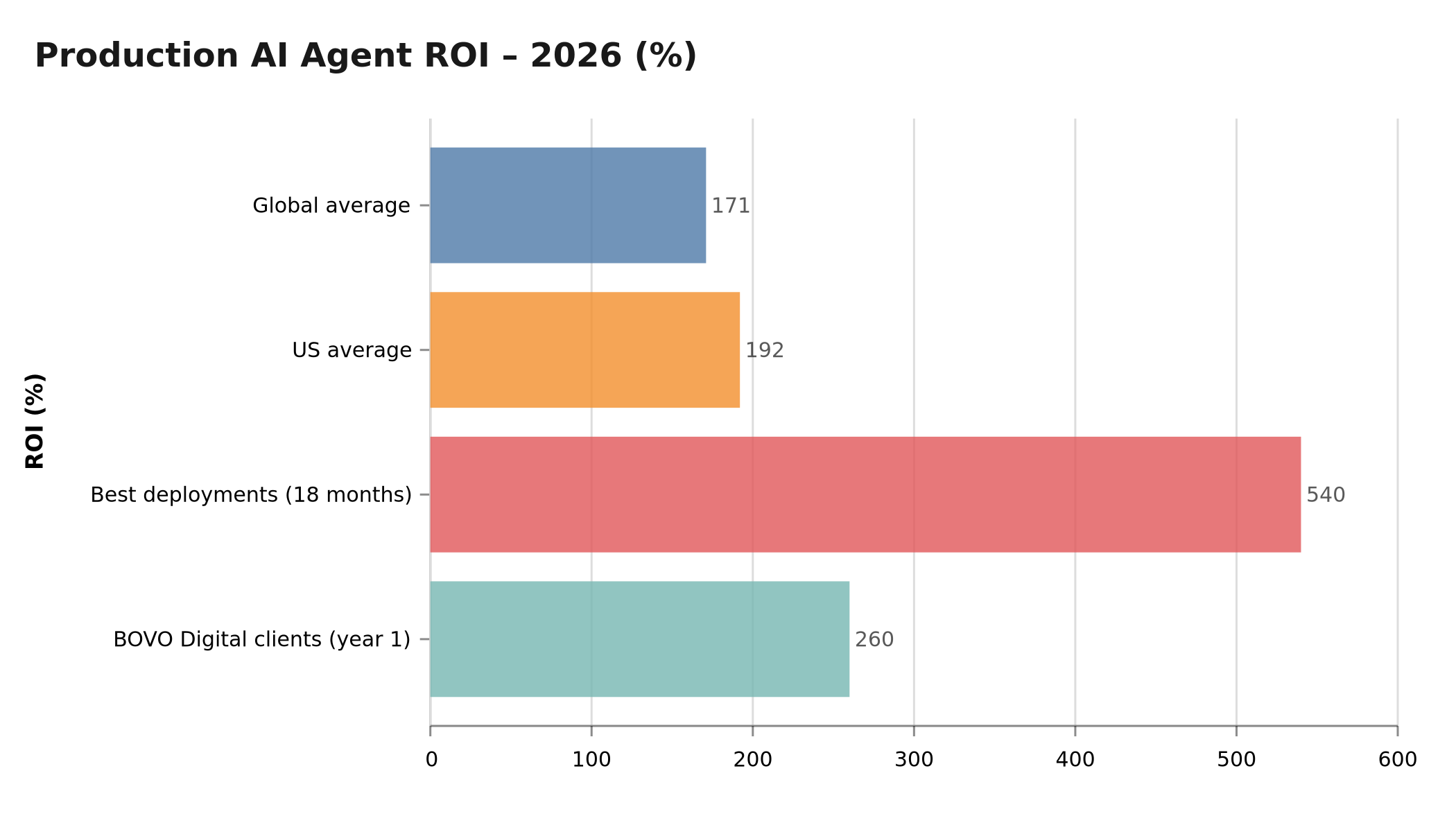 Production AI agent ROI 2026: 171% global average, 192% US average, up to 540% over 18 months for top deployments (sources: AI Automation Global, Gartner, Technova Partners)
And yet, 89% of enterprises are not in this statistic. They've run POCs. Pilots. Board demos. LinkedIn announcements. But they don't have a single agent running 24/7 in production on critical actions. This article explains the gap between testing and shipping, why it exists, how to measure AI agent production ROI with rigor, and how the 11% capturing the 171% actually did it — concretely.
What 2026 numbers really say
Before strategy, the numbers as published by Gartner, AI Automation Global, and Technova Partners in 2026.
Adoption and deployment
- 100% of surveyed enterprises plan to expand agentic AI in 2026.
- 79% claim to run at least one AI agent in production.
- Only 11% truly have AI agents in production on measured critical flows (with KPIs, alerting, ops supervision).
- 42% have no formal agentic strategy documented.
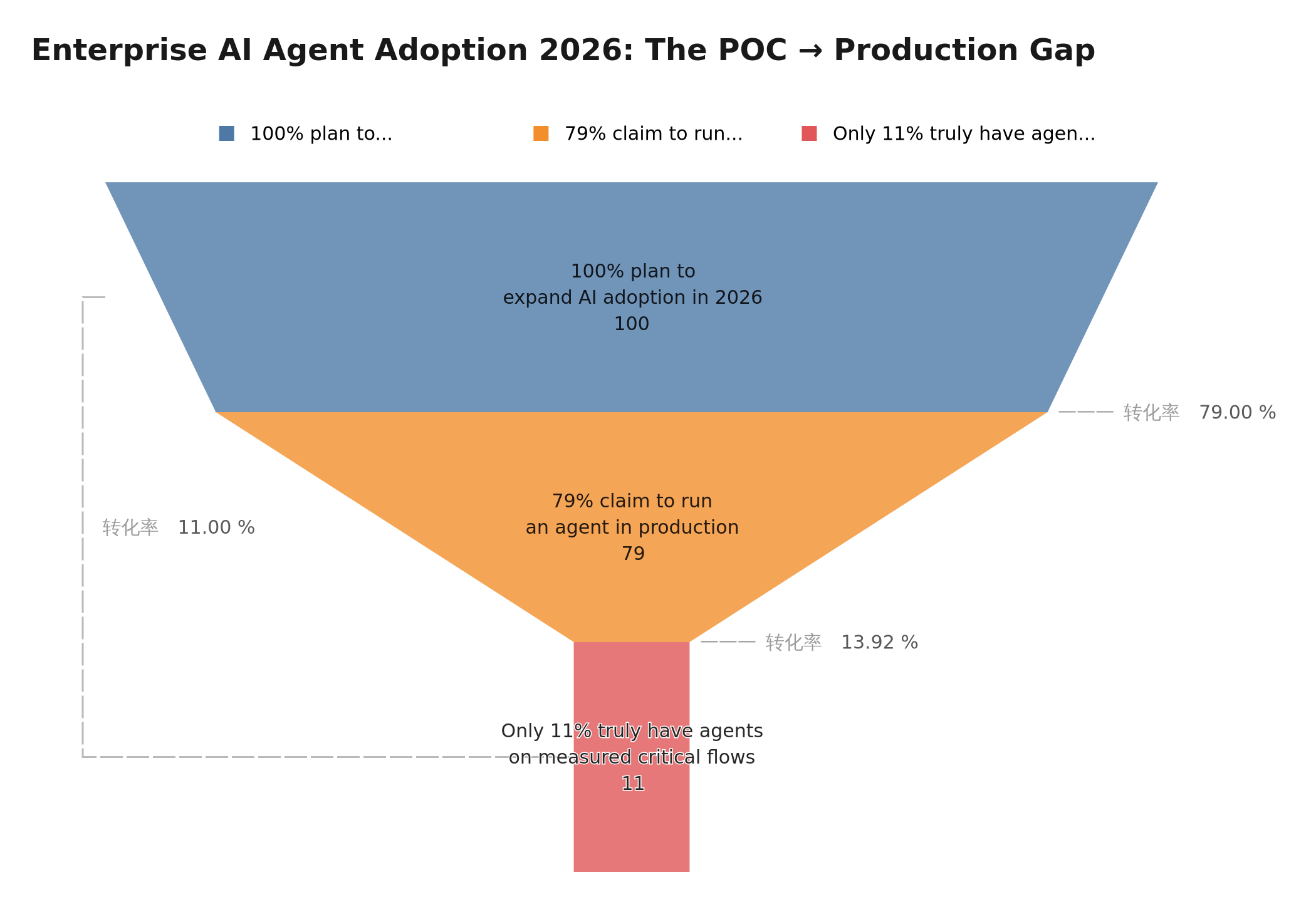 From 100% of enterprises planning AI to only 11% with agents on measured critical flows — the real adoption gap
The gap between 79% and 11% is the entire subject. Many enterprises confuse "we have GPT plugged into Slack" with "we have an AI agent in production." They are not the same thing. The first one doesn't generate the 171% ROI. The second does.
Performance by department
- Finance and procurement: up to 70% cost reduction on automated workflows (bank reconciliation, invoice processing, expense control, payment chasing).
- HR: up to 80% reduction in onboarding cycles (document generation, training, probation tracking).
- Sales: 4x to 7x improvement in lead qualification conversions.
- 74% of enterprises report positive returns in the first year.
- 31% of internal workflows already automated by agents, +33% targeted in 2026.
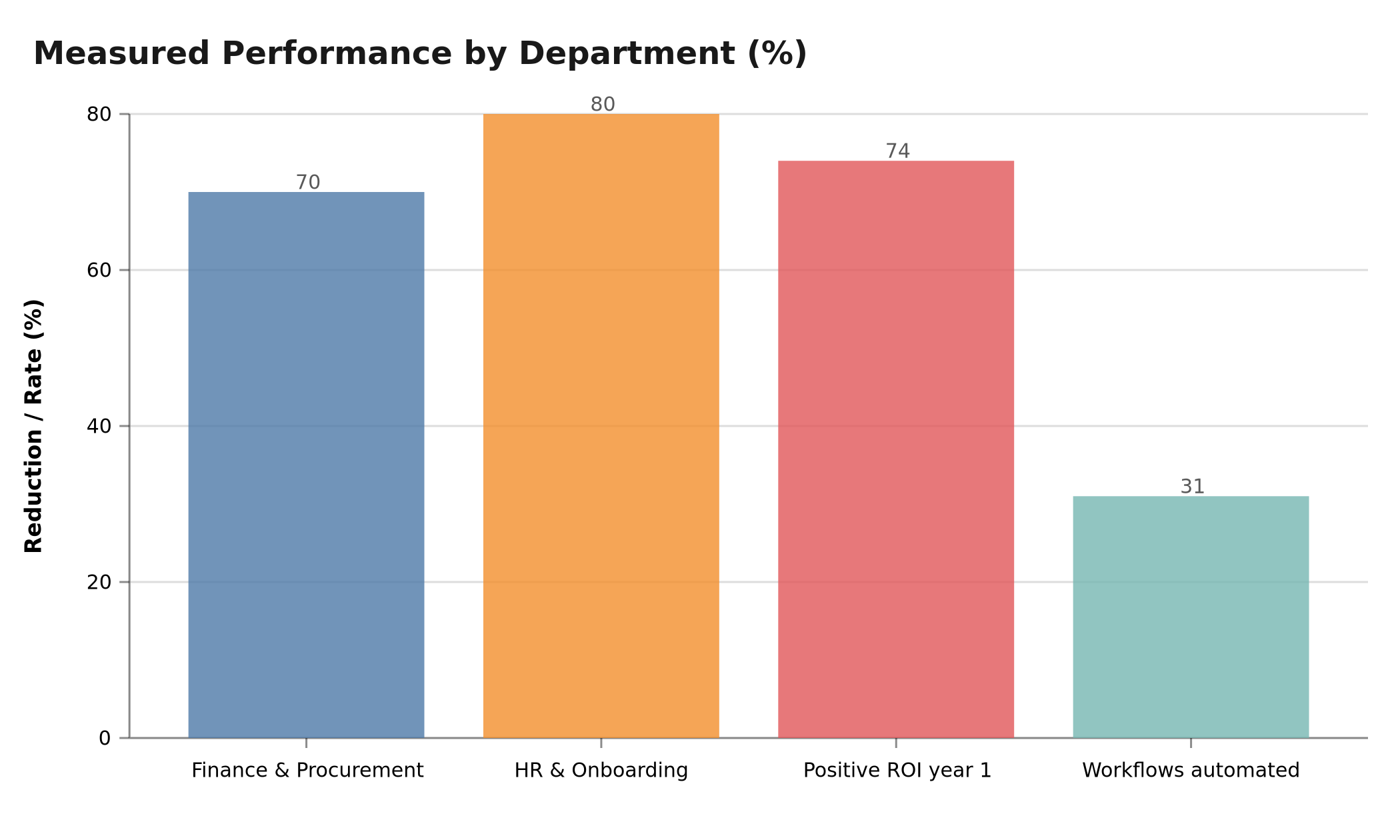 Cost reductions and performance rates measured by department with production AI agents (sources: Gartner, AI Automation Global 2026)
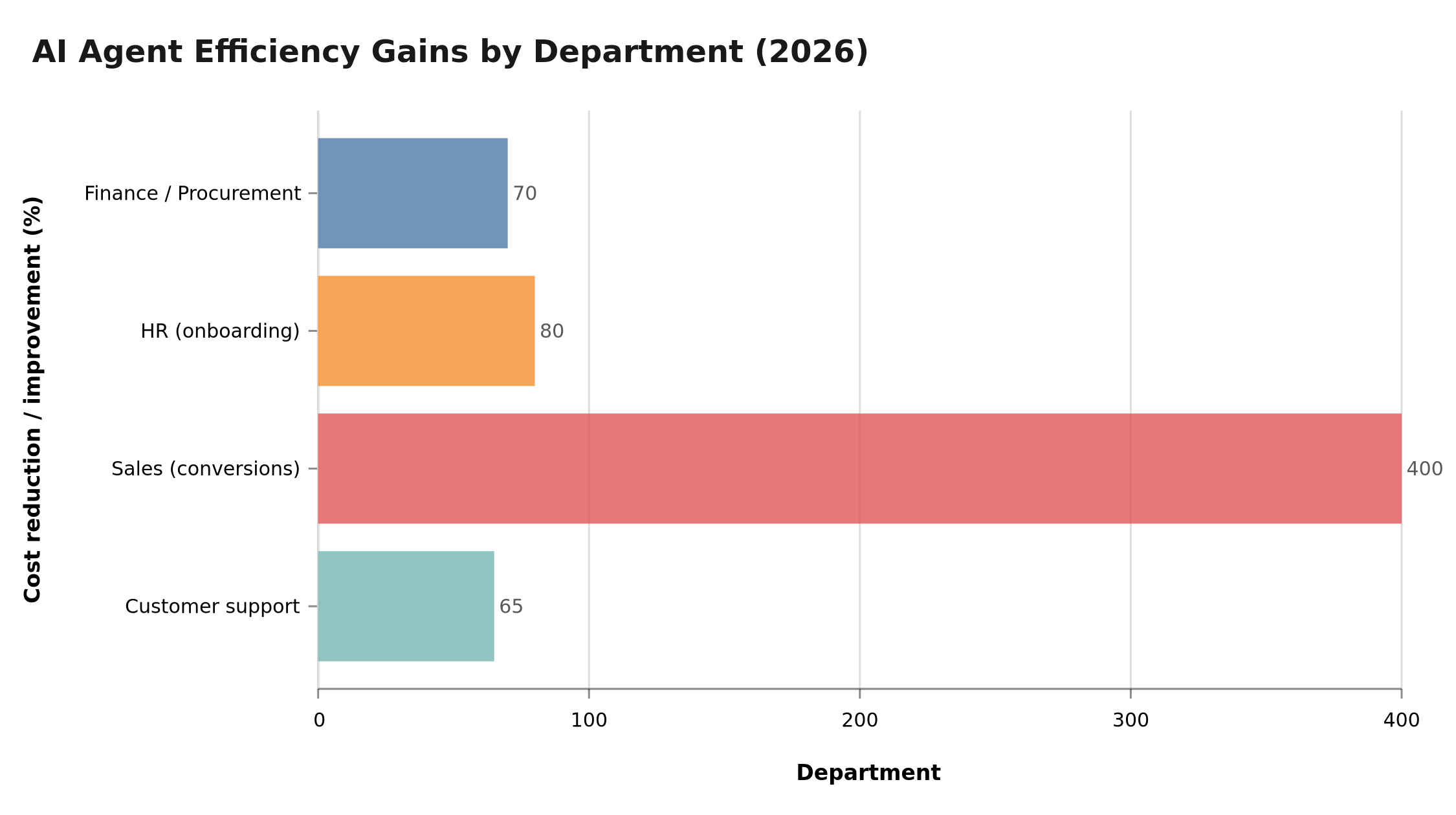 Finance/Procurement: 70% cost reduction; HR: 80% onboarding cycle reduction; Sales: 4x-7x on conversions; Customer support: 65% cost reduction
The 540% ROI over 18 months
It's the most impressive and most misunderstood figure. The 540% isn't reached by plugging an LLM into an inbox. It happens when an agentic system replaces a complete business function — for example: lead qualification + automated calling + appointment booking + follow-up + CRM reporting, running 24/7 unsupervised. On that scope, marginal ops costs drop 70-90%, and the ROI compounds month after month.
How to measure the real ROI of a production AI agent
ROI doesn't fall out of a ChatGPT request. It's built from a rigorous accounting of what the agent costs and what it returns. This is where most projects stumble: gains are vaguely estimated, real costs are systematically undervalued, and the result is either a fantasy ROI on the board slide deck, or an unpleasant surprise after six months. Here is the structured method we apply to measure AI agent production enterprise ROI with discipline.
The real costs of an AI agent
A production agent generates two cost types: a one-time initial investment and a recurring monthly operation cost that compounds for as long as the agent runs.
The initial cost includes: agentic workflow development (architecture, prompts, API integrations), load and security testing, observability setup (LangFuse, Helicone), and team training. Based on our BOVO Digital project experience, for a well-scoped standard use case, this ranges from €8,000 to €25,000 over 8-12 weeks. For complex agents with deep CRM/ERP integrations, voice, or multi-channel, it climbs to €40,000–€80,000.
The recurring monthly cost includes: AI tokens (variable by volume and model — from €200/month for a low-volume DeepSeek V4 agent to €15,000/month for a high-volume GPT-5.5 agent), hosting (VPS, cloud), observability (€100–500/month), and human maintenance (0.2 to 0.8 FTE per agent depending on complexity). That last item surprises teams the most: a production AI agent is not free to run. It requires regular human attention to detect drift, adjust prompts, handle edge cases, and track model updates from providers. For a full breakdown of tooling costs: Automation pricing: n8n and Make in 2026.
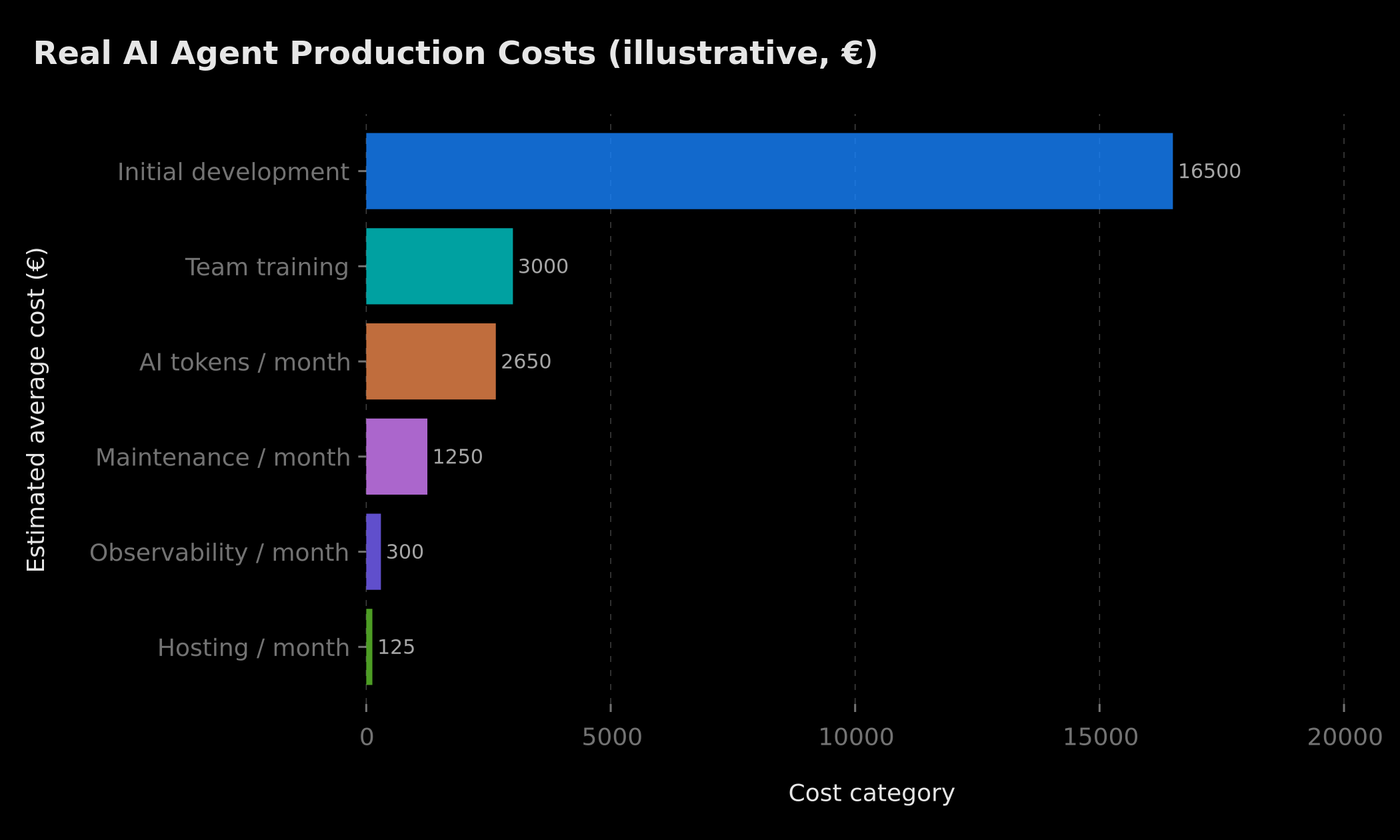 Real AI agent costs: initial development, team training, AI tokens, maintenance, observability, hosting — illustrative order of magnitude based on BOVO Digital experience
The gains to measure
Against those costs, three gain categories must be quantified before any deployment decision:
1. Time freed up: how many human hours per month did the automated task consume? Multiply by the loaded hourly rate, and you get the gross value recovered. For example, an agent replacing 20 hours of processing per week for a €45,000/year employee generates roughly €18,000 of annual value — before any effect on revenue.
2. Revenue generated or protected: a sales qualification agent that improves conversion from 3% to 9% on 100 leads per month at a €3,000 average deal size adds up to €216,000/year in potential revenue. These gains are harder to attribute directly to the agent, but they often make up the bulk of ROI for commercial use cases.
3. Quality and error reduction: an invoice checking agent that eliminates 95% of reconciliation errors can prevent disputes, credit notes, and manual rework whose cost is real and measurable. This item is the hardest to quantify but is non-zero — especially in sectors where human errors carry regulatory exposure.
The calculation formula and decision threshold
ROI follows the standard formula: (Total gains – Total cost) / Total cost × 100, measured over a minimum of 12 months to amortize the deployment. Below 12 months, the initial investment mechanically crushes the result — which leads some teams to incorrectly conclude the agent "isn't worth it" when it's simply still in the amortization phase. The break-even point typically falls between 6 and 14 months depending on sector and volume.
Below €15,000 in automatable annual costs on the target flow, 12-month ROI will be marginal or negative: deployment will cost more than the problem it solves. This is the pragmatic go/no-go threshold we apply systematically before any scoping engagement.
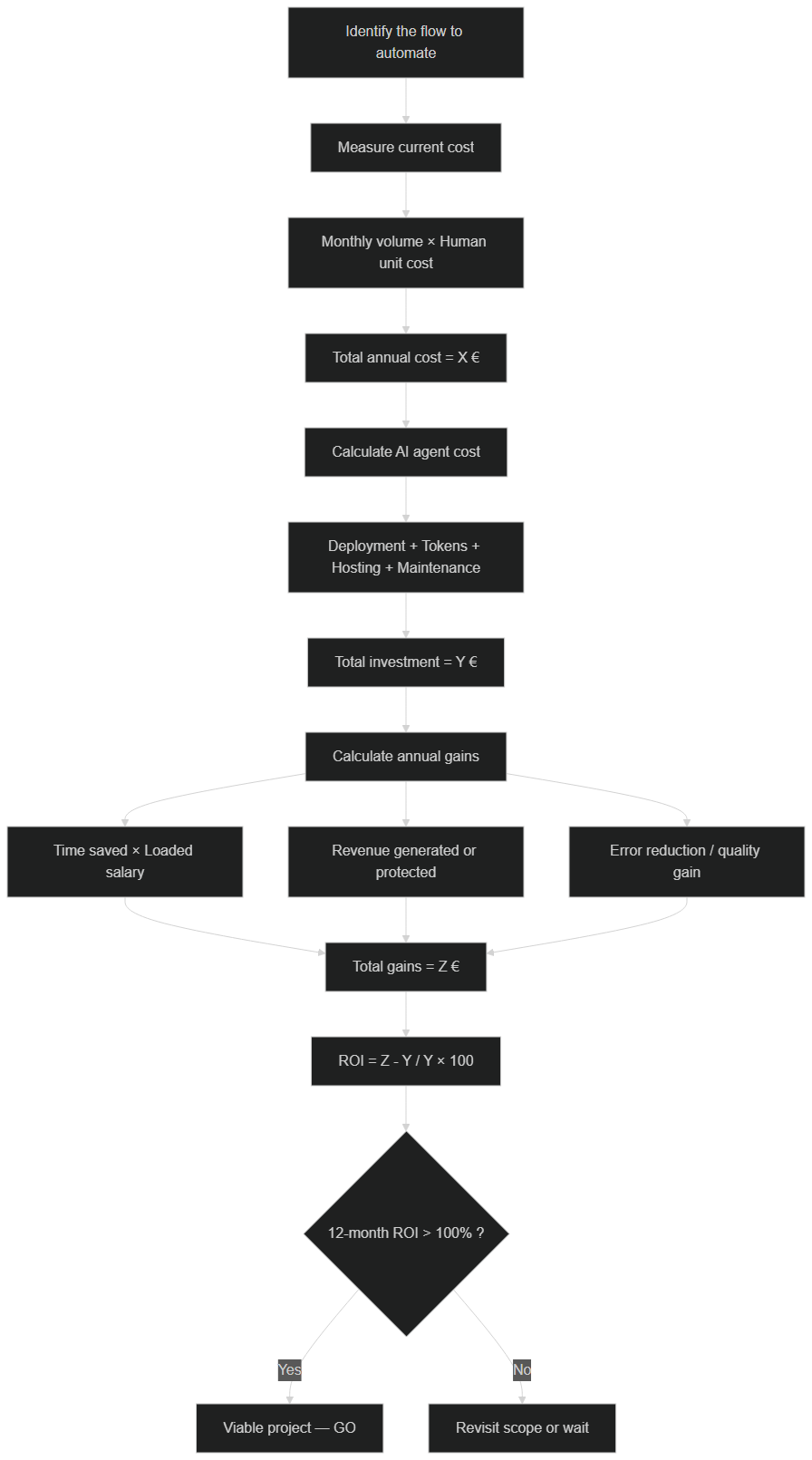 Flowchart: complete AI agent ROI calculation methodology — from flow identification to GO / scope revision decision
Why 89% of enterprises stay stuck in POC
If the opportunity is so clear, why do only 11% of enterprises actually capture the value? Our experience on client projects matches the 2026 surveys on five structural blockers.
1. Confusing POC and production
A POC proves an agent can do a task in favorable conditions. Production guarantees it does it at 99.9% reliability, 24/7, on every edge case, with functional alerting. The distance between the two is as wide as between a Figma prototype and an app on the Play Store. Many teams finish a POC, show a working demo, and believe they "shipped AI." Reality: 3 to 6 additional months are typically needed to go from working POC to production agent.
 POC vs Production: the 6 criteria separating a working prototype from a 24/7 agent with SLA, logs, alerting and business owner
2. No observability
A production AI agent without logs, traces, alerting, or quality dashboard isn't in production. It's a ticking time bomb. The 11% who succeed have systematically put in place:
- Structured logs per request (input, prompt, output, model used, cost).
- Traces of called tool chains (LangFuse, LangSmith, Helicone, Langtrace).
- Alerting on error rate, abnormal latency, abnormal spend.
- Dashboard of business KPIs (conversions, bookings, tickets resolved).
Without this, the agent silently drifts — and the company learns it's been broken for 3 weeks via customer complaints.
3. Wrong multi-model architecture
Sticking an agent to a single model (e.g., GPT-4 on everything) means paying 3 to 7 times too much on 70% of tasks that don't need that horsepower. With DeepSeek V4 at $1.74/M tokens and GPT-5.5 for hard agentic tasks, cost-optimized architectures now route each request to the right model. See our deep dive: DeepSeek V4 vs GPT-5.5.
4. Integration tech debt
An AI agent that reads the CRM, writes to it, sends an email, books a meeting, updates a database, and alerts a human — that's not LLM, it's integration engineering. Enterprises chronically underestimate this slice. CRM APIs alone aren't enough: you must handle retries, idempotency, data conflicts, rate limits, third-party outages. This is exactly where n8n and Make.com earn their keep, and where most projects derail.
5. No engaged business owner
A production AI agent needs a business product owner (not IT) who decides what the agent does, how it fails, when it escalates to a human, which KPIs it optimizes. Without that owner, the agent is technically alive but organizationally orphaned — and gets shut down 3 months in because no one defends its value at the leadership table.
The 11% method: from POC to production in 90 days
Here's the method we apply at BOVO Digital on client projects that crossed the 171% ROI bar. It fits in four phases.
Phase 1 — Business scoping (weeks 1-2)
- Identify one single flow to automate, measurable in euros (current cost, monthly volume, human error rate).
- Define business KPIs: ops/month, target latency, success rate, cost per op.
- Identify acceptable failure cases and critical cases (requiring human escalation).
- Pick a business owner accountable for results at the leadership table.
Phase 2 — Architecture and POC (weeks 3-6)
- Multi-model stack: routing across GPT-5.5, DeepSeek V4, Claude Opus 4.7, and open-source models.
- Orchestration on n8n, Make.com, or LangGraph depending on complexity. To understand n8n's full agentic capabilities: n8n AI Agent — transform your workflows into intelligent systems.
- Storage of conversations, traces, results in a controlled database (Postgres, Supabase, Firebase).
- Mocked critical integrations to test risk-free (CRM, calendar, email).
- POC validated on 30 real cases before pilot.
Phase 3 — Controlled pilot (weeks 7-10)
- Agent processes 10 to 30% of real volume, under human supervision.
- All decisions are logged and audited.
- Success, error, and escalation rates measured daily.
- A/B comparison with human handling on identical cases.
- Adjustments to prompts, model routing, escalation rules.
Phase 4 — Production rollout (weeks 11-12)
- Agent processes 100% of target volume.
- Executive dashboard in place (volume, ROI, error rate, spend).
- Operational SLA and incident runbook defined.
- Monthly continuous improvement plan (edge case review, prompt optimization, model updates).
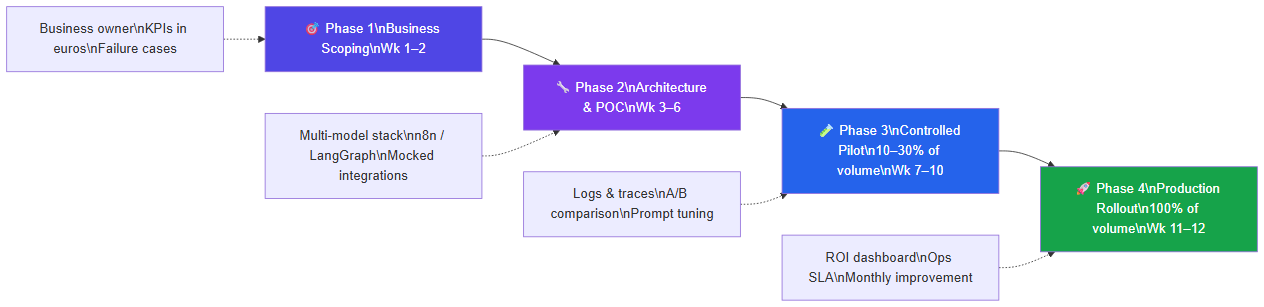 4-phase AI agent production deployment method: business scoping (wk 1–2), architecture & POC (wk 3–6), controlled pilot (wk 7–10), 100% production rollout (wk 11–12)
On this trajectory, the ROIs we documented on client projects span 140 to 380% in year one. Far from the top-tier 540%, but vastly above 0% from forgotten POCs.
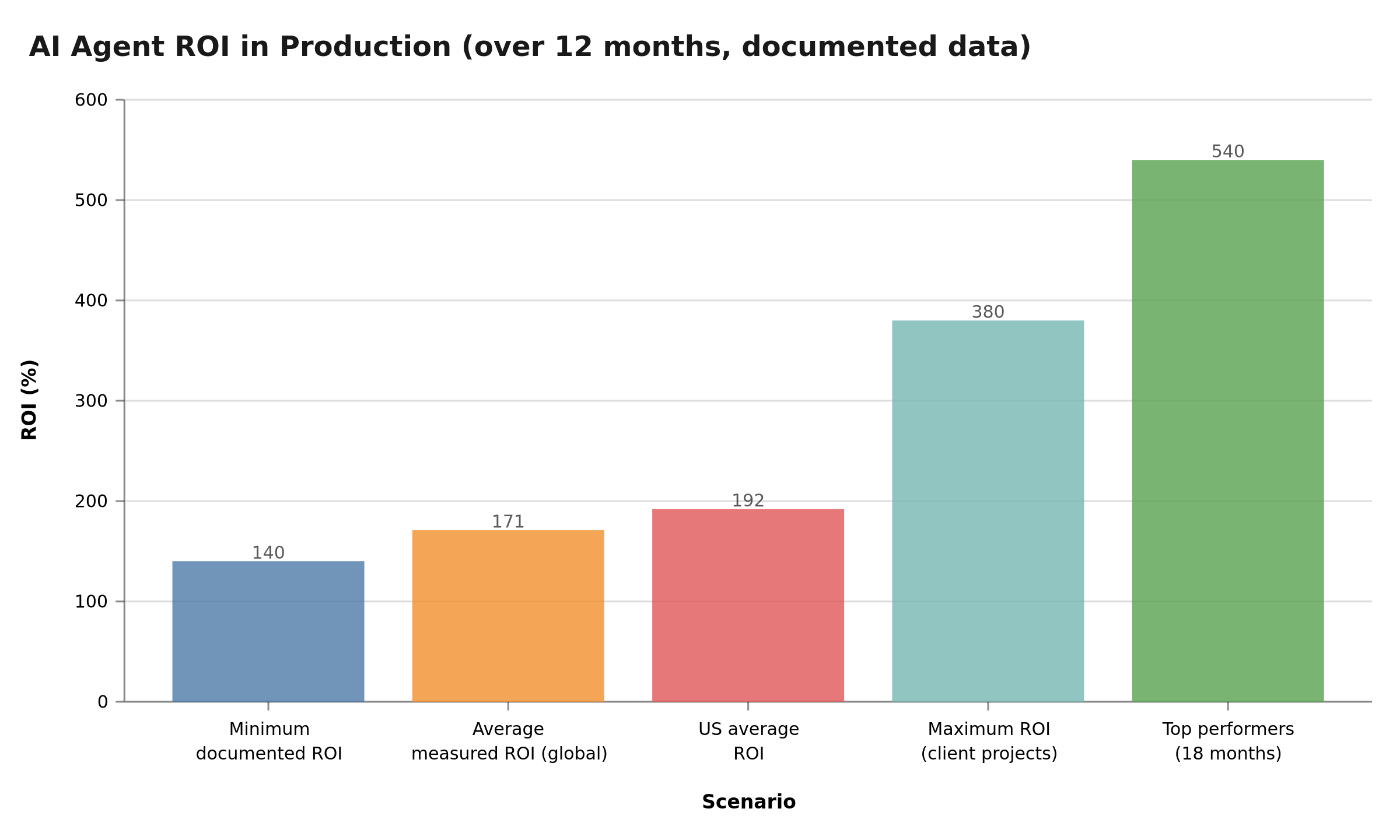 Documented ROI comparison over 12-18 months: minimum 140%, global average 171%, US average 192%, max client projects 380%, top performers 18 months 540%
Three use cases that cross the 171% ROI bar
Case 1 — Automated sales qualification
A voice agent on Vapi or a text agent on WhatsApp that calls or messages new leads within 90 seconds, qualifies against a business grid, handles 4-6 typical objections, and books a calendar meeting for hot leads. Typical ROI: 4x to 7x on conversions. For broader sales workflow automation: Automating 40 hours of work per week with AI agents. See our reference project Illico Voice AI.
Case 2 — Industrialized SEO content generation
An n8n system orchestrating keyword research → brief → article generation → AI proofreading → CMS publishing, hitting different models per step. Typical ROI: 5x to 10x on editorial production cost at equal quality. See our project MaxSEO AI.
Case 3 — Tier 1 and 2 customer support
A chatbot wired to the knowledge base, CRM, and ticketing system, resolving 60-80% of requests autonomously and smartly escalating the rest. Typical ROI: 50-70% support cost reduction. Further reading on support automation: How to eliminate 70% of support emails with automation. See our chatbot offer.
ROI by sector: 2026 benchmarks
Global surveys give 171% as the average. In practice, results vary significantly by sector, use case complexity, and — most importantly — the operational maturity of the team shipping the agent. Here are the ranges we observe on our projects and in available sector publications. These figures are illustrative, based on our experience and the sources cited in the introduction.
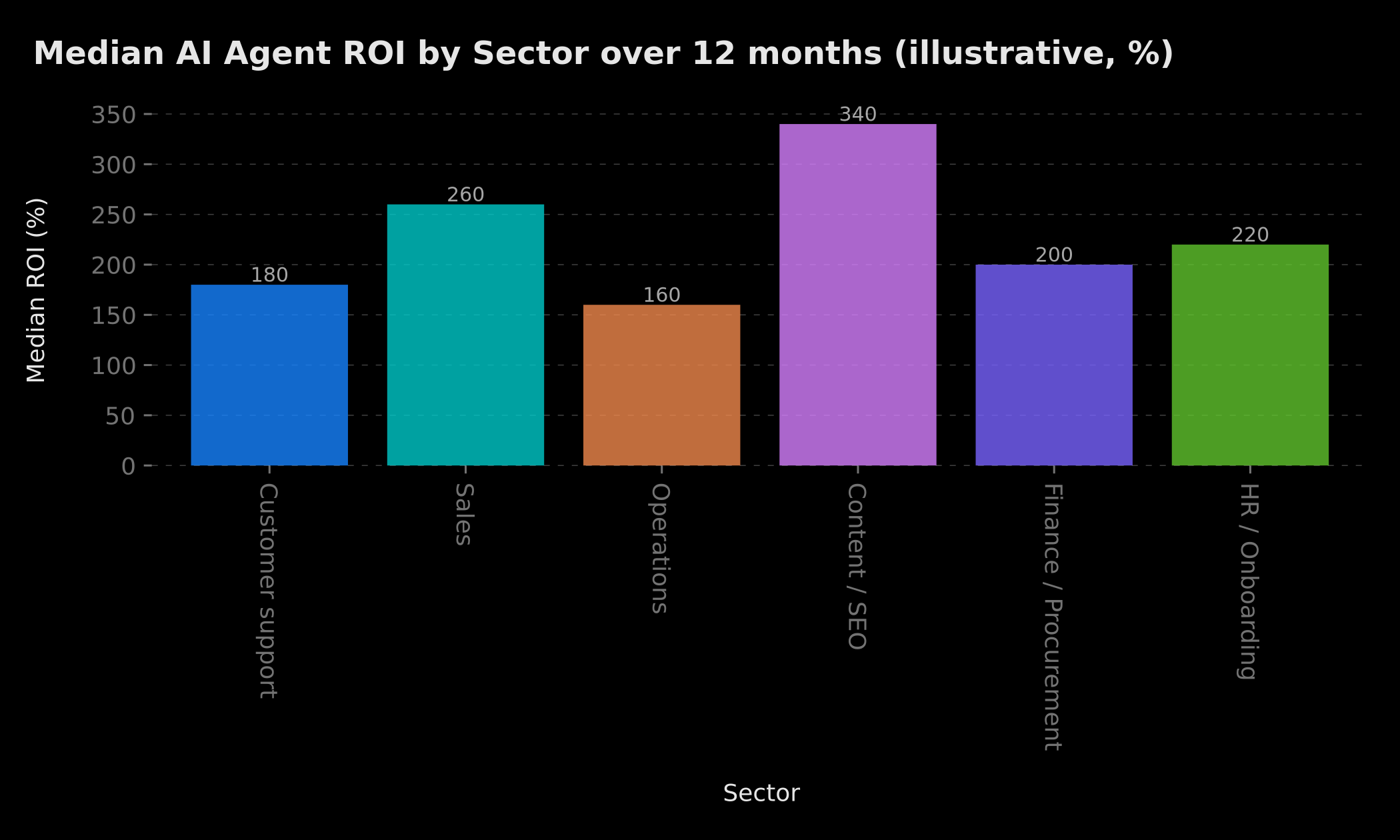 Median ROI by sector: content/SEO 340%, sales 260%, HR onboarding 220%, finance/procurement 200%, customer support 180%, operations 160% — illustrative benchmarks from BOVO Digital and 2026 sector sources
Customer support (tier 1 and 2): median ROI around 150–250% over 12 months. The scope is well-defined, gains directly measurable (tickets resolved, response time, cost per ticket). The key risk: the cost of maintaining the knowledge base is consistently underestimated. An agent that doesn't receive regular updates loses relevance — and customers notice before the metrics do.
Sales and commercial: median ROI around 200–380%. This is where agents generate the most absolute value, acting directly on revenue. Real-time qualification, automated J+1 and J+3 follow-ups, frictionless meeting booking: all high-leverage actions on conversion rates. The break-even timeline is usually the shortest of all sectors — as early as month 3 or 4 in production.
Operations: median ROI around 130–200%. Gains are real but diffuse, spread across multiple workflows (invoicing, reconciliation, reporting, partner onboarding). The challenge is aggregating them into a single, visible number for leadership. It is essential to measure the cost of each task before deployment at a granular level, to be able to demonstrate ROI after the fact.
Finance and procurement: median ROI around 170–220%. Automatic bank reconciliation, invoice processing with OCR + LLM, expense report control: very high-frequency, high-volume use cases with euro-measurable KPIs. The regulatory sensitivity (audit trail, accounting compliance) requires human supervision on anomalies — which is compatible with strong ROI if the agent handles 90% of standard cases and escalates the remaining 10% of anomalies.
Content and SEO: median ROI around 250–500%, often the highest in relative terms. The reason: human editorial production cost is high, and agents can multiply output volume at consistent quality — provided a human review loop is maintained for sensitive content (medical, legal, financial).
HR and onboarding: median ROI around 180–260%. Documentary onboarding cycles, employee FAQs, automated initial training: highly repetitive tasks with high volume during recruitment peaks, and whose human cost is rarely precisely measured before automation.
Time to break-even: based on our experience, break-even is reached in 6 to 14 months depending on sector and volume. Commercial projects reach the threshold fastest (strong gains from the first production quarter); operational projects are slower but generate more stable, less volatile gains over time.
When NOT to deploy an AI agent
The real discipline in 2026 is not knowing how to deploy an agent — it's knowing when to hold off. The most spectacularly failing projects are often the ones that should never have started. Here are the warning signals we have learned to recognize.
The task is too creative or contextual. An agent can write an article; it cannot draft a legal brief or a medical diagnosis that engages the personal liability of a qualified professional. If the value of the task lies in non-reproducible expert judgment, the agent will at best be a crutch, at worst a source of serious errors.
Volume is too low. If the flow to automate represents fewer than 50 occurrences per month or less than €10,000 in annual costs, 12-month ROI will be marginal or negative. The agent will never amortize. A good manual template beats an underused agent every time.
Data is insufficient or unstructured. An agent needs clear examples to calibrate against, and a reliable knowledge base to answer from. Without quality data, you're deploying an agent that fabricates rather than processes — which is worse than deploying nothing.
Regulatory requirements are not under control. In Europe, deploying AI agents in domains touching personal data (GDPR), automated decisions (EU AI Act), or regulated sectors (healthcare, finance) requires upfront legal scoping that many IT teams skip. An agent deployed without that framework exposes the business to penalties whose cost can far exceed the expected ROI.
You don't have a stable process to automate. Automating chaos creates automated chaos. If the process changes every week, the agent will follow those same changes — but with a lag and a high maintenance cost. Stabilize first, automate second.
The team won't accept the tool. A technically functional agent that teams route around generates exactly 0% ROI. Change management isn't optional — it's a success condition on par with architecture. To understand why human supervision remains non-negotiable even in mature deployments: 99% of enterprises make this AI supervision mistake.
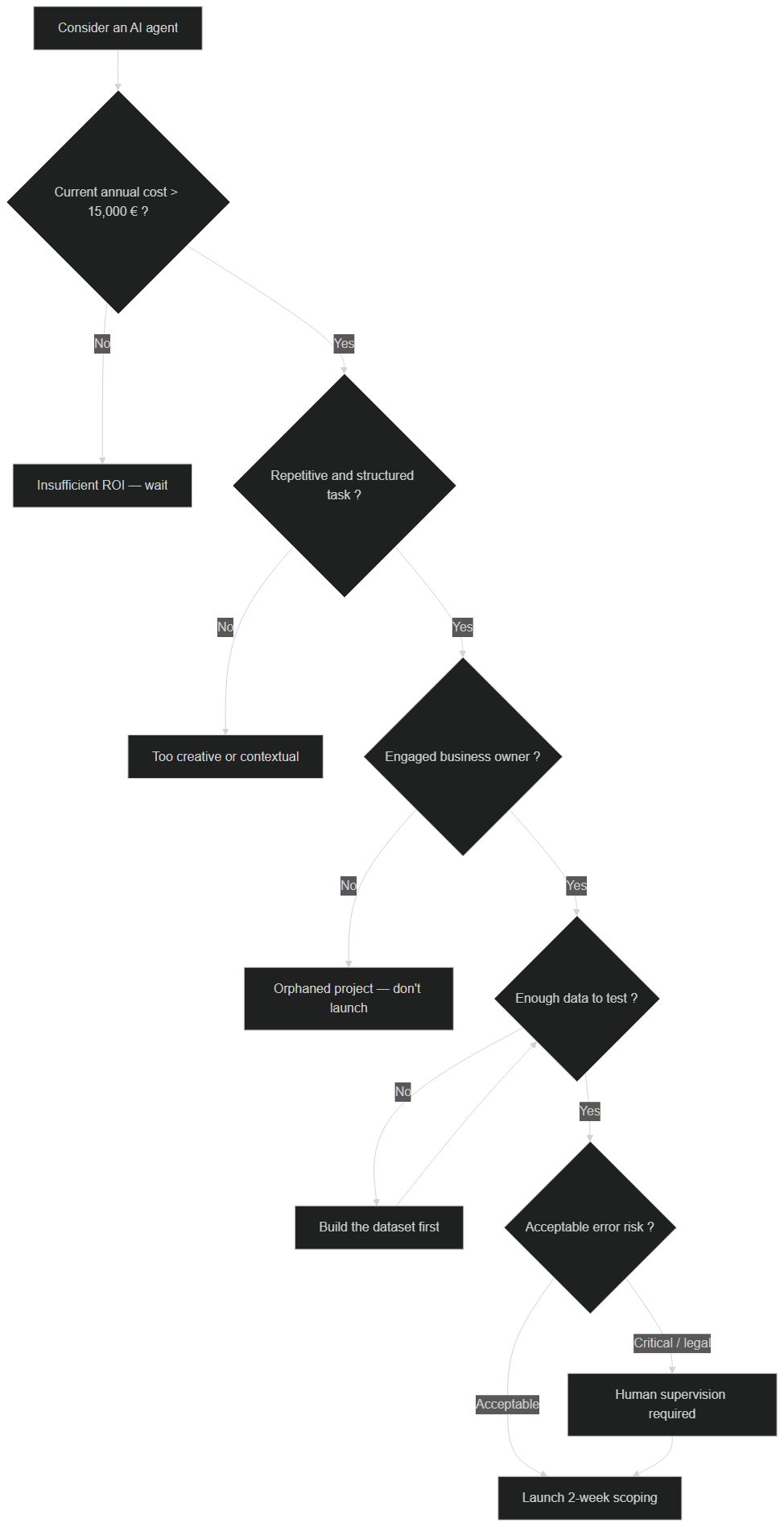 Decision flowchart: criteria to launch or defer a production AI agent — annual cost, task structure, available business owner, sufficient data, acceptable error risk
Blind spots 2026 surveys don't mention
Hidden run cost
Published ROIs almost never include:
- Observability cost (LangFuse, Helicone, Datadog): $100-500/month.
- Continuous ops/improvement time: 0.3 to 1 FTE per production agent.
- Model cost as volume scales: an agent processing 100,000 conversations a month on GPT-5.5 can rack up $9,000-17,000/month in API spend. These costs must be planned at scoping, not discovered after 6 months.
Silent drift
Models evolve. Prompts that worked on GPT-5.4 can degrade to 70% quality on GPT-5.5 due to behavior shifts. Without observability and regression tests, your agent loses 20% efficiency in 6 months unnoticed. The 11% who capture ROI run automated test suites and output quality monitoring at the same level as software unit tests.
Human factor
A technically working agent that teams refuse to use generates zero ROI. Successful deployments systematically include change management: team training, role redefinition, valuing augmented humans (not replaced ones). The 540% ROI is also an organizational success, not just a technical one.
Underestimating maintenance
This is the most common and most painful trap. Teams budget the deployment, forget the maintenance. Yet a production agent does not maintain itself: third-party integrations evolve (CRM APIs, webhooks, auth), models are updated, use cases expand, and regulations change. Based on our experience, maintenance represents 30 to 50% of the initial deployment cost per year — a figure rarely anticipated in initial business plans.
Overestimating day-one gains
ROI does not materialize on day one. The first weeks are learning weeks: the agent processes cases it gets wrong, teams adjust prompts, integrations are retested. Presenting a full ROI in month one of production is like measuring a new employee's productivity in their first week. Real ROI is assessed at 3 months minimum, with an improvement curve that typically stabilizes between months 4 and 6.
How to start without joining the 89%
Three errors to avoid in 2026.
- Don't launch a POC without a named business owner. An orphan POC is dead on arrival.
- Don't buy "turnkey" agentic platforms without scope audit. Most packaged platforms hit under 30% of the value of a custom agent orchestrated on n8n / Make / LangGraph.
- Don't outsource observability to your model vendors. You need your own logs, dashboards, source of truth.
And one good decision to make right now: identify the operational flow in your company that consumes the most human hours on repetitive tasks, measure it in euros, and run a 2-week scoping to assess agentic feasibility. If automation potential exceeds €15,000 in annual costs, the 12-18 month ROI is almost always there.
How BOVO Digital partners with you
We design and ship production AI agents on three perimeters:
- Complex business automations on n8n and Make.com: sales qualification, document processing, CRM ops. See our offer.
- Chatbots and conversational agents on WhatsApp, web, and voice (Vapi). Discover.
- AI-native SaaS on Next.js + Flutter with dedicated analytics dashboards. Browse our work.
Every project includes from scoping: business owner, KPIs in euros, observability (LangFuse / Helicone), multi-model routing, continuous improvement plan. We ship a detailed quote within 24 hours after a free scoping call.
Conclusion
The 171% ROI is real — for the 11% of enterprises that crossed the POC-to-production barrier. For the other 89%, AI remains a cost without return: ChatGPT Pro licenses, tool subscriptions, dead pilots. The difference isn't the model used, nor the tech. It's in execution discipline: business owner, KPIs in euros, observability, multi-model architecture, budgeted maintenance, change management.
Measuring AI agent production ROI is not an exact science, but it is a learnable discipline. The enterprises capturing the 171% are not richer or more tech-savvy than others. They simply decided to treat AI agent deployment as a serious business project — with KPIs, an owner, measurement, and continuous improvement.
In 2026, generic AI is a commodity. The rare skill is turning a POC into a system that runs 24/7 and generates measurable value.
Let's discuss your AI agent project or browse our delivered automations.
Tags
FAQ
Is the 171% AI agent ROI figure reliable?
Yes. It comes from a 500-executive survey by AI Automation Global, confirmed by Technova Partners and Gartner on real production data (not vendor projections). The US average climbs to 192%, and mature enterprises hit 540% over 18 months. But this ROI concentrates on the 11% with real production agents, not the 79% who only ran POCs.
What's the difference between a POC and a production AI agent?
A POC proves an agent can complete a task under favorable conditions. Production guarantees 99.9% reliability, 24/7, on all real cases, with observability (logs, traces, alerting), incident runbook, operational SLA, measured business KPIs, and an engaged business owner. The distance is typically 3 to 6 months of additional work after a successful POC.
How much does it cost to deploy a production AI agent?
For a tightly scoped use case, expect $9,000 to $28,000 for the initial deployment over 8-12 weeks, plus a run cost (models, observability, ops) ranging $330 to $5,500 per month depending on volume. For complex agents (voice, multi-channel, deep CRM/ERP integrations), deployment can climb to $44,000-$90,000.
Which stack should I use for a 2026 production AI agent?
Recommended architecture: orchestrator (n8n, Make.com, or LangGraph), multi-model routing (GPT-5.5 for agentic, DeepSeek V4 for high volume, Claude Opus 4.7 for code), observability (LangFuse or Helicone), storage (Postgres or Supabase), and Next.js front-end if user-facing. Deployed on Vercel or a sovereign cloud per constraints.
How long to go from POC to production AI agent?
Typically 90 days, in 4 phases: business scoping (weeks 1-2), architecture and POC (weeks 3-6), controlled pilot on 10-30% of volume (weeks 7-10), 100% production rollout with executive dashboard and SLA (weeks 11-12). This timeline assumes an available business owner and reasonably standard CRM/ERP integrations.
How to measure the real ROI of a deployed AI agent?
Four critical KPIs: 1) Cost before/after (human hours saved × loaded salary), 2) Volume processed (ops/month × success rate), 3) Conversions generated (bookings, deals closed, tickets resolved), 4) Run cost (API + observability + supervision FTE). ROI = (gains - total cost) / total cost × 100. Measured over 12 months minimum to amortize deployment.
When should you NOT deploy an AI agent?
Six red flags: task too creative or contextual (non-reproducible expert judgment), volume too low (under 50 occurrences/month or under €10,000 annual cost), insufficient or unstructured data, unmastered regulatory requirements (GDPR, EU AI Act, regulated sectors), unstable process changing every week, and no available business owner to champion the project.
We scope one workflow — not a generic demo
You describe a repeated task. We tell you what n8n would ship, the timeline, and what stays out of scope.
- 30 min
- 1 scoped workflow
- No commitment
Singbo Davy AGONMA
Fullstack Developer & AI Expert. n8n automation specialist, Laravel/Flutter development and AI agent integration. Master CS — IFRI.


