
Tech Recap April 7, 2026: CVE Next.js, Vercel IPO Signals, GITEX Africa, and Make Maia
The week of April 7, 2026 was packed: critical Next.js security flaw, Vercel IPO signals, Make.com's AI ecosystem explosion, and GITEX Africa confirming the continent's growing weight in global tech.

Updated

The Busiest Tech Week of the Year (April 7–13, 2026)
The tech news week of April 7, 2026 hit the web development ecosystem like a wave. In just seven days, a critical security flaw forced thousands of teams into emergency patch deployments, Vercel's CEO multiplied public statements about a possible stock market listing, GITEX Africa broke all records in Marrakech, and Make.com officially launched its AI assistant Maia in general access. No time to follow everything? Here is the complete recap of the tech events that defined this week — with full context, technical implications, and what it concretely changes for you.
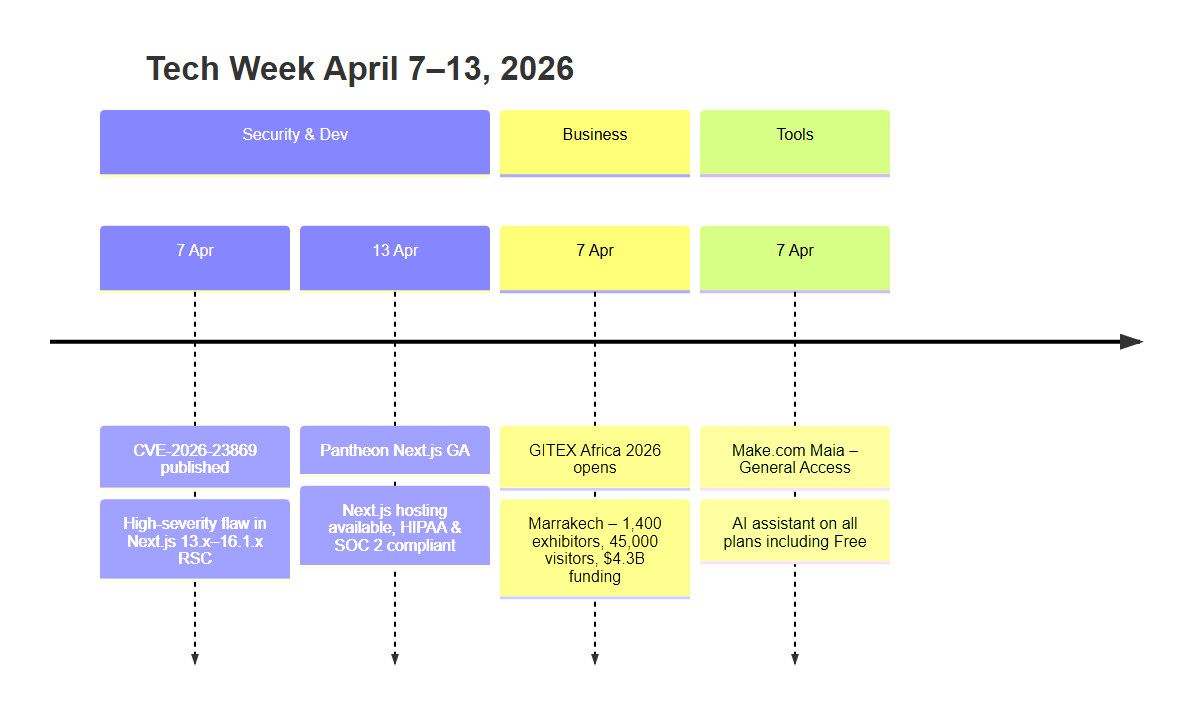 Tech Week April 7–13, 2026: CVE Next.js, GITEX Africa, Make Maia and Pantheon GA
CVE-2026-23869: Understanding the Next.js Security Flaw and How to Respond
What is a CVE and why this one is critical
A CVE (Common Vulnerabilities and Exposures) is a standardized identifier assigned to known security vulnerabilities. CVE-2026-23869 directly concerns React Server Components (RSC) in Next.js versions 13.x through 16.1.x. Its severity is rated high — the level just below critical — which demands a fast response, not a three-sprint planning cycle.
The attack vector is particularly insidious: by sending intentionally malformed HTTP requests to public API routes of a Next.js application using RSC, an attacker can trigger arbitrary server-side code execution. In plain terms: if your application is exposed to the internet with public API routes and RSC enabled, an unauthenticated third party can potentially execute code on your server.
Why React Server Components change the attack surface
With the widespread introduction of RSC in Next.js 13 and their growing maturity in subsequent versions, the boundary between client and server code has become more permeable than ever. It is precisely this power — executing server code directly inside React components — that creates the attack surface exploited by this CVE. Applications that use RSC to fetch data, interact with databases, or call internal APIs are the most exposed.
Purely static applications (generated via next export) have very low risk because they do not serve server-side code at runtime. If your site is a simple portfolio or landing page without a dynamic back-end, you are not the primary target.
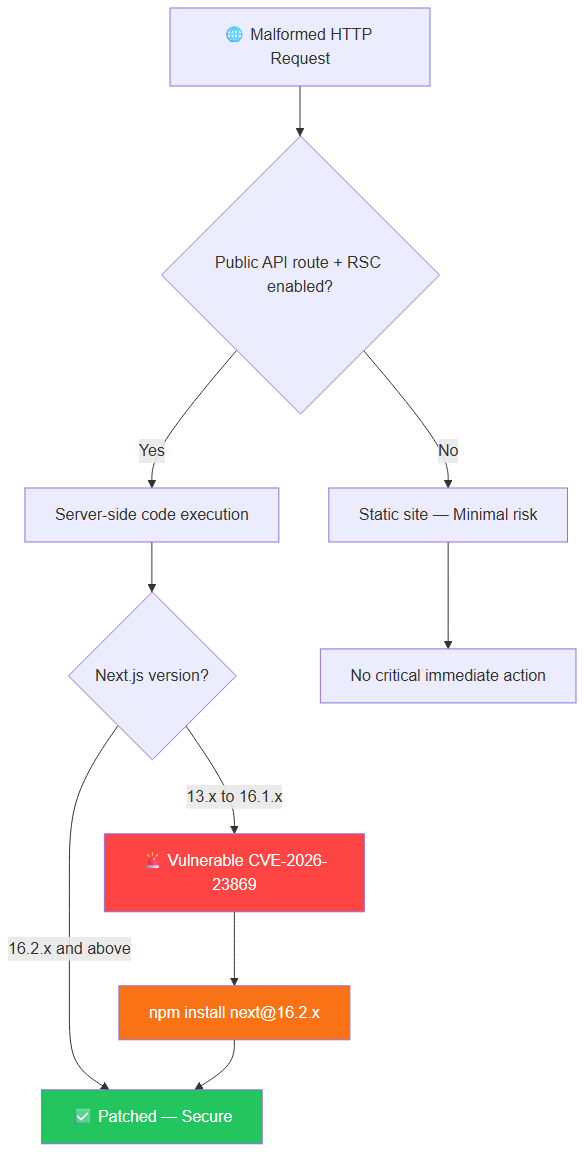 Assessing your exposure to CVE-2026-23869: public API routes + RSC = high risk
What to do — and in what order
The response is simple but non-negotiable. Update Next.js to version 16.2.x, which includes the patch:
npm install next@16.2.x
# or with yarn
yarn upgrade next@16.2.x
If you are still on Next.js 13 or 14, this CVE is an excellent reason to migrate seriously now. Moving to 16.x also brings substantial performance improvements and Developer Experience enhancements. Read our detailed analysis of what changes concretely in Next.js 16.2 to prepare your update confidently.
If an immediate migration is impossible due to architecture or scheduling constraints, adopt temporary mitigation measures: audit your public API routes and add strict validation of incoming requests. You can also place a reverse proxy (Nginx, Cloudflare WAF) upstream to filter malformed requests. These are not permanent solutions — they are safeguards while you prepare the update.
The underlying lesson: security can no longer be optional in continuous deployment
This CVE is a reminder of an uncomfortable reality: modern applications evolve fast, and attack surfaces evolve with them. Automated deployment practices accelerate value delivery but can also accelerate the deployment of vulnerabilities to production. We detailed this risk in our article on security time bombs in automated deployment — recommended reading if your team practices CD without regular security audits.
For a deeper look at classic web vulnerabilities, the OWASP Top Ten 2025 remains the indispensable reference. CVE-2026-23869 falls into the server-side injection category — the first line of the Top Ten for years.
Vercel Is Looking at the Stock Market: Signals, Rumors, and Implications
The context of Guillermo Rauch's statements
This week, Guillermo Rauch, Vercel's CEO, gave several interviews in which he explicitly discussed IPO preparation. He did not announce a date or confirm any formal commitment. His statements remain in the register of strategic signals: "web infrastructure for the AI era has no ceiling," "our revenue growth justifies looking at all long-term financing options." No S-1 has been filed as of the writing of this article. This is a serious rumor, not an official announcement.
What fuels the speculation: Vercel raised $150 million in a Series E in 2023 at a valuation of $3.25 billion. The platform's growth, driven by massive Next.js adoption and AI deployments, has pushed this valuation in private estimates. Rumors suggest an S-1 filing before the end of 2026 for an IPO in early 2027.
Why a publicly traded Vercel changes the rules
For the developer ecosystem, Vercel going public is not simply a financial milestone. It is a change of nature. When critical infrastructure becomes publicly traded, several dynamics kick in:
Pressure on profitability. Financial markets demand margin growth, not just revenue growth. For Vercel, this could translate into pricing revisions, more aggressive segmentation between free and premium plans, or the removal of features currently available on mid-tier plans.
Increased enterprise focus. Stock markets value predictable recurring revenue. Vercel will need to demonstrate its ability to sign long-term enterprise contracts, which may shift its product priorities toward features demanded by large enterprises at the expense of smaller teams' needs.
Heightened competition. The announcement — even partial — has already energized its competitors. The timing of Pantheon's general availability on April 13 is probably not a coincidence. AWS Amplify and Cloudflare Pages have both accelerated their Next.js roadmaps in 2026.
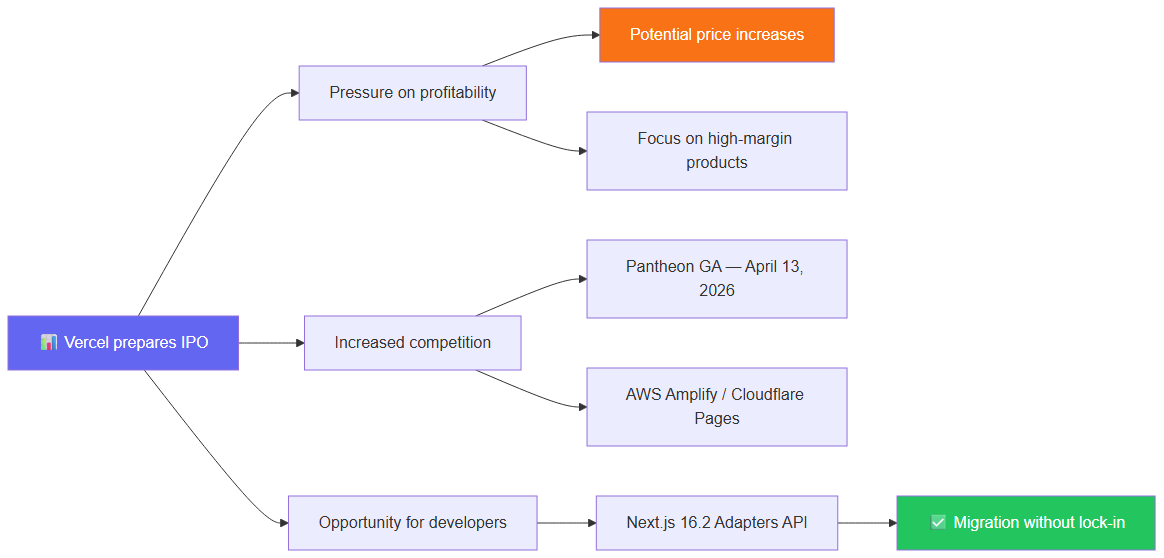 How to prepare your hosting strategy in response to Vercel's IPO signals
What strategy to adopt in the face of this uncertainty
The good news is that Next.js 16.2 introduced the Adapters API, precisely to allow migrating from one hosting provider to another without rewriting code. If you currently use Vercel and want to prepare for a potential pricing change, now is the time to verify that your stack is compatible with the Adapters API and that a migration to Pantheon, Cloudflare Workers, or Railway would be technically feasible in days, not months.
Dependency on a single infrastructure provider — known as vendor lock-in — is one of the most underestimated strategic risks in teams building on Next.js. The signals sent by Vercel this week are an invitation to revisit your hosting architecture with a strategic lens.
GITEX Africa 2026: Marrakech at the Center of the Global Tech Ecosystem
Four years and a radical transformation
GITEX Africa is in its 4th edition. Comparing the 2023 numbers to those of 2026, the progression is staggering. This year, Marrakech hosted from April 7–9 an event that has little left to envy from European and American tech shows:
- 1,400 exhibitors (including 850 startups)
- 45,000 visitors from 130 countries
- $4.3 billion in announced funding
These numbers deserve context. 850 startup exhibitors is more than many reference European conferences. 130 countries represented is a geopolitical reach that far exceeds the African frame. And $4.3 billion in announced funding in three days is a signal that global investors have definitively identified Africa as a strategic terrain.
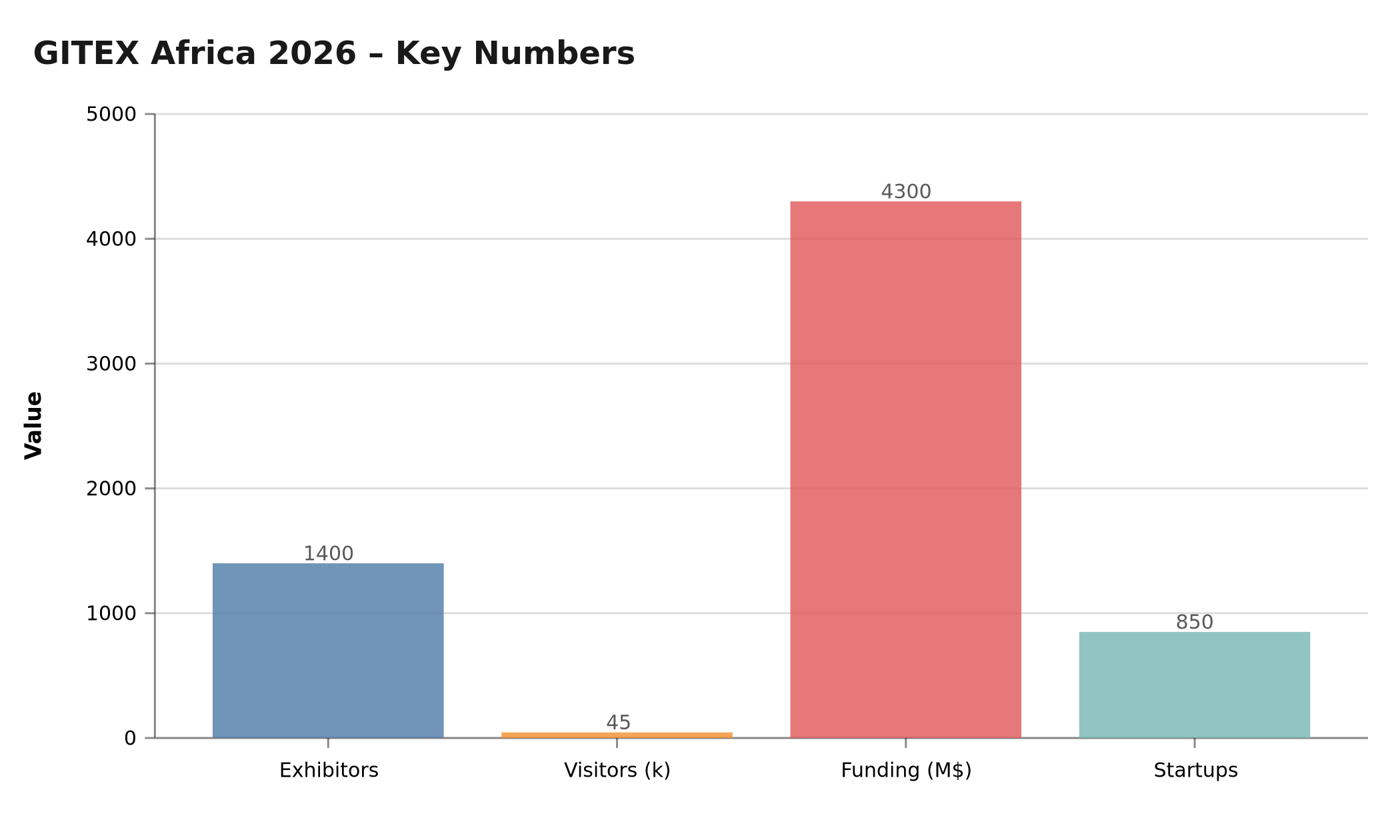 GITEX Africa 2026: 1,400 exhibitors, 45,000 visitors from 130 countries, $4.3B in announced funding
The dominant message: Africa produces tech
The narrative dominating GITEX Africa 2026 is no longer "how to attract foreign investment in Africa" but "how African solutions are exporting internationally." This is a major semantic and strategic pivot. Startups based in Nairobi, Lagos, Dakar, and Casablanca were presenting products aimed at European and American markets — not just local ones.
The theme of digital sovereignty was omnipresent. Facing GAFAM domination of cloud infrastructure, several African sovereign cloud initiatives were on display. To understand the stakes of this digital sovereignty and the opportunities it represents for digital entrepreneurs, see our in-depth analysis of GITEX Africa 2026 and opportunities for the digital entrepreneur.
What this means for developers and entrepreneurs
For developers and entrepreneurs, GITEX Africa represents an opportunity on two levels. First, the African tech market — with its massive mobile adoption rate and fast-growing fintech sector — is one of the fastest-expanding digital markets globally. The addressable market is real and growing. Second, local solutions with regional cultural understanding increasingly outperform global products deployed without adaptation.
If your digital business can address African markets, GITEX Africa is now a strategic appointment to plan — not a geographic curiosity to observe from a distance.
Make.com Launches Maia in General Access: Conversational AI Meets Automation
What exactly is Maia?
Announced in beta in January 2026, Maia is Make.com's conversational AI assistant. On April 7, 2026, it reached general access across all plans, including Free. This is a significant commercial decision: Make.com chooses to include Maia in its free offering, which will massively accelerate adoption and potentially recruit a new generation of users who would never have considered Make.com without this feature.
Concretely, Maia enables three things:
Scenario generation from natural language. You describe what you want to automate in natural language — "send me an email when a new form is submitted on my site and create a row in Airtable" — and Maia generates the complete Make.com scenario, with the appropriate modules, data mappings, and filters.
Automation extraction from a document. You upload a PDF of specifications or functional requirements, and Maia extracts the relevant automation steps to propose a scenario architecture. This is particularly useful for consultants and agencies working with clients who have detailed specs.
Revision of existing scenarios through conversation. You can point to an existing scenario and ask Maia to improve it, add error handling, or optimize it to reduce operation consumption.
Maia vs n8n: BOVO Digital verdict
The question our clients ask immediately is: does Maia make n8n obsolete for building automations?
The short answer: no. The longer answer: it depends on your context.
Make.com with Maia shines on simple to medium automations: connecting two or three SaaS services, automating notifications, creating recurring reports, managing leads. Natural language generation works very well in these cases. Make.com's visual interface, already excellent, becomes even more accessible with Maia as a guide.
n8n retains the advantage on complex architectures: multi-AI-agent orchestration, conditional workflows with advanced business logic, self-hosting for GDPR compliance reasons, and code customization via JavaScript in Function nodes. If you are building automation systems for enterprise clients with specific constraints, n8n is still the superior technical choice.
The real question is not "which one is better" but "which one is most adapted to your use case and technical level." Make.com + Maia is an excellent combination for onboarding non-developers into automation. n8n remains the Swiss Army knife for advanced technical teams.
Pantheon Next.js: General Availability Reshapes the Hosting Market
What Pantheon's GA really means
On April 13, 2026, Pantheon announced the general availability (GA) of its Next.js hosting offering. This announcement is strategically timed at the end of a week in which Vercel raised concerns about its post-IPO future. That timing is not a coincidence.
Pantheon differentiates from Vercel on three key axes. First, native WordPress + Drupal + Next.js support on a single platform: if your organization manages both traditional CMS sites and modern Next.js applications, Pantheon unifies hosting under a single contract, a single dashboard, and a single commercial contact. This is a very strong value proposition for web agencies.
Second, predictable pricing. Unlike Vercel's usage-based pricing, which can deliver surprises on the end-of-month bill, Pantheon offers fixed-price plans. For public, non-profit, or growth-stage startup projects, budget predictability is not a detail — it is an operational constraint.
Third, HIPAA and SOC 2 Type II compliance opens markets that Vercel cannot address. Healthcare projects, medical data platforms, applications used in public institutions subject to security audits — all these cases require certifications that Pantheon offers and that Vercel does not yet provide on its standard plans.
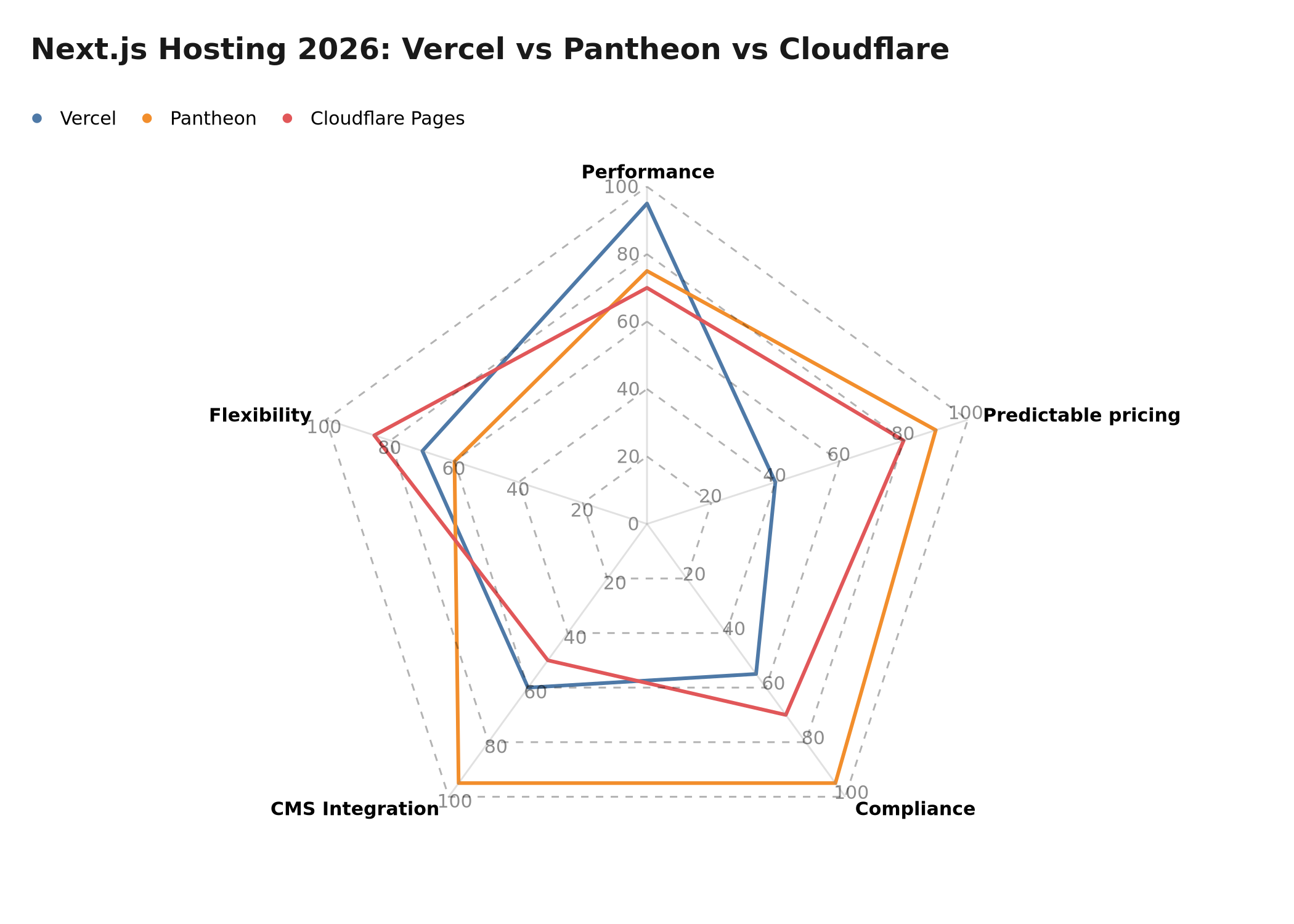 Comparing Next.js hosting platforms: performance, pricing, compliance, and CMS integration
Key Numbers of the Tech Week of April 7, 2026
The contextual data from this week paints a picture of the state of the tech industry in 2026:
| Indicator | Value | What it says |
|---|---|---|
| Active French AI startups | 1,114 | France is the 3rd largest AI ecosystem in Europe |
| % French using AI (pro or personal) | 48% | Nearly half — adoption is mainstream |
| Make.com operations processed in March 2026 | 2.1 billion | No-code automation has exploded |
| Publicly available MCP Servers | 180+ | AI interoperability is accelerating |
The 1,114 active French AI startups figure is particularly significant. In 2024, this number was around 600. Doubled in two years — driven by government announcements around the France 2030 plan and the democratization of OpenAI, Anthropic, and Mistral APIs. The market has densified considerably, which also means competition for the same clients is intensifying.
The 48% of French using AI — based on market research available at that time — marks an important psychological threshold. AI is no longer a niche tool for early adopters. It is a daily habit for nearly one in two French people. For developers and entrepreneurs building products, ignoring this reality is no longer an option.
Week Trends: What These Announcements Reveal About the Market
This week concentrates three underlying trends worth naming explicitly.
First trend: RSC security is not yet mature. CVE-2026-23869 is the second significant vulnerability related to React Server Components in less than 18 months. This is not a coincidence. RSC is a powerful but relatively young technology, and security patterns around client/server boundaries are still stabilizing. Teams adopting advanced RSC architectures must invest more in regular security audits and active CVE monitoring for their stack.
Second trend: the Next.js hosting market is entering a phase of competitive consolidation. For years, Vercel dominated without a real challenger. The arrival of Pantheon GA, combined with Cloudflare Workers' and AWS Amplify's efforts on Next.js, indicates that Vercel's hegemony is being challenged seriously for the first time. For developers and architects, this is good news: more choice, more pressure on pricing and features.
Third trend: conversational AI is integrating into no-code and low-code tools. Maia is not a gimmick. It is the materialization of a paradigm shift: automation tools are no longer addressing only developers or power users who master visual interfaces. They are addressing all professionals capable of describing what they want to do in natural language. This democratization will massively accelerate the adoption of automation tools in small and medium businesses.
What This Changes for Your Web Stack in 2026
Depending on your profile, the lessons from this week differ.
If you are a full-stack developer or tech lead: the urgency is on the CVE. Audit your Next.js versions this week. Set up an automated CVE monitoring process if you have not already — tools like Snyk, Dependabot, or the GitHub CVE database can send automatic alerts. Then, think about your hosting strategy over a 12–18 month horizon integrating the scenario of a Vercel pricing evolution post-IPO.
If you run a web agency: Pantheon GA deserves a serious evaluation, especially if you manage projects for public sector institutions or healthcare actors. Predictable pricing is also a strong selling argument with clients who struggle to understand Vercel's variable bills.
If you are a digital entrepreneur or startup founder: test Maia now. Open Make.com, create a Free account if you do not have one, and try describing in natural language an automation you have always wanted to set up. You will be surprised by the quality of the result for simple use cases. The time saved on repetitive tasks can be reinvested in your product or your clients.
If you operate in Africa or target African markets: GITEX Africa 2026 may have passed you by this year. Do not miss the next edition. It is today the best place to meet investors, partners, and potential clients in a world-class African tech context.
Lessons to Take Away from the Week of April 7, 2026
Five takeaways to keep in mind after this packed week:
1. Emergency patching is not optional — it is a responsibility. CVE-2026-23869 is a reminder that technical security debt can be paid instantly, and maintaining outdated dependencies is not neutral.
2. Pricing stability of your hosting must be a selection criterion. Before choosing a hosting platform solely on its performance, evaluate its long-term pricing structure and the realistic existence of alternatives in case of change.
3. AI in no-code tools is no longer a promise — it is an operational reality. Maia in general access proves that generative AI has reached everyday professional tools. Ignoring this wave is at your own risk.
4. African tech is no longer emerging — it is competing. GITEX Africa 2026 confirmed this with record numbers. Updating your view of the African market is urgent.
5. Diversifying your critical dependencies is a strategy, not a luxury. Between Vercel's IPO signals and the Next.js CVE, this week demonstrated that an overly concentrated web stack is a fragile stack. Resilience requires diversity of providers and migration capability.
What Tech News Should You Watch Next Week?
- Anthropic should announce a major Claude Opus update (Opus 5 rumors)
- Google I/O 2026 (announced for late April): Gemini 3.1 Ultra and deep Android integration
- Open Source AI Summit in Brussels: open-source AI regulation on the agenda
Want to receive this recap every week directly in your inbox? Subscribe to our newsletter.
And if any of these developments impact your business, the BOVO Digital team is available to discuss.
Tags
FAQ
Does CVE-2026-23869 affect all Next.js sites?
It affects Next.js 13.x through 16.1.x using React Server Components with public API routes. Purely static sites (static export) have very low risk. Updating to 16.2.x fixes the flaw.
Will Vercel really IPO in 2026?
The signals are strong (CEO statements, recent funding round), but no date is official. Rumor has it an S-1 could be filed before end of 2026 for an IPO in early 2027. This is not an official announcement.
Is Make Maia really free?
The Maia assistant is accessible on all Make.com plans including Free. Operations generated by scenarios created via Maia count toward your monthly quota (1,000 free ops/month).
What is the difference between Vercel and Pantheon for hosting a Next.js project?
Vercel offers the best overall performance and native Next.js integration, but its usage-based pricing can be unpredictable. Pantheon offers fixed pricing, HIPAA and SOC 2 Type II compliance, and native WordPress and Drupal support alongside Next.js. Pantheon is ideal for public sector and healthcare projects; Vercel for startups and product teams.
Why does GITEX Africa 2026 matter for developers and entrepreneurs?
GITEX Africa 2026 in Marrakech gathered 1,400 exhibitors, 45,000 visitors from 130 countries, and announced $4.3 billion in funding. It is the continent's largest tech event and a strong signal that Africa is now a producer of tech solutions, not just a consumer. For developers and entrepreneurs targeting African markets, it is a strategic event to attend.
Free audit: we check the impact on your site and workflows
Next.js CVE, new agent, MCP… We tell you what actually applies, and what to patch or ignore.
- 30 min
- Stack reviewed
- No commitment
William Aklamavo
Web development and automation expert, passionate about technological innovation and digital entrepreneurship.


