
The Pentagon and AI: Why Google and NVIDIA Said Yes, Anthropic No
On May 1, 2026, the Pentagon officially announced 7 AI partners including OpenAI, Google and NVIDIA — but not Anthropic. This decision reveals deep fractures in the AI industry on values, responsibility, and the future of military AI.

Updated

The Pentagon and AI: Why Google and NVIDIA Said Yes, Anthropic No
On May 1, 2026, when the US Department of Defense officially announced seven AI partners for its military technology acceleration program, the absence of Anthropic from the list triggered a debate that goes far beyond a simple commercial agreement. OpenAI, Google DeepMind, NVIDIA, Microsoft, SpaceX, Reflection AI, and AWS were among the signatories — but not the creator of Claude. This decision crystallizes a deep fracture in the military AI industry: who decides how these technologies can be used, and at what ethical cost? For entrepreneurs, developers, and decision-makers who build their products on large language models, this divide will durably reshape their vendor selection criteria and, potentially, their own market reputation.
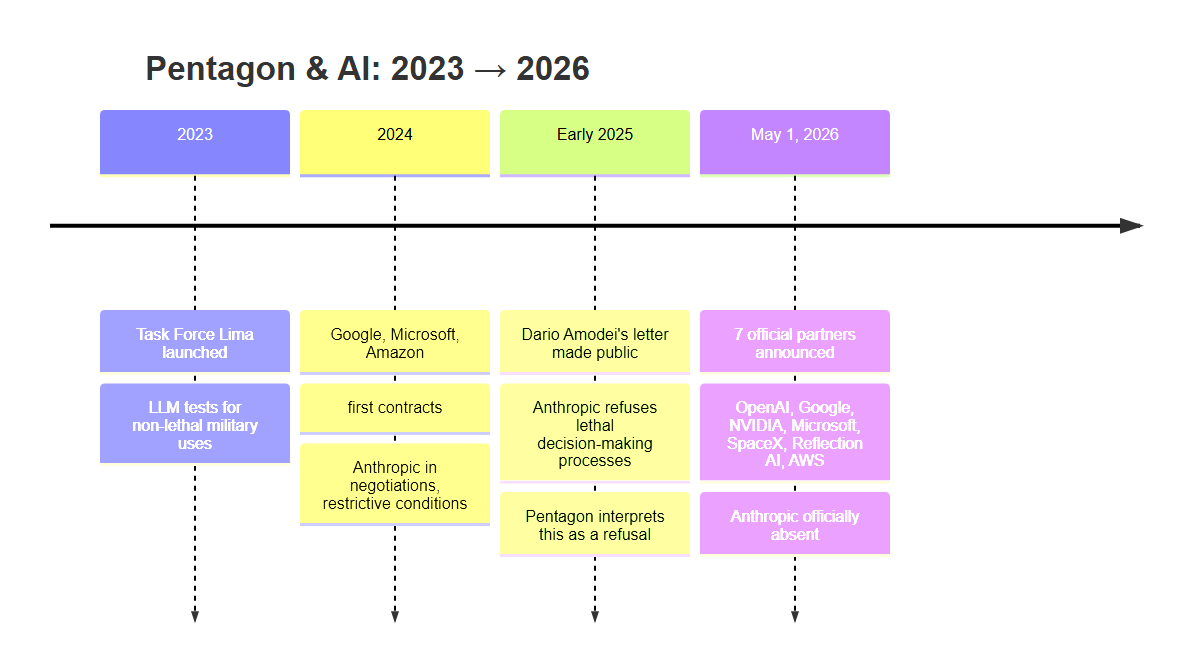 From Task Force Lima (2023) to the announcement of 7 partners on May 1, 2026
Historical Context: From Project Maven 2018 to the 2026 Turning Point
To understand the full significance of the May 1, 2026 agreement, we need to go back to 2018 — the year that marked the first major ethical crisis for AI in the military domain. Project Maven, launched by the Pentagon in 2017, aimed to use computer vision algorithms to analyze imagery from military drones, automating the detection and classification of potential targets. Google had signed a contract worth approximately $9 million to provide TensorFlow technology to the program. When the details became public, more than 3,100 Google employees signed an internal petition demanding that the company "not be in the business of war." A dozen engineers resigned in protest. Under this unprecedented pressure, Google announced in June 2018 that it would not renew the Maven contract upon its expiration.
This withdrawal had lasting consequences. On one hand, it sent a powerful signal to the entire tech industry: employees have the power to block government contracts they consider contrary to their values. On the other hand, it fed a growing perception within the Pentagon that major civilian tech companies could not be reliable long-term partners — a perception that the 2026 events would definitively overturn. In the years following Maven, Google did not abandon its government sector relationships but carefully redefined the boundaries of those collaborations, explicitly excluding direct lethal applications.
Between 2019 and 2022, the landscape of military AI contracts continued to evolve around the major cloud players. The legal battle over the JEDI contract (Joint Enterprise Defense Infrastructure), contested between Microsoft and Amazon for several billion dollars, demonstrated the Pentagon's colossal appetite for large-scale cloud infrastructure. It was only in 2023, with the launch of the "Task Force Lima" program, that the Department of Defense created a dedicated structure for the systematic evaluation of LLMs for concrete military applications. Initial tests focused on non-lethal use cases — analysis report synthesis, intercepted communication translation, satellite data correlation — but the declared ambitions went much further.
In 2024, Google, Microsoft, and Amazon signed first contracts for access to their models for non-classified intelligence applications. Anthropic was in discussions but its negotiators imposed restrictive conditions that quickly crystallized the disagreement. In early 2025, the incident became public: Dario Amodei, Anthropic's CEO, reportedly wrote an internal letter stating that Anthropic "cannot guarantee that Claude will not be used for automated lethal decision-making processes." The Pentagon interpreted this as a categorical refusal. On May 1, 2026, the definitive list of seven partners was announced — without Anthropic.
Google's Return: From Maven to 2026, an Arc-Shaped Trajectory
How do we explain Google's return to the Pentagon's fold, eight years after the Maven debacle? The answer lies in a conjunction of economic, geopolitical, and internal factors that would be reductive to attribute to simple profit-seeking. Since 2018, the AI market configuration has radically changed. China has massively invested in military AI — the Chinese government has allocated tens of billions of dollars to defensive and offensive artificial intelligence programs, with companies like Huawei and Baidu closely collaborating with the People's Liberation Army. Faced with this geopolitical context, the internal discourse at Alphabet evolved: refusing to collaborate with the Pentagon doesn't "neutralize" the technology — it simply means adversaries of the West advance without an American counterpart.
On the internal front, shareholder and board pressure also played a role. US government contracts represent billions of dollars in recurring revenue, with high margins and multi-year durations. Sundar Pichai, Alphabet's CEO, progressively aligned the company's strategy around the idea that "responsible defensive technology" is compatible with Google's values — provided robust contractual safeguards are in place.
This time, Google imposed significant conditions in its Pentagon agreement. Based on our analysis of available information, applications are limited to intelligence data synthesis, logistical decision support, and satellite imagery analysis for defensive purposes — not autonomous weapons systems or direct targeting processes. These contractual safeguards are not publicly verifiable, which partly explains the persistent skepticism of some engineers within the company. But they illustrate an evolution in discourse: this is no longer an unconditional collaboration, but a partnership with defined usage perimeters.
NVIDIA: The Infrastructure Provider Role
NVIDIA's participation deserves separate analysis, because it rests on a fundamentally different logic than Google's or OpenAI's. Jensen Huang has consistently maintained a clear position: NVIDIA manufactures GPUs and develops inference microservices (NIM), not decision models. The analogy is that of a processor manufacturer selling its chips to the military to equip military computers — it is not responsible for the software that will run on them, nor for the decisions made using those systems.
This position is philosophically coherent, but it raises a fundamental question: can infrastructure be separated from the content it supports? In the physical world, a weapons manufacturer is responsible for the lethal nature of their product even if they don't control who pulls the trigger. In the AI world, the boundary between "infrastructure" and "decision-making capability" is far more porous. NVIDIA's GPUs are not neutral: they enable inference of models that process sensitive data and, potentially, formulate recommendations in contexts with life-or-death stakes. This is precisely the grey area that the military AI debate seeks to clarify.
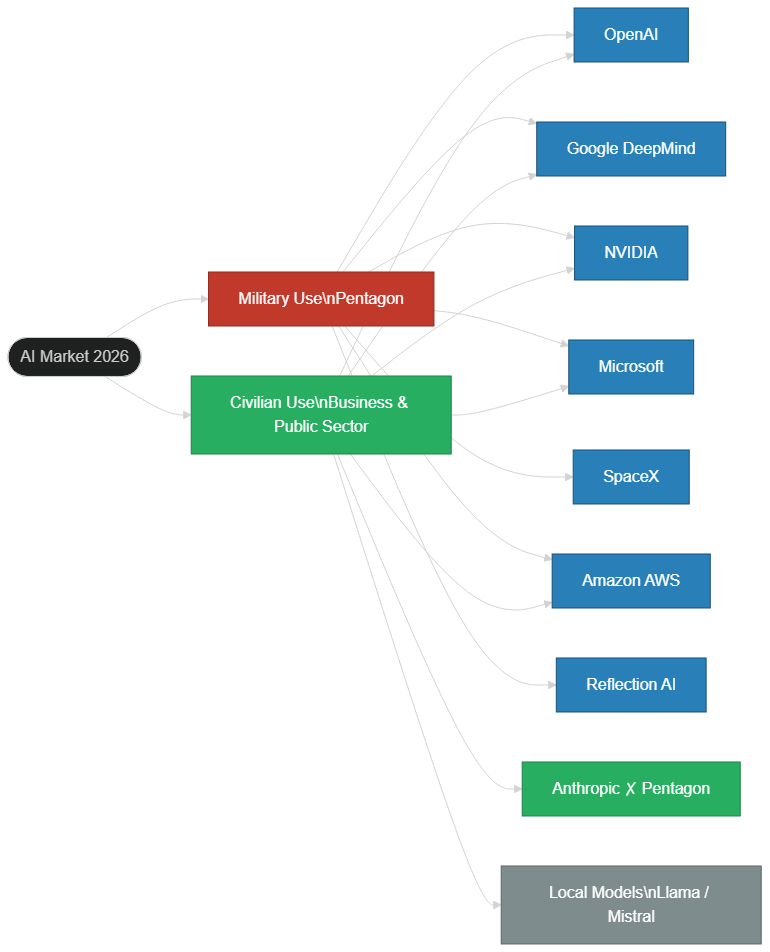 Who plays in both camps? Who remains exclusively civilian?
Analysis of the Seven Signatory Companies
The seven companies that said yes to the Pentagon don't all have the same motivations, and it would be simplistic to treat them as a monolithic bloc.
OpenAI was the most direct in its positioning. Sam Altman clearly communicated that the organization "is not a pacifist company" and that government contracts are legitimate as long as safeguards exist. The agreement includes "human-in-the-loop" clauses for high-impact decisions, meaning no automated decision can be executed without intermediate human validation. How these clauses will be applied in operational contexts under time pressure remains to be seen.
SpaceX represents a particular case: AI integration into Starlink satellite communication systems had already been underway for several years. The Pentagon agreement merely formalizes and extends an already operational collaboration. The Starlink network has already been used by Ukrainian forces since 2022 — the 2026 agreement thus represents logical continuity rather than a rupture.
Microsoft already has Azure Government Cloud, certified for classified US data before this agreement. Extending AI capabilities in that environment is technically and contractually simpler than for other signatories — it's an integration into an existing ecosystem rather than a new collaboration.
Reflection AI and AWS complete the list with their respective specializations: Reflection AI in complex reasoning models, AWS in large-scale deployment infrastructure within secure government environments.
 OpenAI, Google, NVIDIA, Microsoft, SpaceX, Reflection AI, AWS sign — Anthropic absent
Why Anthropic Refused: Deep Analysis of Its Constitutive Positioning
Anthropic was founded in 2021 by Dario Amodei, Daniela Amodei, and several former OpenAI researchers who felt their former employer was taking reckless risks with AI safety. From its inception, the company distinguished itself through an approach called "Constitutional AI" — a framework in which the model learns to self-critique according to explicitly defined ethical principles. This philosophy is not merely a marketing argument: it is embedded in the architecture of Claude's training itself.
Anthropic's Acceptable Use Policy explicitly prohibits several categories of applications: mass surveillance, autonomous weapons systems, disinformation for military purposes, and more broadly any use likely to cause physical harm to individuals without adequate human oversight. The refusal of the Pentagon contract is therefore not a one-time decision made under pressure — it is the logical and predictable consequence of this policy, applied consistently since the company's founding.
What makes Anthropic's positioning particularly interesting is that it exposes a fundamental tension in the AI industry. All major players claim to work "for the benefit of humanity," but this vague formula plays out very differently depending on whether you believe US national security is a global public good or whether you consider lethal autonomous technologies to constitute a systemic threat. Anthropic has explicitly sided with the latter interpretation — and accepts the commercial consequences of this choice, including exclusion from billions of dollars in US government contracts.
For a deeper look at the internal tensions behind this decision, see our analysis Anthropic vs Pentagon: When AI Refuses War.
The Ethical Debate: Autonomous Weapons, International Law, and Accountability
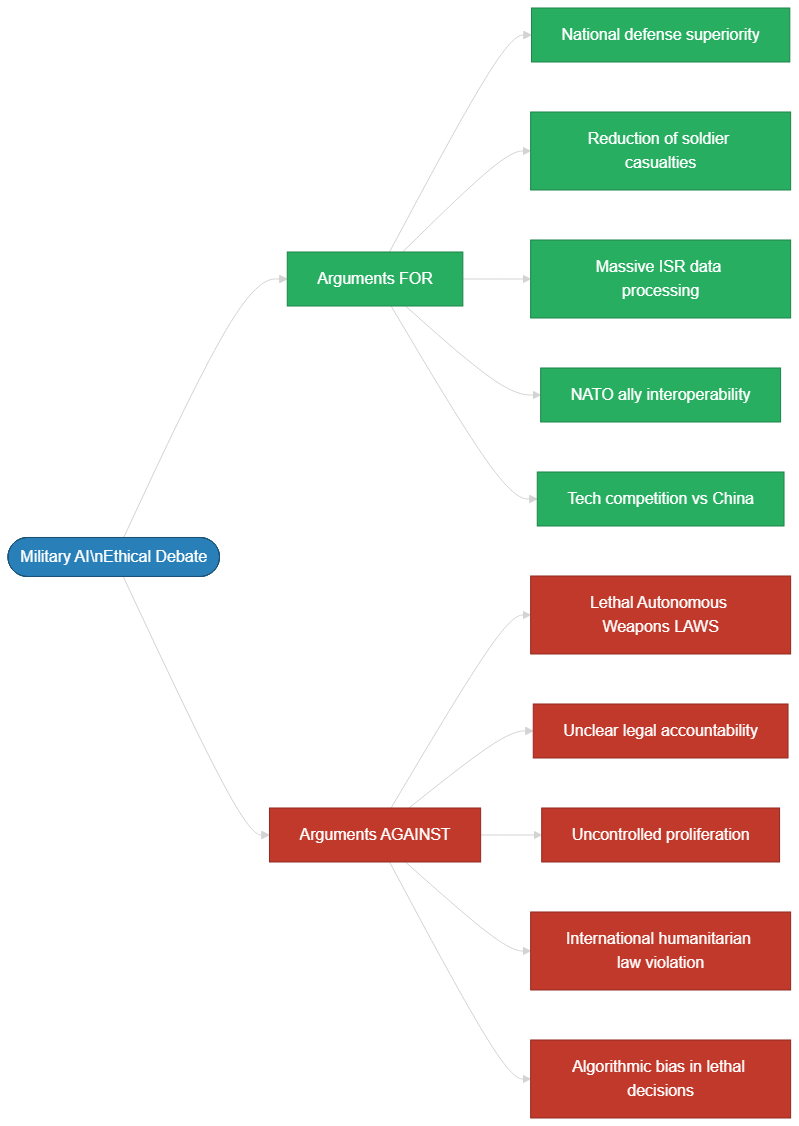 The five key arguments on each side of the military AI debate
The heart of the disagreement between Anthropic and the Pentagon signatories lies in a domain that international lawyers call "meaningful human control" over lethal decisions. This concept is central to ongoing international negotiations on LAWS — Lethal Autonomous Weapons Systems. A drone that automatically identifies a target and decides to engage it without human intervention is a LAWS. The question is not theoretical: systems with capabilities approaching this definition already exist, notably in certain anti-missile defense systems and border surveillance systems.
International humanitarian law (IHL) rests on three fundamental principles that any weapon — including AI-powered autonomous weapons — is supposed to respect: the principle of distinction (differentiating combatants from civilians), the principle of proportionality (avoiding civilian casualties excessive relative to the expected military advantage), and the principle of precaution (taking all feasible measures to minimize civilian harm). An AI, however sophisticated, can make errors in these distinctions — and the stakes here are literally vital. A misclassification error in a combat context can mean the death of innocent civilians.
Legal accountability is the other blind spot of this debate. If an AI makes a lethal error, who is responsible: the engineer who designed the algorithm? The company that sold it? The military commander who authorized its deployment? The soldier who pressed the "activate" button? Current international law has no clear answer to this question — creating what lawyers call an "accountability gap" that could be catastrophically exploited. This gap is precisely what Anthropic's decision seeks not to deepen further.
It would be unfair not to present the other side's arguments. Proponents of military AI argue that AI-guided weapons can be more precise than human decisions made under combat stress — potentially reducing civilian "collateral damage." They also point out that geopolitical competition with powers that develop their own LAWS (notably China and Russia) makes unilateral disarmament by Western democracies potentially counterproductive from a security standpoint. These arguments are serious and deserve consideration — even if, in our analysis, they do not resolve the fundamental problem of legal accountability and meaningful human control.
AI Defense Budget: The Technological Arms Race
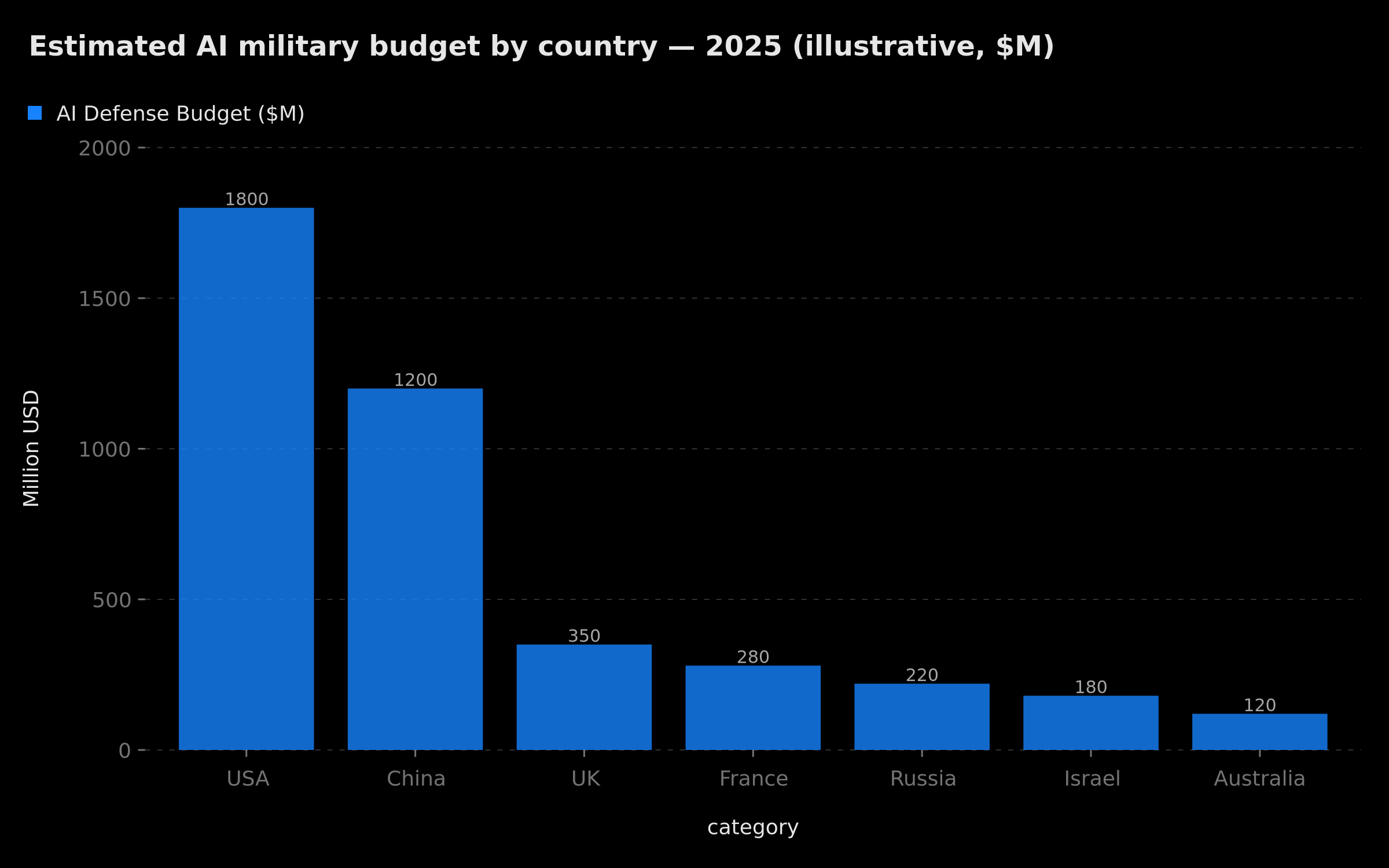 The US and China dominate military AI investment
The scale of military AI investments illustrates why major technology companies struggle to resist the temptation to participate. The United States devotes, according to our analysis of publicly available data, several billion dollars annually to military AI programs — Task Force Lima being just one of many initiatives. China is not far behind, with massive defense AI investments integrated into its national industrial policy. This technological arms race creates systemic pressure on companies: refusing to participate doesn't stop AI armament — it simply cedes the field to less scrupulous actors or adversary powers.
This economic reality creates a genuine moral dilemma that simplistic narratives on either side fail to capture. Companies that refuse military contracts are not necessarily making the world safer — they may simply be abdicating influence over how military AI is developed and constrained. Conversely, companies that participate are not necessarily building a safer future — they may be accelerating a race toward autonomous lethal systems that will ultimately escape the very safeguards they claim to be implementing.
Impact on User and Business Client Trust
The Pentagon agreement immediately raised practical questions from commercial users of GPT-5, Gemini, and other concerned models. The most frequent question: does my professional data transit through the same systems used for military applications? The official answer from Google and OpenAI is no — military classified environments operate on distinct instances hermetically separated from commercial infrastructure. In practice, this isolation is difficult to audit externally, leaving a margin of uncertainty that companies in sensitive sectors cannot ignore.
For NGOs, human rights organizations, and independent media outlets that had been using GPT-5 or Gemini, the agreement creates powerful symbolic discomfort. Using the tools of a company that officially collaborates with the US military can create tensions with their own stakeholders, donors, or organizational mission. This is not a data security question — it's a values coherence question. For this client segment, Anthropic's Claude becomes mechanically more attractive.
For European B2B companies, the question is more nuanced. The EU AI Act has been progressively entering into force since 2024, imposing transparency and documentation obligations on users of high-risk AI systems. Even if classified military applications are technically distinct, the existence of official agreements between an AI provider and a military can complicate the compliance documentation of a European company using that same provider to process sensitive data. This is a reputational and compliance risk to anticipate, not ignore.
To explore how to avoid risks related to poorly chosen AI vendors, our guide Avoiding AI Hallucinations: Complete Enterprise Guide offers a vendor selection and validation framework applicable to any provider.
How Entrepreneurs and Developers Should Position Themselves
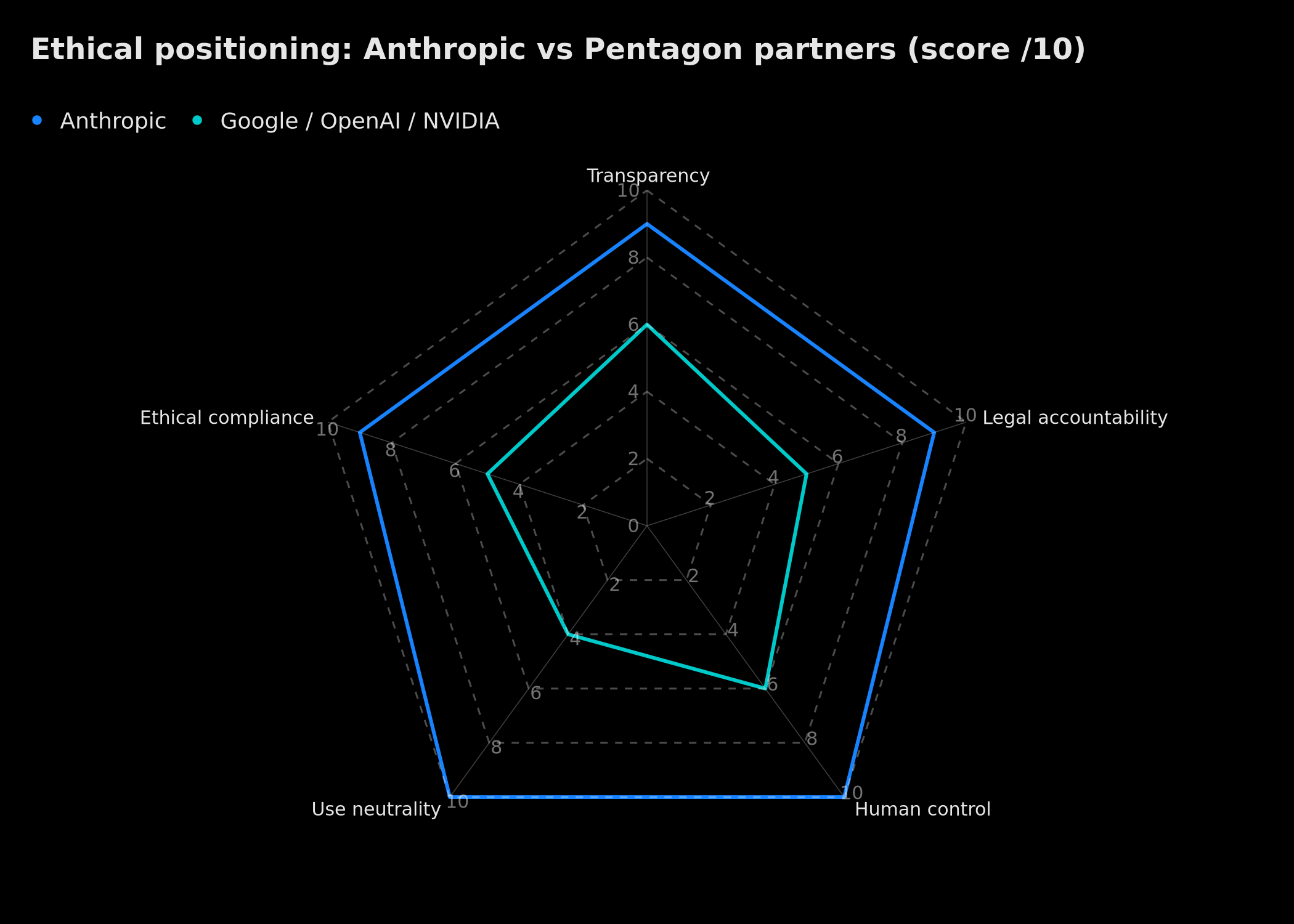 Multi-dimensional ethical comparison: Anthropic maintains a clear advantage on use neutrality
Faced with this market bifurcation, how should developers and entrepreneurs navigate? The first mistake would be to treat this debate as purely theoretical and distant from daily reality. Choosing an AI provider has become a strategic decision with concrete reputational, legal, and ethical implications.
If you use GPT-5, Gemini, or one of the seven signatories' models, your commercial terms of service have not changed. The military agreement concerns isolated environments that have no direct impact on your API access. But if your client operates in a sensitive sector — healthcare, civil defense, law, investigative journalism, humanitarian support — and requires guarantees on your AI provider's neutrality, you will need to document your technical stack choice and justify why you consider the environmental isolation sufficient. This documentation is no longer optional in European public procurement.
If you use Anthropic's Claude, the Pentagon refusal decision becomes a commercial argument you can explicitly claim with certain clients. It's not an advantage in every market — but in markets where the ethical neutrality of the provider is an evaluation criterion, it can make the difference between winning and losing a contract. This is typically the case in European public sector procurement, international foundations, and companies that have their own ESG commitments to honor.
If you use local models — Llama 3, Mistral via Ollama, or other open-source models deployed on your own infrastructure — you are completely agnostic to these debates. Your data transits through none of the seven signatories, and your technical stack is sovereign by design. This is the most neutral position, but also the most expensive in terms of infrastructure and internal competencies to maintain. The decision to go this route depends on your data sensitivity and your tolerance for reputational risk.
Regardless of your current situation, we recommend documenting your AI selection policy now. This means: identifying the use cases for which you use each model, documenting the criteria that guided your choice, and regularly reviewing this documentation as the landscape of industrial partnerships evolves. This is not just a compliance question — it's a credibility question vis-à-vis your clients.
To understand how the most successful startups and agencies structure their AI strategy, see our analysis Why 68% of Funded Startups Put AI at the Core of Their Strategy.
Implications for the AI Market: The Lasting Bifurcation
The May 1, 2026 agreement is not a conjunctural anomaly — it is the marker of a structural bifurcation in the AI market that will deepen in coming years. Two distinct ecosystems are progressively emerging: on one side, "universal" providers that serve both civilian and military markets, with colossal usage volumes and revenues but less constraining use guarantees; on the other, "constrained" providers that have chosen to forego military contracts in exchange for differentiated positioning in sensitive and regulated markets.
This bifurcation will influence valuations and investment strategies. Anthropic, with its restrictive policy, will probably never match OpenAI's or Google's revenues in the sole US government AI market. But its valuation rests on a growing niche of clients who pay specifically for ethical certainty — a premium that ESG (Environmental, Social, Governance) investors will be increasingly inclined to value. In our analysis, this segment represents an addressable market of at least several tens of billions of dollars globally, particularly in Europe and in emerging markets adopting strict regulatory frameworks.
The bifurcation will also push toward the emergence of sector standards. Organizations like IEEE, ISO, and sector consortiums will progressively define "ethical AI" certifications that will allow buyers to differentiate providers based on objective criteria rather than mere declarations of intent. These certifications, still embryonic in 2026, will likely become contractual requirements in the European public sector by 2028-2030.
The models war we observe in 2026 between different actors unfolds within this broader context. For a detailed analysis of respective technical performances, see our comparison DeepSeek V4 vs GPT-5.5: The 2026 Open-Closed AI War.
Implications for European Regulation
The Pentagon-AI agreement arrives in a particular European regulatory context. The EU AI Act explicitly classifies "lethal autonomous weapons systems" as prohibited AI applications within the European Union. This prohibition is theoretically robust — but it applies to European territory, not to the practices of US companies in their own market. What the Pentagon agreement concretely raises for European companies is a question of systemic reputation and compliance: by using GPT-5 or Gemini for your own civilian applications, you remain outside the perimeter of the military applications concerned. But you indirectly contribute to the revenues and R&D capacity of companies that officially participate in military programs.
This nuance may seem subtle, but it is already being taken into account by some large European contracting authorities in their procurement processes. "AI provider neutrality" clauses are beginning to appear in French, German, and Dutch public contracts — requiring service providers to document the military partnerships of their technology suppliers and justify why this doesn't compromise the project's compliance. This is not yet the norm, but the trend is clear.
For European companies that process sensitive personal data with commercial LLMs, the recommendation is to integrate this question into your GDPR impact assessment: document your provider choice, the isolation guarantees obtained or verified, and your regular reassessment policy. This documentation is both legal protection and a signal of maturity toward your clients.
Perspectives: Toward International Regulation of Military AI?
The question looming over the next few years is that of international governance of military AI. Multilateral processes already exist — the Convention on Certain Conventional Weapons (CCW) at the UN has been discussing LAWS since 2014 — but without resulting in a binding treaty. The international "Stop Killer Robots" campaign, supported by hundreds of civil society organizations, advocates for an international treaty banning lethal autonomous weapons, but faces opposition from the United States, China, and Russia, which consider these technologies strategically essential.
In our analysis, two scenarios are plausible by the 2030 horizon. In the first, national regulatory pressures — EU AI Act, British, Australian regulations — create a "compliance market" that pushes large companies to differentiate on ethical criteria, strengthening Anthropic's position and creating incentives for stricter safeguard adoption. In the second, accelerated geopolitical competition between the US and China creates an AI arms race whose negative externalities quickly exceed national regulatory capacity, making a multilateral agreement increasingly urgent but increasingly unlikely in the short term.
What is certain is that Anthropic's May 1, 2026 decision is not the last chapter of this story — it's the beginning of a bifurcation whose consequences will unfold over at least a decade. Entrepreneurs, developers, and decision-makers who anticipate this evolution will have a considerable strategic advantage over those who continue to treat LLM selection as a purely technical decision.
At BOVO Digital, we choose our AI partners based on each project: local models for sensitive data, cloud for high volumes, Anthropic for regulated sectors. We document every choice and stay informed about the evolving industrial partnerships of our providers. If you'd like to define or audit your AI selection policy, we'd be happy to discuss it.
Tags
FAQ
Is using Anthropic's Claude safe after their Pentagon refusal?
Yes, the Pentagon refusal strengthens confidence in Claude for civilian uses. It signals that Anthropic maintains strict safeguards on Claude's use. For regulated sectors, NGOs and the European public sector, this positioning is actually a commercial advantage.
Which LLMs does BOVO Digital use in its projects?
BOVO Digital chooses the LLM based on the project: Claude (Anthropic) for projects requiring strict ethical guarantees, GPT-5 or Gemini for high-volume projects, and local models (Llama 3, Mistral via Ollama) for sensitive data that must not leave the client's infrastructure.
Does the Pentagon agreement affect data of commercial Google or OpenAI users?
According to both companies, classified military deployments operate on separate and isolated instances from commercial infrastructure. Your data as a commercial user doesn't transit through military environments. However, this isolation is difficult to verify externally for obvious confidentiality reasons.
What are LAWS and why do they pose a major ethical problem?
LAWS (Lethal Autonomous Weapons Systems) are weapon systems capable of selecting and engaging targets without direct human intervention. They pose a fundamental ethical problem: if an AI makes a lethal error, who bears legal responsibility? International humanitarian law requires "meaningful human control" over any lethal force decision — something LAWS fundamentally challenge.
Is Anthropic's refusal a competitive advantage or a commercial disadvantage?
Both, depending on the target market. It's a disadvantage in the US government market, which represents billions of dollars in contracts. But it's a distinctive advantage in regulated European markets, NGOs, the education sector, and any company that considers the ethical neutrality of its AI provider as a procurement criterion. In our analysis, this segment will grow rapidly as AI regulation tightens globally.
How should a European company adapt its AI policy in light of these military partnerships?
It should document in its GDPR impact assessment (if processing sensitive personal data) the AI provider used and its known partnerships. The EU AI Act already requires transparency on high-risk AI systems. In practice, this means identifying whether your use of GPT-5 or Gemini falls into a sensitive category and documenting why you concluded that the isolation of military environments is sufficient for your use case.
Free audit: we check the impact on your site and workflows
Next.js CVE, new agent, MCP… We tell you what actually applies, and what to patch or ignore.
- 30 min
- Stack reviewed
- No commitment
William Aklamavo
Web development and automation expert, passionate about technological innovation and digital entrepreneurship.


