
75% of Google's Code Written by AI: What It Changes for Developers
Sundar Pichai confirmed on April 27, 2026 that 75% of Google's new code is now generated by Gemini AI. This doesn't mean the end of developers — it means the end of certain ways of working. A complete analysis.

Updated

75% of Google's Code Written by AI: What It Changes for Developers
On April 27, 2026, at the Google Cloud Next conference in Las Vegas, Sundar Pichai dropped a number that swept LinkedIn in under 24 hours: 75% of Google's new code is now generated by Gemini AI, up from 50% a year earlier. This is not science fiction, a marketing projection or a forecast. It is the publicly declared operational reality of a company that employs over 180,000 engineers worldwide. For developers, freelancers and tech companies, understanding what this concretely means for AI code developers in 2026 has become a strategic necessity. Here is a complete analysis.
What Pichai Said Exactly — and What He Didn't
Precision matters here, and nuance is fundamental. Sundar Pichai did not say Google's developers write 75% less code. He stated, during the Google Cloud Next keynote on April 27, 2026, that 75% of newly integrated lines of code in Google's repositories come from AI suggestions and automatic generation by Gemini — source: The Verge, April 29, 2026.
Engineers supervise, review, correct and validate. They no longer write from a blank page. This is a fundamental distinction that most alarmist commentary missed. The developer remains central to the process — but their role has profoundly transformed. They move from code producer to code director.
This evolution wasn't a surprise to those closely watching the industry. It was predictable since 2023, when language models started covering entire functions, not just line completion suggestions. What Pichai did on April 27 was plant a public, measurable, irrefutable milestone on a trend that was already well underway.
The Historical Progression: From 10% to 75% in 4 Years
The 75% figure didn't come from nowhere. It's the result of a progression that shows the vertiginous acceleration of AI tools for developers:
- 2022: approximately 10% of Google's code from AI autocomplete (GitHub Copilot early access, Codex models)
- 2023: approximately 25% — suggestions start covering entire functions, not just isolated lines
- 2024: approximately 50% — AI agents generate complete modules from text descriptions
- 2026: 75% — agents draft entire features from natural language specifications
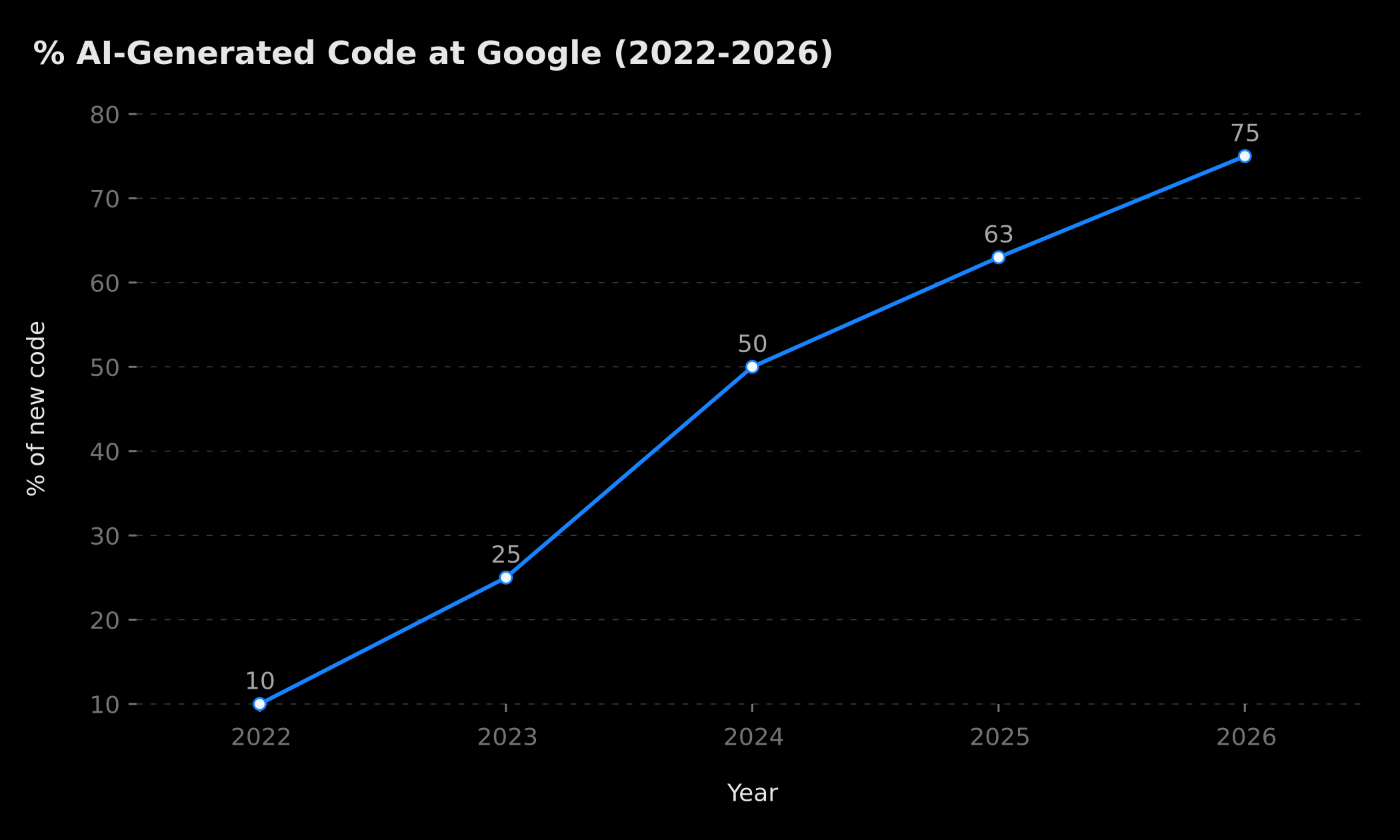 From 10% to 75% in 4 years: the exponential curve of AI adoption in Google's development cycle.
This isn't linear acceleration. It's exponential acceleration, driven by three converging factors: the quality of code generation models (GPT-5, Gemini 2.5 Pro, Claude Opus 4), the sophistication of IDE integration tools (Cursor, GitHub Copilot Enterprise, Gemini Code Assist), and the emergence of context standards that allow agents to access business data in real time (MCP protocol, AGENTS.md files). These three pillars reinforce each other and explain why the curve is accelerating rather than plateauing.
What Other Tech Giants Are Doing
Google isn't alone in this transition. The entire industry is following a similar trajectory, with speeds and approaches that differ according to company cultures.
Microsoft: In its March 2026 report, GitHub Copilot is used on over 50% of Microsoft's internal projects. Azure teams report productivity gains of 35 to 55% on repetitive coding tasks — test generation, automatic documentation, boilerplate code. Microsoft also announced that GitHub Copilot Enterprise now integrates autonomous agent features capable of submitting complete pull requests.
Meta: Mark Zuckerberg announced in January 2026 that Meta is targeting "one AI engineer per team of 5 humans" in 2026 — meaning a dedicated AI agent for each small development team. Concretely, this means each team has an agent capable of handling routine tasks while human engineers focus on complex problems.
Amazon: AWS CodeWhisperer, renamed Amazon Q Developer, has been deployed across all internal teams since Q3 2025. Amazon also indicated that its internal teams use agents to automate the migration of legacy code to modern microservice architectures — a traditionally very time-consuming task.
Apple: Characteristically discreet, Apple launched internally its own code assist system based on a model fine-tuned on their proprietary Swift codebase. No public numbers available, but job listings mentioning "AI-assisted software engineering" have grown significantly in their hiring over the past six months.
The trend is universal and irreversible. This isn't a Google-specific thing — it's the direction the entire global software industry is heading.
Real Impact on Code Quality and Technical Debt
Where the debate becomes genuinely interesting is on the question of quality. AI generates functional code — but is it good code? The answer is nuanced, and it has direct implications for developers who want to remain relevant.
AI code is often syntactically correct but architecturally risky. Code generation models excel at producing isolated functions that pass unit tests. They are less good at anticipating interactions between components at scale, edge cases in complex business contexts, or the security implications of a design choice. The risk isn't syntax errors — models make few of those. The risk is functional code that exhibits unexpected behavior under real-world conditions.
AI-generated technical debt is an emerging reality. When an agent generates 10,000 lines of code in a few hours to fulfill a specification, it can introduce redundant patterns, poorly designed abstractions or unnecessary dependencies. Without rigorous human review, this debt accumulates quickly. Teams using AI without structured review processes report technical debt that's harder to identify — not because it's larger in volume, but because it's less visible. AI code "looks clean" on the surface.
Human code review evolves, it doesn't disappear. However, its content changes. Reviewing AI code doesn't mean looking for typos or verifying the basic logic of a loop. It means evaluating implicit architectural choices, detecting patterns that could be problematic at scale, and validating that the generated code corresponds not just to the written specification, but to the real intent of the product. This "AI-aware review" skill is rare and increasingly valued in the market.
AI Coding Tools in 2026: Complete Landscape
The AI code revolution doesn't rest on a single tool but on a rapidly evolving ecosystem. Here are the players concretely shaping how developers work today.
Cursor IDE has become in 2025-2026 the reference for developers who want to move fast. Built on VSCode, it integrates agents capable of modifying multiple files simultaneously, understanding project architecture through conventions (.cursor/rules/), and executing actions on the terminal. Its ability to maintain context of the entire project — not just the open file — makes it qualitatively different from simple autocomplete. SpaceX even acquired Cursor for $60 billion in 2026, a strong signal of the strategic value of these tools.
GitHub Copilot Enterprise has evolved from autocomplete to agentic. The 2026 version can create branches, submit pull requests and interact with GitHub issues. Integrated into VS Code, JetBrains and now directly into CI/CD pipelines, it covers the entire code lifecycle, not just its production.
Gemini Code Assist is the tool Google uses internally to reach that 75%. Available publicly via Google Cloud, it performs particularly well on Go and Python codebases (Google's two dominant languages) and integrates documentation search capabilities through RAG connectors.
Codeium / Windsurf has established itself as a credible open and free alternative to Copilot. Its adoption is strong among independent developers and startups looking for a less expensive option. Its Windsurf editor offers an experience comparable to Cursor with multi-file agents.
Claude Code from Anthropic is particularly appreciated for complex refactoring and codebase analysis tasks. Its strength: the ability to maintain quality consistency over long sessions, where other models tend to "drift" on large-scale projects.
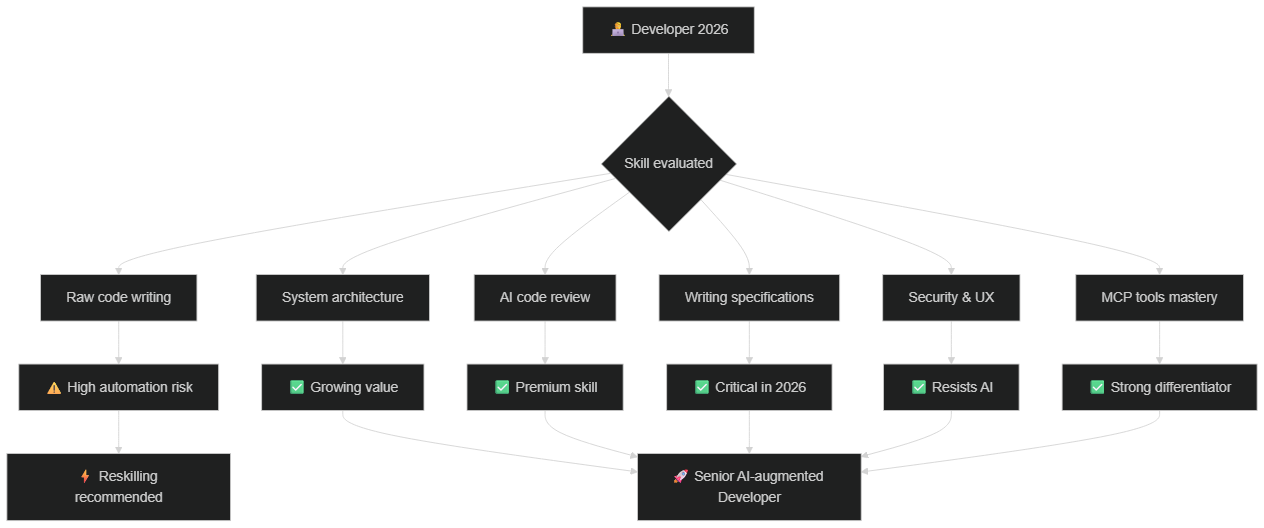 Flowchart of developer skills in 2026: those that resist AI (architecture, review, specs) and those being automated.
The 5 Skills That Become Even More Valuable
Paradoxically, code automation makes certain human skills more valued, not less. This is a dynamic that technological history has already illustrated several times — when calculators replaced manual computation, mathematicians who knew how to frame the right problems became more valuable, not less.
1. System architecture design is now the first defense against AI-generated technical debt. The more AI generates code, the more critical architecture decisions become. A bad architectural choice amplified across 1000 automatically generated functions creates technical debt of a scale that's difficult to correct. The architect who decides on module organization, service communication patterns and data strategy remains the most valuable team member.
2. Writing precise specifications has become a technical skill in its own right. AI produces what you ask for. If the specification is vague, the code will be inadequate — functionally, but especially semantically with respect to real product needs. The ability to write user stories with precise acceptance criteria, clear ADRs (Architecture Decision Records) and explicit API contracts has become a premium skill directly linked to the quality of generated AI code.
3. Critical review of AI-generated code is a new type of competency. Reviewing AI code means looking for patterns specific to model limitations: edge case handling, semantic coherence with the business domain, non-apparent security implications, architectural redundancies. This skill is rare and its market value is rising rapidly.
4. Understanding model limitations is what differentiates the senior AI-augmented developer from the amateur. Knowing which model to choose for which task type — low-level code, architecture, testing, documentation, refactoring —, when to trust a suggestion and when to question it, how to structure a prompt to avoid hallucinations on specific APIs: this meta-skill about AI tools themselves is increasingly discriminating in interviews and performance evaluations.
5. Mastery of context tools (MCP, AGENTS.md) represents the most advanced frontier of developer productivity in 2026. Developers who know how to configure MCP servers to give agents real-time access to business data — internal APIs, databases, documentation — and who master context file conventions (AGENTS.md, .cursor/rules/) are structurally more productive than their peers. And structurally better paid.
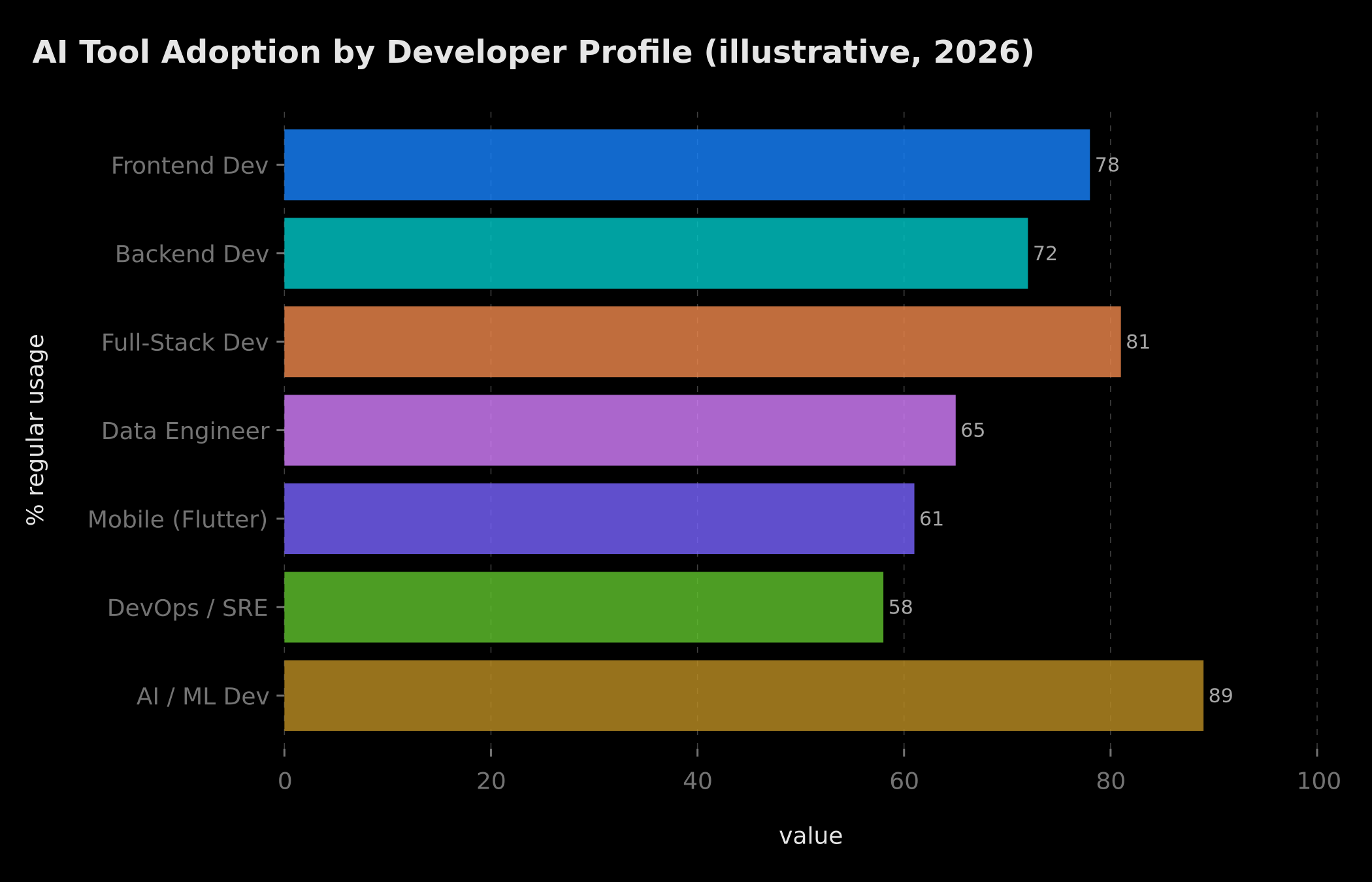 Regular AI tool usage rate by developer type in 2026 — ML/AI devs and Full-Stack developers lead adoption.
Impact on the Developer Job Market
The developer job market is restructuring around a clear dividing line: those who master AI tools and those who don't. This fracture is deeper than the "junior" vs "senior" divide — it cuts across both experience levels.
Developer jobs that resist well are those requiring systemic understanding that AI cannot acquire without context: platform and infrastructure engineering, application security (security stakes depend on organizational context, not just code), large-scale distributed systems architecture, and user experience design (UX engineering). These roles require context continuity, human judgment and understanding of organizational constraints that current agents don't possess.
Jobs under growing pressure are those that primarily consist of writing repetitive code or maintaining well-documented legacy code. Junior developer positions whose main role is implementing features from detailed tickets are the most exposed to progressive automation. This isn't a brutal disappearance — it's a market compression on these specific profiles.
Compensation for AI-augmented developers is rising. A senior developer capable of supervising agents across multiple projects in parallel, delivering complete features in 48 hours and ensuring high-level quality review is structurally more valuable than a developer who codes manually. The market is beginning to reflect this in daily rates and salaries. For freelancers, our analysis of daily rates and AI automation in 2026 explores this phenomenon with concrete figures.
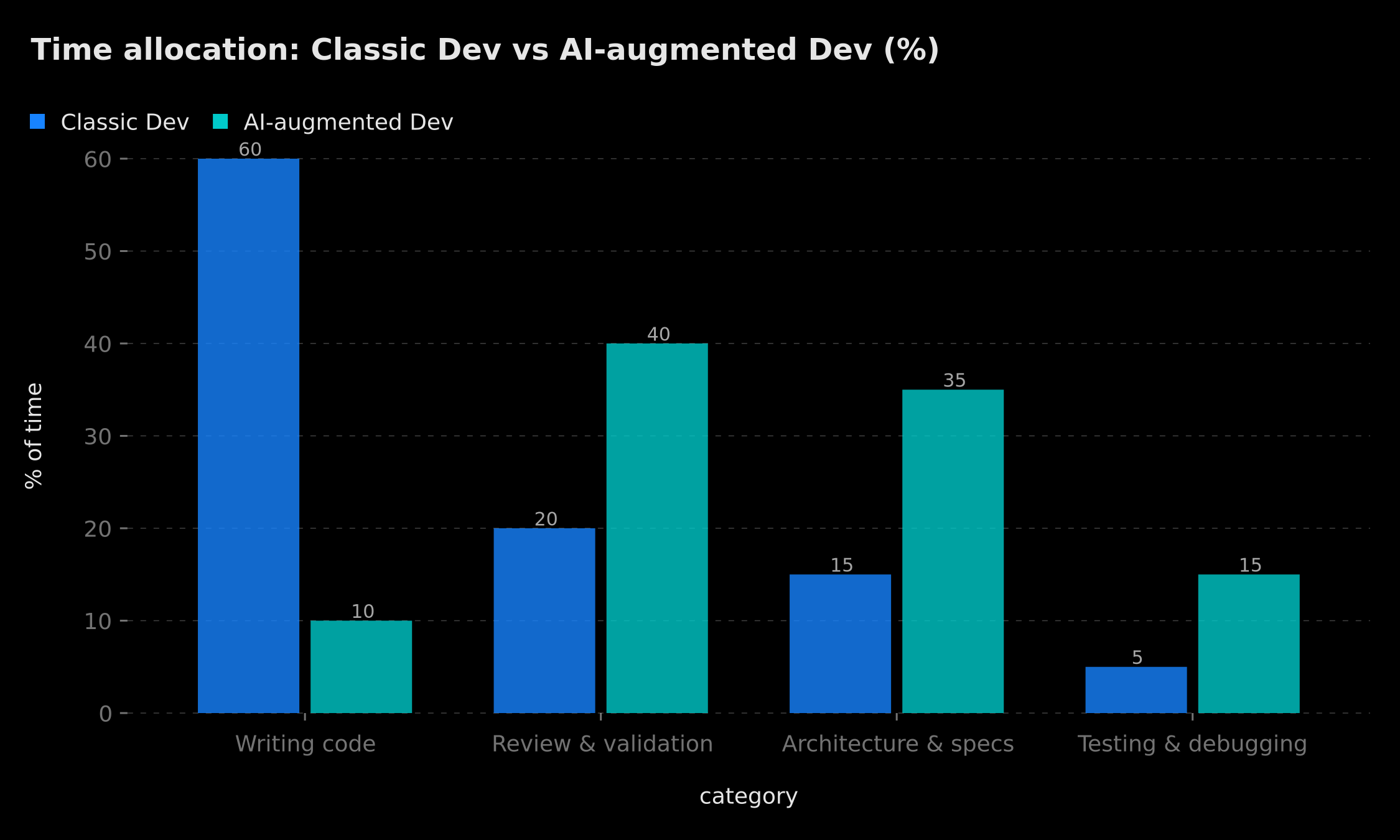 Time allocation inverts: the AI-augmented dev spends 10% of time writing code vs 60% for a classic dev, and dedicates 40% to review and 35% to architecture.
Impact on Freelancers and Digital Agencies
The AI code revolution of 2026 has particularly important implications for freelancers and agencies that develop digital projects for clients. It's both an opportunity and a competitive pressure factor.
For freelancers, the dynamic is paradoxical but favorable to those who adapt. On one hand, a freelancer equipped with a mature AI stack can deliver a project that previously took 3 months in 5 weeks. This is an opportunity to multiply the number of clients served without increasing workload. On the other hand, this increased productivity puts pressure on daily rates: if the client knows a feature can be generated in a few hours, they'll question a day-rate quote. The answer is to bill by value delivered, not time spent — and to explicitly document the stack used and the associated quality guarantee.
The AI differentiation question is acute for agencies. An agency that doesn't use AI is structurally slower and more expensive. But an agency that uses AI without validation processes can deliver insufficient quality code. The winning positioning is "AI-augmented with expert human supervision" — faster than a classic agency, more reliable than an unsupervised AI tool. Our analysis of the AI agent vs freelancer hybrid model in 2026 explores the different possible operational models.
What This Changes for Hiring (or Getting Hired)
If you're hiring developers, the criteria change profoundly. A developer who produces 500 lines of code per day manually is structurally less competitive than a developer who supervises 2000 AI-generated lines with equivalent or superior quality. Interview questions evolve accordingly. In 2026, systematically ask: "Describe your AI workflow. What tools do you use? How do you validate generated code? Show me a project you shipped with an AI stack." The ability to answer these questions precisely is a strong signal of technical maturity.
If you're looking for a position, document your AI workflow in your CV and portfolio. Don't just list "Cursor" or "Copilot" in a tools section — show concrete examples of systems you've built with agents, specifying your role (architecture, supervision, validation), metrics (delivery speed, volume of supervised code, error rate) and conventions you've established. This concrete proof differentiates the AI-mature developer from someone who has "just tried ChatGPT."
Cross-Disciplinary Skills Gaining Value
Beyond pure technical skills, the AI code era values cross-disciplinary competencies that were previously considered "secondary" in developer profiles.
Systems thinking — the ability to see interactions between components of a complex system, anticipate side effects and design architectures that hold at scale — becomes the central competency of the senior developer in 2026. This is precisely what AI cannot do: account for organizational context, operational constraints and future product evolutions.
Application security takes on a new dimension. AI-generated code can contain vulnerabilities that classic review tools don't easily detect — unnecessary dependencies, incomplete input validations, outdated cryptographic patterns. The developer who can read AI code through a security lens is extremely valuable, especially in regulated contexts (finance, healthcare, e-commerce).
UX engineering — the ability to translate user needs into technical design decisions — remains deeply human. Understanding why an interface is frustrating for a user, designing micro-interactions consistent with human behaviors, arbitrating between technical performance and perceived fluidity: these judgments involve empathy and experience that AI only simulates on the surface.
Technical communication — writing clear specifications, facilitating architecture review meetings, documenting design decisions — has become even more strategic. In a world where AI generates code from text descriptions, the quality of descriptions directly conditions the quality of code. The developer who writes with precision produces, via agents, better quality code than one who writes approximate prompts.
How to Adapt Your Tech Watch in 2026
The pace of AI tool releases for developers has become difficult to follow. A few principles to stay current without drowning in the information flow.
Filter by impact on your productivity, not novelty. Every week brings a new AI tool or model version. The question isn't "is it new?" but "does it make me faster on tasks I already do, on my type of projects?" If the answer is no, move on.
Adopt in layers, without skipping steps. First master one AI editor (Cursor or GitHub Copilot), learn to configure it properly, exploit its advanced features (multi-file agents, project rules). Then add a conversational LLM for architectural reflection. Then build your first MCP integrations. Don't switch your primary tool before you've fully exploited the one you're using.
Follow metrics, not benchmarks. AI model benchmarks (HumanEval, SWE-Bench) don't necessarily reflect your real productivity on your code type and business domain. Measure yourself: how long did this type of task take before AI? And now? What proportion of your generated code do you accept without modification? These personal metrics are far more useful than model rankings.
Train on patterns, not versions. Versions change every 3 to 6 months. Fundamental patterns — structured prompting with context, agentic supervision, AI-aware review, architecture for extensibility — remain stable over 2 to 3 year horizons. Invest in deep pattern understanding rather than memorizing novelties.
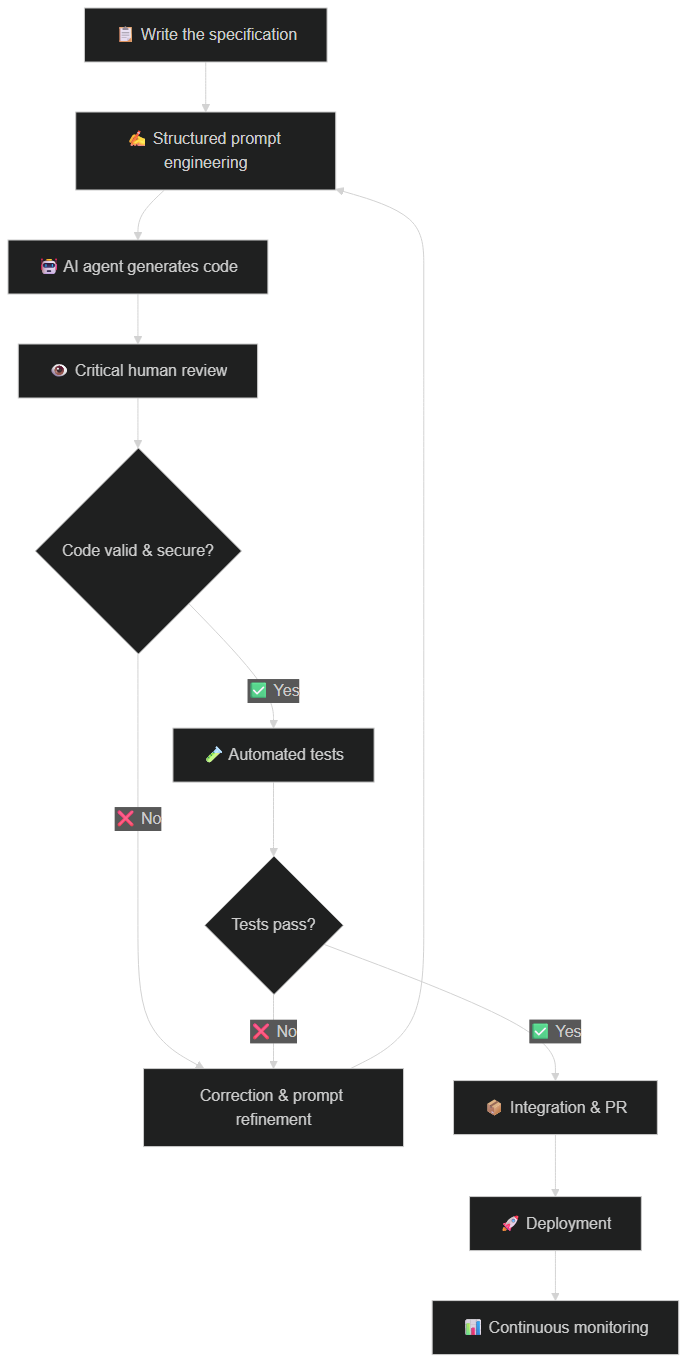 The AI-augmented development cycle: from specification to monitoring, human supervision remains central at every critical stage.
Outlook 2026-2028: What's Going to Change Next
If Google's 75% represents today's reference level for a major tech company, where will we be in 18 to 24 months? The answer depends on several dynamics playing out in parallel.
Code generation models will continue to improve, but with diminishing marginal gains on low-level tasks (writing isolated functions) and significant gains on high-level tasks (understanding and refactoring large codebases, generating integration tests, migrating legacy systems). Generating complete features from natural language descriptions will become more reliable, but also more demanding in terms of specification quality.
Agentic AI will accelerate. By 2027-2028, agents capable of handling a complete development cycle — from specification to deployment including testing and documentation — will be a reality for standard projects. This evolution will further redistribute roles: fewer developers on implementation tasks, more on agent orchestration and output validation.
The open vs closed AI debate will influence available tools. The tension between high-quality open-source models and proprietary closed models will determine what type of tool developers can deploy in regulated environments. Our analysis of DeepSeek V4 vs GPT-5.5 and the open-closed AI war explores the implications of this debate for developers.
The job market will polarize further. Developers who have invested in architecture, AI supervision and technical communication skills will be increasingly sought after — and better paid. Those who haven't made this transition risk growing pressure on their rates, or even partial obsolescence of their profile. The adaptation window is still open in 2026, but it's closing progressively.
The impact on initial training is already visible. Computer science schools and bootcamps are beginning to integrate AI into their curricula — not as a tool to teach, but as a work environment in which all exercises are done. The next generations of developers will never have known a world without an AI agent in their IDE. This generational change will accelerate adoption and make the fracture with non-transitioned developers even more visible.
What It Means If You're a Business That Has Development Done
If you use developers or an agency for your tech projects, this change concerns you directly and immediately.
Demand transparency on the AI tools used. A service provider who doesn't use AI in 2026 is structurally slower and more expensive for the same result. This isn't a question of modernity — it's a question of economic competitiveness. Ask directly in your RFPs.
Evaluate supervision quality, not just delivered code. A good AI-augmented provider documents how they validate generated code: review process, automated tests, code conventions, technical debt management. This process is the quality guarantee that tools alone don't provide.
Revise your timeline estimates and budgets. With a mature AI stack, development timelines can be reduced by 30 to 60% on standard projects. If your provider is quoting the same timelines as in 2023 without justification, that's a warning signal.
At BOVO Digital, we run a multi-editor stack (Cursor + Claude Code + GitHub Copilot) with portable conventions and a documented review process. Our projects ship 2 to 3x faster than a classic cycle, without quality loss and with full traceability of generated code.
Tags
FAQ
Is AI going to replace developers?
No — but it will replace certain ways of working. A developer who supervises and directs 2000 lines of AI code per day is more productive and more valuable than one writing 500 manually. Value shifts toward architecture, validation and creative direction. Developers who master AI tools will be the ones who thrive through this transition.
What AI tools do developers use at Google?
Google primarily uses Gemini Code Assist (their internal version of GitHub Copilot) integrated into their internal IDEs. Agents write entire functions from specifications, and engineers review and validate. The logic is similar to what developers do on Cursor or GitHub Copilot Enterprise.
How can freelancers adapt to AI-generated code?
Freelancers must reposition their value — from "I write code" to "I design, supervise and deliver." Those who master an AI stack (Cursor, Claude Code, Copilot) can deliver projects 2 to 3 times faster, increase their daily rates and take on more clients. The hybrid human-agent model is the key to their competitiveness in 2026.
Which developer skills best resist AI automation?
System architecture, writing precise specifications, critical review of generated code, application security and mastery of context tools (MCP, AGENTS.md) are the most resistant skills. These are judgment, design and validation competencies that AI cannot yet reliably reproduce.
How does BOVO Digital integrate AI into its development?
We run a multi-editor stack (Cursor + Claude Code + GitHub Copilot per project) with portable conventions. All delivery cycles include validation of generated code. Our projects are delivered 2 to 3 times faster than a classic cycle without quality loss.
Does your site book meetings — or just present you?
We open your URL together, mark the 3 leaks, and tell you whether a fix is enough or a rebuild is required.
- 30 min
- No commitment
- Action plan
William Aklamavo
Web development and automation expert, passionate about technological innovation and digital entrepreneurship.


