
WWDC 2026 (Siri & Gemini): Why SMEs Must Automate First
WWDC 2026: Siri AI rebranded, Apple Intelligence v2 co-developed with Google Gemini, EU excluded at launch. Analysis for SMBs, Flutter devs and n8n agencies.

WWDC 2026 (Siri & Gemini): Why SMEs Must Automate First
On June 8, 2026, Apple doesn't release a Siri update. It buries the old assistant and announces Siri AI — a complete rebrand, powered by Google's Gemini technology, deployed in a closed ecosystem that excludes the European Union at launch. For European SMBs, the message is clear: Apple's native conversational AI won't reach you anytime soon.
The first week of June 2026 opens with the most anticipated consumer tech event of the year: the Worldwide Developers Conference (WWDC), keynote on June 8, 2026. Apple unveils Siri AI, the conversational version of its assistant, Apple Intelligence v2, and an unprecedented technical partnership with Google on foundation models. Tim Cook delivers his last WWDC keynote before the planned handoff to John Ternus on September 1, 2026.
This recap goes beyond slide summaries. It translates every announcement into concrete implications for European SMBs (excluded from Siri AI in the short term), Flutter mobile developers, and automation agencies building on n8n and the MCP protocol. You'll find fact-based analysis, five diagrams, and an operational action plan at the end.
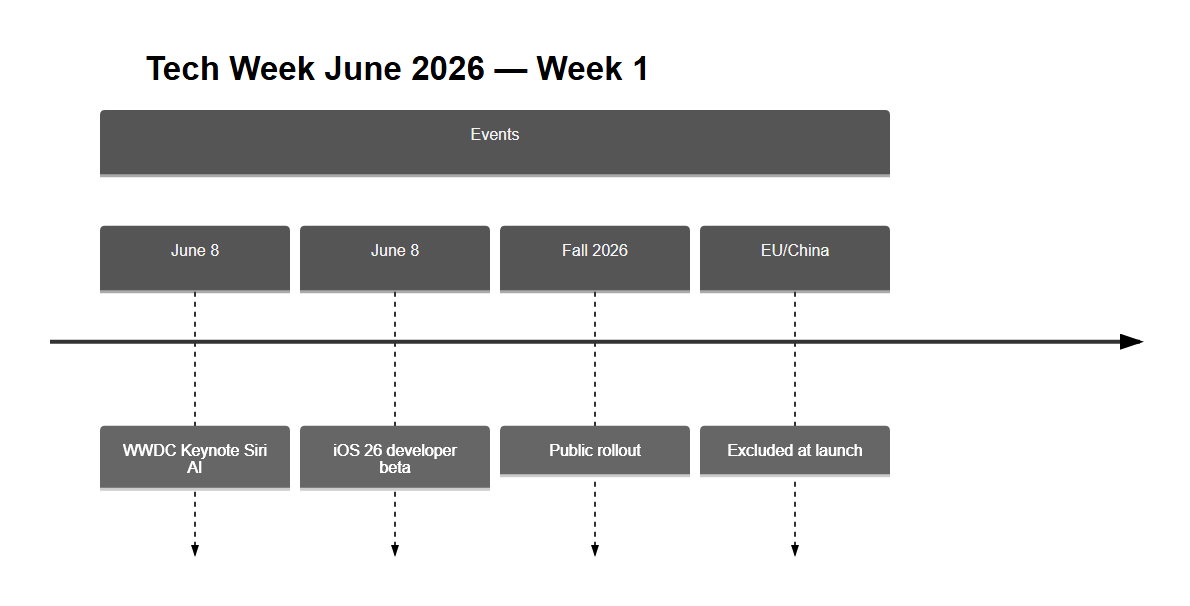 Tech Week June 2026 — Week 1: WWDC June 8, Siri AI, Apple Intelligence v2, developer beta and fall 2026 rollout
WWDC 2026: A Pivotal Keynote for Apple and the Industry
WWDC 2026 is not just another conference. It's the moment Apple repositions its relationship with artificial intelligence after two years of Apple Intelligence v1 — perceived as promising but falling short of expectations compared to ChatGPT, Gemini and Claude. Official sources (Apple Newsroom) and analyses from TechCrunch, The Verge, CNBC and MacRumors converge: Apple is betting everything on a credible, system-integrated conversational assistant, backed by a technical alliance with its historical rival Google.
Tim Cook: Last WWDC Before a Leadership Transition
Tim Cook confirmed during the keynote that WWDC 2026 would be the last he would present before handing over to John Ternus, Apple's hardware chief, effective September 1, 2026. This announcement adds symbolic weight to the decisions presented: Siri AI and Apple Intelligence v2 are not experiments — they are the strategic legacy of a CEO who has led Apple for over fourteen years.
For industry observers, this transition signals that Apple's major technological orientations — closed ecosystem, privacy as a commercial argument, vertical hardware/software integration — will likely continue under Ternus, with a reinforced focus on hardware (M4 chips, iPhone 17 Pro, iPhone Air).
A Tech Week That Extends Beyond Apple
While WWDC dominates the news cycle, the first week of June 2026 continues signals observed in May. Google's figure of 75% AI-generated code, analyzed in our May 2026 tech recap, shows the industry shifting to operational AI. WWDC 2026 confirms this trend on the consumer and mobile side: AI is no longer a gadget — it's the operating system's primary interface.
Siri AI: The Rebrand That Buries the Old Siri
The central WWDC 2026 announcement is the rebrand of Siri as Siri AI. Apple no longer speaks of a "Siri update": it presents a conversational assistant capable of multi-turn dialogues, with a dedicated app and cross-platform presence across iOS 26, iPadOS 26 and macOS 26.
A Dedicated App and Conversational Experience
Unlike the old Siri — activated by "Hey Siri," limited to short queries and often frustrating on complex tasks — Siri AI is designed to maintain conversation threads. Users can ask follow-up questions, request clarifications, or chain multiple actions without restating their intent each time. The dedicated app centralizes conversation history and offers an entry point distinct from Spotlight search.
Demonstrations reported by The Verge and TechCrunch show concrete scenarios: planning a trip by cross-referencing calendar, weather and emails; summarizing a Messages thread before replying; launching a complex shortcut in natural language. This isn't science fiction — it's Apple's product positioning against ChatGPT and Gemini on mobile.
What Fundamentally Changes
Three breaks deserve attention:
Conversation replaces command. The old Siri excelled at "Set an alarm for 7 AM" and failed at "Find the restaurant Jean mentioned last week and send him a message to confirm." Siri AI explicitly targets the second type of query.
System integration becomes the competitive advantage. Siri AI accesses Calendar, Messages, Photos, Safari and Shortcuts with an orchestration level that third-party apps cannot replicate — by design, Apple limits competitors' access to this data.
The rebrand signals long-term commitment. Apple isn't fixing Siri — it's replacing it. This implies years of investment and hardware alignment (iPhone 17 Pro, iPhone Air, M4/M3 chips) for a consistent experience.
Apple Intelligence v2 and the Technical Alliance with Google Gemini
The second major announcement concerns Apple Intelligence v2 and Apple Foundation Models, co-developed with Google leveraging Gemini technology. This partnership, confirmed by Apple Newsroom and analyzed in detail by CNBC and TechCrunch, surprises given the partners' identities: Apple and Google are rivals in mobile, browsers and cloud — but united in the foundation model race.
Why Apple Partners with Google on AI
The answer lies in the economic and technical reality of large language models. Training and maintaining competitive models costs billions per year. Apple, despite AI research investments, fell perceptibly behind OpenAI, Google and Anthropic in 2024-2025. Rather than ship a mediocre model, Apple chooses to co-develop with Google — while retaining control of system integration.
This isn't a simple "Siri powered by Gemini" as you might see on an Android device. Apple insists on a layered architecture: foundation models leverage Gemini technology, but the system orchestrator, on-device processing and Private Cloud Compute remain under Apple's control. Google supplies the model building block; Apple builds the experience.
The Link to the "AI in Code" Trend
This alliance fits the broader movement documented in our article Google 75% AI Code: What Changes for Developers. When the world's largest smartphone maker allies with the world's largest AI model producer, the industry message is clear: foundation models concentrate among a few players, and competitive advantage shifts to integration, orchestration and distribution.
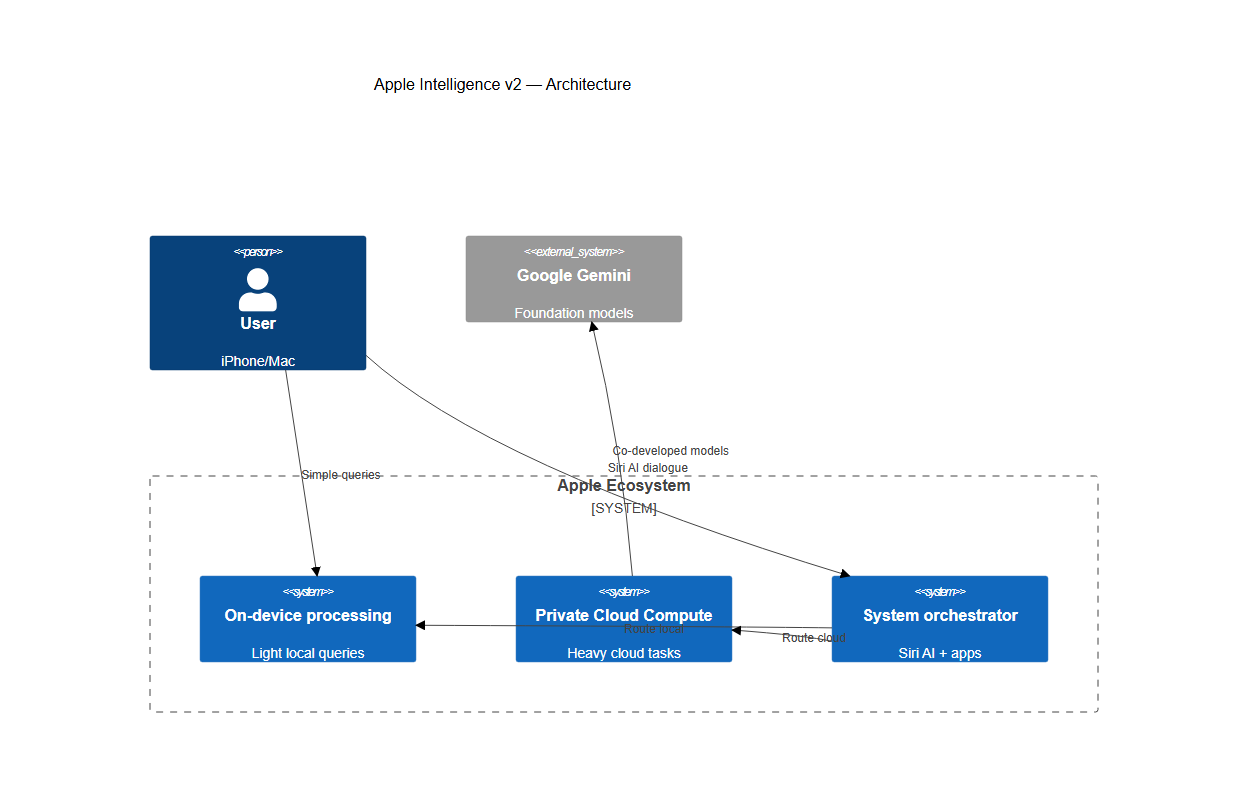 Apple Intelligence v2: on-device processing for privacy, Private Cloud Compute for heavy tasks, system orchestrator to coordinate Siri AI and apps
Three-Layer Architecture: Privacy, Power, Orchestration
Apple presents a three-pillar architecture for Apple Intelligence v2. Understanding this architecture is essential for developers and tech decision-makers evaluating whether — and how — to align with Apple's ecosystem.
On-Device Processing
The first layer executes lightweight queries directly on the device: short summaries, reply suggestions, simple intent classification. Apple emphasizes privacy: this data never leaves the phone. This aligns with Apple's historical privacy positioning and is a strong commercial argument against cloud-only assistants.
The constraint is hardware. On-device foundation model processing requires performant Neural Engine chips and sufficient RAM — hence the high hardware requirements (M4+, 12 GB RAM).
Private Cloud Compute
For tasks exceeding local capacity — long summaries, image generation, complex reasoning — Apple routes queries to Private Cloud Compute (PCC). Apple claims these servers don't retain data, don't use it for training, and that the code is auditable. The Verge and MacRumors noted that PCC runs on Apple Silicon hardware in datacenters, not classic NVIDIA GPUs.
For European businesses, PCC raises sovereignty questions: where are these servers physically located? What legal framework applies? Apple hasn't yet clarified these points for the EU — contributing to regional exclusion at launch.
The System Orchestrator
The third layer is the most differentiating: the system orchestrator coordinating Siri AI, apps, Shortcuts and Apple services. When you say "Summarize my urgent emails and create a reminder to reply to the most important one," the orchestrator decomposes the query, calls Mail, Calendar and Reminders, and assembles the response. No third-party app has access to this integration level — it's Apple's competitive moat.
For automation agencies, this architecture is the opposite of what the stable MCP protocol offers: an open standard connecting agents to tools, interoperable across vendors. Apple builds a proprietary orchestrator; the open ecosystem builds bridges between systems.
Deployment Timeline: Beta, Fall 2026 and Geographic Exclusions
Timeline information, confirmed by Apple Newsroom and reported by MacRumors, structures planning for developers and businesses.
Developer Beta from June 8, 2026
The developer beta of iOS 26, iPadOS 26 and macOS 26 — including Siri AI and Apple Intelligence v2 — is available from June 8, 2026, keynote day. Developers enrolled in the Apple Developer Program can download the first builds and begin testing App Intents, AI Shortcuts and new APIs.
Public Beta and Fall 2026 Rollout
The public beta will follow in the weeks after WWDC, per Apple's usual calendar (typically July). General public deployment is planned for fall 2026, alongside the commercial release of iPhone 17 Pro and iPhone Air. End users not on required hardware will get degraded or delayed access.
European Union and China: Unavailable at Launch
The most critical point for BOVO Digital readers: Siri AI and advanced Apple Intelligence v2 features will not be available on iOS and iPadOS in the European Union or China at launch. Apple cites regulatory constraints — the Digital Markets Act (DMA) in Europe, local rules in China — without providing a resolution date.
For a European SMB, this means employees with iPhones won't benefit from Siri AI until a later deployment, potentially in 2027 or beyond. This isn't speculation — it's a confirmed Apple exclusion.
English Only at Launch
Apple specifies that Siri AI will be available in English only at launch. European languages — French, German, Spanish — will follow in later updates, without a precise timeline communicated. For European markets, it's a double penalty: geographic and linguistic exclusion.
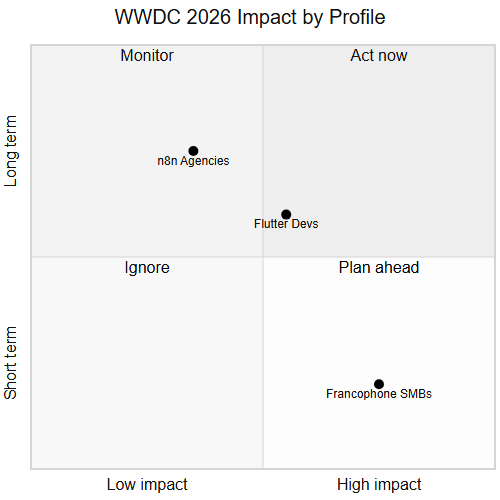 WWDC 2026: differentiated impact for European SMBs (EU exclusion), Flutter developers and n8n/MCP automation agencies
Hardware Requirements: Fragmentation Complicating Enterprise Deployment
Apple communicates precise hardware requirements for Siri AI and Apple Intelligence v2's most advanced features:
- iPhone 17 Pro or iPhone Air for the full mobile experience
- iPad with M4 chip or newer and 12 GB RAM minimum
- Mac with M3 chip or newer and 12 GB RAM minimum
Older devices (iPhone 15, iPad M2, Mac M1) will access limited features but not the full conversational experience. MacRumors published a detailed feature matrix by device.
For businesses, this fragmentation creates fleet management problems. If you deploy iPhones for sales teams, models purchased in 2024-2025 won't be fully compatible. Hardware refresh becomes an AI prerequisite — a hidden cost that keynotes don't highlight.
Implications for European SMBs: Don't Wait for Siri AI
EU exclusion transforms WWDC 2026 into a non-event for European SMBs' operational AI — in the short term. Here's what this concretely means.
EU Excluded: A Gap the Open Ecosystem Can Fill
If your employees can't use Siri AI, your business processes must not depend on that assistant. Alternatives exist and are mature:
AI assistants via API — ChatGPT, Claude, Gemini via API, integrated into your business tools (CRM, ERP, Slack) through n8n and the MCP protocol.
Conversational automations — n8n workflows that receive a natural language question (via webhook or Slack), query your databases, and return a structured response. It's not Siri, but it's operational today in French, in Europe, without geographic restrictions.
Custom business chatbots — AI agents connected to your documentation, inventory, schedules — deployable on web (Next.js) and mobile (Flutter) without depending on Apple.
The temptation is to wait for Siri AI to arrive in Europe. That's a risky bet: the DMA imposes obligations on Apple (interoperability, default browser choice) that the company contests. European deployment could take 12 to 24 months, or longer.
What Leaders Should Retain
Don't block your automation projects waiting for Apple. SMBs that postponed AI deployments "to see what Apple announces" now have their answer: Apple doesn't serve you in the short term.
Invest in MCP and n8n skills rather than Apple Intelligence skills. The MCP protocol, stabilized in April 2026, is the standard connecting your AI agents to your tools — CRM, database, email, calendar — without depending on a smartphone manufacturer.
Document your AI policy for clients and partners. Apple's EU exclusion of Apple Intelligence raises data sovereignty questions. Businesses that can demonstrate a European, hosted, auditable AI stack have a commercial advantage over those promising "Siri for your business" without being able to deliver.
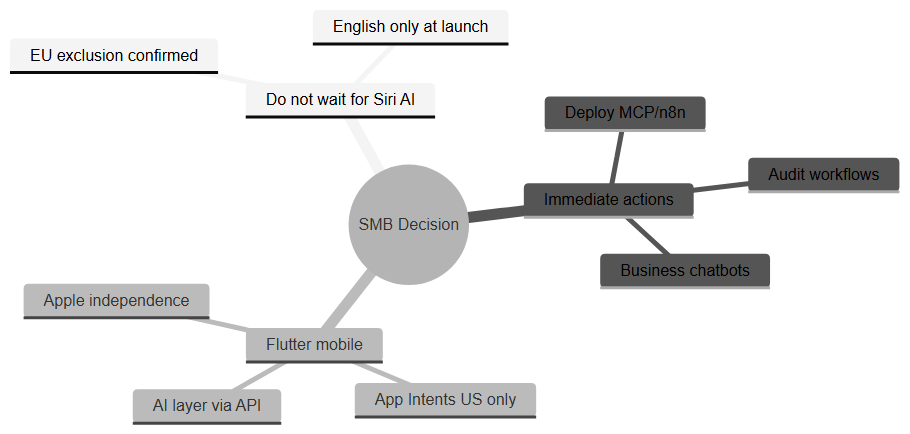 European SMBs: should you wait for Siri AI? No — evaluate workflows, deploy MCP/n8n, plan mobile without Apple Intelligence dependency
Flutter Developers: Between App Intents and Strategic Independence
For mobile developers — especially those using Flutter for cross-platform — WWDC 2026 poses a direct question: should you integrate Apple Intelligence into your apps?
What Apple Offers Third-Party Developers
Apple highlights App Intents and AI Shortcuts as integration points for developers. Concretely, your Flutter app (via a native Swift plugin) can expose actions that Siri AI triggers in natural language: "Order a latte in MyCoffeeApp." This is useful for user engagement in markets where Siri AI will be available — essentially the US and a few English-speaking countries at launch.
But conversational AI logic — understanding complex queries, cross-referencing data, orchestrating multiple apps — remains confined to Apple apps and services. Your Flutter app doesn't access the system orchestrator or Apple Foundation Models.
The Recommended Cross-Platform Strategy
For a mobile app targeting the European market, the pragmatic strategy combines three axes:
Integrate App Intents for US users who will benefit from Siri AI — it's a plus, not a strategic pivot.
Build your own AI layer via API (OpenAI, Anthropic, Mistral) or MCP agents, accessible from Flutter through HTTP calls — as detailed in our guide How to Create a Mobile App in 2026.
Don't condition your roadmap on Apple Intelligence. If your app only works fully with Siri AI, you de facto exclude the European market — 450 million potential inhabitants.
Automation Agencies: Open MCP/n8n Stack vs Apple's Closed Ecosystem
The most instructive contrast from WWDC 2026 plays out between two philosophies: Apple's closed ecosystem and the open ecosystem automation agencies build with n8n, the MCP protocol and AI agents.
Apple's Walled Garden
Apple Intelligence v2 is designed to work exclusively within Apple's ecosystem: iPhone, iPad, Mac, Apple Watch. Data stays in the system. Integrations go through Apple APIs (App Intents, Shortcuts). Models are co-developed with Google but deployed under Apple's control. It's a remarkable user experience — for those who have access.
But for an agency automating an SMB's processes — invoicing, sales tracking, client onboarding, reporting — the walled garden poses three problems:
No access from Windows or Android. Your clients aren't all on Apple.
No direct integration with your business tools. Salesforce, HubSpot, Notion, Airtable, your ERP: Apple doesn't orchestrate them natively.
European exclusion. Your French clients can't use Siri AI at launch.
The Open Stack: MCP, n8n, AI Agents
The alternative is the stack BOVO Digital deploys daily:
n8n as workflow orchestrator — visual, self-hostable, connected to 400+ services.
MCP (Model Context Protocol) as the connection standard between AI agents and tools — stabilized, documented, interoperable.
AI models of choice — Claude, GPT, Gemini, Mistral — according to each client's cost, privacy and compliance constraints.
A typical workflow: a salesperson sends a Slack message "Where's the quote for Client X?" → n8n receives the webhook → an MCP agent queries the CRM → the response is posted in Slack. No Siri, no iPhone, no geographic restriction. Operational in French, in Europe, today.
To go deeper on concrete deployment: Connect n8n to an MCP Server for Your AI Agents.
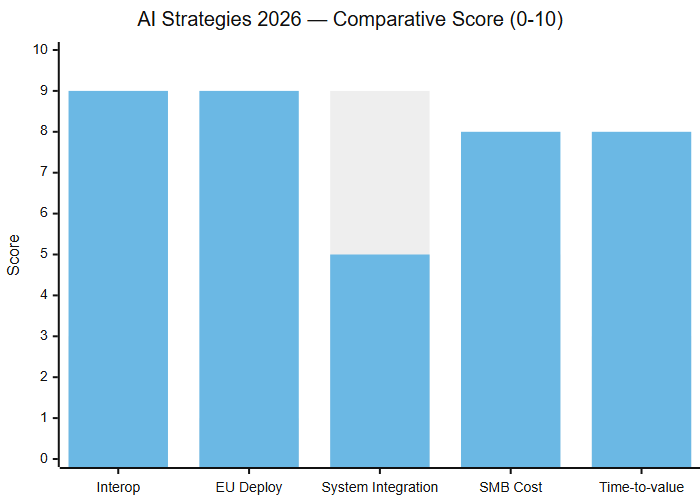 AI Strategies 2026: Apple closed ecosystem (Siri AI, EU exclusion) vs open MCP/n8n stack (interoperable, deployable in Europe)
Other WWDC 2026 Announcements: Beyond Siri
WWDC 2026 isn't limited to Siri AI. Apple unveiled cross-cutting AI features worth attention, even for professionals excluded from Siri AI in Europe.
AI Shortcuts
AI Shortcuts let you create automations in natural language: "Every Monday morning, summarize my emails from the week and send me a briefing." The AI generates the shortcut, the user validates and executes it. It's personal automation made accessible — a direct competitor to n8n workflows, but limited to Apple's ecosystem and eligible users.
Safari AI Tabs
Safari integrates intelligent tabs: automatic grouping by topic, open page summaries, suggestions to close inactive tabs. For researchers and consultants juggling dozens of tabs, it's a concrete productivity gain — but again, reserved for eligible markets.
Messages: Reply Suggestions
Messages offers contextual reply suggestions, drafted by AI based on the conversation thread. Apple emphasizes on-device privacy for this feature. It's a simplified version of what business AI agents already do via API — with the advantage of native integration.
Photos: Advanced AI Editing
Photos gains AI editing tools: object removal, automatic enhancement, semantic search ("beach photos in 2024"). Apple competes directly here with Google Photos and Gemini tools.
Image Playground
Image Playground — Apple's AI image generation tool — gains power with Apple Foundation Models v2. Illustration, avatar and presentation visual generation, integrated into the system. A creative or marketer on Mac M3+ can generate visuals without leaving Apple's ecosystem — where agencies use Midjourney, DALL-E or Stable Diffusion via API.
What This Week Confirms for the Tech Industry
Cross-referencing WWDC 2026 with May 2026 signals, four trends emerge:
AI becomes the operating system interface. Apple, Google (Android), Microsoft (Copilot) converge on the same model: AI isn't one app among many — it's the layer orchestrating the system. For developers and businesses, AI integration is no longer optional — it's the prerequisite.
Alliances strengthen around models. Apple + Google on Gemini, OpenAI + Microsoft, Anthropic in ethical positioning. Foundation models concentrate; integration and distribution become the battleground.
Regionalization accelerates. EU exclusion, China exclusion, English only. AI isn't global — it's fragmented by regulation. European SMBs must build on sovereign stacks.
The open ecosystem gains ground where Apple can't go. As long as Siri AI is excluded from Europe, MCP, n8n and custom AI agents remain the only credible option for European businesses.
Conclusion: Key Takeaways and How to Act
WWDC 2026 marks a turning point for Apple — Siri AI, Google alliance, Apple Intelligence v2 — but not for European SMBs, excluded from initial deployment. The lesson isn't to reject Apple: it's not to condition your AI strategy on an assistant you won't be able to use for months, possibly years.
Three findings:
- Siri AI is an American product at launch — English, outside EU, outside China, recent hardware required.
- The Apple-Google Gemini alliance confirms model concentration — advantage shifts to orchestration and integration.
- The open ecosystem (MCP, n8n, AI agents) remains your best lever in Europe — operational, multilingual, without geographic restrictions.
Siri AI Needs Your Data: The Urgency to Structure Your CRM via n8n
The announcements from Apple (Siri AI with Apple Intelligence) and Google (Gemini) all point to the same reality: the intelligence of agents depends on the quality of the data they can access. Before hoping an AI assistant can answer your clients or draft your quotes, your systems (CRM, billing, databases) must be perfectly synchronized and structured. This is where automation via n8n becomes an absolute prerequisite. An AI agent cannot invent what is not in your information system.
Prepare Your Company for the Agent Era: Book an Audit
Is your SME ready for AI assistants? BOVO Digital helps you lay the necessary automation foundations. Before dreaming of Apple Intelligence, we structure your data flows with n8n so your future AI agents are reliable and high-performing. Book a data infrastructure audit.
Your Concrete 90-Day Action Plan
If You Lead a European SMB
- Week 1: List tasks where your teams would have wanted a voice or conversational assistant. For each, identify whether an n8n workflow or MCP agent can cover it.
- Weeks 2-4: Pilot an AI agent connected to a business tool (CRM, knowledge base, calendar) via MCP. Measure time saved on 10 typical queries.
- Months 2-3: Document your AI stack (models, hosting, GDPR compliance) for clients and RFPs. Position yourself as sovereign against unavailable Apple solutions.
If You Develop in Flutter or Next.js
- Short term: Integrate App Intents if you target the US, but don't condition your product value on Siri AI.
- Medium term: Add an AI layer via API or MCP in your app — business chatbot, semantic search, embedded assistant — accessible from Europe.
- Watch: Follow Apple Intelligence EU deployment evolution; prepare integration if and when it arrives.
If You're an Automation Agency
- Immediate: Update commercial proposals — mention Siri AI's EU exclusion and position your MCP/n8n expertise as the operational alternative.
- Offer: Propose a "Business AI Assistant" audit: 3 automatable workflows in 30 days, without Apple dependency.
- Training: Build skills on the stable MCP protocol and n8n connectors — that's where European demand will play out for the next 18 months.
BOVO Digital supports SMBs and agencies in deploying AI agents, n8n automations and Flutter/Next.js applications — without depending on Apple's geographic availability.
June 2026 series — read by category
| Category | Related article |
|---|---|
| Tech news | Microsoft: 70 GitHub repos compromised — AI supply chain attack |
| Web development | Next.js 16 production checklist without Vercel lock-in |
| Automation | 5 n8n workflows we deploy for every client |
| Entrepreneurship | Outsource automation or hire ops: 2026 decision model |
| Tutorials | Secure n8n + GitHub pipeline after supply chain incident |
Tags
FAQ
Will Siri AI be available in the European Union at launch?
No. According to Apple's announcements as reported by Apple Newsroom, TechCrunch, The Verge and MacRumors in June 2026, Siri AI and advanced Apple Intelligence v2 features will not be available on iOS and iPadOS in the European Union at launch, due to regulatory constraints. European users will need to wait for regulatory clarification or a later rollout. In the meantime, European SMBs should rely on open stacks (MCP, n8n, third- party APIs) rather than Apple's ecosystem for their AI assistants.
What Apple hardware is required for full Siri AI capabilities?
The most powerful Siri AI and Apple Intelligence v2 features require recent hardware: iPhone 17 Pro or iPhone Air, iPad with M4 chip or newer and at least 12 GB of RAM, or Mac with M3 chip or newer and 12 GB of RAM minimum. Older devices will access limited features only, creating significant fragmentation for businesses deploying heterogeneous hardware fleets.
Does Apple actually use Google's Gemini technology?
Yes. Based on Apple's communications and analyses from CNBC, TechCrunch and The Verge published during the June 8, 2026 WWDC, Apple confirmed that its Apple Foundation Models are co-developed with Google, leveraging Gemini technology. The architecture remains Apple-proprietary: on-device models, Private Cloud Compute and the system orchestrator form an integration layer that Google does not directly control.
How does Siri AI differ from the old Siri?
Siri AI is a complete rebrand: Apple presents a conversational assistant capable of multi-turn dialogues, with a dedicated app and deep integration across iOS 26, iPadOS 26 and macOS 26. Unlike the old Siri — limited to short commands and one-shot queries — Siri AI can chain exchanges, understand system context and orchestrate actions across multiple apps through the Apple Intelligence orchestrator.
Should Flutter developers integrate Apple Intelligence into their apps?
Not necessarily. Apple Intelligence and Siri AI are system services, not an open API comparable to MCP or n8n webhooks. Flutter developers targeting iOS can leverage App Intents and AI Shortcuts for certain integrations, but conversational AI logic remains confined to Apple's ecosystem. For a cross-platform strategy, it is more effective to connect your apps to AI agents via open protocols.
What should SMBs concretely do this week?
Three priority actions: audit your current workflows to identify those that depend on a voice assistant (and plan an MCP or API alternative), document your open AI stack (n8n, MCP protocol, self-hosted models) to avoid Apple dependency, and plan mobile roadmaps accounting for Siri AI's EU exclusion until further notice. BOVO Digital offers applied tech briefings to translate these announcements into a 90-day action plan.
Free audit: we check the impact on your site and workflows
Next.js CVE, new agent, MCP… We tell you what actually applies, and what to patch or ignore.
- 30 min
- Stack reviewed
- No commitment
Vicentia Bonou
Full Stack Developer & Web/Mobile Specialist. Committed to transforming your ideas into intuitive applications and custom websites.


