
SpaceX Buys Cursor for $60 Billion: What It Reveals About the AI Developer Tools Market in 2026
On April 21, 2026, SpaceX announced a $60 billion option to acquire Cursor — double its November 2025 valuation. Combined with the Colossus supercomputer (1M H100 equivalent), it reshapes the AI developer tools market. Strategic analysis for agencies, freelancers, and tech teams.

Updated

SpaceX buys Cursor for $60 billion: what it reveals about the AI developer tools market in 2026
On April 21, 2026, SpaceX announced an acquisition option on Cursor — the AI code editor used daily by hundreds of thousands of developers — at $60 billion. If the option isn't exercised, SpaceX still pays $10 billion for the partnership. The startup, valued $29.3 billion in November 2025, was negotiating a $50 billion raise at the time of the announcement. Important: this is an acquisition option according to sources from that period (TechCrunch, Reuters, CNBC, The Verge) — its actual exercise had not been publicly confirmed at the time of writing.
This isn't an ordinary financial transaction. It's the most brutal vertical integration in AI since Microsoft's investment in OpenAI: GPU infrastructure (Colossus, equivalent to 1 million H100s) + a code-generation model (Composer) + developer distribution (Cursor). And it's a strategic signal for any company that codes, automates, or commercializes AI services in 2026.
This article unpacks the real implications for agencies, freelancers, and tech leadership — well beyond the eye-popping number. It also analyzes the reality of the AI developer tools market in 2026: who's playing, who's winning, and who's about to disappear.
What actually happened
Deal terms
According to TechCrunch, Reuters, and CNBC publishing on April 21, 2026:
- SpaceX has an option to acquire Cursor for $60 billion in 2026.
- If unexercised, SpaceX still pays $10 billion for the partnership.
- Stated goal: "create the world's best coding and knowledge work AI."
- The deal lands two months after the SpaceX-xAI merger (February 2026), forming a giant Musk-led AI conglomerate.
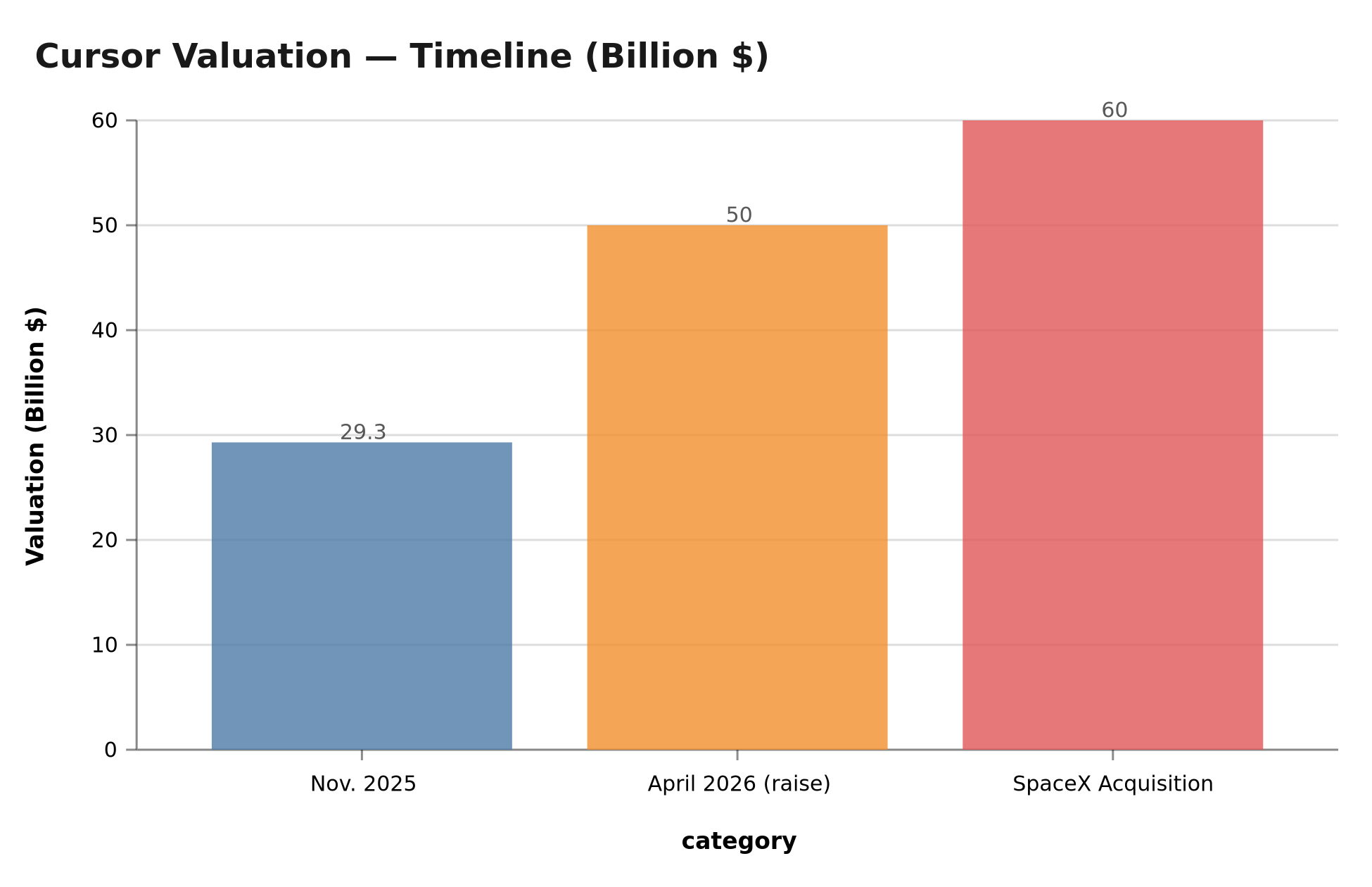 Cursor: from $29.3B (Nov. 2025) to $60B (SpaceX acquisition option, April 2026)
Why $60 billion for a code editor?
At first glance, the multiple looks irrational. Cursor has a massive user base but still relatively modest revenue compared to traditional incumbents. SpaceX's calculation isn't on current revenue. It's on three strategic levers:
- Captive distribution: hundreds of thousands of developers locked into Cursor, with adoption ratios beating GitHub Copilot in several 2025-2026 studies.
- The proprietary Composer model: an LLM optimized for code generation, partly trained on Cursor usage flows — an asset no one else can replicate.
- Infrastructure synergy: plugging Cursor + Composer into Colossus (SpaceX infrastructure equivalent to one million Nvidia H100s) enables massive context windows, ultra-low latency, and competitive marginal cost that neither GitHub Copilot nor JetBrains can match without spending tens of billions on datacenters.
What this acquisition reveals about the 2026 market
The SpaceX-Cursor deal isn't isolated. It's the logical conclusion of an AI developer tools market reshuffle accelerating for 18 months.
The market shifts from tool to platform
For years, code editors were tools: VSCode, JetBrains, Sublime, Vim. You paid a license (sometimes zero) for software. With deep AI integration, the editor becomes a platform that consumes compute, routes to models, generates and executes actions. Value moves out of the binary — into compute, models, and usage flow.
This shift explains why:
- Microsoft invested $13 billion in OpenAI to lock GitHub Copilot.
- JetBrains aggressively pushes AI Assistant integrated and accelerates on agents.
- Cursor raised at $50 then sold at $60 billion in 6 months.
- Anthropic embedded Claude Code directly into GitHub.
Barrier to entry explodes
Entering the "AI editor" market in 2026 now requires three simultaneous assets:
- A popular editor with an active user base.
- A specialized model or exclusive partnership with a top-tier model provider.
- Massive GPU infrastructure or guaranteed access to a hyperscaler-grade cluster.
That's exactly what SpaceX-Cursor consolidates. And it makes new entry nearly impossible without an equally muscular integration. Small independent AI editors will disappear or get acquired in the next 12-18 months.
Developers and enterprises are cornered
User-side, this concentration creates risk: higher dependency. If you've integrated Cursor + Composer into your 30-developer team's workflow and SpaceX decides tomorrow to double prices, change moderation policy (refusing to generate certain types of code), or restrict access from certain countries, you have no immediate recourse. Migrating to another stack costs weeks of productivity.
This is exactly the risk serious tech leadership anticipates in 2026, by building multi-editor and multi-model stacks rather than monoculture dependency.
Detailed comparison: Cursor, GitHub Copilot, Windsurf, and Codeium in 2026
Making informed decisions requires moving beyond marketing and comparing tools on concrete criteria. In 2026, four platforms are competing for the majority of developers who use AI tools daily.
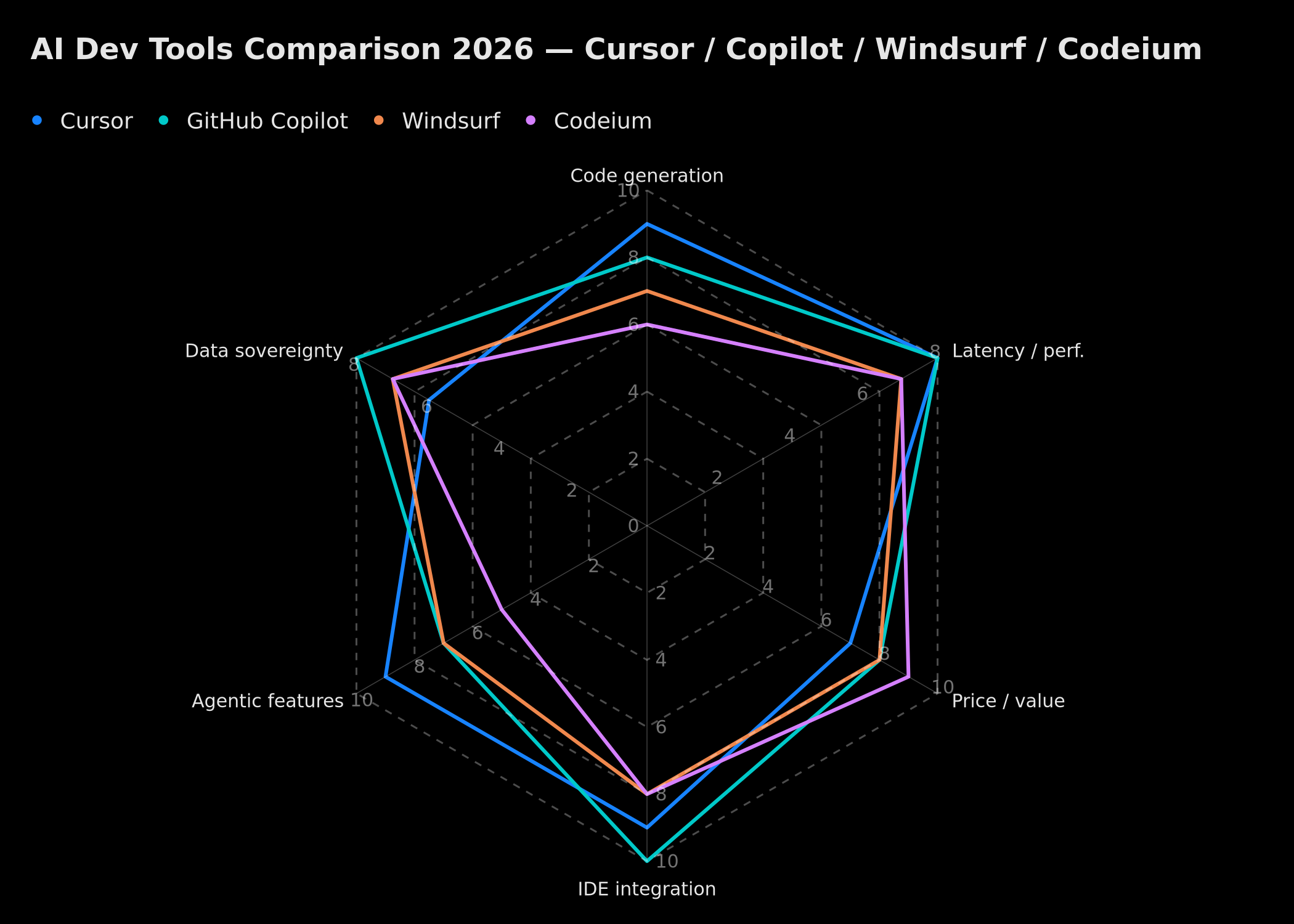 Illustrative scores out of 10: code generation, latency, price, IDE integration, agentic features, data sovereignty
Cursor is today's reference for agentic power. Its Composer mode lets you hand off a complex task — "refactor this module, write the corresponding unit tests, fix lint errors" — and receive a deliverable within minutes. Its context window (up to 200,000 tokens depending on the connected model) lets it analyze large codebases without losing the thread. Its main weakness in 2026 remains data sovereignty: code is sent to external servers, which creates compliance issues for sensitive projects. After the SpaceX acquisition option, concerns about how privacy policy might evolve have multiplied across engineering teams.
GitHub Copilot is the safe harbor for enterprise environments. Its native integration across Visual Studio, VS Code, JetBrains, and now GitHub.com gives it a significant logistical edge: no new software to deploy, no learning curve on the interface. Copilot Enterprise now offers a "codebase-aware" mode that indexes the company's GitHub repository to contextualize suggestions. Microsoft is also pushing on agentic features with Copilot Workspace, but remains behind Cursor for autonomous generation workflows. On the data sovereignty front, however, Copilot is stronger: Microsoft provides clear contractual commitments on data retention for Enterprise customers.
Windsurf (formerly Codeium Editor, rebranded in 2025) chose a clean interface and competitive pricing. It stands out for completion speed and a generous free plan, but its agentic mode remains less powerful than Cursor in 2026. It's particularly well-suited for solo developers and early-stage startups looking to adopt AI without a significant budget.
Codeium offers the market's fastest line-by-line autocomplete, with a free plan that makes it accessible to all teams. Its limitations appear on complex tasks: large-scale refactoring, full automated test generation, or multi-file workflows. It nonetheless remains an excellent complementary tool in a multi-editor stack.
The 2026 verdict: no single tool dominates on all dimensions. The optimal strategy is a hybrid stack — Cursor for complex and agentic tasks, Copilot for Microsoft/enterprise environments, Codeium as a complement for daily completion speed.
AI developer tool adoption in 2026
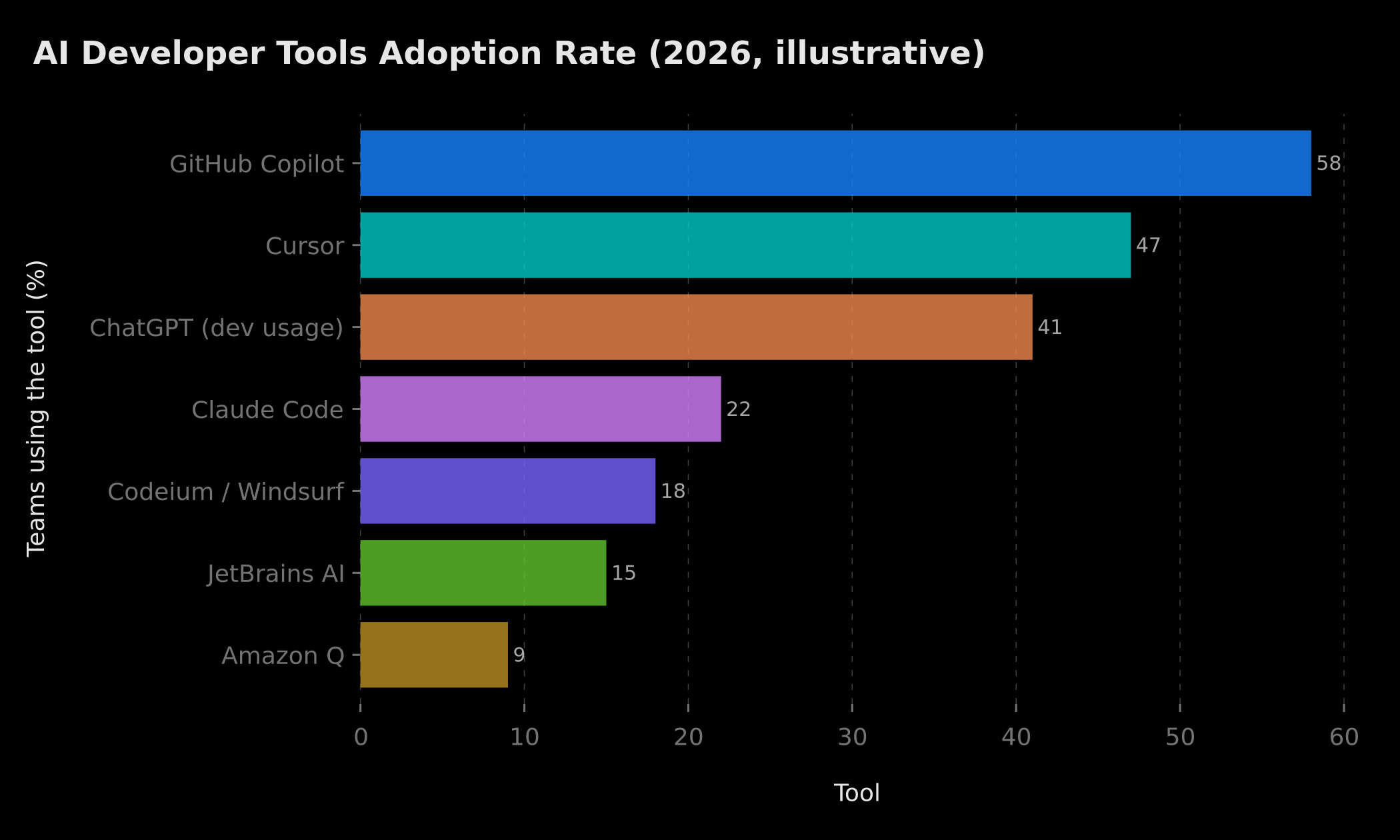 Share of teams reporting at least weekly tool usage (illustrative data based on observed trends)
Adoption data observed in 2026 reveals an interesting hierarchy. GitHub Copilot maintains its leadership position in raw usage rates, particularly through its built-in distribution via GitHub and the Microsoft ecosystem. Cursor is growing at an accelerated pace, especially among full-stack developers and AI-native agencies. ChatGPT retains an important place in developer workflows, often used alongside an AI editor for architecture questions or complex debugging. Claude Code is gaining momentum, driven by Anthropic integrating it directly into CI/CD environments and developer terminals.
These figures require careful interpretation: adoption doesn't equal depth of use. A developer using Copilot for autocomplete and another using Cursor Composer to generate entire modules are in entirely different usage categories. The structural trend of 2026 is that value is shifting from the quantity of users toward the depth of workflow integration.
Coding agents: the next frontier of 2026
Among the trends reshaping the AI developer tools market, autonomous coding agents represent the deepest shift since autocomplete. A coding agent doesn't just suggest the next line — it plans, executes, iterates, and delivers.
Concretely, a coding agent can receive an instruction like "implement an OAuth2 authentication system for this Express API, with unit tests and documentation" and produce the entire deliverable in minutes, reading the existing codebase, creating the necessary files, running tests, and iteratively fixing errors. In 2026, Cursor Composer in agent mode, Claude Code, Aider, and Sweep are the references in this category.
This evolution has direct implications for the developer's role: less time writing boilerplate code, more time dedicated to architecture, design decisions, quality review, and component integration. This isn't the disappearance of the developer — it's the transformation of that role into an orchestrator of AI systems rather than a line-by-line code writer.
The ongoing war between open and closed AI models is directly tied to this evolution: the most powerful coding agents rely on proprietary models (Claude Opus, GPT-5.5), but teams concerned about data sovereignty are turning to open-source alternatives like DeepSeek V4 or Mistral, deployable in self-hosted mode.
The developer workflow in the age of AI agents
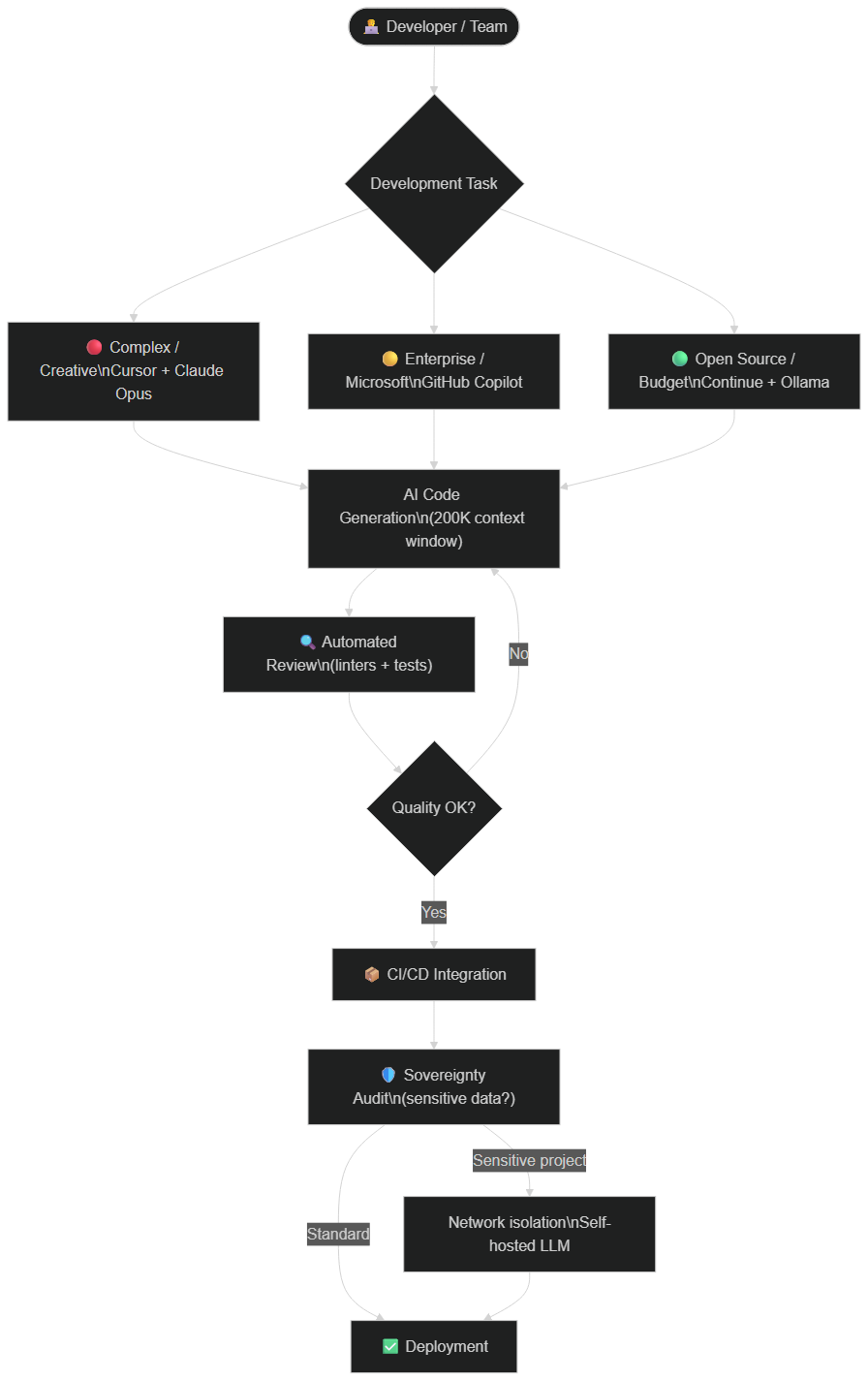 Complete pipeline: tool selection by task type, AI generation, automated review, sovereignty audit, deployment
The developer workflow in 2026 looks increasingly different from what it was in 2023. The typical sequence of a development task in an AI-augmented team now follows a multi-step pattern. First, tool selection based on the nature of the task: Cursor for complex refactoring and new features, Copilot for Microsoft environments, Continue + Ollama for teams requiring fully local execution. Next, AI generation with iteration: the agent produces a first draft, identifies errors, fixes them autonomously until tests pass. Then automated quality review: linters, test suites, static code analysis, problematic pattern detection. Finally, sovereignty audit before any deployment on sensitive projects: verifying that proprietary data wasn't exposed, network isolation when necessary.
According to Google, 75% of their code is now AI-assisted — a verifiable statistic from their 2026 company report, illustrating how rapidly this workflow has normalized among tier-one tech actors. For agencies and smaller teams, the percentage varies — but the direction is unanimous.
Strategic stakes: training data and sovereignty
Behind the AI editor war, an even deeper battle is playing out: who controls training data. Every time a developer uses Cursor, GitHub Copilot, or Codeium, their interactions — prompts, generated code, corrections — are potentially used to improve the underlying models. This is why these tools are worth tens of billions: not for their current revenues, but for the proprietary feedback loop they fuel.
For SpaceX, acquiring Cursor means capturing a training data stream from hundreds of thousands of professional developers — the best raw material there is for improving a code generation model. Combined with xAI's training data (via Grok) and Colossus's compute, it's a data → model → adoption → data flywheel that will be very hard to stop.
For engineering teams, this reality demands serious thought about data policy. Sending proprietary code, secret algorithms, or infrastructure configurations to an AI editor managed by SpaceX is not a neutral act. The most sensitive projects — fintech, defense, healthcare, critical infrastructure — must either route through editors offering solid contractual guarantees (Microsoft Enterprise Agreement for Copilot), or migrate to self-hosted solutions. Automating certain critical workflows via self-hosted n8n represents a complementary path for teams wanting to control their end-to-end pipeline.
Three direct consequences for freelancers, agencies, and tech teams
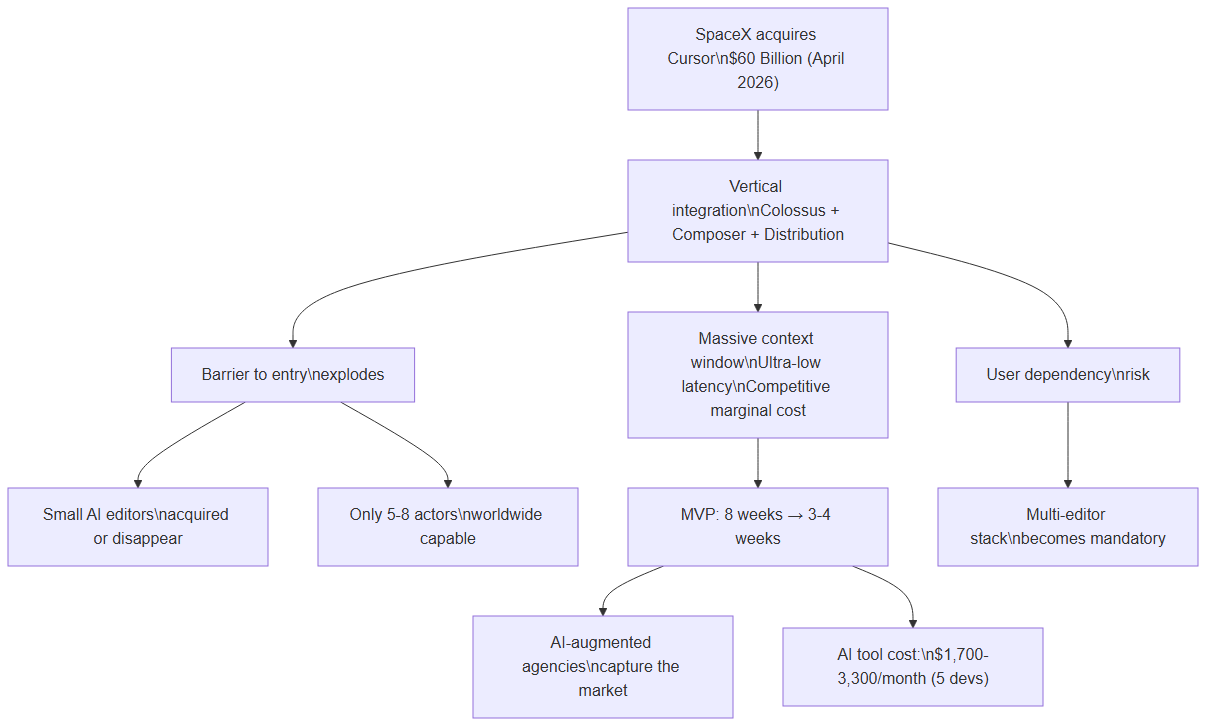 Impact chain: SpaceX-Cursor vertical integration → accelerated productivity → multi-editor stack becomes mandatory
Consequence 1 — "Cursor / Copilot engineer" skill becomes obsolete
In 2024-2025, prompting Cursor was a rare, valuable skill. In 2026, it's a baseline, like using an IDE. The rare skill becomes:
- Architecting multi-model workflows (Cursor + Claude Code + GPT-5.5 + DeepSeek V4 by task).
- Writing rules, MCP servers, and skills that deeply customize the assistant for a given project.
- Measuring AI output quality with automated test suites (the boom of tools like Aider, Sweep, or in-house evaluators).
- Guaranteeing code sovereignty: avoiding data leaks, handling GDPR, isolating sensitive projects from an IDE that talks to external servers.
It's an architect-level skill, not a user-level one.
Consequence 2 — Fast-shipping agencies capture the market
The SpaceX-Cursor acquisition accelerates software development productivity. An agency that shipped an MVP in 8 weeks in 2024 now ships it in 3-4 weeks with an optimized AI stack. This transforms the trade economics:
- End clients pay less for an MVP, but pay more for quality, SEO, conversion optimization, scaling.
- Agencies without AI in their process sit at a major cost disadvantage — already visible on 2026 RFPs.
- Freelancer value proposition shifts: less "I code" and more "I architect an AI-augmented system and ship 4x faster than the average."
At BOVO Digital, we ship a detailed quote within 24 hours precisely because this acceleration is built into our process. Our Tontineo, Illico Voice AI, and MaxSEO projects landed on cycles 2-3x shorter than a classic 2023 cycle.
Consequence 3 — AI tool rent creates a new cost
To ship fast, you consume. A 5-developer team on Cursor Pro + GitHub Copilot Enterprise + Claude Pro + ChatGPT Pro + Composer Pro easily costs $1,700-3,300/month in AI tools alone. This cost is largely amortized by productivity — but it must be explicitly budgeted, which many agencies still omit in 2026 quotes.
On long projects (>6 months), this represents $5,500-16,500 of hidden cost that must be billed to the client or absorbed by margin. Agencies pricing projects without integrating this end up with gross margin below historical standards.
What to do concretely in 2026
For tech leadership
- Audit your dependency on Cursor / Copilot / Composer. How many developers? Monthly cost? Alternative if SpaceX flips brutally?
- Build a multi-editor stack: Cursor + VSCode + Claude Code + JetBrains AI by profile, with project conventions (rules, MCP servers, skills) portable across editors.
- Invest in generated-code observability: test suites, linters, AI-assisted code reviews. Generated code without audit is hidden technical debt.
- Educate on data leaks: an AI editor potentially sends your code to a third party. For banking, medical, or defense projects, it's not acceptable without compliance audit.
For freelancers
- Move past tool-user posture. Position as AI architect: stack design, model integration, client workflow automation via n8n and Make.com.
- Document accelerated delivery cycles. A freelancer proving 3x faster delivery than peers easily justifies a 30-50% higher day rate.
- Bake AI cost into transparent quotes. Serious clients prefer a quote breaking down "$220/month of AI tools for this project" over a foggy one.
For enterprises commissioning external dev
- Reject quotes that don't explain the AI stack used. An agency that can't answer "how does Cursor / Copilot fit your process?" is 18 months behind.
- Demand full code ownership and portability (no lock-in on a particular IDE).
- Prefer agencies with documented fast deliveries. Speed has become a quality proxy in this ecosystem.
Trends to watch: 2026 and beyond
The AI developer tools market in 2026 is not frozen — it's evolving at a speed that few players anticipated eighteen months ago. Several structural trends deserve close attention in the months ahead.
End-to-end code generation is advancing rapidly: we're no longer just talking about generating functions or components, but generating entire applications from a natural language specification. Tools like Bolt, Lovable, and Vercel's v0 are popularizing this approach for web projects, while Cursor Composer and Claude Code enable finer-grained generation on complex existing projects. This trend will restructure the outsourced dev market: value shifts toward design, validation, and maintenance rather than raw implementation.
Domain specialization is another strong trend. Models and agents specialized by domain are emerging: for mobile development (Flutter agents, React Native agents), for smart contracts (Solidity agents), for data engineering (dbt, SQL agents). This specialization produces output quality significantly superior to generalist models for domain-specific tasks. In parallel, the rise of context protocols like MCP (Model Context Protocol) is creating a new layer of interoperability — allowing AI assistants to plug into databases, APIs, internal tools, and documentation sources without manual copy-pasting. This infrastructure layer is quietly becoming as strategically important as the models themselves, and the teams that invest in building solid MCP tooling today will have a compounding advantage in 2027.
Open source as a shield is also gaining momentum. Faced with market concentration around a few players (Microsoft-OpenAI, SpaceX-Cursor-xAI, Anthropic-Google), communities organized around Continue, Aider, and self-hosted models (Ollama, LM Studio) are building viable alternatives. These solutions don't yet compete on raw power, but offer portability and sovereignty that commercial editors cannot guarantee. For regulated industries and enterprises operating under strict data residency requirements — GDPR in Europe, data localization laws in the Middle East and Southeast Asia — open source tooling is not just a cost play, it's a compliance necessity. Expect significant enterprise investment in open-source AI coding infrastructure through 2026 and 2027.
The 18-month scenario
Our reading at BOVO Digital of likely next moves:
- GitHub Copilot replies aggressively: Microsoft can't let SpaceX dominate. Expect a Copilot feature surge by end of 2026, with deeper Claude and OpenAI integration.
- JetBrains accelerates on AI: their AI Assistant goes agentic and competes with Cursor on enterprise.
- Several independent AI editors get acquired or shut down within 12 months.
- A serious open-source editor emerges (likely community-driven around Continue, Aider, or a VSCode + LSP AI fork), backed by enterprises refusing hyperscaler dependency.
- Regulators (EU, China) get involved: market concentration, infrastructure access, data leaks. Expect a 2027 regulatory framework.
How BOVO Digital integrates this new reality
We design our web development, mobile, chatbot, and AI automation services with a multi-editor, multi-model stack:
- Cursor + Claude Opus 4.7 on tight-sprint complex projects.
- GitHub Copilot on enterprise projects where Microsoft ecosystem is mandated.
- n8n / Make.com workflows for AI integrations into client operations.
- Systematic code sovereignty audit on sensitive projects.
Our delivery cycles are 2-3x shorter without quality loss — visible across our reference projects and customer satisfaction scores (≥ 4.7/5 on store-published mobile apps).
Conclusion
The SpaceX acquisition option on Cursor at $60 billion — whether exercised or not — isn't just a financial play. It's the closure of a phase. The phase where you could build an AI editor in your garage, push it on Product Hunt, and raise at $50 billion 18 months later. The new phase belongs to actors mastering GPU infrastructure, proprietary models, and developer usage flows simultaneously. Three assets only 5 to 8 actors worldwide can pull together.
For agencies, freelancers, and tech companies, two options: endure this concentration (paying the rent) or leverage it (architecting multi-editor stacks, optimizing delivery speed, charging the differentiated quality this acceleration enables).
Let's discuss your AI-augmented development strategy or browse our delivered projects.
Tags
FAQ
Did SpaceX really acquire Cursor for $60 billion?
On April 21, 2026, SpaceX announced an acquisition option on Cursor for $60 billion exercisable in 2026. If unexercised, SpaceX still pays $10 billion for the operational partnership. The announcement was covered by TechCrunch, Reuters, CNBC, and The Verge the same day. It's roughly a 2x multiple over the November 2025 valuation ($29.3 billion). Note: this is an acquisition option — its actual exercise had not been publicly confirmed at the time this article was written.
Why is a code editor worth $60 billion?
Not for current revenue, but for the combination of three assets: 1) captive distribution with hundreds of thousands of developer users, 2) a proprietary model (Composer) optimized for code generation, partly trained on Cursor usage flows — an asset no one else can replicate, 3) synergy with Colossus (SpaceX infrastructure equivalent to 1M H100s). This vertical GPU + model + distribution integration justifies the multiple.
Should I keep using Cursor in 2026?
Yes, but without exclusive dependency. Cursor remains excellent. However, a serious 2026 tech stack includes at least 2 different AI editors (Cursor + GitHub Copilot or Cursor + JetBrains AI) with portable conventions (project rules, MCP servers, skills). This protects against an abrupt pricing or policy flip from the new owner.
What's the impact on web and mobile development agencies?
Agencies without AI in their process are at major competitive disadvantage. Delivery cycles dropped 2-3x at AI-augmented agencies. Clients now demand fast delivery and audit provider AI processes. Agencies unable to answer "how does Cursor / Copilot fit your workflow?" lose 2026 RFPs.
How much do AI tools really cost for a developer team in 2026?
For 5 developers with a complete stack (Cursor Pro, GitHub Copilot Enterprise, Claude Pro, ChatGPT Pro, multi-model API access): between $1,700 and $3,300/month in tools, or $20,000-40,000/year. Largely amortized by productivity gains, but must be explicitly budgeted and billed/absorbed per business model.
How does BOVO Digital integrate the new AI tools in its services?
We run a multi-editor stack (Cursor + Claude Code + GitHub Copilot per project) with portable conventions (rules, MCP servers, skills). All delivery cycles include a code sovereignty audit on sensitive projects, automated test suites, and explicit AI cost in the quote. Our projects ship 2-3x faster than a classic 2023 cycle, without quality loss (≥ 4.7/5 on store-published apps). Start with a free scoping call via /en/expert-site-web.
What is the difference between Windsurf, Codeium, and Cursor for a solo developer?
Windsurf (formerly Codeium Editor) emphasizes a smooth experience and competitive pricing — ideal for solo developers or small teams on a tighter budget. Codeium offers a generous free plan with fast completions, suited for learning or personal projects. Cursor is positioned on agentic power and extended context windows, better suited for complex projects. In 2026, the recommendation is to trial all three for a month and choose based on project type.
What are coding agents and how do they differ from a simple code assistant?
A code assistant (classic GitHub Copilot, autocomplete) suggests lines or blocks of code at cursor position. A coding agent (Cursor Composer in agent mode, Claude Code, Aider) can plan a task, read multiple project files, run terminal commands, create tests, fix errors in a loop, and autonomously deliver a complete result. In 2026, coding agents represent the active frontier of the sector.
Free audit: we check the impact on your site and workflows
Next.js CVE, new agent, MCP… We tell you what actually applies, and what to patch or ignore.
- 30 min
- Stack reviewed
- No commitment
William Aklamavo
Web development and automation expert, passionate about technological innovation and digital entrepreneurship.


