
GITEX Africa 2026 & Digital Sovereignty: Business Opportunities for the Digital Entrepreneur
GITEX Africa 2026 (Marrakech, April 7-9) confirms that digital sovereignty in Africa is a real business reality. Fintech, agritech, B2B SaaS: the sectors, strategies, and concrete opportunities for digital entrepreneurs.

Updated

GITEX Africa 2026 & Digital Sovereignty: Business Opportunities for the Digital Entrepreneur
The African continent is no longer preparing for the digital revolution — it is living it, building it, and exporting it. GITEX Africa 2026 is the most compelling proof of this.
From April 7-9, 2026, Marrakech hosted the 4th edition of GITEX Africa, which has become the largest tech and startup show on the African continent. With over 1,400 exhibitors and 45,000 visitors from 130 countries, the event confirms a reality many still underestimate: Africa has become a central actor in global digital innovation. For entrepreneurs questioning what GITEX Africa 2026 digital sovereignty means in practice, the answer is clear: it is not a regulatory constraint, it is a market worth tens of billions of dollars in active construction. This article gives you the conceptual framework, verified figures, and a concrete strategy to position yourself right now.
The Numbers That Boggle the Mind
| Indicator | 2024 | 2026 |
|---|---|---|
| EU digital market | €58B | €70B |
| French AI startups | 630 | 1,114 |
| Africa startup funding | $2.1B | $4.3B |
| % French using AI | 31% | 48% |
Sources: Propulse by CA, VivaTech, GITEX Africa 2026
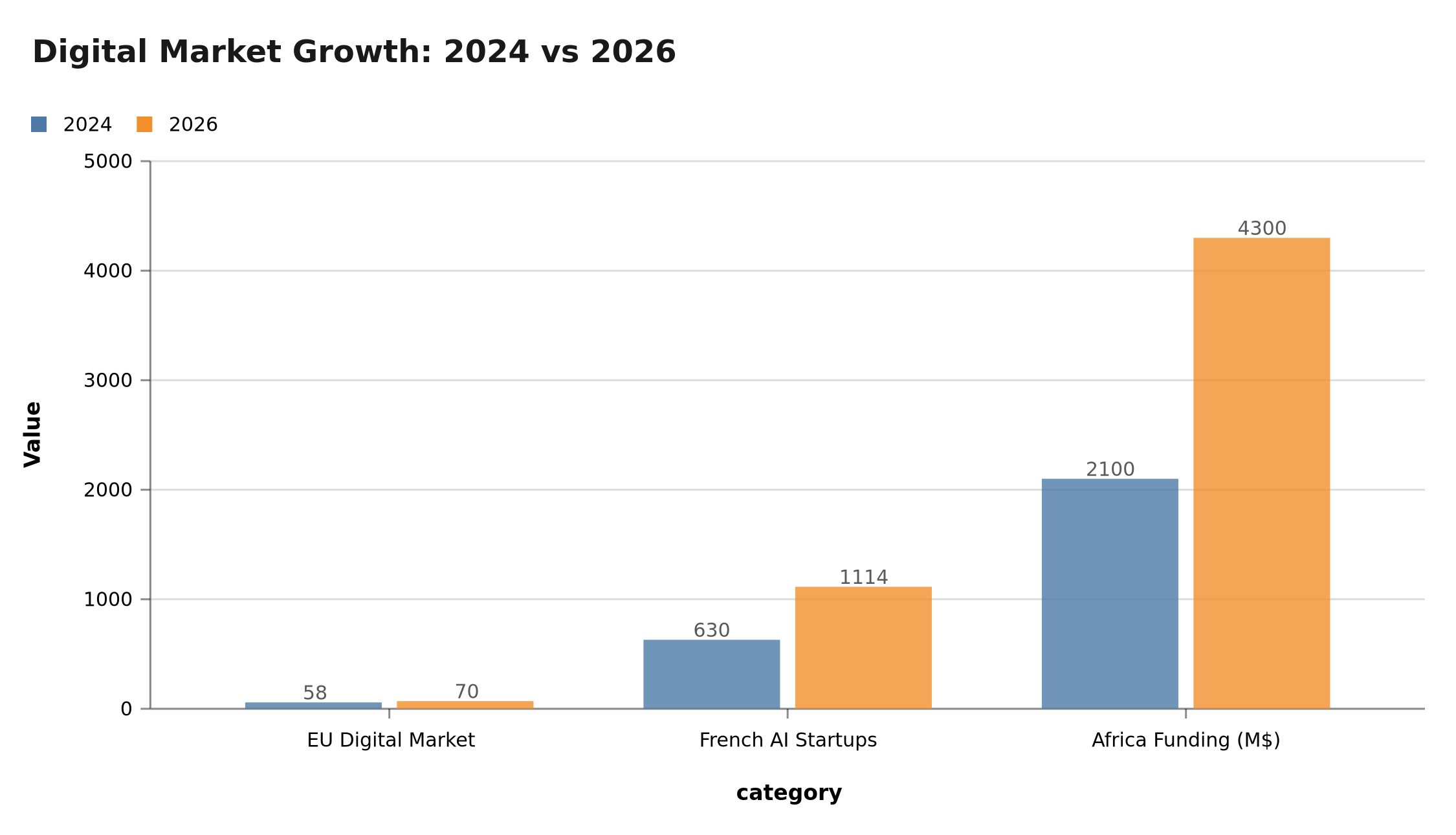 2024–2026 evolution: EU digital market (€58B→€70B), French AI startups (630→1,114), Africa funding ($2.1B→$4.3B)
These figures deserve careful reading. The doubling of African startup funding in two years is not an accident: it reflects a combination of structural factors — rapid urbanization, the explosion of mobile telephony, a young population, and an African diaspora in Europe and the United States increasingly willing to invest locally. Meanwhile, the rise of French AI startups from 630 to 1,114 units illustrates a continental ecosystem that is densifying on both sides of the Mediterranean. Entrepreneurs positioned at the intersection of these two dynamics — Europe and Africa — are in a particularly favorable arbitrage position.
GITEX Africa: From Regional Show to Global Innovation Showcase
Launched in 2023 under the impetus of KAOUN International, the historic organizer of GITEX Global in Dubai, GITEX Africa climbed the ranks at breathtaking speed. Its first edition in Marrakech attracted a few hundred exhibitors. Three years later, the 2026 edition surpassed 1,400 exhibitors representing 130 nationalities, with national pavilions for Morocco, Kenya, Nigeria, Ivory Coast, Senegal, Egypt, and South Africa, among others.
This meteoric success is explained by several factors. First, Marrakech is an established international conference city with proven infrastructure. Second, Morocco plays a strategic role as a bridge between Europe and sub-Saharan Africa, with political and economic stability appreciated by foreign investors. Third, the timing is perfect: international funders — World Bank, African Development Bank, IFC — are actively seeking African tech projects in which to deploy capital.
The 2026 edition distinguished itself with two new central themes. The first is sovereign cybersecurity, with entire sessions devoted to African Security Operations Centers (SOCs) and digital resilience strategies. The second is generative AI for African languages, with impressive demos of models trained on Swahili, Wolof, Amharic, and Bambara corpora. These themes are not anecdotal: they reveal where the continent's public and private investors will concentrate their budgets over the next five years.
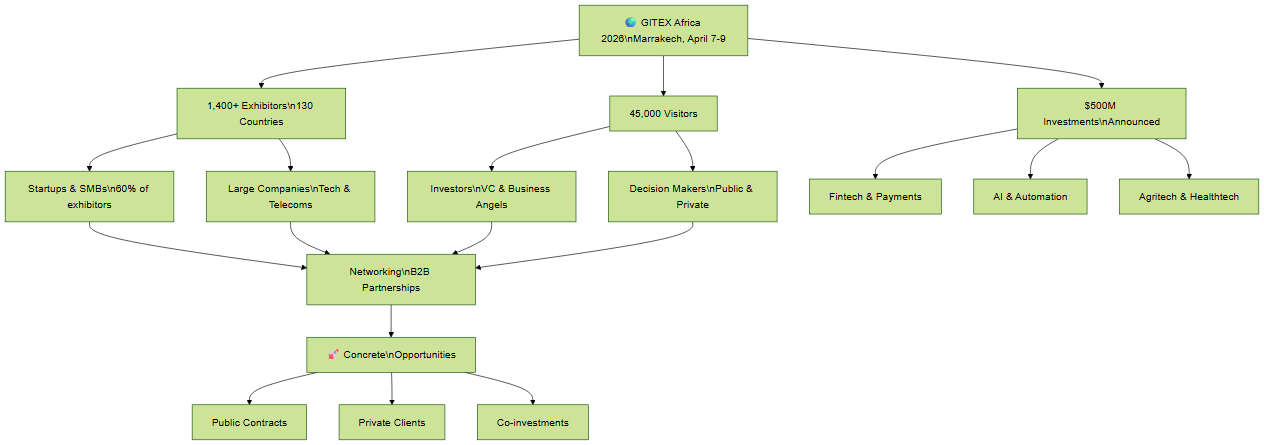 Map of the GITEX Africa 2026 ecosystem: from B2B networking to concrete opportunities in fintech, AI, and agritech
Digital Sovereignty in Africa: A Decade-Defining Challenge
The concept of digital sovereignty has been the subject of intense debate in Europe since GDPR and the discussions around the American Cloud Act. In Africa, the debate takes on an additional dimension: that of economic independence. For decades, data from African companies and citizens was stored on servers located in the United States or Europe, generating high latency costs, poorly managed legal risks, and a structural form of technological dependency.
The regulatory response is now underway. In Kenya, the Kenya Information and Communications Act has required since 2025 that personal data of Kenyan citizens be processed on national soil. In Senegal, the Data Protection Commission (CDP) has tightened its localization requirements as part of the revision of Law No. 2008-12. In Morocco, the ANPDP (National Authority for Personal Data Protection) actively pushes for Moroccan government data to avoid transiting through foreign clouds. These regulatory developments are not mere constraints: they create massive demand for local solutions.
For digital entrepreneurs, this dynamic opens specific opportunities. African companies that want to remain compliant need African or European cloud providers, locally hosted SaaS applications, and consultants capable of auditing and guiding them through compliance. Players like AWS Africa (Cape Town), Google Cloud (Johannesburg), and Azure (Johannesburg and Lagos) are investing heavily, but they do not cover the entire continent and do not always meet the strict territorial localization requirements of states that want data held within national borders.
This is precisely where the European or African digital entrepreneur can differentiate. By offering solutions hosted on a continental cloud provider with contractual commitments on data localization, you are directly addressing the legal and IT departments of African companies — decision-makers who now have a precise roadmap and dedicated budgets for this purpose.
The 4 Tech Sectors Driving African Growth in 2026
Not all tech sectors are created equal in Africa. Some are mature and already highly competitive. Others are still in seed phase and offer interesting premium pricing opportunities. Here are the four sectors to prioritize.
Fintech remains, by far, the most dynamic and best-funded sector. The African continent is home to more than 500 million unbanked people who access financial services exclusively via mobile. Platforms like Wave (Senegal), Flutterwave (Nigeria), and M-Pesa (Kenya) have proven that it is possible to build multi-billion dollar companies starting from this fundamental need. For a digital entrepreneur, the preferred entry point is integration: building SaaS solutions that interface with these mobile payment networks to help local SMBs manage their accounting, collections, and bank reconciliations.
Agritech represents an often underestimated opportunity. More than 60% of the African population depends directly or indirectly on agriculture. The digitization of cooperatives, real-time weather data collection, market access for small producers via mobile apps, and the traceability of agricultural supply chains are problems where technology can deliver immediate, measurable value. Startups like Hello Tractor (Nigeria) or Twiga Foods (Kenya) illustrate this potential vividly.
AI-powered healthtech is booming. With a chronic shortage of doctors — the WHO estimates a 2.4 million healthcare worker deficit in sub-Saharan Africa — AI diagnostic support tools, telemedicine platforms, and hospital management applications have a direct impact on patients. African governments, often unable to train enough doctors in the short term, are receptive to technological solutions that multiply the effectiveness of existing caregivers.
B2B automation is the least exploited sector but may offer the most attractive margins. African SMBs — distribution stores, accounting firms, communications agencies, logistics companies — have not yet experienced the automation wave that swept European companies between 2020 and 2025. They still do their invoicing in Excel, customer reminders by manual SMS, and inventory management in paper notebooks. An entrepreneur capable of deploying n8n or Make.com workflows for these companies can charge high-value-added rates in a market that is still lightly competitive.
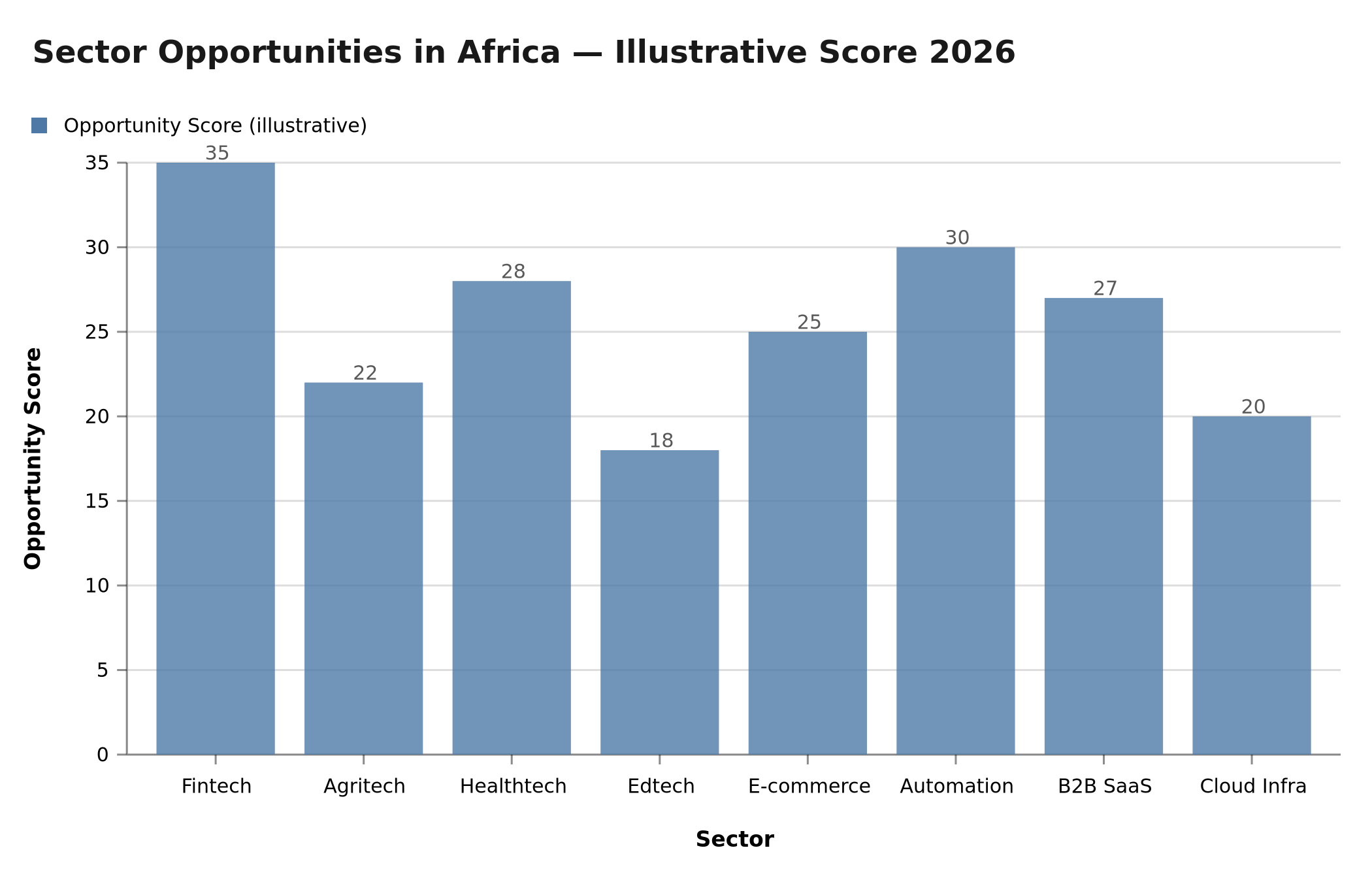 Illustrative comparison of tech sector opportunities in Africa in 2026: fintech and automation lead market potential
Tech Funding in Africa: Who Invests, Where, How Much?
African tech startup funding reached $4.3 billion in 2026 according to consolidated estimates from GITEX Africa and Propulse by CA. This global figure masks important geographic disparities that are essential to understand before defining your market entry strategy.
Nigeria alone captures a disproportionate share of continental funding, driven by Lagos establishing itself as the "Silicon Valley of West Africa." Kenya maintains its historical lead thanks to its mature startup ecosystem around Nairobi (IHUB, Nairobi Garage) and its progressive fintech regulations. Morocco, host of GITEX Africa, benefits from growing attractiveness for French and European investors seeking a gateway to the continent in a familiar legal environment. Egypt leverages its demographic size (110 million inhabitants) and its exploding e-commerce market. Ivory Coast and Senegal, despite still modest volumes, show high startup ecosystem growth rates.
This funding geography should guide your choice of primary market. A first project in French-speaking West Africa — Senegal or Ivory Coast — offers the advantage of a common language and a business culture close to France, with less direct competition than English-speaking Nigeria.
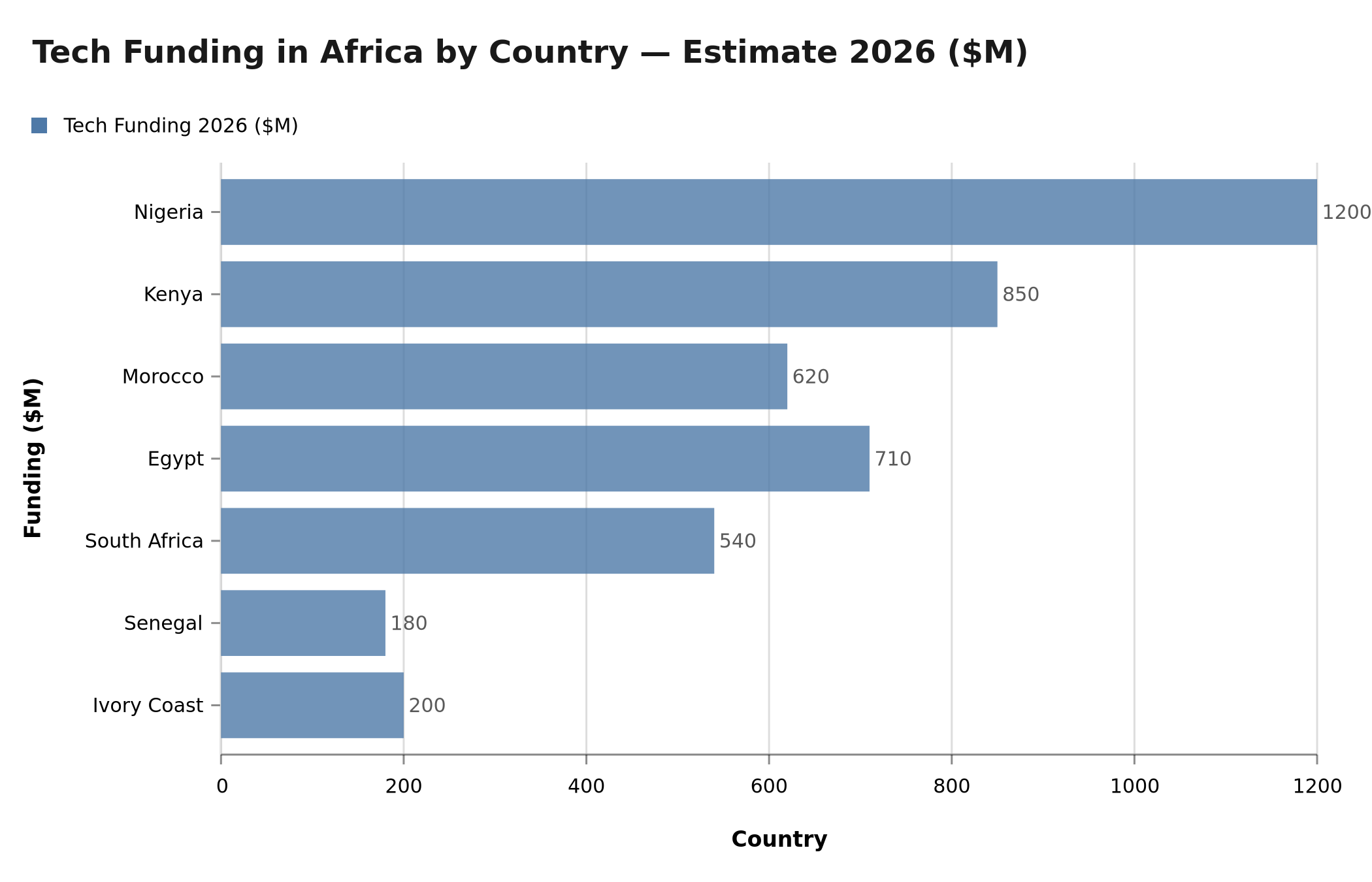 Estimated distribution of African tech funding 2026 by country: Nigeria and Kenya lead, French-speaking West Africa growing strongly
3 Major Trends Identified at GITEX Africa 2026
1. Digital Sovereignty: A Business Opportunity, Not a Constraint
Demand for "Made in Africa" or "Made in Europe" digital solutions is exploding. Companies — especially in finance, healthcare, and the public sector — no longer want to depend on American solutions whose contractual terms and data transfer practices toward the United States have become problematic since the invalidation of the Privacy Shield and its successive versions.
Concretely for you: if you develop web apps, mobile apps, or automation solutions, the "hosted in Europe" or "data on the continent" label is now a strong commercial argument. Procurement departments at major African companies now integrate this criterion in their requests for proposals, alongside price or functional quality. This is a barrier to entry for your Asian or American competitors — and a real competitive advantage for a well-positioned European or African player.
2. AI for SMBs, Not Just Large Corporations
One of GITEX Africa 2026's revelations: the most impactful AI use cases don't come from large companies. They come from SMBs with 5 to 50 people automating their processes with tools like n8n, Make.com, and Claude or GPT-4o agents. The cost-benefit ratio is particularly favorable because qualified local labor remains scarce: automation is equivalent to multiplying productive capacity without hiring.
Concrete example seen in Marrakech: a Moroccan veterinary clinic reduced its administrative time by 70% by automating reminders, invoices, and inventory management with n8n. Total budget: €3,800. To build this type of system, read our map of 1,114 French AI startups and our analysis of why 68% of funded startups put AI at the core of their strategy. The same logic applies to African markets with an even larger unexplored penetration potential.
3. African Freelance Platforms Are Rising
Platforms like ComeUp (born in France, strong presence in French-speaking Africa) and emerging local ones are capturing more and more tech projects. The sought-after profile: developers who can deliver fast, at competitive prices, with a genuine understanding of local markets. But beyond platforms, what GITEX Africa 2026 reveals is the emergence of a direct B2B market between African entrepreneurs and African clients — a market increasingly bypassing traditional Western intermediaries.
How to Position Yourself in the African Market: Our Roadmap
Launching in the African digital market without a method is a guaranteed way to run into avoidable obstacles. Here is the roadmap we recommend for digital entrepreneurs who want to capitalize on the dynamics revealed by GITEX Africa 2026.
Step 1: Choose a precise geographic market. "Africa" is not a market — it is a continent of 54 countries with radically different legislation, languages, and digital maturity levels. Start with a single country, ideally one within your linguistic and cultural comfort zone. For a French-speaking entrepreneur, Senegal, Ivory Coast, or Morocco are natural entry points.
Step 2: Identify a sector and client type. Resist the temptation to address everyone. Choose a vertical sector (fintech, healthtech, agritech, B2B automation) and a precise customer segment (distribution SMBs, consulting firms, private clinics). This specialization is your best sales argument against generalist competitors.
Step 3: Find a local partner. This is the sine qua non of a successful establishment. A local partner brings you three things: knowledge of decision-making channels, cultural credibility with customers, and essential regulatory monitoring in environments where laws evolve rapidly. Events like GITEX Africa are precisely designed to facilitate these encounters.
Step 4: Launch an MVP in 3 to 6 months. Not a perfect product — a functional product that solves a real problem for 5 to 10 pilot clients. This approach allows you to validate your market assumptions before investing large sums, and to generate local references that will facilitate your subsequent commercial development.
Step 5: Measure, iterate, scale. Key metrics to track: retention rate, NPS, customer acquisition cost. If they are good, you have the market proof needed to raise local or European funds and accelerate your deployment. AI agents in production now achieve ROI of 171% according to the most recent data — these results are replicable in African markets with an adapted approach.
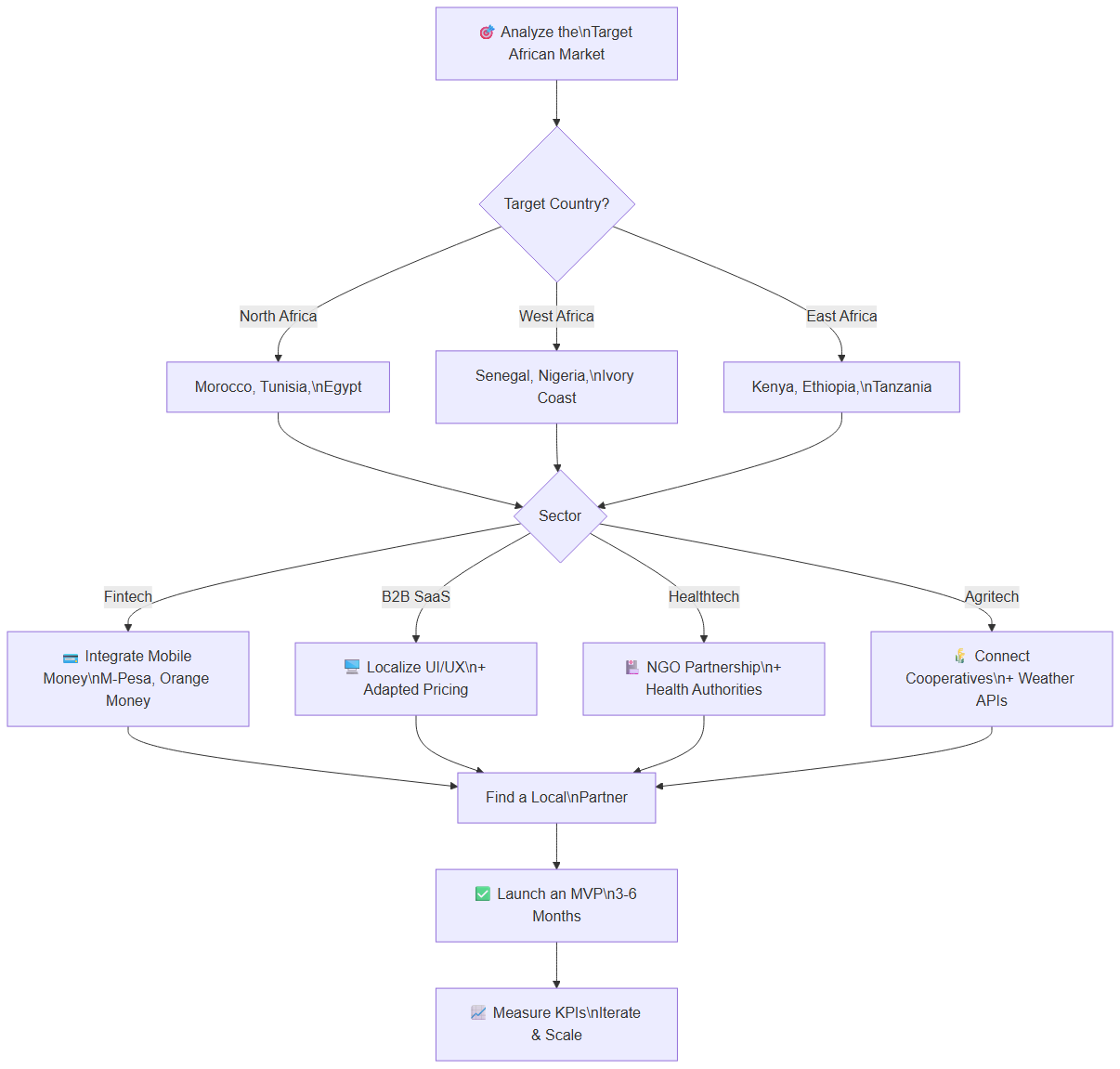 5-step roadmap for entering the African digital market: from target market analysis to KPI-driven scaling
Challenges and Barriers to Entry: Don't Idealize
An honest article about African opportunities must also address the real obstacles. Ignoring them would do you a disservice.
Access to international payments remains a major barrier. Collecting revenue from Africa into a European account, or invoicing in euros to an African client, involves significant friction: high currency conversion fees, long transfer delays, and exchange control regulations in some countries (Nigeria, Ethiopia). Solutions exist — Stripe, Flutterwave, Paystack — but their availability varies by country and regulatory environment.
Payment terms are often longer than in Europe. In many African B2B markets, payment cycles run from 60 to 120 days, sometimes more for government contracts. Your working capital requirements must account for this reality from the outset.
Internet connectivity remains uneven. While major cities (Lagos, Nairobi, Dakar, Casablanca) have adequate 4G and sometimes 5G coverage, rural areas remain under-connected. If your solution requires permanent high-speed internet access, adapt your architecture to operate in degraded mode or with an offline-first design philosophy.
Local regulation changes rapidly. A law adopted in Senegal can impose a partial redesign of your technical architecture within months. Regulatory monitoring is not optional — it is a permanent investment that must be built into your operational budget.
The cultural challenge finally: B2B sales cycles in Africa rely more on personal relationships than on functional arguments. Trust is built over time, often around physical meetings. Conferences like GITEX Africa are not luxuries — they are indispensable accelerators of commercial relationships. The return on investment from tech conferences like NVIDIA GTC applies equally to GITEX Africa: the value is not in the keynotes, it is in the hallways.
VivaTech 2026: The Next Step (Paris, June 2026)
After GITEX Africa, the unmissable agenda is VivaTech 2026 in Paris (June 2026): 15,000 startups expected, with a focus on AI and Tech for Good. It's the ideal moment to:
- Pitch your solution to international investors, many of whom are actively seeking tech projects to deploy in African markets
- Find technical partners to scale in Europe while maintaining an African presence
- Meet enterprise clients — multinationals operating in Africa that are looking for solutions compliant with local digital sovereignty requirements
The combination of GITEX Africa (April) + VivaTech (June) constitutes an effective commercial development calendar for any Franco-African digital entrepreneur: you meet your African clients and partners in spring, and access European financing in early summer. This sequence is not accidental — it reflects an ecosystem increasingly organized around these two complementary events.
The Orange Social Ventures Prize: €10,000 to Grab
If you're an entrepreneur in one of the 17 countries where Orange operates in Africa and the Middle East, apply for the OSVP (Orange Social Ventures Prize) before May 10, 2026. The program supports innovative high-impact projects with funding up to €10,000 and 12 months of support.
Eligible projects must demonstrate measurable social impact — improved access to education, healthcare, water, or energy — with a digital component. Selected entrepreneurs also benefit from access to the Orange Ventures network and distribution through Orange's African channels, which can represent significant commercial acceleration. Even if your project is not social-impact focused, the application process forces you to formalize your value proposition — always a useful exercise.
Why GITEX Africa 2026 Marks the Right Time for African Digital Entrepreneurs
At BOVO Digital, we have worked with entrepreneurs from West Africa and French-speaking Europe since 2021. What we clearly observe in 2026 represents a convergence of favorable factors rarely assembled simultaneously.
Digital demand is exploding but qualified local supply is still rare. This asymmetry creates market conditions particularly favorable for players capable of delivering quality solutions: pricing is not being driven down in the same way as in Western Europe where competition is more intense.
Budgets are more realistic than five years ago. Clients better understand the value of digital: a well-designed mobile application means salespeople available 24/7; automating client reminders means a recovery rate that goes from 60% to 85%. These benefits are measurable, and increasingly digitally educated African clients are willing to invest to obtain them.
AI creates a multiplier effect whose effects are now being felt in Africa with a few years' lag compared to Europe. Two developers with the right AI tools — GitHub Copilot, Claude, Cursor — deliver as much as a team of eight. For an African entrepreneur operating in a context of tech talent shortage, this leverage is transformative. The same dynamics that fueled the growth of French AI startups are now at work on the African continent, with a still-virgin market reserve.
Digital sovereignty finally, far from being a brake, has become a commercial accelerator. African companies that want to remain compliant with new local regulations need trusted technology partners. Being present in this market now means having a five-year head start over competitors who will wait until the market is "more mature."
If you're still hesitating to launch your digital business in Africa, GITEX Africa 2026's data should convince you: the market is here, now, and the opportunity window is open.
Conclusion: Your Next Concrete Action
GITEX Africa 2026 is not simply another tech show. It is the reflection of a deep and rapid transformation of the African digital landscape, driven by the convergence of digital sovereignty, generative AI, and the explosion of tech funding. Digital entrepreneurs who act now — by choosing a market, identifying a local partner, and launching an MVP — will be in a position of strength in five years.
The question is no longer whether digital Africa is a real opportunity. The question is who will be present to capture its value.
Let's discuss your project. We give you a clear estimate in 24 hours.
FAQ
Is GITEX Africa only for large companies? No. The 2026 edition had more than 60% startups and SMBs among exhibitors. That's one of the event's strengths: connecting local innovative solutions with international buyers and investors.
What does digital sovereignty actually mean in Africa? Digital sovereignty refers to the ability of a state or company to control its data and infrastructure without dependence on foreign actors. In Africa, this translates into data localization laws, public procurement requirements for continental hosting, and a growing preference for local solutions.
Which sectors offer the most digital opportunities in Africa in 2026? Fintech remains sector #1. Agritech, AI-powered healthtech, and B2B automation are the three fastest-growing sectors in relative terms. These four sectors account for more than 70% of African tech funding in 2026.
How do you find a local partner to establish yourself in Africa? Several paths work: attending GITEX Africa and regional events, joining local incubators (CTIC Dakar, CcHub Lagos, IHUB Nairobi), using African diaspora networks in Europe, or contacting Franco-African chambers of commerce.
Is the African digital market accessible to European agencies? Yes, increasingly so. Demand for SaaS solutions, mobile apps, and automation is strong in French-speaking Africa. The key: having local references and offering continental hosting to meet digital sovereignty requirements.
How to apply for VivaTech 2026 as a startup? Applications are made through vivatechnology.com. Selection is done by sector. Selected startups get a booth, pitch access, and introductions to enterprise clients.
Tags
FAQ
Is GITEX Africa only for large companies?
No. The 2026 edition had more than 60% startups and SMBs among exhibitors. That's actually one of the event's strengths: connecting local innovative solutions with international buyers and investors. African startup booths were among the most lively at the show.
How to apply for VivaTech 2026 as a startup?
Applications for the VivaTech startup program are made through vivatechnology.com. Selection is done by sector (AI, Green Tech, Health Tech...). Selected startups get a booth, pitch access, and introductions to enterprise clients.
Is the African digital market accessible to European agencies?
Yes, increasingly so. Demand for SaaS solutions, mobile apps and automation is strong in the financial, healthcare and retail sectors in French-speaking Africa. The key: having local references and offering continental hosting to meet digital sovereignty requirements.
What does digital sovereignty actually mean in Africa?
Digital sovereignty refers to the ability of a state or company to control its data, infrastructure, and platforms without dependence on foreign actors. In Africa, this translates into data localization laws (e.g. Kenya, Senegal, Morocco), public procurement requirements for continental hosting, and a growing preference for "made in Africa" or "made in Europe" solutions over "made in USA" ones.
Which sectors offer the most digital opportunities in Africa in 2026?
Fintech remains sector #1 with the boom in mobile payments (Orange Money, M-Pesa, Wave). Agritech is surging with the digitization of agricultural cooperatives. AI-powered healthtech is growing with telemedicine and AI-assisted diagnostics. B2B automation (n8n, Make.com) is still under-exploited but growing fast. These four sectors account for more than 70% of African tech funding in 2026.
How do you find a local partner to establish yourself in Africa?
Several paths work: attending GITEX Africa and regional events (Africa Tech Summit, AfricArena), joining local incubators (CTIC Dakar, CcHub Lagos, IHUB Nairobi), using African diaspora networks in Europe, or contacting Franco-African chambers of commerce. A local partner brings regulatory knowledge, network access, and the cultural credibility essential to any successful launch.
Budget, process, priorities — decided together
Website, chatbot, or automation? We pick the next job that unlocks cash, not the trendy stack.
- 30 min
- Clear priorities
- No commitment
William Aklamavo
Web development and automation expert, passionate about technological innovation and digital entrepreneurship.


