
NVIDIA GTC 2026: What Entrepreneurs Must Know from the AI Conference of the Year
The GTC 2026 conference (March 16-19) from NVIDIA promises major announcements. With $215 billion in annual revenue and a $30B investment in OpenAI, NVIDIA is at the heart of the AI revolution. Here is everything every entrepreneur must know.

Updated

NVIDIA GTC 2026: What Entrepreneurs Must Know from the AI Conference of the Year
From March 16 to 19, 2026, San José hosts NVIDIA's GTC (GPU Technology Conference), the most anticipated event of the year in the AI and hardware world. With financial results that defy imagination and a central role in the global AI ecosystem, NVIDIA is no longer just a chip manufacturer — it is the backbone of the AI revolution. And this GTC 2026 edition is shaping up to be a pivotal moment that will redefine the rules of the game for entrepreneurs worldwide.
Here is why, even if you are not a hardware engineer, this conference will directly impact your business — your costs, your tools, your market opportunities, and your competitive advantage.
NVIDIA by the Numbers: Absolute Dominance
Before diving into GTC 2026 announcements, we need to establish the context. NVIDIA is no longer the graphics card company for gamers it was a decade ago. It has become the most strategically critical infrastructure provider in the global digital economy, with numbers that are genuinely staggering.
| Metric | Q4 Fiscal 2026 | Fiscal Year 2026 |
|---|---|---|
| Revenue | $68.1B (+73% YoY) | $215.9B (+65% YoY) |
| Data Center | $62.3B (+75% YoY) | — |
| Q1 2027 Forecast | $78.0B | — |
| OpenAI Investment | $30B | — |
These numbers are unprecedented in tech history. For perspective: NVIDIA's quarterly revenue ($68B) exceeds the annual revenue of most Fortune 500 companies. And this is not speculative hype — it is real demand, driven by hyperscalers (Microsoft, Google, Amazon, Meta) investing massively in their AI infrastructure.
Based on our analysis, the share of the Data Center segment in NVIDIA's revenues (over 91% of quarterly revenue) reveals a fundamental reality: every time an AI API responds to your request, an NVIDIA chip is involved. These are no longer speculative sales cycles — this is critical infrastructure.
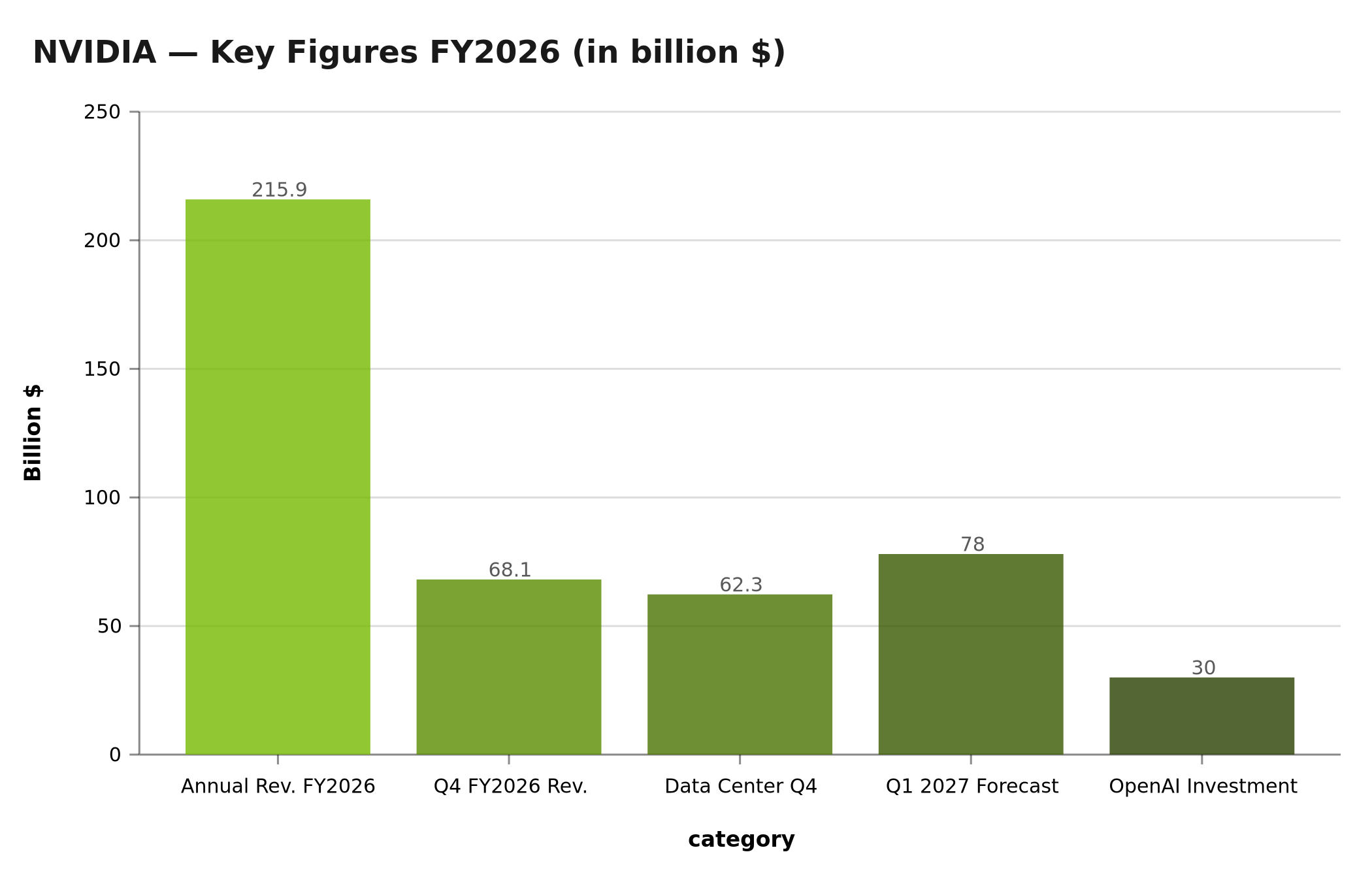 NVIDIA — Key Figures FY2026 in billion $
GTC: The Technology Event That Redefines the Rules
The GPU Technology Conference is not just another tech expo. Over the past several years, it has become the moment when the global AI industry sets its roadmap for the next 12 to 24 months. Jensen Huang, NVIDIA's CEO, delivers keynotes that land like strategic earthquakes across every industry.
For GTC 2026, the main themes structuring the event align precisely with the needs of modern entrepreneurs: accessible computing power, embedded AI, real-time inference, data security, and the geographic expansion of AI infrastructure. These four conference days concentrate announcements that will take months to materialize in the market — but the companies that anticipate them now gain a decisive head start.
This is not an event reserved for CTOs and ML researchers. It is a strategic compass for any entrepreneur who wants to understand where the AI economy is headed, which tools will become accessible, and at what price point. As AI-first startups now represent 68% of funded companies in 2026, ignoring NVIDIA's GTC is like ignoring your electricity provider's annual conference: the lights stay on, but you lose all visibility on how rates and services will evolve.
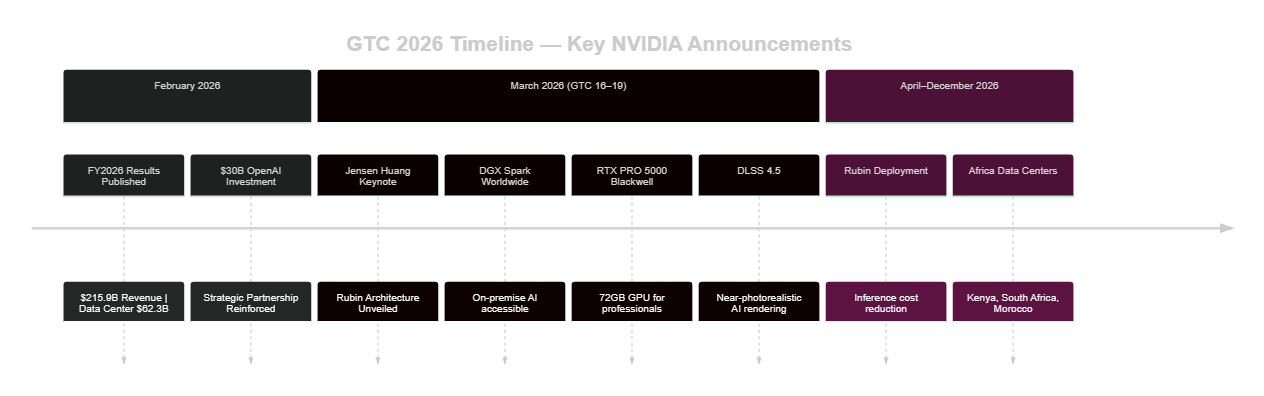 GTC 2026 Timeline: from financial results to Rubin deployment and African expansion
What to Expect from GTC 2026
1. The Rubin Architecture: The Next GPU Frontier
NVIDIA is expected to unveil at GTC 2026 the successor to the Blackwell architecture, with the code name Rubin. This announcement is arguably the most strategically significant for entrepreneurs, as it charts the trajectory of AI performance and cost for the next two years.
Each new NVIDIA GPU generation delivers spectacular improvements across three axes: raw performance, energy efficiency, and new functional capabilities. Based on the trends observed across generations, the Rubin architecture should deliver between 2 and 3 times more performance in AI model training compared to Blackwell, while significantly reducing energy consumption per processed token. This last point is critical: in a context where the power consumption of AI data centers raises sustainability questions, NVIDIA must demonstrate that it can do more with less.
Expected new capabilities include improved real-time inference, better support for complex reasoning (essential for autonomous AI agents), and potentially tighter integration with so-called NPU (Neural Processing Unit) architectures that already equip high-end smartphones and PCs. For entrepreneurs, the business impact is direct: faster and cheaper AI models to operate translate to more affordable APIs, faster responses for your end users, and improved ROI on your AI investments.
2. DGX Spark: On-Premise AI, Finally Accessible
NVIDIA extended the worldwide availability of DGX Spark at GTC 2026. This is one of the most concrete and immediately actionable announcements for entrepreneurs and developers.
DGX Spark is a desktop mini-computer capable of running large AI models locally, without relying on the cloud. Where previous on-premise AI solutions required investments in server racks costing hundreds of thousands of dollars, DGX Spark represents a radically different approach: a compact, accessible format that can be deployed in any office.
The use cases for entrepreneurs are numerous and immediate. For developers who want to iterate quickly on AI prototypes, DGX Spark eliminates the cloud costs associated with API calls during development and testing phases — phases that can quickly become expensive when making thousands of requests. For companies handling sensitive data in the medical, legal, or financial sectors, DGX Spark offers an answer to the data sovereignty question: your models run on your hardware, in your premises, without transit through third-party servers. For startups looking to rapidly prototype differentiating AI solutions, DGX Spark provides a powerful sandbox without the friction of API call delays and rate limiting constraints.
Based on our analysis, DGX Spark's worldwide availability announced at GTC 2026 is a strong signal: NVIDIA is betting on the democratization of embedded AI, not just on the growth of hyperscalers. This is a structural trend that will shape the AI hardware market for SMEs through 2027-2028.
3. DLSS 4.5 and RTX PRO 5000: Creative Production Revolutionized
For entrepreneurs in the creative sector, game development, and graphical applications, GTC 2026 also brings significant announcements. DLSS 4.5 (Deep Learning Super Sampling) represents the latest evolution of NVIDIA's AI-assisted rendering technology: it achieves near-photorealistic quality with significantly reduced GPU power consumption, which directly impacts production costs for digital creative studios.
The RTX PRO 5000 72GB Blackwell sets a new benchmark for professional workstations. With 72 gigabytes of dedicated memory, this GPU opens the door to use cases previously only accessible on compute clusters: real-time 3D rendering of complex scenes, high-fidelity physics simulation, and training medium-sized models directly from a workstation. For creative agencies, animation studios, and industrial simulation companies, this is a paradigm shift. G-SYNC Pulsar, finally, delivers improved motion clarity for e-sports and interactive visualization applications, a market that continues to grow at double-digit rates.
Why Entrepreneurs Should Care About NVIDIA
AI Is No Longer a Luxury — It Is Infrastructure
NVIDIA is not just a chip supplier. It is the infrastructure provider of the entire AI economy. Understanding this reality means understanding why decisions made at GTC directly concern you, even if you never purchase a single NVIDIA GPU.
- ChatGPT runs on NVIDIA GPUs
- Claude from Anthropic runs on NVIDIA GPUs
- Gemini from Google runs on its own chips AND on NVIDIA GPUs
- Your n8n workflows using LLMs... go through NVIDIA GPUs
Every time you call an AI API, every time an automated agent executes a task in your tech stack, you are consuming compute power that rests on NVIDIA architecture. When NVIDIA launches a new GPU generation, the entire AI value chain benefits from better performance and reduced costs. API providers pass those gains on to their pricing — and your monthly bill goes down.
The AI Cost Reduction: A Massive Democratization Factor
Each NVIDIA GPU generation reduces the cost per token of AI at a dizzying pace. This is not speculative projection — it is a documented trend across multiple technology cycles.
| Generation | Year | Relative Cost per Token |
|---|---|---|
| A100 | 2020 | 100% (baseline) |
| H100 | 2023 | ~40% |
| Blackwell | 2025 | ~15% |
| Rubin (expected) | 2026 | ~5-8%? |
Concretely: an AI chatbot that cost $5,000/month in 2023 could cost approximately $500/month in 2026. For an AI agent in production handling thousands of interactions per day, the difference is massive. This makes AI accessible not only to SMEs but also to micro-businesses and solo entrepreneurs.
Based on our analysis, this cost reduction curve is the most powerful argument for investing in an AI strategy right now, even if the ROI does not look optimal at current pricing. In particular, AI agents in production — which require numerous LLM interactions — will see their fundamental economics dramatically improve with each new GPU generation.
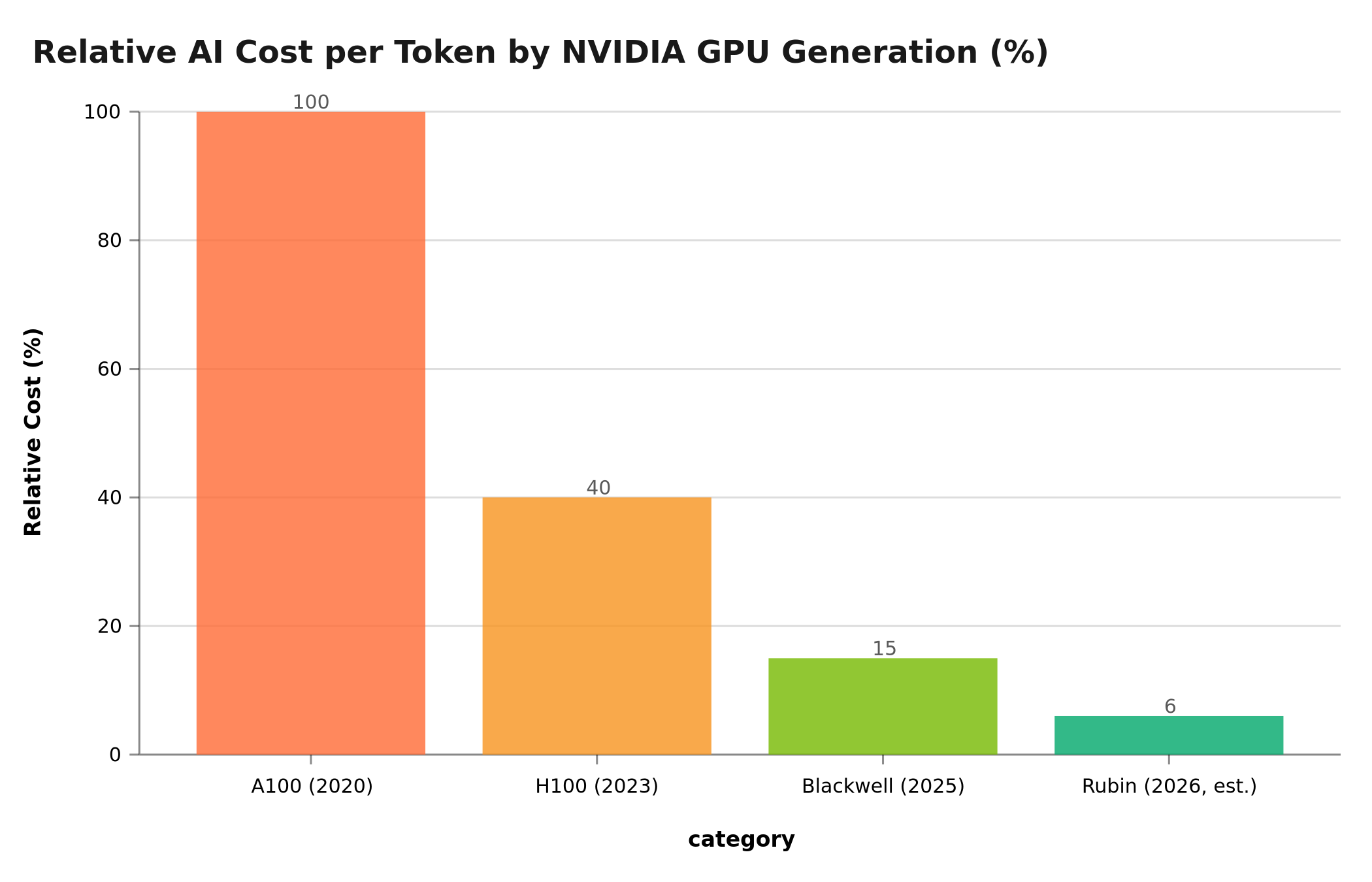 Relative cost per token: from 100% (A100) to ~6% (Rubin estimated)
The $30 Billion OpenAI Investment: A Virtuous Cycle to Understand
NVIDIA's investment in OpenAI creates a feedback loop that structures the entire AI industry for the coming years. Understanding this mechanism means understanding why NVIDIA's dominance is self-sustaining.
- NVIDIA invests $30B in OpenAI
- OpenAI develops even more powerful and efficient models
- These models require more NVIDIA GPUs for training and inference
- NVIDIA earns more revenue, reinforces its position
- NVIDIA can reinvest more in R&D and partnerships
This is a virtuous cycle for the AI ecosystem — but also a concentration risk that regulators are monitoring closely. For entrepreneurs, this reality has a concrete implication: investing in skills and tools compatible with the NVIDIA ecosystem (CUDA, PyTorch, OpenAI APIs) guarantees maximum exposure to AI innovation in the coming years. As demonstrated by the DeepSeek vs GPT benchmarks in the open/closed AI war, the model landscape evolves rapidly, but the underlying hardware infrastructure remains NVIDIA.
Concrete Implications by Actor Type
GTC 2026 announcements do not have the same impact depending on your position in the entrepreneurial ecosystem. Based on our analysis, three business profiles need to adapt their reading of these events:
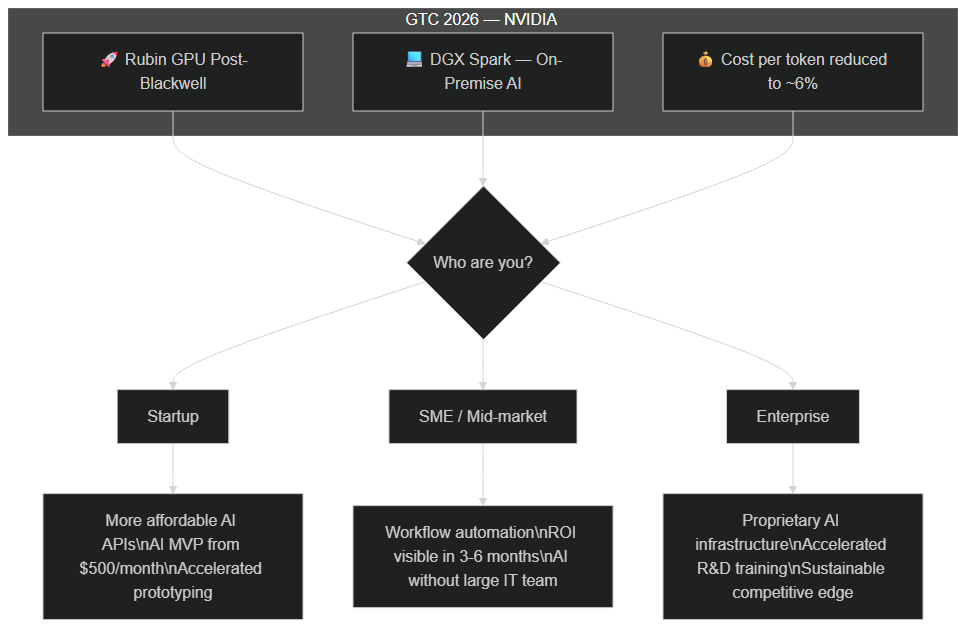 NVIDIA GTC 2026 announcement implications by business profile
For startups, the reduction in cost per token is the most immediately actionable news. If you are building an AI product in SaaS mode, every point reduction in your inference costs directly improves your gross margin. With the Rubin architecture potentially at ~5-8% of the A100 cost, business models that seemed difficult to balance become viable. DGX Spark also opens the way to hybrid architectures: cloud inference for peak loads, local inference for low-latency or sensitive data use cases. GTC 2026 gives AI startups a new floor of economic viability.
For SMEs and mid-market companies, the main interest lies in the growing accessibility of AI tools without requiring an internalized data science team. The reduction in API costs means that solutions like AI customer support chatbots, document analysis agents, or intelligent automation workflows — which BOVO Digital deploys via tools like n8n coupled with LLMs — become economically viable for structures of 10 to 200 employees. The DGX Spark signal is also relevant for SMEs that handle sensitive customer data.
For large enterprises, GTC 2026 announcements confirm the trajectory toward proprietary AI infrastructure. With the RTX PRO 5000 and projections on Rubin, CIOs and CTOs can now plan AI hardware roadmaps over 24-36 months with sufficient visibility on performance and costs. The question is no longer "should we invest in AI?" but "how do we structure our AI infrastructure for the next 3 years?"
How to Adapt Your AI Strategy Following GTC 2026 Announcements
Conference announcements are worthless without a concrete action plan. Here is how to translate GTC 2026 signals into operational decisions for your business.
Revisit your AI ROI calculations. If an AI project seemed economically fragile six months ago — too expensive in tokens, too slow in inference — GTC 2026 announcements justify redoing the exercise. The cost-per-token projections for the Rubin architecture suggest that the economic barriers blocking certain projects will lower significantly in the next 12 to 18 months.
Evaluate your position on sensitive data. DGX Spark makes on-premise AI accessible to a new category of organizations. If you have regulatory constraints (GDPR compliance, medical sector, legal professional privilege), now is the time to seriously study a hybrid AI architecture combining cloud and on-premise. This is no longer reserved for large enterprises.
Train your team on AI fundamentals. GPU knowledge is no longer reserved for hardware engineers. Understanding the basics of GPU architecture, transformer architectures, and inference optimization is becoming a differentiating asset for your developers and data scientists. This human capital is an investment with a 3-5 year horizon that gains full relevance in the trajectory traced by NVIDIA.
Position yourself on emerging AI markets. The expansion of NVIDIA infrastructure toward Africa is a strong strategic signal. Entrepreneurs who serve or plan to serve emerging markets have a window of opportunity: where AI infrastructure is still rare, being among the first to deploy relevant local solutions creates a durable competitive advantage.
Monitor post-GTC announcements. Jensen Huang keynotes are the starting point, not the end. Follow NVIDIA research publications in the weeks after GTC, cloud provider updates (AWS, GCP, Azure) that reflect new GPU architectures in their offerings, and OpenAI, Anthropic, and Mistral API pricing, which should decrease as Rubin deployments ramp up.
Hardware Trends 2026-2027 for SMEs
GTC 2026 fits into a broader structural trend that will reshape the AI hardware landscape for SMEs over the next 12 to 24 months. Based on our analysis of signals available in announcements reported by tech media, several developments deserve the attention of decision-makers:
The GPU/NPU convergence: Processors embedded in PCs and smartphones now integrate dedicated Neural Processing Units (NPUs). This convergence means that certain AI tasks will soon be executable directly on client devices without server calls, further reducing latency and costs. For mobile and desktop application developers, this is an architecture shift to anticipate.
Sovereign AI as a competitive advantage: Rising regulatory requirements around data localization will create growing demand for on-premise or edge computing AI solutions. Companies able to offer GDPR-compliant AI solutions with local processing will have a significant commercial advantage, particularly in Europe.
Model specialization: As inference costs drop thanks to new GPU generations, the market will structure itself around specialized models rather than generalist ones. Small, highly efficient models trained on specific business data will outperform large generalist models for many B2B applications. This is a direct opportunity for SMEs that possess exclusive business data.
AI adoption by sector: Based on our analysis of 2026 trends, the financial and healthcare sectors lead adoption with approximately 78% and 65% of companies having integrated AI solutions respectively. Logistics (~55%), retail (~58%), and manufacturing (~52%) follow. The legal (~42%), educational (~45%), and agricultural (~38%) sectors still offer significant differentiation space for entrepreneurs operating in them.
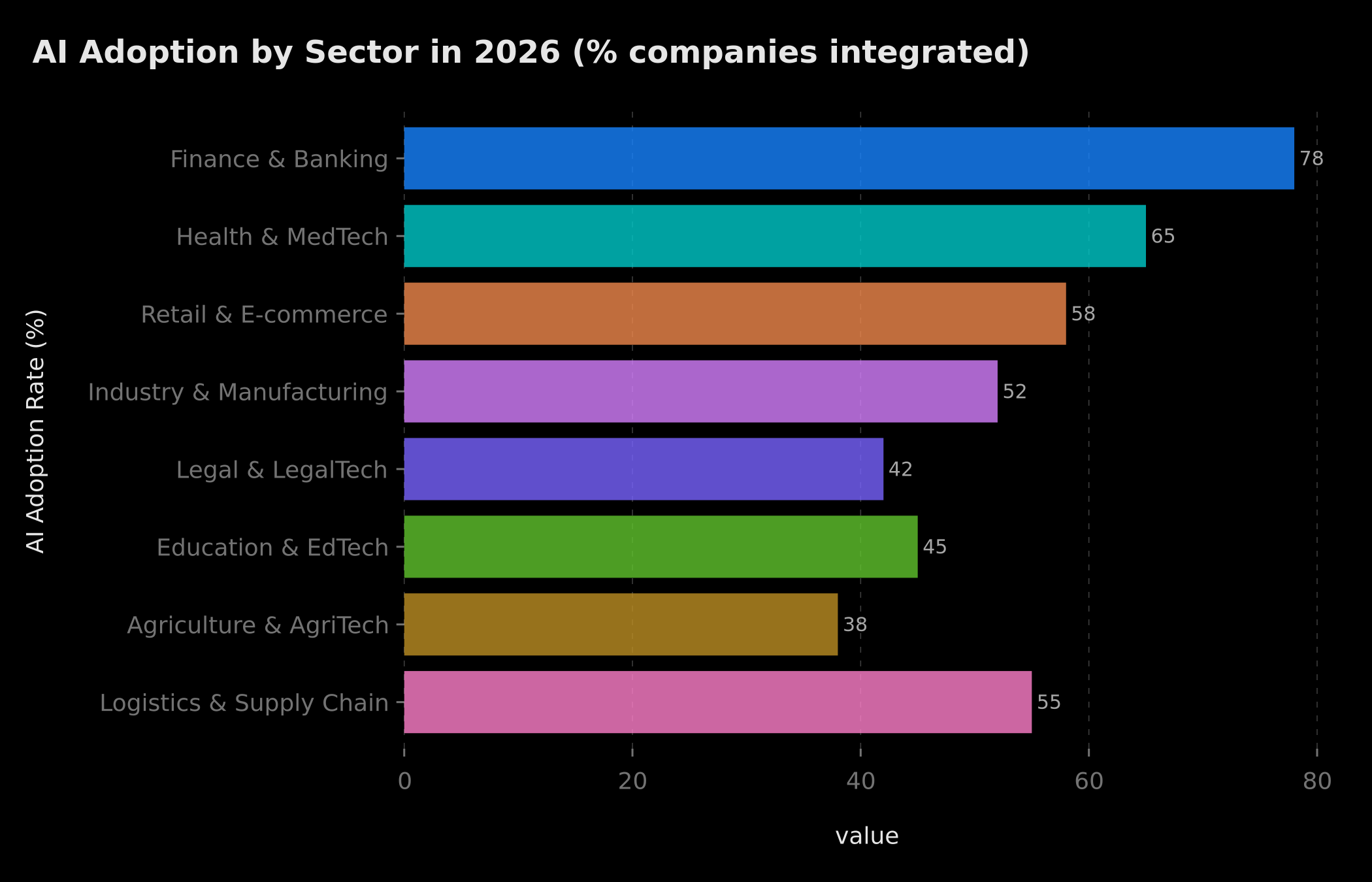 AI adoption by sector in 2026: estimated integration rate by industry (illustrative)
Impact for Africa
African entrepreneurs have a particular reason to follow GTC 2026 closely. According to announcements reported by tech media, NVIDIA has committed to partnerships for deploying AI data centers across the African continent:
- Kenya: Partnership with Huawei for an AI data center
- South Africa: Extension of AI computing capacity
- Morocco: GITEX Africa (March 2026) showcases local AI solutions
This geographic expansion of NVIDIA infrastructure is not trivial. It means that API latency for African users will decrease, bandwidth costs will fall, and most importantly, local data centers will enable compliance with data localization regulations emerging in several African countries.
For African entrepreneurs, this is a positive signal and a call to action: AI infrastructure is arriving on the continent, which will accelerate the emergence of local AI solutions adapted to agricultural, health, fintech, and educational contexts. Those who first build AI solutions rooted in local realities, with local data, will have a considerable advantage over global players attempting to adapt after the fact. For a continent-specific angle on emerging digital economy opportunities, see our analysis of GITEX Africa 2026.
What Are the 5 Concrete Actions to Take After GTC 2026?
1. Watch the GTC Keynotes (March 16-19)
Jensen Huang keynotes are legendary in the tech industry. Do not settle for journalistic summaries: watch the livestream on nvidia.com/gtc to capture the nuances, technical demonstrations, and signals between the lines. Take notes oriented toward "business impact" rather than "technological fascination."
2. Evaluate DGX Spark for Your Sensitive Data
If you work with confidential data (health, legal, financial, intellectual property), conduct a serious analysis of the relevance of on-premise AI deployment with DGX Spark. The 3-year TCO (Total Cost of Ownership) of a DGX Spark may prove lower than cumulated cloud API costs, while giving you better control over your data.
3. Anticipate AI Cost Drops
If an AI project seemed too expensive six months ago, redo the calculations with the new post-Blackwell / Rubin projections. The savings can transform a project with questionable ROI into an obvious opportunity. The pragmatic approach: estimate your current or projected monthly token volumes, apply the estimated cost reduction (-60 to -80% compared to H100 rates), and recalculate your break-even point.
4. Invest in Core AI Competencies
GPU knowledge is no longer reserved for hardware engineers. Understanding the basics of GPU architecture, CUDA, and inference optimization will give you an advantage in designing your AI workflows. To go further on the operational transformation these competencies enable, read our guide on AI agents in production.
5. Explore Emerging Markets
AI will generate a tsunami of value in emerging markets (Africa, Southeast Asia, Latin America). NVIDIA infrastructure arriving in these regions creates a window of opportunity for entrepreneurs capable of deploying relevant AI solutions there. If you serve these markets or plan to do so, prepare for explosive demand over the next 24 to 36 months.
FAQ
Where to start to digitalize and automate your business? Identify your 3 most time-consuming and repetitive tasks. Common quick wins: managing incoming emails, client follow-ups, and manual reporting. BOVO Digital offers a 2-hour diagnostic workshop to prioritize your high-ROI automations.
Will AI replace jobs in my team? AI automates repetitive tasks, freeing your teams for higher-value work. Companies adopting AI typically redeploy staff to creative and strategic activities rather than reducing headcount.
What budget should I plan for integrating AI into my business? No-code solutions like n8n or Make start at less than €100/month for powerful automations. A custom AI integration project with BOVO Digital ranges from €2,000 to €15,000 depending on complexity.
Do NVIDIA GTC 2026 announcements concretely change AI costs for SMEs? Based on our analysis of projections presented at GTC 2026, the Rubin architecture could bring the relative cost per token down to ~5-8% compared to the A100 generation. An AI chatbot that cost $5,000/month in 2023 could cost around $500/month in 2026. This is a massive democratization factor for SMEs.
What is DGX Spark and who is it for? DGX Spark is an NVIDIA desktop mini-computer capable of running large AI models locally without relying on the cloud. It targets companies handling sensitive data, developers wanting to prototype without cloud costs, and startups looking to reduce dependency on external APIs.
Can Africa benefit from NVIDIA GTC 2026 announcements? Yes. According to announcements reported by tech media, NVIDIA has committed to partnerships for AI data centers in Africa (Kenya, South Africa, Morocco). This will reduce latency and API access costs, and accelerate the emergence of local AI solutions in agriculture, health, fintech, and education.
Conclusion: NVIDIA, the New Standard Oil of AI
NVIDIA is to AI what Standard Oil was to oil at the beginning of the 20th century: the essential provider of the fundamental resource for an industrial revolution. With $215.9 billion in annual revenue, a $30 billion investment in OpenAI, and GTC 2026 set to be a historic turning point, Jensen Huang and his team are redefining what it means to be a technology company in the 21st century.
For entrepreneurs, the message is clear and urgent: AI is no longer an option — it is the basic infrastructure of every competitive business. Every NVIDIA announcement — a new GPU architecture, an expansion of DGX Spark availability, a partnership with an African stakeholder — is a signal that the AI playing field is simultaneously democratizing and accelerating. Those who understand these signals in real time, and know how to translate them into operational decisions, will have a considerable advantage over those who discover them six months later in a mainstream press article.
GTC 2026 is not an event for GPU engineers. It is an event for everyone building businesses in a world where artificial intelligence is now as fundamental as electricity or the internet. And if you want to understand how to concretely translate these hardware advances into business results — automated workflows, AI agents, intelligent applications — the ecosystem already exists, and it is accessible today.
At BOVO Digital, we leverage the latest AI advances to automate and accelerate your business. Intelligent chatbots, AI-powered n8n workflows, augmented web development — we transform the raw power of NVIDIA GPUs into concrete results for your business.
Tags
FAQ
Where to start to digitalize and automate your business?
Identify your 3 most time-consuming and repetitive tasks. Common quick wins: managing incoming emails, client follow-ups, and manual reporting. BOVO Digital offers a 2-hour diagnostic workshop to prioritize your high-ROI automations.
Will AI replace jobs in my team?
AI automates repetitive tasks, freeing your teams for higher-value work. Companies adopting AI typically redeploy staff to creative and strategic activities rather than reducing headcount.
What budget should I plan for integrating AI into my business?
No-code solutions like n8n or Make start at less than €100/month for powerful automations. A custom AI integration project with BOVO Digital ranges from €2,000 to €15,000 depending on complexity.
Do NVIDIA GTC 2026 announcements concretely change AI costs for SMEs?
Based on our analysis of projections presented at GTC 2026, the Rubin architecture could bring the relative cost per token down to ~5-8% compared to the A100 generation. An AI chatbot that cost $5,000/month in 2023 could cost around $500/month in 2026. This is a massive democratization factor for small and medium businesses.
What is DGX Spark and who is it for?
DGX Spark is an NVIDIA desktop mini-computer capable of running large AI models locally without relying on the cloud. It targets companies handling sensitive data (healthcare, legal, finance), developers wanting to prototype without cloud costs, and startups looking to reduce dependency on external APIs. Its worldwide availability announced at GTC 2026 marks a key milestone toward accessible on-premise AI.
Can Africa benefit from NVIDIA GTC 2026 announcements?
Yes. According to announcements reported by tech media, NVIDIA has committed to partnerships for AI data centers in Africa (Kenya, South Africa, Morocco). This means African entrepreneurs will have growing access to local AI infrastructure, reducing latency and API access costs, and accelerating the emergence of local AI solutions in agriculture, health, fintech, and education.
Budget, process, priorities — decided together
Website, chatbot, or automation? We pick the next job that unlocks cash, not the trendy stack.
- 30 min
- Clear priorities
- No commitment
Singbo Davy AGONMA
Fullstack Developer & AI Expert. n8n automation specialist, Laravel/Flutter development and AI agent integration. Master CS — IFRI.


