
Automation agency or hire ops: a 2026 decision model
Agency or internal ops? Market day rate 300-700 EUR, BOVO card 2000/3500/5000, 25 documented cases. A market range, not a BOVO median. 13 September 2026.

Updated

Automation agency or hire ops: a 2026 decision model
The objection is not “agency versus internal”. It is: who owns the backlog, the secrets, and the proof of volume?
Outsource automation or hire ops comes back as soon as a first workflow holds. This 13 September 2026 revision answers with three distinct layers: the 25 documented automation cases, the public BOVO rate card, and market ranges (day rates, salaries). Nothing below is a median of signed quotes.
Method and sample limits
Collection date: 13 September 2026. Source: 44 portfolio files. Automatisation filter → 25 cases. Out of scope: CRM, CSV, emails, named quotes. Threshold: 5 cases before a segment aggregate. Content (9) and leads (7) clear it. The rest illustrates.
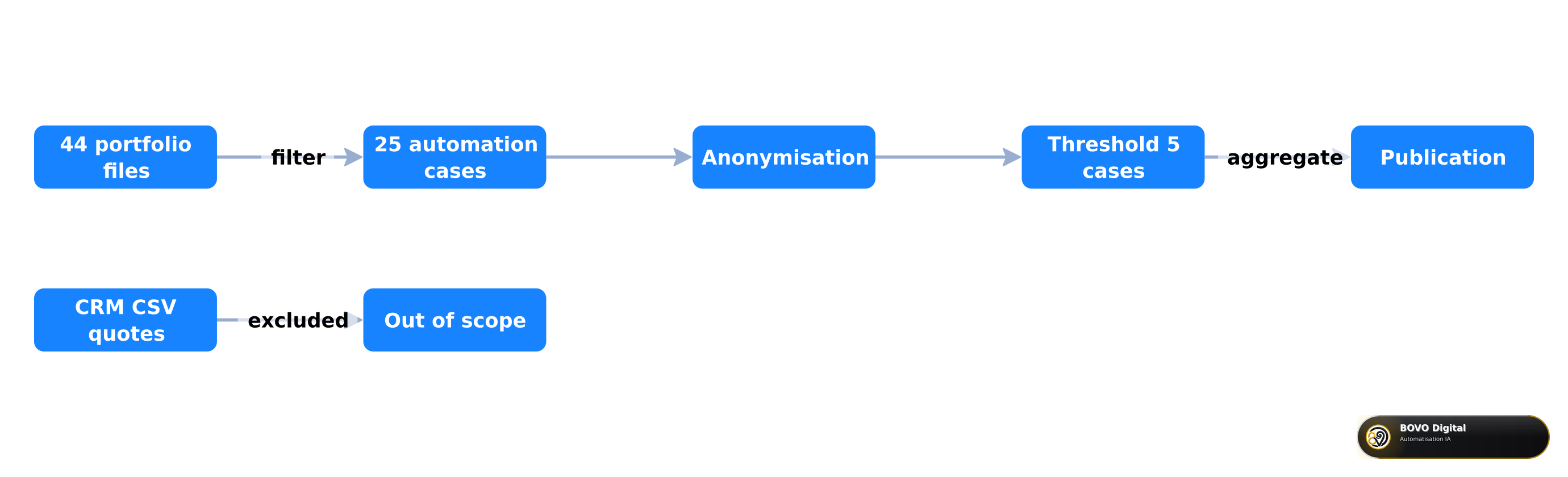 44 files, 25 automation cases, anonymisation, five-case threshold — CRM and quotes out of scope
We have no export of internal time “hours saved per file”. Every payback is therefore a hypothesis. Commercial pages that cite 40 h/month or ROI in 2–3 months are not recomputed here.
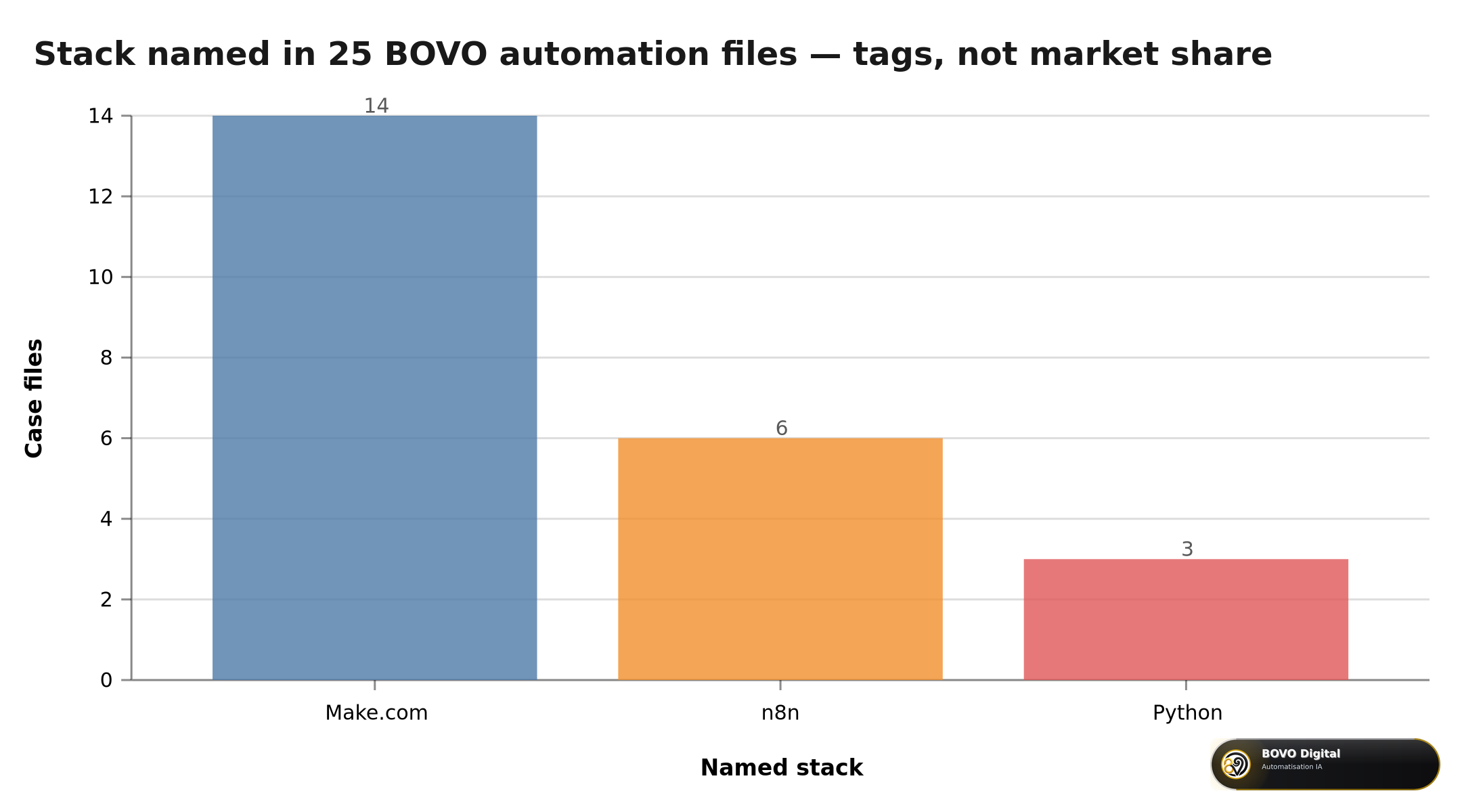 14 Make, 6 n8n, 3 Python: stack tags, not an argument to hire an n8n profile
What the files say about the work to govern
An agency does not sell “ops”. It ships flow types. The publishable families — content and leads — are enough to see why the first build is rarely a hire.
Mini-case 1 — Lead funnel. Capture, AI, follow-ups, Calendly. File: multichannel funnel.
Mini-case 2 — Follow-ups. Cadence +6 h / +12 h (id 20). Internal ops can change the delay in 15 minutes. An agency does it on a ticket. That is the real cost of outsourcing, not the day rate.
Mini-case 3 — Content. One Doc to three channels, −90% metric on this case. File: multi-platform content.
Mini-case 4 — Meeting reminders. 24 h, 6 h, 15 min (id 22). Low maintenance once scoped. A poor reason for a full-time contract.
The five types (leads, follow-ups, WhatsApp, content, catalog) are detailed in 5 typical workflows.
Outsourcing: what we can sign
Structural advantages (not observed averages): shorter time-to-value than a hire, project cost rather than payroll, access to a stack already seen on 25 files.
Limits: lock-in if n8n JSON and secrets stay with the vendor; latency on micro-changes; slower business knowledge.
Public BOVO card (fixed fee)
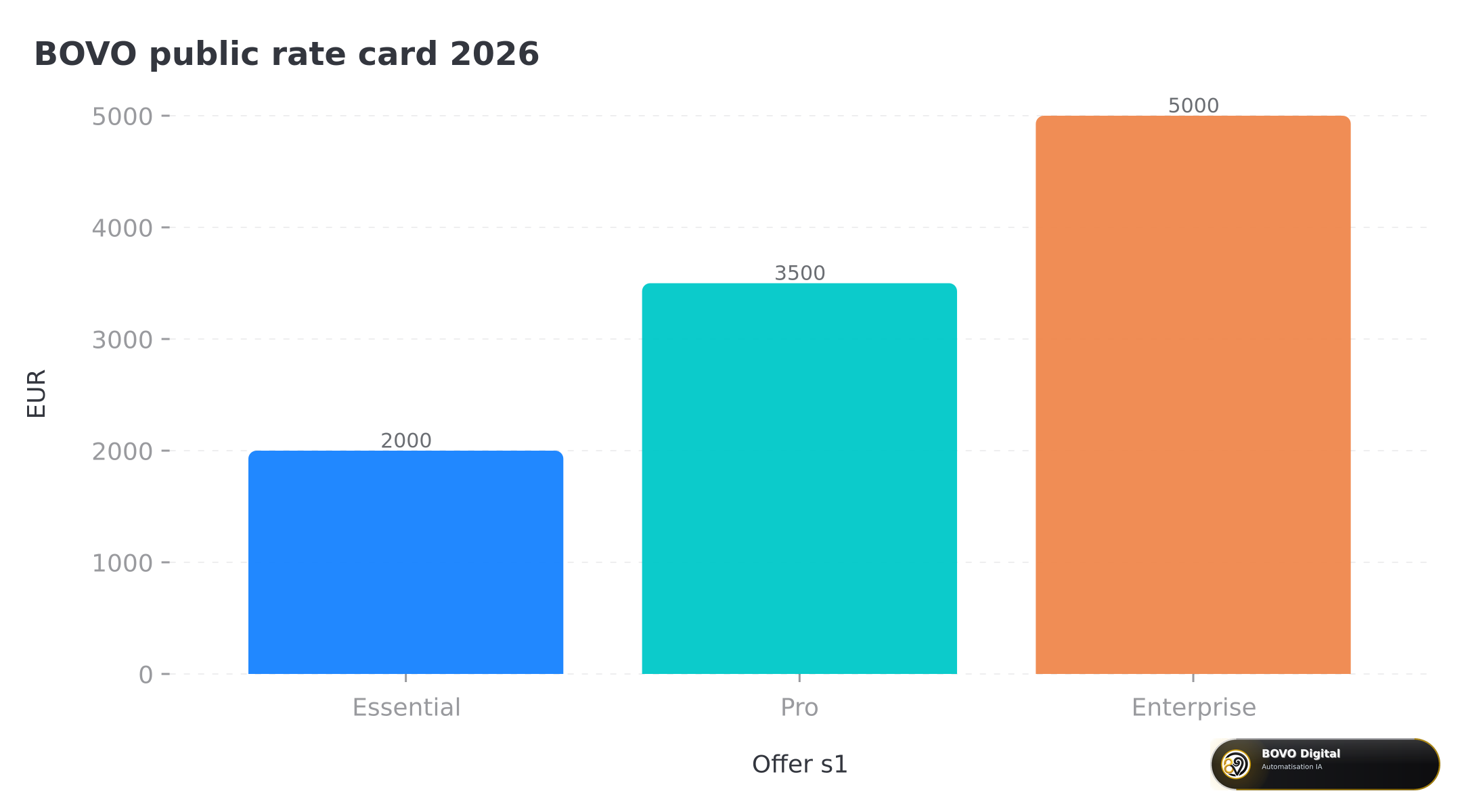 €2,000, €3,500 and €5,000: public commercial card, not an internal median
| Offer | Public price | Scope | Stated delay |
|---|---|---|---|
| Essential | €2,000 | 2–3 workflows | 10–14 days |
| Pro | €3,500 | 5–8 workflows | 3–4 weeks |
| Enterprise | €5,000 | custom architecture | scoped |
Day rate: market range, not a BOVO median
The 2026 francophone freelance market often cites €300–700/day. That is a market range. It is not our internal median — we do not publish one.
Our article on the €660/day rate analyses an editorial positioning (a high-end rung). Read it as such, not as the BOVO rate.
Wider project ranges live in the pricing guide.
Hiring ops: when volume justifies it
Internal ops owns the backlog, monitoring, and business relations. Loaded cost for junior ops in France is often cited €45–65k/year — again a market range, not a figure from our files.
Hiring becomes a discussion when:
- changes are frequent (no longer a one-off ticket);
- data is sensitive and internal governance cuts contractual risk;
- flows touch a proprietary stack the agency would see once a quarter.
Hiring before mapping processes means paying someone to explore. That is an audit role, not a full-time role.
Decision tree (model, not a statistic)
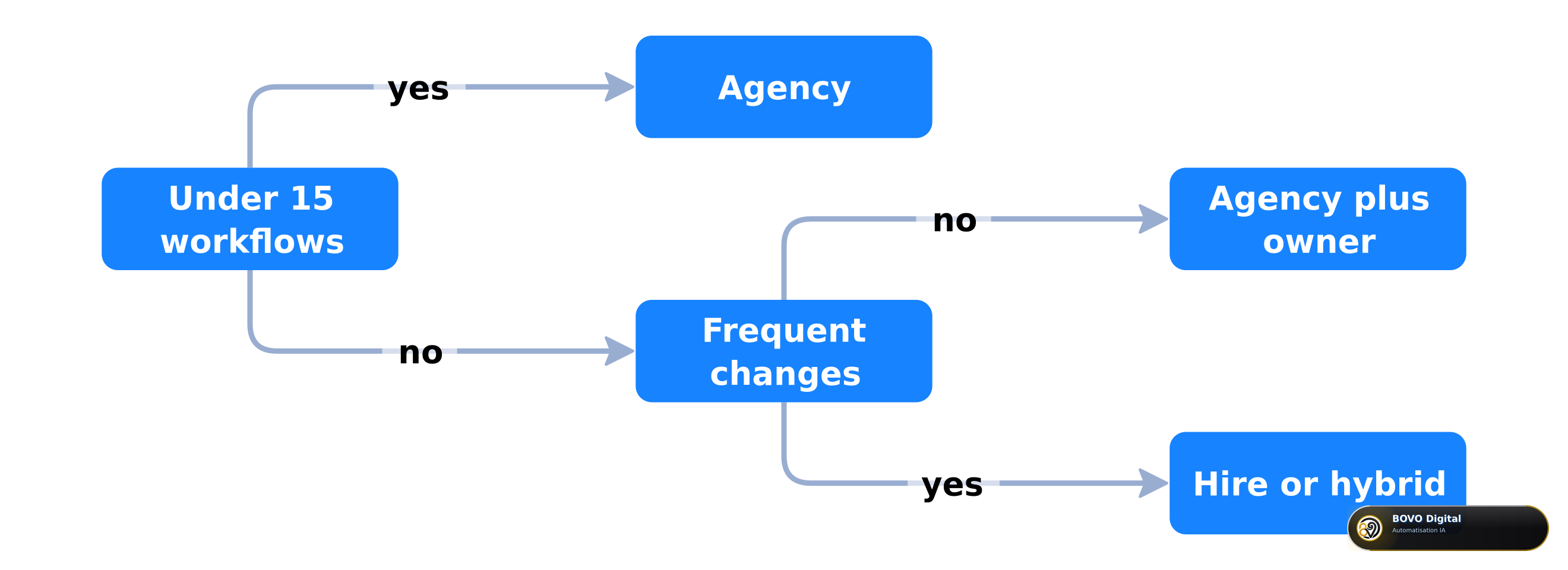 Volume still a first build: agency. Frequent changes: hire or hybrid. Otherwise agency plus an owner
- Is volume still a first build? → agency.
- Are changes weekly? → hybrid or hire.
- Is 18-month salary ROI computed on measured hours? If not, stay in hypothesis and re-measure.
Formula (hypothesis): payback months = year-1 cost ÷ (hours saved × loaded rate / 12). Without measured hours, the number is not evidence.
Hybrid model
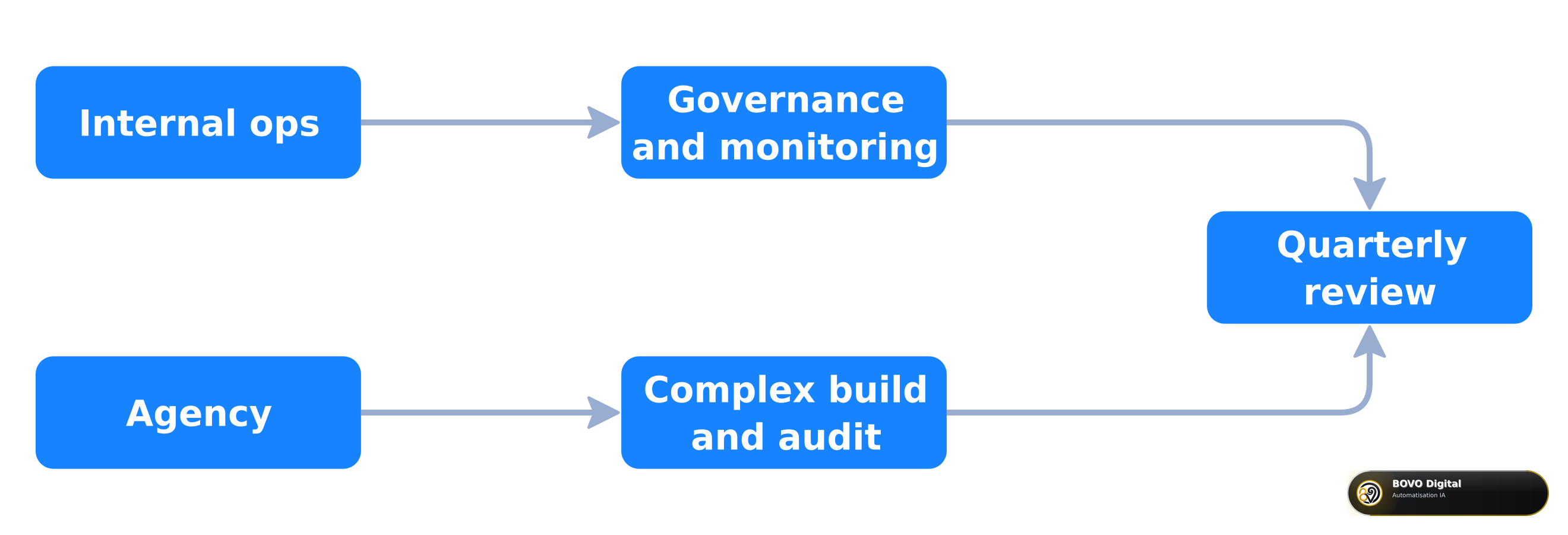 Internal ops for governance, agency for complex builds, shared quarterly review
Internal owner: prioritisation, monitoring, secrets in your vault. Agency: complex flows, audit, peaks. Quarterly review: extend, hire, or stop. The n8n SMB pillar recalls that 14 files are Make and 6 are n8n: hiring “an n8n profile” is not dictated by the sample.
Common mistakes
- Hiring an “n8n profile” for four stable flows.
- Outsourcing without JSON export or credential ownership.
- Treating the €660 day rate as a BOVO median.
- Deciding without hour KPIs. “It feels slow” does not decide.
What the register does not say about internal ops
The 25 files describe deliverables, not a client org chart. From the repo we cannot tell how many files have a dedicated ops lead, a freelancer at €400/day, or a founder who patches n8n on Sundays. Any “8 out of 10 clients ask us X” line from the previous version is gone: it was not an aggregate.
The €45–65k salary and the €300–700/day rate come from the market (public grids, positioning articles). They compare orders of magnitude. They are not extracted from our quotes.
If you want an analogue of what the agency builds, read the five types and the pricing guide. If you want an analogue of who governs, this text is enough: secrets on your side, JSON export, a dated review.
90-day plan (working hypothesis)
Month 1 — Map two flows that already cost time. Time them for five days. Outsource at most the most expensive one; Essential is enough if 2–3 workflows cover it.
Month 2 — Measure hours actually returned, not “it feels better”. Apply a secrets + backup checklist. Decide whether the market day rate (€300–700) or the agency fee is cheaper on that volume.
Month 3 — Short committee: stay with the agency, go hybrid, or open a hire. The criterion is not “we have more than 15 workflows”. It is: is the backlog daily, and do measured hours cover a market loaded salary?
What to bring to a 30-minute audit
Bring two timed flows and a yes/no on JSON export plus credential ownership. Do not bring a job description already written for “an n8n person”: 14 files in the sample cite Make.com. The €660/day article stays a positioning piece, labelled as such — useful to compare with the €300–700 market range, not to invent a BOVO median.
If month-1 still looks like a first build, stay on the public Essential card (€2,000, 2–3 workflows, 10–14 days) rather than opening a hire. That is a scoping default, not a salary study.
Sources and collection date
- BOVO register, 13 September 2026: 44 files, 25 cases, content 9 / leads 7.
- Public s1 card: €2,000 / €3,500 / €5,000.
- €660/day article: editorial positioning, labelled as such.
- Excluded marketing claims: 40 h/month, 103 projects, internal median.
Conclusion
Outsourcing remains the default scope until volume is proven. Hiring is justified on a real backlog, not tool FOMO. €300–700/day is a market range. The BOVO card is a public fee.
Next: audit, agency, contact. Bring measured hours, not a job post already written.
Public figures in this article point to the 13 September 2026 register. If an amount or a cadence is not there, it is either a market range, a labelled hypothesis, or a commercial rate card — never a median of signed quotes. That discipline keeps marketing claims from being recycled as statistics.
Tags
FAQ
How many workflows justify hiring an ops lead?
We do not have an observed threshold in the register. The reading rule here: until volume is stable and changes stay rare, an agency or freelancer remains the default scope. Hiring becomes a discussion when the backlog is daily. That is not a “15 or 20 workflows among our clients” statistic.
Which day rate should we use for an automation freelancer in 2026?
€300–700/day is a francophone market range, not a BOVO median. Our article on the €660/day rate analyses an editorial positioning; it is not our internal rate. The public agency card stays €2,000 / €3,500 / €5,000 as fixed fees.
How much does outsourcing n8n automation cost?
Public BOVO card: €2,000 for 2–3 workflows, €3,500 for 5–8, €5,000 for custom architecture. Wider market ranges (often €800–10,000 excl. VAT) live in the pricing guide. None of these amounts is a median of signed quotes.
What is a hybrid ops + agency model?
An internal owner (sometimes part-time) prioritises and watches. The agency builds complex flows and audits. This is a decision model, not “the most common pattern among our clients” — we do not have that aggregate in the register.
How do I calculate hiring ROI vs an agency?
Compare a market loaded annual cost (often cited €45–65k for junior ops in France — a market range, not a BOVO figure) to annualised agency cost. Divide by hours you actually measured. Without measurement, payback stays a hypothesis.
Should I hire before securing n8n?
No. Credentials, JSON exports and a pipeline checklist come before headcount. Ops without a secret vault widens the surface, internal or not.
Budget, process, priorities — decided together
Website, chatbot, or automation? We pick the next job that unlocks cash, not the trendy stack.
- 30 min
- Clear priorities
- No commitment
Vicentia Bonou
Full Stack Developer & Web/Mobile Specialist. Committed to transforming your ideas into intuitive applications and custom websites.


