
€660/Day: The New Floor Rate for AI Automation Experts in 2026
The Malt x Hopwork April 2026 report confirms: the median daily rate for AI automation freelancers has crossed €660/day (+38% vs 2024). Why this rate is rising, who benefits and how to get there.

Updated

€660/Day: The New Floor Rate for AI Automation Experts in 2026
The Malt x Hopwork April 2026 report confirmed what many suspected: the median daily rate for AI automation freelancers has crossed €660/day. That's 38% more than in 2024. And it's not over.
In 2026, the AI automation freelance daily rate is no longer reserved for a handful of experts who knew the GPT API before everyone else. This figure is now achievable for any profile that knows how to position itself intelligently, document its results and target the right niches. Here's why this rate is rising, who's really benefiting from it, and above all — how to get there if you're not yet there.
The AI Automation Freelance Market in June 2026: A Landscape Overview
The AI automation freelance market has gone through three distinct phases since 2022. The first was the pioneer phase: a few hundred profiles capable of connecting APIs with Zapier or assembling basic workflows in Make. The second, in 2023-2024, saw the explosion of interest in ChatGPT and LLMs bring a wave of new entrants — often underqualified — who temporarily pushed prices downward. The third phase — where we are in 2026 — is the maturity phase: clients have learned to distinguish profiles that deliver in production from profiles that deliver demos. And they pay for the difference.
Based on our market experience and publicly available data from late 2025 and early 2026, several structural trends are clear. European and international companies have massively adopted dedicated AI automation budgets, driven by the combination of competitiveness imperatives and the rising cost of manual labor. Large corporations have started outsourcing their first automation missions rather than hiring in-house, unable to find profiles quickly enough. And ambitious SMBs that watched their competitors automate parts of their operations are now following suit with a 12 to 18-month lag — creating a new, very concrete wave of demand today.
On the tooling front, self-hosted n8n has established itself as the de facto standard for complex missions requiring deep customization and robust GDPR compliance. Make remains dominant for e-commerce and marketing automation use cases where deployment speed takes priority. Zapier retains its market among VSBs wanting simplicity without technical maintenance. AI agents — workflows that can decide, iterate and learn — represent the technology frontier in 2026: this is where the highest daily rates concentrate. For a deeper dive on tool selection, our article on Make AI Agents vs n8n: which to choose in 2026 details use cases for each platform.
Why AI Automation Rates Are Exploding in 2026
Three converging forces explain this rapid increase:
Force 1: Demand exploded, qualified supply didn't follow In 2025, the number of companies looking to automate their processes doubled. In 2026, it doubled again. But the number of freelancers capable of delivering AI automation systems in production didn't follow the same rhythm. The supply/demand imbalance mechanically drives prices up.
Force 2: ROI is immediately measurable Unlike other IT investments, AI automation has an ROI visible in weeks, not years. When an automated workflow saves €3,000/month in manual labor, paying €2,500 to have it developed is an easy decision. This ROI visibility frees up budgets.
Force 3: Specialization becomes an entry barrier AI automation in 2026 is no longer "connecting two APIs with Zapier." It's architecting agents with persistent memory, building MCP servers, integrating RAGs on proprietary document bases, and managing GDPR compliance of data flows. This complexity eliminates generalist profiles and valorizes specialists.
The Best-Paying Sub-Specializations
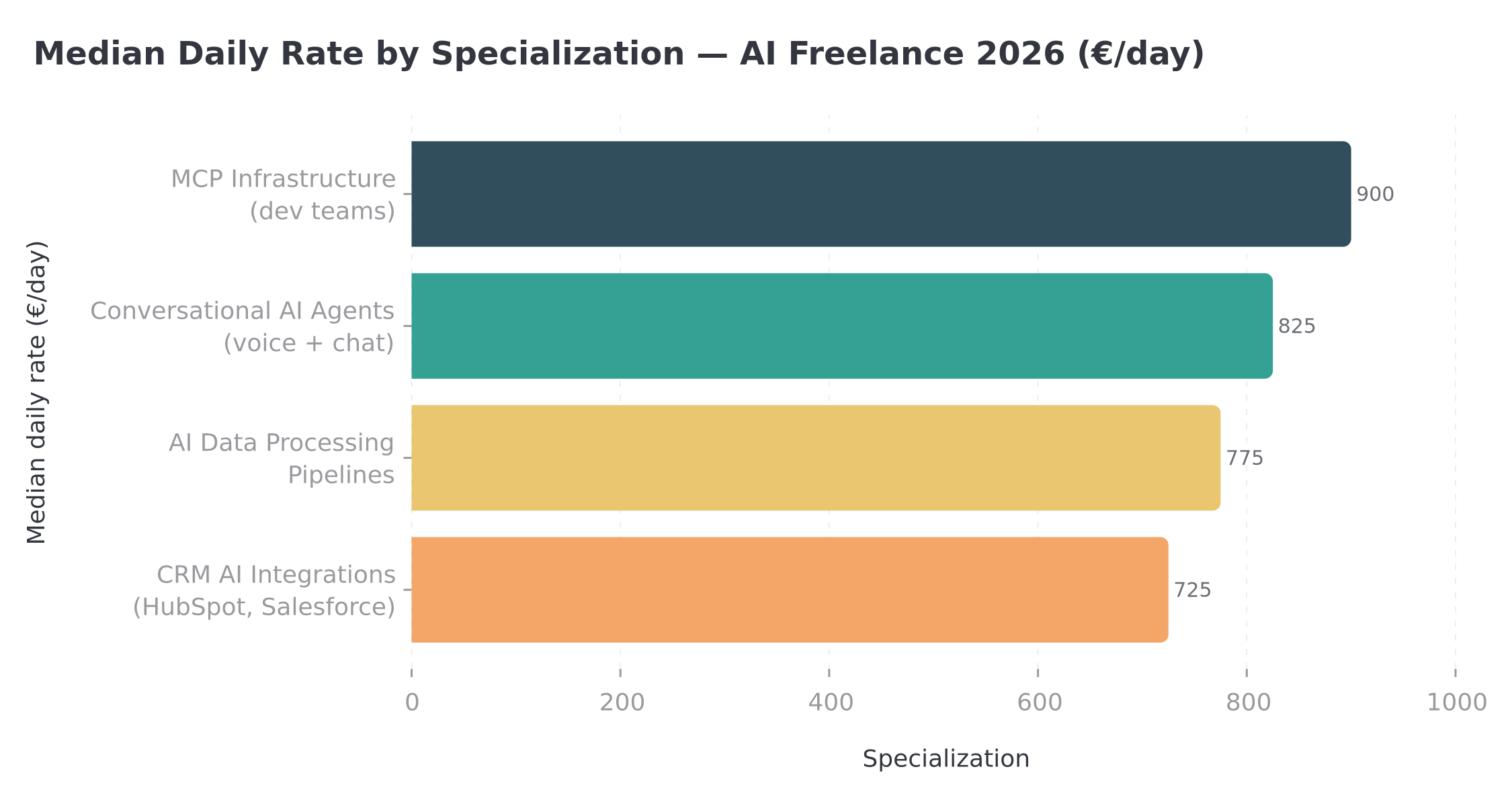 Median daily rate by niche in 2026: from €725/day for AI CRM to €900/day for MCP infrastructure
Within AI automation, certain niches are particularly valued in 2026:
Conversational AI agents (voice + chat): €750 to €900/day The combination n8n + Vapi + WhatsApp Business + Airtable to build voice and text agents is the most in-demand skill. Clients pay for rarity: few freelancers master voice + LLM + CRM integration in production.
AI data processing pipelines: €700 to €850/day AI-augmented extraction, transformation and loading (ETL). Invoice processing, CRM base enrichment, contractual document analysis. Strong in finance, legal, accounting sectors.
CRM AI integrations (HubSpot, Salesforce): €650 to €800/day Companies with installed but underused CRMs look to enrich them with AI agents. Automatic lead qualification, scoring, intelligent follow-ups, automated reporting.
MCP infrastructure for dev teams: €800 to €1,000/day The newest and most technical role: building MCP servers that give AI agents in engineering teams access to proprietary data. Rare role, real complexity, premium rates.
Daily Rates by Experience Level: Updated Ballpark Figures
Beyond niches, experience level strongly conditions the achievable daily rate. Based on market trends observed as of June 2026, here are indicative ranges — formulated as such, since every situation is unique:
For a first-year freelancer with no documented portfolio or client reviews, a daily rate in the €200–€350/day range is generally what the market accepts. This is the reputation-building phase, and trying to shortcut it by immediately displaying €600/day produces the opposite effect: clients with those budgets expect credibility you haven't yet established.
For a freelancer with 6 to 18 months of experience, a few production projects and 2 to 5 positive client reviews, the range expands toward €350–€550/day. This is the specialization phase — choosing your niche and refining your value proposition.
For a freelancer with more than 18 months of experience, a clearly defined niche, at least 8 projects in production and an online presence (LinkedIn, blog articles), the €550–€840/day range becomes realistic. This is the category where the €660/day median daily rate sits.
Beyond €840/day, you enter the segment of recognized experts in a rare sub-specialty (MCP servers, voice agents, complex AI ETL pipelines), often with established public visibility. These rates remain a minority but are documented on Upwork notably for English-language missions with US clients.
Daily Rate Progression Over 24 Months: Illustrative Trajectories
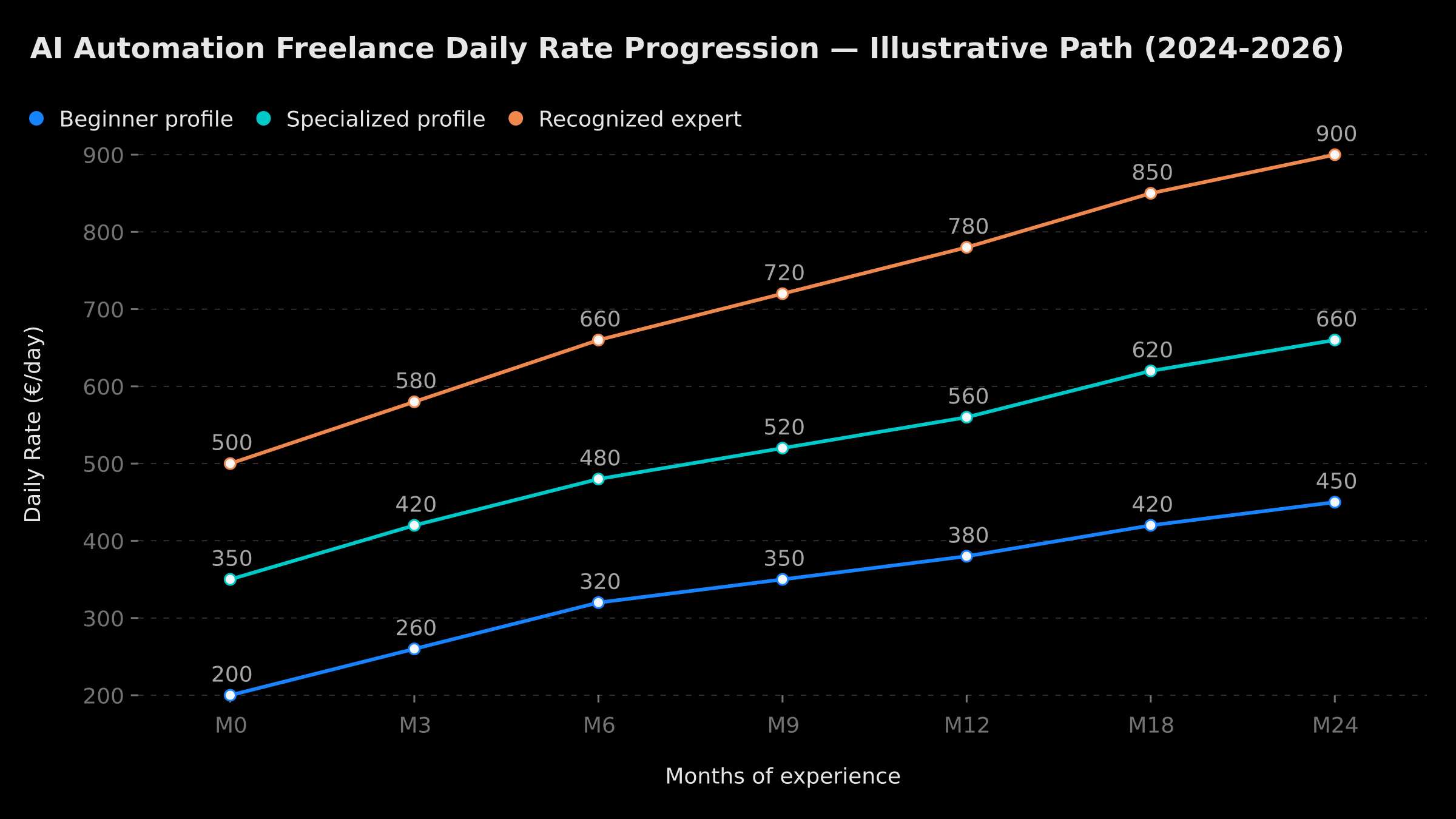 Three daily rate progression profiles over 24 months: beginner, specialized, recognized expert — illustrative ballpark figures
This chart illustrates three typical trajectories observed on the market, depending on starting level and specialization speed. The "Recognized expert" curve — the one that quickly exceeds €660/day — corresponds to profiles who already had related technical expertise (developer, data analyst, digital project manager) before specializing in AI automation. The "Specialized profile" curve is the median trajectory: someone who starts from scratch but seriously invests in skill development and visibility. They reach the €660/day range between months 18 and 24. The "Beginner profile" curve represents those who progress more slowly, often because they stay on small projects too long or don't document their results.
The Roadmap to Reach €660/Day from Zero
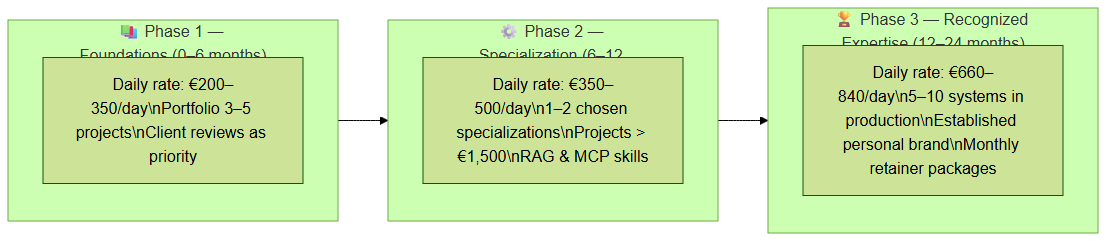 3 phases to go from €200/day to €660-840/day in 12 to 24 months
If you're starting in AI automation and targeting €660/day, here's the realistic progression:
Phase 1 — Foundations (0 to 6 months)
- Master n8n self-hosted: deployment, basic workflows, HTTP nodes, triggers
- Build 3 to 5 portfolio projects with real use cases (even small ones)
- Indicative rate: €200 to €350/day
- Absolute priority: reviews. A portfolio without social proof doesn't allow you to raise rates.
Phase 2 — Specialization (6 to 12 months)
- Choose 1 to 2 specializations: n8n + HubSpot, or Make + e-commerce, or conversational AI agents
- Target projects > €1,500 with clients who have a real digital budget
- Develop RAG and MCP skills for advanced AI use cases
- Indicative rate: €350 to €500/day
Phase 3 — Recognized expertise (12 to 24 months)
- Have 5 to 10 systems in production with documented metrics
- Be known on a specific topic (blog articles, LinkedIn posts, conferences)
- Offer retainer packages (fixed monthly) rather than day-by-day
- Indicative rate: €660 to €840/day
Building a Packaged Offer to Justify €660+/Day
One of the most frequent mistakes among freelancers stuck at €350–€450/day is not having a clear packaged offer. They respond to inbound requests with a bespoke quote, often poorly calibrated, that invites negotiation. Experts billing €660/day or more have generally built two or three packaged offers with a defined scope, an announced timeline and a posted — or at least indicative — price.
A concrete example: a freelancer specializing in AI CRM integration for marketing agencies might offer: "Automatic lead qualification pipeline for HubSpot with AI agent — 3 weeks, €4,500." This rate implies an effective daily rate of €300/day over 15 days, well below €660. But if the same freelancer delivers the project in 7 days because they already have the base blocks built, the effective daily rate climbs to €640/day without the client seeing the difference. This is the principle of value-based billing: you charge what it's worth to the client, not what it costs you in time. We develop this hybrid model in detail in our article on the AI agent or freelance hybrid model in 2026.
A good packaged offer meets four criteria. It names a specific business problem — not a technology. It promises a measurable result with a timeline. It includes what's in scope and what isn't — clarity on exclusions prevents 80% of disputes. And it stipulates a guarantee or success condition that reassures the client without exposing you to arbitrary claims.
Client Acquisition Pipeline: Finding Your First Clients
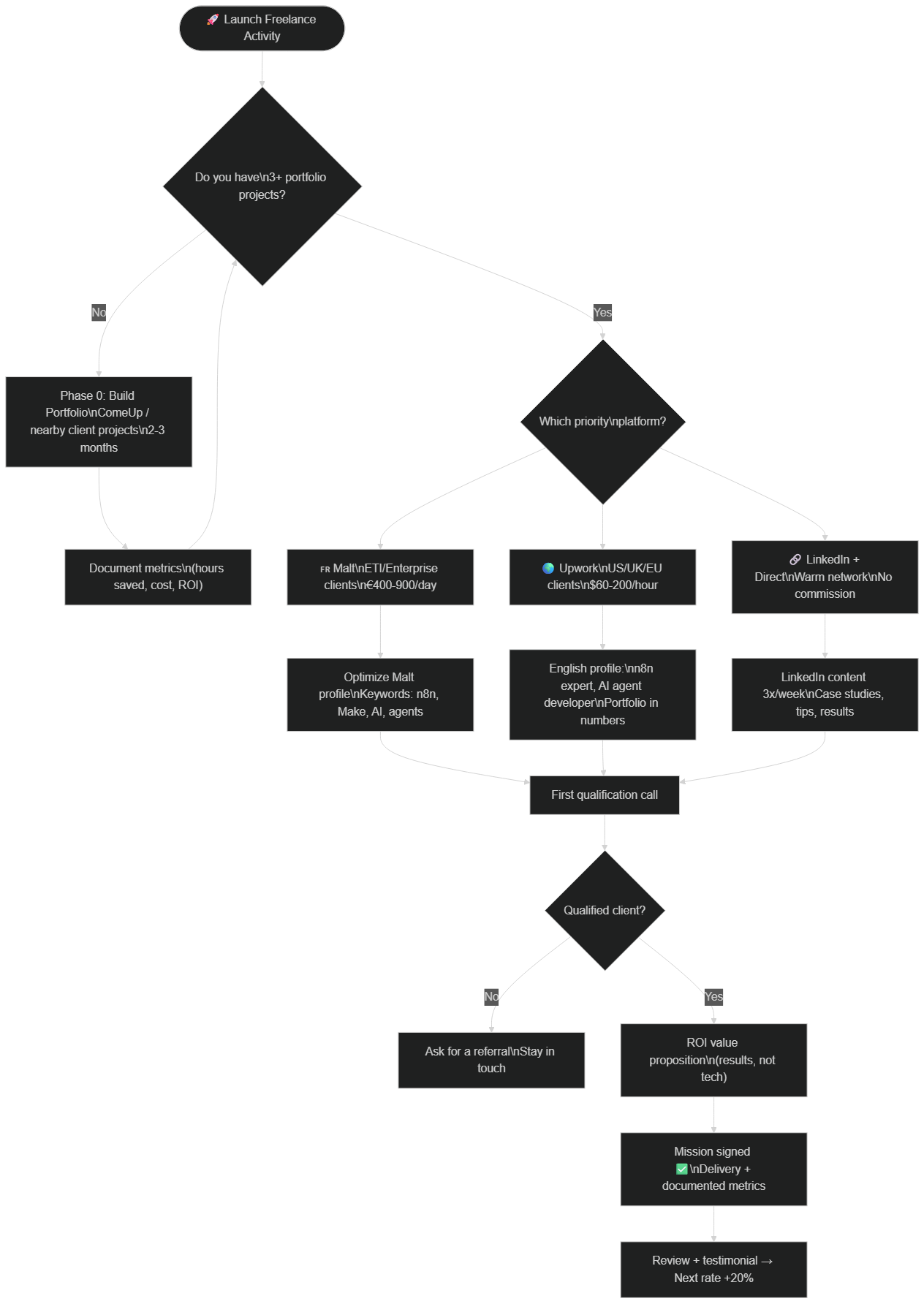 Client acquisition flowchart: from portfolio building to the first qualification call
The question every beginning freelancer asks is: where do you start to find clients when you have none? The honest answer is that the first three clients are always the hardest to get, and you often need to seek them in your close network before tackling platforms.
Step 0 — Immediate network Former employers, training classmates, LinkedIn contacts you actually know. Offer a reduced-rate mission (or even a free one for a specific use case) in exchange for a documented testimonial with real numbers. That first portfolio project with real metrics is worth any certificate.
Step 1 — Platform reviews for reputation Platforms like ComeUp (France) or the entry-level tiers of Upwork are often underestimated by freelancers targeting high rates, but they're the most effective way to quickly build a stock of reviews. Offer entry-level services at €150–€400 for 2–3 months, accumulate 10–20 reviews, then use these as social proof for your Malt or top-tier Upwork profile.
Step 2 — Malt for the French market Malt is the best French market for daily rates of €400–€900/day. Clients there are often marketing directors, SME IT managers or ETI CEOs with real budgets who want an expert, not the lowest price. Malt profile optimization — precise title, results-oriented description, projects with metrics — makes all the difference. A well-referenced Malt profile on "n8n expert" or "AI HubSpot automation" can generate inbound leads without active prospecting.
Step 3 — Upwork for the international market Upwork is the fastest-growing platform in 2026 for AI automation. US, UK and Australian clients have budgets 2 to 3 times higher than French budgets for equivalent missions. An English-language profile well-positioned on keywords like "n8n automation expert", "AI agent developer" or "Make.com specialist" can access missions at $80–$150/hour. The barrier to entry is higher — you often need to spend the first months at a lower rate to build your Job Success Score — but the potential is considerable. Our guide on n8n and Make automation pricing in 2026 details rate ranges by mission type.
Step 4 — LinkedIn and direct network Once you have an established reputation, the most profitable channel is direct networking. A client who contacts you directly via LinkedIn or a referral goes through no intermediary platform and pays no commission. On a €6,000 project, the difference between Malt (10% commission) and direct contact is €600 you keep. Freelancers with the highest effective daily rates are those with the most direct clients, acquired via their LinkedIn content or blog articles.
Platforms and Their Rate Specificities
Not all platforms allow the same rates:
Malt (France): The best market for high rates in France. Well-positioned AI automation profiles reach €600 to €900/day. Clients are often mid-market and large companies with real budgets.
Upwork (International): The fastest-growing market. Hourly rates for AI automation range from $60 to $200/hour (i.e., $480 to $1,600/day). English positioning on keywords like "n8n expert", "AI agent developer" gives access to US and UK clients with budgets 2 to 3 times higher than French clients.
ComeUp (France): Ideal for building initial reviews and reputation. Rates are lower (projects from €250) but allow accumulating the social proof needed to justify premium rates on Malt or Upwork.
LinkedIn + direct network: The most profitable channel once established. A direct client, without platform intermediary, doesn't pay commission. On €5,000 projects, the difference is significant.
How to Justify Your Rate Against Objections
Objection: "That's expensive for automation" → "You're right that the rate is high. Here's what it represents in ROI: if this workflow saves 15 hours per week for a team member at €25/hour, you recover your investment in [quick calculation] weeks. After that, it's pure profit."
Objection: "I can find cheaper offshore" → "Yes. The difference with what I offer: production delivery (not just a demo), complete documentation, load testing, and support during the first 30 days of operation. Those cheaper freelancers rarely deliver all of that."
Objection: "We don't have the budget right now" → "I understand. Here's my proposal: we start with your most critical workflow — the one costing you the most manual hours. We measure the ROI over 30 days. If it doesn't justify itself, we stop there."
Upskilling in 2026: What Actually Matters
The question of upskilling is often asked in the wrong way: "which training course should I take?" The real question is: "which skills will allow me to solve problems that no one else can solve as well as I can?"
In 2026, the skills that make the difference are, in order of market priority: advanced mastery of self-hosted n8n (deployment, debugging, webhooks, sub-workflows, error handling); the ability to integrate LLMs (GPT-4o, Claude, Gemini) into production workflows while managing costs and rate limits; understanding RAG architectures to connect AI agents to proprietary knowledge bases; and the ability to build or consume MCP servers to extend agent capabilities.
In terms of resources, n8n and Make Discord communities are the best up-to-date information sources, ahead of most paid training. Community n8n nodes published on npm, advanced Make templates, and GitHub repositories of developers building production agents are concrete inspiration mines. Our article on how to automate 40 hours of weekly work with AI agents gives specific use cases you can replicate and integrate into your portfolio.
A common mistake is wanting to learn everything before offering your services. The right ratio is 70% hands-on practice on real projects and 30% theoretical learning. Every hour spent building a real workflow — even small, even for yourself — teaches you more than two hours of online courses.
The 5 Mistakes That Keep You at €350/Day
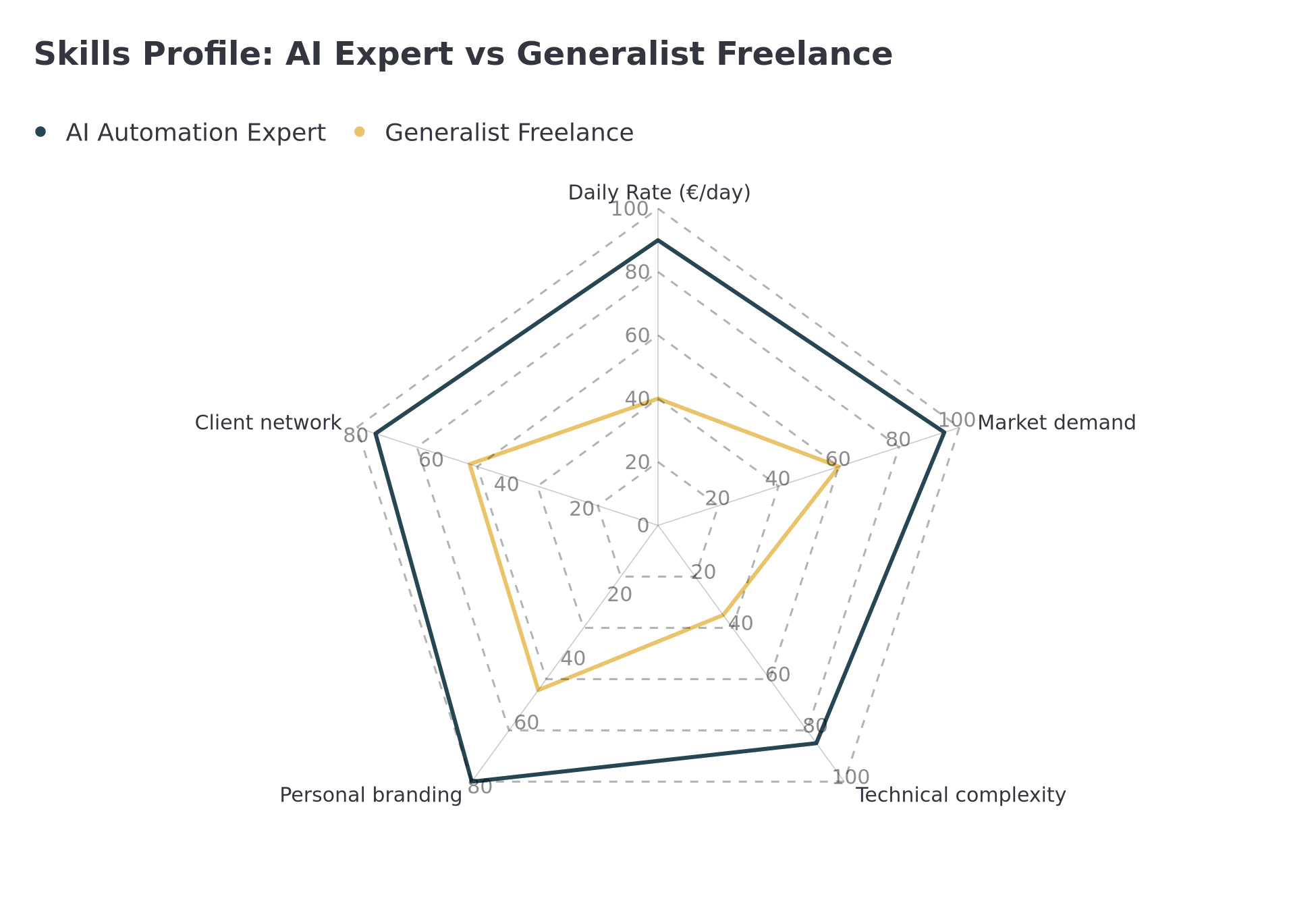 Radar comparison: the 5 dimensions that differentiate the €660/day AI expert from the generalist freelance
Mistake 1: Selling "automations" rather than results. Clients buy recovered time, avoided errors, reduced costs. Sell in terms of business results, not technology.
Mistake 2: Not documenting metrics from your work. "I automated return processing for an e-commerce, reducing processing time from 4h to 20 minutes per day" — that's billable. "I made an automation" — not so much.
Mistake 3: Working on projects too small for too long. A €300 project that takes 2 days makes you €150/day. Quickly target projects at €2,000–€5,000 that take 3 to 5 days, i.e. €400 to €1,000 effective daily rate.
Mistake 4: Neglecting personal branding. Freelancers who reach €660/day have an online presence. Blog articles, LinkedIn posts, open source contributions. This visibility attracts clients who don't negotiate on price.
Mistake 5: Remaining a generalist. "I do automation" is too vague. "I build lead processing pipelines for marketing agencies" — there, you become the only logical choice for the matching client.
Billing for Value, Not Time
This is probably the most important mindset shift to go from €350/day to €660/day and beyond. Daily billing creates a very concrete glass ceiling: if you work 20 days a month and bill at €500/day, your maximum revenue is €10,000 gross/month. To increase it, you can only work more or raise your daily rate — and there are limits to both.
Value-based billing breaks that ceiling. When you propose a workflow that saves your client €4,000/month, the logical mission price is around €6,000 to €12,000 — the value generated over 1.5 to 3 months. If you build this workflow in 8 days, your effective daily rate sits between €750 and €1,500/day. No one asks how many days you worked: the client sees the result, you see the value.
Transitioning to this model requires three things: knowing how to quantify the cost of the problem you're solving before proposing, having confidence in the value of your solution (which requires documented references), and accepting that some missions will be lost because the client wants to negotiate time rather than buy the result.
Outlook 2026–2027: Where Is the Market Heading?
The signals we observe today suggest that pressure on daily rates will continue over the next 12 to 18 months, with a few important nuances.
Demand will segment. The most mature companies will start internalizing AI automation skills — they'll hire "automation engineers" on permanent contracts rather than relying solely on freelancers. This won't eliminate the freelance market, but it will concentrate on higher-complexity missions: transformation projects, agent architectures, audits of existing systems.
AI agents will take an increasingly prominent place in freelancer offerings. In 2025, a freelancer offering "AI agents" was differentiating themselves. In 2027, it will be a baseline expectation for complex missions. Freelancers who don't integrate this dimension today risk seeing their positioning depreciate.
Rates in euros will continue to grow more slowly than dollar rates on Upwork, due to the market maturity gap. For freelancers who want the strongest revenue potential in the short term, the English-speaking market remains the fastest option — provided you master English-language positioning and accept an initial investment phase in your Upwork reputation.
At BOVO Digital, we build for our clients the AI automation systems that move these metrics. And we equip our clients to drive them.
Tags
FAQ
How do I set my daily rate when starting in AI automation?
Early in your career (0-6 months experience), a daily rate of €200 to €350/day or fixed-price projects of €300 to €800 is realistic. The absolute priority is to build 3 to 5 projects with documented metrics. Without a portfolio with social proof, it's very difficult to exceed €350/day.
Does BOVO Digital hire AI automation freelancers?
Yes, we regularly collaborate with specialized freelancers for specific missions on n8n, Make, or MCP server development. Send us your portfolio and availability via our contact page.
What certification or training is recognized for AI automation in 2026?
There's no universally recognized official certification for AI automation yet. The most valued elements by clients: a portfolio with production projects and measurable metrics, contributions on n8n/Make forums, blog articles, and recommendations from previous clients.
Is it better to offer packages or bill by the day in AI automation?
Experts who reach €660/day or more have generally migrated towards project packages or monthly retainers rather than day-by-day billing. Packages allow you to bill for value delivered — a workflow that saves your client €3,000/month is billed at €4,000 to €8,000, regardless of the number of days spent. Day-rate billing is useful early in your career to build trust, then you need to evolve towards value-based pricing.
Budget, process, priorities — decided together
Website, chatbot, or automation? We pick the next job that unlocks cash, not the trendy stack.
- 30 min
- Clear priorities
- No commitment
William Aklamavo
Web development and automation expert, passionate about technological innovation and digital entrepreneurship.


