
Microsoft Supply Chain Hack: Secure Your Deployments and AI Agents
A campaign compromised open-source repos tied to Microsoft's Azure and AI tools. Developer credentials were exfiltrated. Analysis, timeline, and protection checklist.

Microsoft Supply Chain Hack: Secure Your Deployments and AI Agents
On June 9, 2026, the security community documented a campaign targeting Microsoft's open-source repos linked to Azure and AI tools. Developers who cloned or installed these packages may have exposed their credentials.
Mass adoption of coding agents — Cursor, Claude Code, GitHub Copilot — has a side effect security teams have feared since 2024: the developer attack surface has become a gateway to cloud infrastructure. When an engineer clones an "official" Microsoft repo, installs an npm package, or runs a VS Code extension, they implicitly grant full trust to the software supply chain.
On June 9, 2026, several threat intelligence researchers — via publications from Parameter, OpenSourceMalware, and Cloudsmith — documented a campaign that compromised roughly 70 GitHub repositories tied to the Azure AI Tools ecosystem and Microsoft development utilities. The mechanism is not a zero-day in Copilot or Claude: it's a classic supply chain attack, amplified by the AI context, where malicious code exfiltrates secrets on the developer's local machine.
This article breaks down the timeline, modus operandi, targeted credential types, and what you must do today if you work with AI tools, n8n, or Azure/GitHub pipelines — whether you're a freelancer, agency, or enterprise security team.
Timeline: from compromise to public disclosure
Early compromise indicators date back to May 2026, according to analyses aggregated by the OpenSourceMalware community. Abnormal commits — modified initialization scripts, altered npm post-install hooks, extended configuration files — were injected into repos maintained under Microsoft's GitHub organization, without immediately triggering public alerts.
Coordinated disclosure on June 9, 2026 mapped the scope: 70+ impacted repos, touching Azure SDKs, AI integration examples, and CLI tools used to prototype agents. Microsoft began access rotation and dependency review; the community recommends developers who cloned these repos between May and June 2026 to treat their credentials as potentially compromised.
 From the initial May 2026 compromise to the June 9 public disclosure and corrective actions
This calendar echoes a pattern now recurring in the AI industry: tool adoption speed outpaces dependency audit speed. Teams that integrated Cursor or Claude Code in March–April 2026 often cloned Microsoft example repos in parallel to connect agents to Azure OpenAI — creating an exposure window exactly over the compromise period.
Attack mechanism: how secrets are exfiltrated
The operational schema follows a proven model, adapted to the "AI developer" profile:
- Injection — Malicious code is added to a legitimate repo (postinstall script, initialization module, configuration extension).
- Distribution — The developer clones the repo or installs the package via npm/pypi, believing they use an official artifact.
- Local execution — On first CLI, extension, or example script launch, the payload runs with user privileges.
- Collection — Malware scans classic locations:
~/.aws/credentials,~/.azure/,.envfiles, shell history, environment variables exported for AI agents. - Exfiltration — Data is sent to attacker-controlled endpoints, often via HTTPS requests disguised as "normal" traffic.
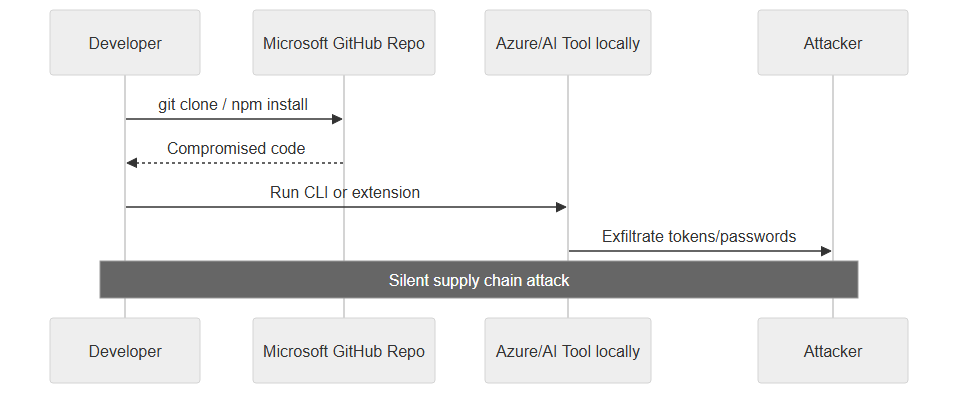 From git clone to silent token exfiltration on the developer machine
The specificity of this campaign lies in the target profile: not production servers attacked directly, but developer workstations handling both Microsoft open source and AI tools with broad access (OpenAI tokens, Azure keys, GitHub PATs with wide scopes).
Types of credentials targeted
Analyses published June 9, 2026 converge on a typical distribution of exfiltrated secrets:
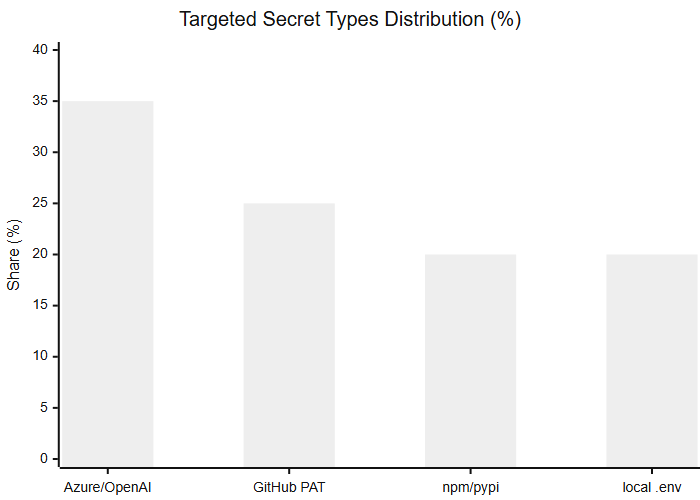 Cloud tokens, GitHub PATs, package manager credentials, and local .env variables
| Secret type | Immediate risk | Action |
|---|---|---|
| Azure / OpenAI token | Billing access + client data | Revoke + regenerate + 30-day log audit |
| GitHub PAT (repo, workflow) | Code modification, CI/CD exfiltration | Revoke all PATs created before June 9 |
| npm/pypi credentials | Publishing malicious packages in your name | Enable 2FA + granular tokens |
Local .env | Multiple API keys, staging DB | Full rotation + TruffleHog scan |
For agencies like BOVO Digital, deploying n8n automations and AI agents for clients, compromising a local .env can expose multiple projects simultaneously — hence the urgency of systematic rather than targeted rotation.
Expanded attack surface: repos, packages, extensions, CLI
The AI developer ecosystem multiplies entry vectors:
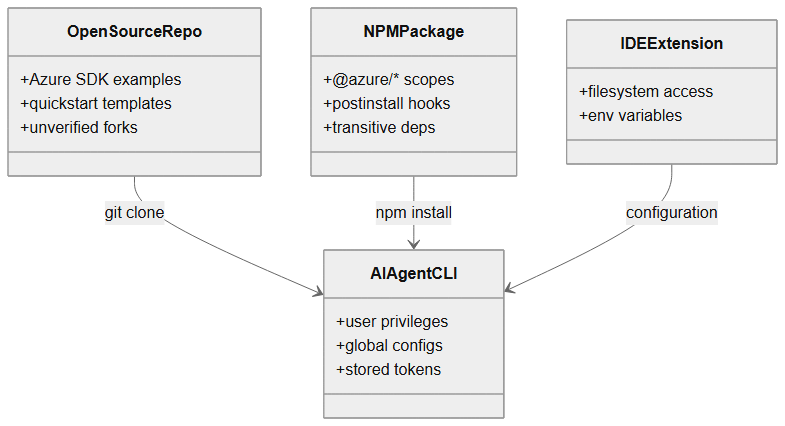 Open source repos, npm packages, IDE extensions, and agent CLIs — four doors to the same risk
- Open source repos — Official examples, unverified forks, "quickstart" templates
- npm/pypi packages — Unaudited transitive dependencies
- IDE extensions — Filesystem and environment variable access
- AI agent CLIs — User-privilege execution, global config access
This map directly overlaps lessons from our article on the Claude Code npm leak: the npm supply chain remains the #1 exposure vector for code and secrets in the AI ecosystem. The difference here: the injection is malicious and intentional, not accidental.
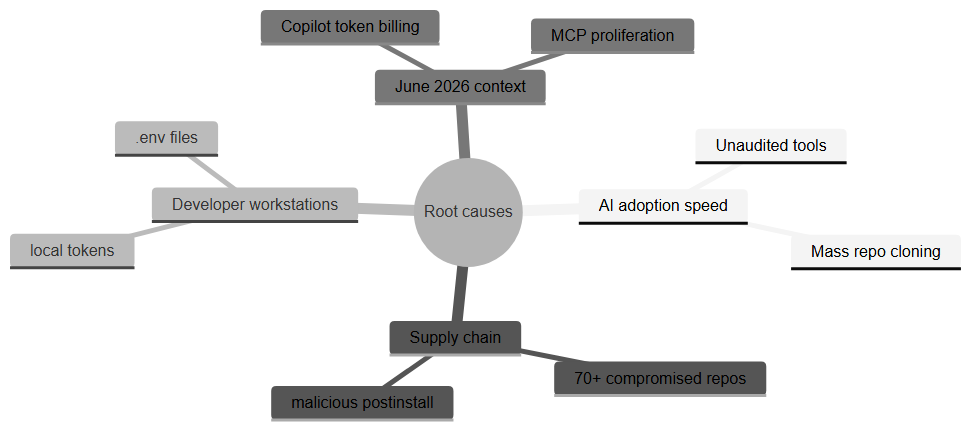 AI adoption speed, unaudited supply chain, exposed developer workstations, and June 2026 context — four converging factors
Link to the June 2026 AI context
Three trends converge to explain why this attack makes headlines:
1. Exploding AI tool budgets. Uber capped Cursor and Claude Code at $1,500/month per tool after burning its annual budget in four months. More engineers using more tools → more tokens stored locally → more value for an attacker.
2. GitHub Copilot moves to token-based billing (June 1, 2026). Companies configure organization keys with high caps — exactly the credential type local exfiltration can capture.
3. MCP server proliferation. AI agents connect to external tools via the Model Context Protocol. A compromised developer machine can pivot to internal MCP servers, n8n webhooks, and Supabase databases.
The lesson is not to slow AI adoption. It's to align adoption speed with supply chain hygiene that most teams haven't industrialized yet.
Immediate checklist for developers and agencies
If you cloned a Microsoft/Azure AI-related repo between May and June 2026, apply this sequence:
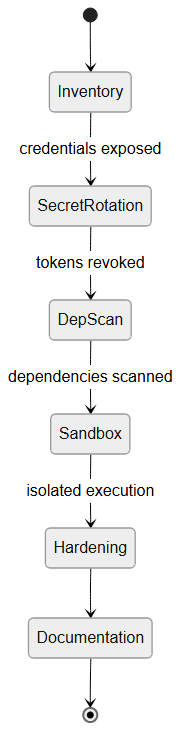 Response states: inventory, secret rotation, dependency scan, sandbox, hardening, and documentation
Step 1 — Inventory (30 minutes)
- List all Microsoft/Azure repos cloned since May 1, 2026
- Identify npm packages installed from
@azure/*,@microsoft/*scopes ormicrosoft/*GitHub repos - Check VS Code extensions installed from non-official marketplace sources
Step 2 — Secret rotation (1 hour)
- Revoke all GitHub PATs and recreate with minimal scopes
- Regenerate Azure OpenAI, OpenAI API, Anthropic keys
- Change npm passwords if a publish token was on the machine
- Update
.envfiles across all active client projects
Step 3 — Scan and audit (2 hours)
- Run TruffleHog or GitLeaks on recently cloned repos
- Compare suspicious commits with hashes flagged by OpenSourceMalware
- Check Azure AD / GitHub Audit Log for abnormal access
Step 4 — Industrialize (ongoing)
- Integrate the secure release checklist with n8n + GitHub Actions
- Apply principles from time bombs in automated deployment
- Review OWASP posture: our OWASP Top 10 2025 guide covers new supply chain categories
Implications for freelancers and automation agencies
The most exposed profiles share three characteristics:
- Multi-project — One compromised
.envcan expose 5–10 clients - Implicit trust — "It's a Microsoft repo, it's safe"
- No SOC — No security team monitoring exfiltration
For an agency like BOVO Digital, deploying n8n workflows connected to WhatsApp, CRM, and Supabase databases, compromising a developer workstation equals potential access to production webhooks, Meta Business tokens, and chatbot encryption keys.
Operational recommendation: separate environments per client (distinct tokens, dedicated machines or containers for sensitive projects), and never reuse a "personal" GitHub PAT on a client repo.
What Microsoft and the community must change
On the vendor side, this incident raises structural questions:
- Mandatory signed commits on all high-traffic
microsoft/*repos - SLSA provenance for packages published on npm under official scopes
- Detection delay — Weeks between compromise and disclosure is too long when thousands of developers clone daily
On the community side, OpenSourceMalware databases and Parameter alerts play a critical collective watch role — an indispensable complement to official advisories, often published late.
Comparison with other recent AI supply chain incidents
| Incident | Date | Mechanism | Primary target |
|---|---|---|---|
| Claude Code npm leak | March 2026 | Accidental source maps | Proprietary source code |
| Microsoft GitHub Azure | June 2026 | Malicious injection | Developer credentials |
| TrustFall MCP (Adversa) | June 2026 | Hackable MCP agents | Exposed MCP servers |
The complementarity is clear: March exposed AI tool code; June targets user secrets. Both reinforce the argument for DevSecOps governance before accelerating agent deployment to production.
DevSecOps: The Only B2B Response to Supply Chain Flaws
A supply chain attack like the Microsoft/Azure one is no longer an anomaly, it is the new normal. The only way for an SME to protect itself is not to hope that open source repositories are safe, but to implement systemic barriers. DevSecOps automation (via strict n8n and GitHub Actions pipelines) allows you to isolate execution, validate dependencies, and automatically rotate secrets before each deployment. This is the essential shield before entrusting your data to AI agents.
Audit the Security of Your CI/CD Pipelines with BOVO Digital
Are your deployments vulnerable to this type of attack? BOVO Digital audits your continuous integration pipelines and deploys secure n8n workflows (DevSecOps) to ensure the integrity of your deployments. Protect your developer credentials today. Request a DevSecOps security audit.
Outlook: toward an "agent-ready" supply chain
The industry is moving toward pipelines where AI agents themselves modify dependencies (npm install triggered by Claude Code, automatic PRs via Copilot). Each autonomous action multiplies supply chain risk if not sandboxed.
Emerging best practices for 2026:
- Container execution for any script cloned from open source
- Dependency allowlists per project, validated in CI
- Ephemeral tokens (1 hour) for CI/CD operations
- Role separation: the "AI dev" workstation has no production secret access
These measures don't slow innovation — they prevent the scenario where a Tuesday GitHub clone triggers a $50,000 Azure bill on Wednesday.
Conclusion: trust doesn't clone
The June 9, 2026 attack is not a signal to abandon AI tools or Microsoft repos. It's a brutal reminder: in the coding agent era, the developer workstation is a critical asset, on par with a production server.
If you have only one action today: rotate your GitHub PATs and Azure/OpenAI keys, then audit repos cloned since May 2026. To industrialize: our n8n release checklist guide turns these checks into an automatic pipeline.
The race for AI agents won't slow down. The supply chain must catch up — before the next compromise targets your n8n production webhooks directly.
June 2026 series — read by category
| Category | Related article |
|---|---|
| Tech news | June 2026 tech recap — Week 1: WWDC, Siri AI, Gemini |
| Web development | Next.js 16 production checklist for SMEs without Vercel lock-in |
| Automation | Automation agency: 5 n8n workflows we deploy for every client in 2026 |
| Entrepreneurship | Outsource automation or hire an ops lead: 2026 decision model |
| Tutorials | Tutorial: secure your n8n + GitHub pipeline after the supply chain incident |
Sources consulted: Parameter (June 9, 2026), OpenSourceMalware, Cloudsmith, GitHub community analyses. Article by BOVO Digital — AI security and automation watch.
Tags
FAQ
Which Microsoft repositories were compromised in June 2026?
According to analyses published by Parameter, OpenSourceMalware, and Cloudsmith on June 9, 2026, a campaign hit roughly 70 GitHub repos linked to Microsoft Azure and AI development tools — including SDKs, extensions, and CLI utilities used by teams deploying coding agents.
What type of data did attackers steal?
Observed payloads target cloud API tokens (Azure, OpenAI), GitHub Personal Access Tokens, npm/pypi credentials, and local environment variables (.env) on developer machines that execute the compromised code.
How does this differ from the Claude Code npm leak?
The Claude Code leak (March 2026) exposed source code via accidentally published source maps. This is an active compromise: malicious code injected into legitimate repos to exfiltrate secrets at local execution time.
Should I stop using Cursor, Claude Code, or GitHub Copilot?
No. The attack does not directly compromise those tools. It exploits developer trust in Microsoft/Azure open-source repos. Mitigation means key rotation, auditing recently cloned dependencies, and sandboxed execution.
How do I automate detection of this threat in my CI/CD pipeline?
Integrate TruffleHog or GitLeaks in GitHub Actions, block commits containing secret patterns, and orchestrate a release checklist with n8n — our dedicated guide details a reproducible secure-release pipeline.
Are freelancers and agencies more exposed than large enterprises?
Often yes: fewer SOC layers, keys shared across client projects, and a tendency to quickly clone 'official' repos without audit. Immediate rotation of PATs and cloud tokens is a priority for this profile.
Free audit: we check the impact on your site and workflows
Next.js CVE, new agent, MCP… We tell you what actually applies, and what to patch or ignore.
- 30 min
- Stack reviewed
- No commitment

Singbo Davy AGONMA
Fullstack Developer & AI Expert. n8n automation specialist, Laravel/Flutter development and AI agent integration. Master CS — IFRI.


