
AI Budget: Why Uber Caps Tools at $1,500 (FinOps 2026)
Uber burned through its entire 2026 AI budget in 4 months. The fix: a $1,500/month cap per tool (Cursor, Claude Code). This number tells us everything about enterprise AI pricing.

AI Budget: Why Uber Caps Tools at $1,500 (FinOps 2026)
Uber's entire 2026 AI budget was consumed in four months. The response: a $1,500/month cap per coding tool. This is a strong signal for the entire industry.
The adoption of coding agents in enterprise environments is following a curve that nobody anticipated when setting 2025 budgets. Cursor, Claude Code, GitHub Copilot — these tools went from "nice-to-have" to critical infrastructure within months for thousands of engineers. The result: last year's budgets simply don't hold. Uber is the most documented example to date.
The story broke at Bloomberg, reported by Natalie Lung. Simon Willison, a well-known developer and author in the open-source community, analyzed it on June 3, 2026 on his blog simonwillison.net. His conclusion goes beyond a simple corporate anecdote: this $1,500/month cap is a rational pricing signal for the entire industry.
In this article, we break down what this number reveals about the true cost of AI in enterprise, the pricing paradox between individual users and large organizations, and what it concretely changes for freelancers, agencies, and SMBs deploying these tools.
What Happened at Uber
Uber set its 2026 AI budget at the end of 2025. That was before the real explosion in agent usage — before Cursor and Claude Code became tools that engineering teams use daily to generate, refactor, and test code in a near-autonomous fashion.
The outcome: within just four months, the annual allocation had been consumed. Spending on coding agents had simply outpaced initial projections in a non-linear way.
Uber's response was pragmatic: implement a $1,500/month cap per tool, specifically for coding agents (Cursor and Claude Code are explicitly named). This is not a ban. It's not a signal that the company wants to slow adoption. It's a budget governance measure in response to spending that had grown unexpectedly fast.
 From the 2025 budget-setting to the $1,500/month cap: the Uber timeline
The Bloomberg source, relayed and analyzed by Simon Willison, provides important context: this type of budget overrun is not isolated. Many tech companies are facing the same challenge — tools whose usage cost explodes as engineers integrate them deeply into their workflows.
Breaking Down the Numbers: 11% of Salary
The $1,500/month figure only gains full meaning when contextualized against Uber's salary realities.
According to levels.fyi data, the median total compensation for a software engineer at Uber in the United States sits at around $330,000/year — including base salary, bonus, and equity.
Let's do the math:
- 2 tools (Cursor + Claude Code) × $1,500/month × 12 months = $36,000/year
- $36,000 / $330,000 = ~11% of total compensation
This is the threshold Uber's leadership has implicitly validated as "acceptable." In other words: if an engineer uses Cursor AND Claude Code at full capacity, the company is prepared to allocate the equivalent of 11% of their total cost — provided the ROI is there.
This ratio is remarkably consistent with what economists call the rational tooling threshold: a company invests in tools as long as their cost remains below the productivity gain they generate. For an engineer earning $330,000/year, a 15-20% productivity gain easily justifies $36,000/year in AI tooling.
Simon Willison puts it clearly: this cap is not a brake — it's a fair price signal for the industry. It indicates what large enterprises are actually willing to pay when AI proves its value.
The Pricing Paradox: Individual vs. Enterprise
One of the most illuminating aspects of Simon Willison's analysis concerns the price gap between individual users and large organizations.
Simon Willison uses these tools at an intensive personal level. His estimate: approximately $1,000/month in tokens consumed. Yet he only pays $100/month thanks to subsidized plans designed for individual developers.
AI providers — Anthropic for Claude, Cursor for its own service — heavily subsidize individual plans. The goal is transparent: drive adoption, build habits, make developers dependent on these tools. Once usage is embedded in professional workflows, the companies employing those developers then pay the full, unsubsidized rate.
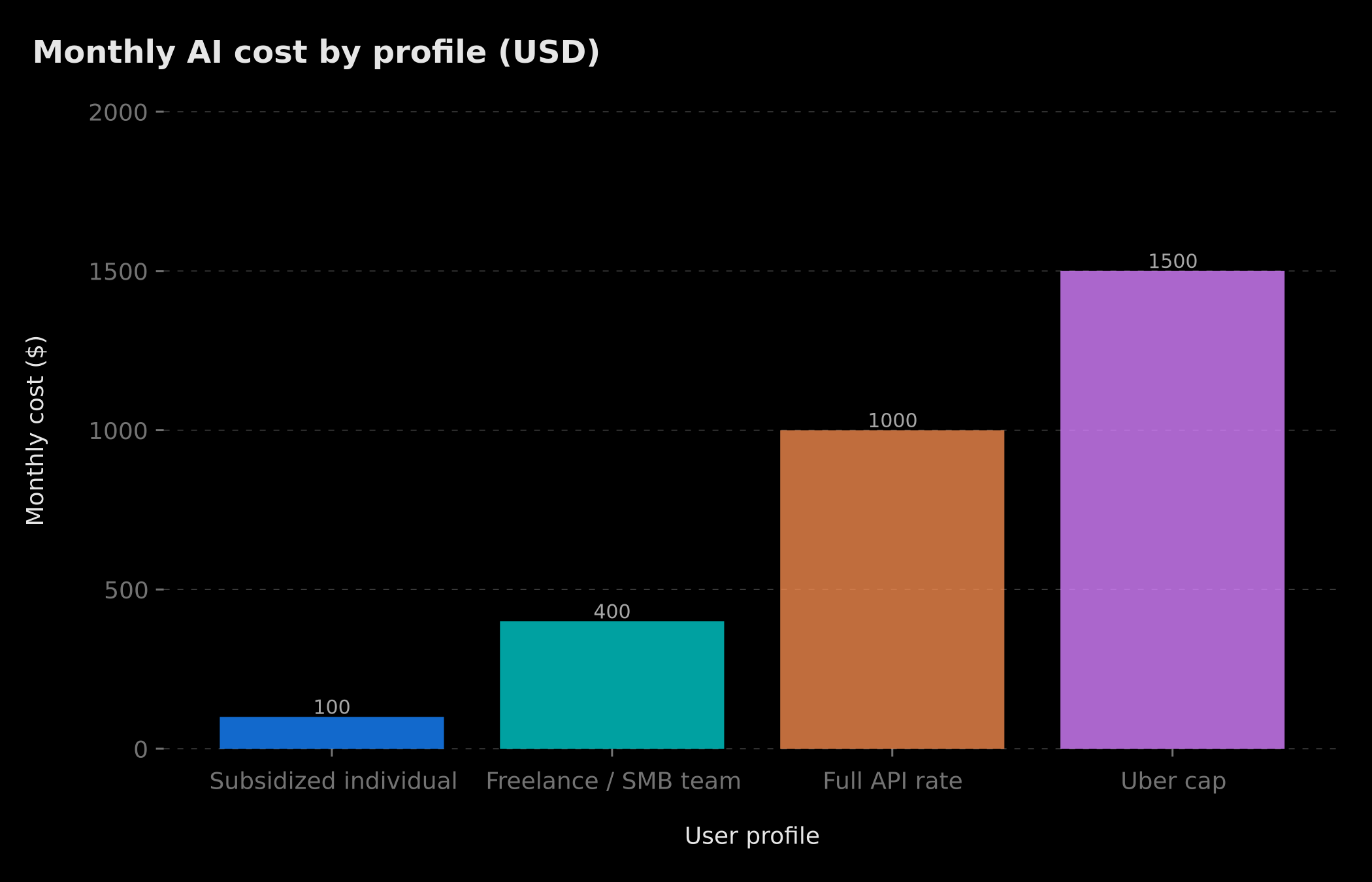 Real monthly AI cost: from $100 for a subsidized individual to $1,500 for the Uber enterprise cap
This model is not new — it's the exact same logic as freemium pricing in SaaS. But the sums involved are unprecedented in scale. Individual subsidies sometimes represent a 10x factor versus full price. And it is precisely this subsidy that is fueling the rapid adoption that corporate budgets failed to anticipate.
For freelancers and small organizations, this paradoxically creates a temporary competitive advantage: access to the same tools as Uber at one-tenth of the cost.
What This Means for Freelancers and SMBs
Uber's $1,500/month cap establishes a clear industry benchmark. If one of the world's largest tech companies considers $1,500/month per tool to be the upper acceptable limit, it calibrates the entire conversation around AI pricing in enterprise.
For a freelancer specializing in automation or AI development, this is a strong signal: your corporate clients are willing to spend at this level if you can demonstrate the corresponding ROI.
For agencies and SMBs integrating AI tools into their teams, this benchmark informs three key decisions:
1. Sizing the AI tooling budget. If your company employs 5 developers each using 2 tools, the reasonable annual budget lands around $36,000 (the Uber cap) or less depending on your sector.
2. Pricing your services. If your AI tooling costs reach $1,500/month, you need to factor that into your rate structure — or absorb it as an investment if the productivity gain justifies it.
3. Tool selection. The per-tool cap suggests Uber maintains 2 active tools per developer. Having 5 tools active at $300/month each is not equivalent — fragmentation reduces ROI.
AI FinOps: How to Audit and Control Your SaaS Licenses
Uber's main lesson is not to spend less, but to spend better. The proliferation of AI subscriptions (Cursor, ChatGPT, Claude, n8n) without centralized tracking inevitably leads to budget overruns. This is the role of FinOps (cloud and SaaS cost optimization). Implementing a consolidated dashboard and auditing the actual use of licenses often reduces the bill by 30 to 40% without impacting productivity.
Regain Control of Your AI Budget with a BOVO Audit
Do you know exactly how much your different AI tools cost you each month, or if they are actually being used by your teams? BOVO Digital performs FinOps audits of your tool stack (SaaS, APIs, infrastructure). We identify redundancies, consolidate your licenses, and set up tracking dashboards so your AI budget remains a profitable investment. Request your AI FinOps audit.
How to Optimize Your AI Budget Without Losing Productivity
Uber's lesson is not "spend less." It's "measure better." Here is a structured approach to managing your AI budget.
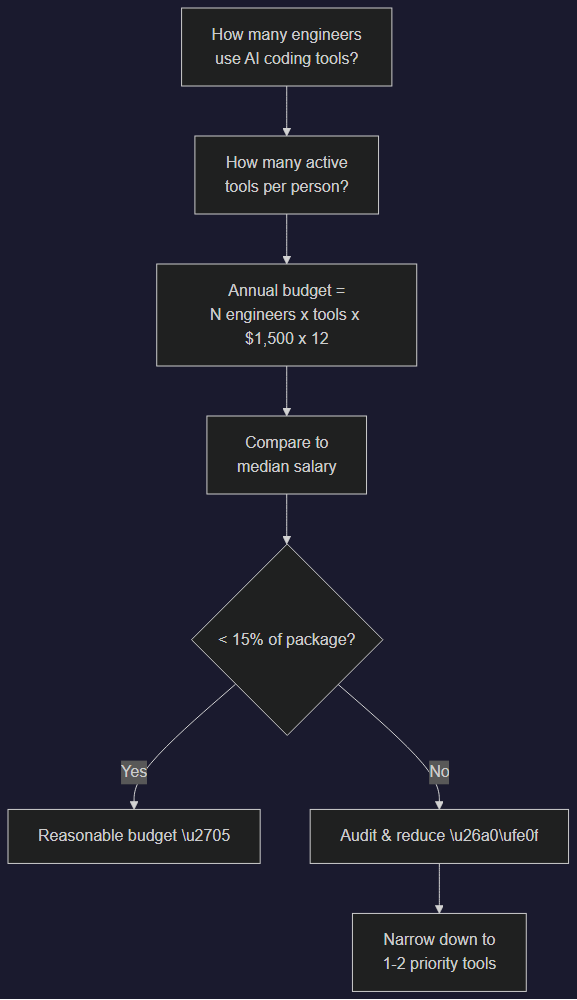 Decision framework: from tools inventory to the 'reasonable budget' or 'audit needed' verdict
Focus Usage on 1-2 Tools
The temptation to test every new AI tool is strong. But real productivity comes from deep mastery of one tool, not from multiplying subscriptions. Cursor and Claude Code take different approaches — Cursor is IDE-focused with excellent integration, while Claude Code offers superior agent autonomy for complex tasks.
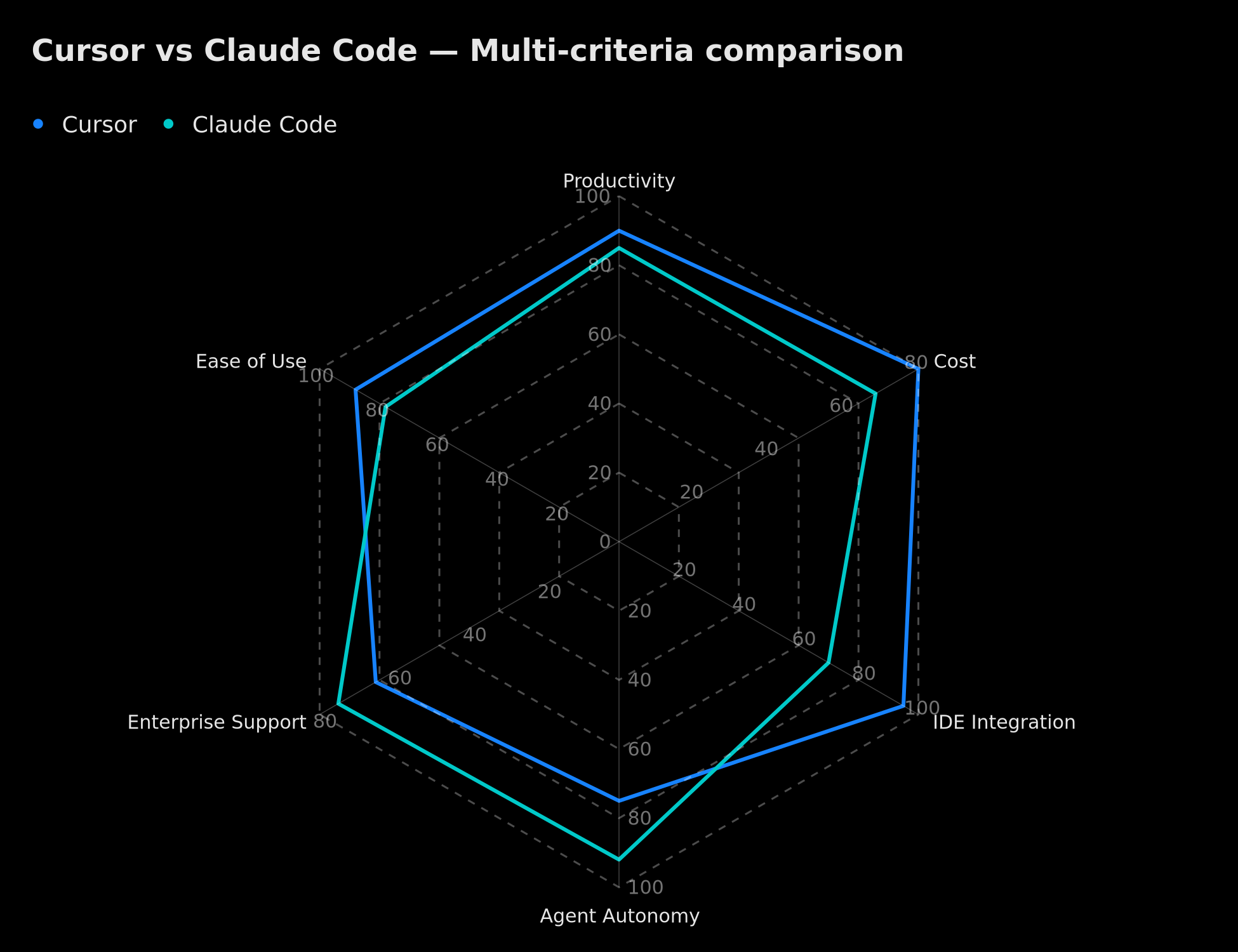 Radar comparison: Cursor excels in IDE integration and ease of use, Claude Code in agent autonomy
If your team must choose, ask these questions: are you working primarily inside an IDE (Cursor wins)? Do you need autonomous agents for long-horizon tasks (Claude Code wins)? The answer to these questions, more than price, should guide your decision.
Measure Real Usage
Cursor offers usage analytics in its team dashboard. Claude Code (via the Anthropic API) exposes detailed consumption metrics per API key. Activate these dashboards from day one — don't discover the consumed budget at end of month.
A simple rule: if a developer regularly consumes more than $800/month on a single tool, examine their usage patterns. That consumption level indicates either exceptional usage (and therefore exceptional value that should be documented), or non-optimized utilization.
Negotiate Team Plans
Individual subsidized plans are not accessible to enterprises, but team plans do offer volume economics. Anthropic, Cursor, and other providers offer negotiable rates starting at 10-20 seats. Before implementing an arbitrary cap, explore negotiation with your provider AEs — especially if your consumption is documented and growing.
The strategic stakes are also real: a provider that sees you as a committed enterprise client will be more inclined to offer SLAs, early access to new features, and priority support integration.
Key Takeaways
Uber's decision is not bad news for the AI ecosystem. It's a sign of market maturity. Large companies are beginning to treat AI tools like any other software infrastructure: with budgets, governance, and ROI measurement processes.
What changes:
- $1,500/month/tool is now the implicit benchmark for a "reasonable enterprise budget" for a coding agent
- 11% of the engineer package is the ratio that CFOs appear willing to accept
- The individual subsidy → full enterprise rate model will continue: providers need rapid adoption to justify their valuations
- Freelancers and SMBs have a temporary competitive advantage over large enterprises thanks to subsidized plans — for now
The real lesson from this story? Don't set your AI budget at year-end based on past usage. Coding agents evolve too fast. Build a quarterly review process, measure ROI per developer, and adjust. That's exactly what Uber should have done — and what they're doing now.
Tags
FAQ
Why did Uber blow through its AI budget in 2026?
Uber's 2026 AI budget was set in late 2025, before the explosion in coding agent usage (Cursor, Claude Code). Within just four months, engineering teams had already consumed the full annual allocation, forcing management to implement a $1,500/month cap per tool.
Is $1,500 per month per tool expensive for a company?
In absolute terms, it's substantial. But relative to Uber's median software engineer package ($330,000/year), two tools at $1,500/month amounts to $36,000/year — roughly 11% of total compensation. This signals that Uber is willing to pay that amount when ROI is demonstrated.
Are individual plans cheaper than enterprise plans?
Yes, dramatically. Simon Willison explains that he uses approximately $1,000/month worth of tokens but only pays $100 thanks to subsidized plans for individual developers. These plans are not available to large enterprises, which pay full price.
How do I set a reasonable AI budget for my team?
Multiply the number of engineers by the number of active tools, then by $1,500/month. Compare the annual result to your total salary cost. If AI spending exceeds 15% of the median package, it's time for an audit and a reduction to 1-2 priority tools.
Are Claude Code and Cursor the only tools subject to this cap at Uber?
According to information published by Bloomberg (Natalie Lung) and analyzed by Simon Willison on June 3, 2026, the $1,500/month cap specifically applies to coding agents — with Cursor and Claude Code cited by name. Other internal AI tools may have their own budget policies.
Free audit: we check the impact on your site and workflows
Next.js CVE, new agent, MCP… We tell you what actually applies, and what to patch or ignore.
- 30 min
- Stack reviewed
- No commitment

Singbo Davy AGONMA
Fullstack Developer & AI Expert. n8n automation specialist, Laravel/Flutter development and AI agent integration. Master CS — IFRI.


