
1,114 AI Startups in France: Mapping the 2026 Ecosystem
France has 1,114 AI startups, 50,000 direct jobs, and €16 billion raised. Full ecosystem breakdown, geographic hubs, unicorns, and entrepreneurial opportunities.
Updated

1,114 AI Startups in France: Mapping the 2026 Ecosystem
The AI startups France 2026 landscape is fundamentally reshaping Europe's digital economy. According to the France Digitale & Bpifrance report published in early 2026, France officially counts 1,114 active AI startups, placing the country third globally behind the United States and China. With 50,000 direct jobs, €16 billion raised since the earliest foundations of this ecosystem, and champions like Mistral AI and Doctolib gaining international recognition, France's AI ecosystem has never been denser, better structured — or richer in opportunity.
This article is a comprehensive map of that ecosystem: historical origins, sector breakdown, geographic dynamics, major technology categories, unicorns and scale-ups to watch, structural challenges, and — most importantly — how you, as an entrepreneur or developer in the Francophone world, can integrate it and benefit from it.
The History of AI in France: From Pioneers to Champions
France didn't arrive on the AI scene by accident. The country has a long tradition of mathematical and algorithmic research: Yann LeCun, one of the fathers of deep learning and 2018 Turing Award laureate, is Franco-American. His work on convolutional neural networks (CNNs), conducted partly at INRIA and the Pierre-and-Marie-Curie University, laid the theoretical foundations of the current AI revolution.
The modern era of the French AI ecosystem took off in the mid-2010s, with the acceleration of venture capital for deeptech. The creation of Station F in 2017 — the world's largest startup campus — marked a symbolic turning point: Paris became a credible destination for tech entrepreneurs worldwide. The French Tech Mission, launched by the government in 2014, progressively structured a network of incubators, accelerators, and labels across 17 French metropolitan areas.
In 2018, the Villani Report commissioned by Emmanuel Macron set the AI roadmap for France: invest heavily in public research (INRIA, CNRS), create AI chairs at grandes écoles, open public data for training models, and attract global talent. This report remains a foundational reference for understanding French strategy.
The France 2030 Plan, announced in 2021 and progressively deployed, reserves €1.5 billion specifically for AI. These funds support fundamental research projects, high-performance computing centers (GENCI, Jean-Zay), sector-specific calls for projects, and direct support for startups via BPI France. In 2026, these investments are beginning to produce measurable effects: France now trains over 10,000 AI engineers per year, according to data from the Conférence des Grandes Écoles.
The Ecosystem in Numbers
| Metric | Value |
|---|---|
| Active AI startups | 1,114 (source: France Digitale & Bpifrance, 2026) |
| Direct jobs | 50,000+ |
| Total funds raised | €16B |
| 2025 raises | €3.2B |
| Global rank | #3 |
| Main hub | Paris Île-de-France (72%) |
The figure of 1,114 AI startups comes from the annual census co-produced by France Digitale and Bpifrance. It includes companies where AI is a core technological component — not simply those using a third-party API. This strict perimeter explains why this number is lower than some broader estimates that inflate the count by including any software using a recommendation algorithm.
The €16 billion raised represents the cumulative total since the founding of the surveyed startups, not just 2025 alone. The annual raise of €3.2 billion in 2025 is impressive in a context of tighter financial markets and higher interest rates. It signals that investors — French funds like Elaia or Partech, but also American (a16z, Sequoia) and Middle Eastern ones — continue to bet heavily on the French ecosystem.
Sector Mapping: Who Does What?
The French AI ecosystem is far more than language models. The sector breakdown reveals remarkable industrial diversity, reflecting the richness of France's economic fabric.
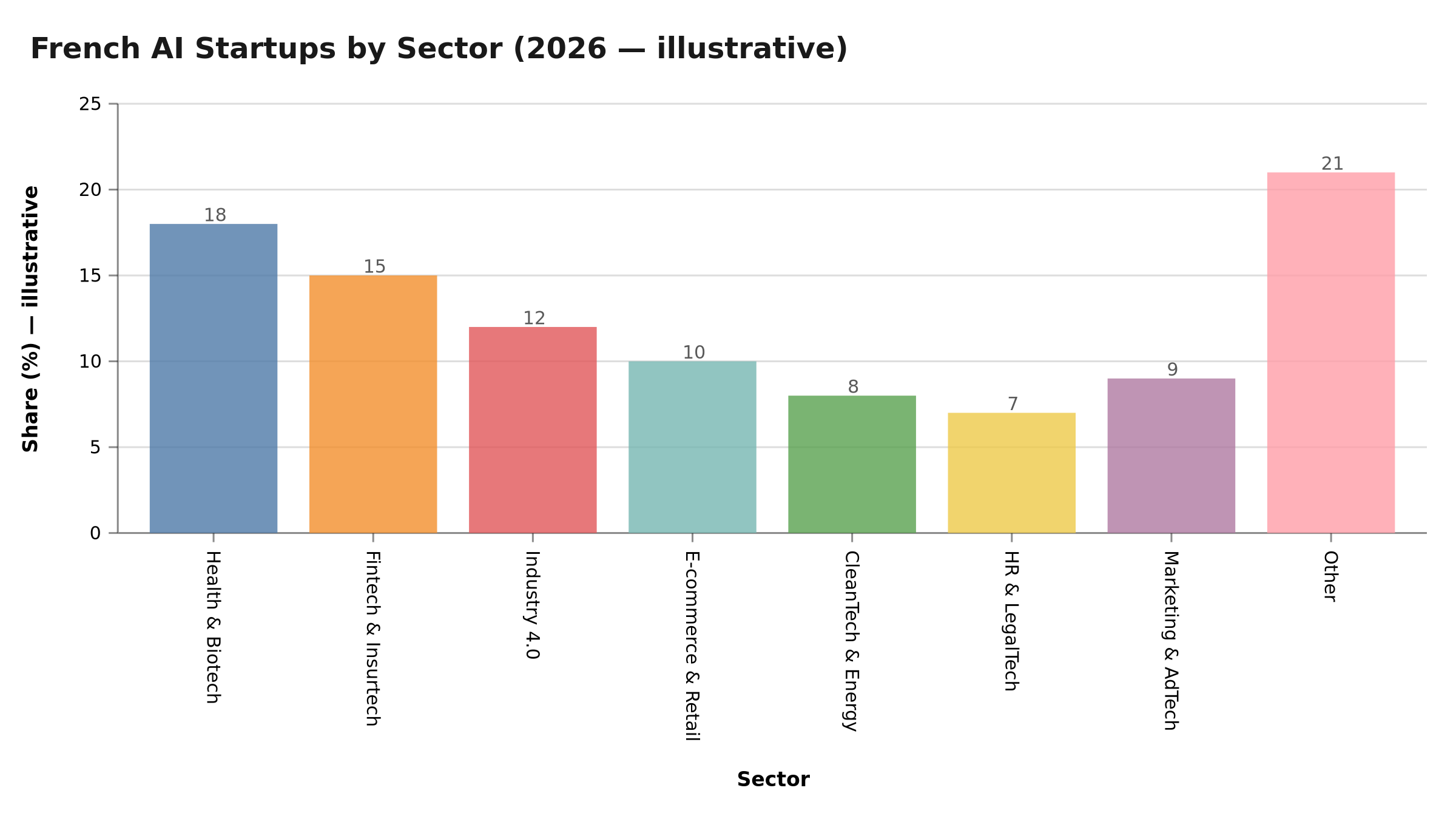 Relative weight of each sector in France's 1,114 AI startup ecosystem — illustrative data based on observed sectoral trends
Health & Biotech (≈18%)
Healthcare is the most represented sector in the French AI ecosystem. The convergence between abundant medical data (thanks to France's universal health system and access to French Health Insurance data via the Health Data Hub), excellence in biomedical research at Inserm, and the acute needs of the care system creates exceptional fertile ground.
Emblematic examples: Owkin applies federated learning to sensitive clinical data, enabling model training on hospital data without centralizing it. Nabla has built an AI assistant for doctors that automatically transcribes and structures medical consultations. Implicity continuously monitors patients with pacemakers using AI. These three companies embody three complementary approaches: foundational research AI, clinician-patient interface AI, and continuous monitoring AI.
Fintech & Insurtech (≈15%)
France has one of Europe's most active fintech sectors. AI has found fertile ground there on two fronts: real-time fraud detection and alternative credit scoring. Shift Technology is now the world leader in AI-powered insurance fraud detection, with clients in 25 countries. Alan, the French health neo-insurance, uses machine learning to personalize contracts and automate reimbursements — an approach that helped it surpass 500,000 policyholders in 2025.
The sector benefits from a relatively favorable regulatory environment in France, with the Autorité de Contrôle Prudentiel et de Résolution (ACPR) having opened regulatory "sandboxes" for innovative fintechs.
Industry 4.0 (≈12%)
French manufacturing — aerospace, automotive, agri-food, energy — is in the midst of digital transformation. AI is deployed primarily for predictive maintenance (anticipating failures before they occur), automated quality control via computer vision, and supply chain optimization.
Cosmo Tech has developed a digital twin simulation platform used by clients including Airbus and EDF. Scortex offers a computer vision solution for in-line production quality control, capable of detecting defects invisible to the human eye. These companies illustrate the potential of industrial AI in a country that remains the world's fourth-largest industrial power.
E-commerce & Retail (≈10%), CleanTech (≈8%), HR & LegalTech (≈7-9%)
E-commerce and retail concentrate startups specializing in algorithmic personalization, dynamic pricing, and predictive inventory management. CleanTech AI is growing strongly in precision agriculture (yield forecasting, early disease detection) and energy grid optimization. HR and LegalTech represent an emerging market: semantic candidate matching, automated contract analysis, and legal risk detection in tenders.
The Three Major Technology Families
Beyond sectors, it is useful to distinguish French AI startups by their technological nature:
1. Generative AI groups startups that create or exploit models capable of producing content — text, image, code, audio. Mistral AI is the most emblematic French example in this category. These models are revolutionizing content creation and automation workflows.
2. Predictive AI is the most industrially mature. It relies on classic machine learning algorithms (random forests, gradient boosting, deep neural networks) to anticipate future events from historical data. Shift Technology (fraud), Cosmo Tech (industrial simulation), Implicity (cardiac monitoring) belong to this family.
3. Decisional AI combines business rules, mathematical optimization, and machine learning to automate complex real-time decisions — such as dynamic resource allocation in a logistics network or automated investment portfolio management. This is the most discreet domain but often the most immediately lucrative for large enterprise clients.
The Geography of AI Innovation
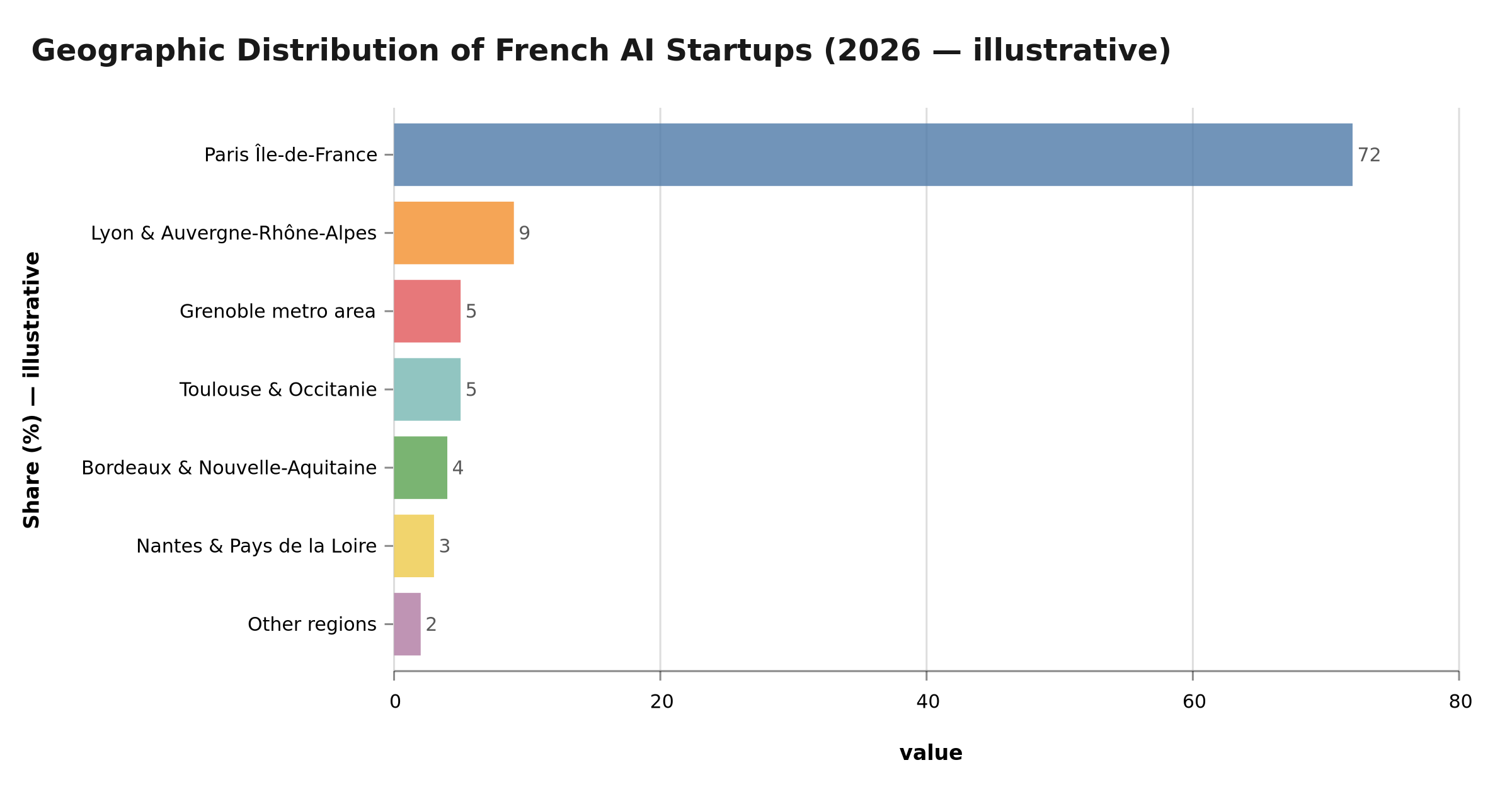 Estimated geographic concentration of AI startups in France — Paris dominates at 72%, but regional hubs are gaining momentum
Paris Île-de-France: The Indispensable Hub (≈72%)
Paris concentrates three-quarters of the French AI ecosystem, a concentration comparable to London's for the UK. The reasons are structural: presence of grandes écoles (ENS, Polytechnique, HEC, ESSEC), major research campuses (INRIA Paris, CEA List at Saclay), headquarters of large enterprise clients (Total, LVMH, BNP Paribas, SNCF, Air France), and unique investor network density.
The Saclay plateau, south of Paris, deserves special mention. With Paris-Saclay University (ranked in the global top 20 for mathematics and physics), HEC campus, CEA, INRIA, and dozens of laboratories, it has become the densest deeptech cluster in Europe. Some of France's most advanced algorithms were born here.
Lyon & Auvergne-Rhône-Alpes (≈9%)
Lyon is France's second-strongest AI hub. The region benefits from dense manufacturing industry (chemicals, technical textiles, mechanics) that generates strong demand for industrial AI. Digital League, the regional digital business network, brings together over 400 players. Notable startups include Hoomano (AI robots for customer reception) and Lifen (health data interoperability).
Grenoble: The Semiconductor and Deeptech Hub (≈5%)
Grenoble is unique in France: it is the only territory challenging Paris for the title of top deeptech hub, in very specific domains like semiconductors, photonics, and embedded AI (edge AI). The presence of STMicroelectronics, Soitec, Schneider Electric, CEA-Leti, and the LIG laboratory creates a highly hardware-software oriented ecosystem. Local startups like Kalray (neuromorphic processors) illustrate this hardware anchoring.
Toulouse & Occitanie (≈5%)
Toulouse, birthplace of Airbus and capital of European aerospace, naturally develops AI very oriented toward aerospace, defense, and mobility. The Aerospace Valley competitiveness cluster brings together over 800 members and funds AI projects for aircraft predictive maintenance, air traffic management, and autonomous navigation. Predict (now Sysnav) and Sigfox (IoT connected to AI) emerged from this ecosystem.
French AI Champions
| Startup | Sector | Estimated Valuation |
|---|---|---|
| Mistral AI | Open-source LLM | ≈€6B |
| Doctolib | HealthTech | ≈€5.8B |
| Hugging Face | ML Platform | ≈€4.5B |
| Poolside | AI Dev Tools | ≈€3B |
| Shift Technology | Insurtech | ≈€1B |
| Alan | Neo-insurance | ≈€1.5B |
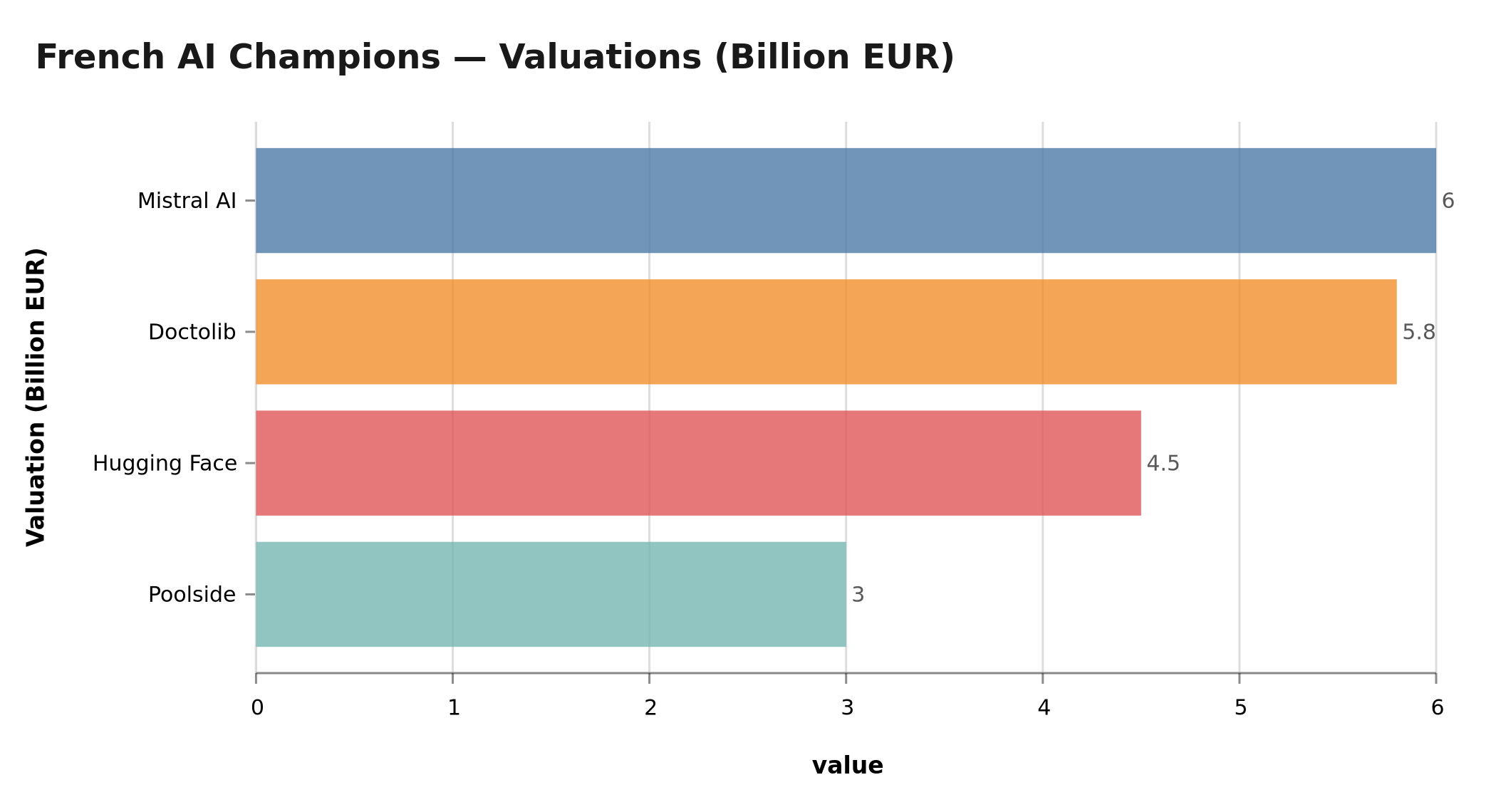 Valuation comparison: Mistral AI, Doctolib, Hugging Face, Poolside — estimates based on latest 2025-2026 funding rounds
Mistral AI deserves special attention. Founded in May 2023 by former DeepMind and Meta AI researchers — Arthur Mensch, Guillaume Lample, Timothée Lacroix — the company raised in a few months what others spend years accumulating. Its differentiation rests on an assumed open-source strategy, which allowed it to build a global developer community while monetizing premium versions via its La Plateforme offering. Mistral 7B, Mixtral 8x7B, and then Mistral Large have marked a remarkably fast R&D trajectory for such a young company.
Hugging Face, though founded in New York by Frenchmen (Clément Delangue, Julien Chaumond, Thomas Wolf), is considered a French source of pride. Its platform hosts over 500,000 models and 150,000 datasets, making it the GitHub of global AI. Hugging Face's influence on the standardization of model formats (GGUF, ONNX popularization) and libraries (Transformers, Diffusers) is considerable.
To understand more about the fundraising dynamics of these models and what this means for entrepreneurs, read our analysis of the impact of AI mega-raises on the ecosystem.
The Funding Ecosystem: From Seed to Unicorn
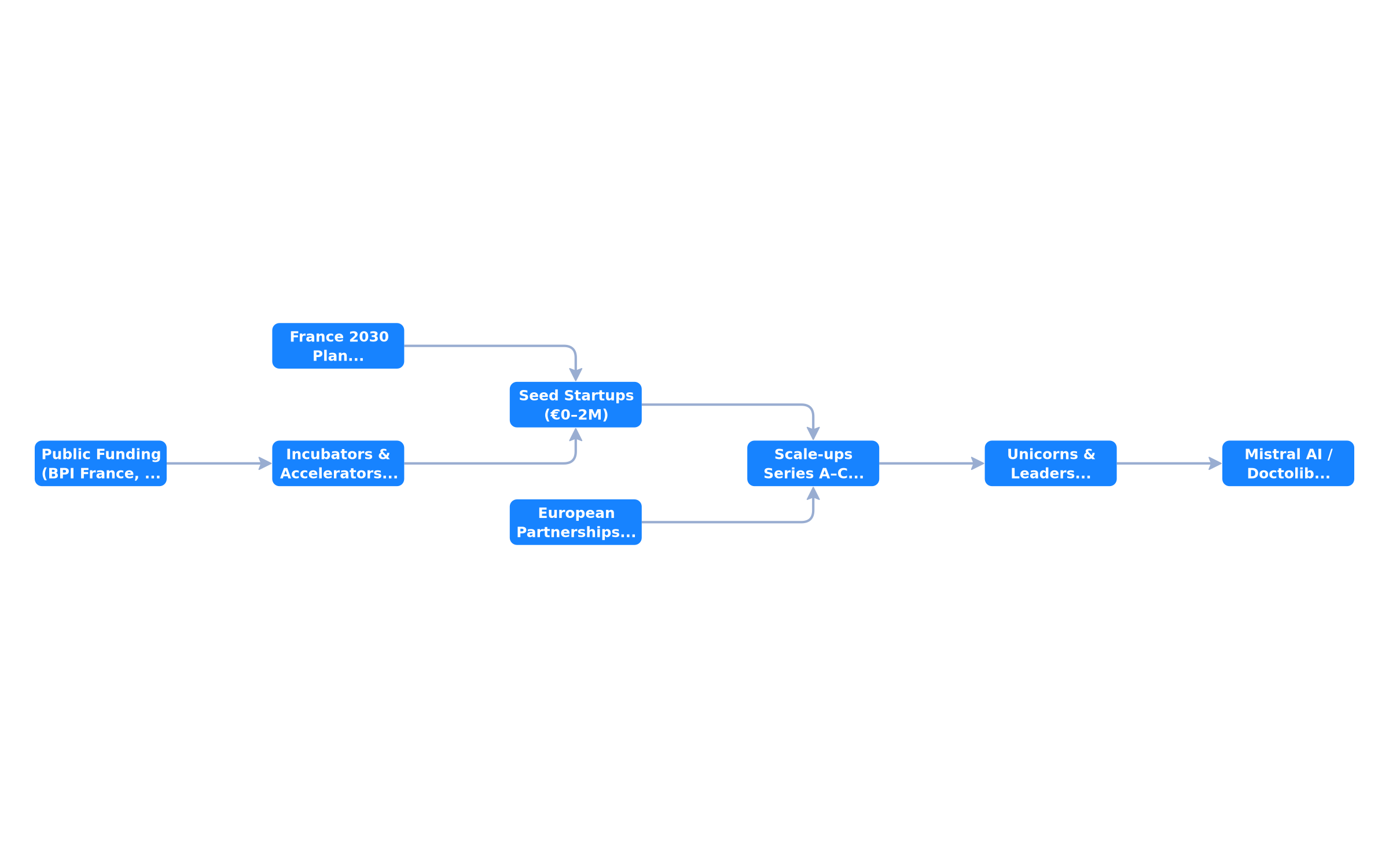 French AI funding flow: from public grants to unicorns via incubators and funding rounds
Understanding how funding works is essential for any entrepreneur wanting to integrate the ecosystem. France has built over the years a funding continuum covering all stages:
Seed Stage (€0–500K): Early resources often come from a combination of the French Tech Grant (€30,000, processed in under 5 days), the Research Tax Credit (CIR, up to 30% of R&D expenses), and the INPI Grant for intellectual property protection. Public incubators like SATTs (Technology Transfer Acceleration Companies) allow monetizing patents from public research.
Seed Round (€500K–3M): At this stage, early-stage French funds engage: Kima Ventures (300+ portfolio companies), Elaia Partners, Partech Paris, 360 Capital. Business Angels organized in networks like France Angels also play a growing role. BPI France also offers the Innovation Loan, a non-dilutive loan up to €5M.
Series A-B (€3–50M): Major European funds take over — Eurazeo Growth, Idinvest, Balderton Capital (London). Corporate venture capital (CVC) arms like Total Ventures, Orange Ventures, LVMH Luxury Ventures invest in strategically aligned startups.
Series C and beyond: At these amounts, American funds (a16z, General Atlantic, Tiger Global) and sovereign funds from the Middle East and Asia enter the picture. Mistral AI's €6B valuation was co-built with investors such as Andreessen Horowitz and Lightspeed.
This entire ecosystem explains why €3.2 billion raised in 2025 represents a remarkable performance: funding channels are diversified, mature, and interconnected.
Structural Challenges Facing the Ecosystem
The French AI ecosystem shines through its successes, but faces important structural challenges that must be honestly acknowledged.
The Talent War
Training 10,000 AI engineers per year in France is not enough to match exploding global demand. The salaries offered by GAFA and startups like Mistral AI (competitive packages including options) absorb a large share of top profiles. For seed-stage startups, hiring a senior ML engineer in Paris costs between €80,000 and €130,000 gross annually. Startups that cannot compete on salary must compensate with mission, impact, and flexibility.
Brain drain remains a sensitive topic: many researchers trained at ENS or Polytechnique subsequently move to Google DeepMind, OpenAI, or Meta AI. Yann LeCun himself is based in New York. France is working to strengthen the attractiveness of its research laboratories, notably via the "AI Chairs" program that co-funds researchers between university and industry.
Late-Stage Funding Gap
While seed stage is well covered, mega-rounds of €500M and above remain rare in France. The bulk of this capital comes from American or Asian funds, which can create tensions around governance and data localization. The creation of the Tibi II fund (€500M mobilized from French institutional investors) and discussions around a European AI sovereignty fund attempt to bridge this gap.
AI Act Compliance
The EU AI Act, progressively entering into force since August 2024, imposes new obligations on companies that develop or deploy high-risk AI systems (medical, HR, security). For health or HR startups, this means compliance audits, formalized technical documentation, and sometimes costly certifications. France has the advantage of regulators — CNIL, ANSSI — that understand technological issues and engage with the ecosystem.
To understand why the regulatory framework also changes strategy for companies adopting AI, see our analysis on AI-First strategies in 2026.
Digital Sovereignty: The Political Stakes
France has made digital sovereignty a strategic differentiation axis in global AI competition. This translates concretely into several initiatives:
The France AI Computing Plan provides for the construction of supercomputers dedicated to AI model training, managed by GENCI. The Jean-Zay supercomputer (IDRIS), regularly upgraded, allows French researchers and startups to access sovereign computing power without depending on American clouds (AWS, Azure, GCP).
The Health Data Hub is a national infrastructure that aggregates and makes available anonymized health data for training medical models. Its existence partly explains the strength of France's HealthTech AI ecosystem.
The GDPR + AI Act policy framework, while constraining companies, also offers a competitive advantage in markets where data trust is crucial. European, Asian, or Middle Eastern clients sometimes prefer working with providers subject to European law rather than American law (CLOUD Act).
France actively advocates at European level for the AI Act to preserve "regulatory sandboxes" allowing startups to innovate before being subject to full compliance obligations.
Opportunities for African Francophone Entrepreneurs
The French AI ecosystem represents much more than a local market. For African Francophone entrepreneurs, it constitutes a gateway to resources, expertise, and global networks.
The AI market in Africa is estimated at $4.5 billion by 2030, according to available data. Four sectors concentrate most of the potential:
Mobile Fintech: countries like Senegal, Côte d'Ivoire, Morocco, and Kenya have mobile money adoption rates unmatched in Europe. AI can improve credit scoring for the unbanked, detect fraud in mobile transactions, or optimize micro-insurance offerings.
AgriTech: agriculture represents 15 to 60% of GDP in many African countries. Precision weather forecasting, crop disease diagnosis via satellite image or smartphone photo, and harvest collection route optimization are AI use cases with strong economic impact.
HealthTech: AI-powered telemedicine can compensate for the lack of doctors in rural areas. Mobile AI diagnostic tools (radiology, dermatology) developed by startups like Ubenwa (Nigeria) and Helium Health are showing the way.
AI Models for African Languages: Wolof, Dioula, Hausa, Swahili, and dozens of other languages spoken by hundreds of millions of people are very underrepresented in major LLMs. This is an untapped market, with lower barriers to entry than Indo-European languages.
The French Tech Africa network and events like GITEX Africa 2026 are ideal meeting points for creating bridges between ecosystems.
How to Join and Contribute to the French AI Ecosystem
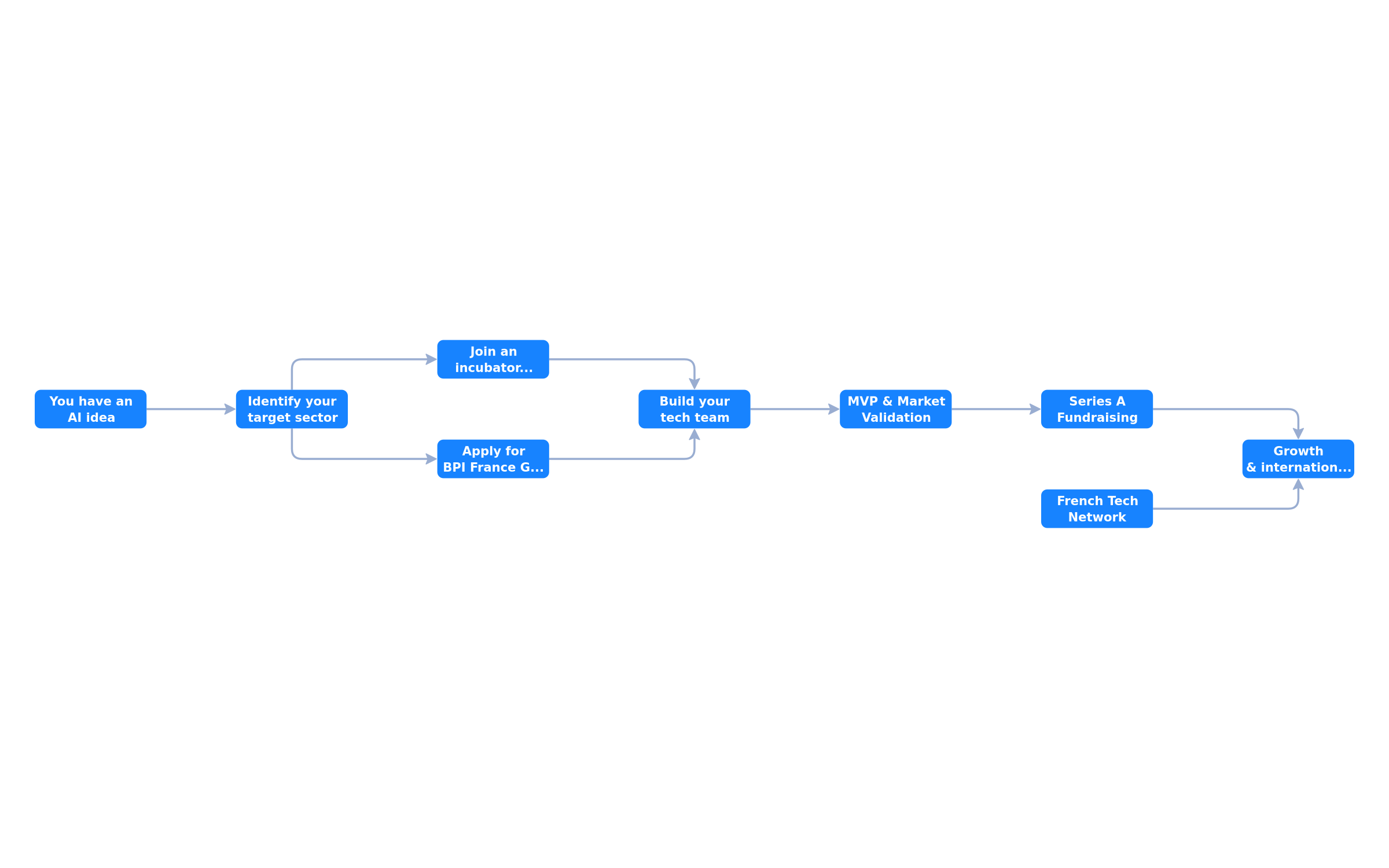 Steps to integrate the French AI ecosystem: from initial idea to international growth
Whether you are a developer, entrepreneur, or SME leader, several concrete paths are available to you:
For Developers and Data Scientists
Contributing to open-source projects like Mistral AI (models available on Hugging Face under Apache 2.0 license) or Hugging Face libraries is the best way to build a reputation in the ecosystem. GitHub issues for these projects are open, community discussions are active on Discord, and quality contributions have led to direct recruitments.
Participating in French Tech hackathons regularly organized in all metropolitan areas allows testing ideas, meeting potential co-founders, and getting noticed by investors.
For Entrepreneurs
Starting with a diagnosis of your target market is essential before applying to an incubator. Station F (Paris), NUMA (Paris, Casablanca, Barcelona), or regional incubators like Impulse (Lyon) and Le Village by CA (multiple cities) offer intensive 6–18 month support programs.
The French Tech Grant (€30,000, processed in under a week) is accessible from the idea stage. It funds feasibility studies and prototypes. It targets innovative companies under 8 years old, with very favorable repayment conditions in case of failure.
The Research Tax Credit (CIR) is an underused but powerful mechanism: it allows deducting 30% of R&D expenses from corporate tax, up to €100 million. For a startup investing €500,000 in developing its AI model, this represents €150,000 in recovered cash.
For Existing Businesses
Integrating AI into your existing processes does not require building your own models. Ready-to-use vertical solutions exist in every sector, often developed by French startups. The challenge is choosing the right partners by evaluating their GDPR compliance, server location, and capacity to support your internal skills development.
See our analysis on the ROI of 171 AI agents in production to understand which indicators to track during an AI deployment.
Outlook 2026–2028: What's Coming
The French AI ecosystem in 2026 is at a turning point. Several underlying trends are shaping the landscape over the next two years:
Consolidation through M&A: after an intense creation phase, the strongest startups will absorb smaller competitors to accelerate growth. BNP Paribas, Orange, Dassault Systèmes, LVMH, and other major French groups all have active AI M&A units.
Edge AI: with the explosion of industrial connected objects, demand for AI models running directly on sensors or devices (without cloud) will grow strongly. France, with its strengths in semiconductors (STMicro, Grenoble) and embedded systems (Toulouse), is well positioned to capture this wave.
Multimodality as standard: models capable of simultaneously processing text, image, audio, and video will become the norm. Startups building multimodal interfaces for vertical sectors (medical, industrial, legal) today will have an advantage.
Regulation as competitive advantage: companies that have invested early in AI Act compliance will be better positioned to sell across Europe and in markets adopting similar standards (Canada, Japan, some Gulf countries). France, which played an active role in drafting the AI Act, has regulatory expertise that American competitors lack.
Finally, the question of open-source AI scalability will become central. Mistral AI has chosen to play simultaneously on open-source (credibility, adoption) and commercial (revenue, sustainability). This hybrid model will likely become the reference for European AI labs.
Conclusion
With 1,114 AI startups counted by France Digitale and Bpifrance, world-class champions like Mistral AI, Hugging Face, and Doctolib, and a unique European public safety net (BPI France, CIR, France 2030 Plan), France has built an AI ecosystem that holds its own against American and Chinese giants — not by imitating them, but by leveraging its own strengths: mathematical rigor, open-source culture, sector diversity, and a trust-based regulatory framework.
AI is no longer the exclusive domain of Silicon Valley. It is also being built in Paris, Lyon, Grenoble, Toulouse — and in Francophone African ecosystems learning to harness it.
For entrepreneurs wanting to understand how to position their offering in this evolving ecosystem, our AI-First 2026 analysis details the strategies adopted by the best-funded startups. And if you're curious about how AI agents create concrete business value, our study on the ROI of 171 AI agents in production will give you actionable data.
At BOVO Digital, we build custom AI solutions in the Francophone ecosystem — from workflow automation to integrating AI agents into your business processes. Contact us to discuss your project.
Tags
FAQ
How many AI startups are there in France in 2026?
According to the France Digitale & Bpifrance report published in early 2026, France counts 1,114 active AI startups, placing the country third globally behind the United States and China. These startups employ over 50,000 people and have collectively raised €16 billion since inception.
Which sectors have the most AI startups in France?
Health and biotech account for approximately 18% of French AI startups, followed by fintech and insurtech (15%), Industry 4.0 (12%), and e-commerce & retail (10%). Marketing tech, HR tech, LegalTech, and CleanTech complete the picture. These figures are illustrative and based on observed sectoral trends.
Who are the French AI unicorns?
The most highly valued French AI companies are Mistral AI (approximately €6B), Doctolib (approximately €5.8B), Hugging Face (approximately €4.5B), and Poolside (approximately €3B). These valuations are based on the most recently disclosed funding rounds and may evolve.
How can I join the French AI startup ecosystem?
Several paths exist: joining an incubator such as Station F or NUMA, applying for BPI France grants (French Tech Grant, Innovation Loan), entering an ANR research program, or contributing to open-source projects like Mistral AI and Hugging Face. The French Tech Mission network (in 17 metropolitan areas) also provides a valuable community accelerator.
What is the impact of the EU AI Act on French startups?
The AI Act, progressively entering into force since 2024, imposes transparency and compliance requirements on high-risk AI systems. French startups benefit from guidance from the CNIL and ANSSI, but compliance costs can be challenging for very small companies. France advocates for regulatory sandboxes that allow innovation without creating blockers.
Why is France the world's third-largest AI hub?
Several factors explain this positioning: excellence of grandes écoles (Polytechnique, ENS, INRIA), the political ambition of the France 2030 AI Plan (€1.5B), an entrepreneurial culture strengthened by Station F and the French Tech Mission, and world-class research labs (INRIA, CNRS, CEA). The GDPR has also pushed companies to develop more ethical and differentiated AI.
Budget, process, priorities — decided together
Website, chatbot, or automation? We pick the next job that unlocks cash, not the trendy stack.
- 30 min
- Clear priorities
- No commitment
Vicentia Bonou
Full Stack Developer & Web/Mobile Specialist. Committed to transforming your ideas into intuitive applications and custom websites.


