
Stable MCP + A2A Protocol: The New Standard for Connecting Your AI Agents
In April 2026, two standards are changing the game for automation: the Model Context Protocol (MCP) reaches maturity, and the Agent2Agent (A2A) protocol emerges to enable agents to collaborate with each other. Here's what it changes for your workflows.
Updated
Stable MCP + A2A Protocol: The New Standard for Connecting Your AI Agents
April 2026 marks a decisive turning point in the history of agentic AI. The stable MCP A2A protocol for AI agents is no longer a lab experiment — it's the infrastructure on which tomorrow's autonomous systems are being built.
If you follow agentic AI closely, you've surely heard of Anthropic's Model Context Protocol (MCP). What was experimental in 2025 has become, by April 2026, the de facto standard for connecting AI tools to external data sources and services. But the real revolution doesn't stop there. The simultaneous emergence of the Agent2Agent (A2A) protocol, championed by Google, creates a two-layer infrastructure that fundamentally changes what it's possible to build with AI agents. Understanding these two protocols, their respective roles, and how they work together has become an essential skill for any professional building intelligent automations.
What is the Model Context Protocol (MCP)?
The Model Context Protocol is an open-source specification published by Anthropic in November 2024 and made stable in 2026. Its purpose is precise: to define a standardized protocol that allows a language model (LLM) to interact with external resources — databases, APIs, file systems, third-party services — in a secure and predictable manner.
Before MCP, every AI integration was an island. Want to connect Claude to your PostgreSQL database? You had to write a custom wrapper. Want to plug GPT-4o into your project management tool? Another bespoke development. And if you switched models tomorrow, everything had to be rebuilt. This fragmentation cost time, created inconsistencies, and slowed AI adoption in enterprises.
MCP solves this problem by introducing a universal abstraction layer. Its architecture rests on two key components: the MCP Client (which lives in the application or model) and the MCP Server (which encapsulates external resources). Communication between the two uses JSON-RPC 2.0, a lightweight and well-documented protocol, transported via stdio (for local servers) or HTTP with Server-Sent Events (for remote servers).
The official MCP specification defines three fundamental primitives that any server can expose. Tools are functions the agent can call to perform actions — for example query_database, create_github_issue, or send_slack_message. Resources are data the agent can read, such as file contents or web pages. Prompts are pre-configured templates the server offers to guide the agent in recurring tasks. This three-part division is simple but powerful: it covers virtually all real-world use cases.
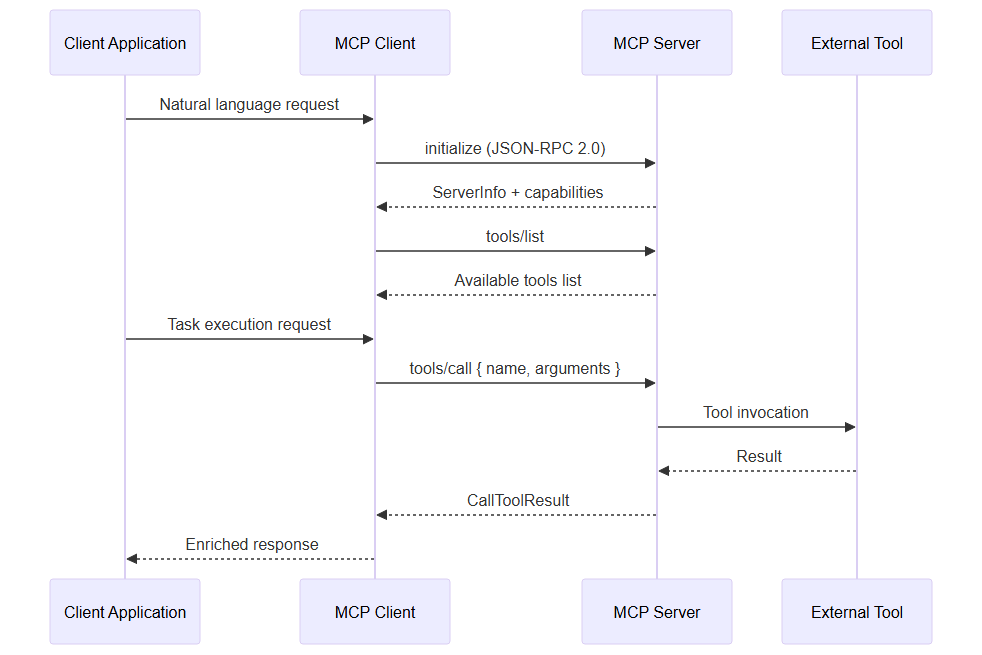 The complete MCP cycle: the agent dynamically discovers available tools, then invokes the ones it needs via JSON-RPC 2.0
Why Stable MCP Is a Major Turning Point
The distinction between experimental MCP (2024-2025) and stable MCP (2026) is deeper than just a version number. Several dimensions have changed that explain the explosive acceleration in adoption.
API stability. During the experimental phase, spec changes forced developers to update their servers regularly. The stable version freezes the core protocol, meaning an MCP server written today will still work two years from now without modification. This is the sine qua non condition for enterprises to seriously invest in MCP integrations.
Official multi-implementation. Anthropic, Google, and OpenAI have all announced native MCP support in their respective SDKs. Claude (via the Anthropic SDK), Gemini (via Vertex AI), and GPT-4o (via the OpenAI API) can all function as MCP clients. This means an MCP server you build is compatible with any of these models, without modification.
Ecosystem explosion. In January 2026, there were approximately 45 officially maintained MCP servers. By April 2026, that number exceeds 180. Companies like Stripe, Notion, Linear, Atlassian, and dozens of others have published their own MCP servers. The open-source community has produced hundreds more. For a developer or automation specialist, this means most tools they use already have a ready-to-use MCP server.
Codified security. The stable spec includes explicit recommendations on authentication (OAuth 2.0 for HTTP servers), per-tool permission scoping, and invocation logging. These institutionalized guardrails allow deploying MCP in sensitive environments without building a custom security layer from scratch.
Integration into no-code tools. n8n since version 2.0, Make.com via Maia, and Cursor in its IDE now natively integrate MCP. An automation specialist who has never written a line of TypeScript can connect an MCP server to their n8n workflow in a few clicks. This shift explains why MCP went from a niche developer topic to a mainstream productivity tool in just a few months.
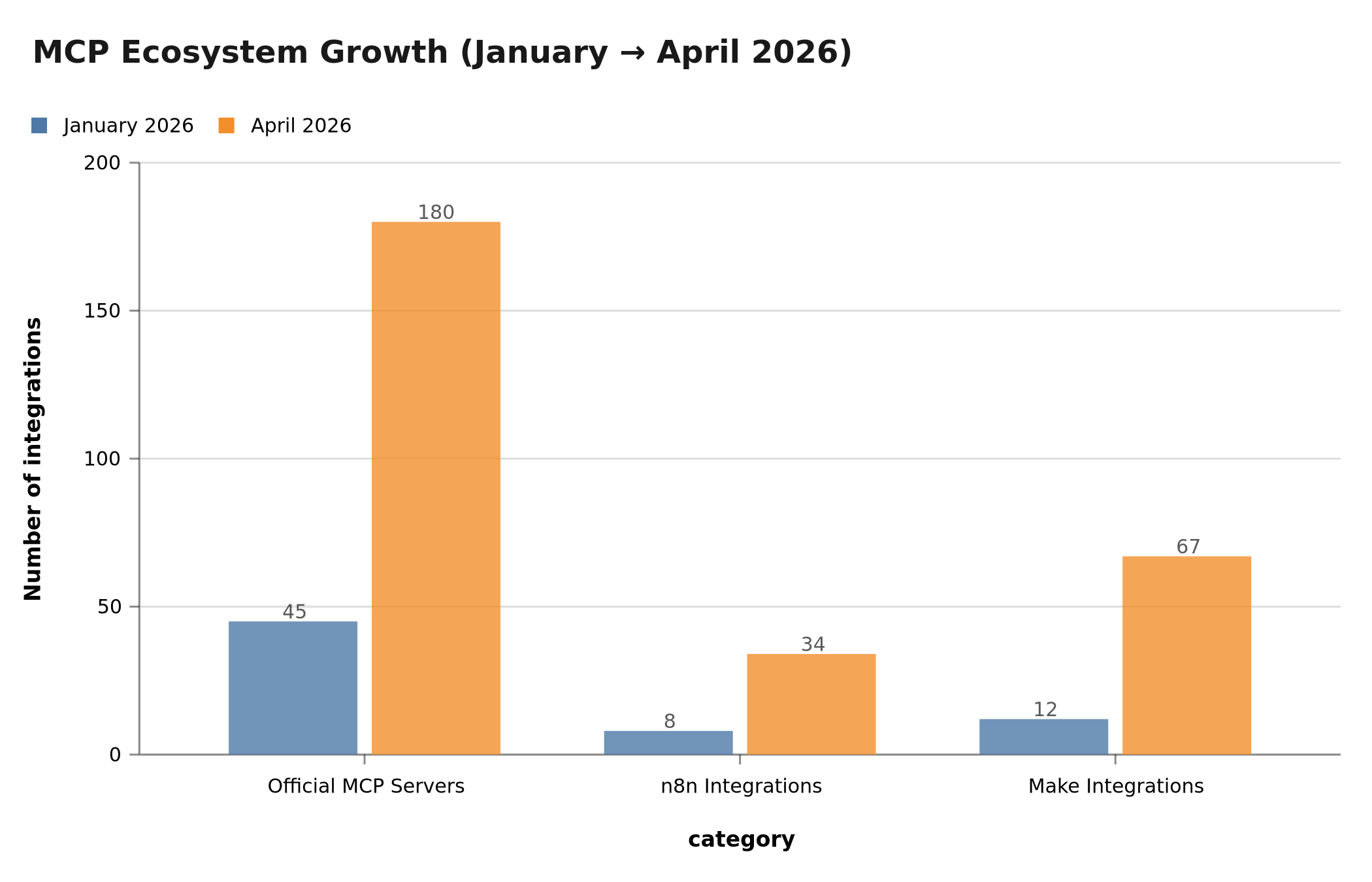 In 3 months, official MCP servers grew from 45 to 180+, Make integrations from 12 to 67
Technical Anatomy of an MCP Server
To understand why MCP is so effective, you need to understand the connection lifecycle. When an MCP client (Claude in Cursor, for example) starts, it sends an initialize message to the server. The server responds with its information — name, version, list of supported capabilities. The client then sends tools/list to get the complete list of available tools with their JSON schema. From that point, the agent knows exactly what it can do.
When the agent decides to use a tool, it sends a tools/call message with the tool name and arguments in JSON. The server executes the corresponding action — a SQL query, an API call, a file read — and returns the structured result. This result is injected directly into the model's context, which can use it to formulate its response or decide on a next action.
What makes this architecture particularly elegant is its dynamic sequencing. The agent doesn't know in advance which tools it will use — it discovers them at runtime, selects those relevant to the current task, and chains them autonomously. This is a paradigm shift from traditional REST APIs where every call must be hard-coded.
Here is a simplified example implementation of a minimal MCP server in TypeScript using the official Anthropic SDK:
// simplified example — adapt to your use case
import { Server } from "@modelcontextprotocol/sdk/server/index.js";
import { StdioServerTransport } from "@modelcontextprotocol/sdk/server/stdio.js";

const server = new Server({
  name: "my-mcp-server",
  version: "1.0.0",
}, {
  capabilities: { tools: {} },
});

// Declare a tool
server.setRequestHandler("tools/list", async () => ({
  tools: [{
    name: "get_weather",
    description: "Get weather for a given city",
    inputSchema: {
      type: "object",
      properties: {
        city: { type: "string", description: "City name" },
      },
      required: ["city"],
    },
  }],
}));

// Implement the tool
server.setRequestHandler("tools/call", async (request) => {
  if (request.params.name === "get_weather") {
    const city = request.params.arguments.city;
    // Real weather API call here
    return { content: [{ type: "text", text: `Weather in ${city}: 72°F, sunny` }] };
  }
  throw new Error("Unknown tool");
});

// Start via stdio
const transport = new StdioServerTransport();
await server.connect(transport);
This server can be connected to any compatible MCP client — Claude Desktop, Cursor, an n8n agent — without any modification. That is the MCP promise: write once, use everywhere.
The A2A Protocol: Agent-to-Agent by Google
If MCP solves the problem of "how does an agent access tools", the Agent2Agent (A2A) protocol solves a different and complementary problem: "how do multiple specialized agents collaborate with each other?"
A2A is an open-source specification published by Google in March 2026. It is designed to allow autonomous agents — potentially running on different platforms, languages, and providers — to discover each other, communicate, and delegate tasks. Google developed A2A with a clear vision: in complex multi-agent systems, each agent should be able to treat another agent as a capable peer, not just an HTTP endpoint.
The central concept of A2A is the Agent Card. This is a JSON file that each agent exposes publicly (typically at the URL /.well-known/agent.json) describing its capabilities: its name, description, the tasks it can accept, the supported input/output formats, its security constraints, and contact modalities. It is essentially the agent's "business card", allowing an orchestrator to understand what it can delegate to it.
A2A communication is organized around the concept of a Task. When an orchestrator agent wants to delegate work to a specialized agent, it creates a Task object with a unique identifier, a message describing the request, and any artifacts (files, data) needed. The specialized agent receives this task, executes it, and returns one or more result artifacts. Communication can be synchronous (the orchestrator waits for the result) or asynchronous (the agent notifies the orchestrator via streaming or webhook).
A2A also supports multi-turn: an exchange of multiple messages between two agents to clarify a request, ask for additional information, or iterate on a result. This enables much richer collaborations than a simple function call.
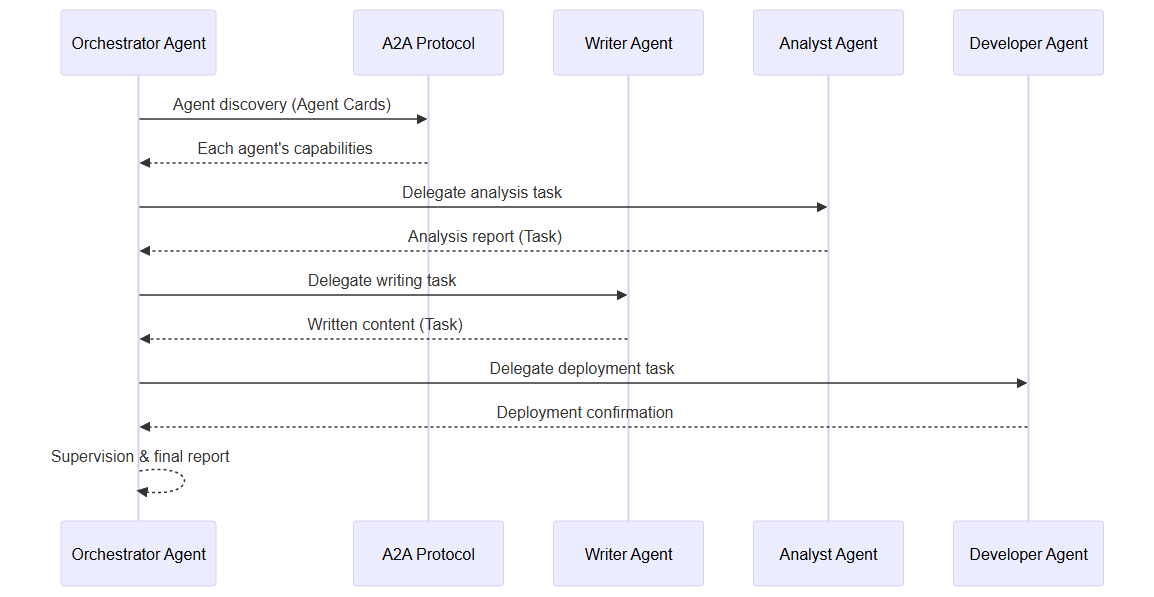 The A2A cycle: the orchestrator discovers agents via their Agent Cards, delegates tasks, and receives results as Tasks
MCP vs A2A: Two Complementary Layers, Not Competitors
The question that comes up consistently is: "Do I need to choose between MCP and A2A?" The answer is no, and here's why these two protocols are not competing — they operate at different levels of the agentic stack.
MCP is a "tool use" layer. It defines how an individual agent interacts with its environment: databases, APIs, files, services. MCP answers the question "what does this agent need to accomplish its task?" It is the layer that gives an agent its "hands" — its ability to act on the world.
A2A is an "agent communication" layer. It defines how multiple agents collaborate with each other: task delegation, result passing, coordination. A2A answers the question "how can these agents work together?" It is the layer that gives agents a "voice" — their ability to speak to each other.
In a mature multi-agent architecture, both coexist naturally. An orchestrator agent uses A2A to delegate tasks to specialized agents. Each specialized agent uses MCP to access the tools it needs to execute its task. The result is a two-tier system that is modular and scalable.
Here's how this translates in practice: imagine an automated competitive intelligence system. The orchestrator agent receives the request via A2A, delegates data collection to an Analyst Agent, delegates report writing to a Writer Agent, and delegates distribution to a Communication Agent. Meanwhile, the Analyst Agent uses MCP servers to query databases, scrape web pages, and call financial data APIs. The Writer Agent uses an MCP Notion server to read report templates and write a new one. The Communication Agent uses an MCP Slack server to send the report to the team. Two protocols, one coherent system.
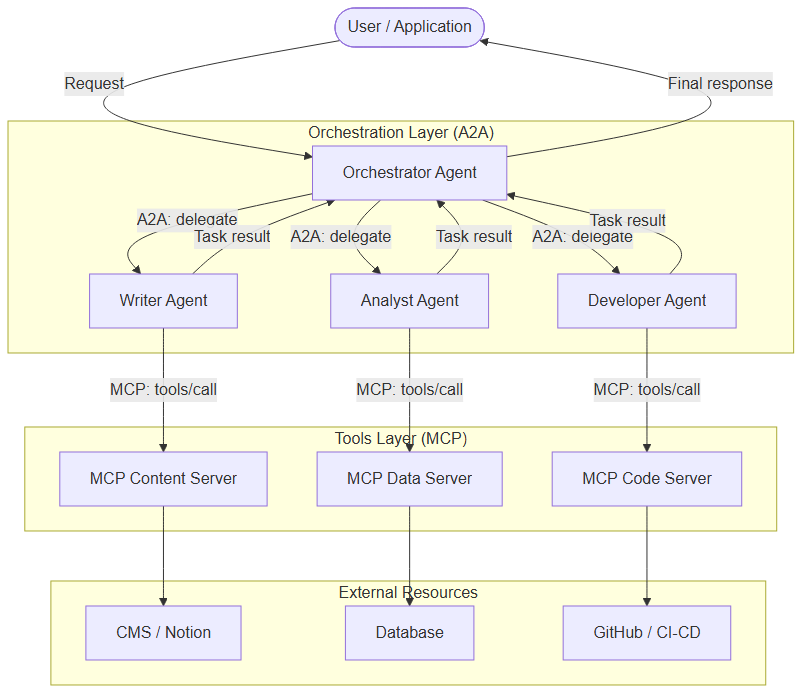 The two-layer architecture: A2A handles communication between agents, MCP handles access to external tools and resources
How to Connect Two Agents via A2A
Implementing A2A in a real system requires a few structured steps. Here is a simplified example showing how an orchestrator agent can discover a specialized agent and delegate a task to it.
The first step is discovery. The orchestrator fetches the specialized agent's Agent Card from its well-known URL:
# simplified example
import httpx

async def discover_agent(agent_url: str) -> dict:
    async with httpx.AsyncClient() as client:
        response = await client.get(f"{agent_url}/.well-known/agent.json")
        return response.json()

agent_card = await discover_agent("https://my-analyst-agent.example.com")
print(agent_card["capabilities"])
# => ["data_analysis", "trend_detection", "report_generation"]
The second step is task creation. The orchestrator sends a Task to the specialized agent with a precise description of what it expects:
# simplified example
async def delegate_task(agent_url: str, task_description: str) -> dict:
    task_payload = {
        "id": "task-001",
        "message": {
            "role": "user",
            "parts": [{"type": "text", "text": task_description}]
        }
    }
    async with httpx.AsyncClient() as client:
        response = await client.post(
            f"{agent_url}/tasks/send",
            json=task_payload
        )
        return response.json()

result = await delegate_task(
    "https://my-analyst-agent.example.com",
    "Analyze May 2026 sales data and identify the three products in decline."
)
The third step is receiving artifacts. The specialized agent processes the task (using its own MCP servers to access data) and returns the results as structured artifacts that the orchestrator can use for the next step in the workflow.
This model is intentionally simple and extensible. Production implementations will add authentication (Bearer tokens), error handling, retry logic, and potentially streaming for long-running tasks.
The Implementation Ecosystem in 2026
One of the strengths of stable MCP and A2A is active support from virtually all major AI players. Here is the state of the ecosystem in June 2026.
Claude and the Anthropic ecosystem. Claude 3.5 and above natively supports MCP via the Python and TypeScript SDK. The most visible integration is Cursor, the AI IDE that allows connecting any MCP server directly from settings — what you're reading right now was likely assisted by a Claude agent using MCP servers to access the codebase.
Google and Gemini. Google has pushed both protocols. Gemini 2.5 Pro supports MCP via the Vertex AI SDK. A2A is incubated directly by Google DeepMind teams, and a reference implementation is available in the official google/A2A repository on GitHub. The Vertex AI Agent Engine SDK integrates A2A to enable multi-agent system creation on GCP.
n8n. Since version 2.0, n8n supports MCP as a native tool in its AI agent workflows. The MCP Client Tool node allows connecting any MCP server with a few lines of configuration. To go further with this integration, our article on how to connect n8n to a custom MCP server details the process step by step.
Make.com. Make has integrated MCP into its Maia interface (conversational AI for building scenarios). Automation specialists can now ask Maia in natural language to connect their agent to resources via MCP, without writing a single line of code.
LangChain and LangGraph. These Python frameworks for building AI agents support MCP via dedicated adapters, and LangGraph is experimenting with A2A for multi-agent coordination in its stateful workflows.
CrewAI. This framework oriented toward "agent teams" is one of the first to implement a form of A2A, with an agent delegation system that aligns with the Google spec.
Concrete Use Cases: Specialized Agents Collaborating
The MCP+A2A architecture opens up use cases that were impossible or prohibitively expensive to build just a year ago. Here are three representative examples.
The e-commerce monitoring system. An orchestrator agent continuously monitors sales data. As soon as it detects an anomaly, it delegates via A2A to an Analyst Agent that digs into the data (via MCP Postgres), then to a Writer Agent that generates a contextual alert (via MCP Notion), then to a Communication Agent that notifies the team (via MCP Slack). All in under two minutes, without human intervention. This type of workflow is exactly what our article on n8n AI Agent and intelligent systems describes.
The multi-agent development assistant. In Cursor, a developer asks Claude to add a new feature. Claude identifies it needs to understand the codebase, research best practices, and write code. Via MCP, it queries the MCP Filesystem server to read relevant files, the MCP GitHub server to consult commit history, and potentially an MCP Documentation server to access specs. With an A2A architecture in place, it could delegate security analysis to a specialized agent while it writes the code.
The content marketing pipeline orchestration. An agent receives a content brief. It delegates to a Research Agent (which uses MCP to query data sources and news monitoring APIs), then to a Writer Agent (which generates the content), then to an SEO Agent (which optimizes metadata), then to a Publishing Agent (which publishes via MCP CMS). Each agent is specialized, reusable in other workflows, and can be replaced or updated independently.
Comparison: MCP, A2A, and Traditional Approaches
To place MCP and A2A in the broader landscape of integration protocols, here is a comparison across several key dimensions.
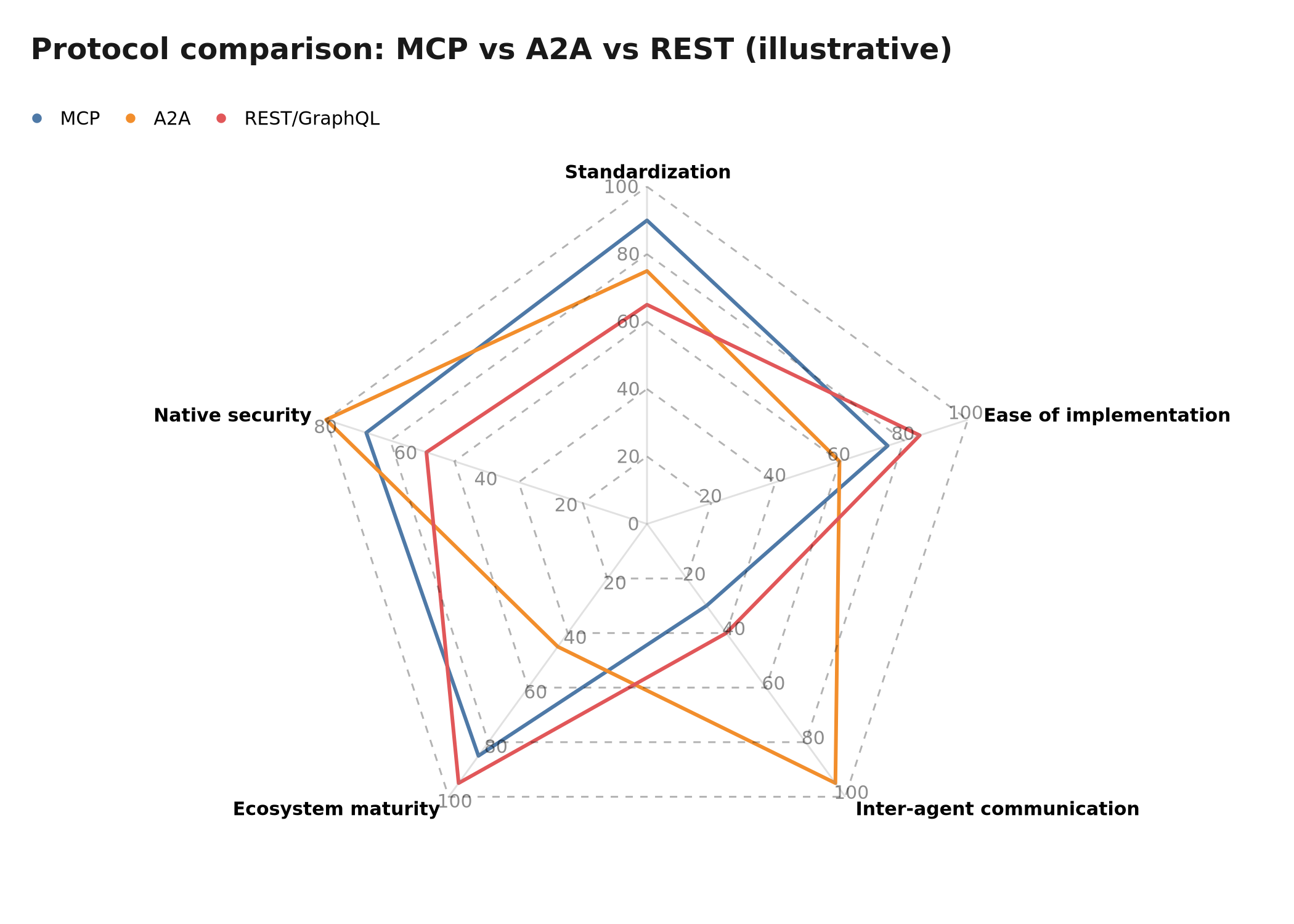 Illustrative comparison across 5 criteria: MCP excels in standardization and ecosystem maturity, A2A in inter-agent communication, REST in ease of implementation and raw maturity
REST APIs remain the default choice for classic technical integrations — they are mature, well-understood, and supported everywhere. Their limitation in an agentic context is their static nature: the agent must be "pre-programmed" to know what to call. MCP solves exactly this problem by introducing dynamic capability discovery.
A2A, for its part, addresses a space that REST APIs were never designed to cover: semantic communication between agents. A REST call sends data. A2A delegates an intention — "analyze this situation and tell me what you find" — with all the contextual richness that implies.
The interesting point for technical teams is that MCP and A2A don't replace REST: they layer on top of it. An MCP server can be built on top of an existing REST API, and A2A uses HTTP as its transport. Adoption is therefore progressive and non-destructive.
How to Get Started Today
The good news is that you don't need to wait for a hypothetical future version to start benefiting from MCP and A2A. Here is a practical path depending on your level.
If you're an automation specialist (n8n, Make), the priority is to explore pre-built MCP servers available for the tools you already use. The MCP Postgres, GitHub, or Notion server can significantly enrich your existing n8n agents without a single line of code. Check our tutorial to deploy an AI agent with MCP in 20 minutes for a concrete starting point.
If you're a developer, investing in the official MCP SDK (TypeScript or Python) pays off today. Building an MCP server for your internal resources — databases, proprietary APIs, legacy systems — allows any compatible agent to use them. To go further, the A2A spec is accessible on GitHub and the first implementation examples are available in the official Google repository.
If you're a decision-maker, the question is no longer "should we adopt MCP?" but "which internal resources deserve an MCP server first?" The obvious candidates are CRM databases, ERP systems, project management tools, and any system containing data your teams consult regularly. To compare no-code tools that already natively support MCP, our article Make.com AI Agents vs n8n: which to choose in 2026 offers a detailed analysis.
The era of isolated AI agents is over. With stable MCP and the A2A protocol, the question is no longer whether agents will collaborate — it's already happening. The question is whether your infrastructure will be ready to benefit from it.
Key Takeaways
The stable MCP A2A protocol for AI agents in 2026 represents a two-layer infrastructure that will define autonomous system architecture for years to come. MCP standardizes access to tools and data — it gives each agent its "hands". A2A standardizes communication between agents — it gives them a "voice". Together, they enable building modular, interoperable, and scalable multi-agent systems, with use cases that far exceed what a single AI can accomplish alone.
For automation specialists, developers, and enterprises building on these foundations today, the competitive advantage will be significant. The MCP+A2A infrastructure you deploy now will be compatible with the next generations of models and platforms — that is exactly what a mature standard promises.
At BOVO Digital, we integrate MCP and multi-agent architectures into our automation projects for clients who want durable and scalable systems. If you'd like an audit of your existing workflows or support in adopting these standards, contact us.
Frequently Asked Questions About MCP and A2A
Are MCP and REST APIs the same thing? No. REST APIs are static interfaces: you need to know in advance which endpoints to call. MCP is dynamic: the agent itself discovers the server's capabilities and chooses appropriate tools based on context. MCP also speaks the native language of LLMs — it returns structured results that the model can interpret directly, without additional transformation.
Is A2A already usable in production? The A2A protocol is in early adoption phase in 2026. Experimental implementations exist in LangGraph, CrewAI, and Google's Vertex AI Agent Engine SDK. For critical production systems, thorough testing of each integration is recommended. n8n and other platforms should natively integrate A2A by end of 2026.
Do you need to code to use MCP? Not necessarily. Hundreds of pre-built MCP Servers are available for Postgres, GitHub, Notion, Slack, and many other services. For custom integrations, JavaScript or Python is needed. Make.com offers no-code MCP integration via its Maia interface, and Cursor integrates MCP directly into its IDE.
What is the fundamental difference between MCP and A2A? MCP defines how an agent accesses external tools and data (the "tool use" layer). A2A defines how multiple agents communicate and delegate tasks to each other (the "agent communication" layer). Both protocols are complementary and designed to coexist: an agent uses MCP for its tools, and A2A to communicate with other agents.
Does MCP work with all LLMs? MCP is designed to be model-agnostic. In 2026, Claude, Gemini models, GPT-4o, and many open-source models support MCP through their respective SDKs. Adoption continues to accelerate and covers virtually all major commercial LLMs.
How do you secure an MCP server exposed to the internet? The MCP spec recommends OAuth 2.0 authentication for HTTP connections, strict input validation on the server side, per-tool permission scoping, and logging all invocations. For sensitive environments, prefer stdio transport (local) or place the MCP server behind an API Gateway with rate limiting.
Tags
FAQ
Are MCP and REST APIs the same thing?
No. REST APIs are static interfaces: you need to know in advance which endpoints to call. MCP is dynamic: the agent itself discovers the server's capabilities and chooses appropriate tools based on context. MCP also speaks the native language of LLMs — it returns structured results that the model can interpret directly, without additional transformation.
Is A2A already usable in production?
The A2A protocol is in early adoption phase in 2026. Experimental implementations exist in LangGraph, CrewAI, and Google's Vertex AI Agent Engine SDK. For critical production systems, thorough testing of each integration is recommended. n8n and other platforms should natively integrate A2A by end of 2026.
Do you need to code to use MCP?
Not necessarily. Hundreds of pre-built MCP Servers are available for Postgres, GitHub, Notion, Slack, and many other services. For custom integrations, JavaScript or Python is needed. Make.com offers no-code MCP integration via its Maia interface, and Cursor integrates MCP directly into its IDE.
What is the fundamental difference between MCP and A2A?
MCP defines how an agent accesses external tools and data (the "tool use" layer). A2A defines how multiple agents communicate and delegate tasks to each other (the "agent communication" layer). Both protocols are complementary and designed to coexist: an agent uses MCP for its tools, and A2A to communicate with other agents.
Does MCP work with all LLMs?
MCP is designed to be model-agnostic. In 2026, Claude, Gemini models, GPT-4o, and many open-source models support MCP through their respective SDKs. Adoption continues to accelerate and covers virtually all major commercial LLMs.
How do you secure an MCP server exposed to the internet?
The MCP spec recommends OAuth 2.0 authentication for HTTP connections, strict input validation on the server side, per-tool permission scoping, and logging all invocations. For sensitive environments, prefer stdio transport (local) or place the MCP server behind an API Gateway with rate limiting.
We scope one workflow — not a generic demo
You describe a repeated task. We tell you what n8n would ship, the timeline, and what stays out of scope.
- 30 min
- 1 scoped workflow
- No commitment
Vicentia Bonou
Full Stack Developer & Web/Mobile Specialist. Committed to transforming your ideas into intuitive applications and custom websites.


