
Flutter vs React Native in 2026: The Ultimate Guide for MVPs
Flutter or React Native for your mobile app in 2026? Performance, costs, ecosystem, hiring: the honest comparison from an agency that ships both. With benchmarks, table and use-case recommendations.

Updated

Flutter vs React Native in 2026: The Ultimate Guide for MVPs
When a client reaches out to build a mobile app, the first strategic question isn't the design, nor the budget. It's the tech stack: Flutter vs React Native? This duel drives every agency decision in 2026, and the answer is never a vague "it depends" without explanation.
This choice commits your project for 3 to 5 years: maintenance costs, hiring capacity, perceived user performance, ability to share code with your web app. Pick right and save 30 to 50% of the app's lifetime cost. Pick wrong and pay twice — once to build, once to fix or migrate.
In this article, I'll share the exact comparison we present to clients at BOVO Digital — without marketing bias, based on the 100+ mobile projects we've delivered. You'll leave with a clear decision framework, dated orders of magnitude, and a verdict tailored to your profile.
TL;DR — Our agency verdict in one sentence
Flutter if you're starting a mobile-first project where performance, consistent UI and development speed matter. React Native if your team is already React/Web and you want to share code between your website and mobile app.
That's it. If you want details and numbers backing that verdict, read on.
Flutter vs React Native: two opposite architecture philosophies
Before comparing numbers, you need to understand why these two frameworks behave differently. They answer the same promise — one codebase for iOS and Android — but with two radically opposite philosophies. Everything else (performance, cost, maintenance) flows from that initial architecture choice.
Flutter: everything is a widget, everything is compiled
Flutter is built on Dart, a typed language designed by Google and ahead-of-time (AOT) compiled directly to ARM machine code. There's no bridge between your code and the platform: the app runs native binary just like a Swift or Kotlin app.
Flutter's second core idea is that everything is a widget. Buttons, margins, animations, themes: every visible element is a Dart object that Flutter draws itself, pixel by pixel, through its Skia rendering engine (and now Impeller on iOS and Android). Flutter doesn't rely on the system's visual components: it redraws them. That's what guarantees a button looks exactly the same on an iPhone and a Pixel.
The direct consequence: Flutter controls the entire graphics pipeline. Pixel-perfect consistency, fully mastered animations, but also full responsibility — if a new iOS visual ships, it's up to Flutter (and you) to replicate it.
React Native: JavaScript that drives native components
React Native keeps React's philosophy: you describe an interface in JavaScript/TypeScript, and the framework translates it into real native components of the platform. A React Native <Text> becomes an actual UILabel on iOS and a TextView on Android. You don't imitate the native UI, you use it.
Historically, this JS-to-native dialogue went through an asynchronous "bridge", a latency source. The New Architecture (the Hermes engine, the JSI layer, the Fabric renderer and TurboModules) removed that bottleneck by allowing direct synchronous calls between JavaScript and native. It's the most important transformation of the React Native ecosystem in recent years.
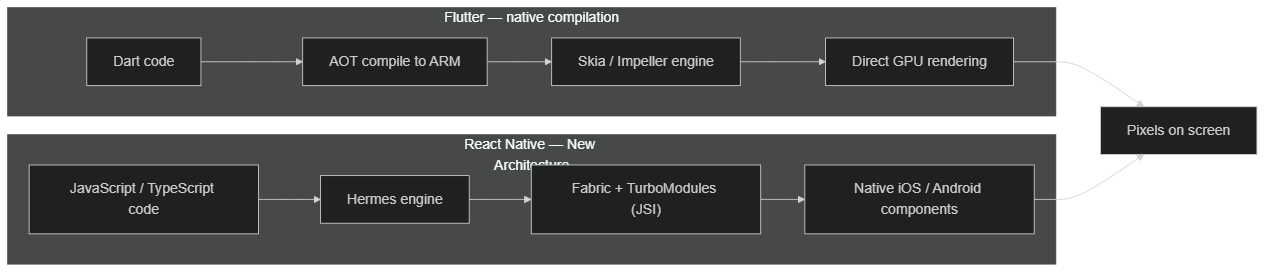 Two opposite rendering chains: Flutter compiles Dart to ARM and draws via Skia/Impeller, React Native runs JavaScript that drives native components through Fabric and TurboModules
Remember this fundamental opposition: Flutter redraws the interface, React Native reuses the native interface. This distinction explains 90% of the practical differences we'll detail next.
1. Performance and rendering: who's really faster?
Flutter compiles to native code
As we saw, Flutter compiles directly to ARM machine code. No JavaScript bridge, no runtime interpretation. The UI is rendered by Skia/Impeller directly on the GPU, which makes the framework very predictable on smoothness.
Concrete result: stable 60 fps on the vast majority of screens, smooth animations, cold start often under one second. On screens that stack shadows, gradients and transitions at once, Impeller also reduced the micro-stutters ("jank") that penalized the old Skia pipeline on a shader's first render.
React Native and the New Architecture
With the New Architecture fully adopted, React Native 0.76+ performance gets very close to Flutter on classic apps. For a list screen, a form or a payment funnel, the user won't notice any difference.
The gap reappears on two fronts: complex JavaScript-driven animations and very long lists where each cell triggers computation. React Native handles these very well with the right tools (Reanimated, which runs animations on the UI thread, FlashList for scrolling), but it requires engineering discipline. With Flutter, that level of smoothness is more of a default behavior.
The benchmark that matters (BOVO Digital internal measurements, March 2026)
| Metric | Flutter 3.27 | React Native 0.77 | Native iOS Swift |
|---|---|---|---|
| Cold start (iPhone 13) | 0.9 s | 1.4 s | 0.7 s |
| Stable 60fps animations | ✅ | ⚠️ (90% screens) | ✅ |
| Android APK size | 18 MB | 24 MB | — |
| Idle RAM usage | 95 MB | 110 MB | 80 MB |
| Long scroll FPS (1000 items) | 60 | 55-58 | 60 |
These figures are orders of magnitude measured on our own projects in March 2026, not a universal truth: they vary with the device, the framework version and code quality. But the trend is stable from one project to the next: Flutter starts a bit faster and produces a lighter binary, React Native keeps pace on perceived smoothness as long as the app stays reasonably simple.
For 80% of business apps, both are performant enough. The gap becomes visible on complex animations, infinite lists and graphics-heavy apps (games, AR, video).
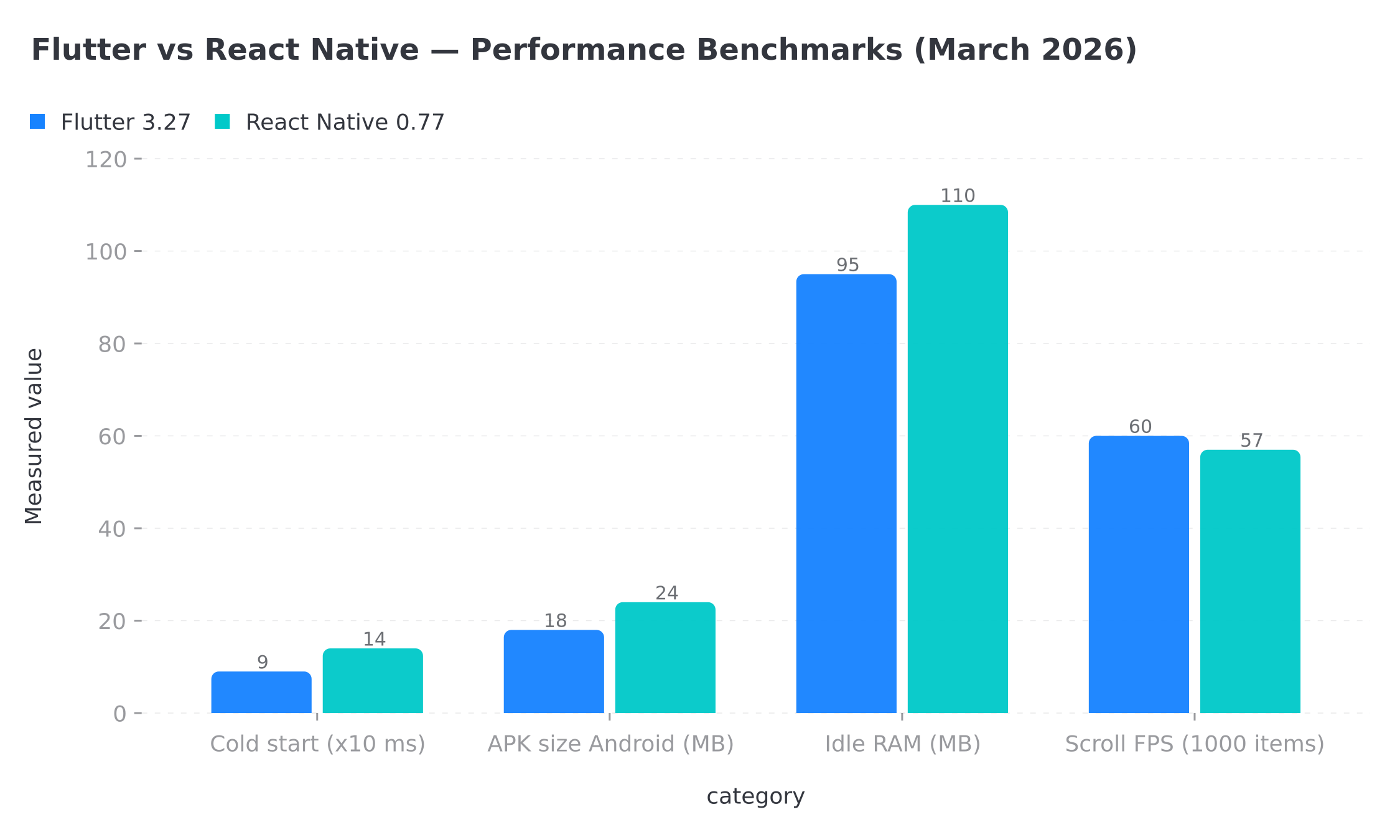 Performance metrics comparison: cold start, APK size, idle RAM and scroll FPS on 1000 items — BOVO Digital internal measurements March 2026
2. Native API access and hardware features
A serious mobile app sooner or later touches hardware: camera, GPS, Bluetooth, biometric sensor, push notifications, in-app payment. How each framework accesses these APIs changes the game on ambitious projects.
Flutter exposes native APIs through plugins. For common needs (camera, geolocation, secure storage), official plugins maintained by the Flutter team or Google cover the essentials. When a plugin doesn't exist, you write a platform channel — a manual bridge to Swift/Kotlin code. It's doable, but it requires a developer comfortable with native code.
React Native follows the same logic with TurboModules. React Native's historical advantage is seniority: for an exotic sensor or a proprietary SDK (a payment terminal, an industrial NFC reader), a community module often already exists. The downside is the uneven quality of these modules and their fragility during version upgrades.
In both cases, the agency rule is the same: for 90% of features, the plugin exists and is stable. The remaining 10% — specific hardware integrations, partner SDKs — are the real risk factor, and that's where you must audit module availability before locking in the tech choice. To frame these needs upfront, our guide on how to build a mobile app details the functional checklist to run before writing the first line of code.
3. Development and maintenance cost
Total app cost = initial build + 3-year maintenance. The two budgets don't behave the same way.
Initial cost (10-screen MVP, iOS + Android)
| Phase | Flutter | React Native | Native (Swift + Kotlin) |
|---|---|---|---|
| Project setup | 2 d | 1.5 d | 5 d |
| UI development (10 screens) | 18 d | 20 d | 32 d |
| Business logic + API | 10 d | 9 d | 16 d |
| Testing + store publication | 5 d | 6 d | 8 d |
| Total (man-days) | 35 d | 36.5 d | 61 d |
Conclusion: Flutter and React Native are tied on initial development. Both cut cost by 1.7× vs native. If a vendor quotes a big price gap between the two frameworks for the same spec, it's not the tech talking — it's their margin or their level of mastery.
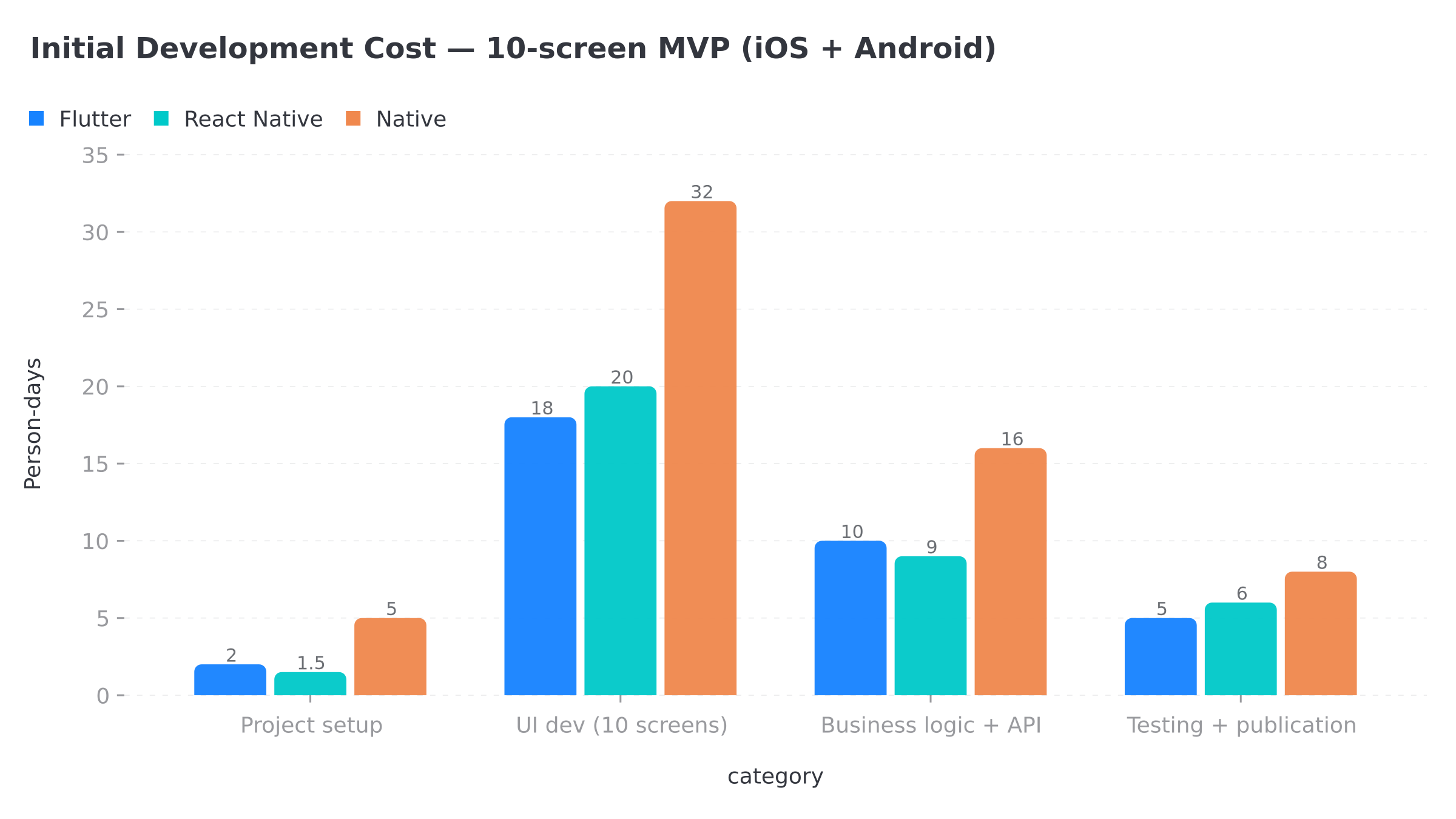 Phase-by-phase initial cost breakdown for a 10-screen iOS + Android MVP: project setup, UI, business logic, testing and store publication
For a detailed view of price ranges by app type, see our dedicated analysis of Flutter mobile app development pricing.
3-year maintenance cost
This is where the two frameworks really diverge.
- Flutter: rare breakage between major versions (3.0 → 3.27 with no major breaks), roughly a 1-day upgrade per year.
- React Native: more frequent breakage on each version bump (the move to the New Architecture broke a notable share of older packages), 5 to 15 days upgrade per year depending on dependency count.
- Native: no framework upgrade cost, but double the development effort on every feature (two codebases to maintain).
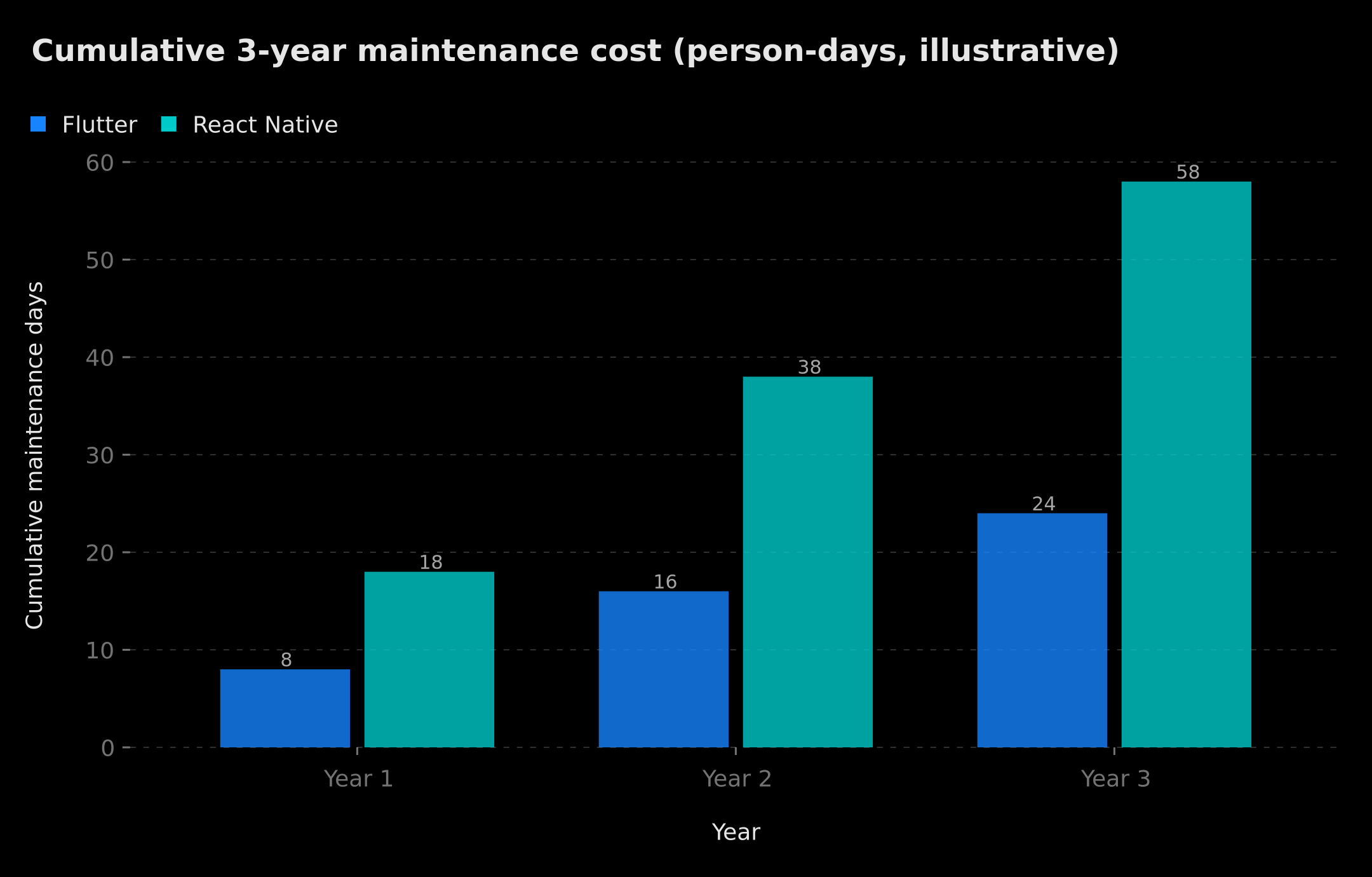 Illustrative projection of cumulative maintenance cost over 3 years: the gap widens at every version bump, mostly because of React Native dependencies that need fixing
Over 3 years, Flutter is 25 to 35% cheaper to maintain than React Native in our experience. This isn't an accounting detail: maintenance often costs more than the initial build. We documented it in our article on why an app costs 5x more to maintain — technical debt gets paid back when you least expect it.
4. Ecosystem and packages
React Native has the seniority advantage
React Native exists since 2015. Its npm ecosystem benefits from 18,000+ mobile-specific packages. For nearly all common needs (payment, geolocation, notifications, biometrics), a package already exists, often in several competing versions.
The flip side: many packages are abandoned, poorly maintained, or broken at every major upgrade. Sorting them out takes time, and picking a fragile dependency today means committing to fixing it tomorrow. A rich ecosystem is an asset… as long as you know how to audit a package's health (last commit date, number of maintainers, New Architecture compatibility).
Flutter is catching up
Flutter (launched 2018) now counts 42,000+ pub.dev packages. Official Google packages (firebase_core, google_maps_flutter, image_picker) are maintained by Google directly — guaranteed quality and compatibility over time.
Flutter's advantage is less about volume than governance: pub.dev shows a standardized quality score (popularity, convention compliance, documentation), which makes auditing a dependency faster than on npm. For an equivalent need, you waste less time choosing between two Flutter packages than between two React Native ones.
5. Learning curve and hiring
Picking a framework is also a bet on your ability to find — and keep — the developers who master it.
React Native: the largest community
- Roughly 240,000 React Native developers worldwide in 2026.
- France freelance daily rate: 450-650 € / day depending on seniority.
- Easier to hire if you already have React web developers: a React dev becomes productive on React Native within days.
The argument is huge for an in-house team: if your front-end engineers already write React, React Native reuses their reflexes, their tooling and part of their code.
Flutter: the fastest-growing community
- Roughly 110,000 Flutter developers, but growing about +45% per year.
- France freelance daily rate: 500-700 € / day.
- Learning Dart: expect ~2 weeks for an experienced developer to become productive.
Dart is deliberately simple and familiar to anyone coming from Java, C# or TypeScript. The barrier isn't the language, but the widget paradigm, which takes a few weeks of adjustment.
For an in-house team that's already React, React Native wins the hiring match. For a project outsourced to an agency, the tech choice barely matters on this criterion: you pay for a delivered and maintained result, not for a skill to recruit. The real question then becomes choosing the partner, which we cover in how to choose your mobile development agency.
6. Web code reuse
This is the killer argument in favor of React Native, and it deserves an honest look.
React Native + Next.js = unified stack
If your website already runs on React or Next.js, you can share a significant share of your code between web and mobile:
- TypeScript schemas (shared types, Zod validators).
- Business logic (hooks, services, state machines).
- API calls (React Query, tRPC, generated clients).
- Sometimes even UI components (via Tamagui or React Native Web).
A web + mobile project in a 100% React stack often means 30 to 40% of shared code: that many features written, tested and fixed only once. For a product team shipping fast on both platforms at once, it's a real productivity lever.
Flutter Web exists but stays limited
Flutter can compile to Web, but the final bundle stays heavy (4-8 MB) and canvas rendering complicates SEO and accessibility. For an internal app or a dashboard, it's viable; for a marketing site that needs to rank on Google, it's not the right tool.
Verdict: if your web stack is React, React Native is the obvious choice. Otherwise, Flutter usually wins on every other criterion.
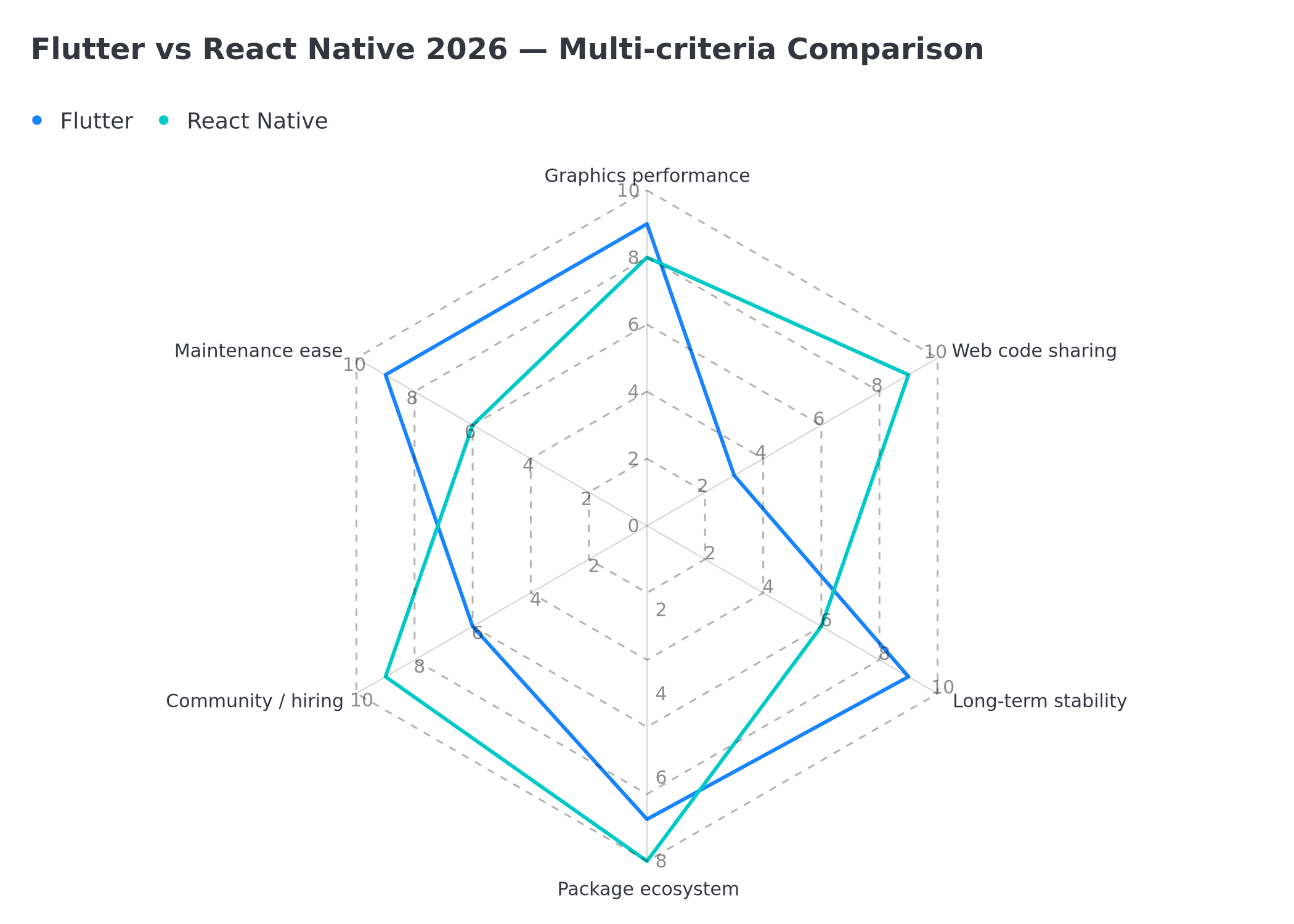 Radar comparison Flutter vs React Native: graphics performance, web code sharing, long-term stability, package ecosystem, community and maintenance ease
7. UI quality and user experience
An app's perceived quality isn't just about fps. It plays out in visual consistency, respect for each platform's conventions and the finesse of animations.
Because it redraws every pixel, Flutter delivers a UI that is identical on iOS and Android, down to the smallest rounded corner. That's a decisive advantage for brands wanting a strong, consistent identity, and for designers who ship a single mockup for both platforms. The flip side: to get a truly "native iOS" feel (list bounce, system context menus), you must enable Cupertino widgets and polish the details; it's not automatic.
Because it reuses native components, React Native gives a UI that by default respects each OS's conventions: a date picker looks like the iOS picker on iPhone and the Material picker on Android, effortlessly. That's an asset for apps that want to blend into the system. The flip side: keeping pixel-perfect consistency across both platforms takes more defensive design work.
In short: Flutter excels when your brand takes priority over system conventions; React Native excels when native integration takes priority over brand identity.
8. Long-term support: Google vs Meta and community
Choosing a framework is betting on its longevity. Both are backed by giants, but with nuances.
Flutter is driven by Google and used in major Google products. That's reassuring, but Google has a history of killing projects (the famous Stadia anecdote keeps coming up). The solid counter-argument: Flutter is open-source (BSD-3 license) with over 1,000 external contributors. Even if Google cut its investment, the ecosystem could survive, as other open-source projects have proven.
React Native is driven by Meta and used in production in Facebook, Instagram and Messenger. More importantly, its support doesn't depend on Meta alone: Microsoft (React Native Windows/macOS), Shopify, Coinbase and Expo invest heavily. This sponsor diversity is a resilience guarantee few frameworks can claim.
Honest conclusion: both frameworks are safe bets over a 3-5 year horizon. The risk of sudden abandonment is low on both sides. The real longevity question isn't "will the framework disappear?" but "will my third-party dependencies stay maintained?" — and there, the edge goes to Flutter for its stricter governance.
9. Use cases: which framework for which app type?
Rather than an abstract verdict, here's how we concretely steer clients by app type.
- Fintech / e-commerce / social app, mobile-first: Flutter. Graphics performance, polished animations, consistent brand UI — exactly its strengths.
- Mobile companion to an existing React web product: React Native. Sharing business logic and types with your site pays off immediately.
- Internal enterprise app (forms, lists, dashboards): both work; the decisive factor becomes the stack and skills already present in the team.
- Highly graphical app (light game, AR, visual editor): Flutter, thanks to its full rendering control and Impeller.
- App requiring an exotic hardware SDK: audit module availability first; React Native's seniority sometimes tips the scale.
Pick Flutter if:
- ✅ Mobile-first project with no existing React web stack
- ✅ You want a consistent UI pixel-perfect between iOS and Android
- ✅ Visual performance matters: animations, e-commerce, fintech, social
- ✅ You prioritize long-term stability over 3-5 years
- ✅ You want one agency partner for both iOS + Android
BOVO Digital Flutter projects examples: Tontineo (fintech, App Store + Play Store), PaniGaspi (anti-waste, App Store + Play Store), FocusLock (productivity).
Pick React Native if:
- ✅ You already have React/Next.js in production
- ✅ Your in-house team is React web and wants to build the app
- ✅ You want to share lots of business logic with your website
- ✅ Your app is complementary to web (not a standalone product)
- ✅ You need specific packages only available in RN
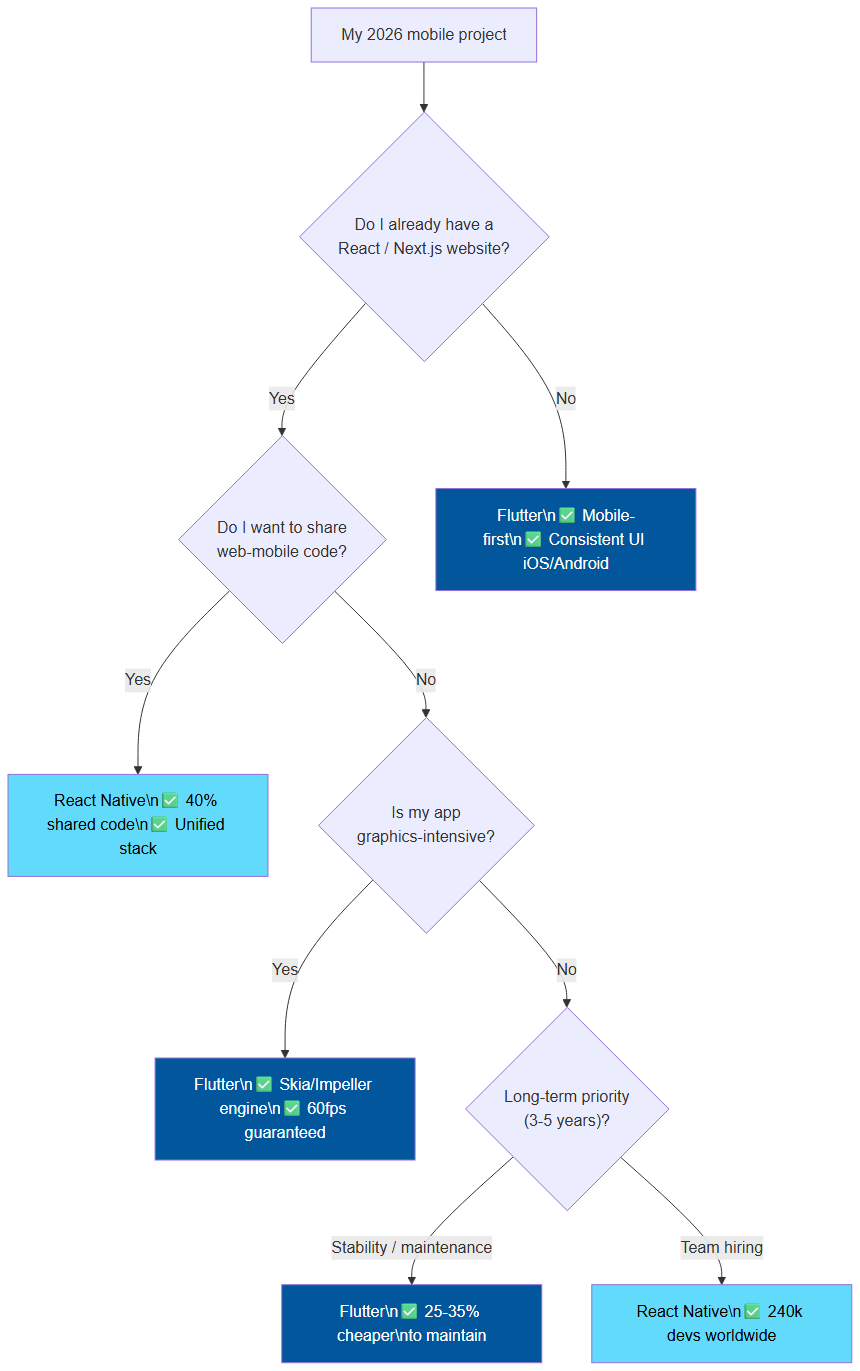 Complete decision tree to choose between Flutter and React Native based on your existing web stack, graphics intensity and long-term priorities
10. The questions we get most often
"But Airbnb dropped React Native, isn't that a bad sign?"
Airbnb dropped RN in 2018, based on the old architecture and constraints specific to an organization of their scale. Since then, Meta, Microsoft, Shopify and Coinbase have massively invested in it, and the New Architecture has fixed most of the problems of that era. That anecdote is obsolete.
"Flutter is Google, they could kill it like Stadia, right?"
Flutter is open-source (BSD-3) with a community of 1,000+ external contributors. Google can reduce its investment, the project will survive through its community. The risk is low but real — as for any framework.
"Is a PWA enough instead of a native app?"
For about 30% of cases (transactional marketing sites), yes. For the other 70% (iOS push notifications, Apple Pay, biometrics access, graphics performance), no. Read our guide on how to build a mobile app to decide based on your real needs.
11. The verdict by profile
- Mobile-first startup with no existing web → Flutter. You gain performance, visual consistency and lower maintenance cost, without paying for web code sharing you don't need.
- Scale-up with a mature React/Next.js stack → React Native. Code sharing and team continuity win.
- SMB wanting a simple, durable internal app → Flutter by default, unless React skills are already in-house.
- Highly visual product publisher → Flutter, for full rendering control.
- Product team iterating fast on web + mobile → React Native, to ship on both sides at the same pace.
The Hidden Cost of the Tech Stack: Recruiting and Maintenance
Beyond raw performance, the choice between Flutter and React Native has a direct impact on your startup's profitability (Fractional CTO perspective). React Native developers often have a higher daily rate due to web demand, while Flutter often allows you to move 20% faster on complex UI creation. A tech stack mistake on an MVP costs months of delays and tens of thousands of euros in rewrites.
Secure Your Launch with a BOVO Digital Fractional CTO
Hesitating on your MVP's architecture? Don't let a developer's personal preferences dictate your company's strategy. At BOVO Digital, we act as a Fractional CTO: we audit your business needs, your existing stack, and your time-to-market goals to choose the right technology. Book a strategic consulting session with our technical experts.
BOVO Digital's final recommendation
At BOVO Digital, we internalized Flutter as our primary stack for 3 reasons:
- Maintenance cost: 25 to 35% savings for our clients over 3 years.
- Visual quality: consistent iOS/Android UI, flawless animations.
- Delivery speed: single codebase to test, single release cycle.
We also deliver React Native projects when the client has a pre-existing React web stack — it's just pragmatic. But on a greenfield project, Flutter wins 9 out of 10 times. The key point, and the whole purpose of this Flutter vs React Native comparison: the right choice is the one that fits your context, not the trend of the moment.
Your next step
You have a mobile app project in 2026?
- Mobile-first with no React stack? → Discover our Flutter Agency offer
- Existing React/Next.js? → Let's discuss directly (15 min free)
Whatever tech you pick, BOVO Digital ships your app — iOS + Android, coded and published within 6 to 12 weeks. Fixed price, satisfaction guarantee.
Article by William Aklamavo, founder of BOVO Digital and mobile architect on 100+ delivered projects.
Tags
FAQ
What's the main difference between Flutter and React Native in 2026?
Flutter compiles to native ARM code through Dart and uses its own Skia/Impeller rendering engine. React Native runs JavaScript that talks to native components via the New Architecture (Fabric). In practice, Flutter gives you a more consistent UI across iOS/Android and better graphics performance, while React Native lets you share code with an existing React web app.
Is a Flutter agency more expensive than a React Native agency?
No, prices are equivalent at start (35 to 37 person-days for a 10-screen MVP). However, over 3 years, Flutter is on average 25 to 35% cheaper to maintain because version upgrades are less breaking. BOVO Digital offers Flutter packages starting at €2,000 for a full MVP.
Should I pick Flutter or React Native if I don't have a website yet?
If you're starting a mobile project without an existing React web stack, Flutter is almost always the right choice: consistent UI, better performance, simpler maintenance. Our agency ships 9 out of 10 projects in Flutter for mobile-first startups.
Does BOVO Digital also develop in React Native?
Yes, we deliver React Native projects when the client already has a React/Next.js stack in production and wants to share 30 to 40% of code between web and mobile. It's pragmatic: we optimize your existing stack rather than force a migration.
How long does it take to deliver a complete Flutter app?
A 10-screen Flutter MVP with Firebase backend and Google Play publication: 4 to 5 weeks. A 20-screen Pro app with web admin and App Store: 6 to 8 weeks. An Enterprise app with 40+ screens, payments and BI: 10 to 12 weeks. All our packages include store publication.
Stuck on a step? We take it to production
Tutorials stop where production starts: secrets, GDPR, no-shows, CRM. A 30-min call to scope the delivery.
- 30 min
- Scoped delivery
- No commitment
William Aklamavo
Web development and automation expert, passionate about technological innovation and digital entrepreneurship.


