
Digital Entrepreneurship 2025: AI, Automation, and Authenticity
In 2025, digital entrepreneurship is no longer just about technology. It is the subtle alliance between invisible automation and radical authenticity that creates tomorrow's leaders.

Updated

Digital Entrepreneurship 2025: AI, Automation, and Authenticity at the Heart of Growth
The entrepreneur who will succeed in 2025 is not the one with the best tools, but the one who remains human while using them to their full potential.
Digital entrepreneurship in 2025 is undergoing a profound and unprecedented transformation. Technical barriers to entry have collapsed thanks to AI and No-Code, creating fierce competition across every market. Tools like ChatGPT, Claude, n8n, and Midjourney now allow a solopreneur to compete with entire teams on tasks once reserved for large organizations. Yet, paradoxically, the winner is not the one with the best technology — it is the one who uses it to become more human, more visible, and more credible.
This paradox sits at the heart of the new reality of digital entrepreneurship. The more AI standardizes content and automates processes, the more valuable human differentiation becomes. We are entering the era of the Augmented but Authentic Enterprise — an era where technology is the lever, but the human remains the fulcrum. This comprehensive guide explores the opportunities, threats, strategies, and concrete cases that define digital entrepreneurship today.
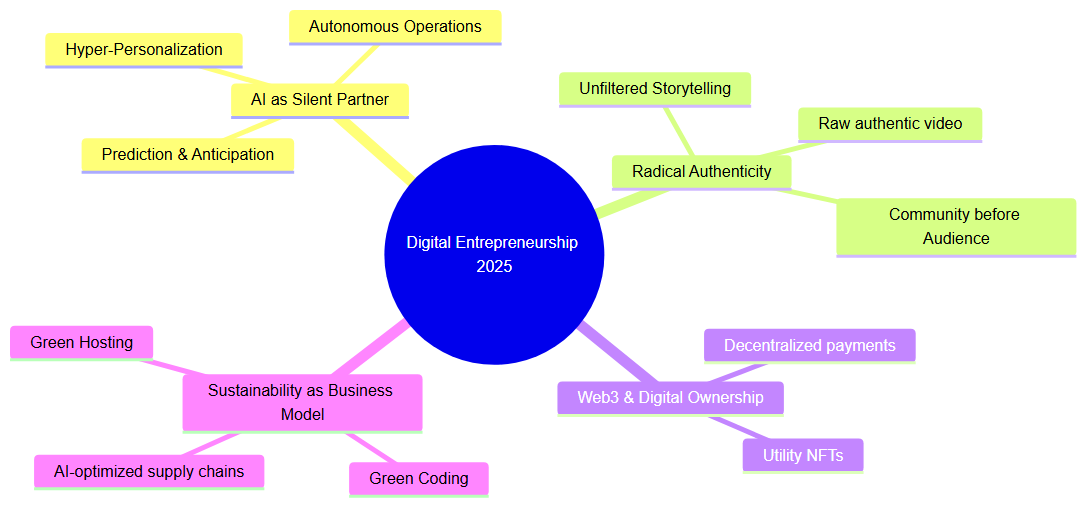 Mind map of the pillars supporting digital success in 2025
1. AI as a Silent Partner, Not a Product
Two years ago, saying "it's powered by AI" was a powerful selling point. Today, it is a commodity. In 2025, AI has become the invisible infrastructure of the enterprise, just like electricity or cloud hosting. Nobody sells "electricity in their product" — they sell what that electricity enables.
Successful entrepreneurs do not use AI to generate mediocre content at scale. They use it for three fundamental missions.
Hyper-Personalization: Analyzing customer behavioral data to deliver a unique experience to every user, adapting email sequences in real time based on actions taken on the site, and personalizing product recommendations down to the individual level. This level of precision used to require large data teams. Today, a tool like Make coupled with an LLM makes it accessible for under €200/month.
Prediction and Anticipation: Anticipating stock trends before they become shortages, identifying customers at risk of churning before they leave, detecting cross-selling opportunities at the right point in the customer journey. AI does not replace human judgment here — it feeds it with data no human alone could process.
Delegated Operations: Entrusting administrative management to autonomous agents — processing incoming emails, qualifying leads, generating weekly reports, tracking sales follow-ups. These tasks consume on average 30 to 40% of a solo entrepreneur's time, based on our field experience. Recovering them through automation represents dozens of monthly hours redirected toward what truly creates value.
The goal is no longer to show that one uses AI, but to ensure the customer feels a fluidity and relevance of service impossible to achieve manually. AI disappears behind the experience.
2. The Pitfalls of Excessive Automation
The enthusiasm around automation hides a less glamorous reality: poorly calibrated automation destroys client relationships faster than it builds them. This is one of the most dangerous blind spots for digital entrepreneurs in 2025.
The Robotic Tone Syndrome
An automated follow-up email starting with "Hello {FirstName}," with the field left blank, or a sequence that sends a congratulations message to a client who just complained — these mistakes seem trivial, but they immediately signal to your contact that they are talking to a machine. The result: an instant and often irreversible loss of trust.
Robotic tone goes beyond technical errors. It also includes responses that arrive too quickly (an email at 3am on a Sunday creates more discomfort than responsiveness), generic formulations without context, and content visibly built on an AI template with no substantive personalization.
Losing the Human Connection at the Wrong Moment
Not all interactions carry the same weight. A prospect in the final decision phase, a dissatisfied client, a partner who wants to negotiate — these moments demand authentic human presence. Automating these critical touchpoints is equivalent to entrusting important negotiations to a voicemail system.
The practical rule: automate transactional processes (confirmations, follow-ups, reports, basic onboarding), but maintain human intervention on high-stakes relational moments (closing, handling dissatisfaction, strategic upsell, premium loyalty building).
The Illusion of Quality-Free Scalability
Many entrepreneurs rush into content automation with the objective of "posting every day without effort." The result: LinkedIn feeds filled with generic posts, newsletters indistinguishable from those of ten competitors, blog articles that read like Wikipedia summaries. Volume explodes; engagement collapses.
Content automation only works when it is built on a solid editorial strategy and a distinctive voice that already exists. Without these foundations, you are automating noise.
3. Radical Authenticity as a Competitive Advantage
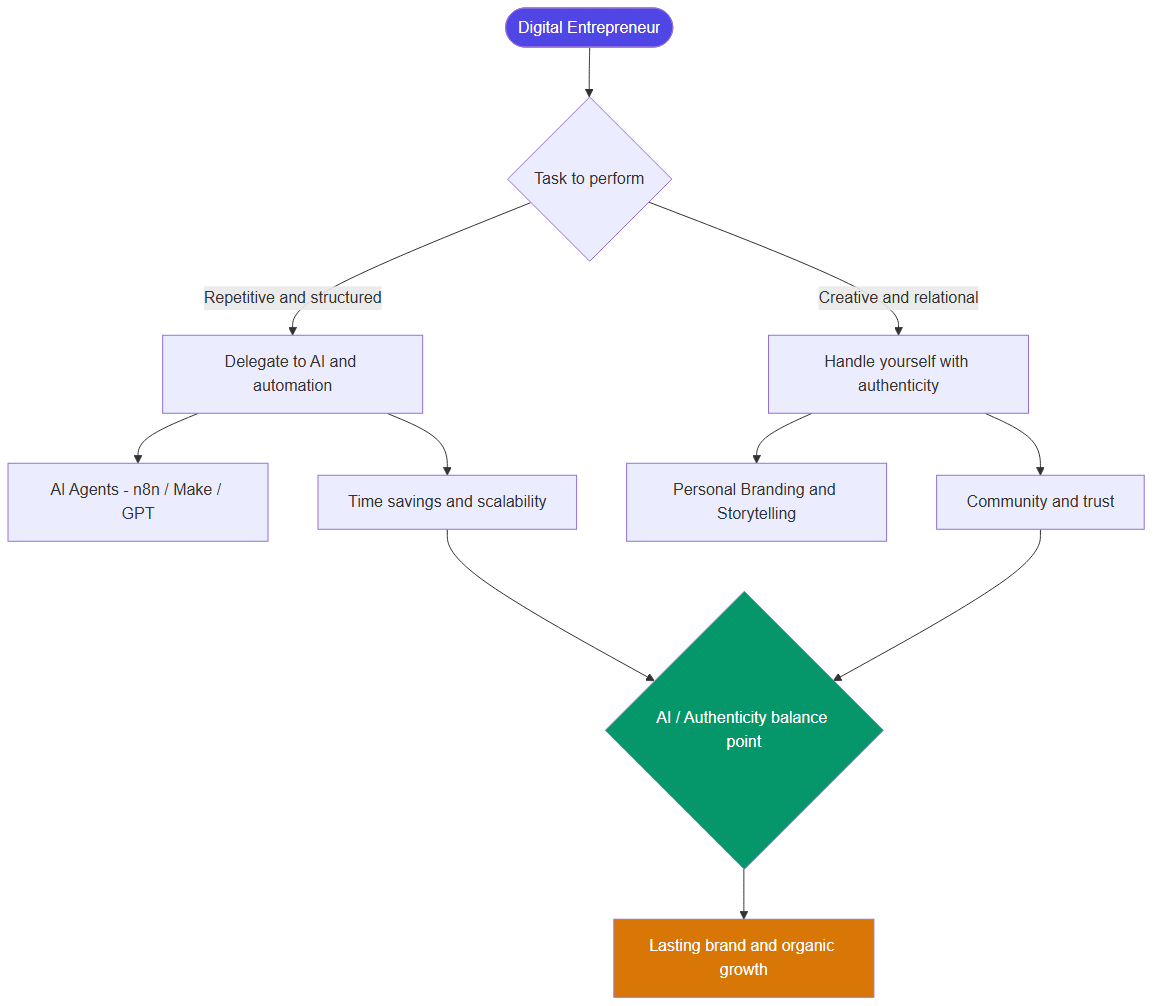 How the digital entrepreneur should balance automation and human presence depending on the type of task
Faced with the tide of AI-generated content, consumers have developed a genuine "synthetic radar." LinkedIn has seen a spectacular rise in engagement on "human" posts — personal testimonials, failure stories, non-consensus opinions — while AI-formatted posts lose organic reach. This phenomenon is equally visible on Instagram, YouTube, and in newsletters.
Consumers are thirsting for real human connection. This is the defining trend of digital entrepreneurship in 2025: Founder-Led Growth, where the growth of a brand is driven by the founder or co-founder themselves.
Why Founder-Led Growth Works
Brands succeeding today are those that embody a story, values, and a face. When you buy a product from a brand whose founder you follow, you are not just buying a product — you are joining a vision, supporting a real person. This emotional bond creates loyalty that even the best recommendation algorithm cannot manufacture.
Founder-Led Growth rests on three concrete pillars.
Unfiltered Storytelling: Documenting failures as well as successes. Sharing behind-the-scenes moments, doubts, pivots, and difficult decisions. This type of content generates empathy and proximity — two rare resources in the age of AI content. An entrepreneur who honestly shares a failure and what they learned from it builds more trust than a perfectly polished success story.
Community before Audience: Building private circles — WhatsApp groups, Discord servers, physical events, live sessions — rather than chasing follower count metrics. The currency of 2025 is not number of subscribers, but engagement rate and relationship quality. A thousand truly engaged fans are worth more than a hundred thousand passive followers.
Raw Video: Over-produced content gives way to authentic videos, shot on smartphones, where the message takes precedence over production quality. A founder who explains in 60 seconds why they made a strategic decision generates more reaction than a perfectly edited corporate video. Imperfection has become a signal of authenticity.
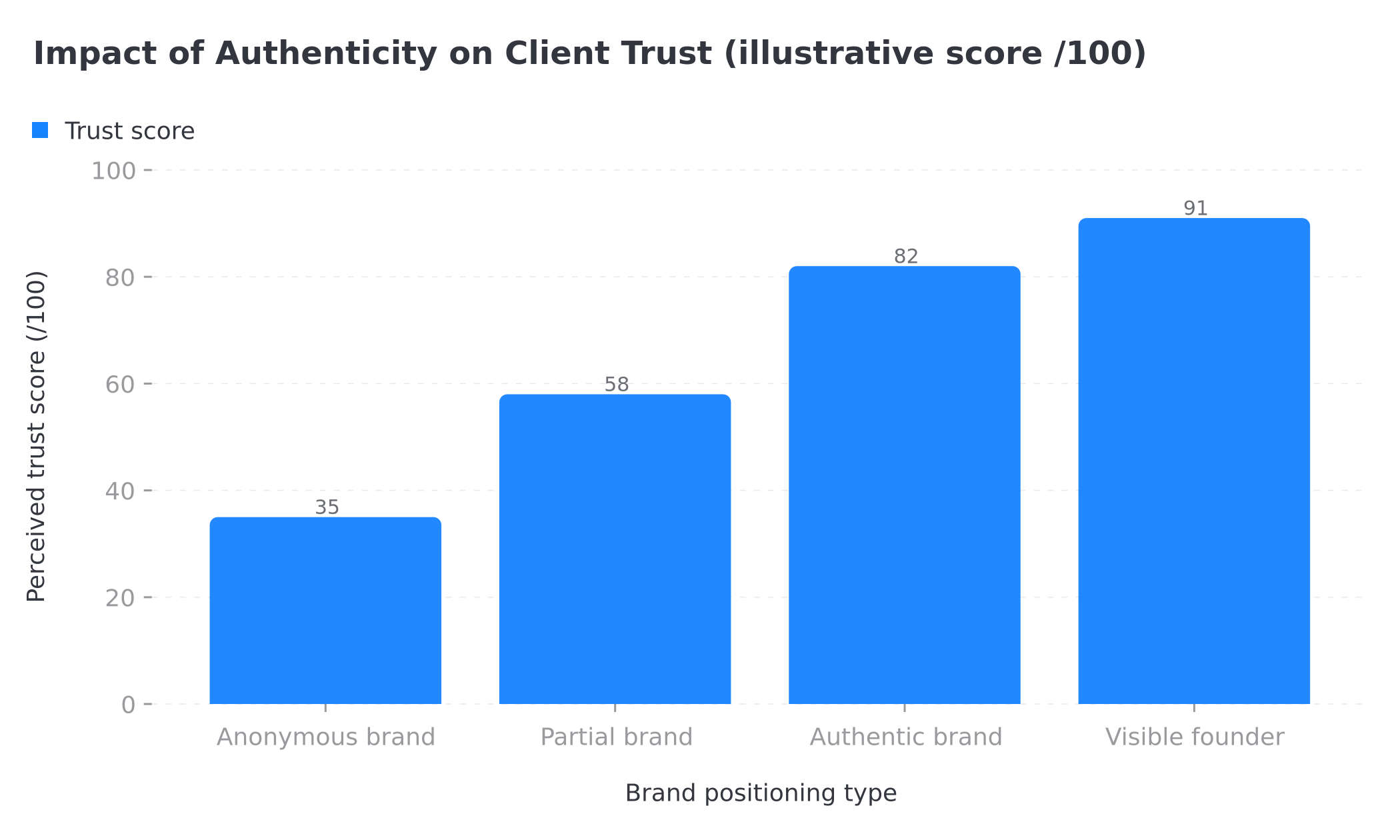 Illustrative perceived trust score by brand positioning: anonymous, partial, authentic, and founder-visible
4. How to Combine AI and Authenticity Without Losing Your Identity
The entrepreneur of 2025 must be a cyborg: ultra-automated in the back office, but ultra-human in the front office. This duality is their strength and their art. But how do you implement it concretely without the two dimensions colliding?
The Human/AI Hybrid Content Model
The most effective hybrid content strategy works in three distinct steps.
Step 1 — Human ideation: This is where everything starts. You identify topics from your client conversations, field observations, and lived experiences. A content idea born from a real interaction — "three clients asked me the same question this week" — will always carry more value than the best keyword research tool suggestion.
Step 2 — AI structure and research: Once the idea is validated, you use AI to build your outline, identify complementary angles, suggest statistics to verify, and generate a first draft. This draft is not your final article — it is a skeleton you will clothe with your voice.
Step 3 — Human revision and signature: You re-inject your personal anecdotes, strong opinions, characteristic phrasing, and real client examples (anonymized where necessary). This is the step where the content becomes truly yours. A regular reader should be able to recognize your voice through your writing, even without seeing your name in the byline.
This approach allows you to maintain a strong editorial cadence without sacrificing quality or singularity. It frees you from research and formatting tasks without stripping you of your editorial identity.
Preserving Your Voice in the Age of Generative AI
An entrepreneur's voice is their editorial fingerprint. It is composed of their preferred phrasings, cultural references, sense of humor, and positions on their industry. AI, by nature, tends toward neutrality and consensus — two enemies of memorability.
To preserve your voice, build what content professionals call a Brand Voice Document: a file that lists your recurring expressions, the topics on which you hold strong opinions, your reference examples, and the formulations to avoid. Use this document as a proofreading guide for every AI-assisted piece of content. The goal: the final content should be impossible to attribute to a machine.
5. Concrete Strategies for Building a Lasting Presence
The Hybrid Content Strategy: Standard Operating Procedure
Let us put this into practice. Here is a tested hybrid content workflow for maintaining a coherent editorial presence across LinkedIn, newsletter, and blog simultaneously.
Monday — Harvest: Spend 30 minutes noting all your observations from the previous week. Client conversations, articles read, situations experienced, questions received. These are your raw materials. Do not filter yet — capture everything.
Tuesday — Production: Choose 1 main idea and 3 secondary ideas. Use AI to develop a plan and a first draft for each piece of content. Add your voice, your examples, your positions.
Wednesday-Thursday — Revision and Scheduling: Proofread, refine, schedule publication via a tool like Buffer or your preferred automation tool. Queue LinkedIn posts, load the newsletter into your sequence.
Friday — Engagement: Dedicate 45 minutes to responding to comments, messages, and community emails. This engagement phase is the only one that cannot be automated — this is where the relationship is built.
This workflow allows you to maintain a strong editorial presence with 3 to 4 hours of work per week versus 12 to 15 hours without AI. The difference goes directly toward your offer, service, and strategic vision.
Building a Community That Becomes an Asset
Community is the most underestimated and most durable asset in digital entrepreneurship. Unlike followers on social media — whose relationship you do not own and who disappear at the whim of algorithms — a community is an asset you control.
To build one effectively, start by identifying the "recurring problem" you solve for your audience. This problem must be specific enough to create an immediate sense of recognition. Then create a dedicated space — private group, Telegram channel, Discord, Slack forum — and animate it with non-negotiable regularity. Regularity creates habit, habit creates belonging.
Live events — Q&A sessions, masterclasses, webinars, in-person workshops — are the most powerful community accelerators available. They create shared memories and interpersonal bonds that asynchronous content cannot replicate.
To go further in this direction, explore how AI agents and the hybrid freelance model are redefining new forms of collaboration in 2026.
Making Your Expertise Visible and Documented
Invisible expertise does not sell. In 2025, the credibility of a digital entrepreneur is built through the systematic documentation of their expertise. This means publishing regularly on the topics where you excel, sharing your methodologies, and exposing your internal processes — even partially.
This transparency may feel counter-intuitive ("if I give everything away, why would they pay me?"), but experience consistently shows the opposite: the more you demonstrate your expertise publicly, the more qualified clients naturally find you, already convinced of your value before the first conversation.
The most effective formats for this expertise documentation are detailed case studies (before/after with real figures), project retrospectives (what worked, what did not and why), step-by-step methodology guides, and sector analyses grounded in your field experience.
6. Building a Lasting Brand in 2025-2026
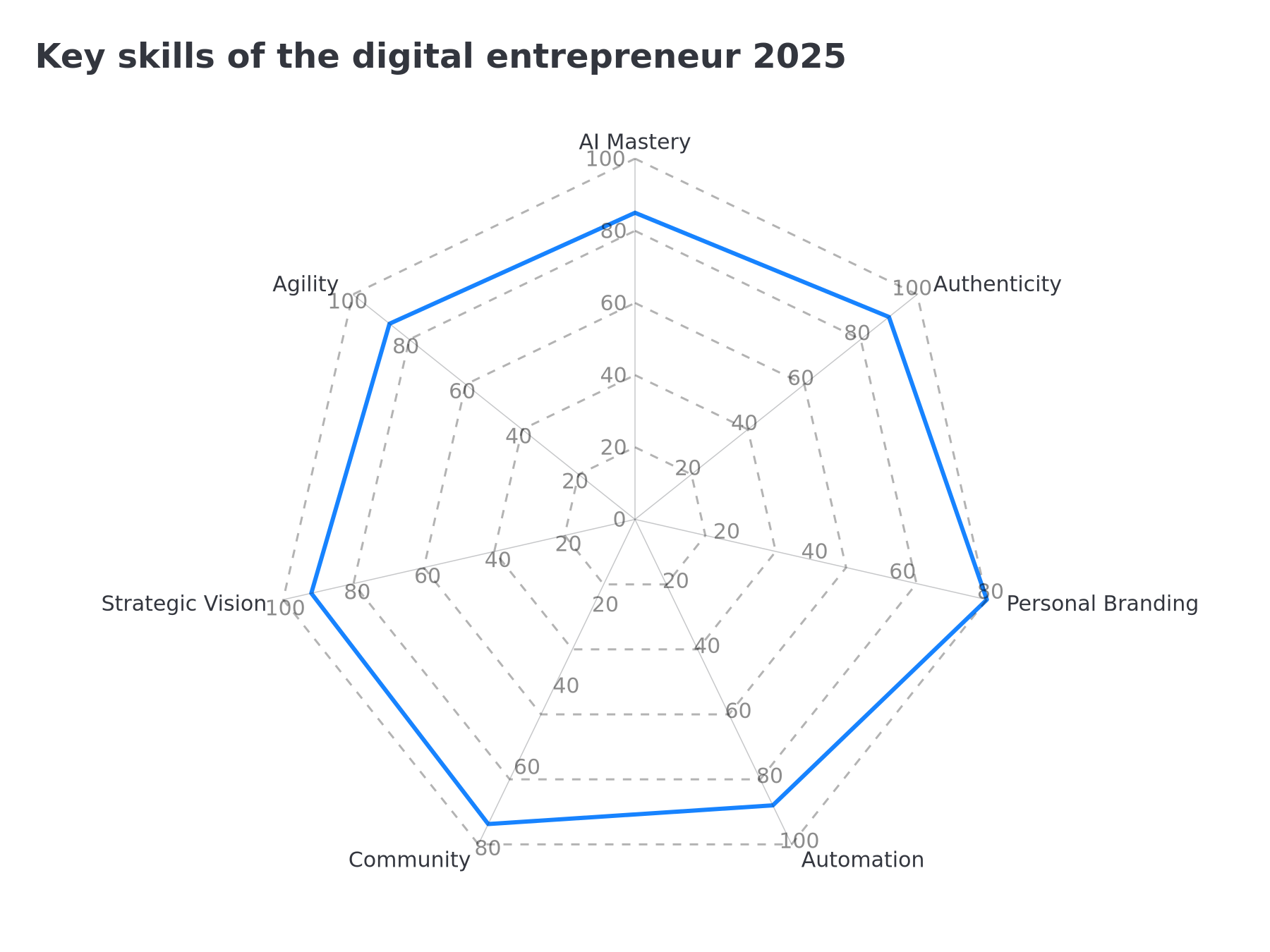 The 7 core competencies every digital entrepreneur must develop to succeed in 2025: AI mastery, authenticity, personal branding, automation, community, strategic vision, agility
A lasting brand is not one that follows every trend — it is one that holds a clear position, a recognizable voice, and a promise consistently delivered over time. In the age of AI, these qualities become even more precious.
The Three Pillars of an AI-Resistant Brand
Radical Niche Positioning: With the saturation of generalist markets, wealth is found in deep niches. AI now allows serving micro-markets with profitability that was not previously possible. A solopreneur can build a hyper-specialized Micro-SaaS and manage it alone thanks to advanced automation. The key: choose a niche where you have real, authentic experience — not just commercial interest.
Long-Term Editorial Consistency: The brands winning in 2025 are not those that had one viral moment. They are the ones that have been present, consistent, and recognizable for 12, 18, 24 months. Consistency creates trust, trust creates authority, authority creates opportunity. Define your 3 to 5 recurring editorial themes and stick to them — even when the algorithm nudges you toward the latest trend.
The Proprietary Ecosystem: Reducing dependence on third-party platforms by building proprietary assets: an email list, a private community, a performant SEO site, direct partnerships. These assets do not depend on Meta or TikTok algorithms — they belong to you and constitute your business safety net.
Sustainability as a Business Model
Eco-responsibility is no longer a CSR option — it is a decisive purchasing criterion for a growing share of consumers. Digital entrepreneurs are adopting Green Coding and green hosting. They optimize their supply chains using AI to reduce waste. Being profitable and being sustainable are no longer antithetical — they have become complementary, even synonymous, in the most dynamic markets.
Web3 and Utilitarian Digital Ownership
Far from the speculation of previous years, Web3 has finally found its utilitarian place in digital entrepreneurship. Tokenized loyalty programs allow brands to create digital assets that provide access to real benefits — priority access, accumulated discounts, participation in brand decisions. This mechanism creates a strong and measurable sense of belonging. For global entrepreneurs, decentralized payments via stablecoins reduce exchange fees and international banking delays — a concrete advantage for businesses operating across multiple monetary zones.
7. Practical Cases: How Entrepreneurs Combine AI and Authenticity
Case 1: The Digital Transformation Consultant
An independent digital transformation consultant uses AI to analyze client processes and generate detailed diagnostic reports in a few hours (versus two days manually). But they maintain absolutely all client meetings in person or via video, with full attention. They publish a weekly "field journal" on LinkedIn — a few raw paragraphs about what they observe with clients, without a filter. Result: their waiting list stretches three months out, without ever investing a euro in paid advertising.
Their secret: AI gives them the time to focus on high-value moments — human exchanges, strategic decisions, reputation building. The automation is invisible. The authenticity is unforgettable.
Case 2: The Founder of a Niche E-commerce Store
A founder of an e-commerce store specializing in sustainable accessories has fully automated her level-1 customer service (FAQ, order tracking, return policies) via an AI agent trained on her own responses. She dedicates the freed time to weekly Instagram Lives where she shares the behind-the-scenes of her supplier choices, her eco-selection criteria, her doubts, and her successes. Her community is small (fewer than 5,000 followers), but her conversion rate is three times the sector average.
Authenticity compensates for size. An engaged community of 2,000 people commercially outperforms a cold audience of 50,000.
Case 3: The Digital Agency That Automates Without Dehumanizing
A mid-sized digital agency implemented a complete automation stack for its internal processes: client onboarding, monthly reporting, deliverable tracking, validation follow-ups. Their teams save around 60 hours per month. These hours are reinvested in longer and deeper client strategy sessions, more demanding creative reviews, and a continuous internal learning culture.
The client does not see the automation — they see a more available, more responsive, and more creative agency. That is exactly the goal.
To go deeper on building this kind of automation stack, discover how to automate 40 hours of work per week with AI agents and what implications this has on freelance rates and value.
8. The Digital Entrepreneur of 2025-2026: Portrait of a Conductor
The digital entrepreneur of 2025-2026 is, above all, a conductor. They no longer play all the instruments themselves — that would be inefficient and exhausting. They direct a symphony of algorithms, AI agents, No-Code tools, and human collaborators. And like any good conductor, they understand each instrument, know when to step in, and maintain the overall vision of the score.
Their mastery of AI is not an end in itself — it is the means by which they recover the hours needed to do what only a human can do: create deep connections, take calculated risks, defend positions that break from consensus, inspire trust, and embody a vision.
Their signature is being recognizable in a world of standardized content. It is turning every client interaction into a memorable experience. It is building, stone by stone, a reputation that withstands algorithmic cycles and market fashions.
AI amplifies their capabilities. Automation frees their time. But it is their authenticity — their unique way of seeing the world and communicating it — that makes them irreplaceable.
Conclusion: Technology is the Lever, the Human is the Fulcrum
Digital entrepreneurship in 2025 is not won with tools. It is won through clarity of vision, consistency of action, and depth of relationships. AI and automation are extraordinary force multipliers — but they only multiply what already exists. No authenticity at the base? Automation amplifies the void. Authenticity, expertise, and generosity? Automation allows you to reach ten times more people with the same intensity.
The winning equation of this new era is simple to state, difficult to execute: automate what can be automated, humanize what must be humanized, and know the difference with precision.
Entrepreneurs who internalize this duality — cyborgs in their back office, human in their face-to-face — are those who will build the most durable and most profitable brands of the coming decade. Competition is no longer fought on technology. It is fought on trust.
To go further in your strategy as an augmented entrepreneur, explore how to be truly AI-First in 2026 — the concrete implications for your business model.
FAQ — Digital Entrepreneurship 2025: AI, Automation, and Authenticity
Where to start to digitalize and automate your business?
Identify your 3 most time-consuming and repetitive tasks — that is where automation ROI is fastest. Common quick wins include managing incoming emails, client follow-ups, and manual reporting. Start with a no-code tool like n8n or Make, configure one simple automation, measure the time saved over a month, then invest further. Progressive adoption is the key to a successful implementation.
Will AI replace jobs in my team?
AI automates repetitive and structured tasks, freeing your teams for higher-value work — creativity, deep client relationships, strategic thinking. Organizations that adopt AI thoughtfully redeploy staff to more fulfilling activities rather than reducing headcount. The key is building skills alongside automation, not as an afterthought.
How do I keep my authenticity when using AI to create content?
The golden rule: AI structures and accelerates, you bring the experience, tone, and truth. Always write a first draft of your ideas before using AI. Then re-inject your personal anecdotes, strong opinions, and real examples. Readers easily detect 100% AI content — your unique voice and clear positions are what create lasting differentiation.
What is Founder-Led Growth and why is it essential in 2025?
Founder-Led Growth is a strategy where the founder becomes the visible face of the brand — through LinkedIn posts, videos, podcasts, or personal newsletters. In 2025, amid the saturation of AI-generated content, seeing and hearing a real human behind a brand creates trust that no algorithm can replicate. It has become one of the most powerful organic acquisition levers available without an advertising budget.
What budget should I plan for integrating AI into my business?
No-code solutions like n8n or Make start at under €100/month for powerful automations. To get started, a budget of €200 to €500/month is enough to automate the most common processes for an SME. A custom AI integration project typically ranges from €2,000 to €15,000 depending on complexity and existing systems.
How do I measure the ROI of automation?
Calculate the hourly cost of each automated task multiplied by the monthly hours saved. Compare that to the monthly cost of your tool. Beyond time, also measure error reduction and processing speed improvements. Most well-configured automations pay for themselves in under 3 months — and the time freed for high-value activities is often even more precious than the direct cost saving.
Tags
FAQ
Where to start to digitalize and automate your business?
Identify your 3 most time-consuming and repetitive tasks — that is where automation ROI is fastest. Common quick wins are managing incoming emails, client follow-ups, and manual reporting. Start with a no-code tool like n8n or Make, set up one simple automation, measure the time saved over a month, then invest further. Progressive adoption is the key to success.
Will AI replace jobs in my team?
AI automates repetitive and structured tasks, freeing your teams for higher-value work — creativity, deep client relationships, strategy. Organizations that adopt AI thoughtfully redeploy staff to more fulfilling activities rather than cutting headcount. The key is upskilling alongside automation, not after.
How do I keep my authenticity when using AI to create content?
The golden rule: AI structures and accelerates, you bring the experience, tone, and truth. Always write a first draft of your ideas before using AI. Then re-inject your personal anecdotes, strong opinions, and real examples. Readers easily detect 100% AI content — your unique voice and clear positions are what create lasting differentiation.
What is Founder-Led Growth and why is it essential in 2025?
Founder-Led Growth is a strategy where the founder becomes the visible face of the brand — through LinkedIn posts, videos, podcasts, or personal newsletters. In 2025, amid the flood of AI-generated content, seeing and hearing a real human behind a brand creates trust that no algorithm can replicate. It has become one of the most powerful organic acquisition levers available without an advertising budget.
What budget should I plan for integrating AI into my business?
No-code solutions like n8n or Make start at less than €100/month for powerful automations. To get started, a budget of €200 to €500/month is enough to automate the most common processes for an SME. A custom AI integration project typically ranges from €2,000 to €15,000 depending on complexity and existing systems.
How do I measure the return on investment of automation?
Calculate the hourly cost of each automated task multiplied by the monthly hours saved. Compare that figure to the monthly cost of your tool. Beyond time, also measure error reduction and processing speed improvements. Most well-configured automations pay for themselves in under 3 months — and the time freed up for high-value activities is often even more precious than the direct cost saving.
Budget, process, priorities — decided together
Website, chatbot, or automation? We pick the next job that unlocks cash, not the trendy stack.
- 30 min
- Clear priorities
- No commitment
Vicentia Bonou
Full Stack Developer & Web/Mobile Specialist. Committed to transforming your ideas into intuitive applications and custom websites.


