
Claude Opus 5: System Card Analysis, Capabilities, Limitations, and Implications
Anthropic releases Claude Opus 5 on July 24, 2026. #1 AI Index (Artificial Analysis), effort scaling, 1M token context, Opus pricing. But 50% hallucination rate and skills compatibility to check. Full analysis.

Claude Opus 5: System Card Analysis, Capabilities, Limitations, and Implications
On July 24, 2026, Anthropic releases Claude Opus 5. #1 AI Index on Artificial Analysis, 1M token context, 5-level effort scaling. But 50% hallucination rate and skills compatibility to watch. Here's the full analysis.
On July 24, 2026, Anthropic releases Claude Opus 5, its flagship model for agentic coding and complex knowledge work. On launch day, the independent ranking Artificial Analysis places Opus 5 at #1 position on both its Intelligence Index and Agentic Index.
Opus 5 promises intelligence close to Claude Fable 5 (Anthropic's most advanced model) at half the price. But independent testing also reveals a 50% hallucination rate and compatibility issues with "skills" designed for Opus 4.8.
This article breaks down the system card, analyzes the benchmarks, and evaluates the implications for teams considering Opus 5 in production.
Technical Specs
Main Characteristics
| Specification | Claude Opus 5 |
|---|---|
| Release date | July 24, 2026 |
| API ID | claude-opus-5 |
| Context | 1 million tokens |
| Input price | $5 / MTok |
| Output price | $25 / MTok |
| Effort levels | low, medium, high, xhigh, max |
| Default effort | high |
| Availability | API, Claude Pro, Max, Enterprise |
 Radar comparison: Claude Opus 5 vs Fable 5 vs GPT-5.6 vs Kimi K3
Effort Scaling: 5 Levels
The effort scaling system is Opus 5's main innovation:
| Level | Usage | Latency | Cost |
|---|---|---|---|
| low | Simple tasks, quick answers | Low | Minimal |
| medium | Implementation, research, tool-heavy workflows | Medium | Moderate |
| high (default) | Most tasks | Medium | Standard |
| xhigh | Difficult coding and agentic work | High | High |
| max | Maximal reasoning, complex problems | Very high | Maximum |
Anthropic recommends xhigh as a starting point for genuinely difficult coding and agentic work. But Every's team tests found that stepping down (to medium) sometimes improved behavior.
Benchmarks: Opus 5 vs Competition
Artificial Analysis Intelligence Index
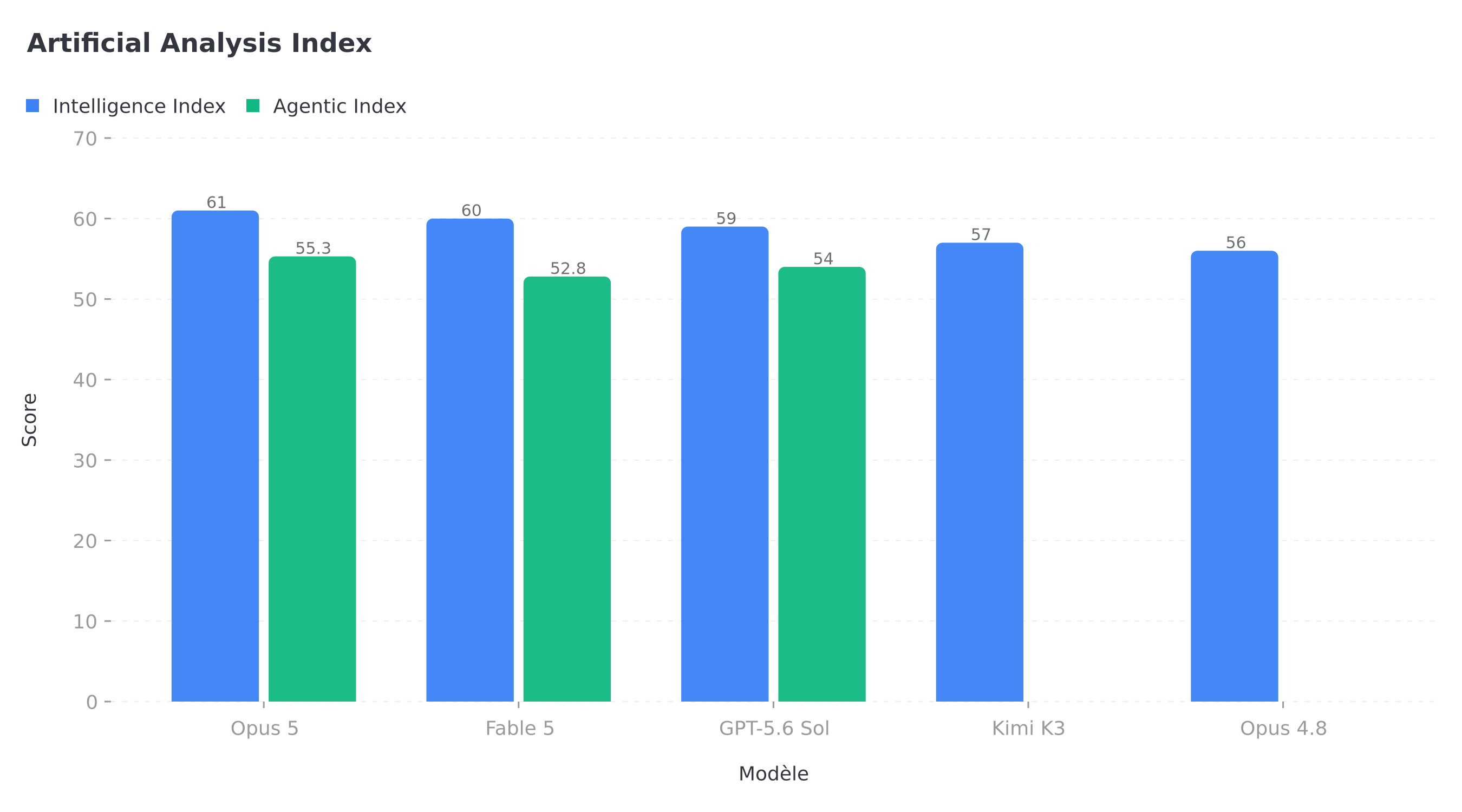 Artificial Analysis Intelligence Index ranking for frontier models
| Model | Intelligence Index | Agentic Index | Price ($/MTok in/out) |
|---|---|---|---|
| Claude Opus 5 (max) | 61 (#1) | 55.3 (#1) | $5 / $25 |
| Claude Fable 5 (max) | 60 | 52.8 | $10 / $50 |
| GPT-5.6 Sol (max) | 59 | 54.0 | $5 / $30 |
| Kimi K3 | 57 | N/A | $3 / $15 |
| Claude Opus 4.8 (max) | 56 | N/A | $5 / $25 |
Anthropic's Specific Benchmarks
| Benchmark | Opus 5 Result | vs Predecessor |
|---|---|---|
| Frontier-Bench v0.1 | 43.3% (agentic terminal coding) | 2x Opus 4.8 (21.1%) |
| CursorBench 3.2 | 0.5% from Fable 5 at max effort | At half the cost |
| ARC-AGI 3 | 30.2% | 4x GPT-5.6 Sol (7.8%) |
| GDPval-AA v2 | 1861 Elo | +114 over Fable 5 |
| AA-Briefcase | 1720 Elo | +146 over Fable 5 |
| OSWorld 2.0 | Beats Fable 5 | At a third of the cost |
| Zapier AutomationBench | 1.5x next-best | At equal cost |
The Headline Result: ARC-AGI 3
The ARC-AGI 3 benchmark measures novel problem-solving without memorized patterns. Opus 5 scores 30.2%, compared to:
- Opus 4.8: 1.5%
- GPT-5.6 Sol: 7.8%
That's a 4x gap over the next-best. No Fable 5 result is available for this benchmark.
The Limitations: What You Need to Know
1. 50% Hallucination Rate
The most significant concern: according to independent testing, Opus 5 has a 50% hallucination rate. This increase is explained by an increased tendency to answer even when uncertain — the model prefers giving an answer over saying "I don't know."

Implication: for critical use cases (medical, legal, financial), this hallucination rate is unacceptable without appropriate guardrails. See our article on n8n AI Agent Governance for mitigation strategies.
2. Compatibility with Opus 4.8 "Skills"
The Every team (Dan Shipper) tested Opus 5 with elaborate "skills" designed for Opus 4.8. Result: Opus 5 can be argumentative, stop before finishing, and perform worse in some mature skill-driven workflows.
Implication: Opus 5 is not a "drop-in replacement" for Opus 4.8. Teams must re-test their existing workflows.
3. Performance Decrease at Max Effort
On two benchmarks (Frontier-Bench v0.1 and Artificial Analysis Coding Agent Index), Opus 5 scores slightly worse at max effort than at the second-highest level (xhigh), despite costing more.
Implication: max effort isn't always the best choice. xhigh may be optimal for most cases.
Cost per Task: The Real Metric
Token price doesn't tell the full story. Cost per task depends on token efficiency:
| Model | Avg cost per Index task | Notes |
|---|---|---|
| Claude Sonnet 5 (max) | $1.53 | Cheapest |
| Claude Opus 4.8 (max) | $1.80 | Predecessor |
| Claude Opus 5 (max) | $2.03 | Mid-range |
| Claude Fable 5 (max) | $2.75 | Most expensive |
At high and xhigh effort, Opus 5 can outperform both Opus 4.8 and Sonnet 5 at a lower cost per task. That's where the real gain lies.
Decision Workflow: Adopt Opus 5 or Not
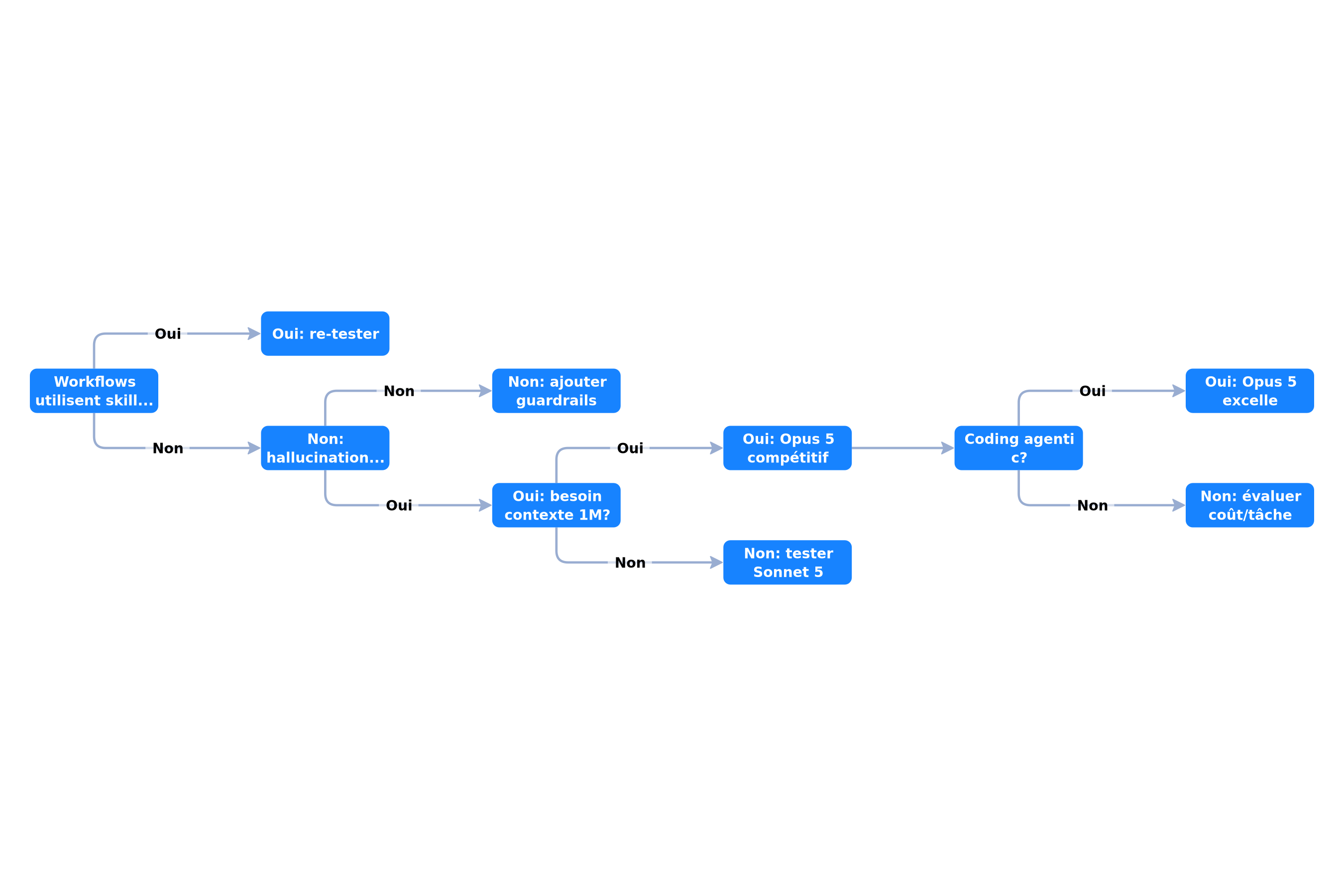 Decision tree for evaluating Claude Opus 5 adoption in production
Questions to Ask
- Do your current workflows use Opus 4.8 "skills"? → Must re-test
- Is the 50% hallucination rate acceptable? → Add guardrails
- Do you need 1M context? → If yes, Opus 5 is competitive
- Is cost per task critical? → Test high vs xhigh effort
- Do you use agentic coding? → Opus 5 excels on Frontier-Bench
Implications for the AI Ecosystem
For Development Teams
Opus 5 is one of the most important models to evaluate in 2026. The official benchmarks, 1M token context, lower-effort efficiency, and Opus pricing make it a serious candidate for agentic coding.
But don't do a blind swap. The Every team recommends conducting your own acceptance tests rather than trusting vendor benchmarks.
For Francophone SMBs
For SMBs using AI for automation, Opus 5 offers:
- Better price/performance than Fable 5 for coding
- 1M context to analyze large documents
- State-of-the-art agentic capabilities
But watch out for hallucinations: any production deployment must include guardrails (validation, HITL, sanitization).
Conclusion
Claude Opus 5 is a genuine generation change — not an incremental bump. The official benchmarks are impressive (ARC-AGI 3 at 4x the next-best, Intelligence Index #1), the price remains Opus, and 1M context opens new use cases.
But the 50% hallucination rate and compatibility issues with existing workflows remind us that vendor benchmarks aren't enough. Every team must conduct its own acceptance tests.
For companies that want to integrate Opus 5 with appropriate guardrails, our AI agent creation service implements validation, HITL, and sanitization from design, and our automation accompaniment covers full integration with governance.
Tags
FAQ
When was Claude Opus 5 released?
Claude Opus 5 was released by Anthropic on July 24, 2026. It's available via the API (claude-opus-5) and Claude Pro, Max, and Enterprise plans.
What is the price of Claude Opus 5?
Claude Opus 5 is priced the same as its predecessor Opus 4.8: $5 per million input tokens and $25 per million output tokens. It costs about half of Claude Fable 5 ($10/$50).
What is effort scaling in Claude Opus 5?
Effort scaling is a 5-level system (low, medium, high, xhigh, max) that balances performance and token usage. Opus 5 defaults to high effort. Anthropic recommends xhigh for genuinely difficult coding and agentic work.
Does Claude Opus 5 have hallucination problems?
Yes. According to independent testing, Opus 5 has a 50% hallucination rate due to an increased tendency to answer even when uncertain. This is a point of attention for critical use cases.
How does Claude Opus 5 compare to Fable 5 and GPT-5.6?
On the Artificial Analysis Intelligence Index, Opus 5 scores 61 (#1), Fable 5 scores 60, and GPT-5.6 Sol scores 59. On the Agentic Index, Opus 5 leads with 55.3 vs 54.0 for GPT-5.6 and 52.8 for Fable 5.
Free audit: we check the impact on your site and workflows
Next.js CVE, new agent, MCP… We tell you what actually applies, and what to patch or ignore.
- 30 min
- Stack reviewed
- No commitment

William Aklamavo
Web development and automation expert, passionate about technological innovation and digital entrepreneurship.


