
Meta Muse Glimmer: Always-On Local 30B AI Agent — Useful for an SME?
Meta ships Muse Glimmer (30B, Apache 2.0) for always-on local agents. Specs, hardware, and when to use it versus n8n + cloud APIs.

Updated

Meta Muse Glimmer: Always-On Local 30B AI Agent — Useful for an SME?
An open-weight 30B model built to stay on locally. For an SME, the real question is not “is it impressive?” but “is it the right choice versus n8n + a cloud API?”
Meta Superintelligence Labs released Muse Glimmer: a roughly 30-billion-parameter open-weight model under Apache 2.0, optimized for always-on local agent workflows. Weights are on Hugging Face. The announcement explicitly targets a Mac or PC with a single consumer GPU — not only the datacenter.
For SMEs, that is a strong signal: local agents are no longer lab-only. But “possible” is not “optimal.” This article sticks to Meta’s public facts, the realistic hardware envelope, and a clear decision frame: when to self-host Muse Glimmer, and when to stay on n8n + Claude/GPT.
What Meta actually announces
Per Meta AI Research’s official post, Muse Glimmer targets local use cases: agents, function calling, local coding, and LLM-as-a-judge evaluation. Meta stresses that most deployments still depend on cloud infrastructure and network access — and that local inference changes availability offline and control over personal context.
The model is multimodal (text + images in, text out) via a dedicated perception encoder. It is trained on data covering 100+ languages. Meta highlights several agentic capabilities working together:
- End-to-end agentic task completion (scaffolds, code, multi-turn requests)
- Reliable tool use with precise schemas
- Multi-step reasoning over long horizons
- Failure recovery when a tool call fails (diagnose and retry)
- Controllable effort (quality versus speed)
- Compatibility with agentic orchestration patterns (including OpenClaw, as cited by Meta)
On benchmarks, Meta cites DeepSearch QA, MCP-Atlas, τ-Bench, and SWE-Bench, and reports strong results in its size class versus Gemma4-31B and Qwen3.6-27B. We do not invent numeric scores; details belong in Meta’s evaluation report.
Hardware: the 24 / 32 GB envelope
At full precision, Meta states a 30B model would need over 55 GB of memory — beyond any consumer GPU. The published strategy: compress weights to roughly 4-bit, shrinking the language model to under 20 GB. That leaves headroom for the KV cache, the perception encoder, and the DFlash speculative-decoding drafter inside a 24 GB or 32 GB envelope.
Meta also measures speed for its K-Quant-17GB build with a quantized DFlash drafter on MacBook M4-Max, M5-Max, and RTX 5090, claiming enough fluidity for conversation and real-time agent interaction — fully on-device.
Operational reading for an SME:
| Item | Practical implication |
|---|---|
| GPU / Mac with ~24–32 GB usable | Realistic prerequisite for quantized inference |
| Apache 2.0 | Easier fine-tuning and redistribution than restrictive licenses |
| Integrations “in the coming days” | llama.cpp, MLX, ExecuTorch, Ollama, LM Studio, Unsloth, vLLM, SGLang |
| Always-on | Budget a dedicated machine, power, updates, monitoring |
If you have neither the machine nor someone for ops, local 30B is not “free”: cost moves from API tokens to hardware and maintenance.
Ops checklist before an SME pilot
Before buying a GPU “for AI,” align on these points with your team:
- Useful load: one critical workflow (e.g. HR attachment triage), not ten parallel use cases.
- Placement: developer workstation, office mini-server, or private GPU cloud — document who has physical and remote access.
- Backup of weights and configs: version prompts, tools, and policies; Hugging Face weights can be re-downloaded, your scaffolds cannot.
- Minimal observability: tool-call logs, failure rate, perceived latency. Without that, you cannot tell whether local is “fast enough.”
- Update policy: who applies new llama.cpp / Ollama / vLLM releases as Meta and the ecosystem move?
Skip this checklist and a Muse Glimmer pilot quickly becomes shadow IT.
Typical local Muse Glimmer agent flow
Before choosing, picture the lifecycle of an always-on agent. This is not a one-shot chat: it is a loop that plans, calls tools, recovers from errors, and continues.
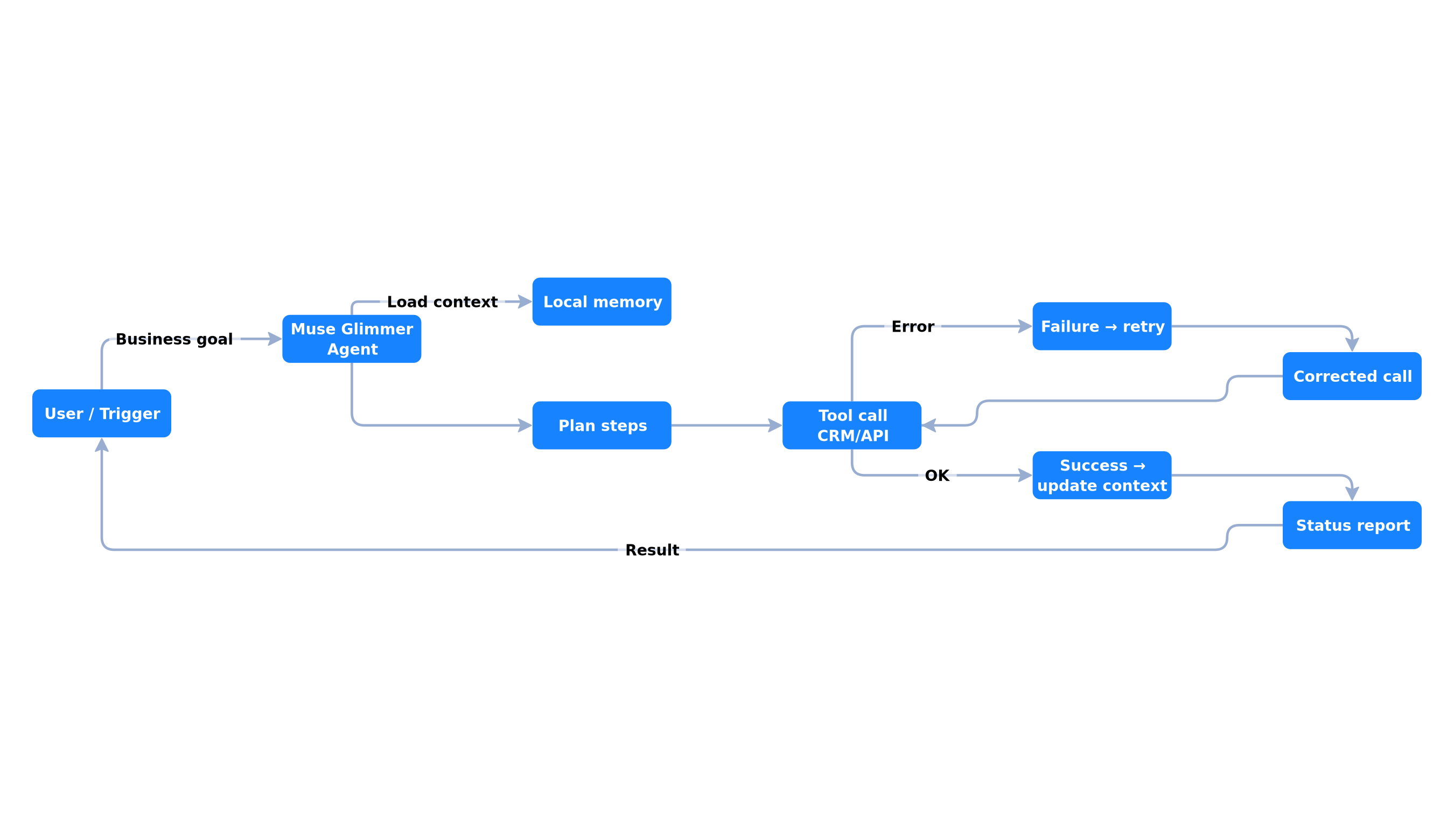 Agent loop: goal, memory, planning, tools, retry, and status report
This matches Meta’s described capabilities (tool use, multi-step, failure recovery). For an SME, the key question becomes: where do tools and data live — on your private machine / server, or with a cloud vendor?
Local Muse vs n8n + cloud API: decision tree
Most SMEs we support do not need a local 30B LLM on day one. They need a reliable orchestrator (often n8n) and a cloud model for understanding / generation. Muse Glimmer moves the cursor when local constraints become strategic.
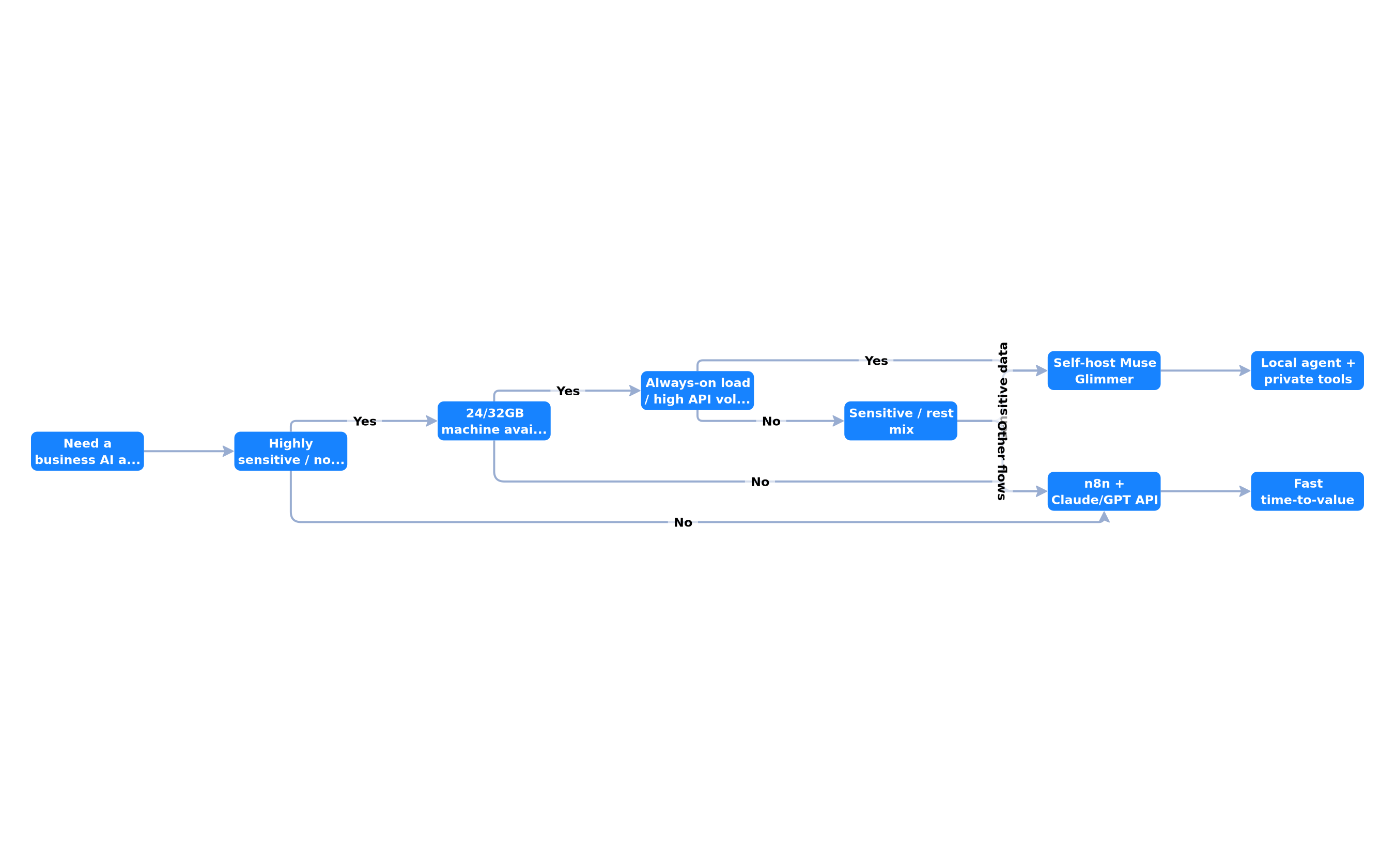 Four questions to choose between self-hosting Muse Glimmer and n8n + cloud API
When Muse Glimmer makes sense
- Sovereignty / operational privacy: HR docs, contracts, customer tickets that must stay inside your perimeter.
- Always-on without network dependency: shop floor, unstable connectivity, field laptop that must keep working offline.
- Stable, high volume: if LLM API calls run constantly 24/7, cloud spend may justify an amortized machine — calculate on your invoices, not invented averages.
- Local multimodal: screenshots, charts, or documents processed with text context without sending images to a third-party API.
- Customization: Apache 2.0 open weights open fine-tuning / adaptation (Meta cites TorchTitan on the PyTorch side).
When to stay on n8n + cloud API
- You want a first production agent in days, not weeks of infra.
- You have no GPU and no budget for a dedicated box.
- Load is spiky (peaks then quiet): cloud scales more cleanly.
- You need frontier reasoning for rare, critical tasks (complex legal, advanced software architecture): a local 30B is not positioned as a universal cloud-frontier substitute.
- Your team has nobody to patch, monitor, and secure a local endpoint.
To trial a lighter local stack before a 30B, our Gemma 4 + Ollama + n8n tutorial remains a solid sandbox.
Three SME scenarios
Scenario A — B2B services firm (10–40 people).
You handle quotes, contracts, and client threads. A cloud agent that “reads everything” speeds work up but raises perceived leak risk. Here Muse Glimmer can drive local drafting and filing; n8n then pushes only structured, already-validated fields into the CRM.
Scenario B — Ecommerce / support.
Ticket volume varies, weekend spikes, need for fast answers. Cloud API + n8n is usually simpler. Muse Glimmer can come later as an internal assistant (product base, back-office screenshots) that must not leave the network.
Scenario C — Field / shop-floor ops.
Uneven connectivity, need for an agent that stays available. Meta’s always-on local pitch is most relevant. Caveat: tools (files, ERP) must also be reachable locally, or the agent “thinks” without being able to act.
In all three cases, measure the cost and latency of your current stack first. Muse Glimmer is not a marketing obligation — it is an architecture option.
Hybrid architecture we recommend for SMEs
The choice is not binary. A healthy pattern often looks like this:
- n8n orchestrates triggers (webhook, cron, inbox, CRM).
- Cloud API (Claude / GPT) handles low-sensitivity or high-reasoning steps.
- Local Muse Glimmer handles steps where documents or context must not leave.
- Human-in-the-loop validates irreversible actions (customer send, accounting write).
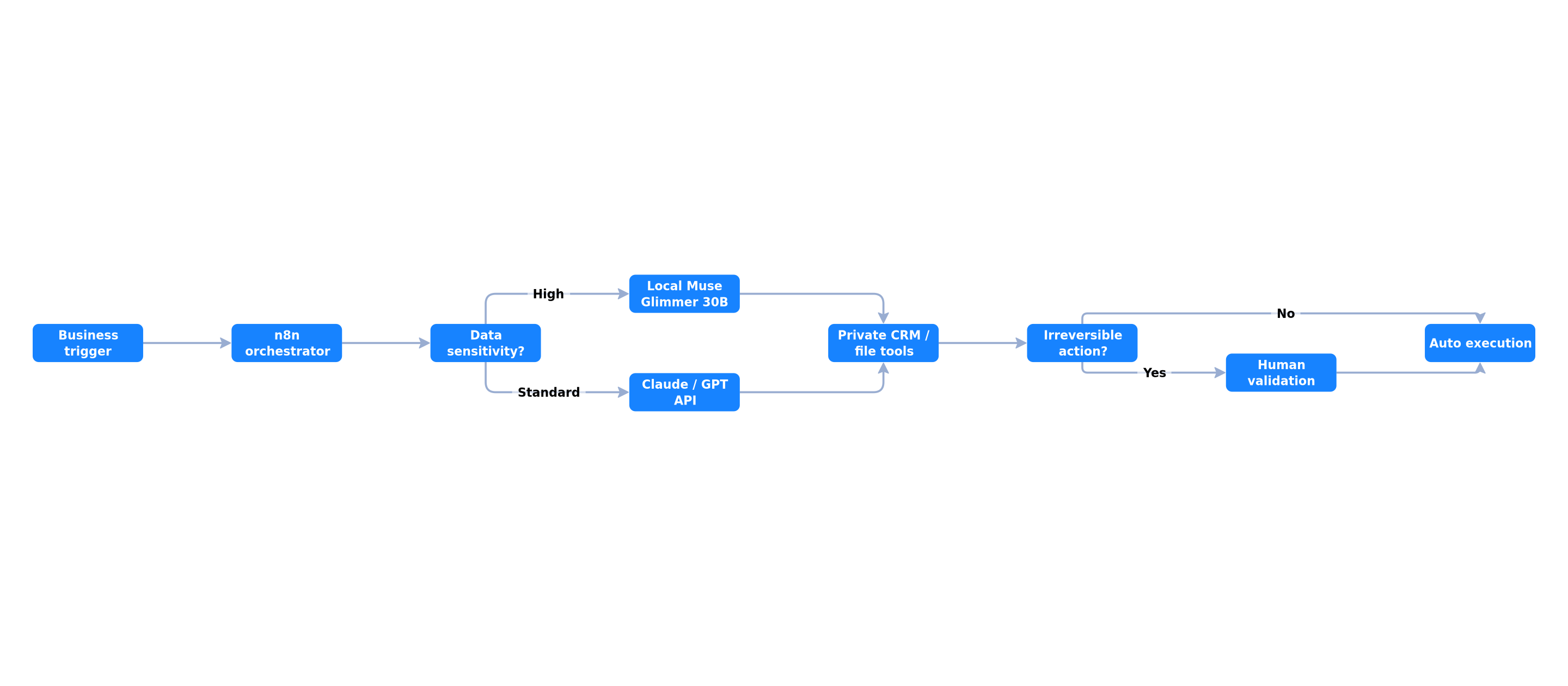 n8n routes by data sensitivity, with human validation on irreversible actions
This aligns two parts of our offer: AI chatbots / conversational agents for the user experience, and n8n automation for orchestration. Muse Glimmer then becomes a local inference engine, not a magical replacement for the whole stack.
Integrations and product maturity
Meta says weights are available now on Hugging Face, with runtime integrations landing in the following days: llama.cpp, MLX, ExecuTorch, Ollama, LM Studio, Unsloth, plus scale serving with vLLM and SGLang. Hosted partners (Together AI, Fireworks AI, OpenRouter) are also named for starting without local hardware.
SME reading: at launch, expect a friction window (runtime versions, docs, quantizations). That is not an argument against Muse Glimmer — it is an argument against promising “zero ops” to leadership.
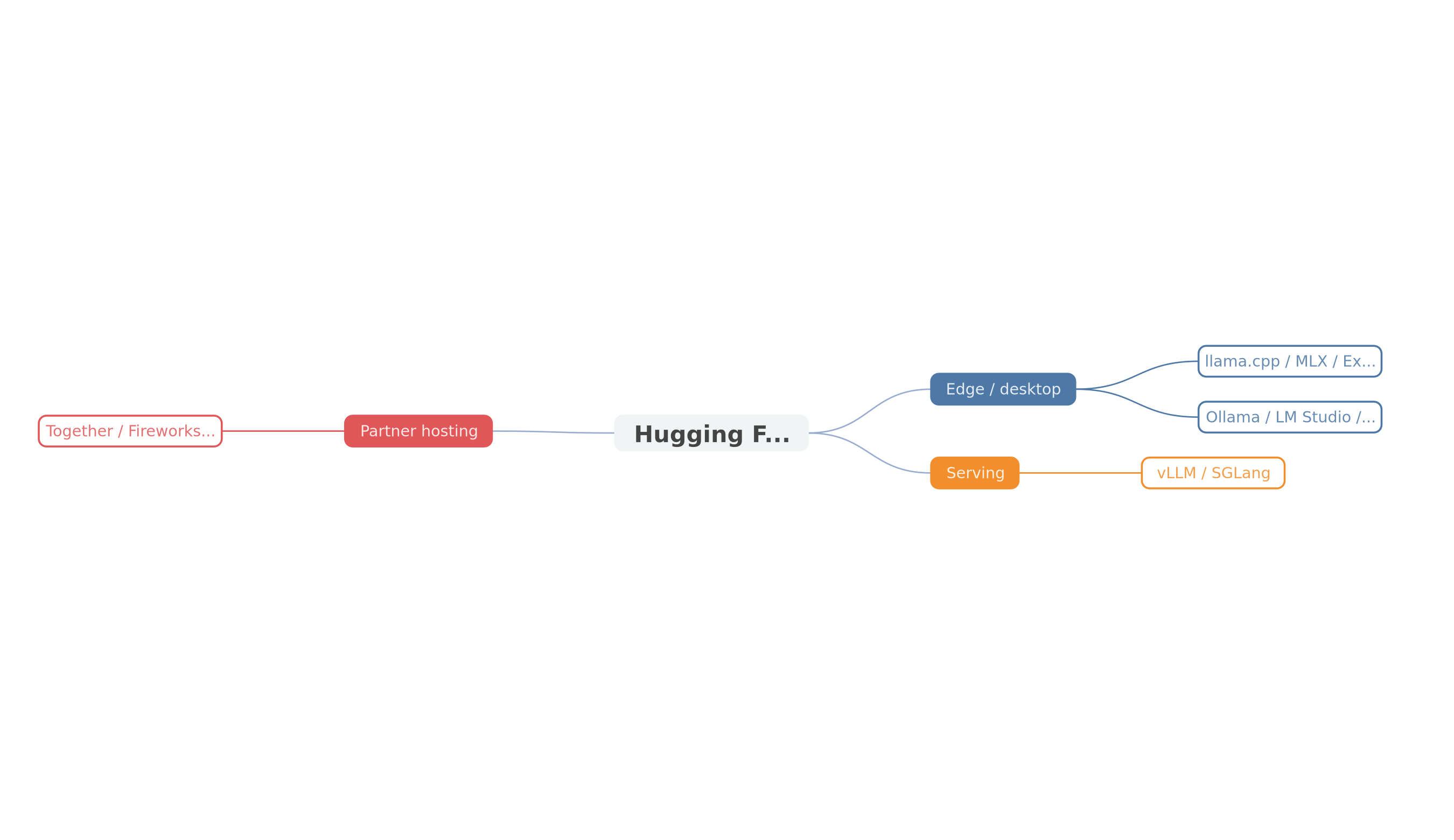 From Hugging Face weights to edge, serving, and partner hosting
Limits to keep in mind (no invented numbers)
Even with a solid Meta announcement, a few guardrails help SMEs stay honest:
- Open weights ≠ open training data. Meta releases weights and related artifacts under Apache 2.0; that does not mean training data or full training code are open.
- “Strong results” ≠ scores invented here. We point to Meta’s report rather than improvising percentages.
- Integrations land progressively. Ollama, LM Studio, Unsloth, llama.cpp and others are announced as arriving quickly — validate the runtime version before promising a date to the business.
- Local security. An always-on agent with tool use on your CRM is powerful… and dangerous without sandboxing, least privilege, and human approval on irreversible actions.
- 100+ languages does not replace a business test. Evaluate your prompts and documents in the languages you actually use — on your cases, not only English demos.
These limits do not reduce Muse Glimmer’s interest. They prevent treating it as a plug-and-play enterprise product on launch day.
Bottom line
Muse Glimmer is a meaningful open-weight milestone: 30B, Apache 2.0, multimodal, 100+ languages, built for always-on local agents, with ~4-bit quantization under 20 GB and DFlash speculative decoding. Meta reports strong agentic results versus Gemma4-31B and Qwen3.6-27B on the suites it highlights.
For an SME, usefulness is not automatic. If your priority is production speed and simplicity, n8n + cloud API still wins. If your priority is sovereignty, always-on local operation, or flat-rate volume cost — and you have the 24/32 GB hardware envelope — Muse Glimmer deserves a focused pilot on one real workflow (internal support, document triage, file agent).
One-week action plan, without over-promising:
- List three candidate workflows and rank data sensitivity.
- Estimate current LLM volume (API invoices) and time spent on manual supervision.
- Pick one local or hybrid pilot with success criteria (felt latency, tool errors, business satisfaction).
- Only then decide whether to invest in a dedicated 24/32 GB machine.
Need a no-hype architecture review? Talk to us about agents and automation: AI chatbot agency and n8n automation.
Tags
FAQ
Does Muse Glimmer really run on a single consumer GPU?
Yes, according to Meta Superintelligence Labs. The model is designed for a Mac or PC with a single consumer GPU. With ~4-bit quantization, the language-model weights shrink under 20 GB and fit a 24 GB or 32 GB memory envelope together with the KV cache, perception encoder, and DFlash drafter.
Should we drop n8n + Claude/GPT for Muse Glimmer?
No. For most SMEs, n8n plus a cloud API remains the fastest path. Muse Glimmer becomes relevant when data sovereignty, flat-rate volume cost, or always-on offline agents matter more. A hybrid stack (n8n for orchestration, Muse locally for sensitive steps) is often the best compromise.
What license does Meta use for Muse Glimmer?
Apache 2.0. Weights are on Hugging Face. Meta announces upcoming integrations with llama.cpp, MLX, ExecuTorch, Ollama, LM Studio, Unsloth, vLLM, and SGLang, plus hosted partners such as Together AI, Fireworks AI, and OpenRouter.
Which benchmarks does Meta highlight for Muse Glimmer?
Meta cites DeepSearch QA, MCP-Atlas, τ-Bench, and SWE-Bench for end-to-end agentic tasks. The company reports strong results versus Gemma4-31B and Qwen3.6-27B in its size class. This article does not invent numeric scores — see Meta's evaluation report for details.
Can BOVO Digital help choose between local and cloud?
Yes. We audit your workflows, data sensitivity, and LLM call volume, then recommend a realistic architecture: cloud API, a local agent such as Muse Glimmer, or a hybrid n8n design. See also our AI chatbot and n8n automation service pages.
Free audit: we check the impact on your site and workflows
Next.js CVE, new agent, MCP… We tell you what actually applies, and what to patch or ignore.
- 30 min
- Stack reviewed
- No commitment
William Aklamavo
Web development and automation expert, passionate about technological innovation and digital entrepreneurship.


