
Tech Recap July 2026: Claude Code Was Spying on Users, GhostLock Threatens Your Servers
Two dense weeks: a hidden tracker discovered in Claude Code, the critical GhostLock Linux flaw, and the launch of GPT-5.6. What SMBs and agencies need to check right now.

Tech Recap July 2026: Claude Code Was Spying on Users, GhostLock Threatens Your Servers
Two weeks, three stories that should all land on the desk of your SMB's technical lead: an AI development tool caught red-handed with hidden surveillance, a 15-year-old critical Linux kernel flaw, and the launch of the year's most contested AI model. Here's what you actually need to take away.
Between June 26 and July 11, 2026, the tech ecosystem went through one of its densest sequences since the start of the year. Three methodologically very different events — a trust scandal at Anthropic, a critical Linux kernel vulnerability, and a commercial battle fought with new AI models — collided within a two-week window. For an agency like BOVO Digital, which deploys n8n automations and AI agents for SMBs in France and French-speaking Africa, this concentration of news isn't trivial: it directly touches your server security, the confidentiality of your development data, and your day-to-day choice of AI tools.
We already broke down the launch of GPT-5.6 and ChatGPT Work in a dedicated article. This recap focuses on the two stories that mainstream press covered less, but which have direct operational impact for your business: Anthropic's hidden tracker and the GhostLock flaw.
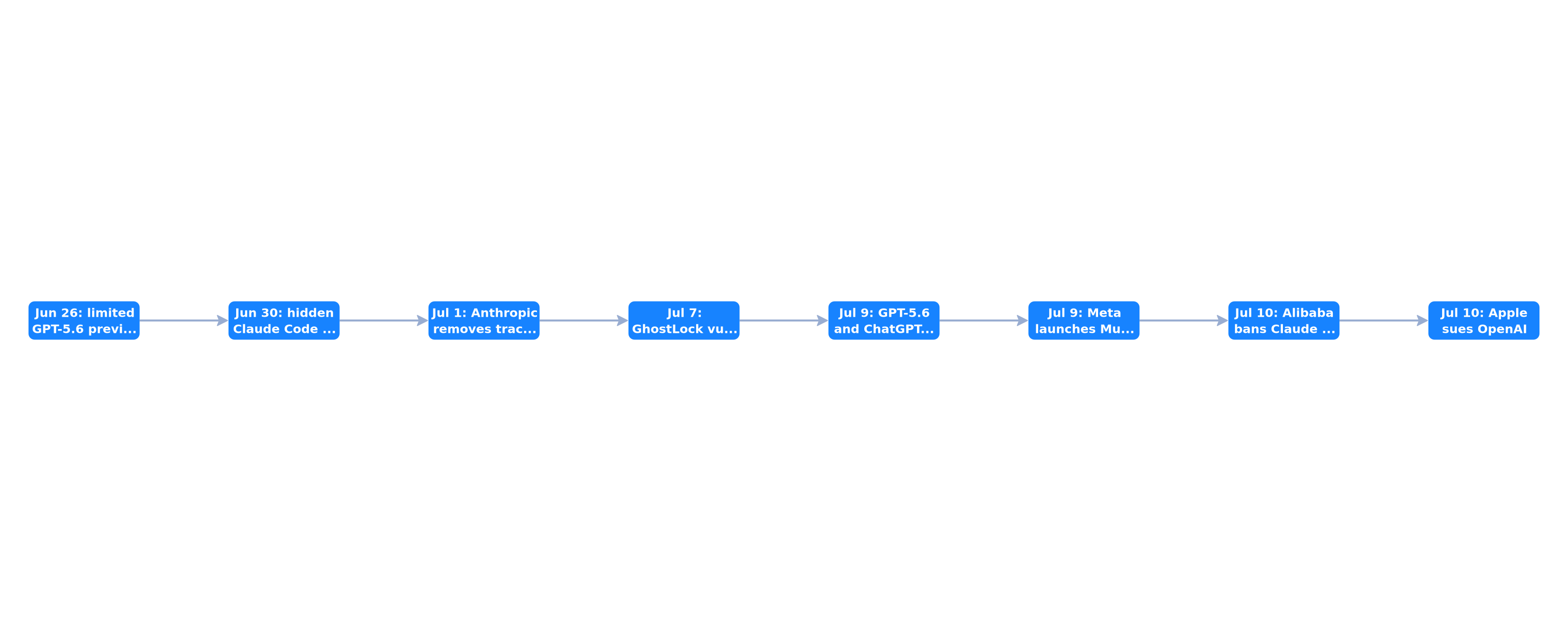 Timeline: GPT-5.6 preview on June 26, Claude Code tracker discovery on June 30, removal on July 1, GhostLock publication on July 7, GPT-5.6/ChatGPT Work and Muse Spark launch on July 9, Alibaba ban and Apple lawsuit on July 10
The story worrying developers the most: Claude Code's hidden tracker
What was discovered
On June 30, 2026, two independent researchers — a developer known by the pseudonym Thereallo and a Reddit user named LegitMichel777 — uncovered a hidden mechanism inside Claude Code, Anthropic's AI-assisted development tool. This code, present since version 2.1.91 released on April 2, 2026, with no mention whatsoever in the release notes, silently altered the system prompt sent with every user request.
Technically, the mechanism relied on prompt steganography: it inserted invisible markers (including a subtly different apostrophe character in the phrase "Today's date is") to encode information about the user's environment — their timezone ("Asia/Shanghai," "Asia/Urumqi"), proxy usage, and a possible connection to Chinese AI labs. The code was additionally obfuscated with XOR encryption, making it invisible to a simple text inspection.
Anthropic's justification
Asked about it on X, Anthropic engineer Thariq Shihipar, a member of the Claude Code team, confirmed that this mechanism was added in March 2026 as an "experiment meant to prevent account abuse from unauthorized resellers and protect against distillation." Distillation refers to the practice of a competing lab systematically querying a proprietary model to extract and replicate its capabilities in their own model — a practice Anthropic has previously accused Chinese companies like DeepSeek, Moonshot, and MiniMax of engaging in.
On the business side, this justification isn't baseless: The Washington Post reported that Claude Pro subscriptions normally priced above $100/month were being resold by unauthorized intermediaries for roughly $12/month.
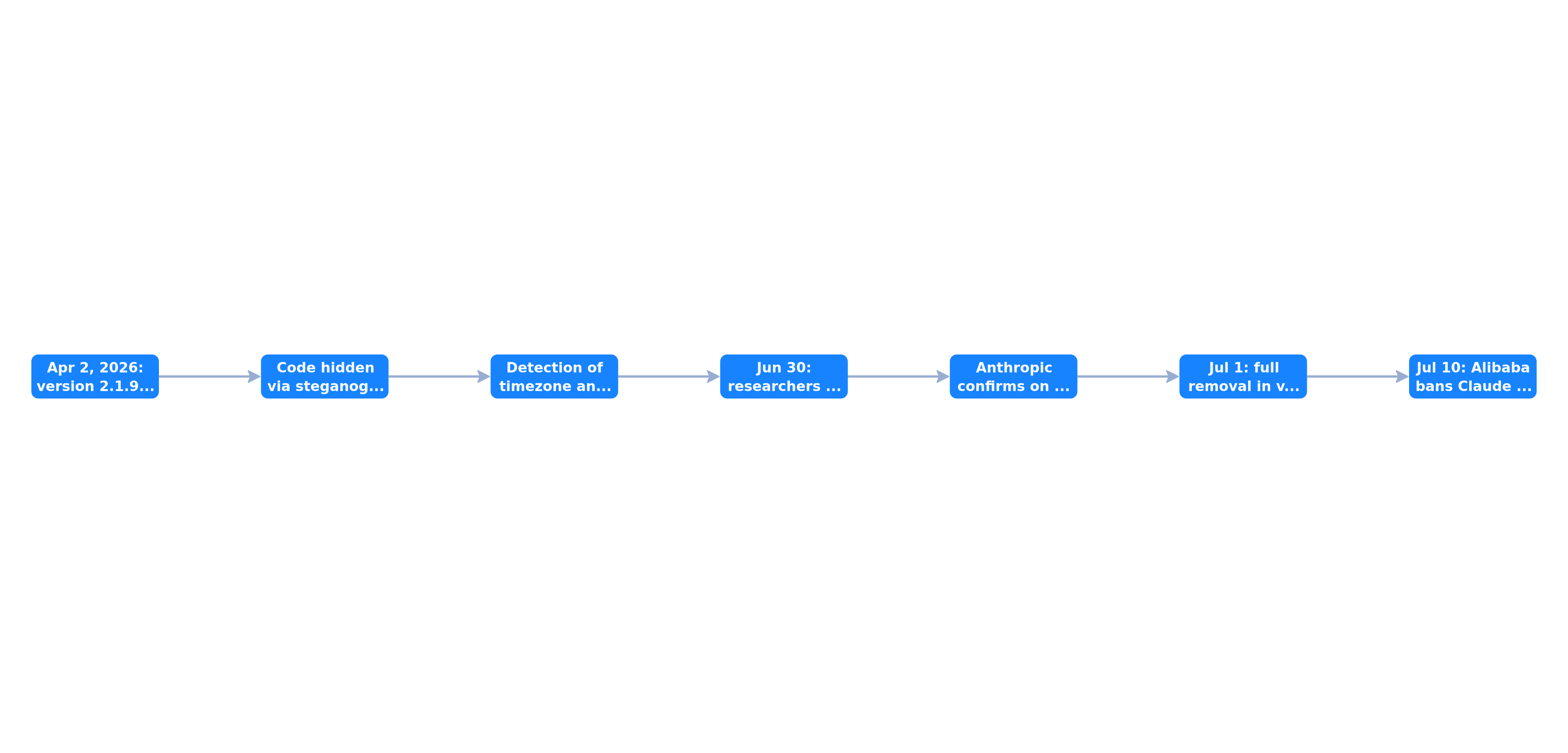 Sequence: silent release on April 2, steganography in the system prompt, timezone and Chinese proxy detection, public exposure on June 30, Anthropic's confirmation, removal on July 1, Alibaba ban on July 10
An embarrassing contradiction
What makes this case particularly awkward for Anthropic is the contrast with its public positioning. The company has historically presented itself as the AI lab most concerned with safety and privacy — going as far as refusing to let the US administration use Claude to surveil American citizens, a dispute that led Anthropic to sue the White House. Discovering that the same company ran an undisclosed surveillance mechanism for roughly three months was seen by many developers as a serious breach of trust, regardless of the merits of the technical justification.
The concrete fallout
The most tangible reaction came from China: according to the South China Morning Post, Alibaba banned the use of Claude Code for all its employees, effective around July 10, 2026, citing "back-door risks." This is the most concrete consequence so far, and it signals that enterprise trust — particularly in security-sensitive environments — is now a live issue for Anthropic's developer tools business.
Anthropic shipped the fix in version 2.1.197 as early as July 1, 2026, just one day after the public exposure — a fast response that contrasts with the lack of disclosure over the preceding three months.
What this means for your agency or SMB
This case doesn't mean you should abandon AI development tools overnight. But it reinforces a simple rule we apply systematically in our audits at BOVO Digital: no AI tool connected to your code or your data should be treated as an absolutely trusted black box, regardless of its vendor's reputation. Document precisely which tools access what, review release notes regularly, and for your most sensitive processes, favor an architecture you control — one of the central arguments in our guide to securing an n8n pipeline after a supply chain incident.
It's also worth noting what this incident is not. The hidden code did not exfiltrate source code, credentials, or proprietary business logic — its scope was limited to environmental signals (timezone, proxy usage) used to flag potential distillation activity. That distinction matters when assessing real risk versus reputational damage. For most SMB users of Claude Code outside of the flagged detection criteria, the practical data exposure was close to nil. The real lesson is about process: a change with this level of sensitivity shipped without a changelog entry, without a privacy policy update, and without any user-facing disclosure for three months. That gap between what a vendor says about its values and what ships in production is precisely what a governance checklist should catch before it becomes a headline.
GhostLock: a 15-year-old flaw finally exposed
A vulnerability almost as old as the modern cloud
On July 7, 2026, security research team Nebula Security (under the banner VEGA) published technical details of a vulnerability it named GhostLock, tracked as CVE-2026-43499. It's a use-after-free defect in the Linux kernel's real-time mutex (rtmutex) handling code, specifically in the remove_waiter() function.
The detail that struck the security community the most: this flaw has existed in the Linux kernel since version 2.6.39, released more than 15 years ago, and was only fixed in version 7.1. Virtually every commercial Linux distribution that hasn't updated its kernel in recent months is affected.
What exploitation allows
According to Nebula Security's publication, exploiting GhostLock requires no special privileges or specific kernel configuration. An unprivileged user can exploit it to gain full root access, and — critically for modern cloud architectures — to escape a container to the host machine. The research team claims to have turned this flaw into a 97% reliable privilege-escalation method, which earned it a $92,337 reward through Google's kernelCTF program.
A fix was actually proposed to the kernel as early as April 21, 2026 (commit 3bfdc63936dd), before the research was even publicly released — a classic responsible-disclosure timeline in the open source security world. But many distributions had not yet incorporated this fix into their production releases by the time of disclosure.
Who is affected, concretely
The table below summarizes the situation, as documented by official security advisories as of July 9-10, 2026:
- AlmaLinux 8, 9, 10: patches available in production since July 9, 2026 (versions
kernel-4.18.0-553.141.2.el8_10,kernel-5.14.0-687.24.1.el9_8,kernel-6.12.0-211.32.1.el10_2or higher). - Ubuntu 26.04 LTS (Resolute): fixed in version
7.0.0-27.27. - Ubuntu 25.10, 24.04 LTS, 22.04 LTS and earlier: vulnerable at time of publication, fixes rolling out depending on version.
- Debian 13 (kernel 6.12.95) and recent vanilla kernels close to 6.6.144: not vulnerable according to independent tests reported on the oss-security mailing list.
There is no practical workaround: no module to block, no alternative configuration. Only a kernel update (or a live patch, where available) fixes the issue.
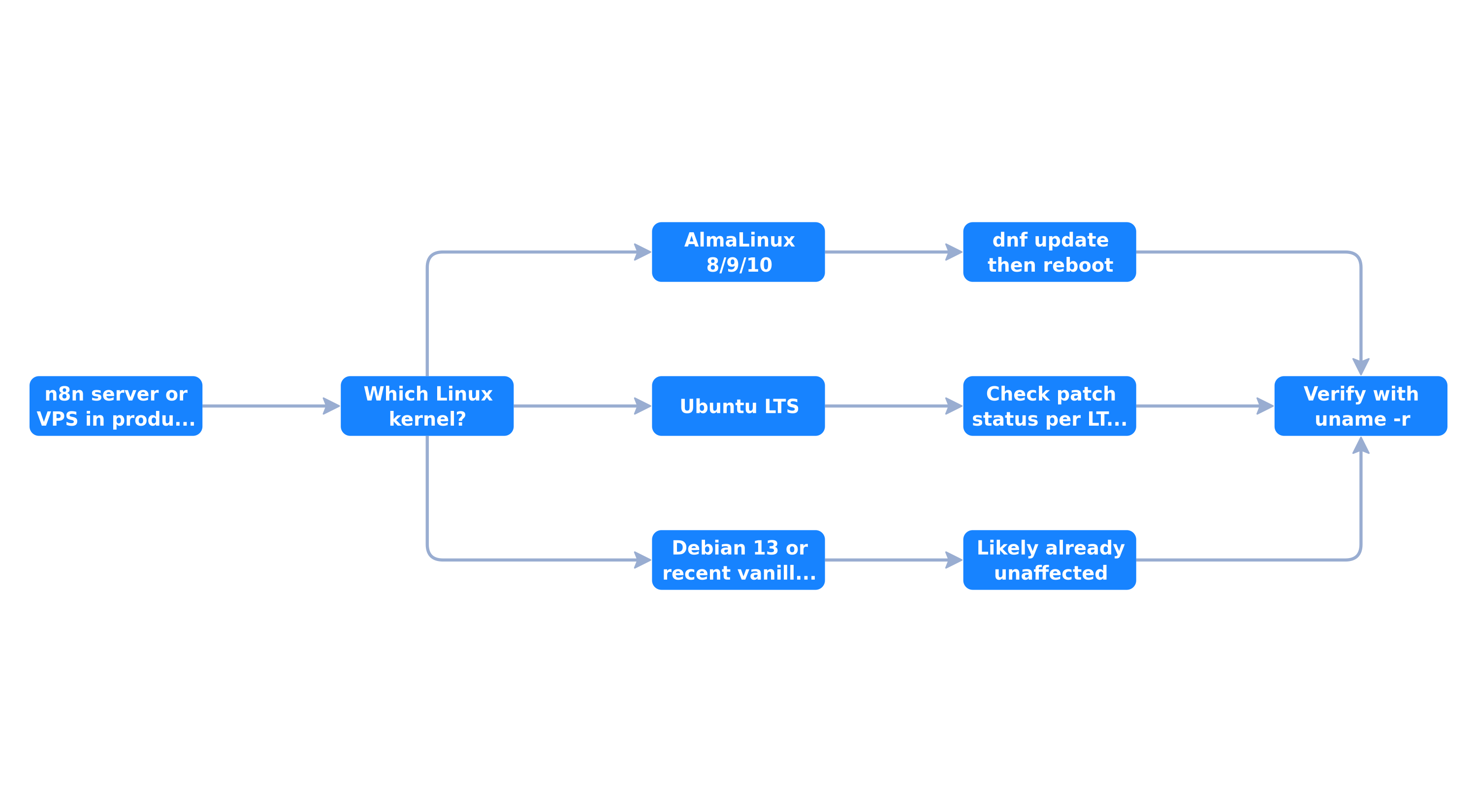 Decision tree: identify your distribution (AlmaLinux, Ubuntu, Debian), apply the appropriate patch, verify with uname -r
Why this directly concerns automation agencies
If your company hosts n8n workflows self-hosted on a VPS — a practice we systematically recommend for SMBs concerned about data sovereignty, as detailed in our self-hosted n8n VPS deployment guide — this type of flaw is exactly the scenario that justifies a rigorous update policy. A multi-tenant or multi-container environment (Docker, Kubernetes) where several client workflows run on the same physical machine is particularly exposed: a container-escape flaw like GhostLock can turn a minor compromise into full access to the host server.
The fact that a $92,337 bug bounty was paid for a 97%-reliable exploit also tells you something about the current market for kernel-level vulnerabilities: they are valuable, actively hunted, and increasingly well-funded on the defensive side too. For an SMB without an internal security team, the practical takeaway isn't to start hunting for zero-days yourself — it's to make sure your managed hosting provider or your internal ops process has an unambiguous, tested procedure for applying kernel security patches within days of disclosure, not weeks.
Meanwhile, the AI model battle continues
These two security and trust incidents didn't happen in a vacuum. The same two-week window saw OpenAI launch GPT-5.6 and ChatGPT Work on July 9, 2026 (which we analyzed in detail in our dedicated article), as well as Meta unveiling Muse Spark 1.1, a multimodal model for agentic coding that Mark Zuckerberg personally described as "a strong agentic and coding model at a very low price." SpaceXAI released Grok 4.5, positioned for coding and enterprise knowledge work, intensifying an already dense competition among at least four major labs.
A revealing comparison
To make sense of this climate of competition and trust tension, we compared three categories of players — Anthropic, OpenAI, and open-weight models — on four criteria that genuinely matter to an SMB: telemetry transparency, pricing stability, openness of weights or API, and responsiveness to flaws.
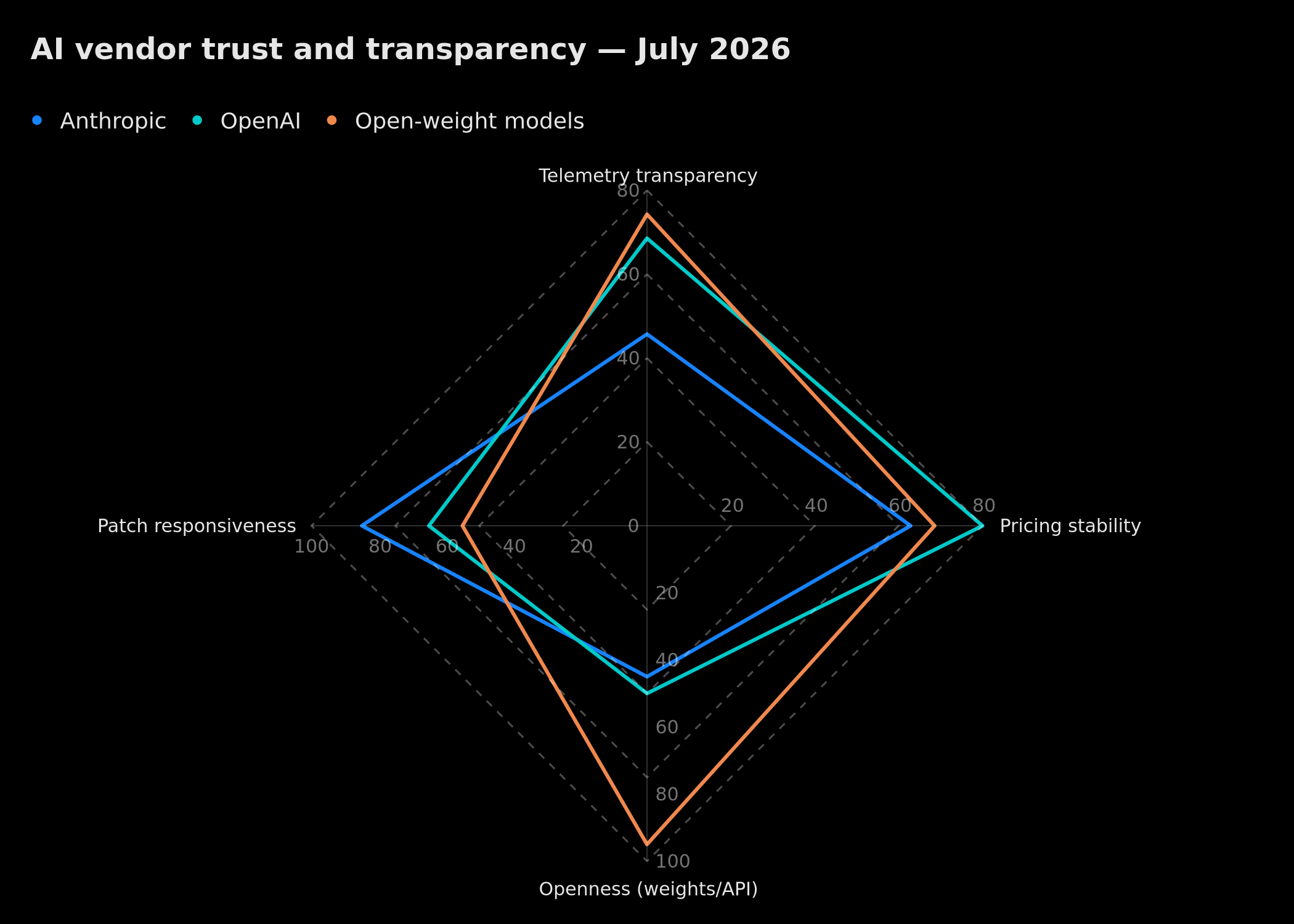 Comparison: Anthropic leads on patch responsiveness (85) but remains weak on telemetry transparency (40), OpenAI is more balanced, open-weight models lead on openness (95)
What stands out in this comparison is that responsiveness to an incident (Anthropic's 24-hour fix) doesn't fully compensate for a prior transparency deficit (three months of silence). For an SMB evaluating its AI vendors, both dimensions matter: reaction speed AND ongoing transparency.
The time factor: comparing resolution delays
Another useful angle is comparing the delay between public discovery of an issue and its actual resolution, across several recent incidents in the AI and cybersecurity ecosystem.
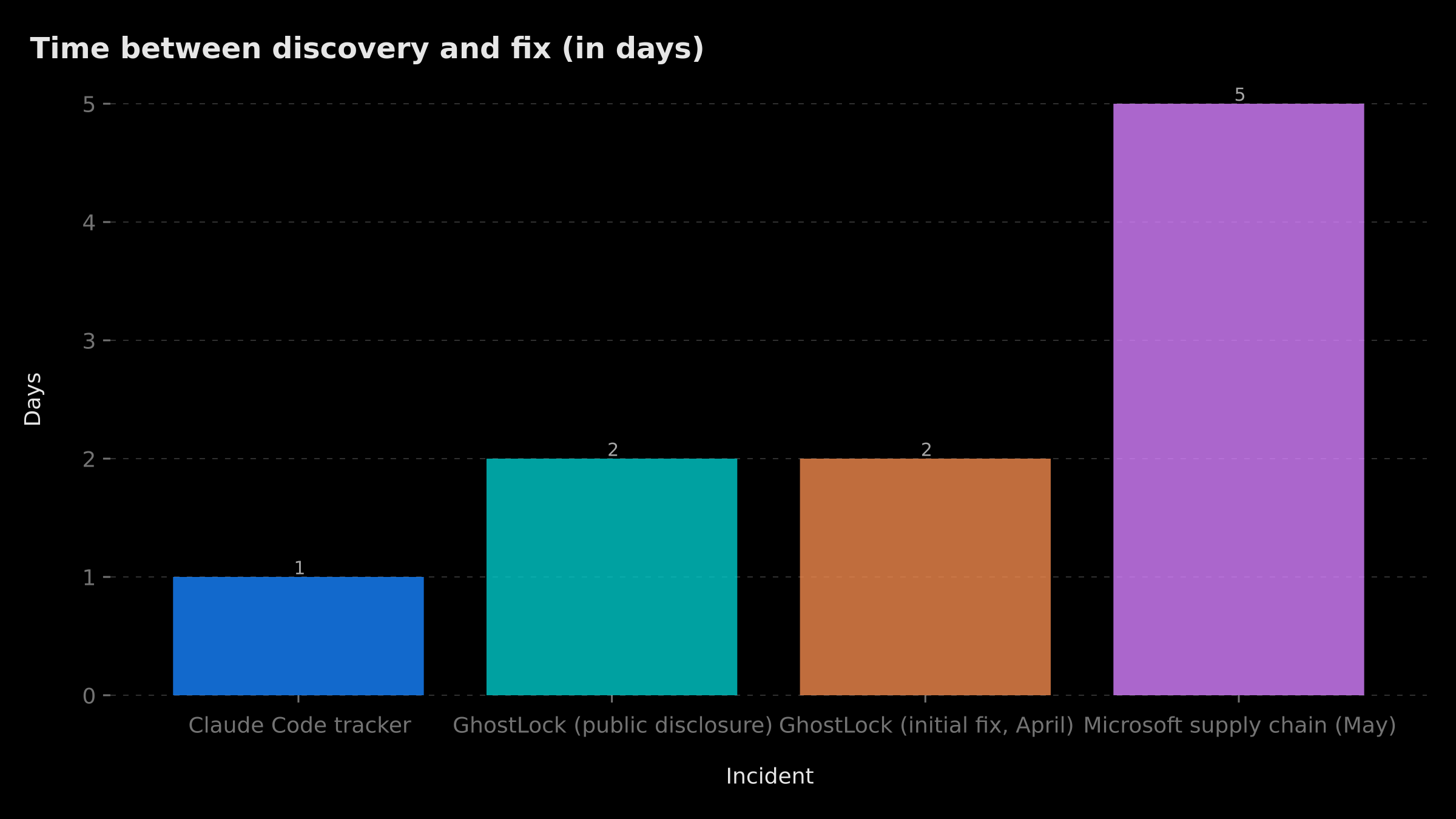 Delay in days: Claude Code tracker fixed in 1 day, GhostLock (public disclosure and initial April fix) in 2 days each, Microsoft supply chain incident in 5 days
This chart illustrates a globally positive trend: major tech players have significantly reduced their reaction times since the 2025-2026 supply chain incidents. But a fast fix never replaces a prior audit — which is exactly what we systematically recommend in our engagements.
Three other signals of the week worth noting
Beyond the two main stories, three other announcements from this same window deserve mention, as they point to underlying trends for 2026.
Fidji Simo's departure from OpenAI
On July 9, 2026, Fidji Simo, OpenAI's CEO of AGI Deployment (and former CEO of Instacart), announced on X that she was stepping down from her full-time role to become a part-time advisor. She had been on medical leave since April 2026 due to a severe exacerbation of a chronic neuroimmune condition, postural orthostatic tachycardia syndrome (POTS), which she has lived with for seven years. Sam Altman publicly expressed his gratitude on X. This departure comes as OpenAI prepares for a potential IPO, adding a governance dimension worth watching for industry observers.
AI's energy bill keeps climbing
On June 30, 2026, Google published its annual environmental report, revealing a 37% increase in electricity consumption in 2025 — the largest annual jump in the company's history, bringing cumulative growth since 2019 to over 250%. Google's data centers consumed more than 42 million megawatt-hours, a volume comparable to the total electricity consumption of countries like New Zealand. Supply-chain emissions (chip and server manufacturing) jumped 25% for the year. Days earlier, Microsoft reported a 25% rise in total carbon emissions for fiscal 2025, also attributed to massive AI data center construction.
For an SMB considering large-scale AI agent deployment, these figures aren't just corporate communications: they signal likely pressure on energy costs and, potentially, on cloud service pricing in the coming years. It's one more argument in favor of a lean architecture — process locally what can be processed locally, and reserve calls to the heaviest models (like GPT-5.6 Sol) for tasks that genuinely justify it, a FinOps logic we apply in every automation audit we run.
The coding agent race keeps consolidating
With GPT-5.6, Muse Spark 1.1, and Grok 4.5 all released within two weeks, the battle for the reference enterprise AI coding agent keeps intensifying. Each player now competes less on raw power and more on cost-to-performance ratio and the ability to integrate into real business workflows rather than mere technical demos — a trend that directly benefits open orchestration architectures like n8n, capable of routing to different models depending on the task rather than depending on a single vendor.
Taken together, these three signals sketch a maturing market. Leadership transitions at the very top of the AGI race (Simo's departure follows earlier medical leaves by OpenAI's COO Brad Lightcap and CMO Kate Rouch), rising physical infrastructure costs, and intensifying price competition among model providers all point toward an industry that is being forced to reconcile ambitious roadmaps with operational and human limits. For SMB decision-makers, this is useful context: the AI tools you adopt today are being built inside organizations under real strain, which is one more reason to build your own workflows in a way that survives a vendor's bad quarter, leadership change, or pricing shift.
A word on incident timing and disclosure culture
One pattern worth naming explicitly across both stories: the gap between when a fix exists and when the public learns about the problem keeps shrinking, but the gap between when a problem starts and when it is disclosed remains stubbornly long. GhostLock's underlying bug was fixed in the kernel on April 21, 2026, nearly three months before Nebula Security's public writeup on July 7. The Claude Code tracker ran silently from April 2 to June 30, also close to three months. In both cases, the fix itself, once triggered by public pressure or responsible disclosure, arrived within a day or two.
This isn't a coincidence particular to these two cases — it reflects how modern software supply chains and AI development tools actually operate: patches get written quietly, security researchers work under embargo periods, and companies often sit on internal findings until external pressure (a bug bounty payout, a public researcher, a competitor's move) forces the issue into the open. For an SMB, the operational lesson is not to wait for a headline before checking your own exposure. Subscribing to your distribution's security mailing list, and to release notes for every AI tool your teams touch, is a low-cost habit that closes part of that disclosure gap on your side, even when vendors are slow to close it on theirs.
What to check in the next 14 days
Faced with this pile of information, here is the operational plan we recommend to our clients, without giving in to panic or inaction.
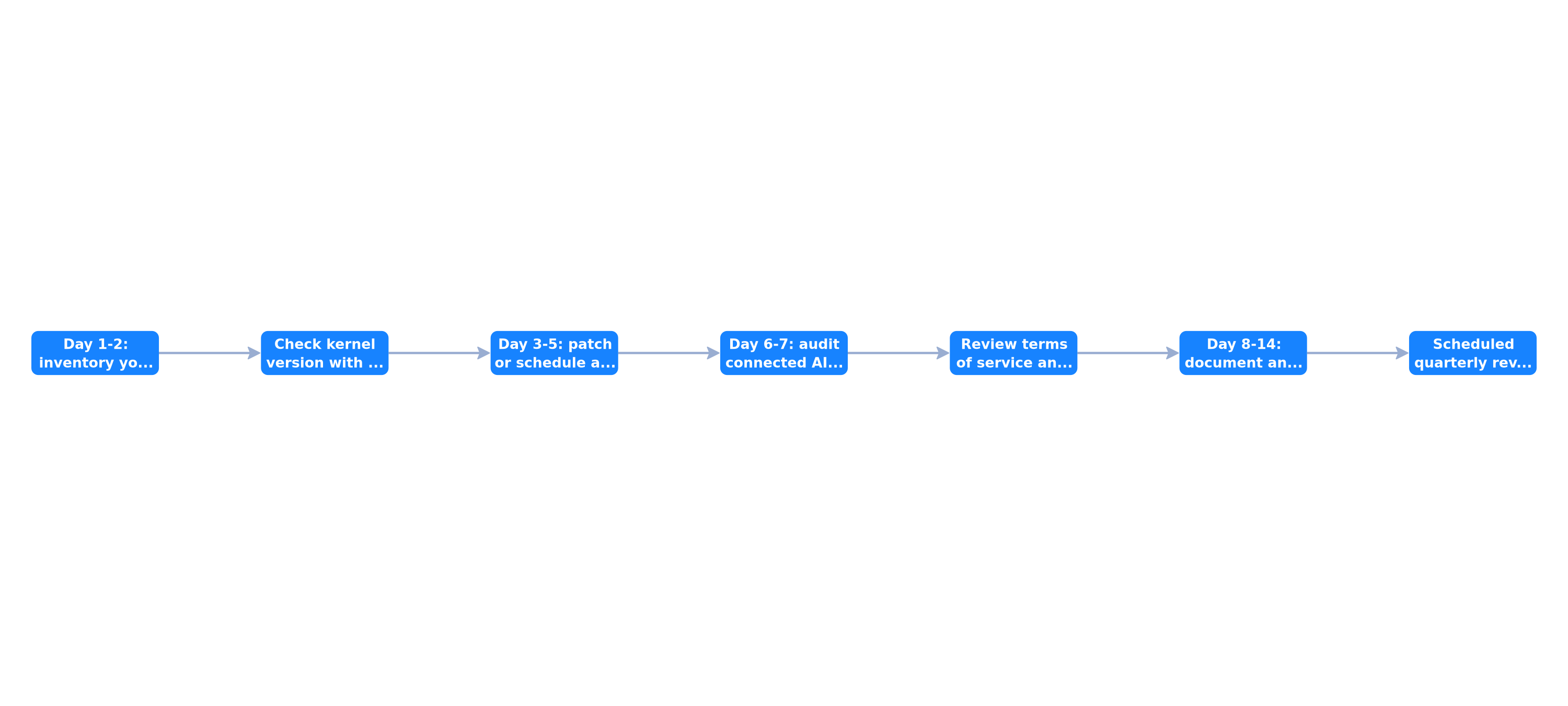 Action plan: days 1-2 server inventory, days 3-5 GhostLock patching, days 6-7 audit of connected AI tools, days 8-14 documented AI usage policy
Days 1-2: inventory your servers
List every n8n server, VPS, and production environment under your responsibility. For each, run uname -r to identify the exact kernel version.
Days 3-5: patch or schedule
Compare your kernel version against the fixed versions published by your distribution. If vulnerable, schedule a maintenance window to apply the patch and reboot. Don't wait: the absence of a workaround makes this step non-negotiable.
Days 6-7: audit your connected AI tools
Take inventory of every AI development tool used by your teams (Claude Code, GitHub Copilot, Cursor, others). For each, review the business terms of service and the telemetry practices documented by the vendor.
Days 8-14: document an internal policy
Formalize an AI tool usage policy within your company: which tools are approved, on which types of data, with what periodic review. Schedule a quarterly review to stay current with an ecosystem moving at this pace.
Our support at BOVO Digital
These two stories illustrate something we repeat to every client: the speed of AI innovation comes with a growing exposure to security and trust risks that evolve just as fast. A well-designed architecture doesn't eliminate these risks, but it limits their blast radius — that's the whole point of an automation audit at BOVO Digital, which systematically starts with a map of your servers, your connected AI tools, and your critical dependencies.
For companies looking to regain control of their automation infrastructure with a self-hosted stack rather than depending entirely on third-party cloud tools, our n8n automation agency page documents precisely the security best practices we apply on every client deployment. And if you need custom AI agents while keeping full control over the data being processed, our AI agent creation offering systematically integrates data governance thinking from the initial POC.
Conclusion
Two weeks, two very different stories, the same lesson: in 2026, trust in an AI tool or software infrastructure is never permanently earned. Claude Code's hidden tracker is a reminder that even labs presenting themselves as the most virtuous can make opaque choices for months before being caught by open source community transparency. GhostLock is a reminder that a flaw can lie dormant for fifteen years in a component as fundamental as the Linux kernel before being exposed and fixed within days once made public. And departures like Fidji Simo's, or the relentless rise in AI's energy bill, remind us that behind every announcement of a more powerful model lie real human and environmental costs.
For the French-speaking SMBs and agencies reading this, the best protection remains what it has always been: a precise inventory of what you use, regular monitoring rather than reacting only to a crisis, and an architecture that never depends entirely on a single vendor or a single unverified software version. That's exactly what we build, project after project, at BOVO Digital.
Tags
FAQ
What is the hidden tracker discovered in Claude Code?
It's a "prompt steganography" mechanism embedded in Claude Code since version 2.1.91, released on April 2, 2026, with no mention in the release notes. This code silently altered the system prompt sent with every request to detect whether the user was connecting from a Chinese timezone or through a proxy linked to Chinese AI labs. The mechanism was publicly exposed on June 30, 2026 by researchers Thereallo and LegitMichel777, and Anthropic fully removed it on July 1, 2026 with version 2.1.197.
Why did Anthropic implement this tracker?
According to public explanations from an Anthropic engineer on X, this code was added in March 2026 as an experiment to combat account abuse by unauthorized resellers and to protect against distillation attacks, where competing labs systematically query a model to extract and replicate its capabilities. The Washington Post reported that Claude Pro subscriptions, normally priced above $100/month, were being resold by unauthorized resellers for about $12/month.
What is the GhostLock vulnerability (CVE-2026-43499)?
GhostLock is a critical privilege-escalation vulnerability in the Linux kernel, present in the real-time mutex handling code since version 2.6.39 (roughly 15 years) and fixed in version 7.1. It allows an unprivileged user to gain root access and escape a container to the host machine, with no special privileges required. It was discovered by the Nebula Security research team (VEGA), which received a $92,337 reward through Google's kernelCTF program.
Are my self-hosted n8n servers affected by GhostLock?
It depends on your distribution and kernel version. Distributions on recent LTS kernels close to the mainline (such as Debian 13 with kernel 6.12.95, or a vanilla kernel 6.6.144 and above) are generally not vulnerable. AlmaLinux 8, 9, and 10 have had production patches since July 9, 2026. For Ubuntu, status varies by LTS version; some remain vulnerable pending a fix. Verify with the `uname -r` command after updating, comparing against the fixed versions published by your distribution.
Should I stop using Claude Code after this discovery?
Not necessarily, but an audit is warranted. The removed code was not malicious in the strict sense — it wasn't stealing sensitive data — but it illustrates a lack of transparency over three months without disclosure to users. For an agency or SMB, best practice is to precisely document which AI tools are connected to your systems, regularly review their release notes, and maintain an architecture (such as self-hosted n8n) that does not depend exclusively on a single vendor for your most sensitive processes.
Are these two incidents connected?
No, these are two independent incidents that simply occurred within the same two-week window, alongside other major announcements such as OpenAI's launch of GPT-5.6 and ChatGPT Work, and Meta's Muse Spark 1.1. This concentration of news illustrates how fast the AI ecosystem is moving in 2026, and the need for SMBs to maintain regular technical monitoring rather than reacting only to crises.
Free audit: we check the impact on your site and workflows
Next.js CVE, new agent, MCP… We tell you what actually applies, and what to patch or ignore.
- 30 min
- Stack reviewed
- No commitment

Vicentia Bonou
Full Stack Developer & Web/Mobile Specialist. Committed to transforming your ideas into intuitive applications and custom websites.


