
GPT-5.6 and ChatGPT Work: What SMBs Need to Know
OpenAI launched GPT-5.6 (Sol, Terra, Luna) and the ChatGPT Work agent on July 9, 2026. A factual breakdown, pricing analysis, comparison with n8n, and an action plan for SMBs and automation agencies.

GPT-5.6 and ChatGPT Work: What SMBs Need to Know
On July 9, 2026, OpenAI didn't just update a model. It launched an entire family — Sol, Terra, Luna — and an agent designed to take over part of everyday office work. For French-speaking SMBs, the question is no longer "should we adopt AI," but "which level of automation should we choose, and at what cost."
July 9, 2026 will stand as a reference date in this year's AI calendar. OpenAI launched the GPT-5.6 family in general availability — three models named Sol, Terra, and Luna — and unveiled ChatGPT Work, an office agent that merges the capabilities of ChatGPT and Codex. The week closed on a more contentious note: on July 10, Apple sued OpenAI, accusing former employees of stealing trade secrets.
For an agency like BOVO Digital, which deploys AI agents and n8n automations for SMBs in France and French-speaking Africa, this kind of announcement is never just a news item. It's a signal that must be translated immediately into concrete decisions: should we migrate to the GPT-5.6 API? Does ChatGPT Work replace an ongoing n8n project? What's the impact on the AI budget of a 15-employee SMB?
This article breaks down the announcements using facts published by OpenAI and covered by specialized press (TechCrunch, The Verge, MacRumors, 9to5Mac), analyzes real pricing, positions ChatGPT Work against an n8n + AI agents stack, and proposes an operational 30-day action plan. You'll find seven diagrams and an FAQ to get straight to the point.
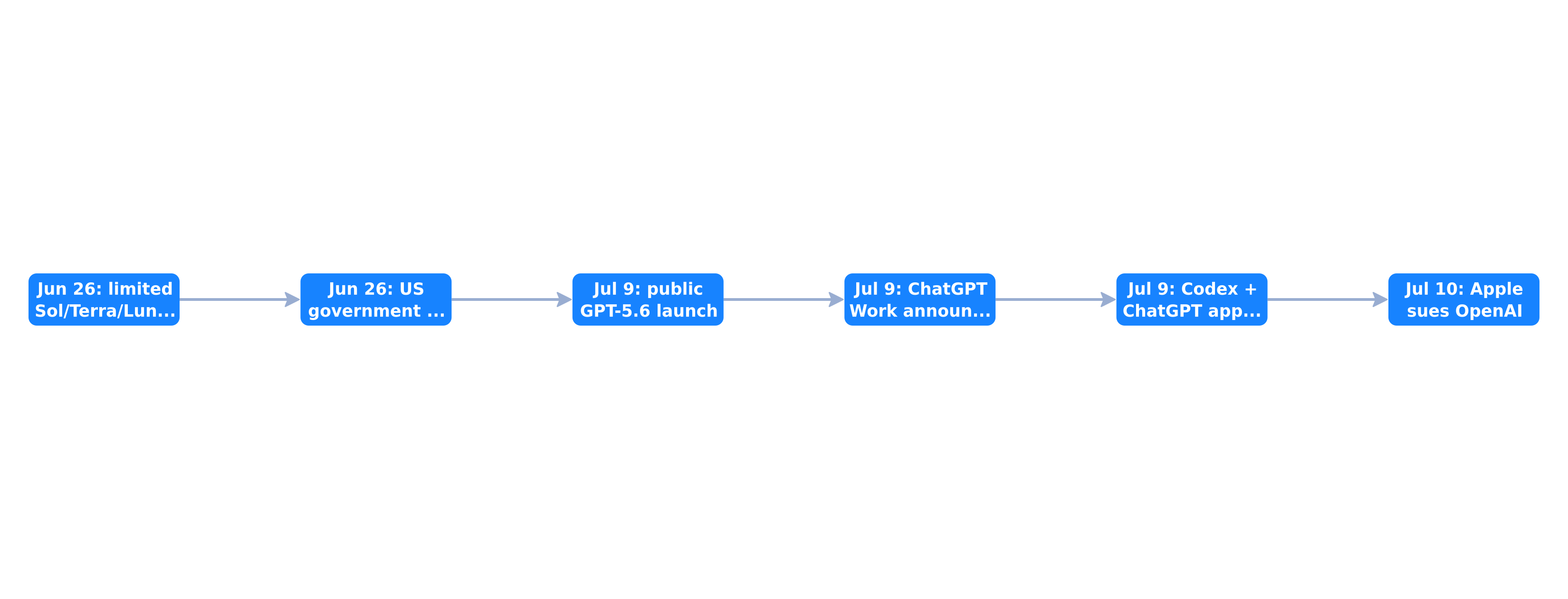 July 2026 timeline: limited preview on June 26, public launch on July 9, ChatGPT Work, Codex/ChatGPT app merge, then Apple's lawsuit on July 10
A decisive week for the AI ecosystem
Context: a preview under government oversight
The story begins on June 26, 2026, when OpenAI opens a limited preview of GPT-5.6 Sol to a restricted circle of trusted partners. This choice is not incidental: according to OpenAI's official communications, this phase is part of coordination with the US administration, under a future regulatory framework referred to as a "cyber Executive Order." OpenAI explicitly states it does not want this kind of prior government access to become the norm, but accepts it as a transitional step to accelerate general availability.
This detail matters for French-speaking SMBs: it shows that the most powerful models now go through visible oversight phases before full commercial availability. The pace of innovation remains high, but it comes with increasingly visible governance — a point worth watching if your company structurally depends on a single model provider. We already flagged this single-vendor dependency risk in our analysis of the US government suspending Fable 5.
July 9, 2026: general availability and a double announcement
On July 9, everything accelerates. OpenAI simultaneously announces:
- General availability of GPT-5.6 (Sol, Terra, Luna) across ChatGPT, Codex, and the API, with a rollout described as reaching full availability within 24 hours.
- The launch of ChatGPT Work, an agent explicitly positioned as the "non-technical office colleague" version of Codex.
- The merger of the Codex app with the ChatGPT desktop app — a structural change that simplifies access to coding capabilities for all ChatGPT users, not just developers.
That same week saw other major competing announcements: Meta unveiled Muse Spark 1.1, a multimodal model for agentic coding, and SpaceXAI released Grok 4.5, positioned for coding and enterprise knowledge work. Mark Zuckerberg described Spark as "a strong agentic and coding model at a very low price." Competition in enterprise AI agents has never been this intense as of summer 2026.
Apple strikes back on July 10
On July 10, 2026, Apple filed a lawsuit accusing former employees of stealing trade secrets on behalf of OpenAI. This legal case, widely covered by 9to5Mac and MacRumors, is a reminder of something SMB leaders sometimes underestimate: the war over talent and intellectual property in AI is no longer a topic reserved for tech giants. If your agency or team works with freelancers or contractors on sensitive AI projects, confidentiality and non-compete clauses deserve a fresh look — a topic we'll explore further in an upcoming entrepreneurship article.
GPT-5.6: Sol, Terra, Luna — understanding the new hierarchy
Three models, three use cases
OpenAI moves away from a "one-size-fits-all" single model toward three durable capability tiers, each expected to advance on its own cadence in future generations:
- Sol — the flagship model. OpenAI presents it as its "best coding model yet," with a score of 80 on the Coding Agent Index, versus 77.2 for Anthropic's Claude Fable 5, while using less than half the output tokens, less than half the time, and roughly a third less cost (figures published by OpenAI on July 9, 2026).
- Terra — a balanced model, with performance comparable to GPT-5.5, but twice as cheap. Positioned for everyday enterprise work.
- Luna — the fastest and most cost-efficient model, which OpenAI claims outperforms Claude Opus 4.8 on certain internal benchmarks.
An "ultra" mode rounds out the offering: it coordinates multiple agents in parallel across separate workstreams to speed up the heaviest tasks — a multi-agent approach also found in the advanced n8n architectures we regularly document.
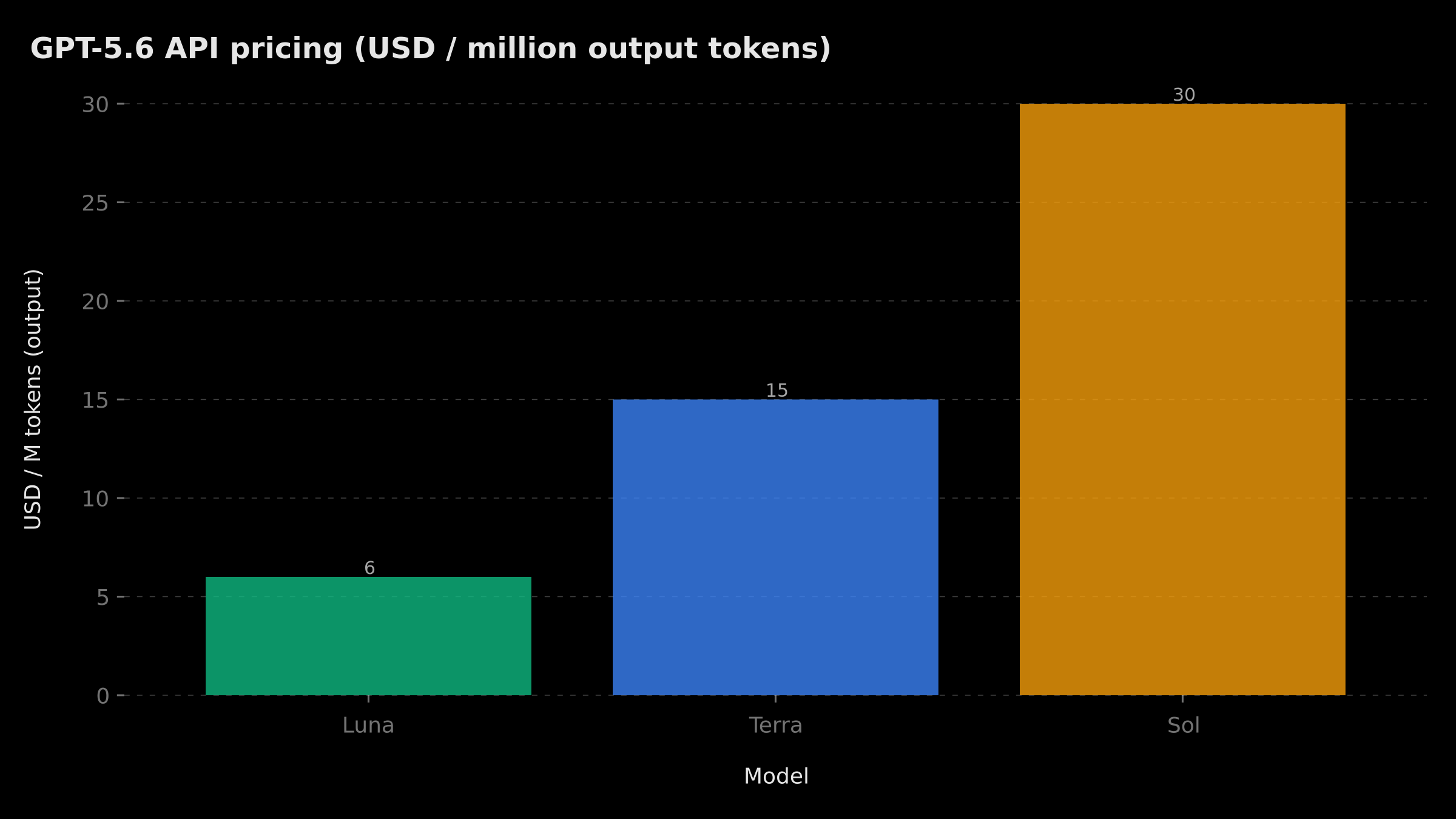 GPT-5.6 API pricing (USD per million output tokens): Luna at $6, Terra at $15, Sol at $30
The real pricing, unrounded
The figures published by OpenAI on July 9, 2026 are precise:
| Model | Input price (per million tokens) | Output price (per million tokens) |
|---|---|---|
| Sol | $5 | $30 |
| Terra | $2.50 | $15 |
| Luna | $1 | $6 |
These rates apply to API access, distinct from the classic ChatGPT subscription (Plus, Pro, Business, Enterprise), which gives access to the ChatGPT Work interface without direct token billing for the end user. For an SMB considering integrating GPT-5.6 into a product or internal workflow via the API, this distinction completely changes the budget equation — and this is precisely where FinOps becomes a strategic topic, as we detailed in our analysis of Uber capping AI tool spend at $1,500/month.
Cybersecurity: a capability taken very seriously
The safety report (system card) published by OpenAI rates all three models in the GPT-5.6 family as "High" capability in cybersecurity and biology/chemistry, while remaining below the "Critical" threshold. Specifically, OpenAI states it tested Sol's ability to discover and exploit vulnerabilities in widely deployed software, without it producing a functional critical-severity exploit in standard tested configurations. For agencies using AI models on production code, this capability level reinforces the case for systematic human review before any deployment — a practice already central to our guide to deploying AI agents with Google agents-cli.
ChatGPT Work: the agent that wants to replace the do-it-all intern
What ChatGPT Work actually does
ChatGPT Work is described by OpenAI as an agent able to "gather context from the apps, files, and workflows you choose and create finished materials such as documents, spreadsheets, presentations, and web apps." A unified plugins directory connects it to tools like Slack, Gmail, Google Drive, calendars, and CRMs.
Technically, OpenAI merges Codex — until now reserved for development tasks — with the consumer ChatGPT interface, making these capabilities accessible to non-technical users. Tasks can be started from any device, including a smartphone, and run in the background across multiple apps, similar to what Anthropic offers with Claude Cowork.
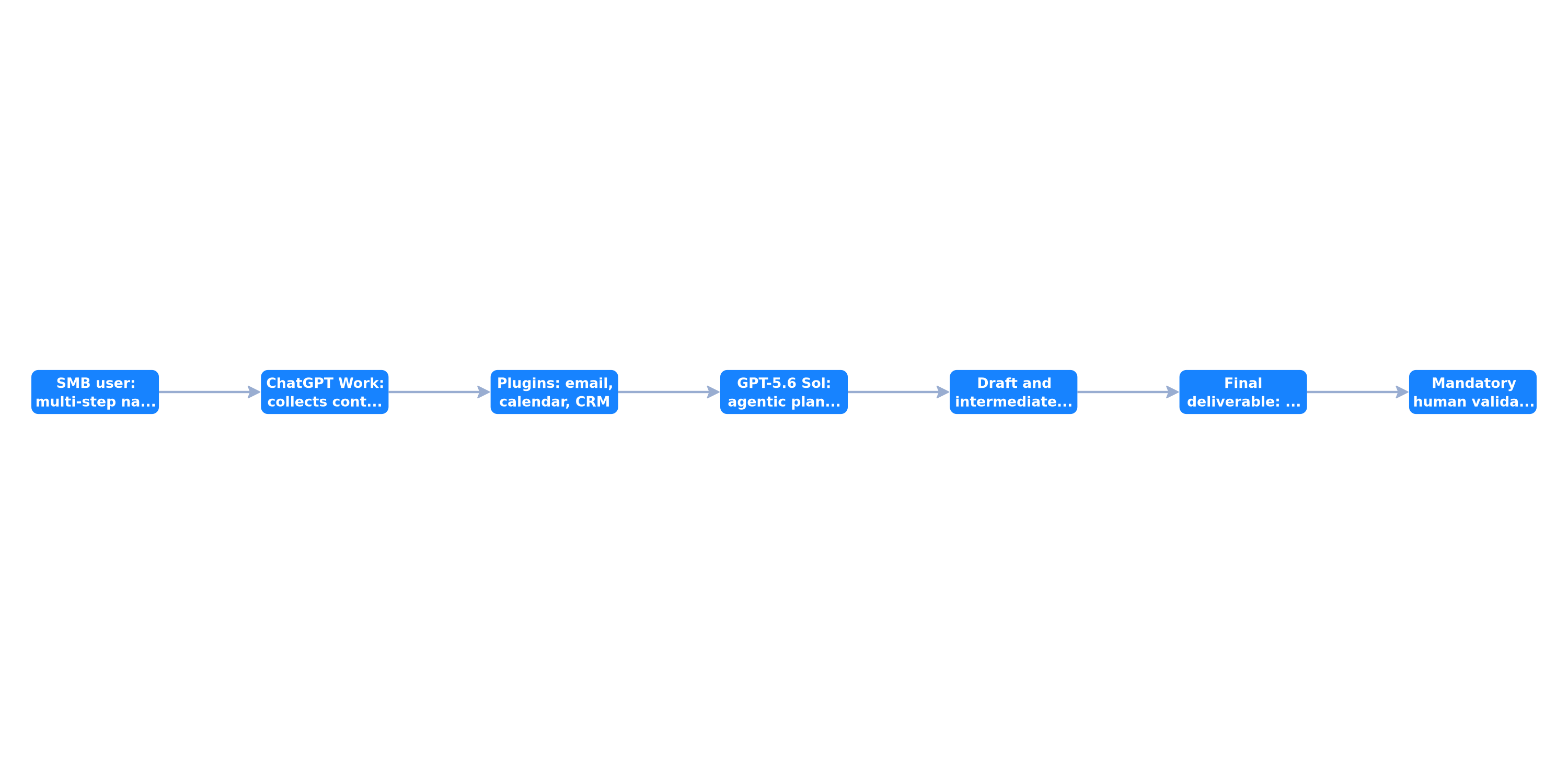 How ChatGPT Work works: user instruction, context collection via plugins, agentic planning by GPT-5.6 Sol, final deliverable, mandatory human validation
Who gets access, and when
The rollout follows a precise schedule announced on July 9, 2026:
- Mac and Windows users of the ChatGPT desktop app, including free accounts: immediate access.
- Pro, Enterprise, and Edu users on mobile and web: first access.
- Plus and Business users: expanded access "over the next few days."
- The rollout starts globally and is expected to reach full availability within roughly 24 hours, according to OpenAI.
Unlike the European Union exclusion announced for Siri AI at WWDC 2026, no specific geographic restriction has been communicated for ChatGPT Work as of this article's publication. French SMBs and French-speaking African agencies do not appear to be excluded at this stage — a point we will continue to monitor in our upcoming recaps.
GPT-Live: voice as the new interface
In parallel, OpenAI introduced GPT-Live, an evolution of ChatGPT Voice designed to make voice exchanges more natural and continuous. Combined with ChatGPT Work, this opens the door to scenarios where an employee verbally briefs a complex task ("prepare a summary of this week's sales and send it to the sales team") without ever touching a keyboard. This is a trend worth watching closely for agencies designing voice interfaces, a topic we've already covered on the n8n side in our WhatsApp chatbot tutorial with n8n and Claude.
Three realistic use cases for an SMB
To move past the marketing language, here are three concrete scenarios where ChatGPT Work could plausibly save time for a 10-to-50-employee company, based on the capabilities OpenAI describes:
Monthly reporting for a non-technical manager. A sales manager asks ChatGPT Work to pull figures from a connected spreadsheet and CRM, then produce a formatted summary slide deck. The task that used to take two hours of copy-pasting becomes a five-minute review of an AI-generated draft.
Ad hoc HR document drafting. An HR coordinator needs a job description, an onboarding checklist, or a policy summary based on existing internal documents. ChatGPT Work can draft a first version by reading the authorized files, leaving the human to adjust tone and legal specifics.
Cross-referencing customer feedback before a meeting. A customer success lead asks the agent to scan recent support tickets and Slack threads to prepare a one-page brief before a client call. This is exactly the kind of one-off, low-stakes task where a general-purpose agent shines, compared to building a dedicated n8n workflow that would only be used occasionally.
None of these three cases involve sensitive financial data, regulated health records, or systems that require an audit trail for compliance purposes. That is precisely the boundary we recommend SMBs respect when deciding whether a task belongs in ChatGPT Work or in a properly governed n8n pipeline.
ChatGPT Work vs n8n: which stack for your SMB?
This is the question that has come up most often with our clients since July 9: "Should we abandon our n8n automations for ChatGPT Work?" The answer, after analysis, is no — but the nuance deserves detail.
Two fundamentally different philosophies
ChatGPT Work is a general-purpose, end-user-oriented agent. It is triggered manually by an employee, runs in OpenAI's cloud, and excels at one-off, non-repetitive tasks: preparing an ad hoc report, cross-referencing data for a meeting, generating a presentation.
n8n, combined with AI agents, is a business process orchestration platform. It is triggered by system events (a webhook, a new database row, an incoming message), runs 24/7 without human intervention, and can be hosted on-premise for full data control — a decisive criterion for SMBs subject to GDPR or handling sensitive customer data. We detailed this architecture in our complete n8n vs Make comparison.
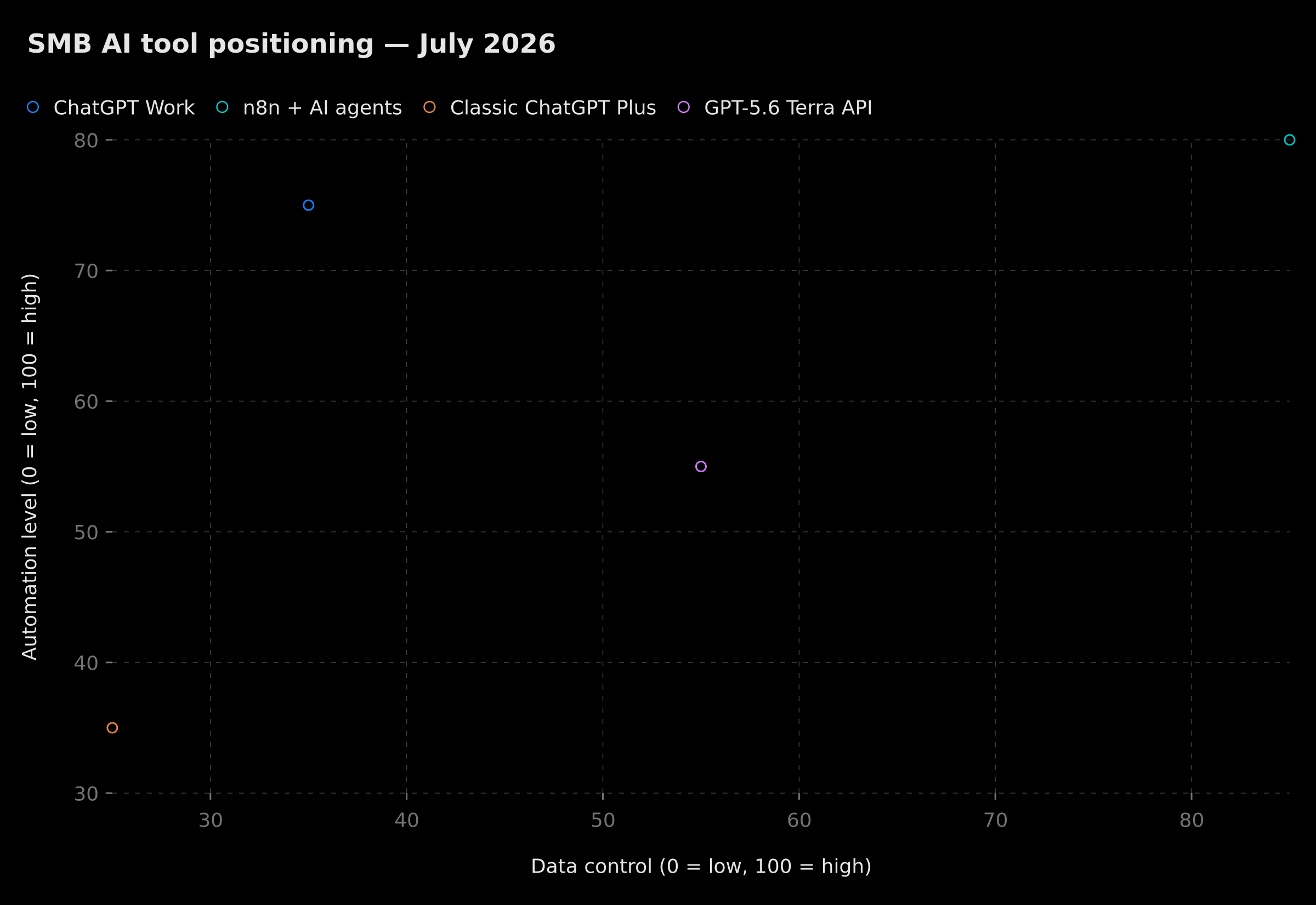
 Positioning: ChatGPT Work combines high automation with moderate data control, while n8n + AI agents maximizes both automation and data sovereignty
The multicriteria comparison
To make the comparison objective, we evaluated three approaches on five key criteria we use in client audits: ease of deployment, data sovereignty, business orchestration, FinOps control, and GDPR compliance.
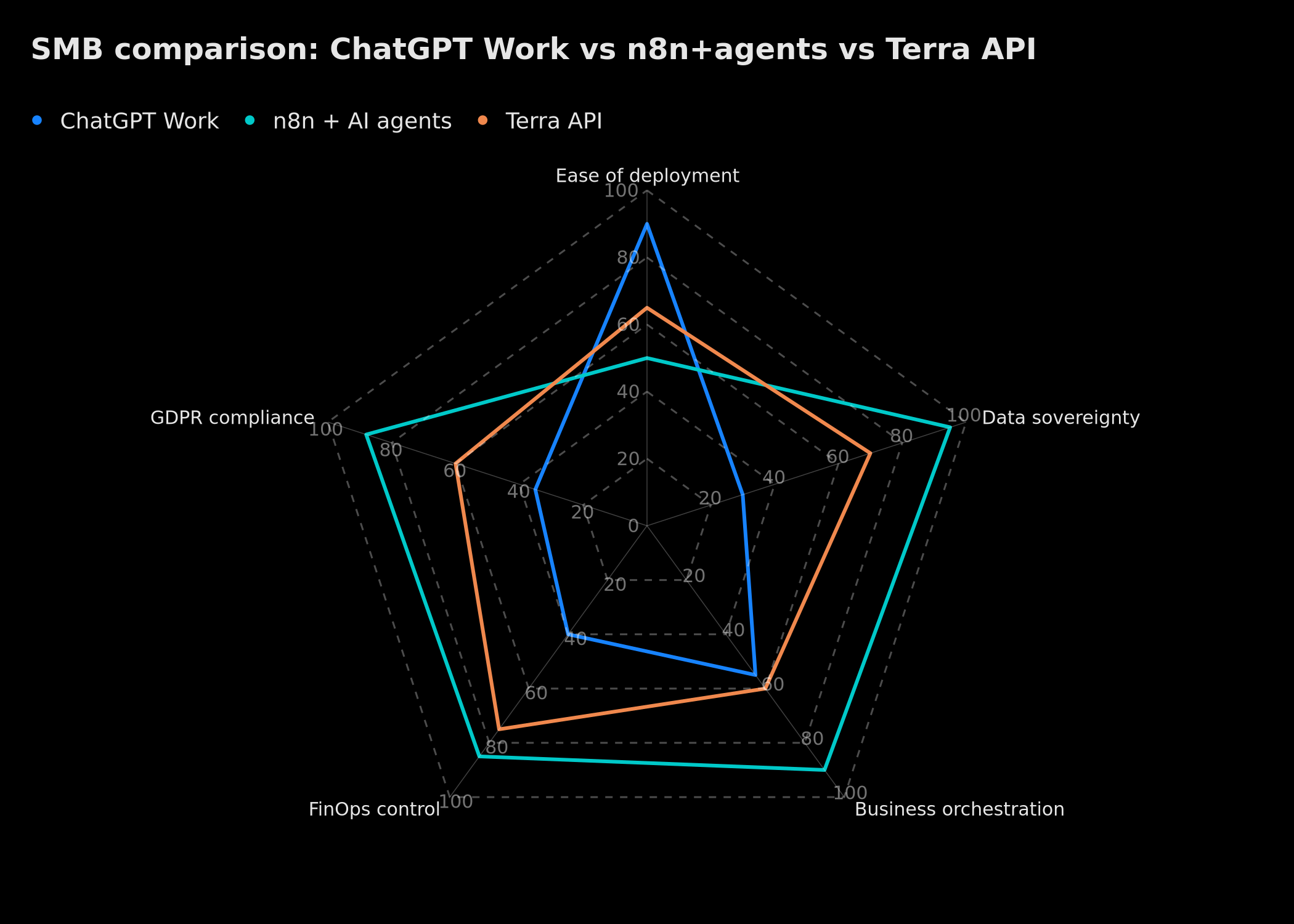 Multicriteria comparison: ChatGPT Work leads on ease of deployment, n8n+AI agents leads on data sovereignty, business orchestration and GDPR compliance, the Terra API offers an intermediate trade-off
What this comparison reveals: ChatGPT Work is not a direct competitor to n8n, it's a complementary tool. A well-organized SMB in 2026 typically combines both: ChatGPT Work for the ad hoc needs of non-technical teams, and n8n for continuously automated business processes — lead qualification, CRM syncing, automated reporting, customer support agents.
The decision tree
To clarify this choice, here is the decision framework we apply with clients during an automation audit.
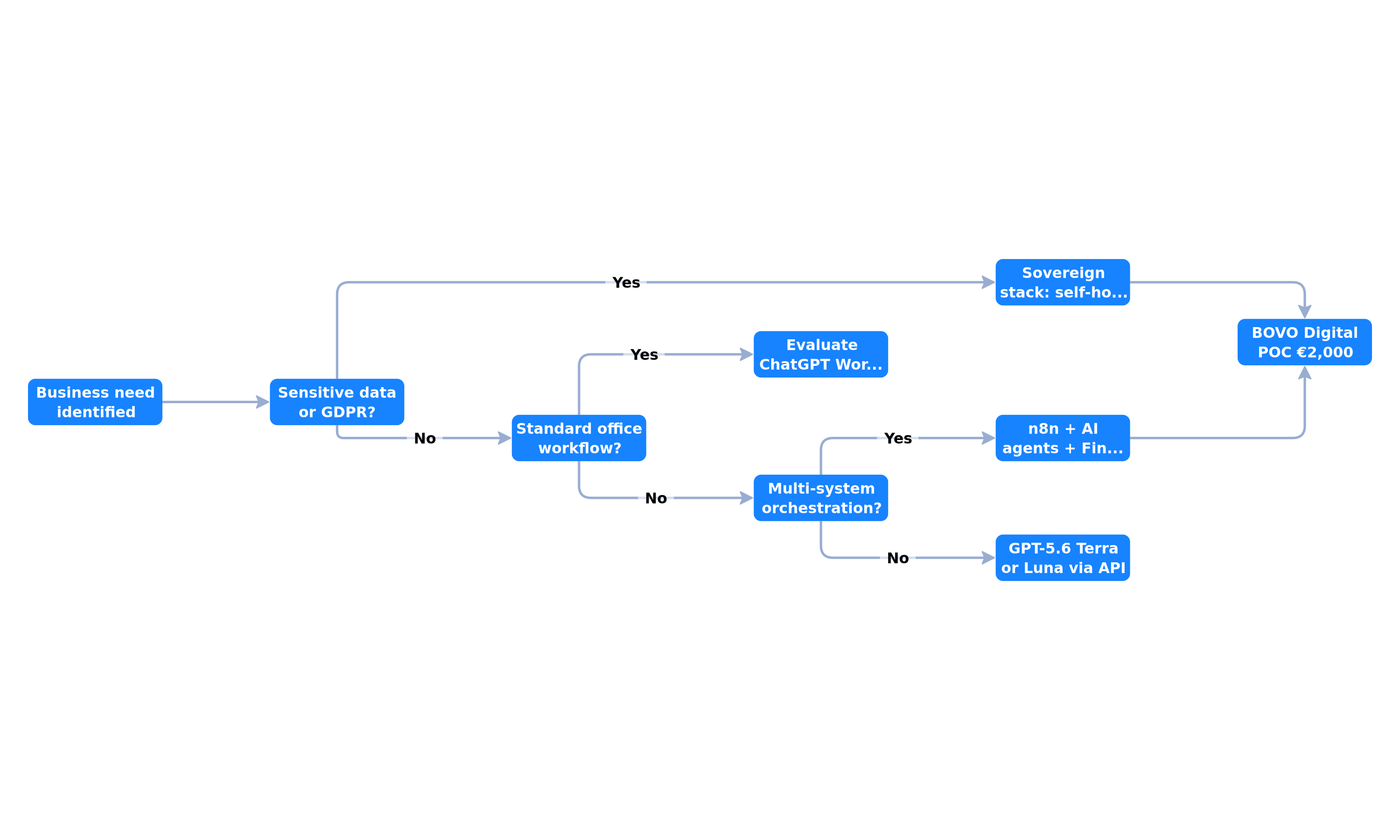 Decision tree: sensitive data → self-hosted n8n, one-off office workflow → ChatGPT Work, multi-system orchestration → n8n + AI agents + FinOps audit
In summary:
- Sensitive or GDPR-regulated data → favor a sovereign stack with self-hosted n8n and the MCP protocol, which we documented in our tutorial on deploying an AI agent with MCP.
- One-off, non-repetitive office task → ChatGPT Work is often the fastest and cheapest option to implement.
- Recurring multi-system orchestration → n8n with AI agents remains the reference for robustness and traceability.
- Intermediate case, moderate volume → direct access to the GPT-5.6 API (Terra or Luna), integrated into your existing tools, may be enough without a full platform.
What Meta and SpaceXAI are also changing this week
It would be incomplete to talk only about OpenAI. The week of July 9, 2026 is also when Meta publicly launched Muse Spark 1.1, an evolution of the multimodal model announced in April, tailored for agentic coding, digital workflow management, and enterprise feature deployment. Mark Zuckerberg personally described Spark as "a strong agentic and coding model at a very low price," highlighting its strength in tool use and "computer use."
This announcement fits into a context we analyzed in detail in our article on Silicon Valley's wake-up call on profitability: Meta recently acknowledged that commercializing its AI agents was taking longer than expected, while continuing to invest heavily in infrastructure. The launch of Spark 1.1 a few weeks later illustrates this tension: the tech giants are accelerating their model releases while simultaneously trying to demonstrate operational profitability.
For SMBs, the lesson is clear: the AI model market remains extremely competitive, with at least four major players (OpenAI, Anthropic, Google, Meta, SpaceXAI) shipping significant updates on cycles of just a few weeks. Building your AI strategy around a single provider, without a fallback plan, is a real operational risk — one more argument in favor of an open orchestration architecture like n8n, capable of switching from one model to another without rebuilding everything.
Risks and limits to keep in mind
No launch announcement mentions its own blind spots, so it's worth naming three risks explicitly before any SMB commits budget or process changes.
Vendor concentration risk. Relying entirely on ChatGPT Work for recurring office tasks creates a dependency on a single vendor's pricing, availability, and terms of service. If OpenAI changes pricing, deprecates a feature, or faces a regulatory restriction in a given region — as happened with Siri AI in the EU — a business built entirely around one tool has no fallback. This is one of the strongest arguments for keeping critical, recurring processes on an open orchestration layer like n8n, where the underlying model can be swapped without rebuilding the workflow.
Data governance blind spots. ChatGPT Work's plugin directory makes it very easy to connect Gmail, Slack, a CRM, and a shared drive in a few clicks. That same ease of connection means it's equally easy to grant broader data access than intended. Before rolling this out beyond a single pilot user, an SMB should document exactly which data categories are exposed to the agent and verify this against its own data protection obligations, particularly for companies handling EU or African client data under GDPR-equivalent frameworks.
Verification overhead does not disappear. GPT-5.6 Sol's strong coding and cybersecurity benchmark scores do not mean its outputs can be used unreviewed. OpenAI's own system card treats Sol as "High" capability in cybersecurity, which is precisely why human review of any code, financial document, or contractual language it produces remains non-negotiable — the same principle we apply to every AI agent we deploy for clients.
Action plan: what to do in the next 30 days
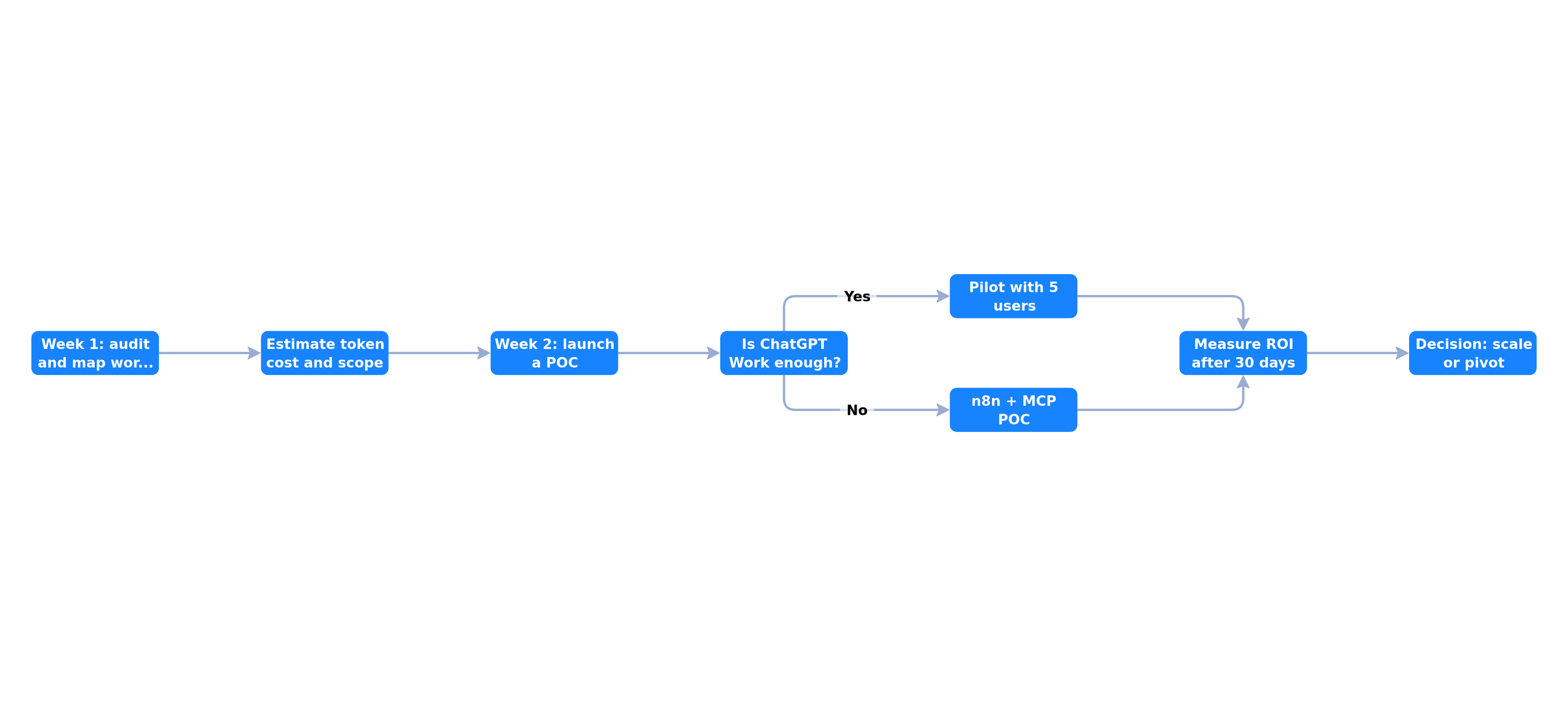
Faced with this flood of announcements, the temptation is to test everything at once. That's rarely the right approach. Here is the structured method we recommend to our clients.
 Action plan: week 1 audit and mapping, week 2 launching a POC (ChatGPT Work or n8n+MCP depending on needs), measuring ROI after 30 days, decision to scale or pivot
Week 1: audit and mapping
List your current workflows involving repetitive office tasks: reports, summaries, presentations, data cross-referencing. For each, estimate the human time consumed per month and the token volume an AI-based process would involve — this is the basis of any serious ROI calculation.
Week 2: launch one or two targeted POCs
Don't test everything. Choose the workflow with the best impact-to-complexity ratio. If the need is one-off and driven by a non-technical user, test ChatGPT Work directly within your existing subscription. If the need is recurring and involves multiple systems, launch an n8n + MCP POC — the format we offer starting at €2,000 at BOVO Digital to validate feasibility before any production commitment.
Weeks 3-4: measure and decide
Measure real ROI after 30 days: time saved, deliverable quality, token or subscription cost. Based on this, decide whether to scale the chosen approach or pivot to the alternative. Never let a POC become a default production system without this quantified validation step.
Our recommendation at BOVO Digital
At BOVO Digital, we track these announcements daily for our SMB clients in France and French-speaking Africa. Our position has remained consistent across several AI announcement cycles: the most powerful tool is never automatically the right choice — it's the one that matches your data constraints, your actual volume, and your FinOps budget over 12 months, not just at launch.
If you want to calmly evaluate where to position GPT-5.6, ChatGPT Work, or an n8n stack in your organization, we offer an automation audit that maps your current workflows and quantifies the available options. For projects that need custom AI agents — sales, support, competitive monitoring — our AI agent creation offering starts with a €2,000 POC before any production commitment. And if your need is specifically automating recurring business processes, our n8n automation agency page documents exactly what we deploy for clients every month.
Conclusion
GPT-5.6 and ChatGPT Work mark another step in the shift from generative AI to agentic AI applied to office work. The numbers are impressive — a score of 80 on the Coding Agent Index, pricing that drops compared to the previous generation, an agent able to produce complete deliverables without constant supervision. But for a French-speaking SMB, the operational question remains the same as at every announcement cycle: what specific business problem does this solve, at what real cost, and with what level of control over your data?
The good news is you don't have to choose between hype and caution. A structured audit, a targeted POC, and a 30-day ROI measurement are enough to turn this news into an informed decision rather than a rushed reaction.
Tags
FAQ
What is GPT-5.6 and how does it differ from GPT-5.5?
GPT-5.6 is OpenAI's new model family, launched in general availability on July 9, 2026, after a limited preview on June 26, 2026 restricted to trusted partners as part of coordination with the US government. It includes three tiers: Sol (flagship, most capable), Terra (balanced, performance close to GPT-5.5 at half the cost) and Luna (fastest and most cost-efficient). According to OpenAI, Sol scores 80 on the Coding Agent Index, 2.8 points above Claude Fable 5, while using less than half the output tokens and costing roughly a third less.
What exactly is ChatGPT Work?
ChatGPT Work is an agent announced by OpenAI on July 9, 2026, combining the capabilities of ChatGPT and Codex for non-technical business users. It can gather context from apps, files, and workflows authorized by the user, then produce finished deliverables (documents, spreadsheets, presentations, simple web apps). A unified plugins directory connects it to Slack, Gmail, Google Drive, calendars, and CRMs.
How much does GPT-5.6 cost per million tokens?
Based on pricing published by OpenAI on July 9, 2026 for API access, Sol costs $5 input and $30 output per million tokens, Terra costs $2.50 input and $15 output, and Luna costs $1 input and $6 output. These rates apply to API access and are distinct from the ChatGPT subscription (Plus, Pro, Business, Enterprise), which gives access to ChatGPT Work and the desktop app without per-token billing for the end user.
Can ChatGPT Work replace an n8n workflow for an SMB?
Not systematically. ChatGPT Work is designed for one-off office tasks triggered by an employee (writing a report, preparing a presentation, cross-referencing ad hoc data). n8n remains preferable for recurring business processes triggered by system events (a new order, a CRM webhook, a support ticket) that require full traceability, on-premise hosting, or deep integration with internal databases. In most of the cases we see with clients, the two approaches are complementary rather than competing.
Can French-speaking and African SMBs use ChatGPT Work right now?
The rollout started on July 9, 2026 for Mac and Windows users of the ChatGPT desktop app, including free accounts, with a global rollout OpenAI describes as reaching full availability within roughly 24 hours. Pro, Enterprise, and Edu users get priority access on mobile and web; Plus and Business accounts follow within the following days. No specific geographic restriction for the EU or French-speaking Africa has been announced at this stage, unlike the EU exclusion seen with Siri AI at WWDC 2026.
What data does an SMB share with ChatGPT Work?
ChatGPT Work accesses the apps, files, and workflows explicitly authorized by the user through the plugins directory (Slack, Gmail, Google Drive, calendars, CRMs). Before any enterprise deployment, it is recommended to precisely audit the scope of shared data, review the data processing terms in OpenAI's business terms of service, and compare that scope against a self-hosted alternative (n8n, MCP) if the data being processed is sensitive or subject to GDPR.
Free audit: we check the impact on your site and workflows
Next.js CVE, new agent, MCP… We tell you what actually applies, and what to patch or ignore.
- 30 min
- Stack reviewed
- No commitment

Vicentia Bonou
Full Stack Developer & Web/Mobile Specialist. Committed to transforming your ideas into intuitive applications and custom websites.


