
Local vs Cloud AI for SMBs: Costs, GDPR, and Open-Weight Performance in 2026
Should mid-market companies pay monthly US Cloud API fees or self-host a sovereign local AI in 2026? 24-month TCO analysis, breakeven thresholds, European AI Act compliance, and implementation.

Local vs Cloud AI for SMBs: Costs, GDPR, and Open-Weight Performance in 2026
Outsourcing your entire corporate intelligence to a proprietary American API is not a forward-looking digital strategy. It is an operational and legal liability whose monthly invoice compounds with every team member you hire.
The enterprise adoption of generative artificial intelligence has entered a mature, demanding phase. Forward-thinking executive leadership is no longer asking whether intelligent models can enhance operational velocity. The defining strategic inquiry of 2026 is: upon which infrastructure must we operate our models to safeguard corporate profitability, intellectual property, and regulatory compliance?
For several years, the decision appeared deceptively simple. On one side stood the effortless convenience of American commercial cloud APIs (OpenAI, Anthropic, Google Vertex AI), accessible instantly via corporate credit cards. On the opposing side sat on-premise local deployments, historically perceived as prohibitively expensive, cumbersome to maintain, and restricted to underperforming open models incapable of coherent domain-specific reasoning.
In 2026, that traditional dichotomy has collapsed under three simultaneous industry disruptions:
- The Performance Breakthrough of Open-Weight Models: Frontier architectures including Gemma 4, Llama 3.3/4, Mistral, and Qwen 2.5 deliver reasoning, structured JSON extraction, and conversational synthesis comparable to proprietary closed models across virtually all standard mid-market enterprise workflows.
- The Enforcement of the European AI Act and Enhanced Regulatory Scrutiny: Deploying third-party cloud tools that route unencrypted internal communications across transatlantic networks now exposes corporate directors to direct compliance liability, GDPR audits, and potential administrative penalties.
- The Financial Trap of Per-Token Pay-As-You-Go Billing: As enterprises embed AI deeper into recurring operational pipelines (continuous background agent loops, RAG document indexing, quote generation), pay-per-token cloud invoices experience exponential creep, eroding operational margins.
Should mid-market leadership maintain external cloud subscriptions or deploy sovereign local infrastructure? What are the true total cost of ownership (TCO) benchmarks across 24 months? And how does an executive calculate the exact financial breakeven point?
This guide provides a comprehensive technical and economic assessment based on verified enterprise production data.
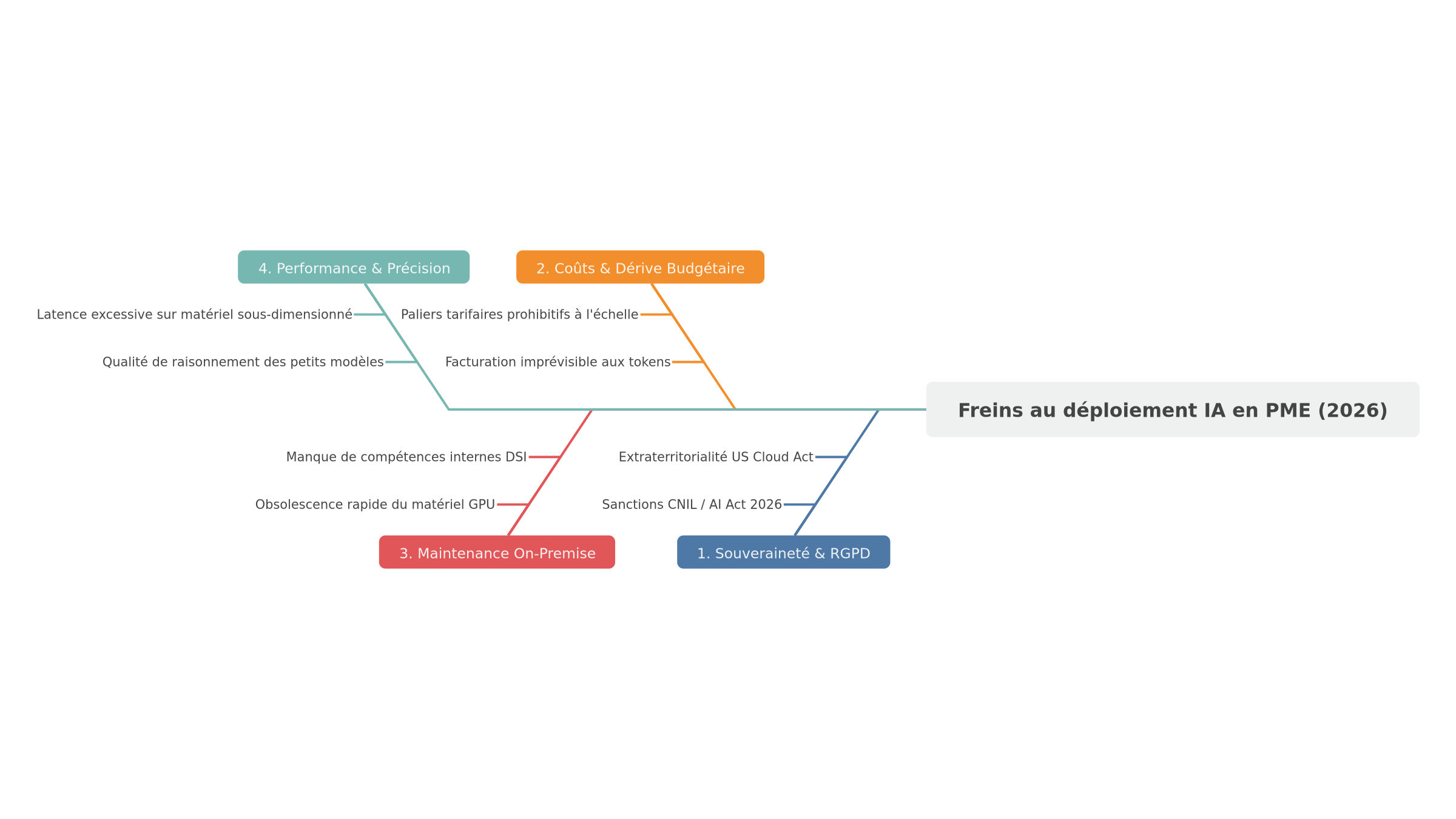 The 4 primary executive hesitations regarding AI adoption in 2026: data sovereignty fears, compounding token expenses, technical maintenance overhead, and performance uncertainty.
The Open-Weight Landscape in 2026: The Democratization of Frontier Intelligence
To evaluate strategic options objectively, leadership must separate open-weight models from experimental amateur scripts. Modern open-weight foundation models are multi-million-dollar engineering assets trained by leading global AI research labs (Google DeepMind, Meta AI, Mistral AI) and distributed under permissive commercial licenses (Apache 2.0 or open commercial agreements).
In 2026, open-weight deployments benefit from foundational mathematical breakthroughs:
- Advanced Quantization Algorithms (AWQ, GGUF, EXL2): Compression techniques enable 14-billion to 70-billion parameter neural networks to execute within standard computer memory or accessible GPU hardware with less than 1% divergence in reasoning accuracy.
- High-Throughput Inference Engines (vLLM, Ollama, SGLang): Utilizing PagedAttention memory allocation, modern inference frameworks slash server RAM consumption by 60% while multiplying concurrent token throughput fivefold.
For a mid-market enterprise processing incoming quotes, summarizing vendor contracts, classifying customer support inquiries, or powering semantic knowledge search, a 14B or 32B open-weight model makes zero operational compromises compared to proprietary models. It runs faster, costs a fraction of the price at scale, and remains entirely under your corporate jurisdiction.
Strategic Decision Matrix: Public Cloud, Sovereign Cloud, or On-Premise?
Different enterprises operate under divergent regulatory constraints and transactional volumes. Before signing long-term cloud commitments or procuring hardware, benchmark your requirements against this architectural roadmap:
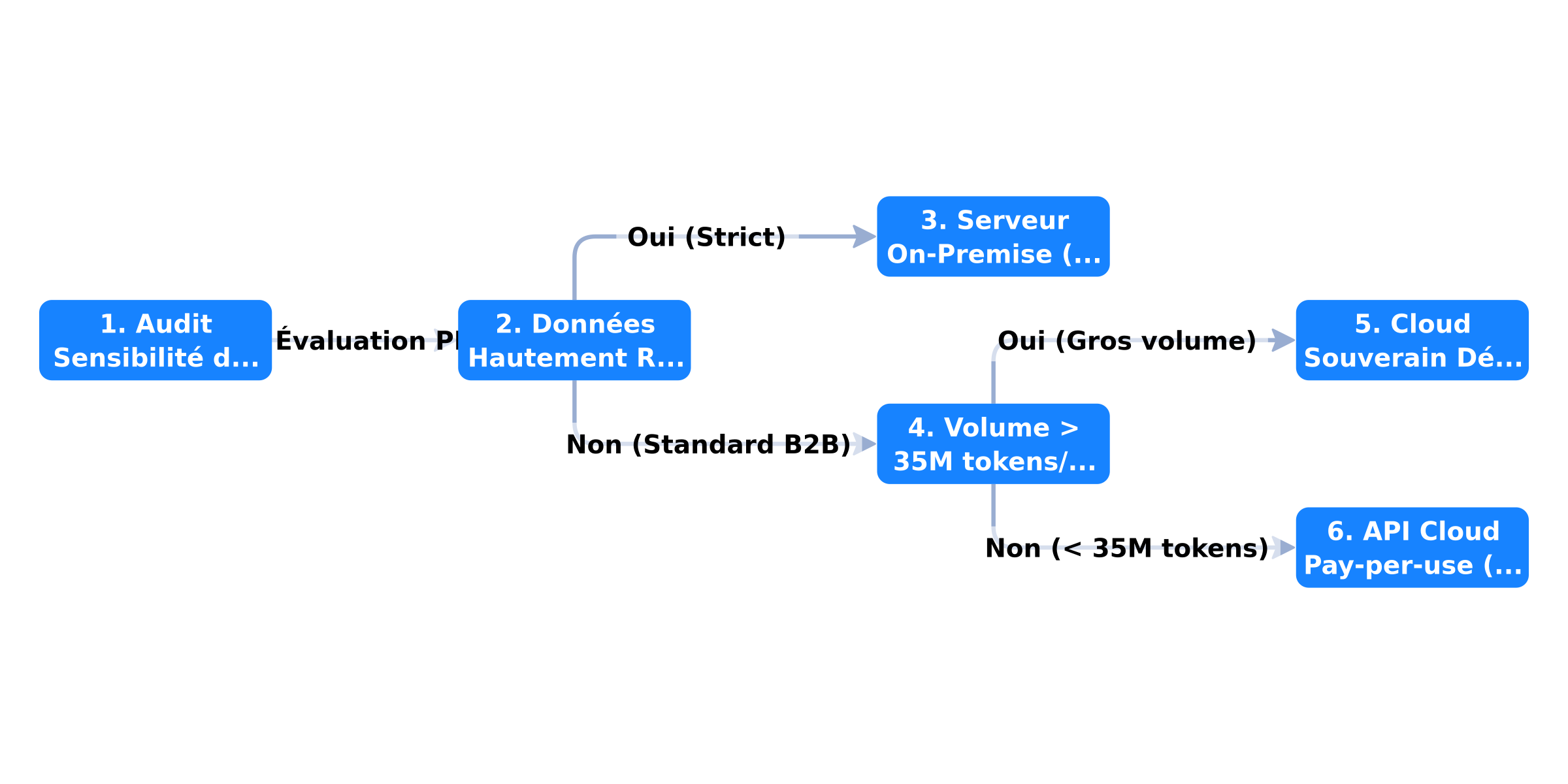 Executive decision matrix for selecting optimal AI infrastructure based on regulatory risk, transaction volume, and latency requirements.
Tier 1: Commercial US Cloud APIs (OpenAI, Anthropic, Google Cloud)
- Target Organization: Early-stage initiatives, proof-of-concept testing, or organizations handling fewer than 15 million tokens monthly (under 150 exploratory requests per business day).
- Core Benefits: Zero upfront capital expenditure, five-minute implementation time, instant access to massive multimodal models without managing compute infrastructure.
- Strategic Liabilities: Compounding variable billing as team usage expands, ongoing reliance on external internet connectivity, and legal exposure to US extraterritorial jurisdiction (US Cloud Act, FISA Section 702).
Tier 2: Dedicated Sovereign Cloud GPU Hosting (Scaleway, OVHcloud, Hetzner)
- Target Organization: Mid-market enterprises processing moderate to high volumes (exceeding 35 million tokens monthly), handling proprietary commercial data, but seeking to avoid physical hardware maintenance on premises.
- Core Benefits: Hardware located strictly within European data centers under European legal jurisdiction. Fixed, predictable monthly costs (renting dedicated enterprise GPU instances between €120 and €250/month).
- Strategic Liabilities: Demands baseline DevOps capability to manage Docker containers and monitor service uptime.
Tier 3: Hardened On-Premise Local Servers
- Target Organization: Regulated professional sectors (law partnerships, certified accounting practices, healthcare providers, precision manufacturers, defense contractors) where corporate governance strictly prohibits data from leaving physical headquarters.
- Core Benefits: Absolute physical data sovereignty, uninterrupted local network operation during external internet outages, and zero marginal cost per inference request beyond standard electricity.
- Strategic Liabilities: Upfront capital hardware acquisition (purchasing Apple Silicon hardware or high-VRAM workstation servers), plus internal responsibility for backup redundancy and hardware maintenance.
Comparative 24-Month Total Cost of Ownership (TCO)
To ground strategic choices in hard numbers, consider a 24-month Total Cost of Ownership (TCO) model evaluated across three common enterprise usage tiers.
Our economic model contrasts:
- Commercial US Cloud APIs: Blended token pricing across typical input/output ratios using Claude 3.5 Sonnet or GPT-4o.
- Dedicated European Sovereign Cloud: A dedicated GPU instance (Scaleway L4 or RTX 6000) running containerized vLLM inference.
- Dedicated On-Premise Hardware: Capital purchase and full 24-month amortization of a dedicated Apple Mac Studio (M3 Max chip, 64GB unified memory) including initial setup labor and electricity.
| Monthly Enterprise Consumption | Commercial US Cloud APIs | Dedicated Sovereign Cloud (Scaleway vLLM) | Dedicated On-Premise (Mac Studio) | Economically Optimal Model |
|---|---|---|---|---|
| 10 Million Tokens / Month (~ 150 standard requests/day) | $3,600 over 24 months | $4,800 over 24 months | $5,200 over 24 months | Commercial Cloud APIs (maximum agility) |
| 50 Million Tokens / Month (Inbound quotes, internal RAG, support) | $18,000 over 24 months | $5,800 over 24 months | $5,600 over 24 months | Sovereign or Local AI (Costs slashed by 3x) |
| 200 Million Tokens / Month (Continuous multi-agent workflows) | $72,000 over 24 months | $9,600 over 24 months | $6,800 over 24 months | Sovereign or Local AI (Costs slashed by 10x) |
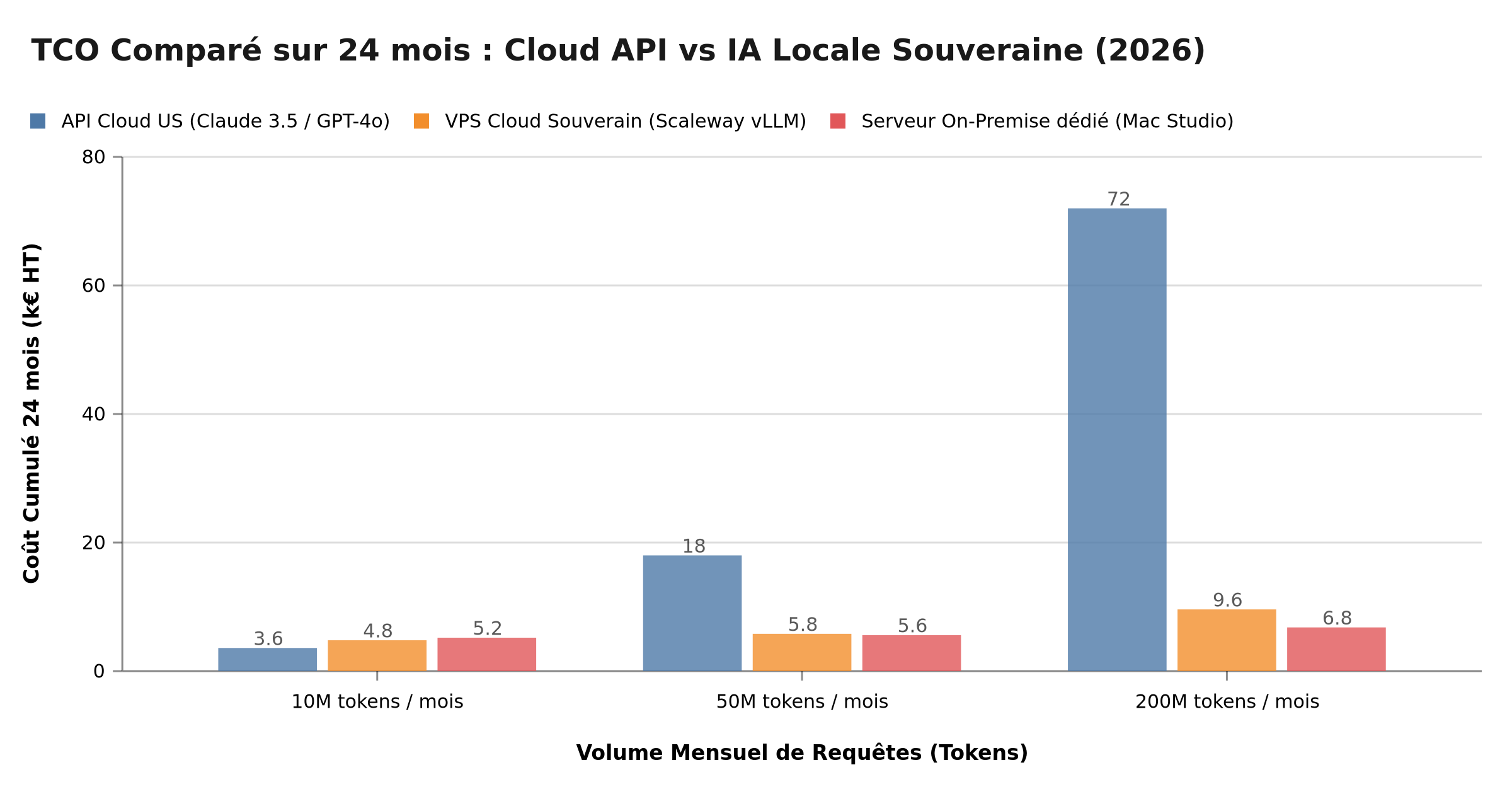 At volumes exceeding 35 to 50 million tokens monthly, local and sovereign AI infrastructure slashes operational overhead by 3x, compounding to a 10x cost reduction at scale.
The Strategic Financial Takeaway
When your team treats AI as an occasional conversational assistant, paying $50 to $100 per month in metered API credits is entirely practical.
However, once you automate operational pipelines using n8n orchestration — automatically indexing every client document, scoring incoming leads, parsing invoice PDFs, and running real-time customer service agents — monthly consumption easily surges past 35 to 50 million tokens. Operating on pay-per-token cloud billing at this scale forfeits thousands of dollars in operating profit each month.
Comparative Analysis of 2026's Premier Open-Weight Models
Selecting the appropriate open-weight foundation model requires understanding that parameter count is not the sole arbiter of operational quality: context length, architectural efficiency, and domain specialization dictate business outcomes.
Here is a performance assessment of the four preeminent open model families in 2026:
1. Gemma 4 (Google DeepMind): Benchmark Efficiency and Dense Reasoning
- Recommended Flavors: Gemma 4 9B and 27B parameters.
- Core Strengths: Unmatched inference speed across modest GPU and unified CPU memory, exceptional multilingual comprehension of technical European languages, and concise document synthesis.
- Hardware Footprint: Operates smoothly in 4-bit quantization on 16GB to 32GB of unified memory.
- Primary Use Cases: Automated inbound email triage, low-latency customer support agents, preliminary quote qualification.
2. Llama 3.3 / Llama 4 (Meta AI): The Universal Enterprise Workhorse
- Recommended Flavors: 70B parameters.
- Core Strengths: Massive developer ecosystem, native optimization for Model Context Protocol (MCP) tool-calling, and exceptional resilience when executing complex multi-step reasoning instructions.
- Hardware Footprint: Demands 40GB to 48GB of VRAM in 4-bit precision (perfectly paired with dual consumer GPUs or an Apple Mac Studio with 64GB+ RAM).
- Primary Use Cases: Autonomous n8n multi-stage workflows, contract risk auditing, complex RFP response drafting.
3. Mistral NeMo & Mistral Large (Mistral AI): European Legal and Linguistic Precision
- Recommended Flavors: Mistral NeMo 12B and Mistral Large.
- Core Strengths: Flawless mastery of European administrative nuances, commercial law terminology, and financial reporting standards, supported by enterprise-friendly licensing.
- Hardware Footprint: NeMo executes on standard developer laptops; Large requires dedicated multi-GPU cloud instances.
- Primary Use Cases: GDPR compliance auditing, commercial lease reviews, healthcare data processing.
4. Qwen 2.5 (Alibaba Cloud Open Source): The Structured Extraction Specialist
- Recommended Flavors: Qwen 2.5 14B and 32B Coder / Instruct.
- Core Strengths: Phenomenal reliability when generating valid, strictly structured JSON output from messy, handwritten, or poorly scanned documents.
- Hardware Footprint: Highly efficient memory footprint (12GB to 24GB VRAM).
- Primary Use Cases: Parsing unstructured customer quotes, tabular financial extraction, automated script generation.
Real-World Case Study: Sovereign AI Migration for a 22-Person Corporate Law Firm
To observe how data sovereignty impacts business value, consider a real-world deployment executed for an established corporate law partnership based in Western France specializing in mergers and acquisitions.
Initial Baseline (January 2026):
- Attorneys and paralegals utilized uncoordinated individual subscriptions to ChatGPT Team and Claude Pro to accelerate legal drafting and transaction due diligence.
- Direct Costs: Over €700 per month in scattered credit card subscriptions.
- Critical Regulatory Exposure: During an independent security audit commissioned by a major industrial conglomerate, the law firm was required to guarantee that draft shareholder agreements and proprietary financial disclosures never traversed servers subject to US surveillance laws. Incapable of providing this technical guarantee, the firm faced imminent loss of a high-value retainer.
The BOVO Digital Migration (Dedicated Mac Studio + Sovereign Local RAG):
- Procured and installed a dedicated Apple Mac Studio (M3 Ultra, 128GB unified memory) within the firm's private, access-controlled on-premise server enclosure.
- Deployed an enterprise-hardened Ollama runtime running quantized instances of Mistral and Llama 3.3.
- Indexed fifteen years of proprietary legal precedent, contract templates, and transaction filings into an air-gapped local Qdrant vector database.
- Delivered a clean, web-accessible interface accessible exclusively through the firm's encrypted internal network and zero-trust VPN.
Verified Outcomes at 6 Months:
- Flawless Compliance: Corporate data physically never leaves the law firm's building. The client enterprise audit passed with zero compliance findings.
- Search Velocity: Associates query 15 years of proprietary transaction precedent in under 2 seconds.
- Financial Payback: Total capital investment (€5,200 in hardware plus professional implementation) was fully recouped within 8 months through eliminated SaaS fees and an estimated 12 weekly hours saved across the legal team.
European Compliance Architecture: GDPR, AI Act, and Cloud Act Immunity
Beyond financial optimization, regulatory compliance represents a matter of direct personal liability for corporate leadership.
Here is the 4-part compliance matrix governing enterprise AI in 2026:
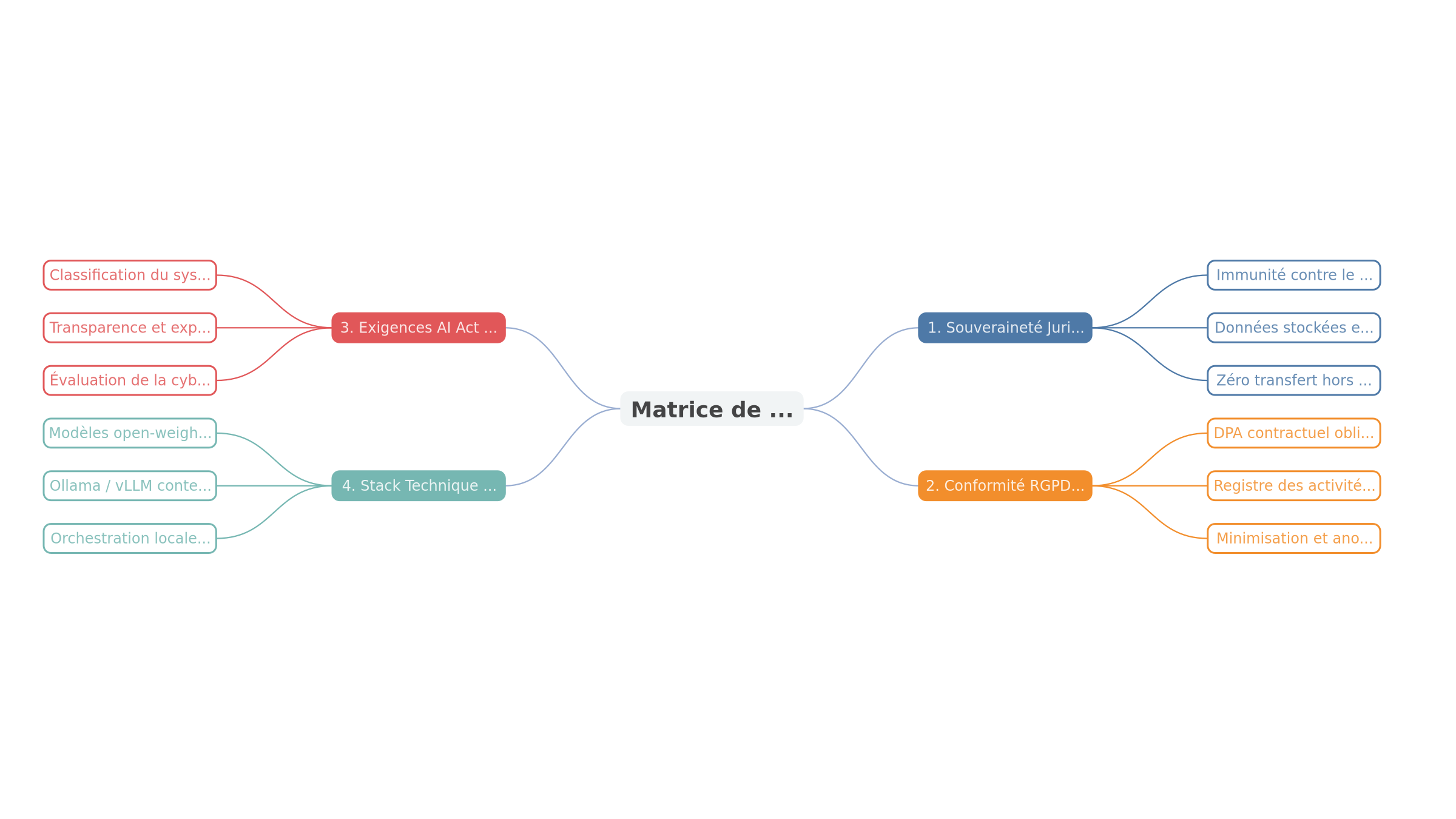 The 4 essential regulatory pillars for enterprise AI deployment in 2026: jurisdictional sovereignty, GDPR data protection, European AI Act compliance, and infrastructure architecture.
1. Immunity from the US Cloud Act and FISA Section 702
The Clarifying Lawful Overseas Use of Data (Cloud) Act allows US federal authorities to compel American cloud corporations to provide access to customer data, regardless of whether that data resides on servers physically located on European soil.
For firms handling proprietary engineering designs, sensitive corporate litigation, or confidential financial records, utilizing US-controlled cloud infrastructure introduces an unavoidable vulnerability. Sovereign local hosting dissolves this risk entirely.
2. GDPR Compliance and Personal Data Protection (PII)
Article 28 of the GDPR mandates that data controllers ensure all third-party data processors uphold rigorous security standards.
- Utilizing external cloud APIs requires executing formal Data Processing Agreements (DPAs) guaranteeing that proprietary customer data is never used to train public foundation models.
- With local or sovereign AI infrastructure, corporate data never leaves your private network perimeter. You execute zero international data transfers, and compliance with Article 17 (Right to Erasure) is directly verifiable within your own databases.
3. Complying with the European AI Act
The European AI Act classifies applications based on risk severity:
- Workflows touching human resources (resume screening, employee evaluation) or credit risk assessment qualify as High-Risk AI Systems.
- High-risk systems demand verifiable technical documentation, dataset traceability, algorithmic transparency, and human oversight.
- Deploying version-controlled open-weight models on your own servers guarantees auditability that proprietary black-box APIs cannot match.
4-Step Production Implementation Guide
Establishing a secure, sovereign AI deployment requires disciplined execution rather than complex research:
Step 1: Compute Sizing and Provisioning
- Sovereign Cloud: Provision an enterprise GPU instance (Scaleway L4 or OVH Public Cloud GPU) running Ubuntu 24.04 LTS.
- On-Premise: Procure an Apple Silicon workstation with 64GB to 128GB of unified memory or an enterprise Linux workstation with modern RTX GPU hardware.
Step 2: Containerized Inference Engine Deployment
Deploy Ollama or vLLM in an isolated container sandbox:
# Production Docker deployment for Ollama with GPU acceleration
docker run -d --gpus=all \
  -v ollama_storage:/root/.ollama \
  -p 11434:11434 \
  --name ollama-enterprise \
  --restart unless-stopped \
  ollama/ollama
Download your selected open-weight foundation model:
# Pull the optimized 2026 enterprise model
docker exec -it ollama-enterprise ollama run gemma4:27b
Step 3: Native n8n Workflow Integration
Inside your self-hosted n8n automation engine:
- Insert an OpenAI Chat Model node.
- Configure the Base URL to point to your internal inference server:
http://internal-ip:11434/v1. - Specify your local model name (
gemma4:27borllama3.3:70b). - Your automated document parsing, quote chiffrage, and customer support workflows now execute entirely within your private infrastructure at zero incremental token cost.
Step 4: Air-Gapped Retrieval-Augmented Generation (RAG)
To empower staff to query internal knowledge bases:
- Index operational procedures, historical proposals, and technical specifications into an internal vector database (Qdrant or PostgreSQL pgvector).
- Incoming queries retrieve relevant context chunks, passing them to your local model with explicit citation requirements to completely prevent hallucinations.
For deeper technical guidance on preventing factual errors in automated workflows, review our comprehensive guide on eliminating AI hallucinations in enterprise environments.
The Hybrid Model: The Pragmatic Enterprise Consensus
For most mid-market organizations, the strategic answer is not an ideological choice between cloud and on-premise. The most profitable strategy is a disciplined hybrid architecture:
- Sovereign Local AI handles 85% of high-volume, routine corporate operations: inbound quote structuring, tier-1 customer service, internal document search, and n8n background tasks. Marginal costs remain flat, and data privacy is absolute.
- Frontier Cloud APIs (Claude 3.5 Sonnet / GPT-4o) serve as specialized reserve engines for the remaining 15% of complex strategic queries, creative brand synthesis, or extraordinary compute tasks.
This hybrid approach caps ongoing operational expenditure while providing your workforce with the finest analytical capabilities on the market.
8-Point DIY Sovereignty Readiness Assessment
Before allocating software budgets for the upcoming fiscal year, evaluate your operational readiness against these 8 benchmarks:
- Data Sensitivity: Does your company handle proprietary engineering specifications, employee compensation, client financial data, or trade secrets?
- Monthly Token Volume: Does your current or projected automation pipeline consume more than 30 million tokens per month?
- Budget Predictability: Does finance require fixed, predictable IT overhead rather than volatile variable API invoices?
- Offline Resilience: Do your internal estimators and service teams require operational AI tooling during external network interruptions?
- Contractual Mandates: Do client enterprise master service agreements mandate that commercial data remain strictly within European borders?
- Infrastructure Management: Does your organization possess internal technical staff or an engineering partner capable of maintaining containerized services?
- Task Suitability: Are your core use cases (quoting, RAG search, customer service) addressed effectively by 14B to 70B open-weight models?
- Actionable Conversion: Are your internal assistants connected to operational outcomes, such as automated proposal generation and confirmed Cal.com calendar appointments?
Meeting 4 or more of these criteria indicates that migrating toward sovereign or local AI will deliver immediate financial, operational, and regulatory returns for your enterprise.
The Hidden Risk of Commercial Cloud APIs: Vendor Lock-In and Silent Deprecations
Beyond immediate financial considerations and transatlantic legal exposure, relying entirely on proprietary cloud APIs introduces a subtle but severe operational vulnerability: vendor lock-in compounded by unpredictable model deprecation cycles.
In the fast-moving commercial AI ecosystem, major cloud vendors regularly retire older model weights, modify system prompt steering behaviors, or adjust underlying quantization settings without meaningful advance notice. An automated customer service workflow or document classification prompt that performed flawlessly in January can suddenly begin hallucinating or misformatting JSON responses in June following an unannounced server-side model revision. When your organization's mission-critical operations depend on a closed black-box API, your engineering team is forced into emergency reactive troubleshooting whenever the provider alters backend behavior.
By contrast, deploying open-weight foundation models provides permanent stability:
- Impenetrable Version Freezing: When you deploy an open-weight model like Gemma 4 or Llama 3.3, you preserve the exact snapshot of that model's weights permanently. Your system prompt engineering, output schemas, and classification accuracy remain deterministic for years, completely immune to external provider shifts.
- Tailored Fine-Tuning and Domain Adaptation: If your enterprise operates within specialized industrial vocabularies, proprietary technical standards, or specific regional legal frameworks, open-weight models can be fine-tuned using lightweight techniques like LoRA (Low-Rank Adaptation). You train the model on your proprietary historical archives, creating a bespoke intellectual property asset that your competitors cannot access or duplicate.
Data Lifecycle Governance: Mitigating Model Poisoning and Training Leakage
A critical concern for information security officers evaluating AI systems is ensuring that corporate queries do not inadvertently leak into public model training corpuses or expose internal knowledge to competitor queries.
While major US cloud providers now offer enterprise tier opt-outs within their standard terms of service, historical data breaches across third-party software supply chains demonstrate that policy guarantees are only as reliable as the systems enforcing them. In contrast, operating private inference servers establishes mathematical guarantees of confidentiality:
- Air-Gapped Processing: When inference executes on an on-premise Mac Studio or a dedicated European private cloud instance, the data packets never traverse the public internet. Network interfaces can be restricted exclusively to internal enterprise subnets.
- Zero Ingestion Risk: Open-weight models running inside Ollama or vLLM operate in pure inference mode. They possess no built-in mechanism to record, store, or transmit prompt inputs to external parties.
- Audit Logging Under Corporate Control: Detailed token telemetry and execution logs are retained strictly within your internal SIEM or compliance database, facilitating frictionless ISO 27001, SOC 2, and GDPR audit certifications.
Reclaim Ownership of Your Corporate Intelligence
Artificial intelligence should not function as a permanent external toll booth taxing every operational transaction your company conducts.
With the performance parity of modern open-weight models, streamlined inference architectures, and the orchestration power of n8n, mid-market enterprises possess the tools to construct their own sovereign digital intelligence: blindingly fast, strictly compliant with European data regulations, and dramatically more economical at scale.
At BOVO Digital, we advise business owners and technology executives through the sizing, deployment, and operational integration of bespoke sovereign AI systems connected to core enterprise tools.
If you are ready to evaluate your financial breakeven threshold and architect an enterprise hybrid AI strategy tailored to your organization, book a 30-minute diagnostic session with our engineering team.
Ready to evaluate sovereign or local AI for your enterprise? In 30 minutes, we assess your monthly token consumption, review your regulatory constraints, and design your target infrastructure roadmap. Schedule your 30-minute strategic consultation on Cal.com
Tags
FAQ
At what monthly request volume does local or sovereign AI become more economical than cloud APIs?
In 2026, the financial breakeven threshold sits between 35 and 50 million tokens per month (equivalent to approximately 1,500 to 2,500 document or support interactions per business day). Below this volume, paying for cloud API tokens on demand (Claude or OpenAI) is generally cheaper. Above it, running an open-weight model on dedicated European cloud GPU instances or on-premise hardware recoups its costs in months while capping ongoing software overhead.
Can open-weight local models match the reasoning quality of GPT-4o or Claude 3.5 Sonnet?
For specialized enterprise workflows (parsing quote requests, contract summarization, RAG semantic search, customer ticket classification), modern open-weight models ranging from 14B to 70B parameters (Gemma 4, Llama 3.3, Qwen 2.5, Mistral Large) match or surpass proprietary models when paired with few-shot prompts or targeted fine-tuning. Proprietary mega-models only retain an edge on highly abstract reasoning or complex multi-step software engineering.
What legal liabilities does the US Cloud Act introduce for European enterprises?
The US Cloud Act empowers American federal courts and intelligence agencies to compel US-headquartered cloud providers (Microsoft, Google, Amazon, OpenAI) to disclose customer data, even when physical servers are located within European data centers. For mid-market firms managing proprietary trade secrets, healthcare data, or sensitive financial records, self-hosting on-premise or utilizing sovereign European cloud providers (Scaleway, OVHcloud) guarantees complete legal immunity.
What hardware infrastructure is needed to run a private AI server inside a mid-market firm?
Companies no longer need six-figure server racks. To execute 14B to 32B parameter models in 4-bit quantization at enterprise inference speeds (30 to 60 tokens/second), a single Apple Mac Studio (M3/M4 Max or Ultra chip with 64GB to 128GB of unified memory) or a dedicated GPU cloud instance rented for €120 to €250/month provides ample capacity for 50 concurrent team members.
How do you connect local AI models into existing workflows and n8n pipelines?
Modern inference engines like Ollama or vLLM expose open REST APIs that replicate the OpenAI standard (`/v1/chat/completions`). Inside n8n workflows, MCP servers, or Next.js applications, developers simply update the base API endpoint URL to point to the local instance (`http://ollama.local:11434/v1`). Transition takes minutes without touching application business logic.
Go from reading to an action plan
We review your situation and propose the next concrete step — website, automation, or chatbot.
- 30 min
- No commitment
- Action plan

William Aklamavo
Web development and automation expert, passionate about technological innovation and digital entrepreneurship.


