
SaaSpocalypse: AI agents vs SaaS — the digital agency opportunity
CNBC’s SaaSpocalypse debate is shaking software stocks. For digital agencies: custom agents + n8n automation versus classic SaaS subscriptions.

Updated

SaaSpocalypse: AI agents vs SaaS — the digital agency opportunity
Wall Street is debating a software apocalypse. On the SME ground, the real question is plainer: which SaaS subscriptions do we replace with agents and workflows — and which do we keep?
In early August 2026, CNBC covered the intensifying “SaaSpocalypse” debate as software stocks swung wildly. The investor narrative: AI agents (coding, support, ops) could hollow out historic SaaS economics, especially per-seat pricing.
We do not invent market-cap figures or “trillions wiped” here. The useful signal for a digital agency and its SME clients is operational: pressure on subscription stacks creates demand for intelligent integration — custom agents, n8n automation, and a clear SaaS-versus-build tradeoff that a founder can actually execute this quarter.
What the debate says (and what it does not)
“SaaSpocalypse” has circulated in tech and financial press since early 2026. Treat it as a market mood label, not a product roadmap. Recurring themes:
- fear that AI agents automate work once done by human “seats”;
- software equity volatility with each AI product wave;
- questioning of per-seat models when agents do the work.
What the debate does not solve for an SME in Cotonou, Lyon, or Dakar:
- which concrete tools in its stack are replaceable;
- who maintains the agents (governance, incidents, LLM cost);
- how to avoid rebuilding an ERP with duct tape and a prompt.
The agency opportunity sits exactly there: translate market narrative into stack decisions. Founders do not need another thread predicting the end of software. They need a ranked list of tools to keep, cut, or automate — with owners and dates.
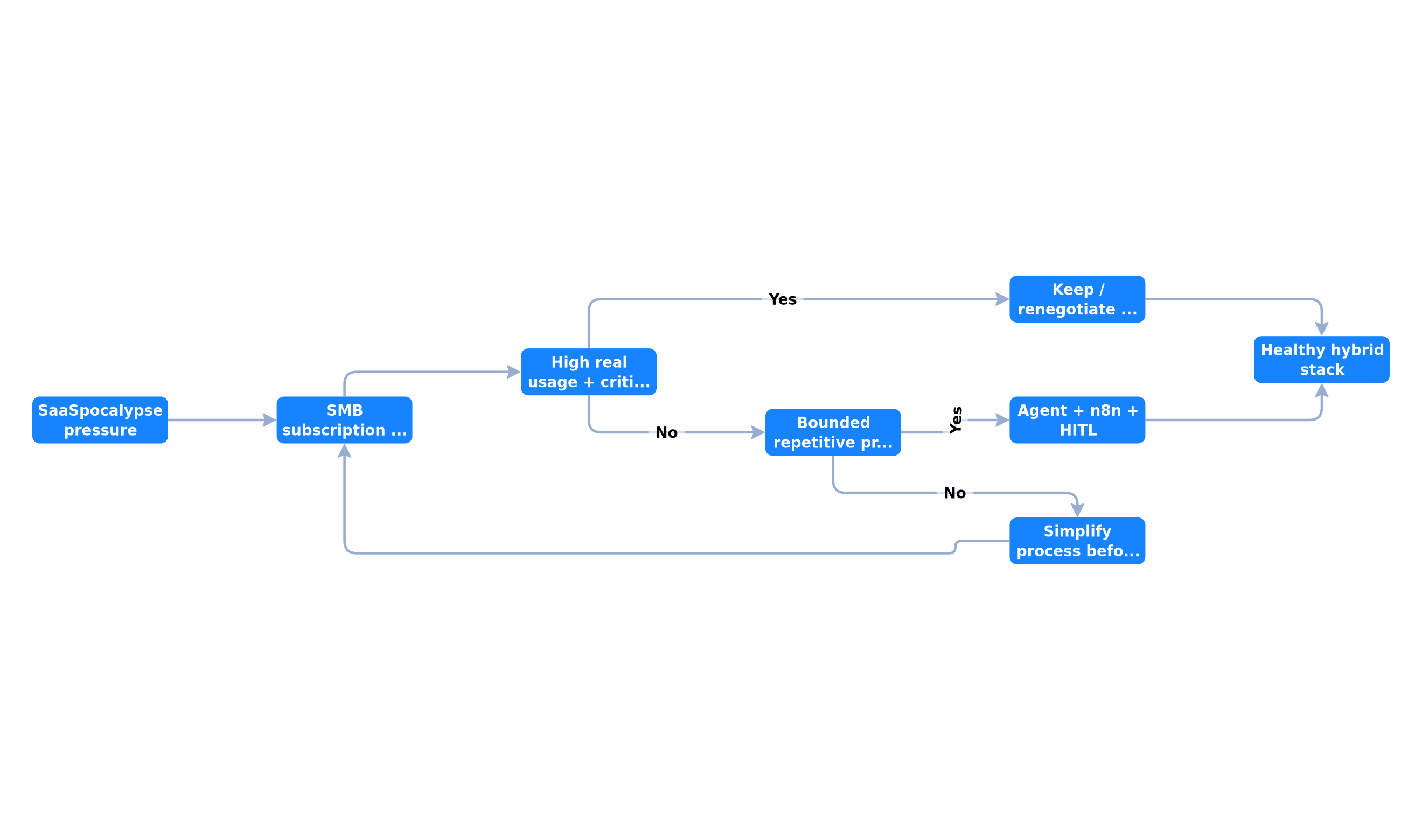 Audit subscriptions, keep critical SaaS, or automate bounded processes
Custom agents + n8n vs SaaS subscriptions: a decision grid
| Criterion | Keep SaaS | Prefer agent / n8n |
|---|---|---|
| Core data | Critical CRM / finance / HR | Satellite process (nudges, reporting, triage) |
| Compliance | Vendor certifications, audit trails | Internally scoped + home-grown logs |
| Frequency | Daily use across a large team | Repetitive task, little UI |
| Cost | Seat justified by usage | 5 tools at €30–80 with 10% used |
| Differentiation | Commodity is fine | Specific business need |
Typical SME example: five overlapping “growth” tools (forms, email, scoring, chatbot, booking). Often one n8n workflow + a WhatsApp channel + the CRM already paid covers 80% of the need — with fewer ghost licenses.
This is not “kill SaaS.” It is stop paying for ghost seats and never-activated features.
Why digital agencies are well positioned
Pure “ChatGPT wrapper” players suffer in this climate: thin moat, LLM margin pressure, churn. Agencies that ship systems win:
- Stack audit — map subscriptions, usage, redundancy.
- Agent design — narrow scope, tools (CRM, mail, WhatsApp), guardrails.
- n8n orchestration — durable, auditable, optionally self-hosted.
- HITL and governance — humans stay on sensitive actions.
- Run & improve — maintenance retainers beat one-shot projects.
Value shifts from the license to integration and ops. See our automation and n8n automation agency pages.
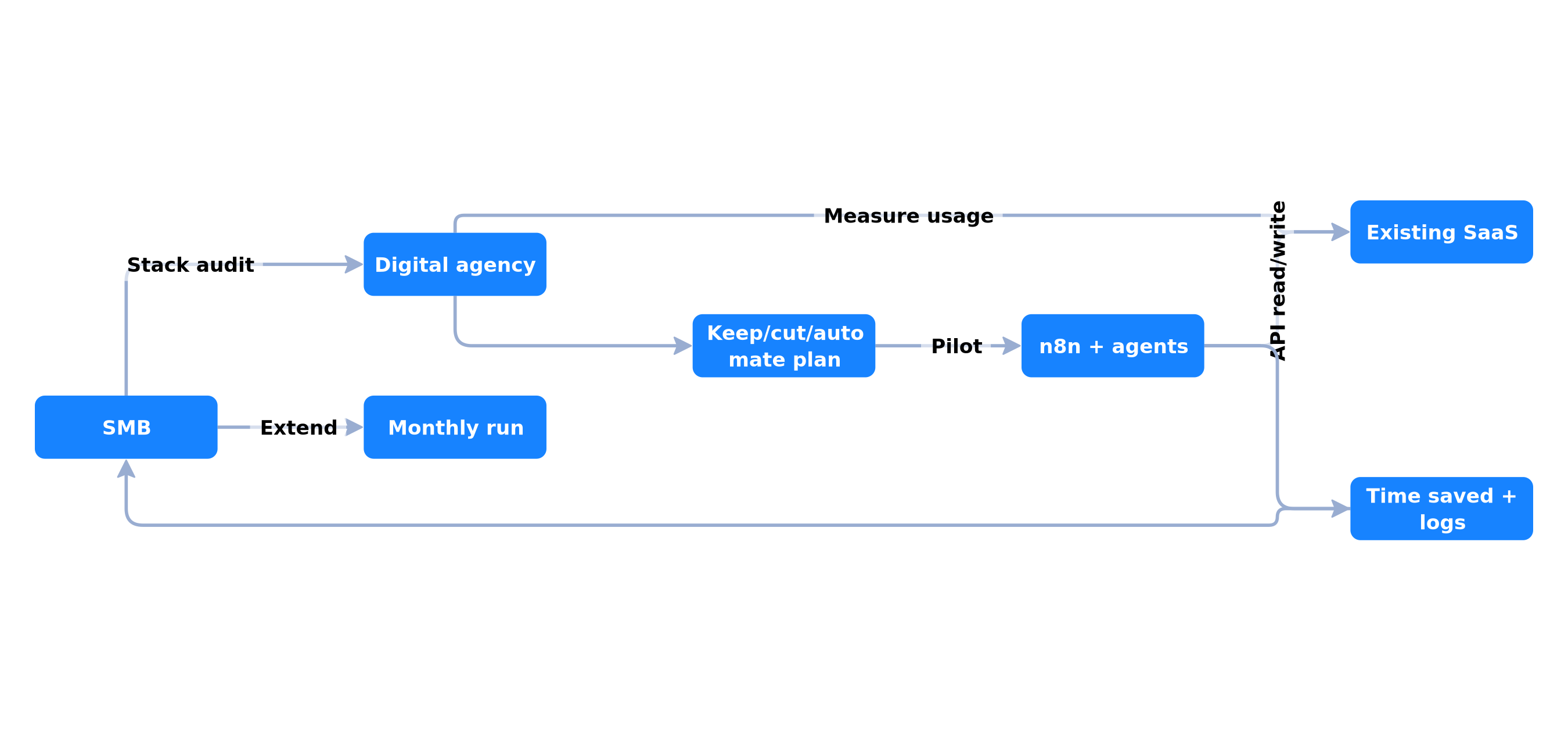 From stack audit to n8n + agents pilot, then monthly run
What not to promise clients
- “We replace Salesforce / your ERP in two weeks.”
- “Zero humans thanks to agents.”
- “Markets are right: all SaaS is dead.”
Promise instead:
- measurable reduction of redundant subscriptions;
- time saved on a bounded process;
- a possible rollback;
- explicit LLM + maintenance costs.
Credibility beats apocalyptic storytelling.
30-day playbook for an agency (or tech founder)
Week 1 — Inventory
List SaaS tools, monthly cost, owner, last login / usage. Tag keep / review / cut.
Week 2 — One pilot process
Pick a painful flow (lead qualification, quote follow-up, stock ↔ ads sync). Spec inputs, outputs, exceptions.
Week 3 — Build n8n + agent
Workflow + LLM calls where language helps (classification, summary), hard rules elsewhere (amounts, permissions). HITL on customer-facing sends.
Week 4 — Measure
Hours saved, errors, internal CSAT, cancelable subscriptions. Decide monthly run or stop.
This playbook sells better than a “SaaSpocalypse” speech: it produces a before/after.
Where SaaS remains rational
Agents do not magically replace:
- certified accounting and local obligations;
- a deeply customized CRM with sales history;
- tools where the ecosystem (marketplace, partners, training) is the product.
In those cases, the better strategy is often: keep the SaaS + attach agents (assisted writing, triage, sync) rather than rebuild.
CNBC’s debate is about equity valuations. Your client talks about monthly invoices and reliability. Connect the two without confusing the scales.
Agency offer packaging (example)
- SaaSpocalypse-ready audit (1–2 weeks): cost map, quick wins.
- Agent + n8n pilot (2–4 weeks): one process, metrics, docs.
- Run: monitoring, prompt/workflow updates, monthly review.
Communicate ops ROI, not the end of software. Francophone SMEs want less tool chaos, not an ideology.
Three client profiles (and what they actually buy)
The overwhelmed founder — ten SaaS tools, three truly used. They are not buying “AI”: they are buying less mental load and a clearer invoice. Talk monthly cost and hours recovered.
The ops / office manager — lives with tools imposed by every department. They buy reliability and runbooks. Show logs, alerts, and who gets called when it breaks at 7 p.m.
The sales lead — does not care about the CNBC debate. They want leads handled faster and fewer no-shows. Attach agents + WhatsApp to the existing CRM; do not propose a CRM rebuild “because SaaSpocalypse.”
Matching the pitch avoids selling an apocalypse to someone who asked for a follow-up calendar.
Agency-side risks (budget them)
- Scope creep: after one successful flow, the client wants to “replace all SaaS.”
- Variable LLM cost: a chatty agent can destroy the margin on a run retainer.
- Key-person dependency: one freelancer who “gets n8n” = bus factor 1.
- Compliance: an agent sending customer messages without opt-in creates legal risk for you and the client.
Simple mitigations: written scope, token quotas, pair coverage / documentation, legal checklist before messaging go-live.
Tie-in with your existing offer
If you already sell sites, chatbots, or automation, SaaSpocalypse is not a magical new vertical. It is a timing argument: clients finally listen when you say “stack less, integrate better.” Use the press debate to open the conversation; use the stack audit to close it.
The automation and n8n automation agency pages remain natural entry points: market narrative brings the lead, stack diagnosis converts it.
Metrics to track after a pilot (no vanity)
Measure what matters for renewing a run retainer:
- hours saved / week on the pilot process (self-report + log timestamps);
- subscriptions cancelled or not renewed thanks to the workflow (euros / month);
- error rate or human takeover (HITL) — if it rises, the scope is too wide;
- cycle time (lead → first contact, quote → follow-up);
- internal satisfaction of the ops people who live in the system daily.
Avoid selling only “X% automation.” A client prefers “two fewer tools and quotes followed up within 24 hours.”
If metrics stall after 30 days, do not force a second agent. Simplify the business process first — that is often the real bottleneck.
Competitive positioning without fear-mongering
Your competitors may tweet that “SaaS is dead.” You can win by sounding calmer:
- acknowledge the CNBC / market debate in one paragraph;
- refuse invented market-cap scare numbers;
- show a before/after stack diagram from a real (anonymized) audit;
- price the pilot so the client can walk away;
- keep a SaaS vendor when it is still the rational choice — honesty builds referrals.
Agencies that survive hype cycles are the ones that still bill for maintenance and judgment, not for apocalypse theater.
Also remember the internal stack: if your own agency runs fifteen overlapping tools, fix that first. Clients smell the gap between your LinkedIn posts and your invoice chaos.
Conclusion
The media SaaSpocalypse — including CNBC’s August 2026 debate on swinging software stocks — opens a window for digital agencies: help SMEs decide between AI agents + n8n automation and stacked, underused SaaS subscriptions.
Keep SaaS where data and compliance demand it. Automate where the process is bounded and integration cost beats ghost licenses. To get started, explore automation and n8n automation agency.
Apocalypse makes good headlines. Workflows that hold make good clients.
Tags
FAQ
What is the “SaaSpocalypse”?
It is the 2026 media nickname for the fear that AI agents will hollow out the value of classic SaaS products (especially per-seat pricing). The debate intensified in financial press, including a CNBC piece in early August 2026 on software stocks swinging wildly.
Will AI agents “kill” all SaaS?
No. Many vendors already embed AI, and software with proprietary data, compliance, and deep workflows remains hard to replace. Lightweight single-job tools and stacks of 15 underused subscriptions are under more pressure.
What is the opportunity for a digital agency?
Help SMEs replace or shrink redundant SaaS with targeted agents and automations (often n8n + LLM + existing systems), with governance, ROI measurement, and maintenance — an integration craft, not hype.
Custom agents + n8n or keep the SaaS?
Keep SaaS when it holds critical data, compliance, or an irreplaceable ecosystem. Build an agent / workflow when the need is narrow, subscription costs stack up, and you control the integrations.
Where should we start in practice?
Audit subscriptions (real usage vs cost), pick one high-volume repetitive process, pilot with n8n + HITL, measure time saved. Our automation and n8n agency pages outline the approach.
Budget, process, priorities — decided together
Website, chatbot, or automation? We pick the next job that unlocks cash, not the trendy stack.
- 30 min
- Clear priorities
- No commitment
William Aklamavo
Web development and automation expert, passionate about technological innovation and digital entrepreneurship.


