
Choosing an n8n agency in 2026: 8 criteria (sovereignty, errors, ownership)
How to choose an n8n agency in 2026: 8 selection criteria, the real questions (sovereignty, errors, workflow ownership), what drives the price and what an audit should show.

Choosing an n8n agency in 2026: 8 criteria (sovereignty, errors, ownership)
The price of an n8n agency is not decided on the rate card. It is decided on questions you ask before signing.
In 2026, the n8n agency market is booming in France. Some build on real production deliveries. Others on templates and promises. How to tell the difference? This article proposes 8 selection criteria tested on our own deliveries (portfolio ids 1, 17, 24, 40, 42) and on competitors'.
What you will learn: questions to ask before the quote, what the "who owns the workflow" rule means, how to check data sovereignty, how to read a production use case, and how to compare offers on the same scope.
Why "the cheapest" is the wrong criterion
On a trivial flow, a freelancer or a small agency is more economical. On a project touching sensitive data, the price difference is paid in fixes, downtime and hours explaining a workflow nobody understands.
Public 2026 ranges (CZ Multimedia, Cuvra): 800 € to 3,000 € for a targeted automation, 4,000 € to 10,000 € for a full deployment with AI agents and integrations, 150 €/month and more for maintenance.
Three structural reasons explain why the low price costs more in automation:
- Automation errors are invisible until the impact: a silently failing workflow (a follow-up step that stopped firing) makes no noise — it loses leads for weeks. The error cost only shows up in revenue, never in the debug.
- Rebuilding costs more than building: an undocumented workflow, taken over by a third party, must be "deciphered" before being fixed. Budget 2 to 3 times the initial cost to take over a poorly designed flow.
- Operating cost dominates: over 3 years, infrastructure and maintenance often exceed construction. Choosing an 800 € agency that bills every fix separately costs more than a 3,000 € agency with clean maintenance.
This is why all the criteria below go through verifiable questions, not promises.
The n8n agency market in 2026: what changed
The n8n provider landscape professionalized in 2026. Three notable shifts:
- AI agents changed the scope: "classic" n8n agencies (workflows + integrations) must now master AI agents, models, memories and tools. An extra selection criterion: the ability to design an agentic flow, not just chained nodes.
- Sovereign data became a commercial argument: GDPR, the NIS2 directive and distrust of non-European clouds push clients to demand European self-hosted instances. Agencies that can deploy and maintain self-hosted stand out.
- "Automate everything" is no longer credible: companies learned to distrust all-horizons promises. Good agencies answer "this flow yes, that one no" after counting your volumes.
These shifts make the 8 historical criteria more relevant than ever — and add a ninth: running AI agents in production, covered in detail in our human-in-the-loop article.
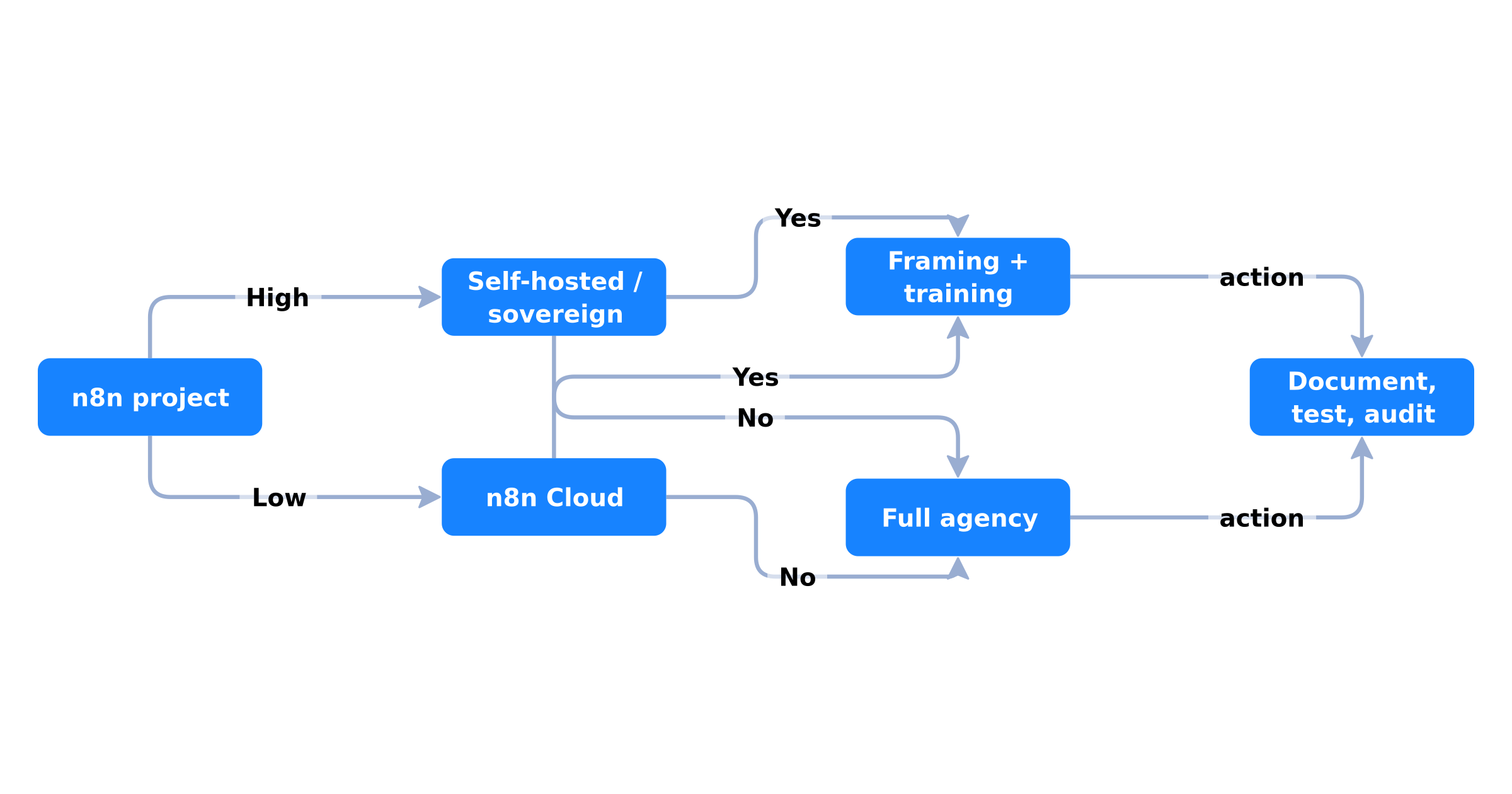
flowchart TD
    A[n8n project] --> B{Data sensitivity?}
    B -->|High| C[Self-hosted / sovereign]
    B -->|Low| D[n8n Cloud]
    C --> E{Internal skills?}
    D --> E
    E -->|Yes| F[Agency for framing + training]
    E -->|No| G[Full agency: design + hosting + maintenance]
    F --> H[Document, test, audit]
    G --> H
(Decision flow: rendered by the Mermaid MCP — code above is the source.)
The 8 selection criteria
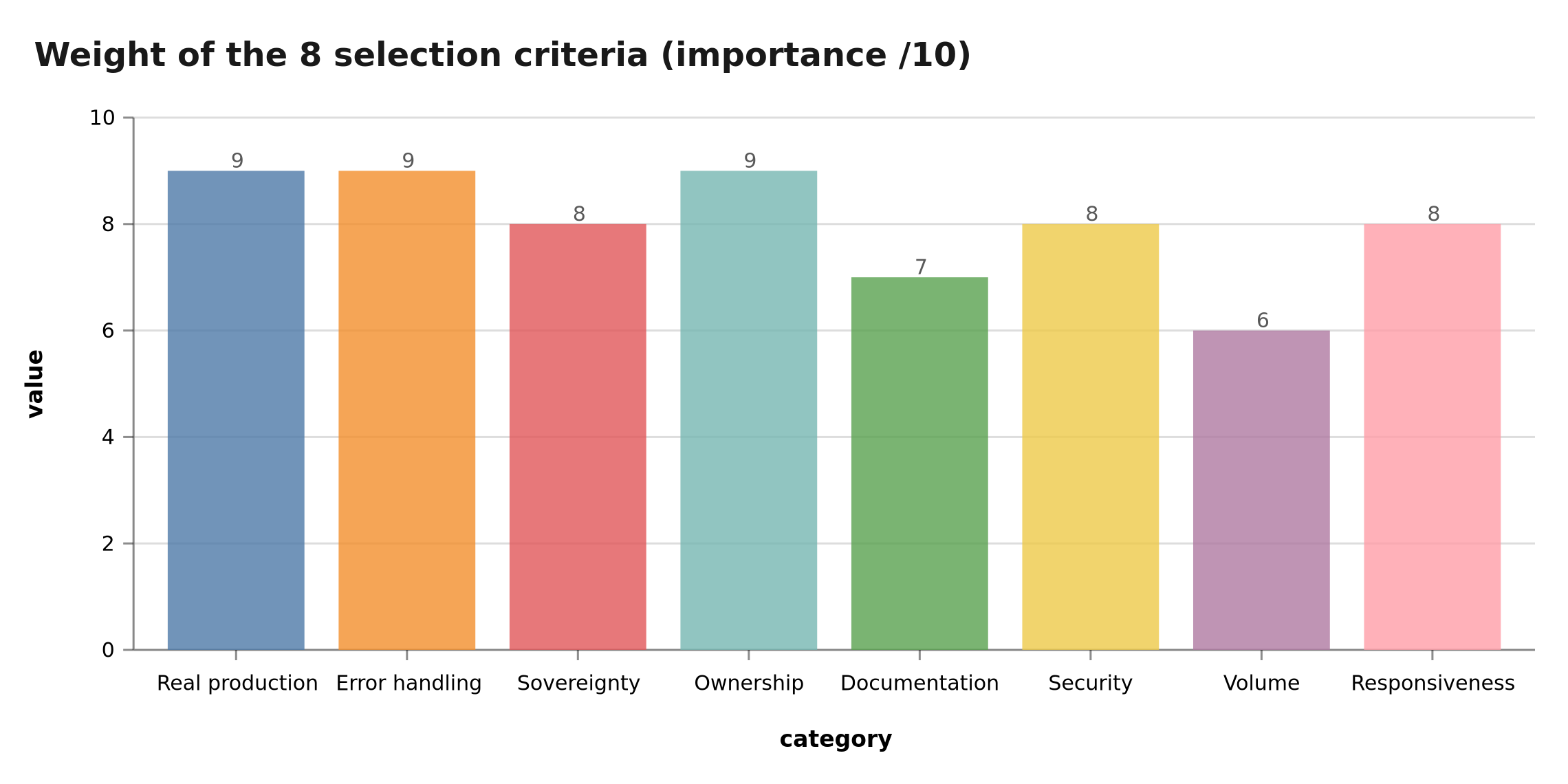 The 8 criteria: production, errors, sovereignty, ownership, doc, security, volume, responsiveness
1. Real production, not templates
Ask for production examples, not screenshots. A good question: "Which workflow is still running for a client after 6 months?" With us, files 17 (PrestaShop SEO), 24 (internal chatbot) and 42 (content engine) document real deliveries.
How to verify without trusting word of mouth? Three tests: 1) ask for production dates (a workflow "in production for 6 months" must have a precise date); 2) ask for the monthly processed volume (execution count, nodes, data passed); 3) ask for a reference contact in the same business sector. An agency that actually delivered answers these three without hesitation. One selling templates answers with generalities.
2. Error handling
Someone who responds when a workflow fails on a Friday evening matters more than canvas beauty. Check: alerts, logs, retry queues, tests before production.
Maturity level is measured on three precise points:
- Alerts: does a workflow fail silently, or does a dedicated channel (Slack, Telegram, email) warn the team within a minute?
- Smart retry: does the flow automatically retry transient errors (timeout, busy API) with backoff, and flag definitive errors for human review?
- Observability: is there a browsable execution history, with input payload and failure reason? Without it, "handling errors" is wishful thinking.
Our file id 24 (internal chatbot) and our n8n agent governance article show the expected production level.
3. Data sovereignty
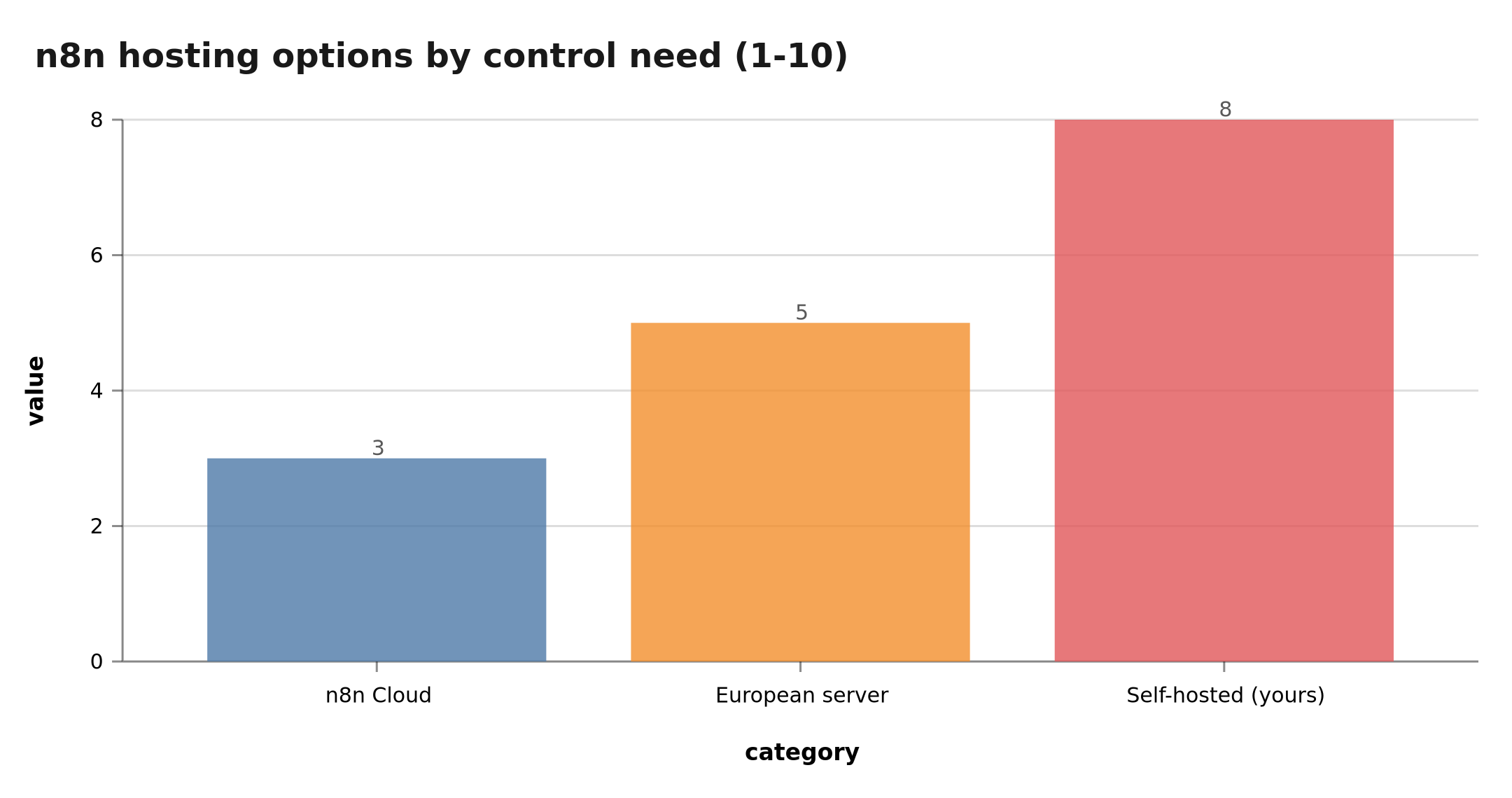
Where does the instance run? n8n Cloud, European server, yours? The answer depends on your data (health, finance, HR). Our VPS self-hosting guide and the SME pillar lay out the options.
Four possible regimes, from least to most sovereign:
- n8n Cloud (official): hosted by n8n, easy, but data transits outside your direct control. Acceptable for non-sensitive flows.
- European cloud: the instance runs on an EU host (Scaleway, OVHcloud, Hetzner, etc.). Data stored in the EU, simple contracting, moderate cost (20 to 60 €/month of VPS depending on size).
- Self-hosted at your place: the instance runs in your infra (or your agency's, if European). Full control, but maintenance to plan (updates, backups, security).
- Hybrid: non-sensitive flows in cloud, sensitive flows self-hosted. The right balance for mixed-data SMEs.
The trap question to ask: "Where are execution data and logs stored?" Many self-hosting agencies forget that execution logs contain complete payloads — sometimes client data. Log storage must follow the same regime as the data itself.
4. Workflow ownership
Who owns the workflows at the end? Who can export them? The contract must provide restitution. Our position: the client owns their instance and flows.
The three points to get in writing:
- Code ownership: the workflows (exportable JSON) belong to the client from final payment.
- Recoverable export: the agency provides a complete export, including credentials (or their re-creation procedure) and environment variables.
- Instance access: the client has admin access, not "viewer" access. No serious agency needs to lock you out of your own flows.
Beware of clauses saying "workflows remain agency property until full settlement" — they turn your automation into a hostage in a dispute. Ownership must be acquired at delivery, not at the end of the maintenance contract.
5. Documentation
An undocumented workflow is technical debt. The agency must provide: schema, node explanations, recovery instructions, and ideally team training.
The minimal documentation package of a serious project:
- A functional diagram (what the flow does, in what order, why).
- A node-by-node explanation (role, data sensitivity, dependencies).
- Recovery instructions (what to do if the flow fails, how to restart, who to contact).
- A change log (what changed, when, by whom).
Without this package, your workflow becomes a black box only the provider can touch — the very definition of lock-in. Documentation is part of the scope: refuse a quote that excludes it.
6. Security (secrets, sandbox)
API keys must live outside JSON, in a secret manager. Tests run through a sandbox. The June 2026 supply chain incident on GitHub repos is a reminder: cloning an "official" workflow without a sandbox exposes tokens (see tutorial).
Five security checkpoints to ask before signing:
- Secrets: are n8n credentials encrypted and kept out of shared JSON exports?
- Quarantine: are test and dev nodes separated from production?
- Access: who can access the instance, and is access logged?
- Backups: frequency, storage location, tested restoration?
- Updates: does the agency keep the n8n version current (CVEs tracked continuously)?
Our n8n security checklist article details each point.
7. Admissible volume
An agency promising to "automate everything" is not credible. The honest one answers: this flow yes, that one no, we need to count your volumes first.
Admissible volume covers three dimensions: the number of executions per day (a flow running every minute is not designed like a weekly flow), the data size passing through nodes (multi-MB payloads vs a few KB change the architecture), and external dependencies (third-party APIs with quotas, costly AI model calls). An agency quoting without asking these questions underestimates either the project or your future costs.
8. Responsiveness
Test support before signing: send a simple question on Friday at 5 pm and measure the response time. It is the best predictor of after-sales service.
Add two complementary tests: answer quality (do they answer your question or point you to the docs?) and real takeover (a workflow down on a Sunday evening: who picks up? what SLA?). Responsiveness is tested before, not after — it is the only criterion you can verify for free.
Questions to ask before the quote
- Do you have an example of a workflow in production with a client for 6+ months?
- How do you handle errors (alert, retry, escalation)?
- Where is data hosted? Can I require a European server?
- Who owns the workflows? How do we export them?
- How do you store secrets?
- What happens if you are unavailable (SLA, recovery, documentation)?
 6 questions: real production, errors, sovereignty, ownership, docs, security — chaining the criteria leads to the right agency
 The 3 n8n hosting options and when to choose them
What an audit should show
A credible automation audit does not sell a solution. It documents: manual processes, volumes, existing tools, quantified opportunities (hours, errors, cycle time), risks. It ends with a plan of 2-3 workflows max, not a catalog of 50 automations.
Our audit offer of 30 minutes to 1 hour delivers this: the flow losing money today.
A good audit answers five questions before proposing anything:
- Which repetitive process consumes the most hours? (often: manual entry, follow-ups, reporting)
- Where are the human errors? (copy-paste, forgotten follow-ups, double entry)
- Which tools are already in place and can be connected without rebuilding everything?
- What volumes must be handled (frequency, size, dependencies)?
- What is the opportunity cost of each candidate flow — the monthly gain if it works?
If the audit outputs a catalog, run. If it outputs one prioritized quantified flow, you have an agency that understands the business.
AI agents change the game: the de facto 9th criterion
In 2026, part of the n8n projects integrate AI agents: memories, tools, retrieval, model calls. This is no longer a "hard-coded" workflow — it is a system that decides. Three extra questions to ask:
- How does the agency test AI replies? An evaluation on real cases (prompt benchmarking on a sample of your data) is the only way to measure quality before production. Without it, you discover errors in production.
- How does it handle human-in-the-loop? Not all AI flows should be autonomous: human validation on costly actions (sends, payments, external communications) must be planned from design. Our human-in-the-loop article sets the frame.
- What is the model execution cost? An AI agent calling an LLM on every execution has a variable cost (0.01 to 0.50 € per execution depending on model and context size). The agency must quantify this item in the business case, not let it appear on your cloud bill.
An agency answering these three precisely masters the 2026 level. One talking only about nodes and canvas stayed at the 2023 level.
The self-hosted specific risks: what sovereignty hides
Self-hosting is often sold as THE sovereign solution. True — provided you understand what it implies. Five specific risks:
- Updates: n8n regularly publishes versions (fixes, new features, security patches). An unmaintained instance accumulates vulnerabilities. Who does the update at your place?
- Backups: without a tested backup, a self-hosted instance is a time bomb. Restoration must be tested, not just planned.
- Logs: execution data (complete payloads) is stored on your server. Its retention must follow your GDPR policy — and its volume can grow fast (an execution with AI replies produces logs of several KB to several MB).
- Disaster recovery: if the server dies, who restarts? Your team may lack the skills. The maintenance contract must cover supervision and intervention.
- Scalability: a 20 €/month VPS suffices for light flows. Intensive flows (WebSocket, heavy processing, AI agents) require more CPU/RAM. Under-sizing means paying for poor performance then migrating in a hurry.
Our n8n self-hosted VPS guide covers these points in detail. Sovereignty is not a hosting — it is a set of practices (updates, backups, logs, supervision) that the provider must document and price fairly.
Comparing two n8n quotes on the same scope
Automation quotes are rarely comparable as-is. Here is how to put them on the same plan:
| Scope element | To ask explicitly |
|---|---|
| Number of workflows included | How many flows, with how many nodes each? |
| Covered integrations | Which APIs, with what configuration (auth, webhooks)? |
| AI interface included | Is an AI agent included, or billed as an option? |
| Tests and validation | Are real-environment tests in the quote? |
| Training and docs | Is the documentation package and training included? |
| Maintenance | Monthly rate, included evolution hours, response SLA? |
| Ownership | Written restitution clauses, exports provided? |
The rule: a quote without explicit scope is an incomplete quote. Ask for the line breakdown (studies, design, development, tests, deployment, training, maintenance) — serious agencies provide it. "Discovery packages" without detail often hide later fix costs.
Warning signs: when to walk away from an agency
Six signals that should make you leave, even at a low price:
- No dated public file: no verifiable client case, no dates, no volumes.
- Canvas screenshots as proof: anyone can draw a workflow on a template.
- Refusing ownership transfer: "the workflow stays with us" is non-negotiable.
- "Automate everything" without counting your volumes: over-promising is the first sign of incompetence.
- No written error or recovery procedure: failure handling will be discovered in production.
- An unreachable contact on Friday: your pre-signing responsiveness test failed — believe it.
Conversely, positive signals: files with volumes and dates, a written answer to your 6 questions, an audit quantifying a precise flow, and an ownership clause already drafted in the quote. Selection happens on these signals — not on price.
The n8n pricing traps: what really drives the quote
Beyond the market ranges above, five factors explain why two agencies quote differently for the same-looking project:
- The number of integrations : connecting two systems with standard APIs takes a day; connecting four systems with webhooks, sync both ways and retries takes weeks. Each integration multiplies the test surface.
- The error strategy : a flow designed with retries, queues and an error channel costs more to build but far less to operate. The quote without an error strategy is not comparable to the one with it.
- The data model : simple payloads (a few fields) are cheap; payloads needing transformation, deduplication or mapping against an external schema cost more. Ask what "message" means in the quote: raw pass-through or processed data?
- The AI layer : adding an AI agent (model calls, memory, tools) changes both the build cost and the running cost. Compare quotes with the AI layer explicitly included or excluded.
- The SLA : a 24/7 monitoring and intervention service has a price. A quote at 800 € without SLA and a quote at 3,000 € with one do not cover the same risk.
When comparing two quotes, rebuild them line by line on these five factors. The gap between 800 € and 3,000 € usually dissolves once scope, error strategy and SLA are aligned.
The 36-month view: total cost of ownership
The initial quote is only the first payment. The full cost of an automation project over 3 years breaks down as follows:
| Item | 2026 range | Typical share |
|---|---|---|
| Initial build | 800 – 10,000 € | 30–40 % |
| Infrastructure (self-host VPS or cloud) | 20 – 150 €/month | 10–15 % |
| Maintenance (fixes, evolutions, monitoring) | 150 – 500 €/month | 30–40 % |
| Evolutions (new flows, integrations) | variable | 15–25 % |
The calculation to make before signing: ask the agency its monthly maintenance rate over 36 months and its hourly evolution rate. Compare two providers on this 3-year total, not on the initial quote. A 1,500 € quote with 400 €/month maintenance costs more than a 3,000 € quote with 150 €/month maintenance — and the quality is not the same.
Choosing between freelancer, agency and internal hire
The n8n market offers three sourcing modes. Each fits a different situation:
- Freelancer: best for a single well-defined flow with limited integrations. Cheaper, but fragile: no backup if unavailable, ownership and documentation depend on the person.
- Agency: best for multi-flow programs, AI agents, and situations requiring SLA, documentation and handover. More expensive, but the delivery is institutionalized.
- Internal hire: relevant only from sustained volume (several flows maintained in-house). Preparing an n8n person costs time and risks skill loss when they leave.
The decision rule: freelancer for a pilot, agency for a production system you depend on, internal hire only when the flow count justifies a permanent role. Our article comparing outsourcing vs recruiting an ops details the full model.
Three test scenarios to impose on the agency
Before signing, impose three concrete tests. They cost nothing and separate real competence from sales pitch:
- The failure test: "Show me how your monitoring tool would alert me if this workflow fails at 3 am." A real agency demos its alert channel and escalation path live.
- The takeover test: "You disappear for a month. What documentation do I have to operate the workflow?" The answer reveals the documentation quality instantly.
- The volume test: "This flow will process 50,000 executions a month. What changes in your design?" The answer reveals whether they understood n8n limits (queue, rate, provider quotas) or are building for a demo.
These three tests take an hour and reliably filter the market. Every agency that passed them in our own selection process turned out to deliver.
The documented BOVO case
Among our files, 6 cite n8n (ids 1, 17, 24, 27, 40, 42). Examples from our own production:
- Access control (id 27): an n8n workflow securing an app linked to user credits, with JWT and IP verification — an "infra" case showing technical depth.
- Product file SEO (id 17): hundreds of PrestaShop files optimized in hours by an n8n + LLM flow.
- SEO content engine (id 42): prompt engineering, mass CMS publishing via API.
Agency selection is therefore verifiable in public files: the BOVO register (docs/seo/data-evidence/register.json) shows the collection method and thresholds — no aggregate under 5 cases. This is our answer to "how do you prove you really deliver?": with dated public files, volumes and integrations, not slides.
Sources
- 2026 market ranges: CZ Multimedia, Cuvra (public pages September 2026).
- BOVO register: September 13, 2026, 44 files, 25 automation cases including 6 n8n.
- Portfolio files: ids 1, 17, 24, 27, 40, 42.
Conclusion
Choosing an n8n agency in 2026 is not decided by page price but by 8 criteria: real production, error handling, sovereignty, ownership, documentation, security, admissible volume, responsiveness. Ask the questions before the quote, require production examples, and verify you stay owner of your workflows.
Add the 3-year cost (maintenance + evolutions), not just the initial quote. And remember: the right provider documents, tests and returns control of your instance — not the opposite.
Next: automating your SME with n8n, self-hosting n8n on a VPS, or n8n/Make automation pricing.
Tags
FAQ
What criteria for choosing an n8n agency in 2026?
8 criteria: real production, error handling, data sovereignty, workflow ownership, documentation, security (secrets, sandbox), admissible volume, and a reachable contact. A good provider shows production examples and answers within 24 hours.
How much does an n8n agency engagement cost?
In 2026, a targeted automation often costs between 800 € and 3,000 €, and a complex deployment (multiple workflows, AI agents, integrations) between 4,000 € and 10,000 €. Maintenance starts around 150 €/month (public ranges CZ Multimedia, Cuvra).
Do I need to self-host n8n to be GDPR compliant?
Not necessarily, but self-hosting gives you storage control and eases compliance. At BOVO, 6 files cite n8n and several run on our own infrastructure. The SME pillar and the VPS self-hosting guide detail the choices.
Who owns the n8n workflows built by an agency?
The question is asked before signing: code ownership, recoverable export, instance access. A good contract provides this restitution. Our rule: the client stays owner of their instance and workflows.
Budget, process, priorities — decided together
Website, chatbot, or automation? We pick the next job that unlocks cash, not the trendy stack.
- 30 min
- Clear priorities
- No commitment

Singbo Davy AGONMA
Fullstack Developer & AI Expert. n8n automation specialist, Laravel/Flutter development and AI agent integration. Master CS — IFRI.


