
Etched: From Harvard Dropouts to $10.3B — The Trajectory of an AI Infra Startup Defying Skeptics
Etched, founded by three Harvard dropouts in 2022, just raised $300M in Series C at $10.3B valuation (July 23, 2026). With $1B in orders and specialized AI chips, the startup defies skeptics.

Etched: From Harvard Dropouts to $10.3B — The Trajectory of an AI Infra Startup Defying Skeptics
Three Harvard dropouts, an AI chip startup, and $10.3 billion valuation in four years. The trajectory of Etched, closed on July 23, 2026, is a case study for understanding where AI infrastructure capital is flowing.
On July 23, 2026, Etched announced the closing of its $300 million Series C at a valuation of $10.3 billion, led by Sequoia. This startup, founded in 2022 by three Harvard dropouts, manufactures specialized AI chips for transformer model inference.
With $1 billion in booked orders and a valuation that doubled in seven months, Etched represents a case study: how a hardware startup manages to defy skeptics in a market dominated by NVIDIA. This article breaks down the trajectory, founding lessons, and implications for the AI ecosystem.
The Trajectory: From 2022 to $10.3B
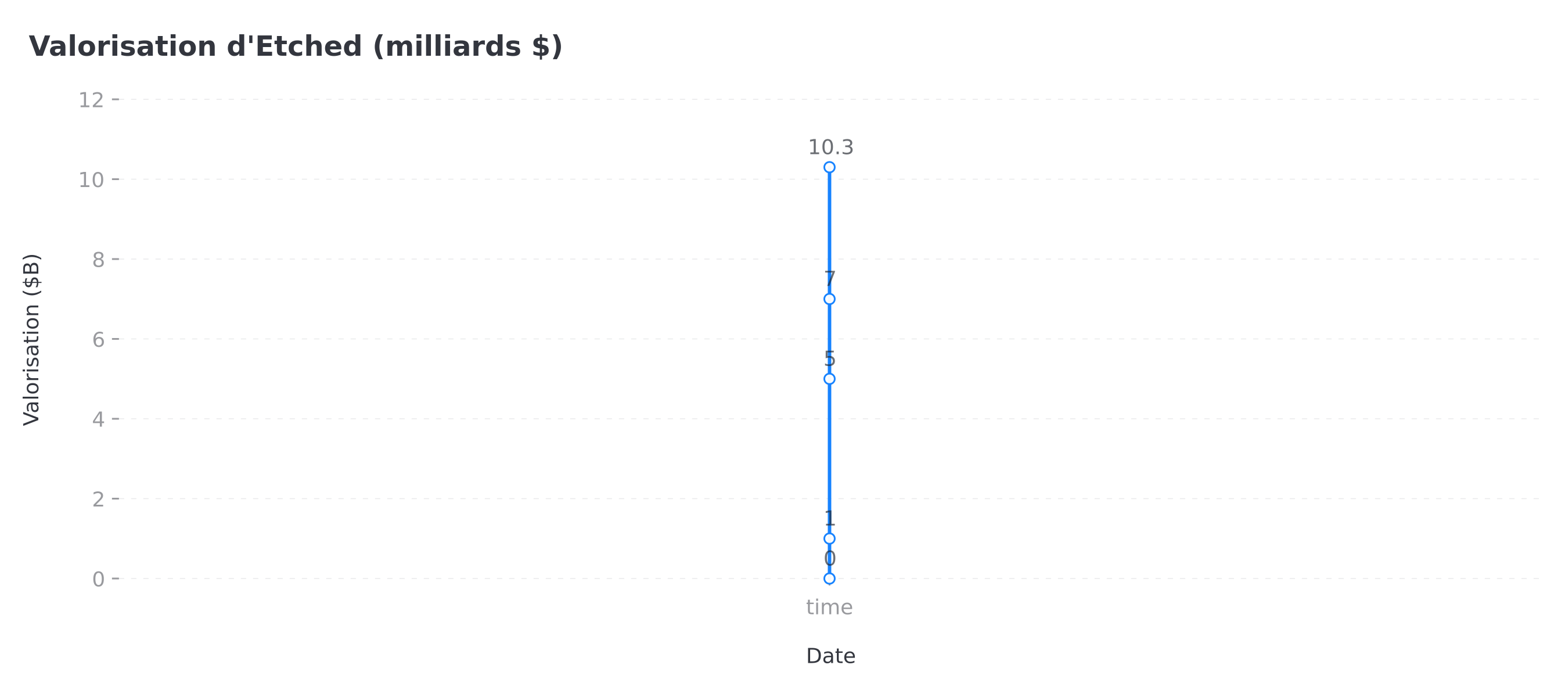 Timeline of Etched's valuation: 2022 founding to 2026 $10.3B
| Date | Event | Valuation |
|---|---|---|
| 2022 | Founded by 3 Harvard dropouts | N/A |
| 2024 | Early rounds | N/A |
| December 2025 | Series B $500M | $5B |
| June 2026 | Successful chip manufacturing, client testing | N/A |
| July 23, 2026 | Series C $300M (Sequoia) | $10.3B |
In seven months, Etched doubled its valuation from $5 billion to $10.3 billion. This is the highest valuation ever for a Sequoia-led Series C, according to co-founder and COO Robert Wachen.
The Product: Specialized AI Chips
The Problem Solved
The AI chip market is dominated by NVIDIA with its GPUs (H100, B200). But GPUs are general-purpose: they accelerate all types of computation, which brings flexibility but also overhead.
Etched manufactures ASICs (Application-Specific Integrated Circuits) designed specifically for transformer model inference — the architecture behind GPT, Claude, and all modern LLMs.
 Comparison of NVIDIA general-purpose GPU vs Etched specialized ASIC across 5 criteria
| Criterion | NVIDIA GPU | Etched ASIC |
|---|---|---|
| Flexibility | High (all compute) | Low (transformer only) |
| Inference performance | High | Very high |
| Cost per token | High | Low |
| Software ecosystem | Mature (CUDA) | In development |
| Availability | Limited (demand > supply) | On order |
Commercial Traction
Etched announced in June 2026:
- Successful manufacturing of homegrown chips
- First systems in client testing
- $1 billion in booked orders
This commercial traction is the key to the valuation: investors are no longer funding a promise, but a startup with a working product and orders.
The Funding Round: Who and Why
The Investors
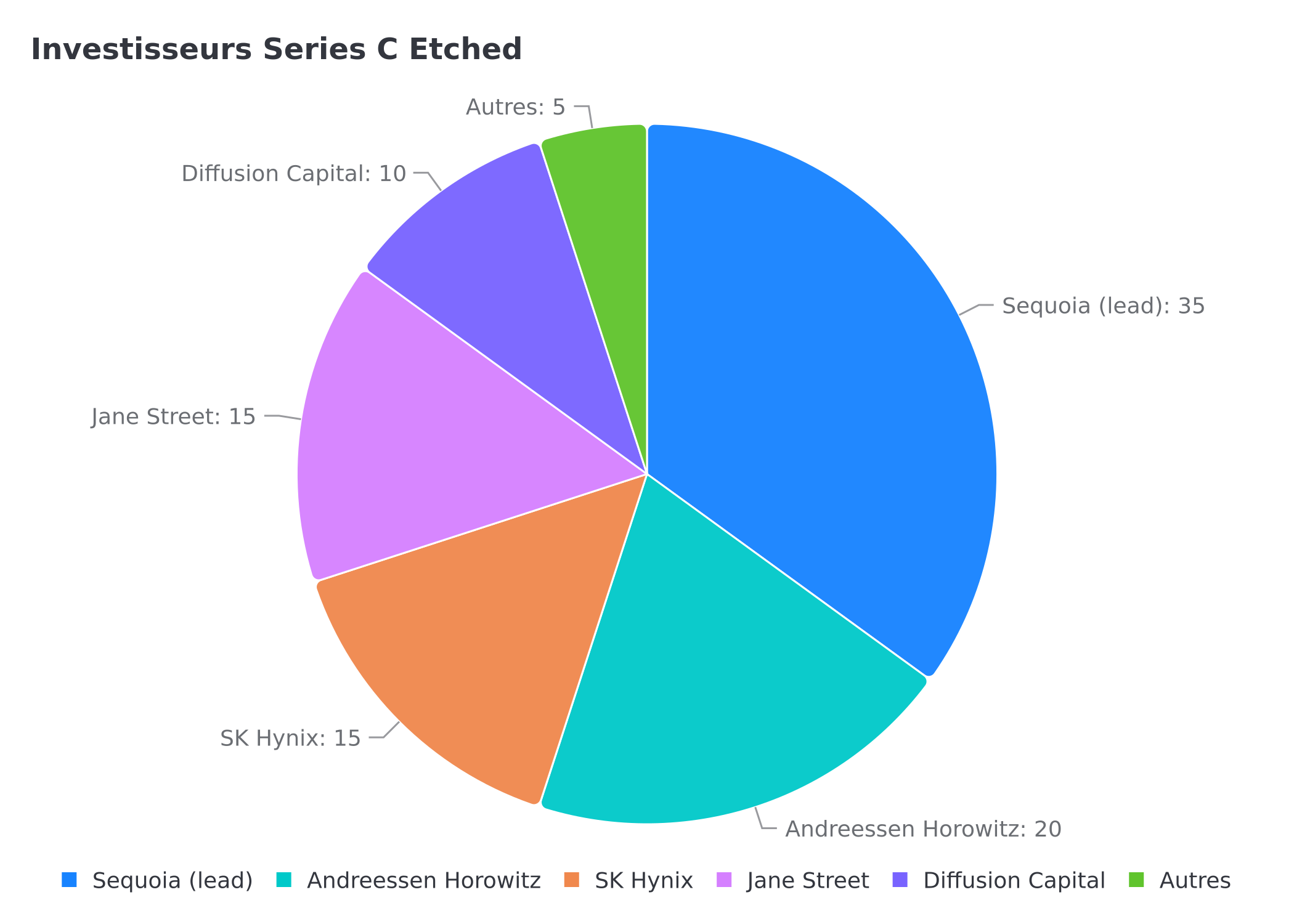 Distribution of Etched's Series C investors July 2026
Series C (July 2026):
- Sequoia (lead)
- Andreessen Horowitz
- SK Hynix (strategic — memory manufacturer)
- Jane Street (financial)
- Diffusion Capital
Previous notable investors:
- Peter Thiel
- Andrej Karpathy (Anthropic)
- Dylan Field (Figma)
- Amjad Masad (Replit)
- Noam Brown (OpenAI)
- Geoffrey Hinton
Why This List Is Remarkable
Etched's investor list includes figures who don't support blindly: Andrej Karpathy, Geoffrey Hinton, and Noam Brown are technical experts who tested the hardware before investing.
"Andrej Karpathy from Anthropic, Noam Brown from OpenAI, Geoffrey Hinton, as well as all the investors in the funding round — these are all people who actually tried the hardware and are very excited about it." — Robert Wachen, COO
This technical validation from experts is a strong signal in a market where many AI startups are funded on promises rather than proof.
The Organization: 40 People, 2 Data Centers
Infrastructure
Etched currently operates:
- 40 employees in its San Jose office
- A 2 MW data center
- A new 80,000 sq ft facility (7,400 m²) in Milpitas, 1 MW
The Private Demo Strategy
Etched's success is partly due to an unusual strategy: private demonstrations in its office. Investors and early customers access the hardware in person.
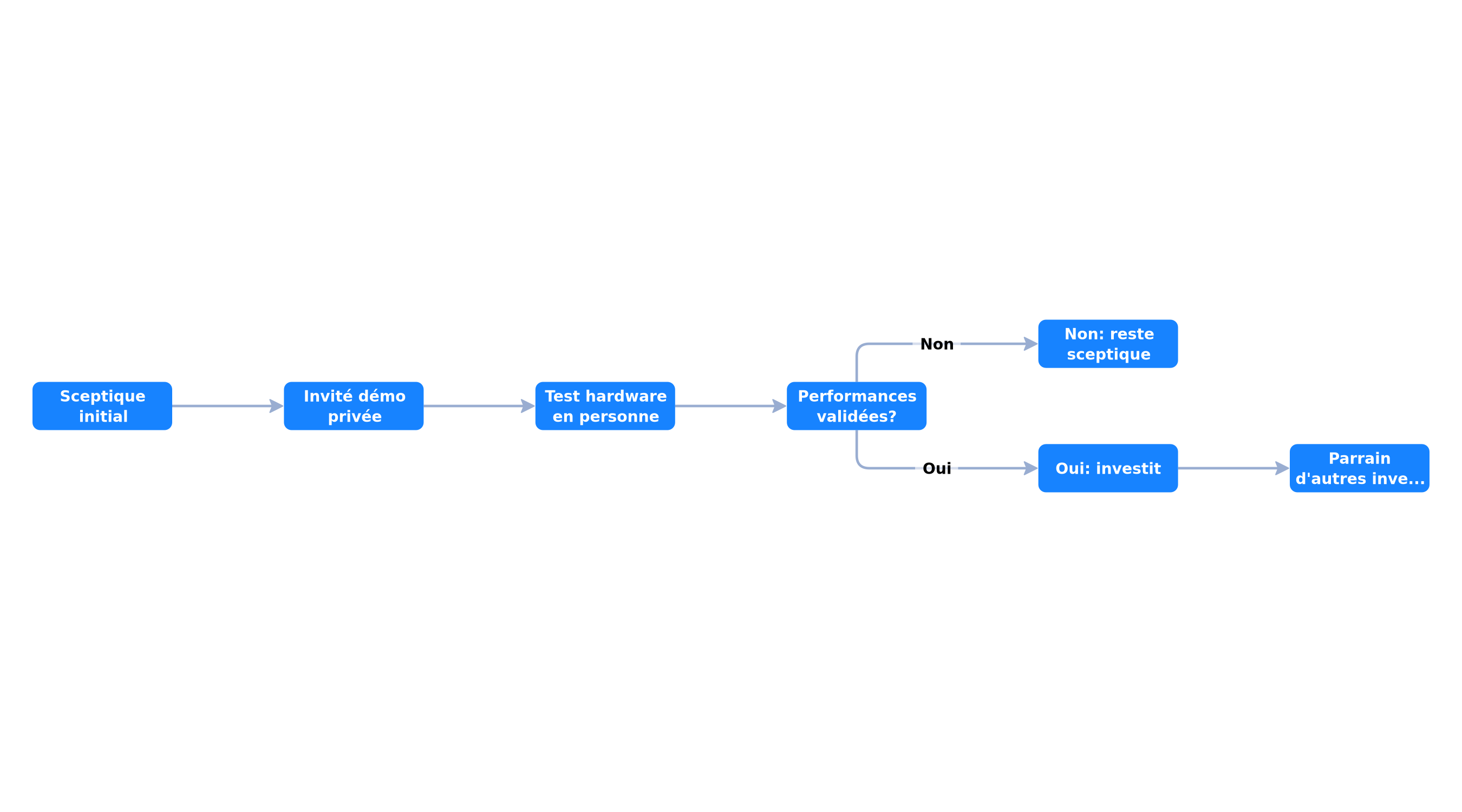 Private demo pipeline: how Etched converts skeptics into investors
This approach is explained by the product's nature: AI chips are difficult to evaluate remotely. In-person demos allow showing real performance, not theoretical benchmarks.
Founding Lessons: What Etched's Trajectory Teaches
1. Specialization Can Overcome Skepticism
In a market dominated by NVIDIA, many thought an AI chip startup couldn't survive. Etched proved that extreme specialization (transformer inference only) is an advantage when the market is large enough.
2. Commercial Traction Beats Hype
With $1B in orders before the Series C, Etched demonstrated that customers will pay for a NVIDIA alternative. In the H1 2026 funding climate where "AI wrappers" are declining, this proof is decisive.
3. Expert Technical Validation Matters
The presence of investors like Karpathy and Hinton — who tested the hardware — creates technical credibility that OpenAI's mega-rounds can't replicate. For hardware founders, getting the product tested by reference experts is a powerful lever.
4. Harvard Dropouts Aren't a Requirement
The "Harvard dropouts" profile attracts attention but isn't the cause of success. The cause is the founders' technical expertise and their ability to execute on a hard problem.
5. Infrastructure Defensibility Remains Attractive
In H1 2026 AI funding, infrastructure (chips, data centers, hosting) attracts more capital than applications. Etched, Fly.io, and others confirm this. Founders building AI infrastructure have a funding advantage.
Implications for the AI Ecosystem
Etched's success confirms several H1 2026 trends:
- Hardware diversification: NVIDIA won't remain alone. Specialized ASICs emerge as a viable alternative for inference.
- Compute sovereignty: companies want alternatives to NVIDIA dependency. Etched answers this need.
- Strategic investment: SK Hynix (memory manufacturer) invested — a signal that the AI hardware ecosystem is structuring vertically.
- Proof > promises: in a mature market, startups with working products and orders win.
Conclusion
Etched's trajectory — from three Harvard dropouts in 2022 to $10.3 billion in 2026 — is a signal for the AI ecosystem: specialized infrastructure remains the most attractive segment. No "AI wrapper", no foundation lab, but chips that accelerate transformer inference.
For founders, the lessons are clear: specialization, commercial traction, validation by technical experts, and private demos. In a market where $510 billion were invested in H1 2026, startups with real infrastructure moats stand out.
If your company wants to explore AI with a defensive approach — sovereign infrastructure, proprietary automation, controlled AI agents — our AI agent creation service integrates these principles from design, and our automation accompaniment covers the technical transition toward controlled AI.
Tags
FAQ
What is Etched and how much did it raise in July 2026?
Etched is a startup specializing in AI chips, founded in 2022 by three Harvard dropouts. On July 23, 2026, it closed a $300 million Series C at a $10.3 billion valuation, led by Sequoia.
Why is Etched valued at $10.3 billion?
Etched doubled its valuation in 7 months ($5B in December 2025 to $10.3B in July 2026) thanks to successful chip manufacturing, positive client testing, and $1 billion in booked orders.
Who are Etched's investors?
The Series C is led by Sequoia, with Andreessen Horowitz, SK Hynix, Jane Street, and Diffusion Capital. Previous notable backers include Peter Thiel, Andrej Karpathy (Anthropic), Dylan Field, and Amjad Masad.
What makes Etched's chips special?
Etched manufactures specialized AI chips (ASICs) designed specifically for transformer model inference, unlike NVIDIA's general-purpose GPUs. This specialization allows a better performance/cost ratio for AI inference.
What founding lessons can be drawn from Etched's success?
Etched demonstrates that specialized AI infrastructure remains fundable in 2026, that private demos to investors create traction, and that hardware specialization can overcome skepticism in a market dominated by NVIDIA.
Budget, process, priorities — decided together
Website, chatbot, or automation? We pick the next job that unlocks cash, not the trendy stack.
- 30 min
- Clear priorities
- No commitment
William Aklamavo
Web development and automation expert, passionate about technological innovation and digital entrepreneurship.


