
ChatGPT Work at $20/month: buy it, or automate with n8n?
ChatGPT Work at $20/month is not a business process. Codex adoption, tokens, n8n: the back-to-school 2026 SMB trade-off for coaches, agencies, consultants.

Updated

ChatGPT Work at $20/month: buy it, or automate with n8n?
An agent subscription is not a process. It is a bright intern with no job description, billed on consumption.
ChatGPT Work vs SMB automation: the question is no longer “will AI replace my assistant?”. Since 9 July 2026, OpenAI has sold ChatGPT Work on the entry tier at $20 per month — about €17 according to BeGeek, 25 August 2026. The promise: a desk agent that chains tasks, not just a chatbot. The temptation, for a coach, a small agency or a consultant, is to buy that and stop.
On 25 August the press reported something else. An OpenAI-backed study of Codex (June 2026): 98% usage among OpenAI employees, 17% among organisational subscribers, under 1% among individual subscribers. OpenAI does not publish the Work / Codex split. The joint app would count 20 million users, against more than a billion people prompting ChatGPT on the web — figures TechCrunch and BeGeek quote with the same caveat: this is not an equivalent adoption metric.
We already unpacked the launch (GPT-5.6 Sol / Terra / Luna, what Work is) in GPT-5.6 and ChatGPT Work. This piece is a decision. Buy Work, ship n8n, or both — and when a 30-minute call beats another subscription.
What $20 actually buys
OpenAI positions Work on office work: reports, spreadsheets, decks, mail roll-ups, sometimes a mini-tool. BeGeek lists concrete cases: turn a sheet into a plan, build a weekly, pull a messy school calendar from an email into Google Calendar. Sam Altman would even use it for holidays. That is not our proof. That is product comms.
Three limits, documented, not invented.
One. Access is not the meter. The OpenAI rate card says ChatGPT Work, Codex, ChatGPT for Excel and Workspace Agents draw from the same agentic credit pool. $20 opens the door. Consumption, especially in business, can continue on credits. Plus is not in the marketing title.
Two. The harness is not magic. BeGeek, still 25 August, stresses: messy permissions, important settings only on the web, agent “effort” that is not intuitive. The agent can create a Google Calendar event, not a new calendar. Ask too little and you get “the worst intern in the office” — BeGeek’s line, not ours.
Three. The keys. To be useful, the agent must see mail, Slack, Notion, Figma, calendar, sometimes the browser. Andrew Ambrosino (OpenAI desktop app) describes it that way, still via BeGeek. The more you open, the more value — and the more data surface. That is not an anti-AI argument. It is a GDPR and client-secret argument that self-hosted n8n does not solve by itself, but that you can scope node by node.
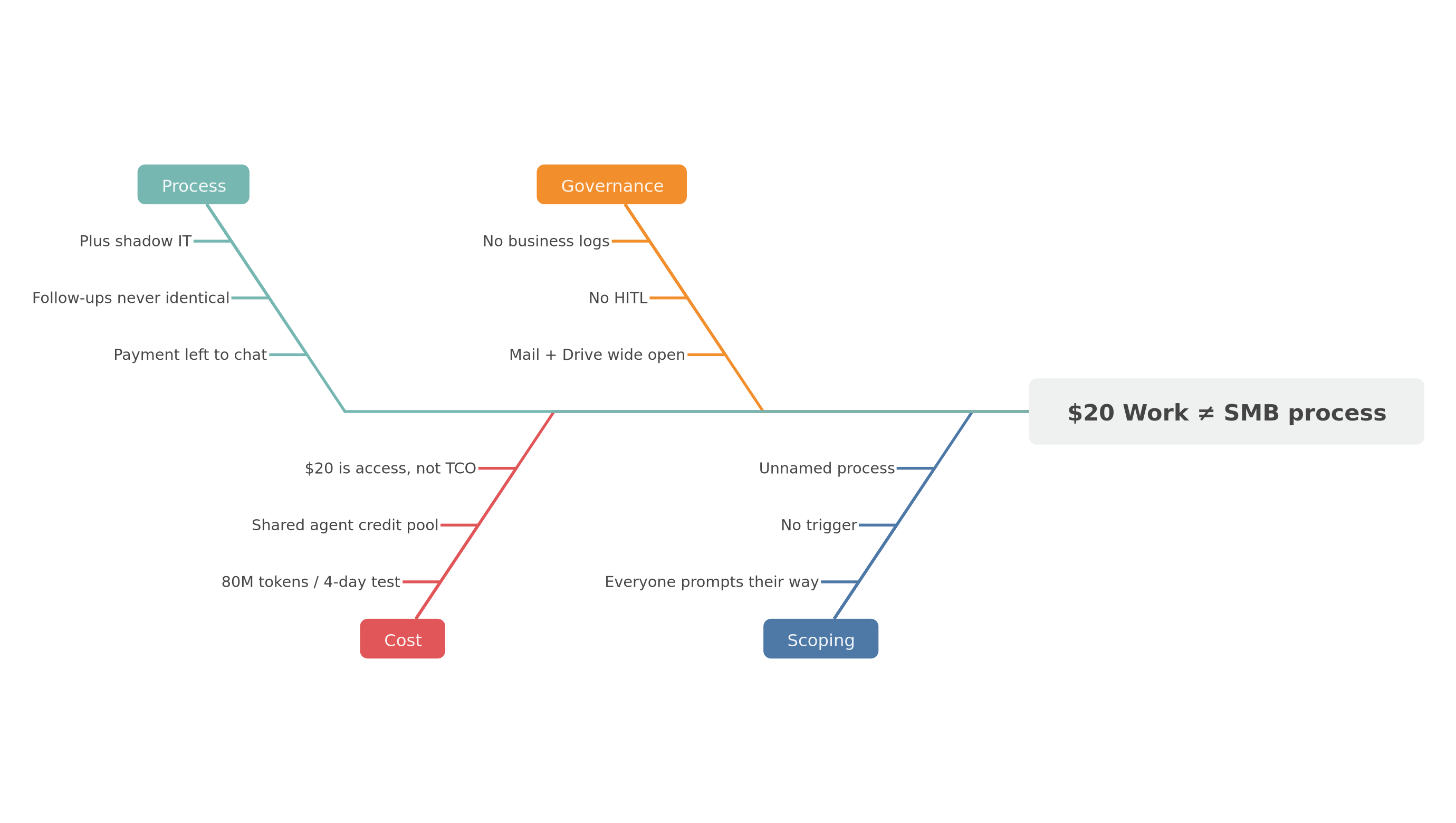 The $20 buys a desk agent. It does not buy a trigger, HITL, or a business execution log.
The adoption study: read the number without twisting it
The figure circulating since late August — 98 / 17 / under 1 — measures Codex, in June 2026, in an OpenAI-backed study (relayed by TechCrunch, BeGeek, Brief IA). It is not “1% of SMBs use ChatGPT Work”. It is: outside the people who build the tool, coding agents barely landed with individual subscribers.
Why that matters for Work vs n8n?
Because Work is the attempt to take that agent stack to non-devs, at Plus pricing. If external Codex adoption is already weak, buying Work “so the whole team automates” with no named process is a bet that the consumer harness will do what the CLI did not. Possible in six months. Not a back-to-school strategy.
The 20 million joint-app users vs a billion web prompts: OpenAI has not defined whether 20 million are monthly actives, cumulatives, or a Work + Codex mix. Do not build a budget on that. Deduce only that the chatbot scales, the agent does not yet.
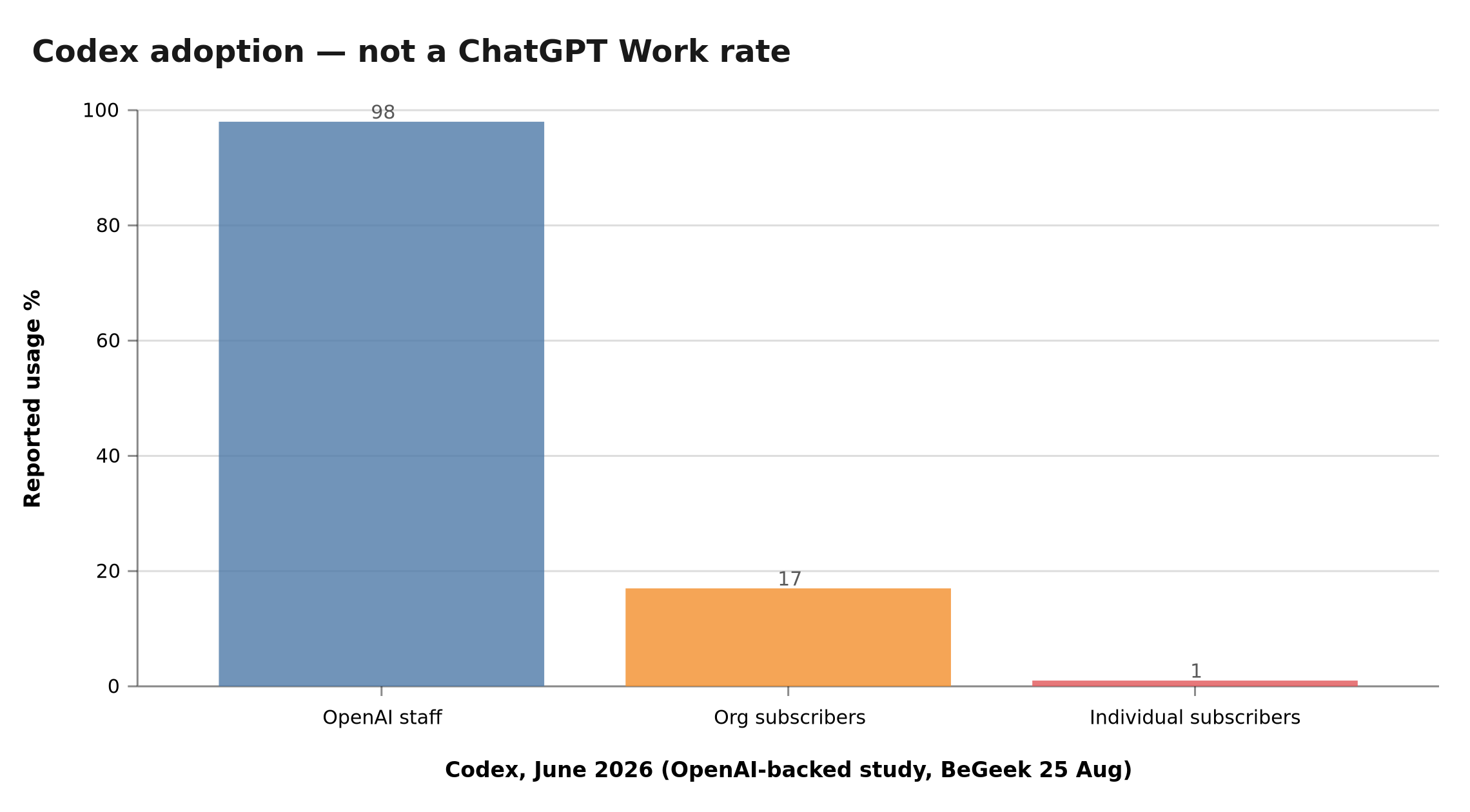 98% at OpenAI, 17% at orgs, under 1% among individuals. Not a Work rate. The gap Work is trying to close.
Work and n8n are not in the same ring
We already said it in July: Work = one-off desk task, started by a person. n8n = recurring process, started by an event. August news did not change that grid. It made it urgent: too many owners buy the sub and think they “did AI”.
| Criterion | ChatGPT Work (~$20/month) | n8n (cloud or self-hosted) |
|---|---|---|
| Who triggers | A human, in the app | A webhook, a cron, a payment, a form |
| What comes out | Doc, sheet, draft, mini-app | Identical email, CRM row, chase, certificate |
| Traceability | Conversation + permissions | Run, retries, logs, Slack error |
| Data | At OpenAI / allowed connectors | With you if self-hosted, else n8n Cloud |
| Variable cost | Tokens / agentic credits | Executions + LLM if you add one |
| Typical failure | Permissions, too little effort, drift | Unnamed process, tool too wide |
| SMB fit | One recap, explore a file | Each new lead → record + day-2 chase |
No row is a lab benchmark. It is the frame we use in an automation audit. ChatGPT Work can prep a client brief. It will not confirm a Cal.com slot, send the same no-show SMS, or update Stripe. For that, see n8n for SMBs 2026 and, on agent tools, n8n’s 70 MCP servers.
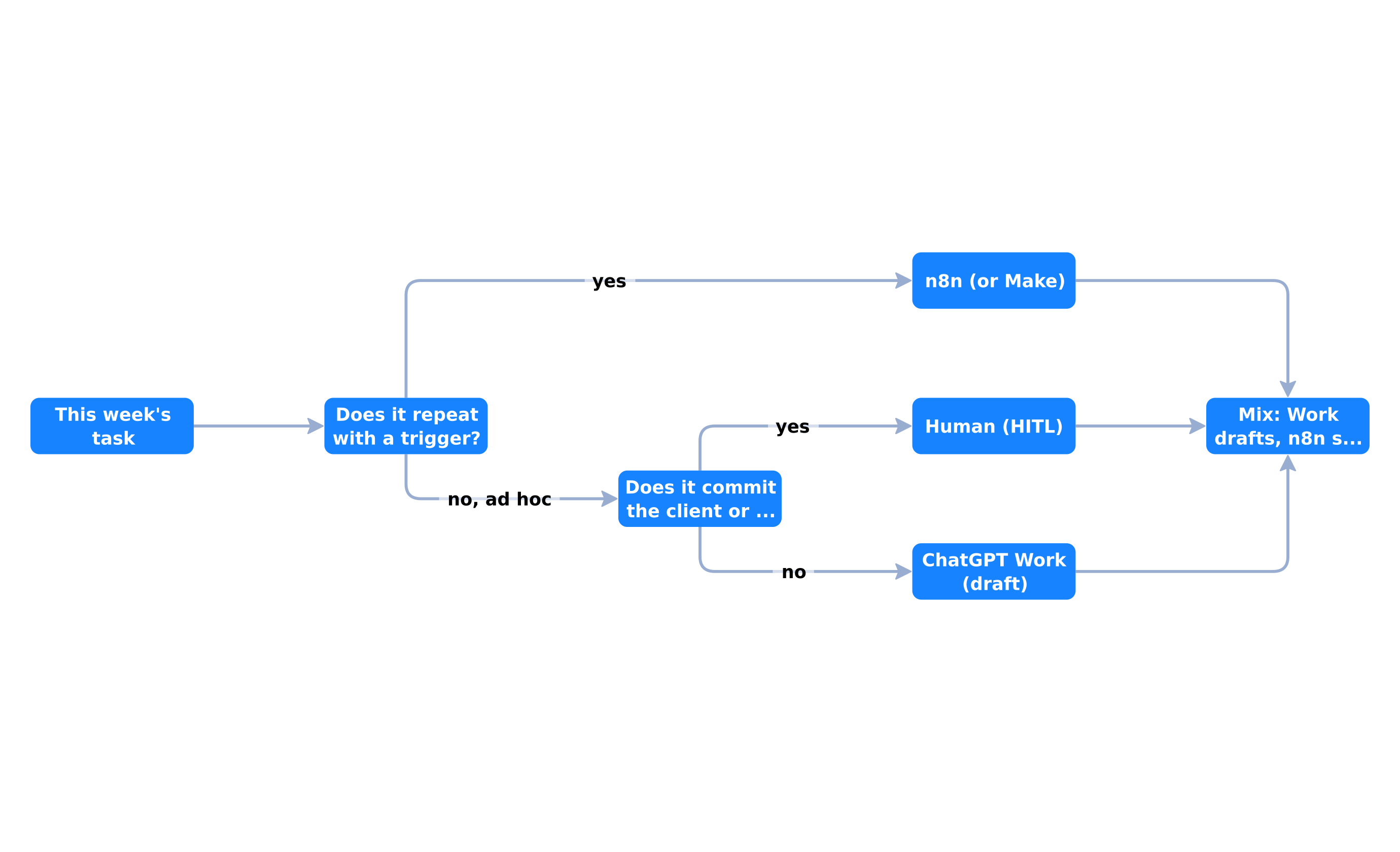 Ad-hoc task → Work. Repeating process with a trigger → n8n. Both if a human drafts and the machine sends.
Three situations, three answers
Same ICP as usual: coach / trainer, small agency, consultant. Not a Work vs Claude Cowork bake-off — the SERP already does that. Here the alternative is a named proprietary process.
Coach: module recap vs enrolment chase
Work is reasonable to draft a session recap from pasted notes, once. n8n is the right tool as soon as Jotform (or equivalent) creates a learner, sends the same email, chases a missing file on day 3. The chase copy can even be proposed by an LLM inside n8n, with a human approving — not by an agent that read your whole inbox.
Buying Work “for the school” without that workflow is paying $20 so everyone prompts their own way. You do not have a process. You have seven email styles.
The Qualiopi trap, without making this that article (it is coming): a certificate or convening letter that comes out “a bit different” every session. Work has no unit test. An n8n node with a document template does. If you train, determinism is not an integrator fetish. It is your file.
Work stays useful in the evening, turning session notes into next module’s plan. Leave it there. Do not give it send rights to the learner list.
Small agency: Monday reporting vs client brief
An account lead can ask Work: “give me a weekly from this CSV”. Useful. Fragile: the CSV changes, Drive permissions break, nobody knows if the number is Meta Ads or a stale export.
n8n (or Make) pulls stats on a cron, writes Notion, posts Slack. If Monday depends on a human opening ChatGPT, you have not automated. You have moved the chore.
A 5–15 person agency often has the same hole: client onboarding (Drive link, questionnaire, first call). Work can draft the welcome email once, for tone. n8n sends it on every new Cal.com booking, with the right fields. That is the kind of job that fits a €2–4k package — an order of magnitude from our practice, not a public rate card.
Work’s “agentic” reporting has another flaw: it has no contract with the Ads API. Yesterday’s CSV is not the ad account. When a client asks “where does this 12% come from?”, you want a node and a timestamp, not a chat memory.
Consultant: the memo vs the pipeline
Work shines on a memo or a proposal draft, if the file is in the allowed perimeter. The pipeline (status, quote chase, invoice) stays n8n plus a billing tool. An agent that closes the opportunity alone is the same anti-pattern we already cut in the MCP article.
The independent consultant almost gets Plus as a “gift”: $20 does not sting. The real cost is re-explaining context every session, and the day Work can see too many clients in Drive. A vault per engagement, an integration account, or simply not connecting Drive: that is not n8n, that is hygiene. n8n starts when the quote chase leaves on day 5 without you thinking, and the call recap lands in the same base as the status.
If you bill €800 to €2,000 a day, recovering three forgotten chases a month more than funds a first workflow. That is not a national statistic. It is the arithmetic we do in scoping, with your rate and your volume.
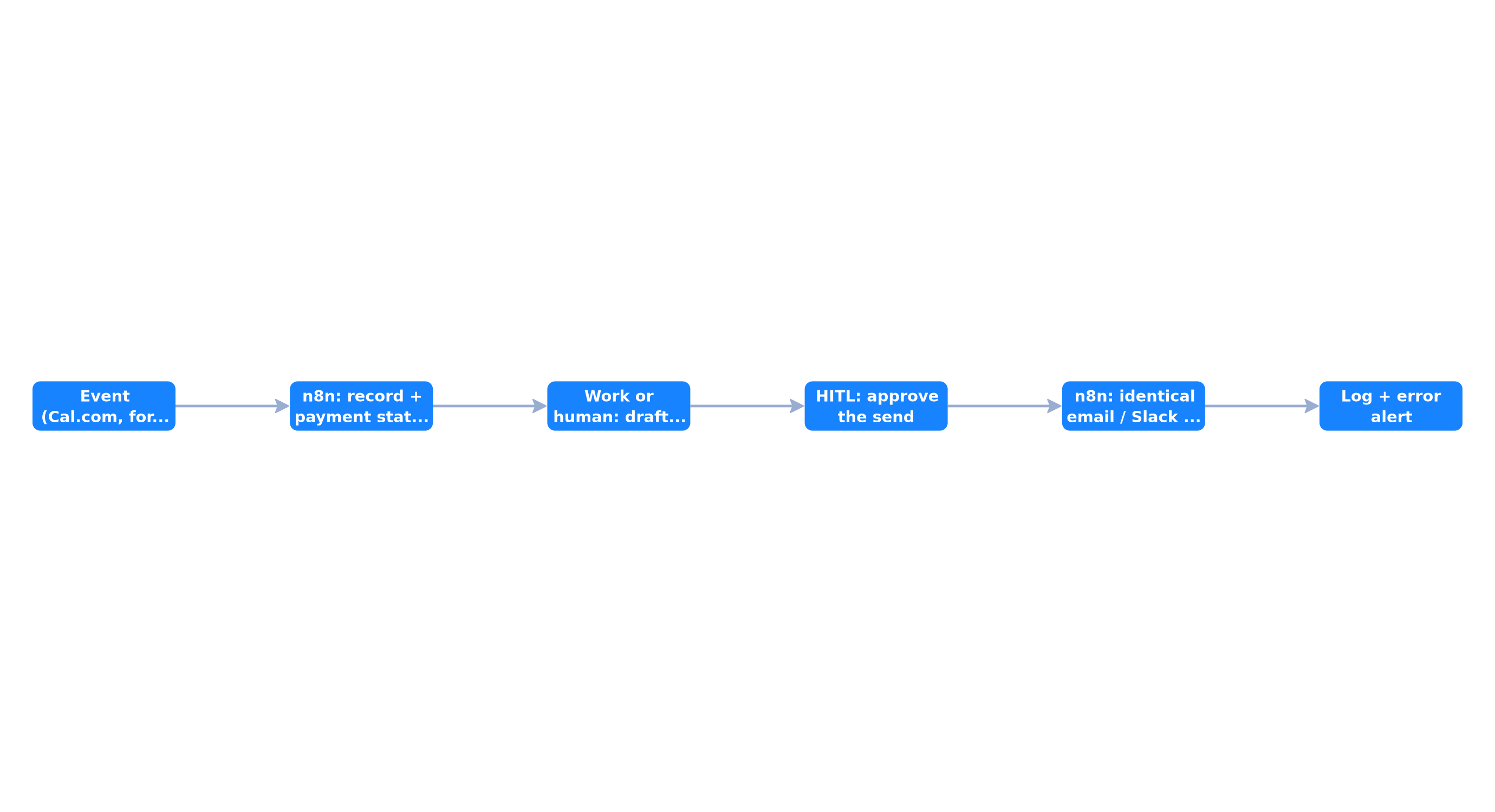 A human (or Work) drafts. n8n sends, logs, follows up. Payment stays a node, not an agent.
The cost the $20 sticker hides
BeGeek cites a test: 80 million tokens in four days of light use, about €56 ($65). One data point, not a national average. It is enough to kill “it is $20 and we are fine”. On Business / Enterprise, OpenAI’s rate card clearly moves to credits. An owner who seats ten people “on Work” with no quota and no tool policy buys a SaaS line plus a variable bill.
n8n is not free. Self-hosted: a VPS. Cloud: executions. An LLM on an n8n agent: tokens too. The difference: you see which step burns. Setup ranges sit in n8n / Make 2026 pricing — orders of magnitude, not an official tariff.
Second cost: trust. BeGeek says it plainly. Mail, Slack, Notion, phone. For an HR firm or a coach, that is not a UI detail. It is a DPA, a register, a decision that “this agent does not get the full file”. n8n allows least privilege per node. Work needs a harness BeGeek still finds confusing.
Third cost: disguised inaction. Buying Plus and Work feels like “we did AI”. The Codex study shows a subscription does not produce usage. A named n8n workflow, even small, produces an email at a fixed hour. Less glamorous. Measurable.
We are not selling you an OpenAI sub. 30 min: we sort your tasks (Work / n8n / human) and we scope one workflow. Book my scoping call
What the SERP compares — and what it misses
Search “ChatGPT Work” in French in August 2026: you get Work vs Claude Cowork tests, GPT-5.6 launches, “what is an agent” pages. Useful if you hesitate between two desk-agent chats. Useless if the real pain is “every Monday nobody sends the report” or “every enrollee waits three days for the email”.
We are not redoing the Cowork bake-off. A later news piece will. Here the alternative is not Anthropic. It is a named workflow, on n8n or Make, with an owner. Work’s $20 and Claude’s $20 do not change that sentence.
Our July article stays the product sheet. This is the purchase sheet: a Plus seat is not an automation policy. Ten seats even less — that is ten ways to talk to the client.
Objections we hear on calls (and the short answer)
“My team already uses ChatGPT.” Good. Split the chat (draft, translate, summarise) from Work (agent + connectors). The first does not need an n8n project. The second, as soon as it touches Gmail and client Drive, needs an access rule. That is not theology. That is risk.
“n8n is too technical.” Scoping is not “learn nodes this weekend”. It is “here is the trigger, here is the email, here is the Slack error”. An agency can carry implementation. Nobody will carry Work for you if the harness stays confusing — BeGeek says it, we see it.
“We’ll wait for Work to mature.” Possible. Meanwhile the form lead does not wait. A webhook node does not need Codex adoption to hit 17% in your company.
“We don’t have automation budget.” The 2026 ranges are in the pricing guide. A simple workflow is not a five-figure project. A poorly scoped Work sub, times the team, plus credits, is not “$20”. Run 12 months, even roughly.
“We’re afraid of AI that sends on its own.” So are we, on money and legal. Hence HITL. Work does not waive that rule. It makes it fuzzier, because the “yes” lives in the thread.
The wall: where DIY stops
You can, tonight, take Plus, open Work, connect Gmail, ask for a report. It may work. That is not a company stack.
- No named process. If you cannot say “when X happens, we do Y”, Work will improvise. You will pay tokens for theatre.
- Kitchen-sink permissions. Full mailbox, HR Notion, client Drive. One incident, and you find the agent in the wrong folder.
- No HITL on what commits. Client email, deal status, invoice: not a yes buried in chat.
- Work for a machine trigger. New Stripe payment, new enrollee. That is n8n. Period.
- Nobody owns the tool. Ten Plus accounts, zero policy. In six months nobody knows what was sent.
- TCO is unreadable. No cap, no monthly credit review. BeGeek showed light use can beat the sub.
That is the same wall as the n8n agency: scoping, perimeter, errors, docs. Work did not remove that work. It moved it into a chat.
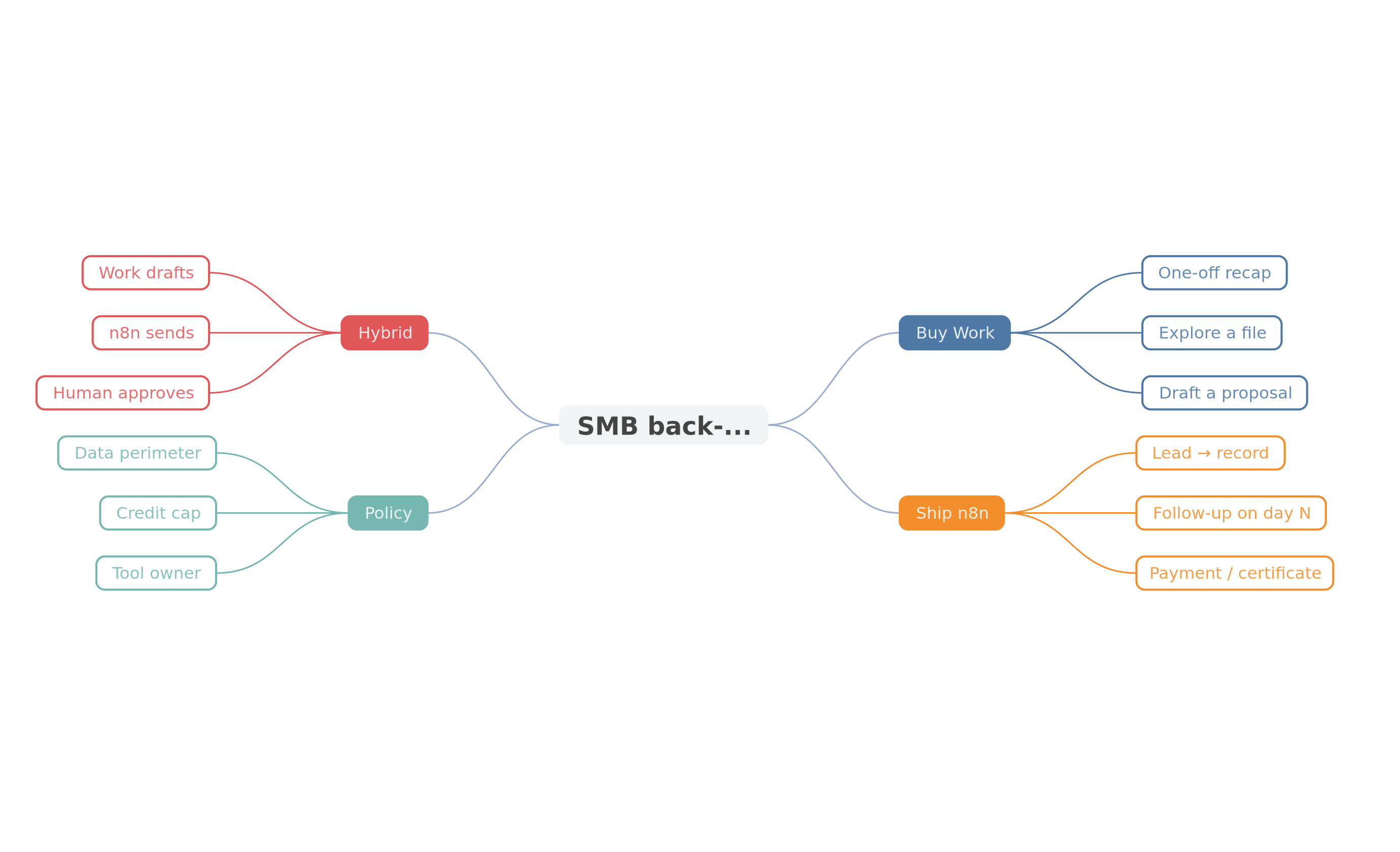 Work for ad hoc, n8n for recurring, human for commitment, access policy for the rest.
30-minute checklist, before you renew Plus
- List three tasks from last week that took more than 20 minutes. For each: human, Work, or n8n?
- Is there a trigger (form, Cal.com, Stripe, dedicated inbox)? If yes, strike Work as the main solution.
- Who has Plus / Business today? How many opened Work this week — not ChatGPT chat?
- Which connectors are already allowed (Gmail, Drive, Notion)? Too wide = data job before agent job.
- Has a token surprise already hit someone (invoice, quota)? Set a cap.
- Does a legal process (certificate, signed quote, payment) go through an LLM that “judges”? Take it out.
- Read our July Work launch if you still do not know what the product does.
- Decide: individual sub for 1–2 people (OK), or an n8n job for the team (the call).
- Write one offer line: “We automate X, not ChatGPT.”
- If the sort sticks, take 30 minutes.
Conclusion
ChatGPT Work at $20/month exists, dated 9 July 2026, pushed at white-collar work. Buying it makes sense for 1 or 2 people who draft, explore, sketch — if they know the credit pool and the need to open data. Automating n8n makes sense as soon as a business event must produce the same action, with logs, without Marie opening an app.
The June Codex study (98 / 17 / under 1), relayed on 25 August, does not bury Work. It buries the idea that an entry price creates usage. SEO competitors compare Work to Claude Cowork. Your back-to-school question is more grounded: which process, which trigger, what stays out of scope. That is entrepreneurship, not model-watch.
Next action: three tasks from this week, tagged Work / n8n / human. Then book scoping if two of them have a trigger and zero workflow. You leave the call with a perimeter, not with another subscription.
Tags
FAQ
Does ChatGPT Work at $20/month replace n8n automation?
Not for a recurring process fired by an event (new lead, payment, enrolment). ChatGPT Work, launched 9 July 2026, is a desk agent a human starts: reports, spreadsheets, decks. n8n runs workflows without anyone opening ChatGPT. They can coexist. They are not the same job.
Why do people say ChatGPT Work is poorly adopted?
BeGeek (25 August 2026) and TechCrunch relay an OpenAI-backed study of Codex usage in June 2026: 98% of OpenAI staff, 17% of organisational subscribers, under 1% of individual subscribers. That is not a standalone Work usage rate — OpenAI does not split Work and Codex. It is the signal that agents have not landed outside the teams that build them. The $20 Work SKU is aimed at that gap.
Do the $20 per month really cover agent usage?
The $20 (about €17 per BeGeek) buys access on the entry Plus plan. Agent usage (Work, Codex, Excel, and so on) draws from a shared credit pool, documented on OpenAI's rate card. A test reported by BeGeek burned 80 million tokens in four days of light use, about €56 ($65) — above a monthly sub. That is not an average. It is a signal: the sticker is not always the TCO.
Should an SMB ban ChatGPT Work?
Rarely. Banning a tool people already use creates shadow IT. Scope it: which folders the agent may see, what stays in n8n (payments, certificates, identical follow-ups), what stays human. A 30-minute scoping call is for that, not to sell another subscription.
Where do I start if I am stuck between Work and n8n?
Name a process that repeats every week, with a trigger (form, Cal.com, Stripe). If there is none, Work can help on ad-hoc tasks. If there is one, n8n (or Make) is the job. Our July GPT-5.6 / Work launch piece describes the product; this one decides the purchase.
Budget, process, priorities — decided together
Website, chatbot, or automation? We pick the next job that unlocks cash, not the trendy stack.
- 30 min
- Clear priorities
- No commitment
William Aklamavo
Web development and automation expert, passionate about technological innovation and digital entrepreneurship.


