
n8n connects 70 MCP servers: what changes for an SMB
On 10 August 2026 n8n opened about 70 MCP servers with a single OAuth click. Three SMB workflows, node versus MCP, and the wall where DIY actually stops.

Updated

n8n connects 70 MCP servers: what changes for an SMB
An OAuth click is not a process. It is a door. You still need to know which room it opens — and which one stays locked.
On 10 August 2026, n8n published a short note: you can now wire about 70 MCP servers from the Node panel, with an OAuth flow. Pick the server, sign in, leave it for the agent. Airtable, Grafana, Miro, New Relic, Jotform and PandaDoc join Notion, Stripe, GitLab, Apify, Linear, monday.com and Hugging Face. The official line is “70 services (and counting)”.
If you run a practice, a small agency, a training body or a services SMB, that sentence can sound like “finally, no integrator needed”. That is not what n8n wrote. It is not what we see in audits. n8n MCP servers 2026 remove a real friction — authentication and tool discovery. They do not decide which process to automate, or how much autonomy to give.
This article translates the announcement into SMB language. You will know what actually changed, how not to mix up n8n as MCP client and n8n as MCP server, when to keep a native node, and three concrete workflows (coach, agency, consultant). At the end, a 30-minute slot: we scope one workflow, not a generic demo.
What n8n actually announced (10 August 2026)
The primary source is the n8n blog dated 10 August 2026, a two-minute read. Three facts. Nothing else.
One. The catalogue of MCP servers available from the Node panel grew. n8n names the new ones (Airtable, Grafana, Miro, New Relic, Jotform, PandaDoc) and those already connectable (Notion, Stripe, GitLab, Apify, Linear, monday.com, Hugging Face). The number they keep is 70, “and counting”. That is not a line-by-line inventory in the docs; it is the announcement figure. Treat it as such.
Two. Connection becomes an OAuth flow: pick, sign in, ready for the agent. n8n illustrates with Notion. Before: ask an admin for permissions, create an internal integration, share pages with it, configure several Notion tools. After: one OAuth click, and the agent can pull meeting notes, draft a page, update a database.
Three. n8n does not throw nodes away. The official post sets three modes, and says a workflow can mix them. We will come back to that: it is the useful part for an SMB. The rest of the note promises more servers, starting with those that speak OAuth and Dynamic Client Registration (DCR). If a service is not on the list, the MCP Client Tool node still points at any MCP endpoint, with more setup.
The MCP credentials docs confirm OAuth2, DCR on by default (RFC 7591), and an optional Resource URL field. The MCP Client Tool node also documents Bearer, headers, and the tool filter: All, Selected, All Except. That last item is not a footnote. It is the only blast-radius switch many teams forget.
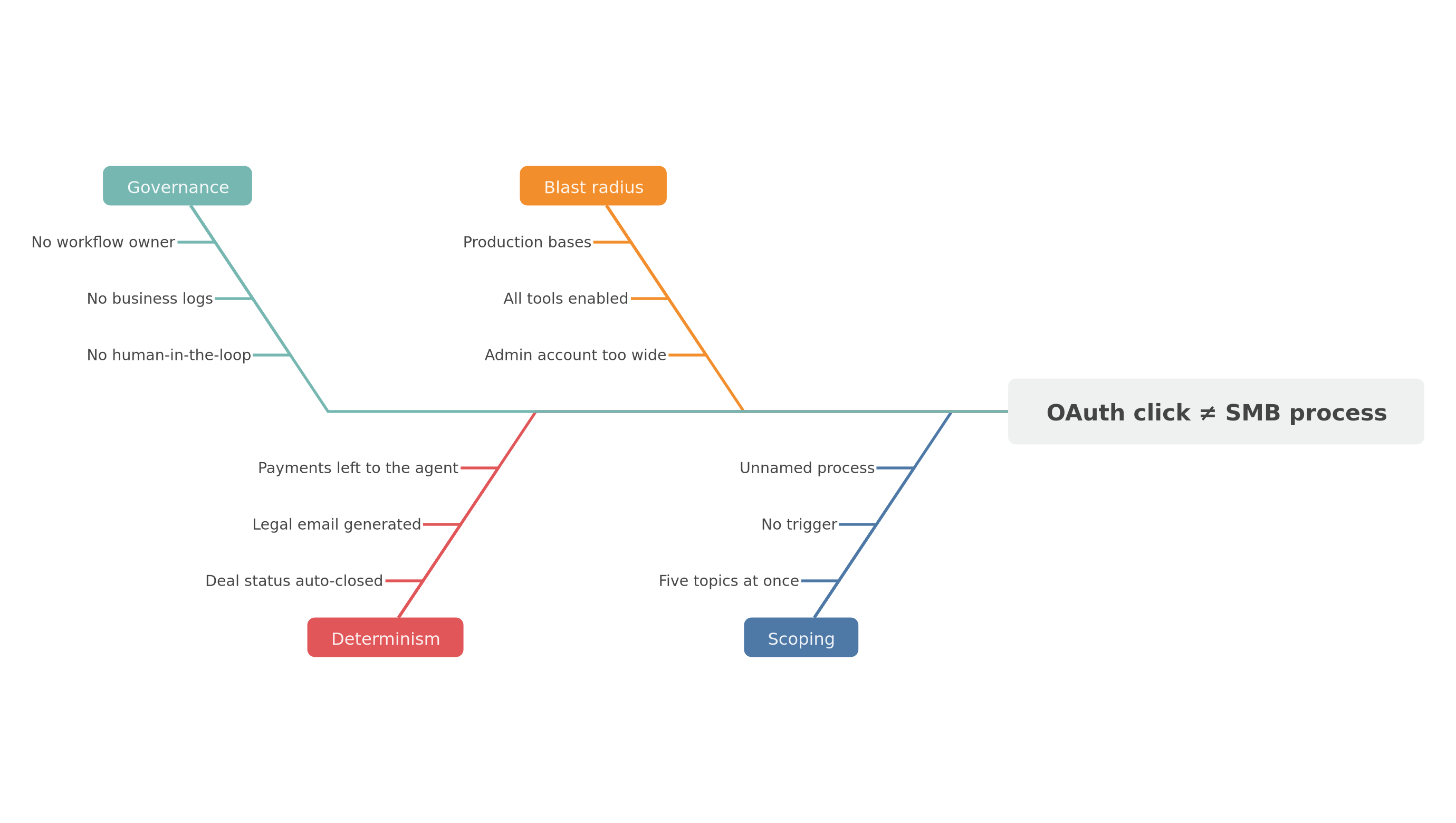 The 70-server catalogue removes auth. It does not remove scoping, HITL, or determinism.
Two MCP directions: do not mix them up
Some French-language coverage glued two distinct products together. AgentLand (13 August 2026) restates the 70-server announcement and n8n 2.33.0’s “Connect a client” dialog. Both exist. They do different jobs.
n8n as MCP client. An agent inside an n8n workflow calls tools exposed by an external server: the client’s Notion workspace, Stripe, Jotform. That is the 10 August announcement. That is what your salesperson will use if you give them an agent that answers “where is file X?”.
n8n as MCP server. An n8n workflow is exposed to Claude, ChatGPT, Cursor or VS Code. The MCP Server Trigger node already existed. From n8n 2.33.0, the docs describe Settings → Instance-level MCP, with a Connect a client dialog (OAuth recommended or API key) and steps per client type (CLI, web, IDE). The other direction: your processes become tools for an external assistant.
If you read “70 MCP servers” and then configure Claude to drive n8n, you did not follow the announcement. You followed the other product. Both can coexist. They need different rights, logs and HITL. Our tutorial connect n8n to an MCP server covers wiring a (often custom) server on the client side. A later article will cover exposing a workflow as a server. Here we stay on what the 70 OAuth connections change inside the workflow.
Node, agent tool, MCP server: n8n’s own frame
n8n did the teaching work many newsletters skipped. Restate it, then apply it to an SMB.
The native node serves a deterministic workflow. You know the call, the fields, the moment. Every new customer gets the same wiki page. Every paid invoice triggers the same email. No judgment. n8n: “Use nodes wherever the logic doesn't need a decision made.”
The agent tool (a Notion, Stripe or HTTP node attached to the AI Agent) lets the model choose when to call, but you froze what. n8n’s example is a “Log escalation” tool pointed at one database. The agent decides an issue needs escalating. It cannot do anything else in Notion. Fewer tools, often fewer LLM round-trips.
The MCP server connects once and gives the agent a toolset. Search a page, pull notes, draft, update a row. You can still toggle tools off. The agent chooses which, when, how. n8n says it: more flexibility, more reasoning, therefore more model calls.
None of the three replaces the others. A booking process can: (1) receive the Cal.com webhook as a native node, (2) let a Notion MCP agent search the prospect brief, (3) write the recap with a frozen agent tool “create recap page in database X”. That is the architecture we set in an automation audit: deterministic first, agent second.
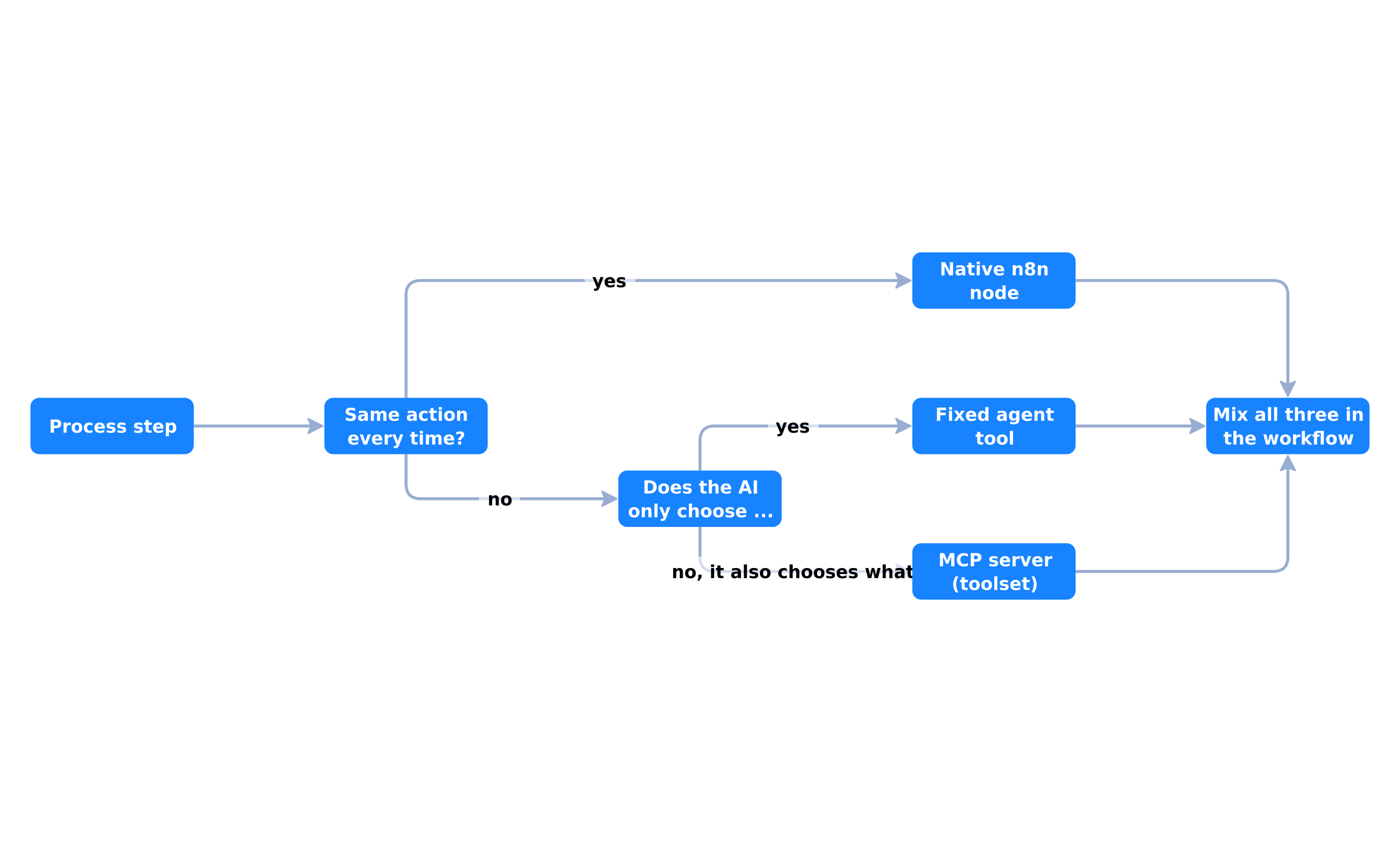 Same action every time: node. AI chooses when, action is fixed: tool. Discretionary toolset: MCP.
| Criterion | Native node | Agent tool | MCP server |
|---|---|---|---|
| Who decides what | You, in advance | You, in advance | The agent, inside the open set |
| Who decides when | The workflow | The agent | The agent |
| Error control | Fine, node by node | Medium | Depends on exposed tools |
| LLM cost | Often zero | Low to medium | Higher (reasoning) |
| Typical SMB case | Payment, identical chase, certificate | “Escalate this ticket” | “Prepare client X’s brief” |
| Main risk | Rigidity | Tool still too wide | Tool surface left open |
This table is not a ranking. It is an audit grid. If your whole n8n is “agent + MCP All tools”, you moved chaos from the human to the model. If everything is a native node, you have visual Zapier — perfectly legitimate, and sometimes enough.
What OAuth and DCR actually change
Before August 2026, wiring an MCP server to an n8n agent often meant: SSE or HTTP Streamable URL, Bearer token in a credential, sometimes a custom header. It works. It is still documented. It scares a founder who has never seen a Bearer.
OAuth2 moves auth to a flow the business already knows: “Sign in with Notion”. n8n stores access / refresh tokens. No key pasted in a node.
Dynamic Client Registration (RFC 7591), on by default in n8n MCP credentials, avoids creating an OAuth app by hand at every vendor. n8n registers as a client. If the MCP server does not speak DCR, you turn the option off and fill Authorization URL, Access Token URL, Client ID, Client Secret — like a generic OAuth2 credential.
PKCE is not the headline of n8n’s 10 August blog post. It is in the product core: fix n8n#34494, shipped in n8n 2.33.0, handles MCP OAuth2 token expiry and enables PKCE (S256) when the authorization server advertises it. In plain language: fewer manual reconnects, fewer secrets travelling. That is not a GDPR guarantee. It is better auth hygiene.
What does not change: the Notion (or Stripe, or Airtable) account you consent. If that account sees the whole organisation, so does the agent — unless you filter tools and bases. OAuth is not a perimeter. It is a door. The perimeter is Tools to Include: Selected, shared pages, and a human who reads logs.
Three business workflows, not a catalogue
The announcement pays off if it shortens a process you already run by hand. Three cases aligned with the profiles we see in France: coach / trainer, small agency, consultant. No screenshot of 70 logos. Three chains, with the node / MCP mix n8n recommends.
Workflow 1 — Coach: enrolment, file, follow-up
The coach takes enrolments through a form (Jotform is in the 10 August additions). Today: CSV export on Sunday, paste into Notion, confirmation email written by hand, “you still have not sent the document” chase three days later.
Deterministic (nodes). Jotform webhook or node → create / update the “learner” row in one database → confirmation email with the same copy. No AI. If the email changes with the model’s mood, you have a compliance problem before you have an n8n problem.
MCP where it judges. An agent, connected to the Notion MCP server (OAuth) and limited to “search + update database” on one base, answers “where is Marie for module 2?” from the notes. It does not create new databases. It does not share pages outside the organisation.
Wall. Chasing a missing document can stay a node (if the rule is binary: document absent = email X). The MCP agent becomes useful when the file is ambiguous (three documents, one unreadable, a comment in Notion). Then a human approves before send — the HITL in our n8n AI Agent Governance article.
Workflow 2 — Small agency: brief, Stripe status, recap
The agency keeps leads in Cal.com, briefs in Notion, deposits in Stripe. On Monday someone opens three tabs to prep the client call.
Deterministic. Cal.com webhook “booking created” → node that creates the client record (fixed fields) → Stripe node that reads deposit payment status. A payment is not a judgment. It is a boolean. Native node, or at most an agent tool “Get invoice status” pointed at that endpoint.
MCP. Notion server: the agent preps the meeting brief from project pages (search, read). Miro server if the workshop already lives there — cited in the announcement, useful only if you actually work in it. Otherwise, a node, not MCP.
Wall. Giving an MCP agent Stripe “All tools” is a bad idea. A refund tool or a payment-link creator has no place in a meeting-prep agent. Selected tools. Restricted Stripe account. Logs.
Workflow 3 — Consultant / SMB owner: pipeline and notes
The consultant notes everything in Airtable (10 August addition) or monday.com (already on the list). After a call they want the opportunity updated and a recap draft.
Deterministic. End of call (Cal.com bookingSuccessful or a “recap due” button) → node that creates a “recap” task with a J+1 due date. Always.
MCP. Airtable or Notion: the agent reads history, proposes a status update, drafts the recap. You accept or correct (Slack / email HITL). Linear if you ship build — on n8n’s list, not mandatory.
Wall. An agent that “closes the opportunity” alone from a fuzzy recap sentence is a commercial risk, not a gain. Won / lost stays a node you trigger, or a single agent tool “set status” after confirmation.
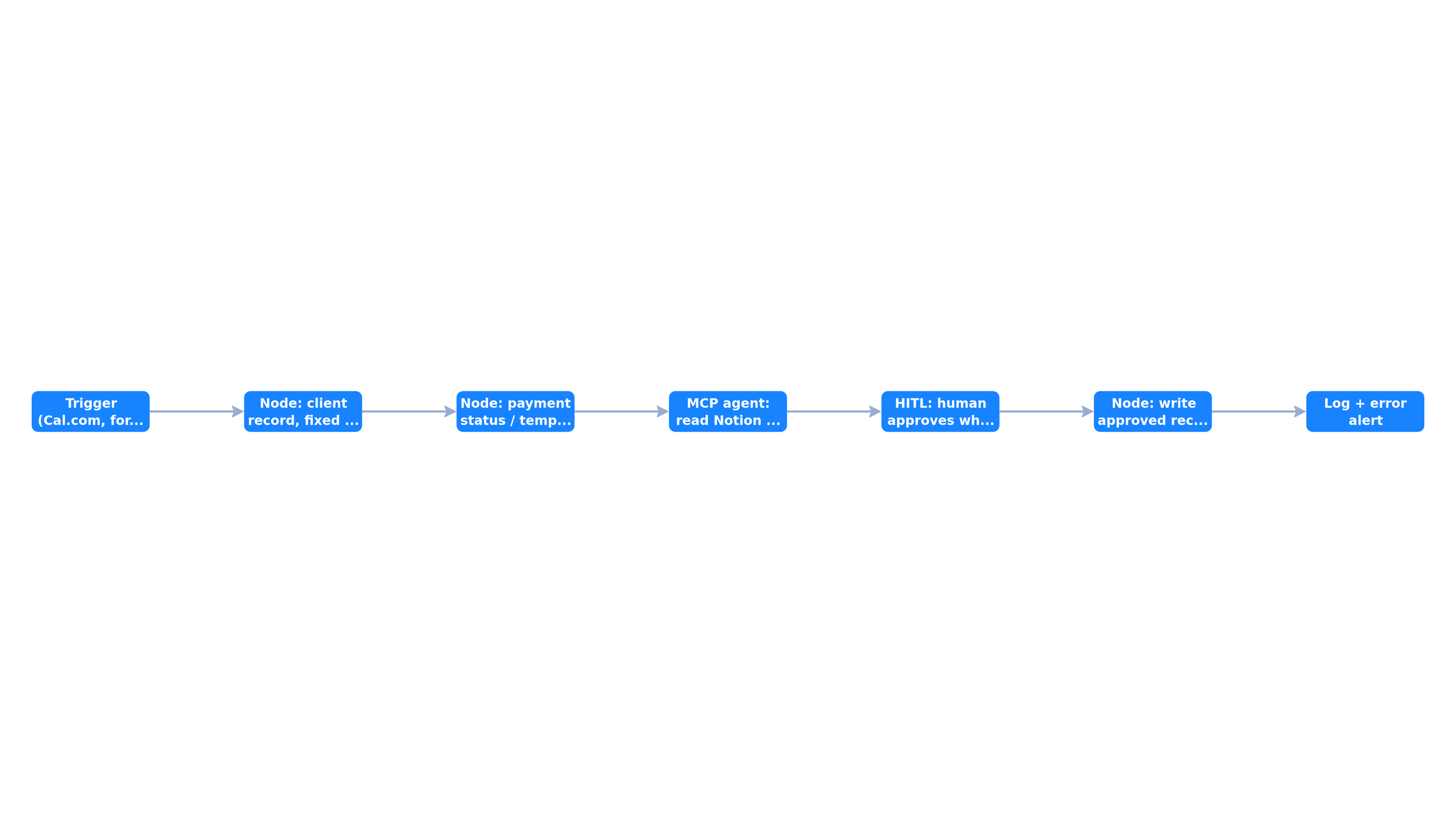 The webhook and the payment stay nodes. The MCP agent reads context and proposes. A human approves what commits.
These three chains fit a typical automation package — setup ranges and TCO sit in our n8n / Make 2026 pricing guide. The 10 August OAuth click did not change those ranges. It changed time spent hand-building Notion credentials.
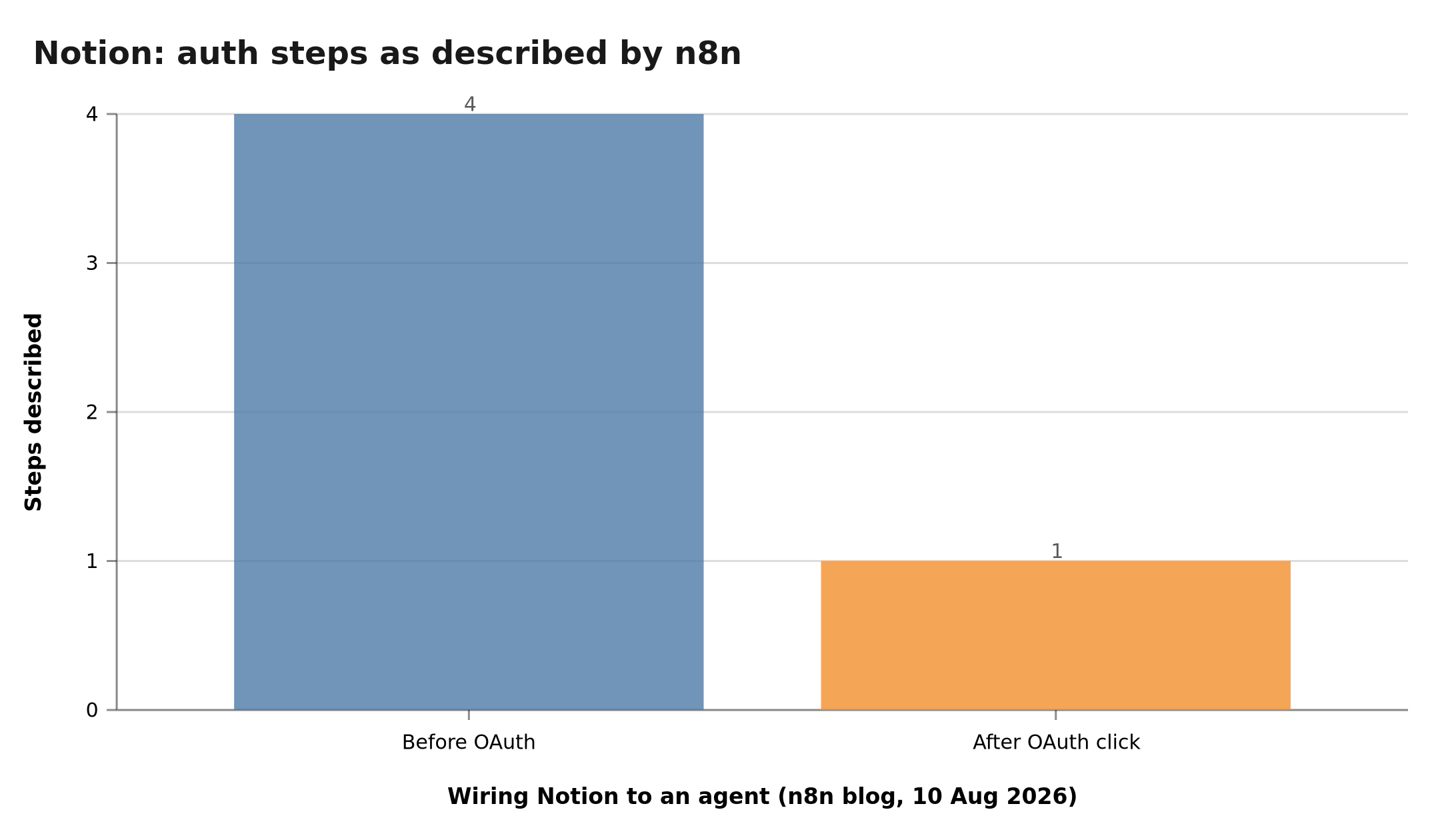 n8n describes four manual Notion steps before OAuth. After: a sign-in flow. The business process still has to be scoped.
What 70 servers do not change
The process does not live in the catalogue. If nobody in the company can say “when a lead arrives, here are the six steps”, MCP stacks tools on fog. The agent will improvise. You will pay tokens for theatre.
Deterministic still wins on money and legal. Payment, certificate, contractual email, GDPR deletion: node, tests, not “the agent judged it was fine”. n8n says that for nodes. We repeat it in production.
All tools is an anti-pattern. MCP Client Tool allows Selected and All Except. A Notion MCP server exposes search, create, update, sometimes share. A coach does not need “share to web”. Cut it.
LLM cost rises with the toolset. n8n writes it: a frozen tool needs less reasoning than a whole server. If your OpenAI / Anthropic bill explodes after “we wired everything as MCP”, that is not a bug. That is the model looking for something to do.
GDPR and processors. OAuth toward a US SaaS (Notion, Stripe, Airtable, Hugging Face) does not become “sovereign” because n8n is self-hosted in the EU. Data follows the MCP server. For self-hosted vs cloud scoping, see n8n automation for SMBs 2026.
Your site can still be a brochure. Wiring Cal.com + n8n + Notion MCP does nothing if the visitor cannot book. That is brochure site vs booking site. Automation starts after the click. Not before.
We scope one workflow, not a demo of 70 logos. 30 min, no commitment: which node, which MCP, what stays out of scope. Book my slot
The deliberate wall: where DIY stops
You can, tonight, update n8n, open the panel, connect Notion with OAuth, drop an AI Agent, test “summarise the last page”. It will work. That is not production.
DIY breaks at precise places.
- The OAuth account is too wide. Notion admin account = the agent sees HR. Create an integration account limited to the pages you need, even with OAuth.
- No tool filter. Selected, not All. Document the list in the workflow README.
- No HITL on what commits. Client email, deal status change, invoice creation: Wait node, Slack, email. n8n’s governance framework (July 2026) exists for this.
- No business logs. Which tool was called, with which arguments, for which client. Otherwise you do not debug, you pray.
- The trigger is improvised. An agent without a reliable webhook (form, Cal.com, Stripe) is a chatbot. Useful. It is not a process.
- Nobody owns the workflow. When n8n goes to 71, 80, 90 servers, the catalogue will move. The process still needs a name, an owner, a test.
That is the same wall we set on the n8n agency offer: scoping, tool perimeter, errors, documentation. 10 August shortened auth. It did not shorten scoping.
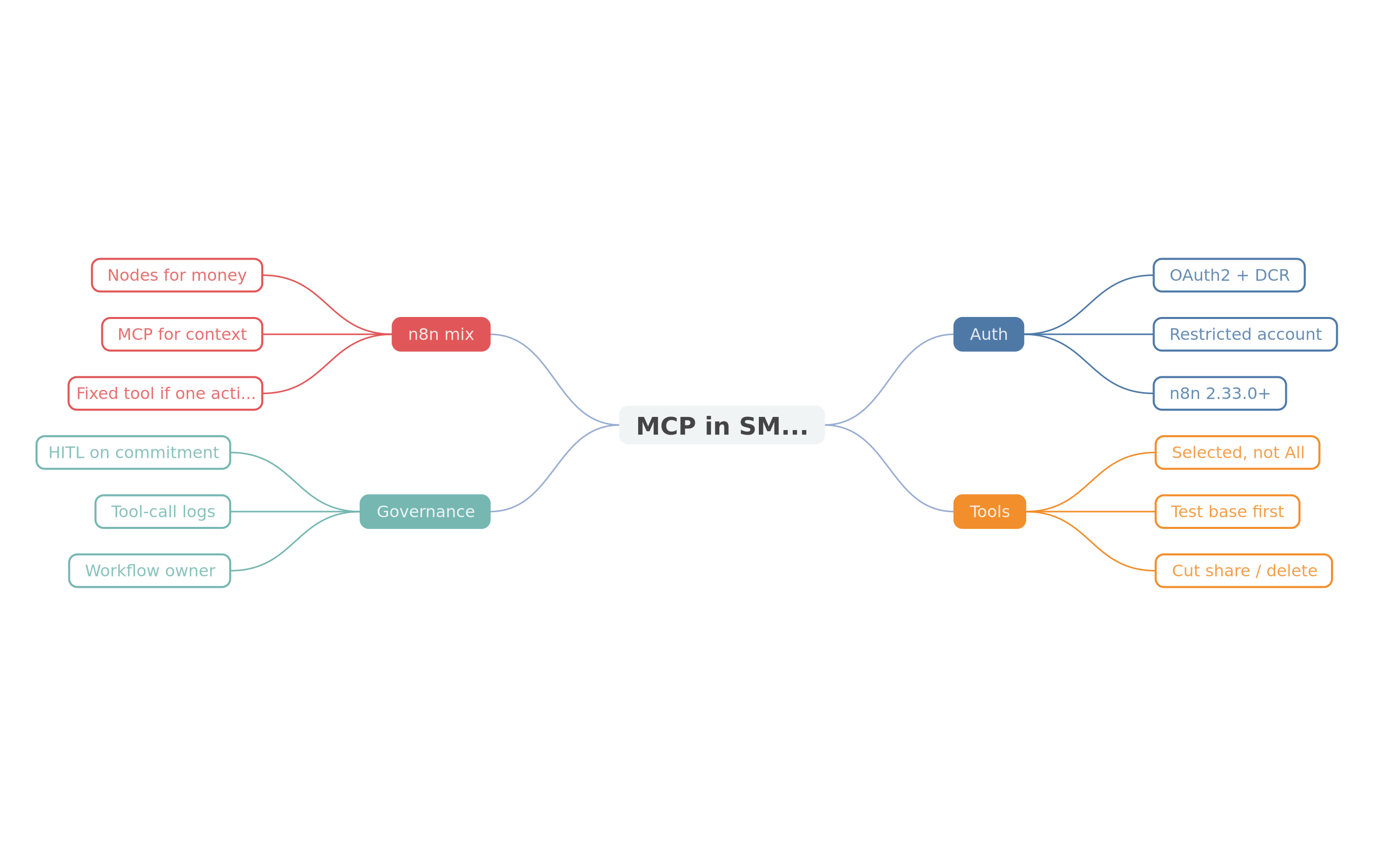 OAuth auth, tool filter, HITL, deterministic nodes, workflow owner: five conditions before you say production.
30-minute checklist, before you call anyone
Do this with your n8n instance open, not with a LinkedIn thread.
- Note your n8n version. MCP OAuth / DCR credentials and the PKCE / expiry fix sit in the 2.33.0+ core; the “70 servers” catalogue is the 10 August announcement — update before you conclude “it does not show up”.
- List one repeated process (not five). One sentence: trigger, action, result.
- Classify each step: node / agent tool / MCP. If you hesitate, it is a node.
- Check whether the SaaS is in the list n8n named (Notion, Stripe, Airtable, Jotform, and so on). If not: manual MCP Client Tool, or HTTP node, or wait.
- Create the OAuth credential. DCR on, unless the vendor requires Client ID/Secret.
- Set Tools to Include to Selected. Uncheck anything that writes outside a test base.
- Test on a junk page / junk row. Not on the production CRM.
- Add an error node (email or Slack): if the agent fails, a human knows.
- Time the process by hand one last time. If you do not know how many minutes it takes, you will not know whether n8n helps.
- Decide: you ship this workflow this week, or you take 30 minutes to have it scoped.
If you stall at step 2 (no named process), do not open MCP. Open a whiteboard.
Conclusion
n8n connects 70 MCP servers: true, dated 10 August 2026, sourced from the official blog. OAuth + DCR (docs) and PKCE / token refresh (2.33.0) make auth less painful. Airtable, Jotform, Grafana and the others named become a click, not a weekend of tokens.
What it changes for an SMB: less friction to give an agent context (Notion notes, Airtable pipeline, Linear tickets). What it does not change: the need for a reliable trigger, deterministic nodes on money and legal, a tool filter, a human on what commits, a workflow owner.
Today’s “n8n MCP 2026” SERP is occupied by GitHub repos that have Claude build workflows, and by guides that expose n8n as a server. Useful for a developer. Incomplete for an owner. Your question is not “how to speak MCP”. It is “which process, how much autonomy, what stays out of scope”.
Next action, not “try 70 servers”: name one workflow, classify each step node / tool / MCP, then book 30 minutes if the classification sticks. You leave the call with a perimeter, a timeline, and what stays deliberately closed.
Tags
FAQ
What did n8n announce on 10 August 2026 about MCP servers?
On its official blog, n8n said you can now connect about 70 MCP servers from the Node panel with a simple OAuth flow: pick the server, sign in, make it available to the agent. New names cited include Airtable, Grafana, Miro, New Relic, Jotform and PandaDoc, on top of Notion, Stripe, GitLab, Apify, Linear, monday.com and Hugging Face.
Should I replace n8n nodes with MCP servers?
No. n8n says it plainly: a native node is right when the action is deterministic (same call, same fields, every time). An agent tool is right when the AI chooses when, but the action is fixed. An MCP server is right when the agent must pick from a toolset. Most SMB workflows mix all three.
What are OAuth and Dynamic Client Registration in practice?
OAuth2 avoids pasting an API key into the workflow: you sign in to the service, n8n stores tokens. Dynamic Client Registration (RFC 7591) lets n8n register itself as an OAuth client with the MCP server, so you do not paste Client ID and Secret by hand. n8n docs turn DCR on by default for MCP credentials. PKCE is handled in n8n core (2.33.0 fix) when the authorization server advertises it.
What is the difference between n8n as MCP client and n8n as MCP server?
Client: n8n consumes external tools (Notion, Stripe, Airtable) so an agent inside a workflow can call them. Server: n8n exposes a workflow to Claude, ChatGPT or an IDE via the MCP Server Trigger node and, from 2.33.0, a Connect a client dialog. Two directions. The 70-server announcement is mainly about the client.
Can an SMB wire everything alone after that OAuth click?
The OAuth click removes auth friction. It does not scope the process, it does not hide dangerous tools, it does not add human-in-the-loop, and it does not replace a deterministic node for a payment or a certificate. That is usually where a 30-minute audit helps: one scoped workflow, not an agent demo.
We scope one workflow — not a generic demo
You describe a repeated task. We tell you what n8n would ship, the timeline, and what stays out of scope.
- 30 min
- 1 scoped workflow
- No commitment
William Aklamavo
Web development and automation expert, passionate about technological innovation and digital entrepreneurship.


