
MCP 2026-07-28: Stateless Transport, MCP Apps, and What Enterprises Must Migrate
The July 28, 2026 MCP release candidate removes sessions and the initialize handshake. Stateless transport, MCP Apps and Tasks extensions, OAuth/OIDC hardening: a migration guide for production teams.

MCP 2026-07-28: Stateless Transport, MCP Apps, and What Enterprises Must Migrate
On July 28, 2026, the Model Context Protocol publishes its largest revision since launch. The MCP 2026 stateless enterprise agents specification is not a marginal update — it is a foundation change for every MCP deployment in production.
In April 2026, we analyzed how MCP stabilization and the A2A protocol reshaped AI agent interoperability. Three months later, release candidate 2026-07-28 — locked on May 21, 2026 per the official MCP blog — goes further. It delivers the 2026 roadmap announced on March 9, 2026: a stateless core that scales on ordinary HTTP infrastructure, first-class extensions (MCP Apps, Tasks), OAuth/OIDC hardening, and a formal deprecation policy.
If your company already connects Claude, Cursor, n8n, or a custom agent to remote MCP servers, this article answers one precise question: what breaks, what improves, and how do you migrate without interrupting workflows? We rely exclusively on official documentation (MCP blog, draft changelog, AAIF announcements) and our production agent deployment experience at BOVO Digital.
Why this release differs from the April 2026 MCP article
The April article established the conceptual frame: MCP for tools, A2A for agent communication, growing ecosystem, hundreds of pre-built servers. Spec 2026-07-28 enters operational territory.
| Dimension | April 2026 (previous article) | July 2026 (2026-07-28) |
|---|---|---|
| Angle | MCP + A2A interoperability, ecosystem maturity | Transport breaking changes, extensions, governance |
| Transport | Streamable HTTP sessions, initialize handshake | Stateless, no Mcp-Session-Id |
| UI | Not covered | MCP Apps (sandboxed HTML) |
| Long-running work | Experimental Tasks in core | Tasks = extension with new lifecycle |
| Auth | General OAuth recommendations | Six SEPs aligned with OAuth 2.0 / OIDC |
| Target audience | Discoverers, architects | Teams with MCP already in production |
This is not a duplicate: it is the logical sequel. If the April article explained why to adopt MCP, this one explains how to migrate when MCP becomes critical infrastructure behind a load balancer, API Gateway, and enterprise IdP.
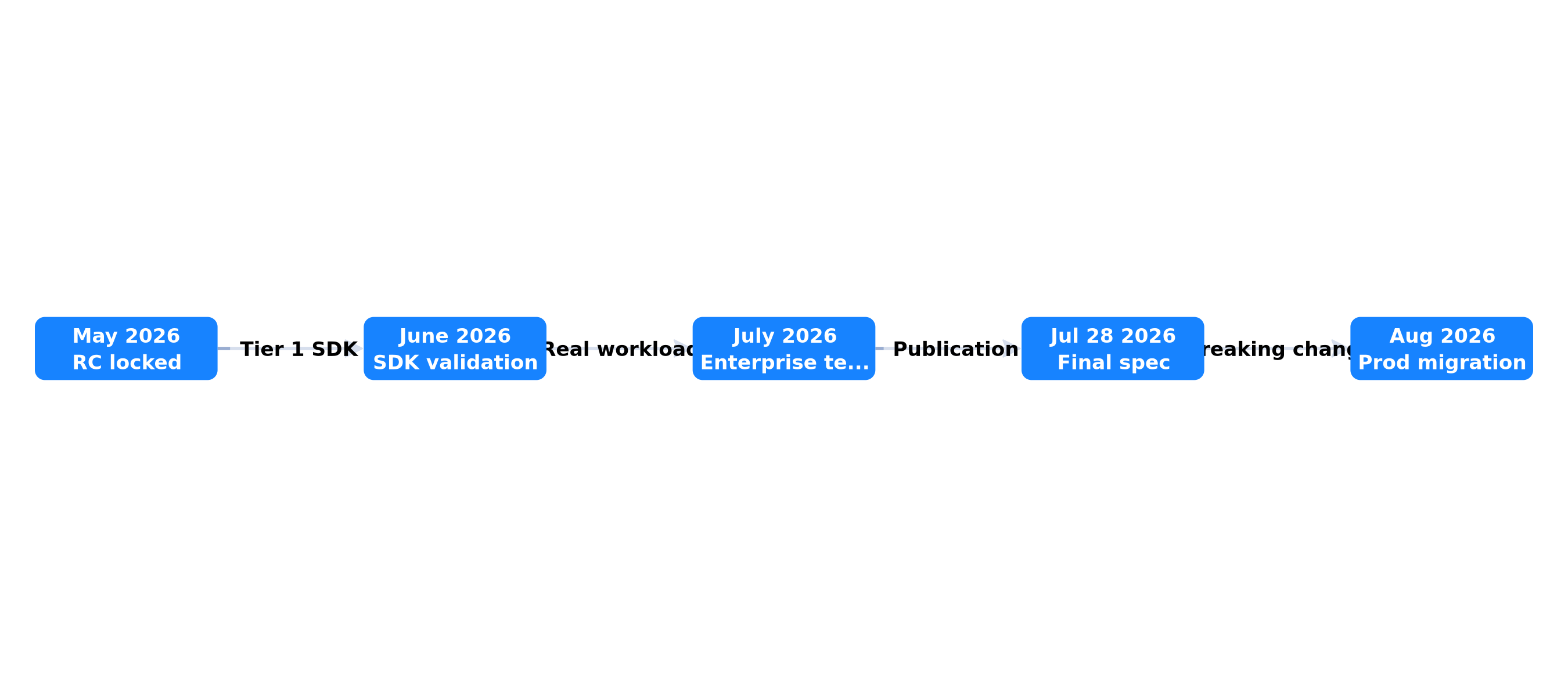 From the locked RC (May 2026) to the final spec on July 28, 2026, then production migration from August
The foundational change: MCP becomes stateless at the protocol layer
The AAIF headline is clear: MCP becomes stateless at the protocol layer. Six Specification Enhancement Proposals (SEPs) converge on this goal, completing the plan laid out in "The Future of MCP Transports" published in December 2025.
Before / after: a tool call over Streamable HTTP
Under 2025-11-25, invoking a tool required establishing a session first:
POST /mcp HTTP/1.1
Content-Type: application/json

{"jsonrpc":"2.0","id":1,"method":"initialize",
 "params":{"protocolVersion":"2025-11-25","capabilities":{},
           "clientInfo":{"name":"my-app","version":"1.0"}}}
The server responded with an Mcp-Session-Id that every subsequent request had to carry, pinning the client to the instance that issued the session:
POST /mcp HTTP/1.1
Mcp-Session-Id: 1868a90c-3a3f-4f5b
Content-Type: application/json

{"jsonrpc":"2.0","id":2,"method":"tools/call",
 "params":{"name":"search","arguments":{"q":"otters"}}}
Under 2026-07-28, the same call becomes a single request any instance can handle:
POST /mcp HTTP/1.1
MCP-Protocol-Version: 2026-07-28
Mcp-Method: tools/call
Mcp-Name: search
Content-Type: application/json

{"jsonrpc":"2.0","id":1,"method":"tools/call",
 "params":{"name":"search","arguments":{"q":"otters"},
           "_meta":{"io.modelcontextprotocol/clientInfo":{"name":"my-app","version":"1.0"}}}}
Immediate operational consequence, per the MCP blog: a remote server that previously needed sticky sessions, a shared session store, and deep JSON-RPC body inspection at the gateway can now run behind a round-robin load balancer, route on the Mcp-Method header, and let clients cache tools/list responses as long as the server's ttlMs permits.
SEP-2575: end of the initialize handshake
The initialize / notifications/initialized pair is gone. Protocol version, client identity, and negotiated capabilities — previously exchanged once at connection time — now travel in _meta on every request, under keys like io.modelcontextprotocol/protocolVersion, io.modelcontextprotocol/clientInfo, and io.modelcontextprotocol/clientCapabilities.
A version mismatch returns UnsupportedProtocolVersionError. For upfront discovery, a new server/discover RPC — which servers must implement — advertises supported versions, capabilities, and server identity. Clients may call it before any interaction, or use it as a STDIO compatibility probe.
SEP-2567: Mcp-Session-Id removal
The Mcp-Session-Id header and protocol-level session are removed. List endpoints (tools/list, resources/list, prompts/list) no longer vary per connection. Two major enterprise consequences:
- Simplified horizontal scaling: no sticky routing imposed by the protocol.
- CDN-friendly cache: tool lists become cacheable resources with explicit metadata.
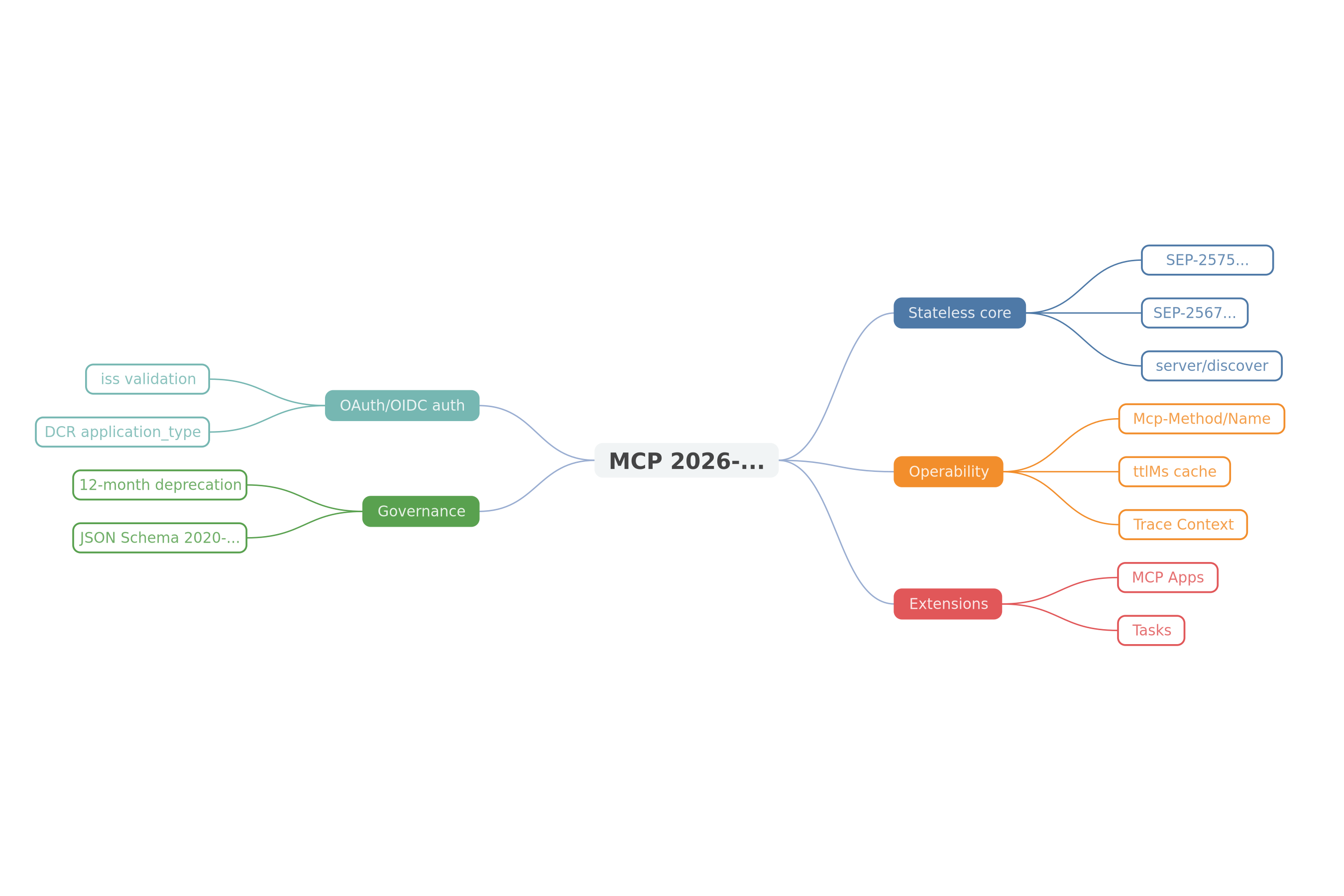 Five pillars: stateless core, operability, extensions, OAuth/OIDC auth, governance
Stateless protocol, stateful applications: the explicit handle pattern
Removing the protocol session does not mean your CRM connector, browser automation, or document pipeline must become amnesiac. MCP maintainers state explicitly: servers that carry state across calls emit an explicit handle — basket_id, browser_id, workflow_run_id — returned by a tool, which the model passes back as an ordinary argument.
In practice, this pattern is often more powerful than state hidden in transport metadata:
- The model sees the identifier and can reason about it.
- It can compose handles across tools ("use the browser_id from step 1 for step 3").
- It can transfer context between steps in an agent chain.
At BOVO Digital, we already apply this pattern on n8n + MCP integrations: an "init_session" node returns an identifier that subsequent nodes consume. Spec 2026-07-28 finally aligns the protocol with what HTTP has done for twenty years — tokens, cookies, opaque IDs — rather than simulating continuity via a proprietary transport layer.
Server→client requests without persistent connections
A stateless protocol must still let the server request input mid-call (delete confirmation, option selection). Two SEPs rebuild this flow:
SEP-2260: server-initiated requests may only be issued while actively processing a client request. No more "out of nowhere" elicitation: every user prompt traces back to an action they — or their agent — started.
SEP-2322 (Multi Round-Trip Requests): instead of holding an SSE stream open, the server returns an InputRequiredResult:
{
  "resultType": "inputRequired",
  "inputRequests": {
    "confirm": {
      "type": "elicitation",
      "message": "Delete 3 files?",
      "schema": { "type": "boolean" }
    }
  },
  "requestState": "eyJzdGVwIjoxLCJmaWxlcyI6WyJhIiwiYiIsImMiXX0="
}
The client collects answers and re-issues the original call with inputResponses and the echoed requestState. Any server instance can pick up the retry: all context is in the payload.
For SRE teams, this is a win: no more long-lived SSE connections to monitor like ghost websockets. For MCP server developers, elicitation handling needs refactoring before August 2026.
Operability layer: headers, cache, distributed tracing
Three "unglamorous but critical" changes make MCP traffic indistinguishable, from a routing and observability standpoint, from a classic HTTP API.
SEP-2243: mandatory Mcp-Method and Mcp-Name headers
Every Streamable HTTP POST request must include Mcp-Method (e.g. tools/call) and Mcp-Name (tool or resource name). Load balancers, API Gateways, and rate-limiters route without parsing the JSON-RPC body. Servers reject requests where headers and body disagree.
At the April 2026 AAIF MCP Dev Summit, several vendors — Kong, Docker, Solo.io, internal platforms like Uber's — were reverse-engineering tool names from the body. That hack disappears on July 28.
The same SEP introduces support for custom headers from tool parameters via x-mcp-header, useful for propagating a tenant ID or correlation ID without changing the business schema.
SEP-2549: ttlMs and cacheScope
Results from tools/list, resources/list, and resources/read carry ttlMs and cacheScope, modeled on HTTP Cache-Control. Clients know how long a tool list stays fresh and whether cache can be shared across users. A long-lived SSE stream is no longer the only way to detect a list change.
SEP-414: W3C Trace Context
Propagation of traceparent, tracestate, and baggage in _meta is documented with fixed key names. An OpenTelemetry trace starting in the host application traverses the client SDK, MCP server, and downstream calls in a single span tree.
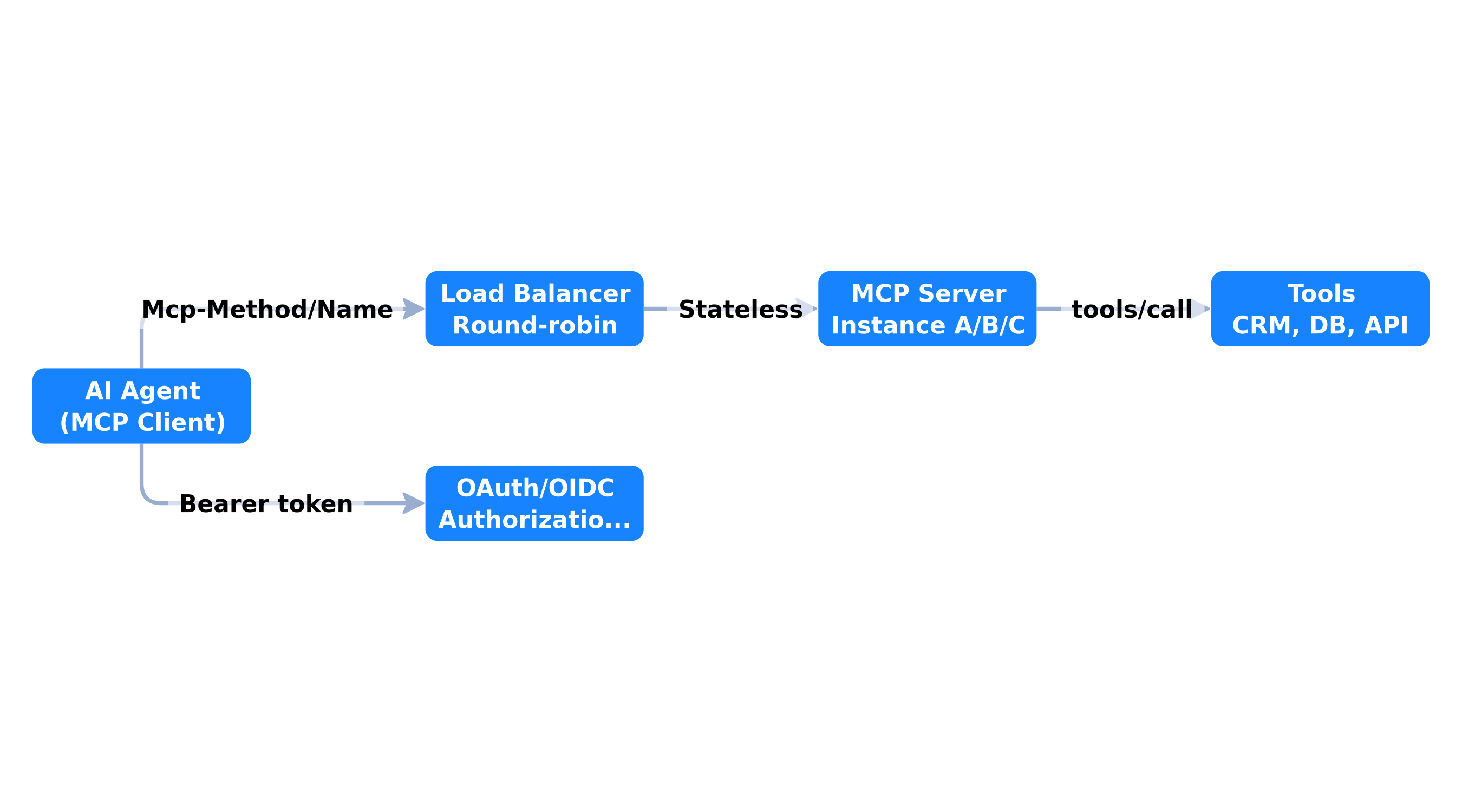 AI agent → round-robin load balancer → stateless MCP instances → business tools, with OAuth/OIDC upstream
First-class extensions: MCP Apps and Tasks
SEP-2133 makes extensions first-class citizens. Identified by reverse-DNS IDs, negotiated via an extensions map on client/server capabilities, hosted in ext-* repositories with delegated maintainers, they version independently of the core spec. A formal Extensions Track exists in the SEP process.
MCP Apps (SEP-1865): sandboxed HTML interfaces
Servers can declare interactive HTML interfaces that the host renders in a sandboxed iframe. Tools declare their UI templates upfront to enable prefetch, cache, and security review before execution. The UI communicates via the same JSON-RPC as tool calls — every UI action goes through the same audit and consent path.
Concrete use cases for an SMB:
- Order validation form before executing a "process_refund" tool.
- Visual file selector before a "bulk_export".
- Lightweight task tracking dashboard (coupled with the Tasks extension).
This is not equivalent to a full Next.js application. For a broader agent-native web stack — Next.js MCP server, Prisma, data contracts — our AI-driven web development analysis details where MCP fits in front/back architecture.
Tasks: graduation to extension with new lifecycle
Tasks was an experimental core feature in 2025-11-25. Production use surfaced enough friction to justify a redesign as an extension.
New model:
- The server can answer
tools/callwith a task handle. - The client drives via
tasks/get,tasks/update,tasks/cancel. - Task creation is server-directed: the client advertises the extension, the server decides when an invocation becomes a task.
tasks/listis removed: without sessions, listing tasks across clients has no well-defined scope.
Explicit breaking change: anyone who shipped against the experimental 2025-11-25 Tasks API must migrate to the new extension lifecycle. Audit your internal servers before July 28.
OAuth/OIDC hardening: six SEPs for the enterprise
The MCP deployment pattern — one client, many protected servers — amplifies certain classic OAuth attacks. Six SEPs align the spec with OAuth 2.0 / OpenID Connect production practices.
| SEP | Change | Enterprise impact |
|---|---|---|
| SEP-2468 | Mandatory iss parameter validation (RFC 9207) | Mitigation of mix-up attacks between authorization servers |
| SEP-837 | OIDC application_type during Dynamic Client Registration | End of localhost redirect URI rejection for desktop/CLI clients |
| SEP-2352 | Credentials bound to issuer; re-registration on migration | Prevents valid tokens on wrong IdP after migration |
| SEP-2207 | Refresh tokens clarified for OIDC providers | Explicit scope semantics on refresh |
| SEP-2350 | Scope accumulation during step-up auth | Uniform behavior across implementations |
| SEP-2351 | Stable .well-known suffix for discovery | Predictable paths for metadata documents |
Priority action August 2026: implement SEP-2468 in every custom MCP client. Mix-up attacks against OAuth-protected APIs have been documented since 2016; MCP inherits the same threat model.
For enterprise n8n + MCP deployments, these changes directly impact OAuth2 credential configuration for n8n and self-hosted MCP servers. Our n8n automation agency systematically includes this IdP review during protocol migrations.
Deprecations: Roots, Sampling, Logging — no immediate removal
SEP-2577 and SEP-2596 introduce an Active → Deprecated → Removed lifecycle with a minimum twelve months between deprecation and possible removal.
| Feature | Recommended replacement |
|---|---|
| Roots | Tool parameters, resource URIs, server configuration |
| Sampling | Direct integration with LLM provider APIs |
| Logging | stderr for stdio; OpenTelemetry for structured observability |
These are annotation-only deprecations: methods, types, and capability flags keep working in this release and in every version published within the following twelve months. Your code calling roots/list on July 29, 2026 will still get a valid response.
Recommended strategy:
- Inventory Roots/Sampling/Logging calls in your servers and clients.
- Plan replacement over Q4 2026 – Q2 2027, not as a July emergency.
- Do not build new features on these APIs — prefer tool parameters and OpenTelemetry.
HTTP+SSE transport (deprecated since 2025-03-26) moves to formal Deprecated status (SEP-2596). Migrate to Streamable HTTP if not already done.
JSON Schema 2020-12 and error code change
SEP-2106 elevates tool inputSchema and outputSchema to full JSON Schema draft 2020-12:
- Input schemas: root
type: "object"preserved, but composition (oneOf,anyOf,allOf), conditionals, and$ref/$defsallowed. - Output schemas: unrestricted root type.
structuredContentcan be any JSON value, not just an object.- Prohibition on auto-dereferencing external
$ref; depth and validation time limits imposed (DoS guards).
A subtler but tricky change: SEP-2164 replaces MCP custom code -32002 (missing resource) with standard JSON-RPC -32602 Invalid Params. If your client matches the literal -32002, update before migration.
For teams exposing MCP tools from polymorphic business APIs — invoices, tickets, CRM entities — JSON Schema 2020-12 is a clear expressiveness improvement. Budget schema validation time in your CI.
Governance: how MCP will evolve without breaking the core
Three governance SEPs accompany the stateless rework:
- Lifecycle policy (SEP-2577 + SEP-2596): minimum twelve-month window, written rules.
- Extensions framework: new capabilities as opt-in, stabilization outside core spec.
- SEP-2484: a Standards Track SEP cannot reach Final without a corresponding scenario in the conformance suite — the same suite that scores official SDKs via the tier system.
Maintainers are explicit: the stateless rework is the kind of foundational change that required a clean break. With deprecation windows and extensions as standard tools, implementations targeting 2026-07-28 should adopt future revisions without rewriting transport and lifecycle code.
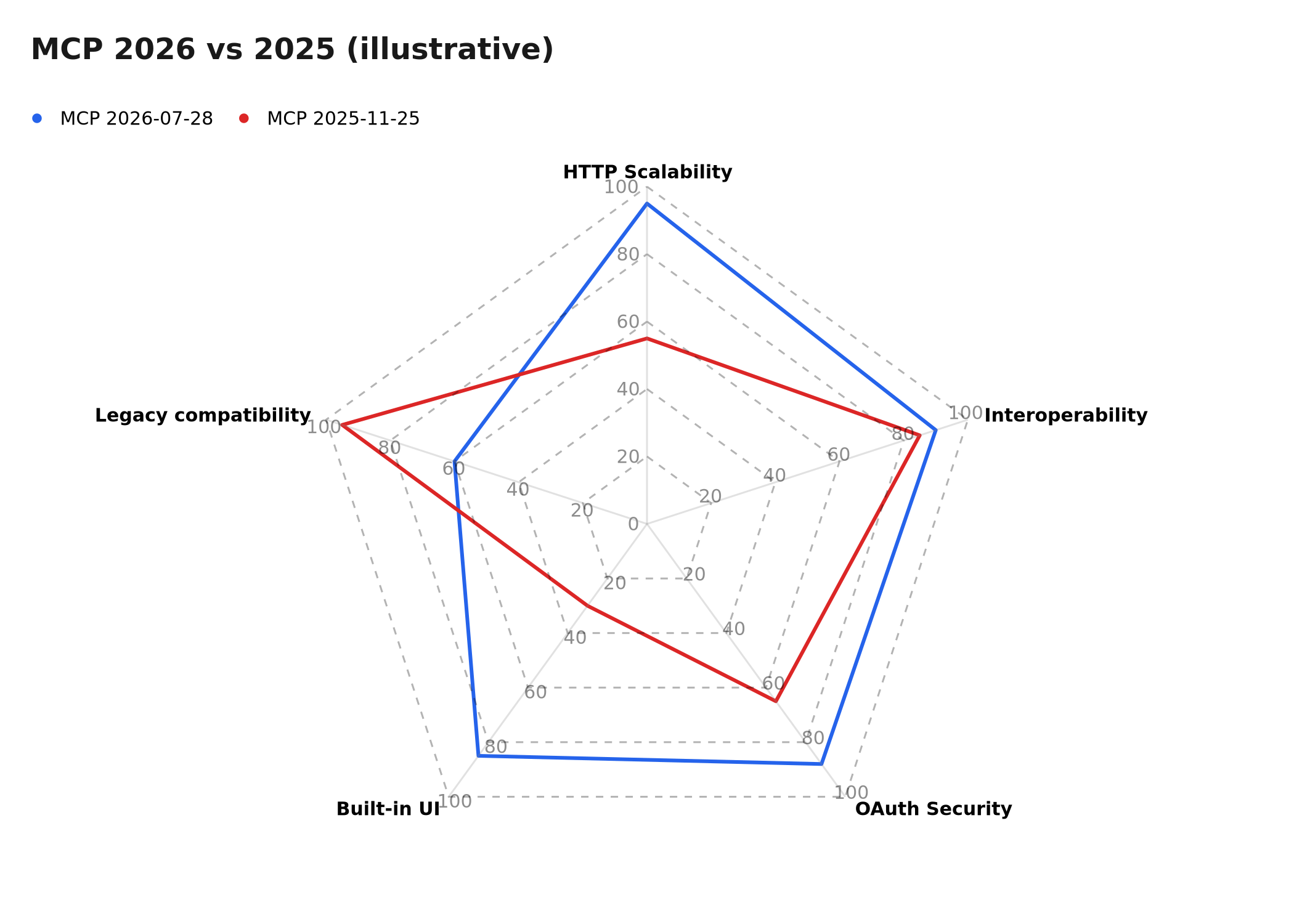 The 2026 spec excels at HTTP scalability, OAuth security, and built-in UI; 2025-11-25 remains more compatible with existing legacy code
Enterprise migration plan: checklist before July 28
Here is the plan we apply at BOVO Digital for clients with MCP in production.
Phase 1 — Audit (week 1)
- List all remote MCP servers and their announced protocol version.
- Identify dependencies on
Mcp-Session-Id, sticky sessions, Redis session store. - Spot experimental Tasks, Roots, Sampling, HTTP+SSE usage.
- Map MCP clients (Cursor, Claude Desktop, n8n agents, custom SDK).
Phase 2 — SDK compatibility (weeks 2–6)
- Check roadmap of SDKs in use (TypeScript, Python) for 2026-07-28 support.
- Test
server/discoveron each internal server. - Validate
Mcp-Method/Mcp-Nameheaders behind your API Gateway.
Phase 3 — Server refactoring (weeks 4–8)
- Replace protocol session state with explicit handles in affected tools.
- Migrate SSE elicitation to Multi Round-Trip Requests.
- Add
ttlMs/cacheScopeto list endpoints. - Instrument W3C Trace Context → OpenTelemetry.
Phase 4 — Auth and security (weeks 6–10)
- Implement
issvalidation (SEP-2468) on the client side. - Fix DCR
application_typefor CLI/desktop clients. - Test re-registration after IdP issuer change.
Phase 5 — Production validation (weeks 10–12)
- Round-robin load test without sticky sessions.
- Chaos test: kill instance mid-request, verify recovery via
requestState. - Documented rollback plan to 2025-11-25 if host client incompatible.
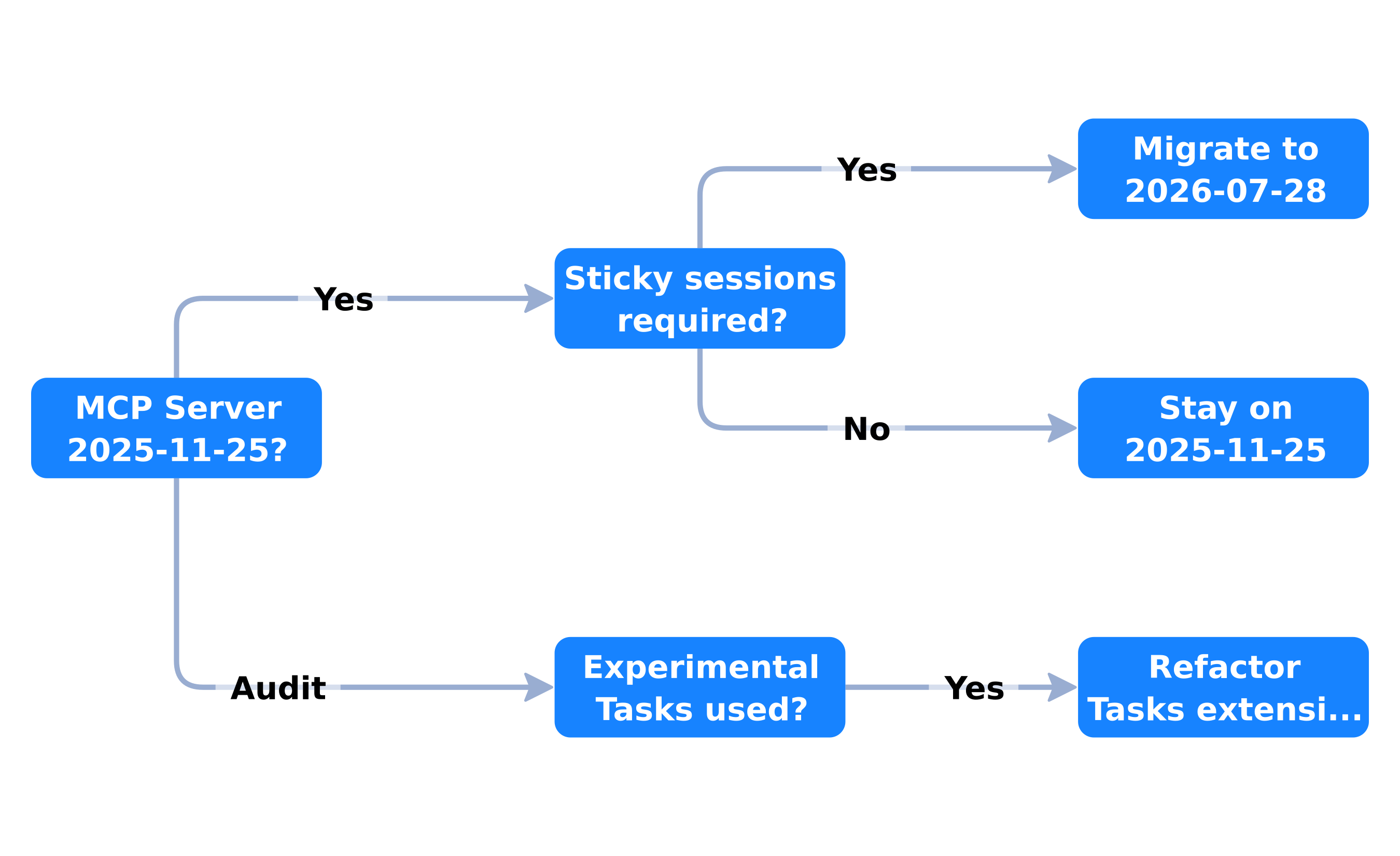 Evaluate sticky sessions and experimental Tasks usage to decide whether to migrate in August 2026 or stay on 2025-11-25 temporarily
MCP 2026-07-28 and your n8n automation stack
n8n was among the first orchestrators to embrace MCP for connecting agents and business tools. The stateless spec changes three things for n8n workflows:
1. Reliability of remote MCP connections. Without a protocol session, a pod restart no longer invalidates all active sessions. Long-running workflows that invoked MCP tools every ten minutes lose an entire class of "session expired" failures.
2. Tool definition cache. With ttlMs, the MCP Agent node can cache tools/list between executions, reducing latency and load on internal servers.
3. Hardened OAuth. n8n OAuth2 credentials connected to MCP servers need review: iss validation, refresh token semantics, issuer binding. It is tedious, but cheaper than an IdP security incident.
If you deploy MCP agents without a dedicated platform team, outsourcing migration to an n8n automation agency experienced with MCP avoids dangerous shortcuts — temporarily disabling auth, ignoring mandatory headers, or shipping unvalidated state handles.
What enterprises gain — and what they pay
Measurable gains
- Horizontal scaling without sticky sessions or mandatory shared store at the protocol layer.
- Observability aligned with OpenTelemetry and standard HTTP headers.
- OAuth security aligned with RFC 9207 and enterprise OIDC practices.
- Extensibility via MCP Apps and Tasks without bloating the core spec.
- Predictability via a minimum twelve-month deprecation policy.
Migration costs
- Refactoring MCP servers that stored state in protocol sessions.
- Experimental Tasks → Tasks extension migration.
- Updating clients matching
-32002or ignoring routing headers. - Load and chaos engineering on the new architecture.
- Team training on explicit handles and Multi Round-Trip Requests.
ROI calculation depends on MCP maturity. An SMB with two internal MCP servers in local stdio has low impact. A group with fifteen HTTP servers behind Kong, ten production agents, and critical Tasks workflows should budget six to twelve weeks of platform engineering.
BOVO Digital positioning: from the April article to the July migration
In April, we recommended adopting MCP as the tool access standard, complementing A2A for inter-agent orchestration. In July, the recommendation evolves:
- If you don't have MCP yet: start directly on 2026-07-28 if your SDK supports it; otherwise 2025-11-25 in local stdio with a Q3 2026 migration plan.
- If MCP is already in production over HTTP: plan the stateless migration before end Q3 2026 — scaling gains are immediate once migrated.
- If you build custom agents: integrate MCP Apps and Tasks extension into your product roadmap, not as an afterthought.
Our AI agent creation offering now includes MCP 2026-07-28 compatibility audit from the scoping phase: protocol version, state pattern, OAuth review, cache strategy. We apply the same standards to our internal agents before offering them to clients.
Official timeline and validation window
Key points from the MCP blog:
- Release candidate locked: May 21, 2026.
- Final spec: July 28, 2026.
- Validation window: ten weeks for SDK maintainers and client implementers against real workloads.
- Tier 1 SDKs: support expected within this window.
- Report a problem: issues on the specification repository; implementation questions via Discord Working Groups.
This release contains breaking changes — not the future norm, but a justified foundational break. Governance tools (deprecation, extensions, conformance suite) exist so future revisions can be incremental.
Conclusion: MCP enters the production infrastructure age
Specification MCP 2026-07-28 answers a promise David Soria Parra (MCP co-creator) made in April 2026: make the protocol ready to productionize agentic systems. Stateless transport, MCP Apps and Tasks extensions, hardened OAuth, written deprecation policy — this is no longer a lab standard, it is an infrastructure layer comparable to what REST was for web APIs.
Three concrete actions this week:
- Audit your MCP servers for sessions, experimental Tasks, and HTTP+SSE transport.
- Test
server/discoverand routing headers on a staging environment. - Plan OAuth migration (SEP-2468 first) with your security team.
If you discovered MCP through our April article on MCP and A2A, treat this as the next chapter: less vision, more runbook. And if your web stack is moving toward agent-native architecture, cross-read with our Next.js, Prisma, and MCP in 2026 guide.
Need support? Our n8n automation agency deploys MCP agents in production with OAuth review, load testing, and migration documentation. For a custom agent with 2026-07-28 compatibility from the POC, see our AI agent creation offering. We start with an audit of your existing MCP stack — not by selling technology you don't use yet.
Tags
FAQ
What concretely changes between MCP 2025-11-25 and 2026-07-28?
Version 2026-07-28 removes the initialize/initialized handshake (SEP-2575) and the Mcp-Session-Id header (SEP-2567). Every request becomes self-contained: protocol version, client identity, and capabilities travel in _meta. Streamable HTTP requests require Mcp-Method and Mcp-Name headers (SEP-2243). Tasks moves out of the core protocol into an extension, MCP Apps ships as an official extension, and six SEPs harden OAuth/OIDC authorization. Roots, Sampling, and Logging are deprecated with documented replacements, with no removal before a minimum of twelve months.
Do I need to migrate immediately on July 28, 2026?
Not necessarily on day one. The final spec publishes on July 28, 2026, but deprecated features keep working for at least twelve months. However, if your MCP deployment relies on sticky sessions, a shared session store, or the experimental Tasks API from 2025-11-25, plan migration starting August 2026. Tier 1 SDKs are expected to ship support within the ten-week window opened by the release candidate locked on May 21, 2026.
How do I manage application state without Mcp-Session-Id?
The protocol becomes stateless, not your application. Servers that must retain context across calls emit an explicit handle — basket_id, browser_id, ticket_id — returned by a tool, which the model passes back as an ordinary argument on subsequent calls. MCP maintainers document this pattern as often more powerful than state hidden in transport metadata, because the model can reason about the identifier and compose it across tools.
Does MCP Apps replace my agents' custom interfaces?
Not immediately. MCP Apps (SEP-1865) lets servers declare HTML interfaces rendered in a sandboxed iframe, with the same audit and consent path as a tools/call. It is an interoperability building block for compatible MCP hosts, not a universal replacement for your Next.js front-end or internal dashboards. For complex business workflows, a dedicated web architecture often remains preferable; MCP Apps mainly covers short interactions embedded in the MCP client.
How does this relate to A2A and the April 2026 MCP article?
The April 2026 article covered MCP stabilization and the emergence of A2A for inter-agent communication. Spec 2026-07-28 does not replace A2A: it rebuilds MCP''s transport and tools layer for production at scale. A2A remains the orchestration layer between agents; MCP remains the layer for accessing tools and resources, now deployable behind a plain round-robin load balancer.
We scope one workflow — not a generic demo
You describe a repeated task. We tell you what n8n would ship, the timeline, and what stays out of scope.
- 30 min
- 1 scoped workflow
- No commitment

William Aklamavo
Web development and automation expert, passionate about technological innovation and digital entrepreneurship.


