
WhatsApp Business API pricing in 2026: Meta rates, providers, monthly budget
The cost of a WhatsApp Business campaign in 2026: Meta per-message rates (marketing, utility, service), the October 1, 2026 change, BSP fees and a realistic SME monthly budget.

WhatsApp Business API pricing in 2026: Meta rates, providers, monthly budget
Meta no longer bills "per conversation". Since July 2025, it bills each delivered template message. And on October 1, 2026, service message rates change.
The WhatsApp Business API became the preferred channel for French-speaking SMEs for 24/7 customer relations. But its real cost stays fuzzy: Meta rates per message, provider (BSP) fees, the October 2026 reform. This article gives the official 2026 rates, a table to estimate your budget, and a look at our documented cases (id 25).
What you will learn: the per-message billing model, Meta rates in France, what changes on October 1, 2026, how to estimate your monthly budget, how to choose between Cloud API and BSP, how to optimize deliverability, and how to avoid deployment traps.
The Meta billing model since July 2025
Important context: Meta moved from "per 24-hour conversation" to per delivered message on July 1, 2025. You are only billed when a template message is delivered to the recipient. Free-form replies in the 24-hour window are handled separately.
Why this change? The "per conversation" model penalized businesses sending short, frequent messages (every conversation opening was billed, even for a single message). The move to per delivered message aligns cost with real send volume and makes pricing more predictable at scale. It also answers BSP pressure: providers billed their clients per message and had to reconcile two logics.
The key point: "delivered" does not mean "read" (delivered = received by the recipient's carrier), nor "sent". A message that fails delivery is not billed. That is an important optimization lever: the cleaner your base and the more approved your templates, the less you pay for nothing.
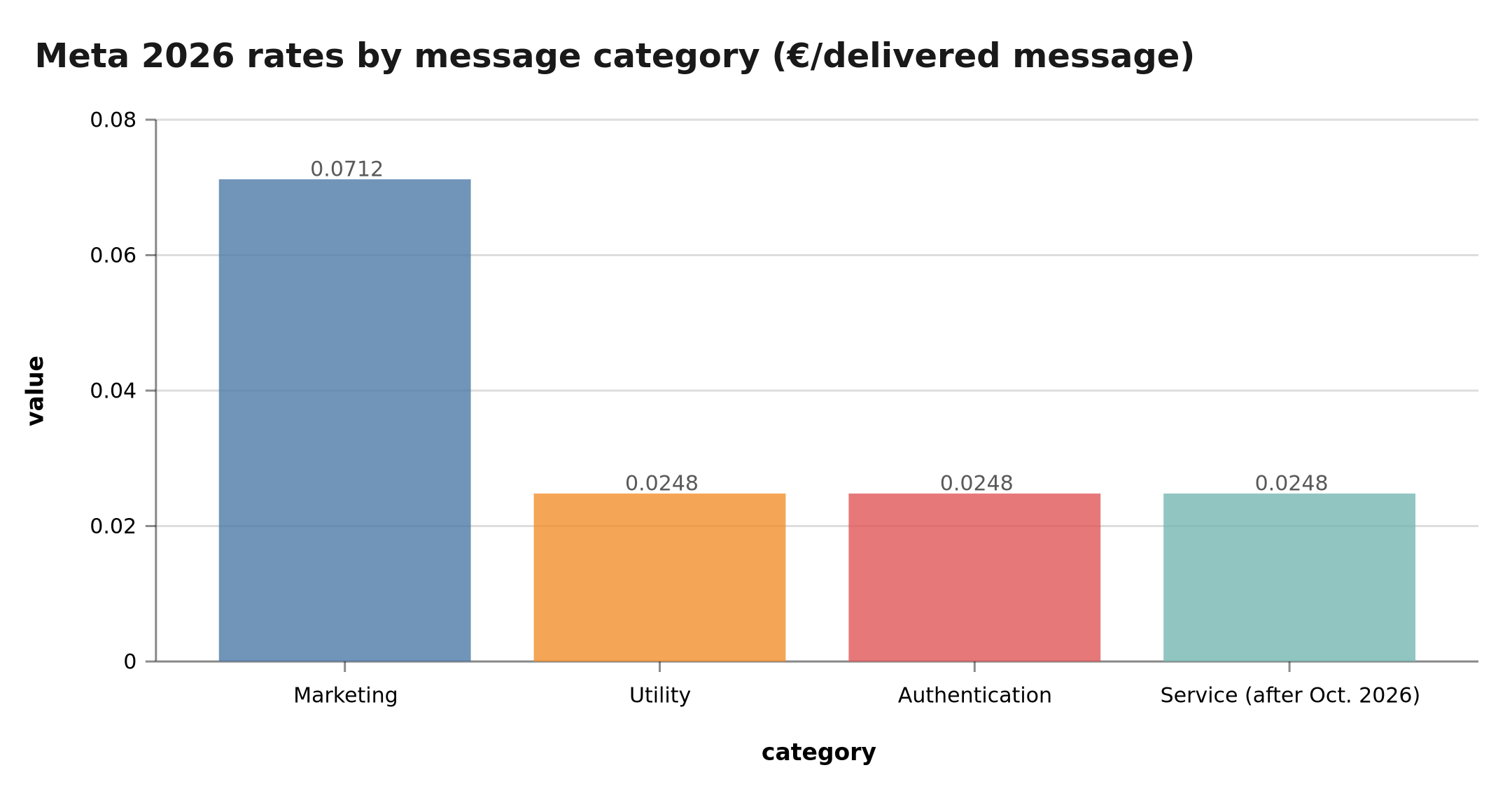 Marketing, utility, authentication and service messages: each category has its own Meta rate per delivered message
The 4 message categories
| Category | Meta France rate 2026 | Use case |
|---|---|---|
| Marketing | 0.0712 € / message | Promotions, newsletters, campaigns (template) |
| Utility | 0.0248 € / message | Order confirmation, delivery tracking |
| Authentication | 0.0248 € / message | OTP code, login, verification |
| Service | 0 € until 09/30/2026, then billed | Free-form replies in the 24-hour window |
Sources: Meta documentation (developers.facebook.com, July 2026 rate cards) and engagelab.com analysis (September 2026). Rates depend on the recipient's phone country and the WhatsApp Business account volume tier.
Special attention: the category is determined by the template type, not your intention. A "Your order is ready" message can be classified as utility WITHOUT marketing content. A newsletter with a discount link will be classified as marketing. Misclassifying a template has two consequences: a higher rate than necessary, or a Meta approval rejection. The category is chosen at template creation, and changing it once approved is difficult.
Volume tiers: how the price drops
Meta applies volume tiers: the more you send, the lower the unit cost. From about 1 million marketing messages per month, rates can drop by 10 to 30 % depending on the country (exact tiers and discounts are published in Meta's documentation; the first significant tier is often around 250,000 to 500,000 messages per month).
For an SME, these tiers are rarely reached — beware of "low volume rate" promises that do not match the real grid. The real SME lever is not the tier, it is the deliverability rate: a clean number base and compliant templates reduce failures, hence delivered messages (the only ones billed).
What changes on October 1, 2026
Meta publishes its grids with at least one month notice. Two documented changes for October 2026:
- Service messages: free since November 2024. From October 1, 2026, Meta bills them per unit, at the utility category rate (0.0248 € base in France). About 1,000 free service messages per number per month are planned.
- Utility messages in the customer service window: billed again. They were free inside the 24-hour window since July 2025.
Practical consequence: a WhatsApp chatbot replying freely inside the 24-hour window will see its cost rise from October 2026. Our delivered cases (ids 25, 26) were framed before this reform; any new deployment must include this change in the business case.
The calculation to do now, not in October: estimate your free-form reply volume in the 24-hour window. Multiply it by 0.0248 €, subtract the 1,000 free quota per number, and you get the reform's monthly surcharge. For a chatbot handling 5,000 service conversations per month: 5,000 − 1,000 = 4,000 × 0.0248 € = 99 €/month. That is exactly the figure in our example table — it did not come out of nowhere.
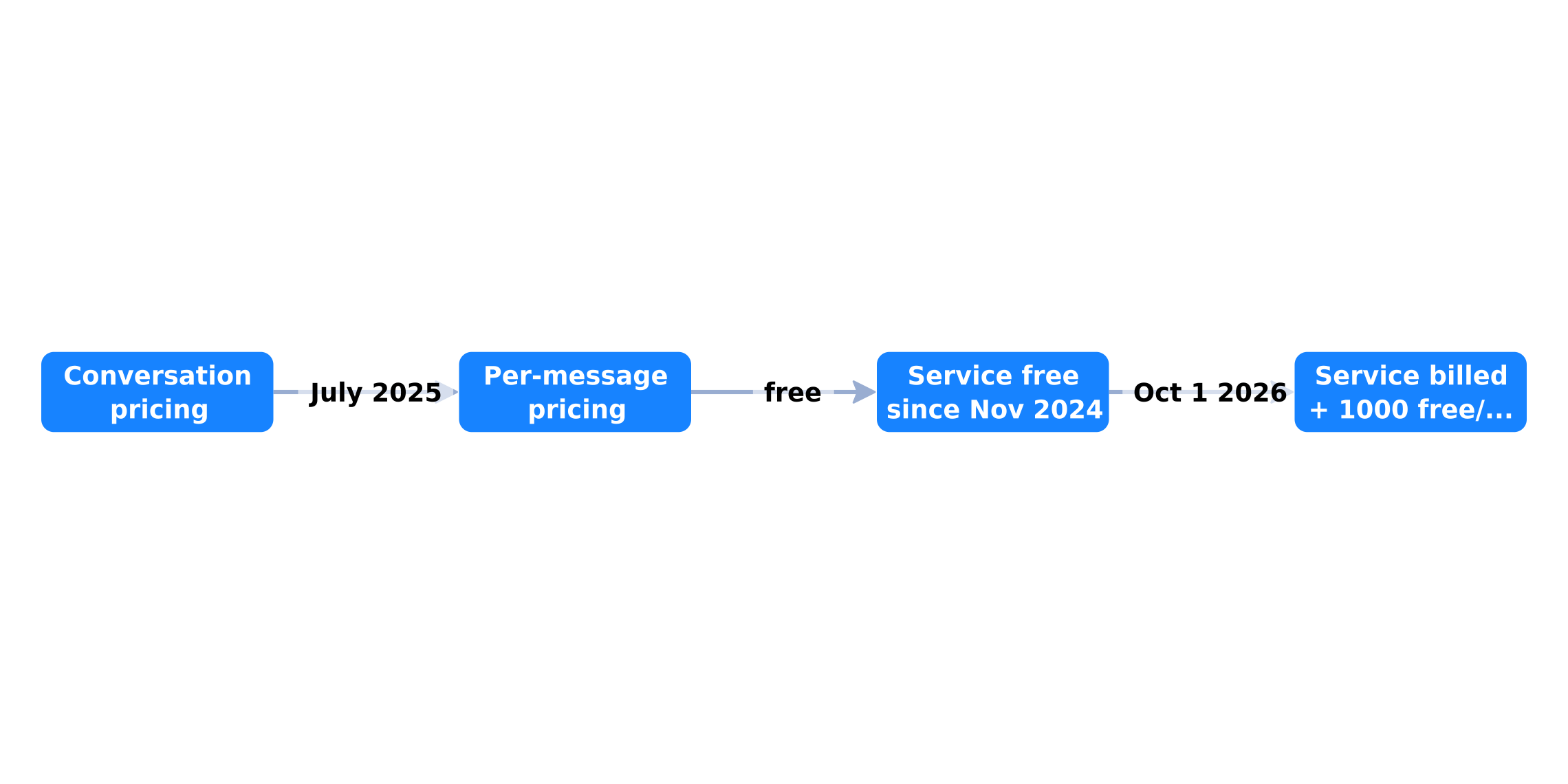 Conversation → per message in July 2025, free service, then billed service on October 1, 2026
Providers (BSP) and their fees
Access to the official API either uses Meta's Cloud API directly (technical) or a BSP (Meta Business Solution Provider): Twilio, 360dialog, MessageBird, etc. The BSP adds its own fees, often a per-message markup, and offers support, compliance and a dedicated number.
Example with Twilio: Meta fees always apply, plus the Twilio margin. Also check number-related fees (monthly rental) and test sends.
Choosing between the three options depends on your profile:
- Direct Cloud API: zero intermediary. You pay Meta and your own infrastructure (server, webhooks, database). Ideal if you have a technical team able to manage webhooks, request signing and monitoring. Total cost is lowest, but implementation time is longer.
- Full BSP (Twilio, MessageBird, 360dialog): provides access, support, often a dedicated number and reporting tools. Per-message cost includes the BSP margin, usually 10 to 25 % above the Meta rate.
- Automation platforms (n8n, Make + WhatsApp module): they rely either on the Cloud API or a BSP. You pay the automation infrastructure on top, but you gain business logic (scenarios, follow-ups, routing). Our WhatsApp n8n chatbot tutorial follows this path.
The selection trap: some platforms display "WhatsApp Business" at low prices without stating they go through a BSP or a non-official aggregator, which raises compliance and number-stability questions. The rule: the number must remain your property and work outside the platform if you switch providers.
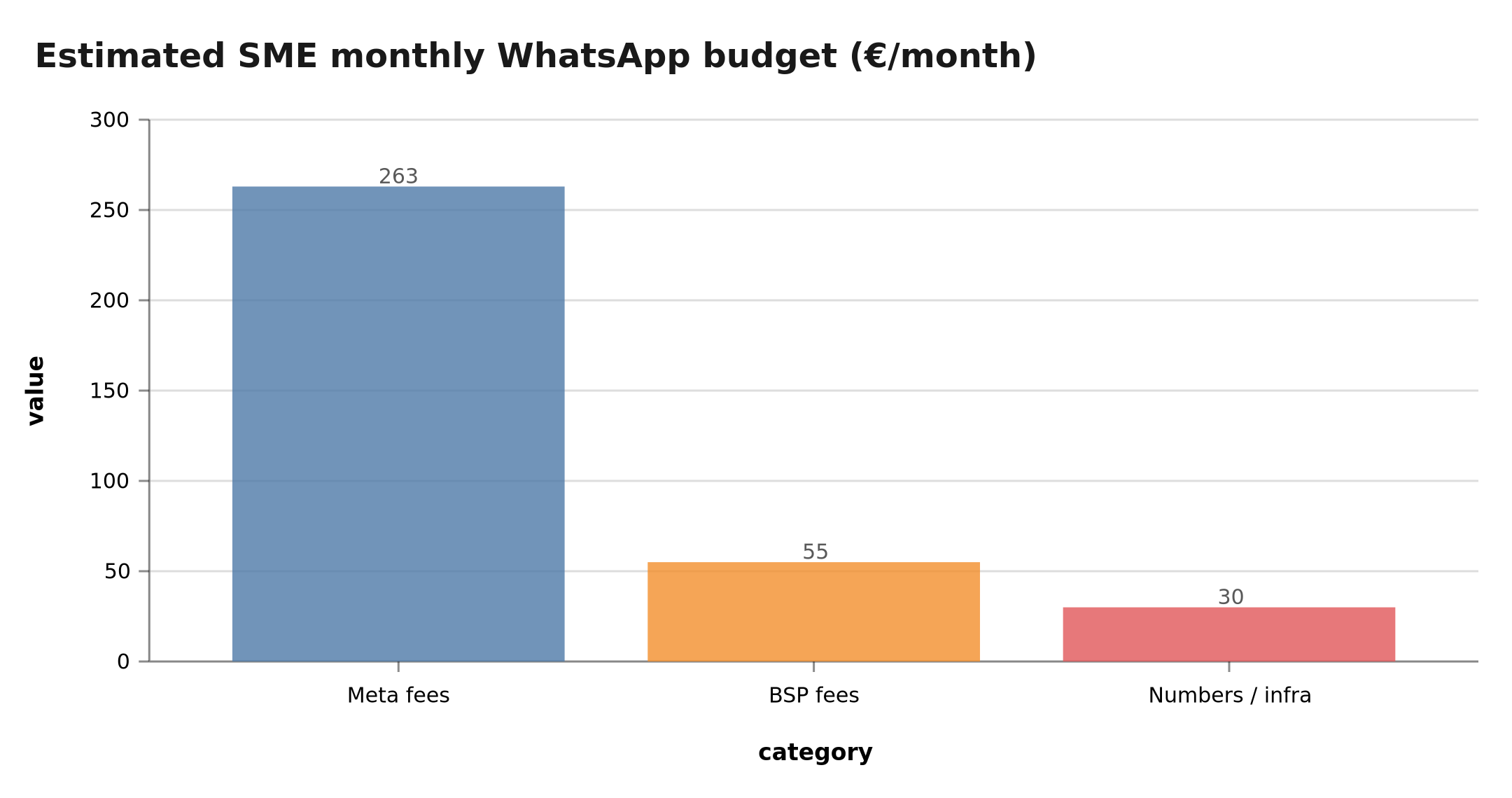 Total cost = Meta fees + BSP margin + numbers + optional AI/automation services
How to estimate your monthly WhatsApp budget
Build your estimate in 4 lines:
| Item | SME example (3,000 mkt + 2,000 util + 4,000 service) |
|---|---|
| Marketing (3,000 × 0.0712 €) | 213 € |
| Utility (2,000 × 0.0248 €) | 50 € |
| Service before Oct. 2026 (free) | 0 € (after Oct: ~99 €) |
| BSP fees (~20 % or per message) | 30–80 € |
| Estimated monthly total | ~300–350 € |
Our method: these figures are estimates from public Meta rates and BSP ranges, not a commercial promise. A precise audit starts from your real volumes.
The 6 items not to forget
A complete WhatsApp budget has six items, not two:
- Delivered template messages — the main item, calculated above.
- Service replies (24-hour window) — free until 09/30/2026, then billed (1,000/number/month quota included).
- BSP fees — per-message margin or monthly flat fee.
- Phone numbers — monthly rental per dedicated number.
- Automation infrastructure — platform cost (n8n, Make) and server.
- Maintenance and scenarios — hours spent updating templates, follow-ups and routing.
Items 4 to 6 are often forgotten in "WhatsApp for 200 €/month" quotes. They typically represent 20 to 40 % of the real total cost of a managed campaign.
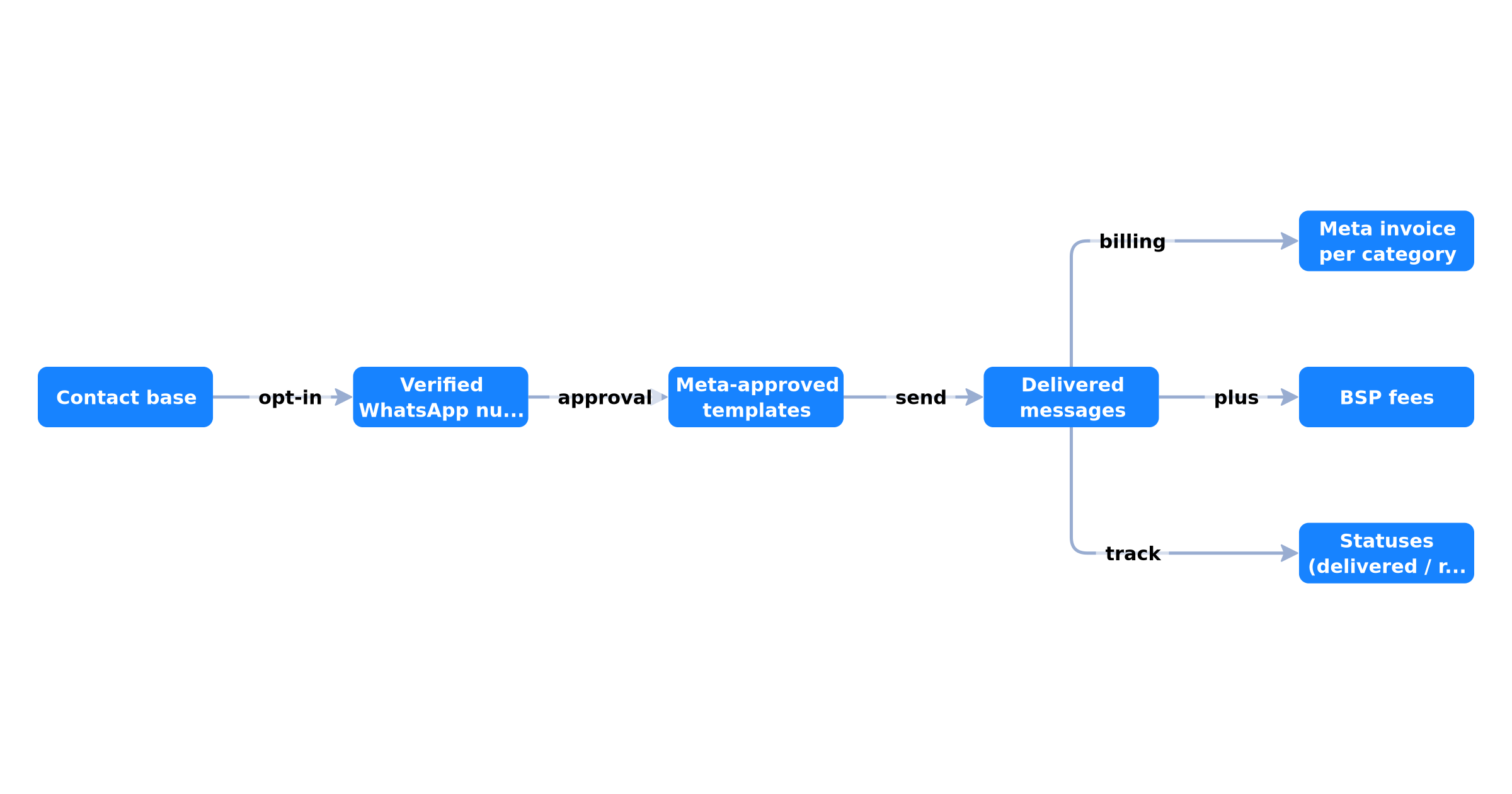 A conversation opens with an inbound message or a template; Meta bills when the 24-hour session closes
Optimizing your bill: 5 proven levers
The WhatsApp cost is not a fixed data point. Five levers reduce the bill without reducing results:
- Clean the contact base: invalid or inactive numbers generate failures (not billed, fortunately) but above all low deliverability rates, which penalize your number's status and can trigger blocks. Clean quarterly at minimum.
- Categorize templates well: a well-written utility template costs 0.0248 € instead of 0.0712 € (marketing). Before creating a marketing template, ask whether the message is "expected" by the client (billing, delivery, appointment) — if yes, the utility category is likely.
- Avoid duplicate campaigns: repeated follow-up scenarios generate superfluous messages. Tracking last sends per contact (a column in your CRM or n8n table) avoids re-campaigning an already contacted lead.
- Consolidate numbers: volume spread across several numbers does not benefit from tiers and multiplies free quotas. Centralizing on one main number maximizes the free service quota and simplifies reporting.
- Negotiate BSP fees on volume: beyond a few thousand messages/month, BSP margins are negotiable. Compare 3 BSPs on the same Meta grid before signing.
These levers are not micro-optimization: on a 300 €/month budget, they often represent 15 to 25 % savings — 50 to 75 €/month, the equivalent of the BSP margin itself.
Three typical budget scenarios
To make the method concrete, here are three scenarios covering the most common SME profiles. Each starts from real one-month volume, not a hypothesis.
Scenario A — The retailer (occasional campaigns)
A retailer sends 500 marketing messages/month (seasonal promotions, back-in-stock) and receives 800 service conversations/month (hours, availability, orders).
| Item | Calculation | Monthly cost |
|---|---|---|
| Marketing (500 × 0.0712 €) | 35.60 € | 36 € |
| Service (800, free until 09/30) | 0 € | 0 € (before Oct.) |
| Service after Oct. (≤ 1,000 quota) | 0 € | 0 € |
| BSP (~15 %) | 36 € × 15 % | 5 € |
| Total | ~41 €/month |
This profile stays under the free service quota until October; the reform changes almost nothing for it. Lesson: the marketing category dominates the cost — categorizing templates well is lever #1.
Scenario B — The e-commerce seller (transactional volume)
An e-commerce seller sends 8,000 utility messages/month (confirmations, deliveries, returns), 1,500 marketing (cart reminders, private sales) and handles 6,000 service conversations.
| Item | Calculation | Monthly cost |
|---|---|---|
| Utility (8,000 × 0.0248 €) | 198.40 € | 198 € |
| Marketing (1,500 × 0.0712 €) | 106.80 € | 107 € |
| Service after Oct. (6,000 − 1,000) × 0.0248 € | 124 € | 124 € |
| BSP (~15 %) | ~430 € × 15 % | 64 € |
| Total | ~493 €/month |
Service becomes the second cost item after the October reform. An e-commerce seller who does not recalculate their business case after October 1 underestimates their bill by 25 %. Levers: consolidate numbers (1,000 quota per number), automate replies with utility templates, and set up monthly monitoring.
Scenario C — The service center (high volume with AI)
A service center (support, health, energy) handles 40,000 service conversations/month via an AI chatbot, with 2,000 utility templates (confirmations, appointments) and 0 marketing.
| Item | Calculation | Monthly cost |
|---|---|---|
| Utility (2,000 × 0.0248 €) | 49.60 € | 50 € |
| Service before Oct. (40,000, free) | 0 € | 0 € |
| Service after Oct. (40,000 − 1,000) × 0.0248 € | 967.20 € | 967 € |
| BSP (~10 %, negotiated volume) | ~1,017 € × 10 % | 102 € |
| Total before Oct. / after Oct. | ~152 € → ~1,119 € |
This scenario is the most impacted by the reform: the bill multiplies tenfold. It is the most common case among companies that automated their customer service on WhatsApp between 2024 and 2026. The October 2026 reform fundamentally changes the economics of these deployments — "free customer service" was a promotional period, not a long-term promise.
What these three scenarios teach: 1) the cost is never a constant — it depends on the category mix and the reform; 2) the free service quota (1,000/number/month) benefits small volumes, not large ones; 3) large volumes must negotiate BSP fees and consolidate numbers today.
How to choose between Cloud API and BSP: the detailed comparison
The Cloud API vs BSP choice is rarely a price question. Here is the full comparison on the criteria that matter:
| Criterion | Direct Cloud API | BSP (Twilio, MessageBird…) |
|---|---|---|
| Cost per message | Meta rate only | Meta rate + 10–25 % margin |
| Implementation | Weeks (webhooks, compliance, monitoring) | Days (UI and docs provided) |
| Dedicated number | Configure yourself | Included or provided |
| Compliance | Manage yourself (opt-in, archiving, GDPR) | Support and models provided |
| Deliverability quality | Monitor yourself | Monitoring tools included |
| Support | Community + docs | Responsive commercial support |
| Switching providers | Number yours, simple switch | Depends on BSP contract |
The pragmatic rule: Cloud API if you have a developer and time; BSP if volume justifies fast production or you lack a technical team. Total cost at equal volume is 10 to 25 % higher with a BSP, but the time saved largely compensates for most SMEs.
Combining WhatsApp with other channels
WhatsApp is never alone in a customer-relations setup. Three typical combinations, with their budget impact:
- WhatsApp + SMS: dual channel for critical messages (confirmations, reminders). SMS costs from 0.04 to 0.08 €/message in France in 2026 depending on the carrier. Redundancy is justified for high-value messages (medical appointments, deliveries) where the SMS read rate bypasses spam.
- WhatsApp + email: email carries the documentary (invoices, terms, summaries), WhatsApp carries the action (confirms, reminds, relaunches). Culturally, the client checks WhatsApp within 5 minutes; email can wait 24 hours.
- WhatsApp + voice agent: the client calls in a hurry, the agent answers, then switches the conversation to WhatsApp for document sending. This is the most complete setup — see our AI voice agent article.
In every case, the WhatsApp channel budget must be estimated within the multichannel frame, not in isolation: SMS/WhatsApp redundancy on critical messages costs little and protects against deliverability losses.
Automating WhatsApp with n8n: the cost architecture
n8n automation adds no extra WhatsApp cost — it adds an infrastructure cost that must enter the budget. Typical architecture of a WhatsApp chatbot on n8n:
| Component | Typical 2026 monthly cost |
|---|---|
| n8n instance (self-hosted VPS or cloud) | 20 – 60 € |
| WhatsApp API (Meta + BSP depending on access) | variable, method above |
| AI model (Claude, GPT) for replies | 30 – 150 € depending on volume |
| Database (conversations, contacts) | 10 – 30 € |
| Total infrastructure excluding API | 60 – 240 €/month |
The WhatsApp n8n Claude chatbot tutorial details the setup. The key point: for a complete AI chatbot, WhatsApp message cost (often 50–150 €/month for an SME) is only a third of the total cost — infrastructure and the AI model weigh as much.
What we saw with our clients: case id 25 in numbers
Our documented case id 25 (24/7 AI WhatsApp assistant) was framed before the October 2026 reform: the business case relied on free service messages. With the reform, the same deployment would cost in service messages (a typical qualification conversation produces 3 to 5 service messages) 0.0248 € × 4 per conversation ≈ 0.10 € per qualified lead. For 500 leads/month: 50 €/month of extra cost — a real impact, but absorbable if the architecture was designed with margin (which is the case for our deliveries).
The lesson for your projects: frame the business case on the October 2026 rates today. What is free today will be billed — the whole question is whether your business model supports it.
Our documented cases
- Id 25 — AI WhatsApp assistant 24/7: lead qualification, booking, quote sending, FAQ — the "customer service" version before the October 2026 reform.
- Id 26 — Personalized campaigns: sending unique messages per contact via Gemini and the Evolution API, tracked in Google Sheets with Telegram alerts.
- Id 19 (leads): multichannel funnel with WhatsApp, SMS and email follow-ups, GPT qualification.
The whole tutorial on building a WhatsApp chatbot with n8n and Claude covers implementation. The WhatsApp opt-in and CNIL article covers the legal side.
The common thread of these three cases: the WhatsApp cost is never the dominant item. What dominates is the business logic cost (scenarios, CRM integrations, AI reply quality). An SME pricing only the messages underestimates the project by 30 to 50 %.
Reading a WhatsApp invoice correctly
Once live, the monthly WhatsApp invoice often looks opaque. Here is how to read it in 5 lines:
- Delivered templates by category: compare each line to the Meta grid of the recipient country. A discrepancy usually means a country you did not expect (a foreign client base) or a volume tier you did not hit.
- Failed sends: not billed, but watch the ratio. A failure rate above 5 % signals a dirty base or blocked numbers — fix it before it degrades your number status.
- Free-form replies (service): before October 2026, they should be zero. After October 1, they appear at the utility rate minus the 1,000 free quota per number.
- BSP markup line: it should match your contract (percentage or flat). A discrepancy here is a negotiation lever.
- Number rental: monthly per dedicated number. Renegotiate or consolidate if you hold several idle numbers.
A five-minute monthly review of these lines catches most billing surprises before they compound. This is the operational habit that turns the pricing knowledge of this article into a recurring saving. Combine it with the five optimization levers above and most SMEs cut 20 to 30 % of their WhatsApp bill within two months — while improving deliverability and compliance at the same time.
Traps before launching
- Confusing Meta rates and total cost: the price displayed by Meta can be lower than the final gross, with BSP margin and numbers on top. Always ask the provider for a total monthly cost, not a per-message rate.
- Ignoring the October 2026 reform: a business case built on free service messages will be wrong from October 1. Recalculate with the utility rate today.
- Relying on the 24-hour window as a marketing plan: the customer service window does not allow marketing. Campaigns stay on the paid marketing template channel.
- Forgetting opt-in: WhatsApp requires consent; the CNIL is attentive for French businesses. A compliant opt-in also reduces reports and number blocks.
- Neglecting deliverability monitoring: your WhatsApp Business number status depends on your deliverability rate and reports. Monthly tracking (deliverability, reports, response time) avoids the silent block — the most expensive failure.
Where to start
- Count your volumes: marketing, utility, authentication, service — over one real month.
- Add the October 2026 reform to your estimate table.
- Choose access: direct Cloud API (if you have a technical team) or BSP (if you want support).
- Frame the chatbot with our WhatsApp n8n tutorial or launch an automation audit.
- Set up monitoring: a monthly dashboard (cost per category, deliverability, reports) from month one.
Sources
- Meta, WhatsApp Business Platform: pricing and updates-to-pricing, July 1, 2026 and October 2026 grids.
- Engagelab, September 2026: WhatsApp Business API pricing.
- BOVO portfolio files: ids 19, 25, 26.
Conclusion
The WhatsApp Business API costs, before provider, 0.0712 € per marketing message and 0.0248 € per utility or authentication message in France (2026 Meta grids). Service messages, free until September 30, 2026, will be billed from October 1. The real monthly budget depends on your volumes, your BSP and — the trap — the upcoming reform. Estimate it before launching, not after.
The per-message unit cost is only the visible part. The hidden part — BSP, numbers, infrastructure, maintenance, the October reform — often represents half the real budget. An SME building its business case on Meta rates alone underestimates the project by 30 to 50 %.
Next: WhatsApp chatbot with n8n and Claude in 30 minutes, WhatsApp opt-in and CNIL, or n8n/Make automation pricing.
Tags
FAQ
How much does a WhatsApp Business message cost in 2026?
Meta bills per delivered message since July 2025. Marketing category: 0.0712 € per message in France (July 1, 2026 grid). Utility and authentication: 0.0248 €. Service messages (replies in the 24-hour window): free until September 30, 2026, then billed from October 1, 2026.
What changes on October 1, 2026 for WhatsApp Business?
Meta starts billing service messages per unit and again bills utility messages sent in the customer service window. Service rates will be aligned with the utility category (0.0248 € base in France). A quota of 1,000 free service messages per number per month is planned.
How much does a WhatsApp campaign cost for an SME per month?
For 3,000 marketing and 2,000 utility messages per month, the Meta budget is about 213 € + 50 € = 263 €, plus the BSP provider fees (Twilio bills an extra per message, for example). Better to build a table-based estimate like the one in this article.
Do I need a provider for the WhatsApp Business API?
Access to the official API goes through a BSP (Meta Business Solution Provider) like Twilio, 360dialog or MessageBird, or through Meta's direct Cloud API (more technical). The BSP adds its own fees and provides support, compliance and often a dedicated WhatsApp number.
We scope one workflow — not a generic demo
You describe a repeated task. We tell you what n8n would ship, the timeline, and what stays out of scope.
- 30 min
- 1 scoped workflow
- No commitment

Singbo Davy AGONMA
Fullstack Developer & AI Expert. n8n automation specialist, Laravel/Flutter development and AI agent integration. Master CS — IFRI.


