
AI voice agent for business: pricing, ROI and real-world feedback
AI voice agent for business: what a voicebot costs in 2026, how to calculate ROI, which sectors win, and documented BOVO cases.

AI voice agent for business: pricing, ROI and real-world feedback
A voice agent does not replace your team. It catches the calls they cannot take, qualifies the request, and escalates complex cases to a human.
The AI voice agent — also called voicebot or phone assistant — moved from experiment to strategic tool in 2026. You still need to know what it really costs, how to calculate its return on investment, and which use cases deliver. This article builds on public 2026 sources, official platform pricing, and our own documented portfolio files.
What you will learn: 2026 cost ranges, the 4-step ROI method, sectors where the voice agent makes a difference, the technical stack underneath, regulatory traps (GDPR, AI Act, premium-rate numbers), and how to frame a 30-day first deployment.
Why the voice agent becomes strategic in 2026
The phone remains the channel clients prefer for an immediate answer. An unanswered call is a lost lead. A 2026 voice market analysis (agentvocal.ai) estimates European growth of +34 %, driven by three factors:
- Voice models (speech-to-text, LLM, text-to-speech) are good enough to hold a natural conversation in French, accents included. Latencies dropped below 800 ms on managed stacks in 2026, making phone conversation fluid.
- The cost of handling a call dropped below one minute of a human receptionist. The crossover can be quantified precisely: per-minute cost of a managed platform (0.08 – 0.30 €) versus the fully loaded cost of an employee (salary, payroll taxes, equipment, training, workspace), typically 1.50 to 3.00 € per real conversation minute.
- No-code platforms (Vapi, Retell, Synthflow) allow a first agent in days, without writing any speech-to-text or text-to-speech code.
But this market also attracts marketing claims. Documented cases remain rare. You are sold "average" conversion figures that never state the source, the period or the volume. A healthier stance: start from your own missed calls, count them for two weeks, and build the business case on that reality — not on a market average.
We show what we actually delivered in our files (ids 43, 44, 45) — not a catalog of unverifiable numbers.
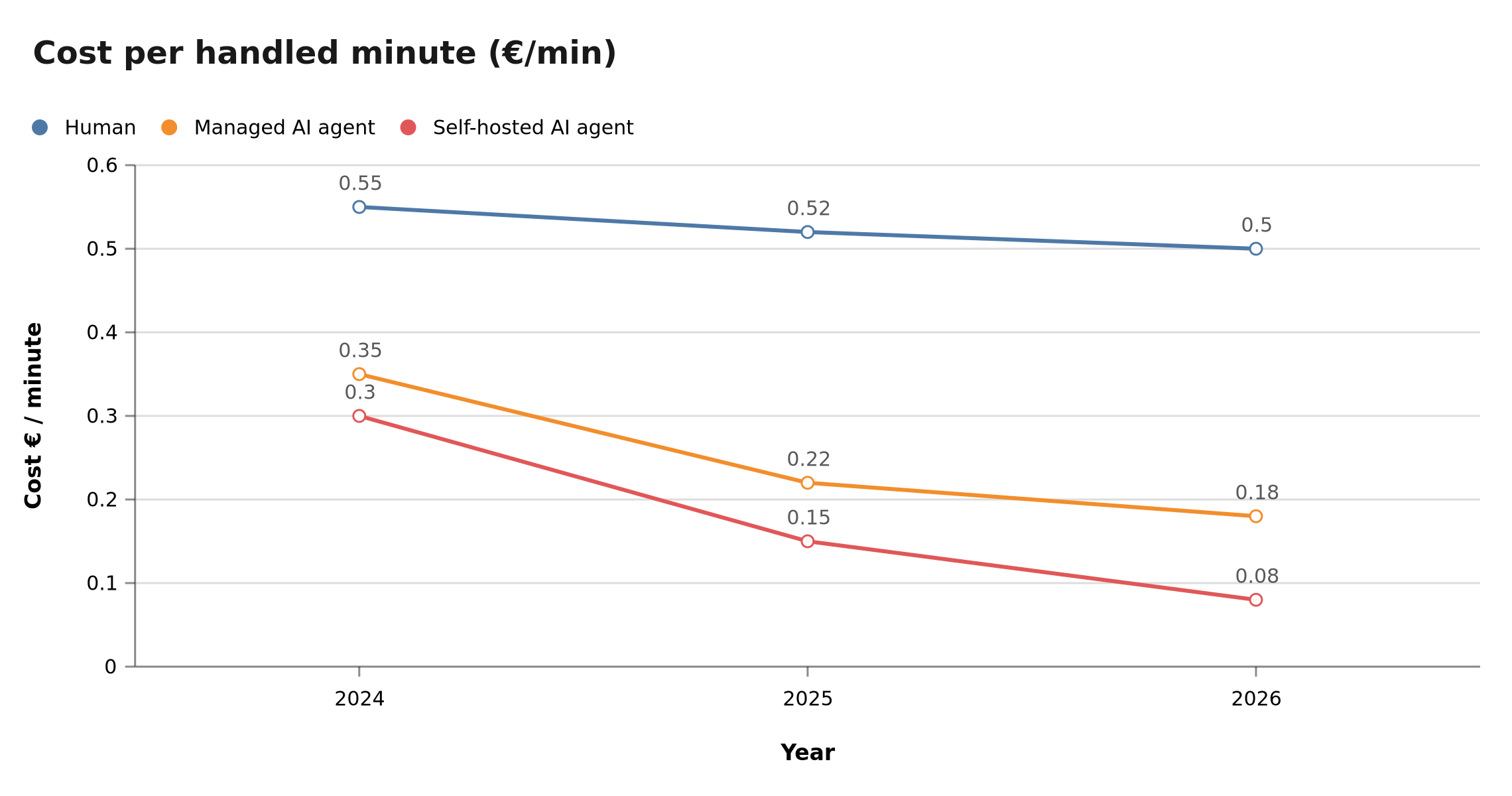 The per-minute cost of an AI voice agent (0.10–0.40 €) versus a human receptionist, 2026 sources
How much does a voice agent cost for a small business in 2026
The three cost items
| Item | 2026 range | What drives the price |
|---|---|---|
| Initial deployment | 2,000 – 15,000 € | Scenario complexity, CRM/calendar integrations |
| Monthly subscription | 80 – 600 € | Call volume, languages, advanced options |
| Cost per minute | 0.10 – 0.40 € | Voice provider, AI model, telephony |
Sources: public grids mkdigitalparis.com and agentvocal.ai (September 2026). At BOVO, the public "Voice + Chatbot Enterprise" offer starts at 5,000 € for an omnichannel deployment with booking integration (6–8 weeks).
Three important remarks on this table:
- Initial deployment is not an option: a "bare" voice agent, plugged into a number without integration, has no measurable value (see trap 1 below). Almost the entire starting budget goes into scenarios, testing and CRM/calendar wiring.
- The subscription depends on volume, not number of lines: platforms mostly bill minutes. A number with 500 minutes per month costs less than one with 5,000 minutes. Tiers are published on platform pricing pages.
- Per-minute cost drops fast: providers adjusted their grids in spring 2026. An annual contract or a volume commitment can halve the minute price.
Cost per minute, the real lever
Managed platforms (Vapi, Retell) charge 0.08 € to 0.30 € per minute in 2026, including transcription, LLM, speech synthesis and telephony. Building your own stack (Deepgram + Claude + ElevenLabs + Twilio) can push the minute below 0.20 €. Self-hosted, below 0.08 € — but with significant upfront engineering cost (Techsy analysis, 2026).
The rule: managed wins under 50,000 minutes/month, self-hosted beyond 200,000 minutes/month.
Why this rule? Between 50,000 and 200,000 minutes, the cost of a dedicated engineer (time spent assembling, maintaining and debugging the stack) exceeds what platforms charge you in margin. Beyond 200,000 minutes, the per-minute price gap becomes large enough to fund internal engineering. The exact tipping point depends on team salaries, but the order of magnitude holds for most European SMEs.
Hidden costs frequently forgotten
The table above is incomplete without four additional items:
- Phone numbers: renting a dedicated geographic or mobile number, billed by the carrier (typically 1 to 10 €/month depending on type, plus activation).
- Inbound call charges: if your customers call a standard (non-premium) number, you bear the call arrival cost. Depending on carrier and number type, this surcharge can be 0.01 to 0.05 € per received call — negligible at low volume, not negligible at 10,000 calls/month.
- Recording and archiving: if you keep conversations (recommended for continuous improvement, mandatory in some regulated sectors), you must store audio files and transcripts. A one-minute call produces roughly 10 to 20 KB of compressed audio — about a hundred GB per year at sustained volume, cloud storage included.
- Ongoing prompt tuning: maintaining a voice agent is not a zero cost. Scenarios evolve (new products, new hours), comprehension errors get fixed. Budget 1 to 4 hours per month of adjustments, in-house or at the platform.
Too many business cases forget these items and fund the agent while ignoring numbers and maintenance. Feedback from the documented cases below shows these items often represent 5 to 15 % of the total annual cost — include them from year one.
How to calculate the ROI of a voice agent in 4 steps
The most solid method, used by agentvocal.ai and Retell, builds on 4 measurable items. Order matters: start with the biggest item for you, do not try to compute everything at once.
1. Savings on handling cost
A call handled by AI costs ~0.20 €/min versus ~1.50–3.00 €/min for a human receptionist (fully loaded). On 1,000 monthly minutes, savings are roughly 1,000–2,500 € gross before agent cost.
Method note: do not compare "AI minute" to "human minute" abstractly. The receptionist does not talk 100 % of the time: they pick up, put on hold, transfer, take notes. A 5-minute conversation for the client can represent 8 to 10 minutes of human work (listening + typing + transfer). AI produces the transcript straight into the CRM — the typing time disappears. This "ghost time" is why real savings often exceed the naive calculation.
2. Capturing lost leads
Often the most profitable item. For a clinic with 60 missed calls/month, a 15 % conversion rate and a 500 € average basket: 60 × 15 % = 9 potential clients × 500 € = 4,500 €/month. Even recovering only 20 % yields 900 €/month.
The most profitable subset: off-hours calls. Evenings and weekends, nobody answers at most SMEs. Yet these slots often represent 20 to 35 % of incoming calls (especially Monday mornings — weekend calls accumulate). A voice agent capturing these calls, qualifying the request and booking an appointment converts volume the receptionist physically cannot handle.
Best practices to protect this gain: the agent must confirm the appointment in writing (SMS or email) at the end of the call, and the CRM must trigger a follow-up if the prospect received no confirmation. An "oral" appointment without a written trace turns into a no-show.
3. Reducing no-shows
A voice agent confirming appointments by phone cuts no-shows. For 200 appointments/month at 20 % no-show and an 80 € slot value: 40 lost appointments × 80 € = 3,200 €. A 60 % no-show reduction frees ~1,900 €/month.
The mechanism is simple and measurable in 2 weeks: the day before the appointment, the agent calls, reminds the date and time, and gives a simple option to cancel or reschedule. Two effects: the client confirms (they are more likely to come) or they reschedule (the slot frees up and can be resold). Sectors with high slot value — health, training, real estate — see the most gains here.
Do not overlook: no-shows have a slot cost, not an average ticket cost. A dental surgeon losing an hour per week to a no-show loses rare billable time: the gain is potentially higher than the slot's simple revenue.
4. Customer satisfaction and retention
Zero queue and 24/7 availability improve NPS and reduce churn. Harder to quantify, but trackable via post-call surveys and retention rate.
A surprising field insight from 2026: customers do not necessarily ask to speak to a human. They ask to be handled — not put on hold, not redirected three times. An agent that resolves the problem on first contact is rated better than a receptionist who transfers. Satisfaction is won on the first-contact resolution rate, which must be tracked as a KPI of its own.
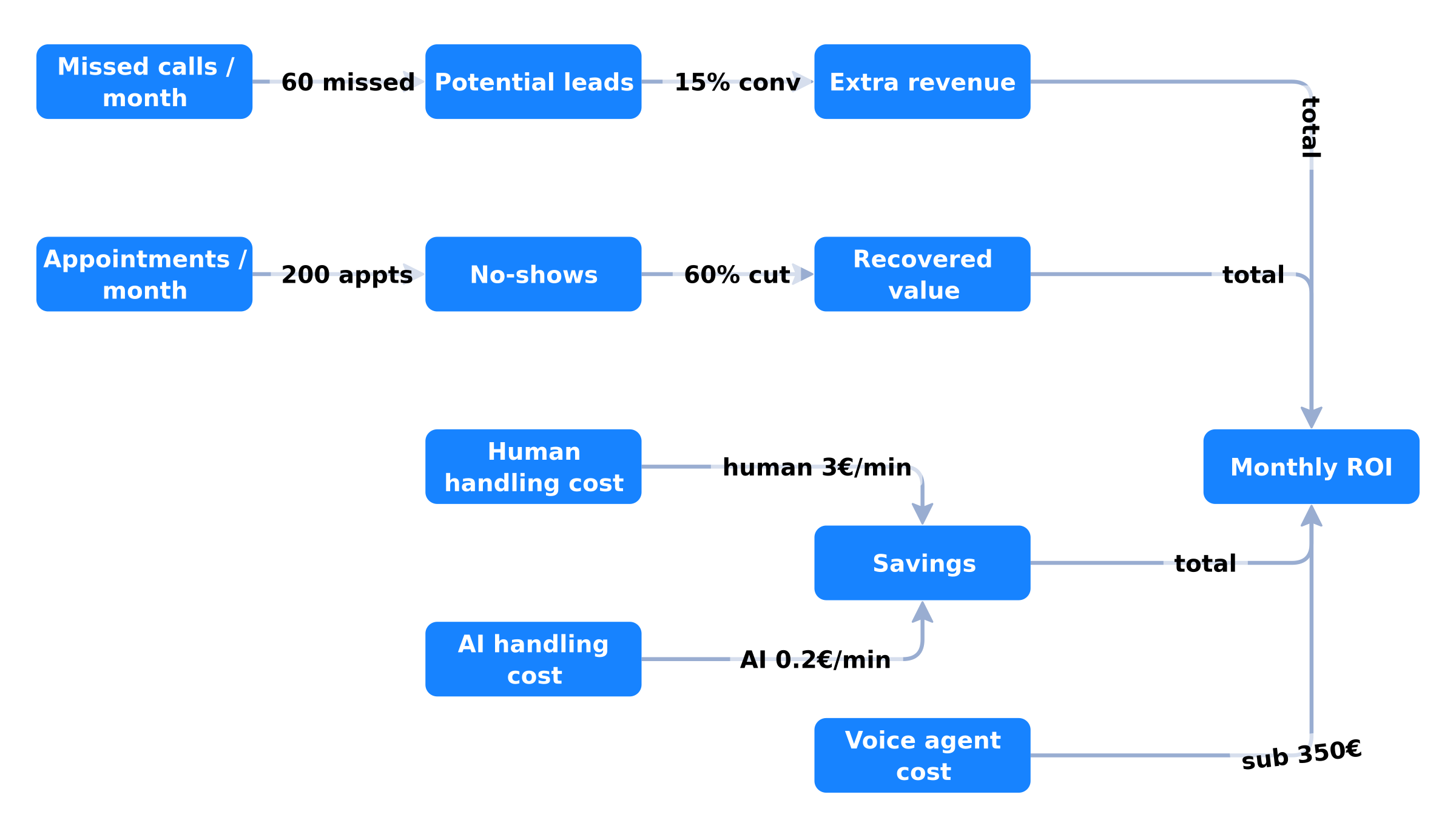 The 4 ROI items: handling, leads, no-shows, satisfaction
Breakeven: most 2026 sources put the return between 2 and 6 months for businesses handling 30+ incoming calls per day. This assumes working CRM/calendar integrations from day one. Without them, breakeven is further away, or never reached.
A complete worked example
Take a physiotherapy clinic receiving 45 calls/day (≈ 900/month), 25 % off-hours, 30 % missed calls, a 60 € average basket per session and 70 % honored appointments.
| Item | Calculation | Monthly gain |
|---|---|---|
| Captured missed calls (270) converted at 10 % | 27 patients × 60 € | 1,620 € |
| No-shows reduced (from 30 % to 12 %) | 18 slots × 60 € | 1,080 € |
| Receptionist time freed (2 h/day) | 40 h × 35 €/h | 1,400 € |
| Total gain | ~4,100 €/month | |
| Agent cost (deployment amortized 12 months) + subscription | 400 € + 250 € | 650 €/month |
| Net gain | ~3,450 €/month |
Breakeven is reached in 1.5 months. Even halving every rate, the project stays positive — that is what a robust business case means: it does not depend on a single optimistic number.
Under the hood: the technical stack of a voice agent
A managed voice agent hides four bricks. Understanding them helps ask the right questions to your provider and price the options.
- Speech-to-text (STT): converting speech to text. 2026 leaders (Deepgram, Whisper, AssemblyAI) handle French with its accents and phone background noise. The criterion: error rate on your real data, not marketing benchmarks.
- Conversational LLM: the "brain" that understands intent, follows the scenario, handles digressions. The choice of model (Claude, GPT, Gemini, hosted open-source models) affects complex response quality and per-minute cost.
- Text-to-speech (TTS): the voice. 2026 models (ElevenLabs, OpenAI TTS, platform-native voices) offer voices nearly indistinguishable from humans, with tone variants. Cloning your receptionist's voice is possible but raises right-of-publicity and consent questions.
- Telephony: call arrival and departure (Twilio, Vonage, European carriers). This brick handles the number, seamless transfers to a human, and routing out to a receptionist.
Managed platforms bundle these four bricks and bill per minute. Assemblers (you + a developer) wire them separately: more control, more maintenance.
The hybrid mode: the winning configuration
The hybrid mode is the best of both worlds: the agent handles simple and off-hours calls, and transfers complex cases to a human without the client having to call back. The transfer carries context: the receptionist receives the call with a summary screen (name, reason, answers already given). The client does not repeat themselves — this detail makes the difference between "I am talking to a machine again" and "I am talking to a team that knows me".
Human transfer triggers: explicit request ("I want to talk to someone"), client refusal of the AI, detected complex case (complaint, legal situation, high amount). Every trigger must be configurable and tested at go-live.
Our documented cases: what we actually delivered
Our public portfolio includes three voice deliveries (ids 43, 44, 45) for a training placement agency:
- Id 45 — the voice persona: a Vapi agent "Pierre" built to qualify training leads, handling complex topics (CPF funding, Pôle emploi, private budgets) in real time. The persona is not a gimmick: it carries the company's language rules and frequent objections.
- Id 44 — the orchestration: Make.com connects the voice agent to the GoHighLevel CRM. During the call, the agent checks real calendar availability and books live. If the slot is taken, it proposes an alternative without stumbling. The loop books the hour in the calendar AND creates the contact in the CRM.
- Id 43 — the dashboard: a Next.js app tracking the conversion rate of calls into real appointments and comprehension errors, to continuously refine prompts. Without this data feedback, agent improvement is blind.
These cases show that the value of a voice agent comes from its integration (CRM + calendar + reporting), not from voice quality alone. A disconnected voice agent is a demo; connected to your CRM, it is a salesperson that never sleeps.
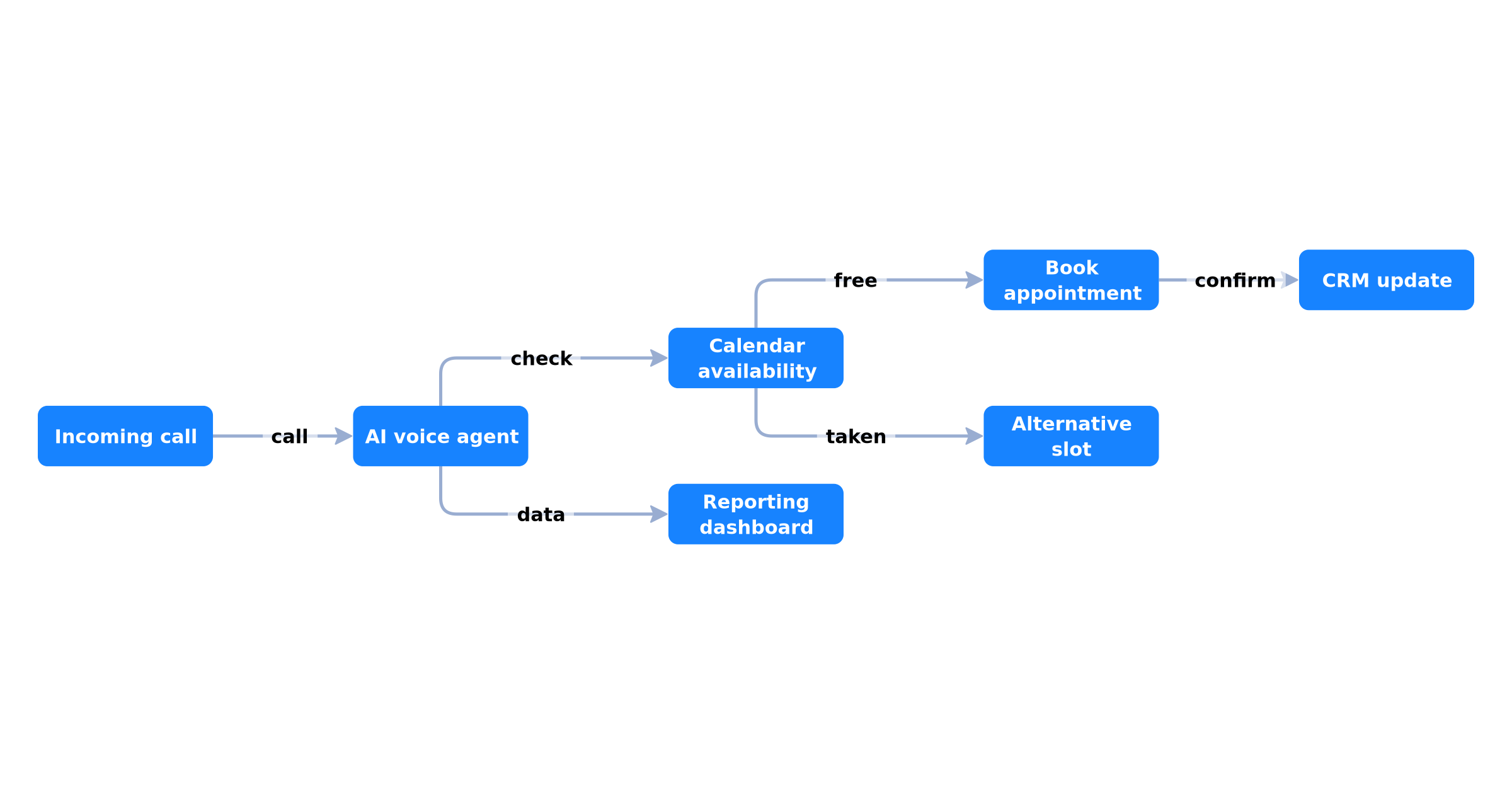 The voice agent, CRM and calendar form a loop: call → availability check → booking → reporting
Which sectors really benefit?
The chart below summarizes sectors with high call volume and appointment booking. The detail:
- Health and wellness: medical secretariats, physiotherapists, dental clinics. The gain comes from no-shows and off-hours calls. GDPR caution: health data = sensitive processing, hosting must be checked.
- Real estate: agencies and property managers. Missed calls are lost viewings; the average basket is high. The agent qualifies (budget, area, property type) before passing to the agent.
- Training: training centers, skills assessment bodies, placement agencies. Complex topics (CPF funding, OPCO) the agent must master — this is our file id 45.
- Craftsmen and home services: plumbers, electricians, gardeners. The demand is urgent ("water leak"), the client wants an immediate appointment, not a form.
- Insurance and mutual funds: simple claims handling, advisor appointment booking. Regulation requires human recourse paths to be planned.
- Restaurants and hotels: table booking, info requests. Volume is seasonal — the agent absorbs peaks without hiring.
The striking fact: ROI is driven by missed calls and unhonored appointments, not just reduced listening time. Sectors with a high average basket and rare slots gain more than small-basket high-volume ones.
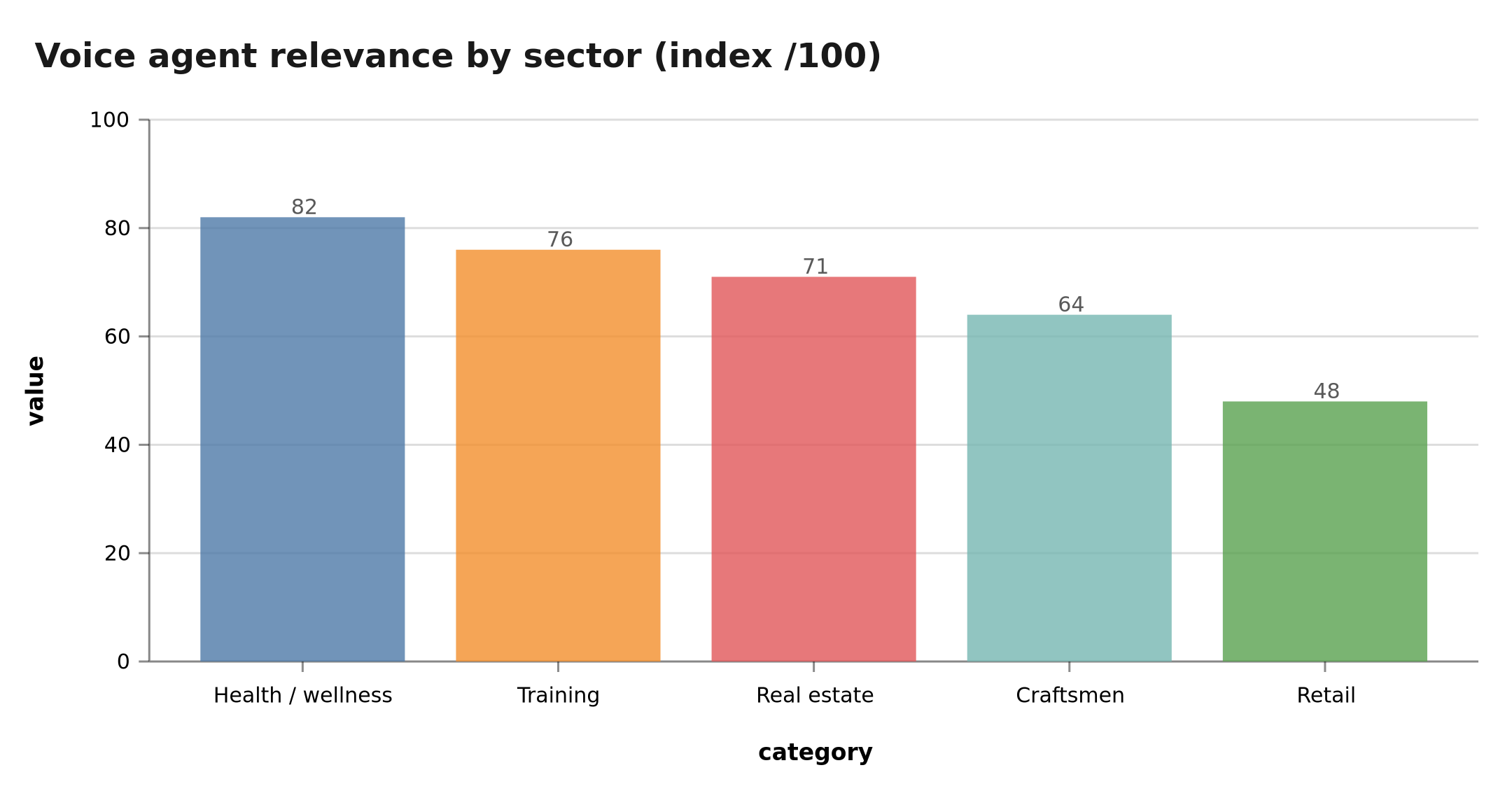 Sectors with high call volume and booking: health, training, real estate, craftsmen
Traps to avoid before launching
Trap 1: focusing on voice, not flow
The decisive test is not "is the voice natural?", but "can the agent check a calendar slot and update the CRM?". Without integration, the ROI measured with the method above is close to zero. Do the demo with a real calendar and a real CRM, not a demo scenario.
Trap 2: ignoring GDPR and the AI Act
In Europe, a voice agent recording conversations must inform the caller before recording, limit data retention and guarantee a right to a human. The AI Act imposes transparency: the caller must know they are talking to an AI. Obviously too: if you record, explicit consent is required, and health data falls under the strictest regime.
Practical points: announce "this call may be recorded for quality purposes" at the start of the call if you record; mention "you are speaking to a voice assistant" where relevant; automatic deletion of recordings after X months; data protection impact assessment (DPIA) for large-scale processing. Our articles on WhatsApp CNIL opt-in and human-in-the-loop in production set the frame.
Trap 3: measuring volume, not value
An agent handling 10,000 calls without converting anyone is useless. Track: call → appointment booked → appointment honored → revenue. That is exactly what our id 43 dashboard does. Two complementary KPIs: first-contact resolution rate (did the client get what they wanted?) and human transfer rate (too low = the agent cheats, too high = the agent is useless).
Trap 4: neglecting pre-launch testing
A voice agent is tested like a critical website: real scenarios, edge cases (angry client, fast talker, regional accent, background noise), recovery testing after errors. Platforms offer test environments; use them at least two weeks before production.
Trap 5: forgetting the human safety net
If the agent fails at 2 pm, who answers? Go-live must plan: a fallback number, automatic transfer to a human on critical error, and a restart procedure. "Better than human" never excuses a system that leaves the client without an answer.
Where to start
- Count your missed calls for 2 weeks. If you lose more than 20/month, the case is already quantified. Simple tool: a read receipt on your switchboard, or your carrier's history.
- Quantify one item, not four: lost leads or no-shows. A single item validates the investment.
- List your priority scenarios: the 3 to 5 conversations representing 80 % of your calls (appointments, hours, pricing, order status). This is where the agent must excel.
- Choose the hybrid mode: the agent takes simple and off-hours calls, escalates complex cases.
- Frame the deployment with a one-hour audit before any quote. See our chatbot & voicebot offer.
The recommended deployment order
A realistic 30-day rollout: week 1 — scenario and integration inventory; week 2 — persona and prompt building, CRM wiring; week 3 — real-environment testing on a dedicated line; week 4 — progressive production (first off-hours calls, then peaks, then everything) and reporting setup. This is not a task list, it is an order: integrations first, voice second.
The three most common deployment mistakes
Feedback from our deliveries and from public case studies points to three recurring mistakes:
- Launching with too many scenarios: a 40-scenario agent fails everywhere; a 5-scenario agent excels everywhere. Start with the 3 to 5 conversations that cover 80 % of your calls, then extend after the reporting proves which scenarios generate value.
- Skipping the off-hours pilot: deploying on the peak daytime flow without a prior off-hours pilot removes your best safety net. The weekend pilot lets you observe conversion, booking accuracy and error rates on a lower-risk volume.
- No first-contact resolution tracking: without a KPI on "did the caller get what they wanted?", you improve the voice and the script while the real blocker — the CRM slot check — stays broken. Fix the loop before polishing the tone.
Sources
- Public 2026 pricing grids: mkdigitalparis.com, agentvocal.ai, techsy.io, Retell AI.
- BOVO portfolio files: ids 43, 44, 45 (dashboard, orchestration, Vapi persona).
- BOVO public offer:
src/data/servicesData.ts— Voice + Chatbot Enterprise from 5,000 €.
Conclusion
An AI voice agent for business costs between 80 € and 600 €/month in operation, plus a deployment of 2,000 € to 15,000 €. ROI is played on missed calls, recovered leads and avoided no-shows, not just reduced listening time. And the difference between a demo and a strategic tool is CRM + calendar + reporting integration.
The decision takes two weeks of counting (your real missed calls), one quantified ROI item, and a well-configured hybrid mode. The rest — the voice, the platform, the model — is execution.
Next: custom AI chatbot pricing, connecting Cal.com to n8n for booking, or BOVO omnichannel voice agent.
Tags
FAQ
How much does an AI voice agent cost for a small business in 2026?
In France, monthly subscriptions range from 80 € to 600 € depending on volume and integrations, with a per-minute cost between 0.10 € and 0.40 € (public 2026 sources). Initial deployment ranges from 2,000 € to 15,000 € for a project with CRM and calendar integrations. At BOVO, the public "Voice + Chatbot" offer starts at 5,000 €.
What is the ROI of an AI voice agent?
ROI is calculated on 4 items: call handling cost reduction, recovered lost leads, reduced no-shows and improved satisfaction. Most 2026 sources put the breakeven between 2 and 6 months for businesses handling 30+ incoming calls per day.
Does the voice agent replace the human receptionist?
No, it complements. The best results come from a hybrid model: the voice agent handles simple and off-hours calls, qualifies the lead and escalates complex cases to a human. See our documented cases (ids 43, 44, 45).
Which sectors benefit most from a voice agent?
Sectors with high call volume and appointment booking: health and wellness, real estate, training, craftsmen. ROI is driven by missed calls and unhonored appointments, not just reduced listening time.
Budget, process, priorities — decided together
Website, chatbot, or automation? We pick the next job that unlocks cash, not the trendy stack.
- 30 min
- Clear priorities
- No commitment

Singbo Davy AGONMA
Fullstack Developer & AI Expert. n8n automation specialist, Laravel/Flutter development and AI agent integration. Master CS — IFRI.


