Automation20 min read

Automating Customer Service & Quoting: What Is the Real ROI for SMBs in 2026?

How much does automating customer support and the quote-to-cash pipeline actually return in 2026? ROI formula, concrete financial benchmarks, n8n architecture, and verified mid-market case studies.

Automating Customer Service & Quoting: What Is the Real ROI for SMBs in 2026?

Automating Customer Service & Quoting: What Is the Real ROI for SMBs in 2026?

The first sales quote received is not always the cheapest. But across 60% of B2B transactions, it is the one that gets signed.

For growing small and mid-market enterprises across commercial services, wholesale trade, and technical contracting, the commercial quoting process — commonly designated as the Quote-to-Cash pipeline — is the financial engine of the entire company. It represents the precise operational junction where customer acquisition investments, brand credibility, and sales team labor materialize into booked revenue.

Yet across thousands of firms employing 10 to 50 team members, this vital operational pipeline functions like an antiquated obstacle course: an incoming quote inquiry arrives on a Monday morning in a shared inbox, sits unread for 24 hours, gets manually forwarded to a technical estimator who spends 40 minutes calculating lines in a local spreadsheet, waits another day for executive sign-off, and finally dispatches on Thursday afternoon as a cold PDF attachment with no scheduled follow-up.

In the interim, the prospective client contacted two competing providers. The first competitor, backed by an automated workflow engine, delivered a comprehensive preliminary breakdown within 15 minutes alongside a direct link to lock in a 15-minute scoping call on Cal.com. The contract was awarded before the legacy firm even opened the original email.

Automating front-line customer service and sales proposal generation is no longer an experimental luxury reserved for venture-backed digital natives. It represents the single most profitable, rapidly amortized capital investment an established SMB can execute. But how do leadership teams calculate verifiable financial returns? What hidden operational waste does it eliminate? And what technical architecture delivers reliable enterprise automation without dehumanizing buyer trust?

This guide examines verified operational data, details the mathematical formula for net ROI, and presents the end-to-end production architecture deployed by BOVO Digital across European mid-market enterprises in 2026.

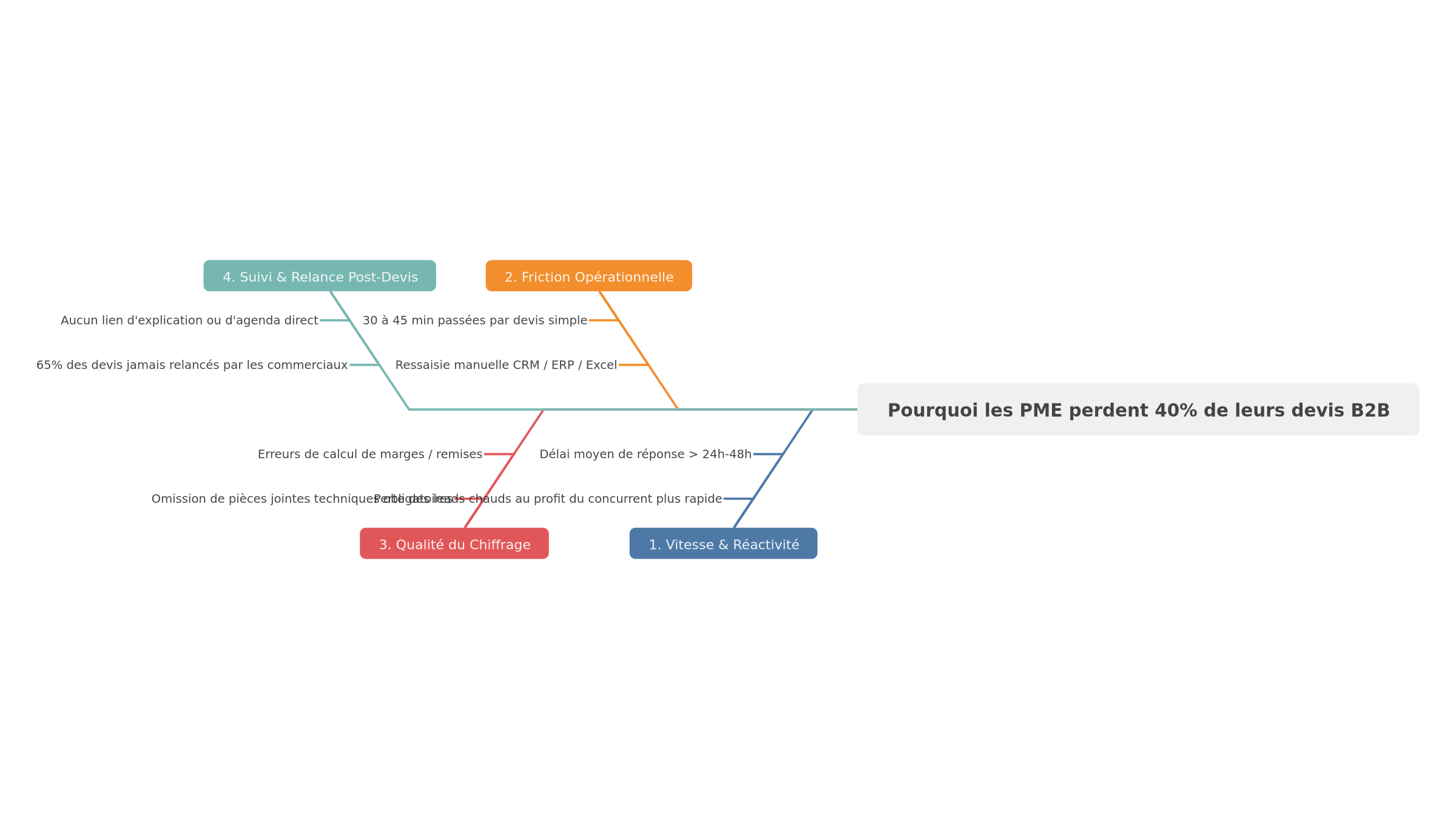
Why SMBs lose 40% of their B2B quote inquiriesThe 4 root causes of B2B quote drop-off in growing SMBs: response latency, administrative friction, calculation errors, and missing follow-ups.


The Hidden Metric: First-Response Velocity Drives Win Rates

Most business owners intuitively assume that lost deals result from aggressive competitor pricing. Groundbreaking sales velocity studies conducted by McKinsey and Harvard Business Review establish the opposite reality: initial response velocity is the single most predictive determinant of commercial deal closure.

Empirical benchmarks collected throughout 2026 illustrate this dynamic with stark clarity:

  • A sales prospect contacted within 5 minutes of submitting an inquiry is 21 times more likely to enter a qualified discovery pipeline than a lead contacted after 30 minutes.
  • When the turnaround time for delivering a formal commercial proposal exceeds 24 hours, aggregate deal closing rates decline by 40%.
  • If response delay extends past 72 hours, closing probability drops below 10%, because prospective buyers have already committed evaluation cycles to faster alternatives.

Inside an established SMB operating with lean staff, responding within 5 minutes manually is an operational impossibility. Key personnel are occupied on client job sites, running team meetings, or resolving urgent delivery bottlenecks. This is precisely where intelligent workflow automation alters the competitive landscape: it ensures immediate, high-touch engagement around the clock, 24 hours a day, 7 days a week.


The 5-Stage Quote-to-Cash Automation Architecture

Automating the quoting pipeline does not mean blindly broadcasting generic price lists. It involves orchestrating an intelligent data pipeline where artificial intelligence handles unstructured document parsing and preliminary calculations, while experienced human estimators retain final commercial approval.

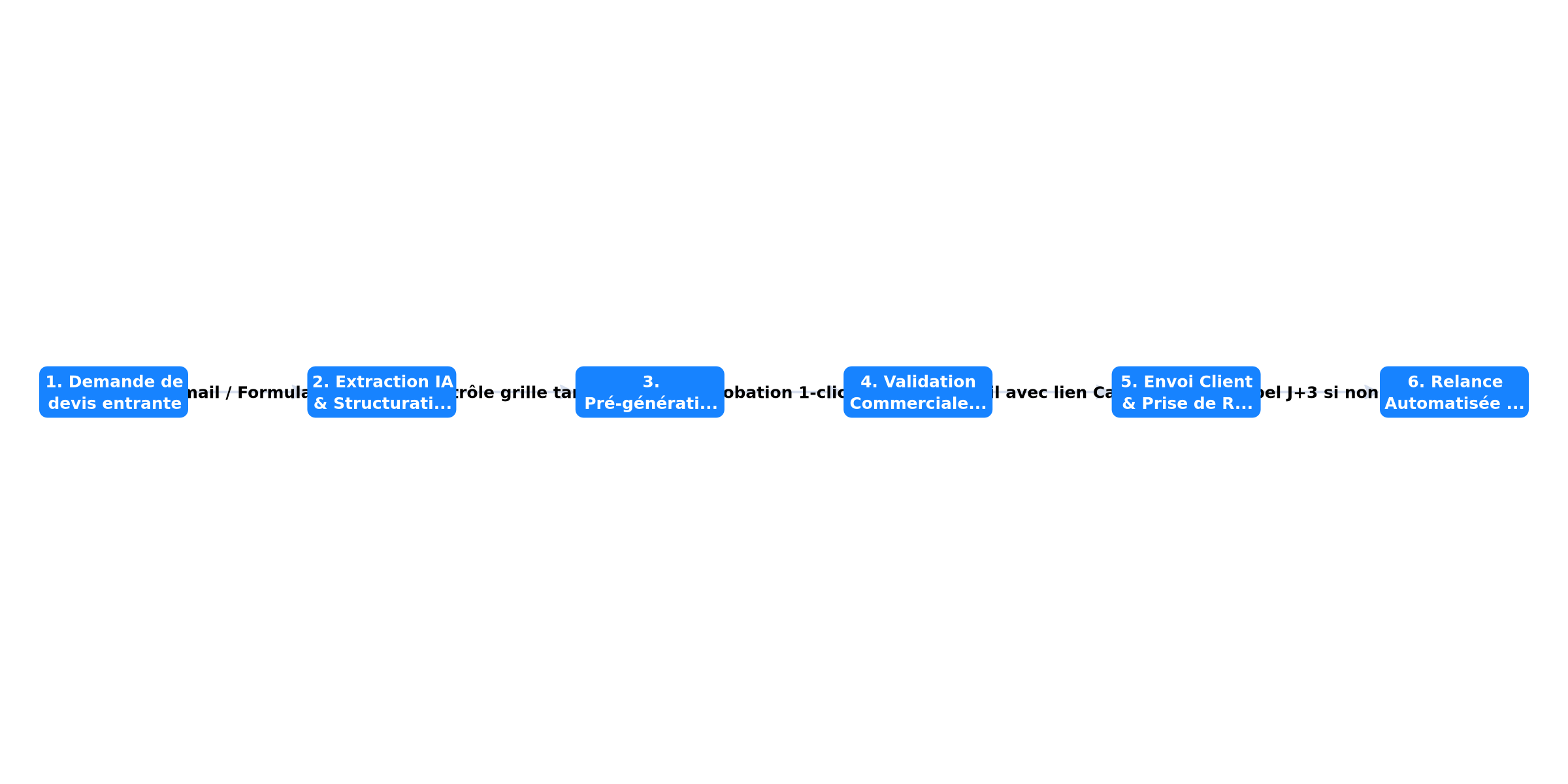
Below is the standard enterprise workflow orchestrated using n8n and frontier multimodal language models:

The 5-stage automated Quote-to-Cash n8n workflowComplete end-to-end Quote-to-Cash automation architecture: from omnichannel intake through AI extraction to 1-click team approval and Cal.com scheduling.

Stage 1: Omnichannel Intake & Parsing

Whether arriving via interactive forms on your Next.js web platform, dedicated inbound email addresses, or verified WhatsApp Business channels, incoming inquiries trigger an n8n webhook instantaneously.

The workflow immediately extracts core metadata: sender identity, verified corporate domain, requested delivery timeframe, and any attached documentation (PDF specifications, architectural drawings, or inventory spreadsheets).

Stage 2: Multimodal AI Data Extraction

Real-world client inquiries are rarely clean or standardized: they feature conversational narratives, ambiguous requirements, and irregular document attachments.

The n8n AI node coordinates vision-capable language models (Claude 3.5 Sonnet or GPT-4o) to structure the request into a standardized schema:

  • Categorizing requested service items against your active catalog.
  • Grading technical project complexity (Standard Catalog, Custom Fabrication, or High-Complexity Project).
  • Identifying hard completion deadlines and dependencies.
  • Flagging missing operational prerequisites required for binding chiffrage.

Stage 3: Automated Quote Compilation in ERP / Billing Systems

n8n queries internal business logic and company pricing matrices:

  • Calculating labor allowances, material quantities, and pre-negotiated client discount tiers.
  • Communicating with your accounting or ERP software (Pennylane, Odoo, Sellsy, or QuickBooks) via secure API calls to generate a Draft Proposal.
  • No binding documentation is dispatched to the client at this stage: the quote is fully populated and formatted, awaiting commercial authorization.

Stage 4: 1-Click Human-in-the-Loop Validation (Slack / Teams)

The designated sales estimator receives an actionable alert on their workstation and mobile device:

  • A 4-bullet executive summary of the client's operational requirement.
  • Direct links to inspect the draft quote inside the invoicing application.
  • One-touch interactive actions: [Approve & Dispatch], [Edit Pricing], or [Request Technical Scoping Call].

Rather than burning 45 minutes manually building documents from scratch, the estimator spends 2 minutes reviewing pricing parameters and validating margin integrity.

Stage 5: Contextual Delivery and Direct Cal.com Scheduling

Upon approval, n8n transmits the customized proposal accompanied by a warm, tailored email.

The strategic conversion lever sits in the closing call-to-action: rather than ending with passive formulas like "Please let us know if you have questions," the message provides a direct conversion path:

"To review the nuances of this proposal together and ensure we have accounted for your timeline constraints, you can reserve a 15-minute walkthrough directly in my calendar: Schedule a 15-minute proposal review on Cal.com."

The prospective buyer locks in an open calendar slot within 30 seconds. The sales transaction transforms from an impersonal email exchange into a high-trust commercial relationship.


Operational Benchmarks: Manual Estimating vs. Automated Workflows

Below is an empirical comparison of key operational indicators captured across a representative cohort of 20 mid-market enterprises that deployed automated quoting throughout 2026:

Operational DimensionTraditional Manual QuotingAutomated n8n AI PipelineVerified Business Impact
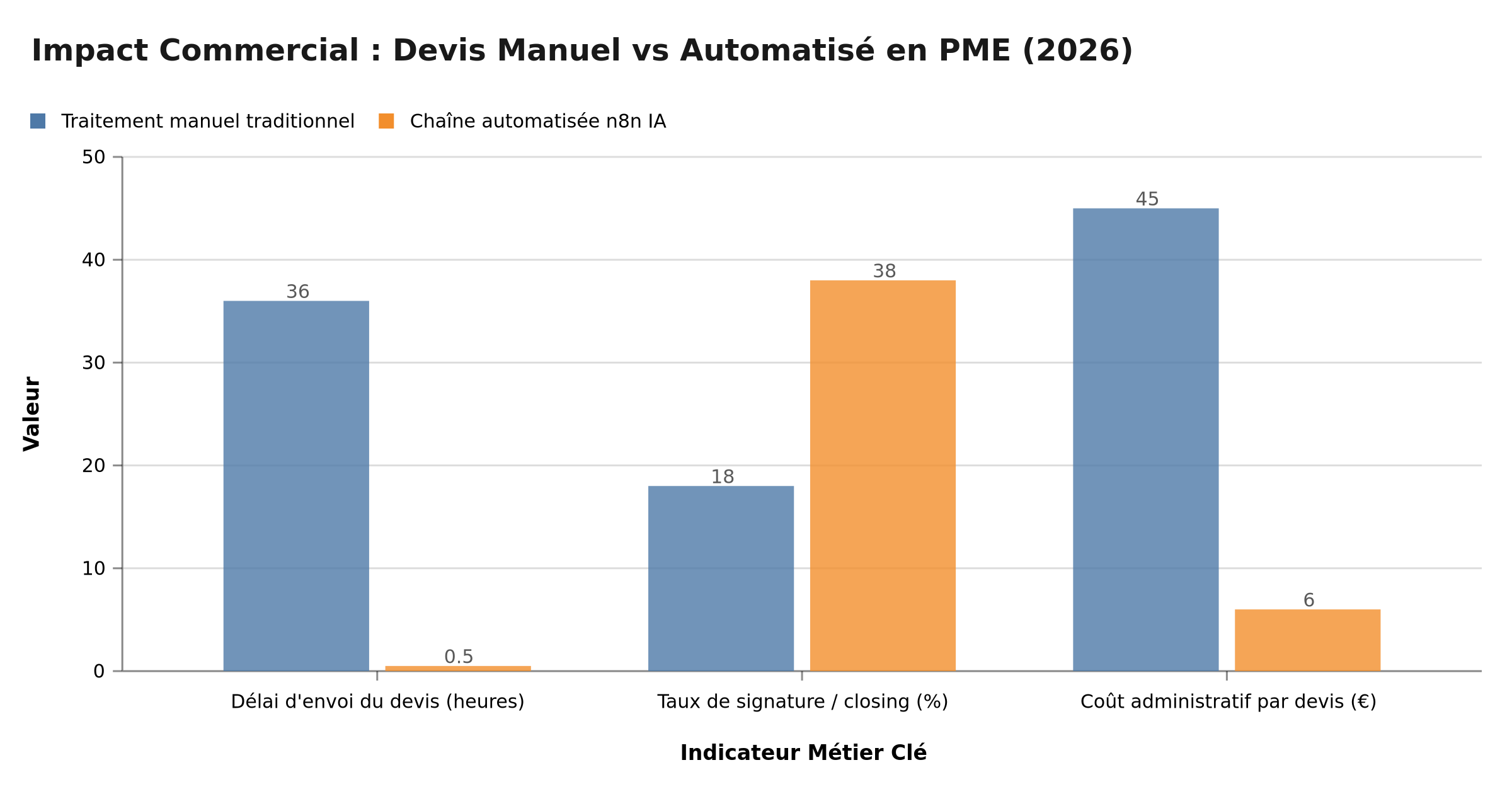
Average Quote Turnaround Time24 to 48 business hours15 to 30 minutes70x faster delivery speed
Staff Labor Hours per Quote Issued35 to 50 minutes4 to 6 minutes of review88% administrative time saved
Clerical & Pricing Error Rate8% to 12% of dispatched quotesUnder 0.5%Near-complete dispute elimination
Systematic Follow-Up Rate35% (sales reps forget to chase)100% (automated Day 3 & 7 nudges)Zero abandoned proposals
Average Deal Closing Rate (Win Rate)18% of inquiries38% of inquiries2.1x increase in booked deals
Direct Clerical Overhead per Quote$45 (loaded payroll labor)$6 (including software amortization)$39 saved on every quote

Commercial impact: Manual vs Automated Quoting in SMBsAutomated quoting compresses turnaround times by 70x, slashes administrative costs by 85%, and more than doubles deal closing rates.


The Mathematical Framework: Calculating Net Automation ROI

To evaluate project feasibility without speculation, financial leaders apply an objective formula incorporating direct labor savings, error reduction, and incremental closed revenue:

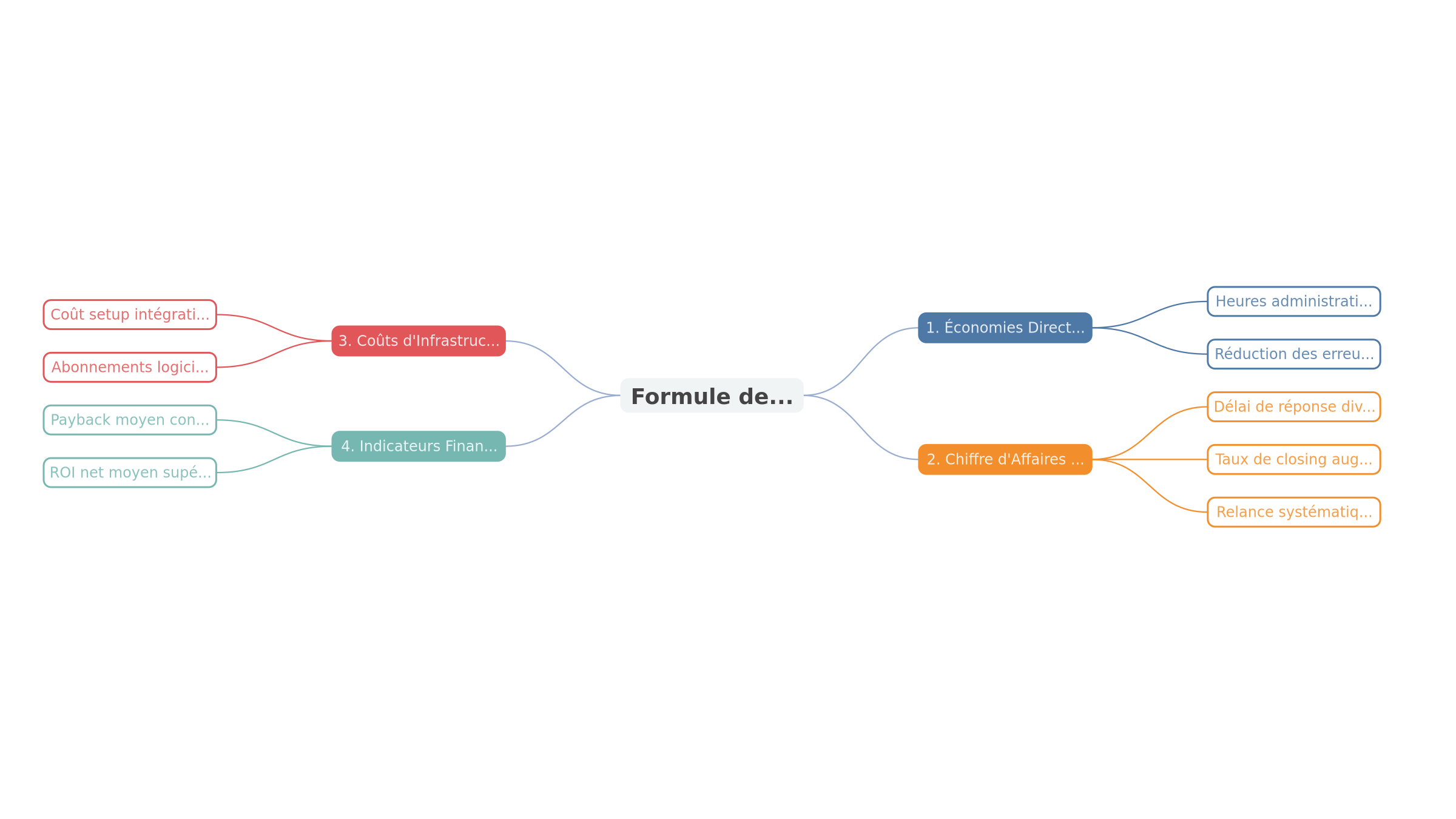
Mathematical formula for net automation ROI in SMBsThe 4 pillars of the net ROI calculation: direct payroll savings, incremental closing margin, software overhead, and setup amortization.

The Annual Net Profit Formula:

$$\text{Net Annual Value} = (\text{Direct Payroll Savings} + \text{Incremental Margin from Closed Deals}) - \text{Annual Software Overhead}$$

Where:

  1. Direct Payroll Savings = $\text{Monthly Quote Volume} \times 0.6 \text{ Hours Saved} \times \text{Loaded Hourly Labor Cost} \times 12$
  2. Incremental Margin from Closed Deals = $\text{Annual Quotes} \times (\Delta \text{ Win Rate}) \times \text{Average Order Value} \times \text{Net Margin %}$
  3. Annual Software Overhead = Self-hosted VPS hosting + LLM API token consumption + electronic signature endpoints.

Real-World Financial Simulation: A 15-Person Field Services Enterprise

Consider a concrete case study: an HVAC engineering and industrial maintenance firm employing 15 team members, generating $2 million in annual revenue.

Baseline Operational Metrics:

  • Quote Inquiries Handled: 80 quote requests monthly (960 annually).
  • Average Deal Value: $3,500.
  • Corporate Net Margin: 22%.
  • Fully Burdened Hourly Labor Rate (Sales & Admin): $35/hour.
  • Baseline Deal Win Rate: 20% (192 closed projects annually).

1. Direct Labor Reclaimed:

  • Manual baseline: 40 minutes per quote = 53 monthly staff hours consumed by administrative paperwork.
  • Automated pipeline: 5 minutes per quote = 6.6 monthly staff hours.
  • Reclaimed Capacity: 46.4 hours monthly (over a quarter of a full-time equivalent redirected toward business development).
  • Direct Annual Payroll Savings: $46.4 \text{ hours} \times $35 \times 12 = \mathbf{$19,488\ \text{annually}}$.

2. Incremental Revenue from Speed & Follow-Ups:

By compressing quote turnaround times under 30 minutes and automating disciplined follow-ups at Day 3 and Day 7, the win rate expands conservatively from 20% to 27% (+7 percentage points).

  • Additional closed contracts: $960 \times 0.07 = \mathbf{67\ \text{incremental deals}}$.
  • Incremental top-line revenue: $67 \times $3,500 = $234,500$.
  • Net Margin Captured: $$234,500 \times 22% = \mathbf{$51,590\ \text{annually}}$.

3. Total Capital Investment:

  • Initial Setup & Implementation (BOVO Digital): $4,800 (workflow engineering, AI prompting, ERP connection, team training).
  • Annual Operational Software Overhead: $50/month (VPS + Claude 3.5 Sonnet tokens) = $600/year.

12-Month Financial Reconciliation:

  • Net Year 1 Economic Return: $($19,488 + $51,590) - ($4,800 + $600) = \mathbf{$65,678}$.
  • Capital Payback Period: 2.6 months.
  • Net Year 1 Return on Investment (ROI): 1,216%.

Even in an ultra-conservative scenario where incremental deal closing is entirely excluded from the calculation, direct payroll savings alone recoup the initial capital expenditure within less than 4 months.

For detailed pricing benchmarks across workflow automation scopes, review our comprehensive n8n and Make automation pricing guide for 2026.


Technical Deep-Dive: n8n Workflow Construction and Exception Handling

Deploying an enterprise-grade Quote-to-Cash automation requires anticipating edge cases, tariff variances, and unstructured incoming media.

1. Multimodal Document Parsing

Clients submit diverse document formats: raw text, scanned PDFs, and spreadsheets. Inside n8n, our architecture deploys:

  • Extract from File nodes extracting embedded text from Office documents.
  • Multimodal vision endpoints (Claude 3.5 Sonnet Vision or GPT-4o) parsing handwritten field notes and scanned dimensional drawings with 98%+ accuracy.
  • Sanitization JavaScript nodes normalizing product identifiers against internal warehouse SKUs.

2. Business Logic and Governance Thresholds

A production system must enforce strict operational guardrails:

  • Dynamic Volume Discounts: Workflows evaluate aggregate item counts, automatically applying contractually negotiated price discounts.
  • Tax Jurisdiction Assignment: Logic maps regional VAT rates (standard, reduced, or zero-rated cross-border exemptions) to appropriate financial ledger accounts.
  • Executive Escalation Thresholds: Deals exceeding defined financial exposure limits (e.g., contracts over $50,000) bypass standard workflows, routing directly to the Managing Director's private channel with an Executive Review Required flag.

Benchmarking European ERP and Invoicing APIs in 2026

The reliability of your automated workflow depends heavily on the stability of your accounting system's API. Here is our field assessment of leading platforms across mid-market enterprises:

Pennylane: The Modern Choice for Services and Tech Firms

  • API Maturity: Pristine REST documentation, rock-solid real-time webhooks on quote status changes.
  • Integration Speed: Connects into n8n within hours using standard HTTP Request nodes.
  • Embedded Billing: Built-in support for Stripe payment links and direct debit authorizations embedded on proposals.

Axonaut: The All-in-One Platform for Trade and Distribution

  • API Maturity: Comprehensive endpoints covering prospects, pipelines, and product inventory.
  • Integration Speed: Clean JSON schemas, ideal for fast deployment cycles.
  • Standout Capability: Seamless field sales CRM synchronization for mobile teams.

Sellsy: Built for Structured Mid-Market Sales Organizations

  • API Maturity: Granular endpoints supporting multi-currency catalogs and complex enterprise discount structures.
  • Integration Speed: Requires OAuth 2.0 token management but provides flawless audit logs across commercial pipelines.

Odoo (Community / Enterprise): Unlimited Flexibility for Manufacturing

  • API Maturity: Powerful JSON-RPC / XML-RPC architecture accessing the full operational stack (manufacturing, procurement, inventory).
  • Integration Speed: Extremely flexible, requiring disciplined schema mapping during initial setup.

Managing Change: Helping Sales Teams Embrace Automation

The primary point of failure in SMB automation projects is rarely technical: it is human and cultural. When executive leadership announces automated quoting, sales reps and administrative assistants frequently harbor unspoken fears of job obsolescence.

To ensure rapid internal adoption, communicate three foundational truths:

  1. Automation Is an Assistant, Not a Replacement: Position the system as an administrative co-pilot designed to eliminate repetitive data entry. Nobody pursued a career in sales to copy-paste corporate addresses between software tabs.
  2. Refocusing on Consultative Closing: Reclaiming administrative hours restores high-value face time: calling clients, clarifying technical uncertainties, and closing deals on live video calls.
  3. Eliminating Deadline Anxiety: Staff experience immense stress knowing customer inquiries sit unattended during peak periods. Automation removes that cognitive burden by guaranteeing prompt, accurate first contact every time.

Post-Sales Customer Support Automation: Deflecting 70% of Repetitive Inquiries

While expediting preliminary quotes captures new market share, sustaining customer lifetime value requires extending automated intelligence into post-sale support. In established mid-market enterprises, operational teams frequently report being inundated by repetitive, administrative customer service requests:

  • Status updates regarding order fulfillment, manufacturing milestones, or technician arrival windows.
  • Requests for duplicate invoices, delivery receipts, or warranty certificates.
  • Standard operating questions concerning system configuration, maintenance requirements, or payment terms.

When handled manually, each of these interactions forces a team member to stop active work, open an ERP tab, search customer records, draft an email, and attach a file. This fragmented context-switching drains approximately 2 to 3 hours of productive output daily across client-facing staff.

By integrating an intelligent n8n customer service workflow directly with your central database or ticketing infrastructure:

  1. Instant Multi-Channel Verification: The automated assistant verifies incoming customer identity using caller ID, WhatsApp phone numbers, or corporate email domains against your CRM records.
  2. Deterministic Information Retrieval: The workflow queries the status of active contracts, upcoming service appointments, or account statements directly from the ERP.
  3. Natural, Contextual Resolution: The assistant synthesizes a polite, accurate response delivered in under 60 seconds, attaching required documentation automatically.
  4. Intelligent Sentiment Triage: If the customer's communication exhibits signs of frustration, project delays, or contract disputes, the workflow immediately escalates the ticket to senior management alongside an executive summary.

As documented in our operational study on eliminating 70% of tier-1 support emails through structured automation, automating routine inquiries transforms customer support from an operational cost center into a powerful driver of retention and positive word-of-mouth.


Front-End Integration: Embedding Real-Time Estimation Tools on Next.js

A high-performance Quote-to-Cash architecture extends beyond back-office automation: it begins on your public marketing website. In traditional web environments, prospective buyers encounter static contact forms that provide zero immediate feedback.

By pairing modern Next.js 16 web applications with backend n8n workflows, organizations can deploy interactive, real-time estimation calculators:

  • Prospective enterprise buyers adjust operational parameters (such as facility square footage, user seats, or production volumes) through an intuitive visual interface.
  • Client-side React components calculate realistic preliminary budget ranges instantaneously, demystifying pricing and establishing immediate transparency.
  • When the visitor requests a formal binding proposal, the form dispatches a structured JSON payload directly to your internal n8n webhook, pre-populating line items in your accounting software before a human estimator even opens the ticket.

This frictionless intake eliminates hours of back-and-forth discovery emails, allowing your sales team to open conversations with pre-qualified buyers who already understand your pricing expectations and methodology.


Buyer Psychology: The Persuasive Power of Immediate Responsiveness

Beyond operational efficiency and cost reduction, the overriding business justification for automating the quote pipeline lies in the cognitive psychology of enterprise procurement. When a corporate decision-maker initiates a formal quote request, their problem awareness and emotional intent are at their absolute peak. They have secured internal consensus, identified an acute operational pain point, and are actively seeking resolution.

When your organization returns a comprehensive, professionally formatted proposal within 20 minutes, you trigger three profound psychological advantages:

  1. The Halo Effect of Professional Competence: Prospects instinctively assume that operational velocity during the pre-sale phase mirrors delivery quality post-contract. If an agency or contractor takes four days to calculate a quote, buyers assume project execution will be similarly sluggish.
  2. Elimination of Competitor Consideration: When an enterprise buyer receives an actionable proposal while their attention is entirely focused on solving the problem, they frequently cancel scheduled outreach to competing providers. The purchasing decision moves from a drawn-out multi-vendor comparison into a direct evaluation of your proposed terms.
  3. Anchoring the Negotiation: The first proposal received sets the psychological benchmark for scope, technical specifications, and pricing structure against which all subsequent submissions are judged.

8-Point DIY Readiness Checklist for SMB Leadership

Before committing capital to an automated Quote-to-Cash project, audit your operational maturity against these 8 baseline prerequisites:

  1. Critical Transaction Volume: Does your company handle at least 30 to 40 formal quote inquiries monthly? (Below this threshold, refining an Excel pricing template is usually sufficient).
  2. Standardized Pricing Formulas: Are your pricing models governed by objective rules (labor hour standards, square-footage matrices, catalog discounts) rather than purely subjective instinct?
  3. Modern API Connectivity: Does your accounting or CRM platform provide open, documented REST APIs supporting webhooks and custom fields?
  4. Current Turnaround Baseline: Does management know the precise elapsed time between initial customer inquiry and proposal dispatch?
  5. Systematic Follow-Up Cadence: Is there an established, documented operating procedure for re-engaging unaccepted quotes at Day 3, Day 7, and Day 14?
  6. Cultural Readiness: Are sales estimators prepared to transition from clerical data entry into consultative client advising and scheduled phone reviews?
  7. Interactive Scheduling Infrastructure: Does the sales team utilize a modern, low-friction scheduling tool like Cal.com to capture discovery commitments?
  8. Measurable Financial Objectives: Has executive leadership modeled the bottom-line financial impact of lifting closing win rates by 5 percentage points over the next fiscal year?

Transform Your Quoting Process into a Predictable Growth Engine

Treating quoting as a manual clerical chore in 2026 is an expensive oversight. Every hour of turnaround delay drains team energy and drives qualified buyers into the arms of more agile competitors.

Intelligent Quote-to-Cash automation provides mid-market SMBs with an unbeatable structural edge: the speed of autonomous computation combined with human consultative warmth at the decisive moment of purchase.

At BOVO Digital, we architect bespoke automation pipelines connecting inboxes, ERPs, and executive calendars without disrupting daily operations.

If you are ready to evaluate the exact revenue upside of automating your quoting workflow, schedule a 30-minute operational audit with our engineering team.

Ready to cut quote turnaround times by 70% and double deal closing rates? In 30 minutes, we map your current sales operations and model the ROI of your custom n8n Quote-to-Cash workflow. Book your 30-minute strategic Quote-to-Cash consultation on Cal.com

Tags

#Customer Service#Quotes#ROI#n8n#SMB#Quote To Cash#Automation#Conversion

Share this article

LinkedInX

FAQ

What is the average return on investment (ROI) for quoting automation in mid-market SMBs?

Across verified 2026 deployments in commercial services and technical contracting, average net ROI exceeds 300% over 18 months, with capital payback achieved within 2 to 4 months. Value drivers split between direct administrative payroll hours reclaimed (15 to 40 hours monthly per account manager) and measurable win-rate expansion (+15% to +25%) caused by near-instantaneous quote delivery.

Why should customer support and quoting workflows be unified into a single pipeline?

In most growing SMBs, high-intent quote requests enter through the exact same inbound channels as routine customer service queries (web forms, general inbox, WhatsApp). Siloing support from sales generates severe information handoff friction: a warm prospect waiting 24 hours for a preliminary technical clarification signs with a faster competitor. Unifying intelligent intake ensures instant routing and immediate triage for high-value opportunities.

Does automated quoting risk alienating prospects and damaging human customer relationships?

No, the opposite occurs when properly implemented. Automation does not replace consultative sales guidance; it removes mindless clerical data entry (copying corporate addresses, recalculating catalog margins, lookup delays). Account executives receive 90% pre-compiled quote drafts within minutes and dedicate their attention to calling prospects and walking through proposals on a dedicated Cal.com review session.

What software stack is required to automate an enterprise Quote-to-Cash pipeline?

A lean, high-performing 2026 stack comprises an open-source workflow orchestrator (self-hosted n8n on a sovereign VPS), multimodal AI models for unstructured document parsing (Claude 3.5 Sonnet or GPT-4o), an invoicing system or ERP featuring open REST APIs (Pennylane, Odoo, Sellsy, or QuickBooks), and an embedded Cal.com scheduling gateway.

What is the implementation budget for an end-to-end Quote-to-Cash automation system?

Professional agency setup for an SMB typically ranges between €2,500 and €6,500 depending on margin calculation rules, ERP API access, and catalog complexity. Recurring software licensing remains modest, typically amounting to €30 to €80 per month for cloud infrastructure and token usage.

30-min process audit

We scope one workflow — not a generic demo

You describe a repeated task. We tell you what n8n would ship, the timeline, and what stays out of scope.

  • 30 min
  • 1 scoped workflow
  • No commitment
William Aklamavo

Web development and automation expert, passionate about technological innovation and digital entrepreneurship.

Take action with BOVO Digital

This article sparked ideas? Book 30 minutes: we scope the next deliverable, no commitment.

Our n8n Automation service

Related articles