
AI Funding H1 2026: $510B Global Record, 88% to US — How to Position Outside the OpenAI/Anthropic Circle
AI funding hits a record $510 billion in H1 2026 per Crunchbase. 88% goes to the US, 43% to OpenAI and Anthropic alone. Breakdown for non-US founders and SMBs wanting to position themselves.

AI Funding H1 2026: $510B Global Record, 88% to US — How to Position Outside the OpenAI/Anthropic Circle
The first half of 2026 sets all records with $510 billion in startup funding, 43% going to OpenAI and Anthropic alone. For founders outside the mega-round circle, here's what the data says and how to position.
The first half of 2026 marks an absolute record for global venture capital: $510 billion invested in startups, according to Crunchbase data published in July 2026. This figure exceeds the $440 billion of the entire year 2025 and establishes a new high for a six-month period.
But behind this record lies extreme concentration: OpenAI and Anthropic alone absorbed 43% of all startup funding in H1 2026, or $217 billion. And nearly 88% of AI funding went to US-based companies.
For founders outside this circle — non-US startups, SMBs, "AI wrappers" — the landscape is brutal but not without opportunities. This article breaks down the data and identifies winning strategies.
The State of AI Funding in H1 2026
The Absolute Record
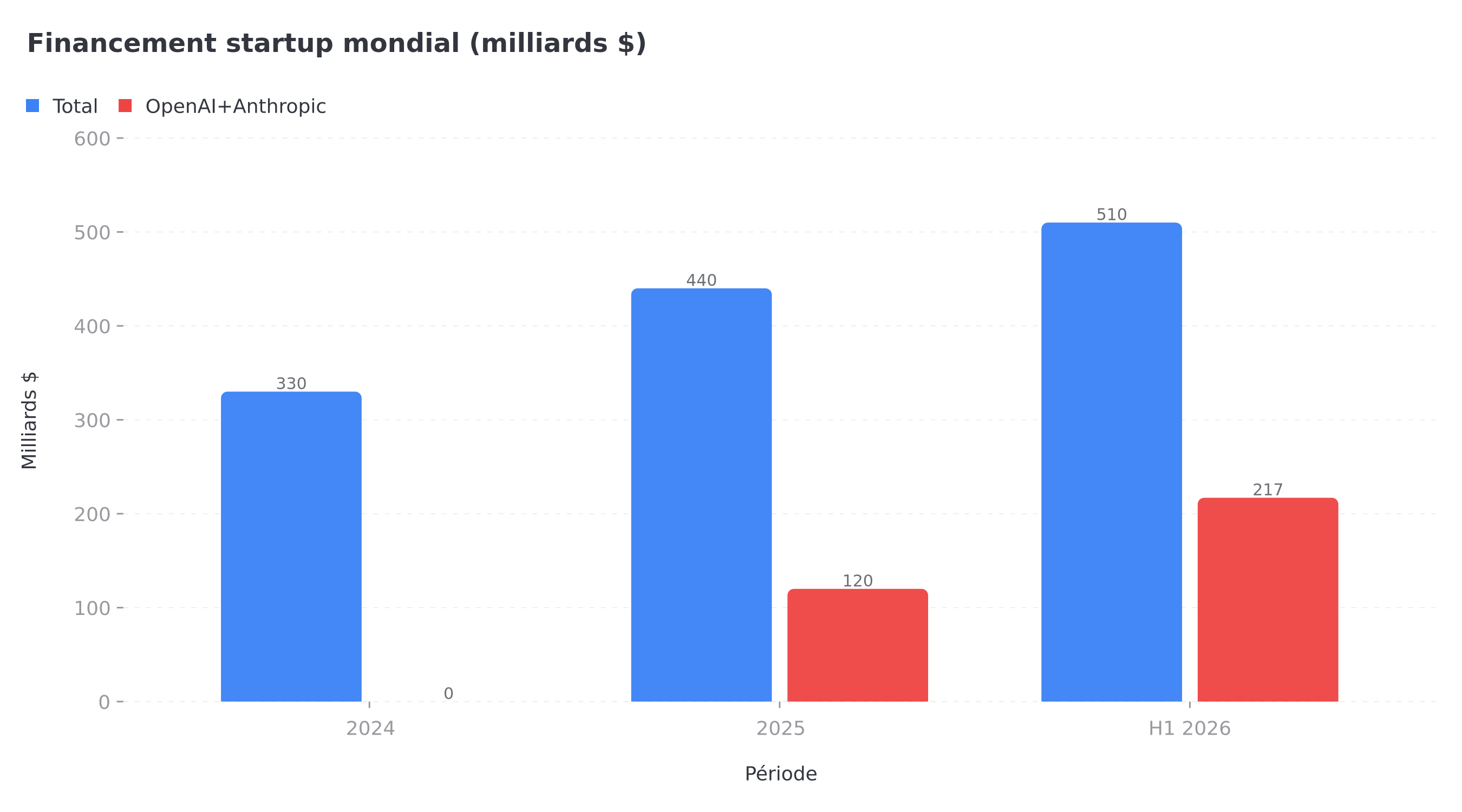 Comparison of global startup funding: H1 2026 record $510B vs 2025 ($440B) vs 2024
| Period | Total funding | Source |
|---|---|---|
| 2024 (full year) | ~$330B | Crunchbase |
| 2025 (full year) | $440B | Crunchbase |
| H1 2026 | $510B | Crunchbase (July 2026) |
H1 2026 surpassed all of 2025 in just six months. But this record comes with a major caveat: an unprecedented share of capital went to just two companies.
Capital Concentration
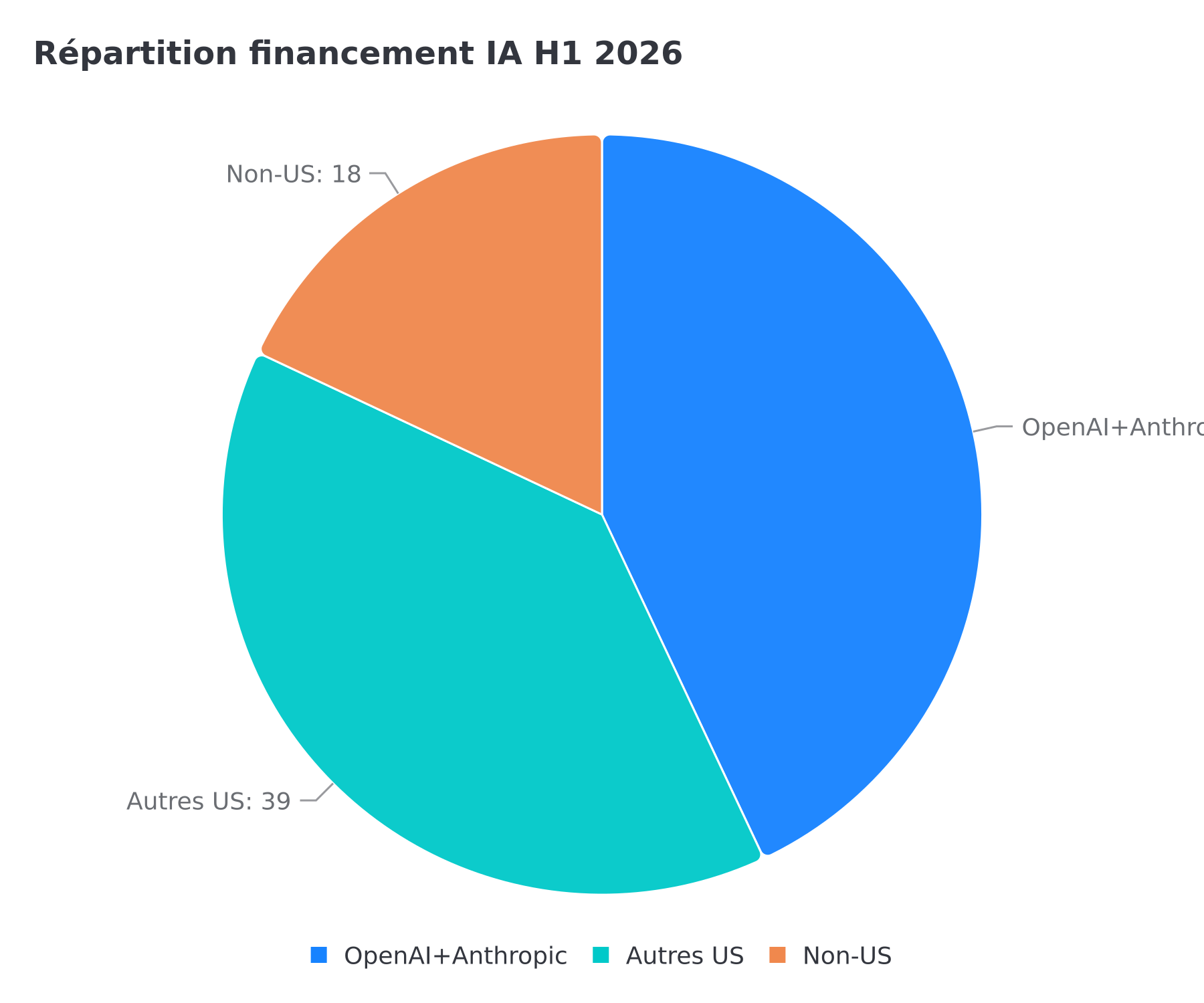 AI funding distribution H1 2026: OpenAI, Anthropic, and the rest
- OpenAI + Anthropic: $217B (43% of total)
- Other US startups: ~$200B (39%)
- Non-US startups: ~$93B (18%)
Geographic Distribution
| Region | 2026 funding | AI share | Trend |
|---|---|---|---|
| United States | ~$400B | 88% of AI | Absolute record |
| China | $33B | ~50% | Rising after sluggish years |
| United Kingdom | $16.5B | AI + Fintech | Rising ($19.5B for all 2025) |
| France | Moderate | Mixed | Stable |
| Germany | Moderate | Mixed | Stable |
| India | Rising | Tech | Stable |
| Japan, South Korea | Stable | Mixed | Stable |
Mega-Rounds That Distort Statistics
H1 2026 saw several mega-rounds that distort market perception:
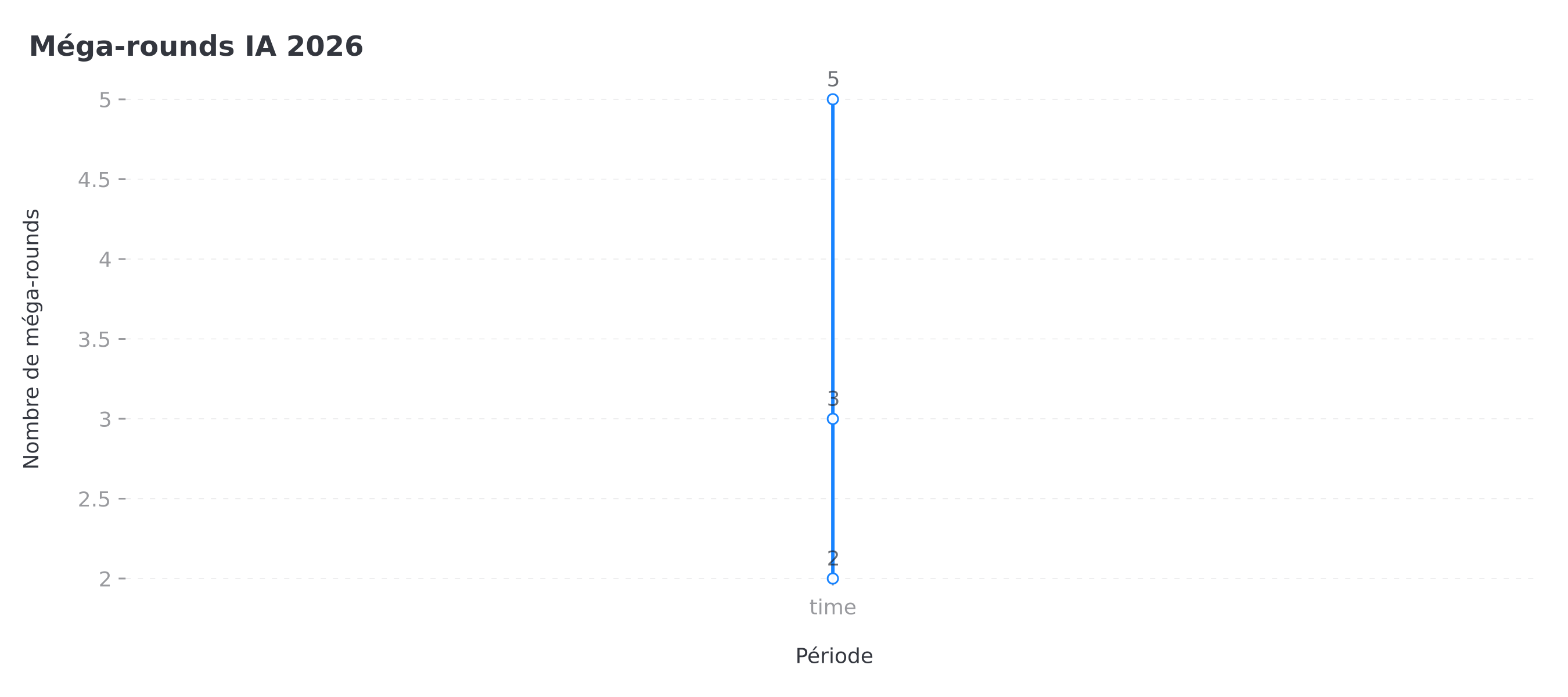 Timeline of significant AI mega-rounds in 2026
| Company | Amount | Valuation | Date |
|---|---|---|---|
| OpenAI | $110B | $730B | 2026 |
| xAI | $20B | N/A | Early 2026 |
| Etched | $300M (Series C) | $10.3B | July 23, 2026 |
| Prentis | $100M (in talks) | $1B | July 24, 2026 |
| Emergent | $130M | $1.5B | 2026 |
| Fly.io | $25M (Series D) | N/A | 2026 |
| DeepSeek | Suspended ($74B planned) | N/A | 2026 |
The DeepSeek case is notable: the Chinese startup suspended its planned $74 billion valuation round amid governance scrutiny. This signal shows that even mega-rounds are not guaranteed.
The "AI Wrapper" Problem
Definition
An "AI wrapper" is a startup that relies solely on a proprietary AI model's API (OpenAI, Anthropic) to offer a service, without its own defensibility. In 2026, this model is particularly vulnerable:
- Margin compression: API prices drop, but compute costs rise
- Replication risk: proprietary models can replicate features
- Provider lock-in: total dependency on pricing and policy changes
The Tough Climate
 Radar of AI startup defensibility: wrapper vs defensible across 5 criteria
Based on July 2026 analyses, the market prioritizes:
- Defensibility: IP, data moat, infrastructure ownership
- Enterprise revenue: proof that customers pay
- Infrastructure: owning the critical technical layer
- Verticality: sector expertise vs generalist
Strategies for Non-US Founders
1. Target Verticalized Markets
AI funding concentrates on foundation labs and infrastructure, but vertical applications remain relatively underfunded. VCs look for startups with deep sector expertise.
2. Build a Data Moat
Without proprietary data, an "AI wrapper" has no defensibility. Startups that collect unique data (sector usage, customer interactions) build a durable advantage.
3. Local Infrastructure
Non-US startups can win on local infrastructure: sovereign hosting, regulatory compliance (GDPR, CCPA), regional latency. DeepSeek suspended its round, but the Chinese market remains active.
4. Revenue Before Growth
In 2026, VCs are less patient with revenue-less startups. H1 2026 shows that rounds beyond Series A demand enterprise revenue proof.
5. Enterprise Partnerships
Startups that secure enterprise contracts early (even small ones) demonstrate the real traction VCs look for. The Prentis case ($50M in signed contracts before the round) is instructive.
Lessons for Francophone SMBs
The H1 2026 AI funding market offers several lessons for Francophone SMBs and founders:
- The market isn't global: 88% of AI capital goes to the US. Non-US founders must target specialized funds or vertical markets.
- Mega-rounds distort perception: OpenAI and Anthropic don't represent the global market. Most rounds remain sub-$100M.
- Defensibility first: "AI wrappers" are in decline. Building a durable advantage (IP, data, infra) is non-negotiable.
- Liquidity is back: IPOs and M&A are at their highest, creating possible exits for startups.
- Infrastructure emerges: rounds in AI infrastructure (chips, data centers, hosting) are multiplying. Etched ($10.3B) and Fly.io are examples.
Conclusion
The $510 billion record in H1 2026 is a powerful signal: AI is the dominant sector in global venture capital. But this record masks extreme concentration where 43% of capital goes to two companies.
For founders outside the mega-round circle, the strategy is clear: defensibility, enterprise revenue, infrastructure, verticality. "AI wrappers" without a moat are in decline, but startups with a durable advantage remain fundable.
If your company wants to explore AI automation as a competitive advantage, our AI agent creation service builds defensible solutions with sovereign infrastructure. For agencies wanting to reposition toward AI, our automation accompaniment covers the technical and business transition.
Tags
FAQ
How much did the AI sector raise in the first half of 2026?
According to Crunchbase, global AI funding reached a record $510 billion in the first half of 2026, surpassing the $440 billion invested in all of 2025.
What share of AI funding goes to the United States in 2026?
Nearly 88% of AI funding in 2026 went to US-based companies, or approximately $319 billion, according to Crunchbase data. This figure includes mega-rounds from OpenAI and Anthropic.
What share goes to OpenAI and Anthropic alone?
OpenAI and Anthropic together absorbed 43% of all startup funding in the first half of 2026, or $217 billion out of the $510 billion total.
How can a non-US startup get funded in 2026?
Data shows that non-US startups must focus on defensibility, enterprise revenue, infrastructure, and intellectual property. The UK ($16.5B), China ($33B), and India are the most active alternatives.
What is an "AI wrapper" and why is it risky in 2026?
An "AI wrapper" is a startup that relies solely on a proprietary AI model's API (OpenAI, Anthropic) without its own defensibility. In 2026, these startups are particularly vulnerable as margins compress and proprietary models can replicate their features.
Budget, process, priorities — decided together
Website, chatbot, or automation? We pick the next job that unlocks cash, not the trendy stack.
- 30 min
- Clear priorities
- No commitment
William Aklamavo
Web development and automation expert, passionate about technological innovation and digital entrepreneurship.


