
Entrepreneur AI Clones in 2026: Should You Build Your Digital Twin?
Frederic Mazzella (BlaBlaCar) launched Fred24, his AI clone. Other French Tech figures are following. A technical and business breakdown of whether building your digital twin makes sense in 2026.

Entrepreneur AI Clones in 2026: Should You Build Your Digital Twin?
On July 7, 2026, Frederic Mazzella, co-founder of BlaBlaCar, announced on LinkedIn the launch of his AI clone, Fred24. Within days, several other French Tech figures followed suit. Beyond the media buzz, a concrete question for every entrepreneur, consultant, or coach: is this a real business lever, or a media gimmick that won't survive the year?
"It's a magic trick I've been preparing for months," wrote Frederic Mazzella on LinkedIn when announcing Fred24, his personal AI assistant trained on twenty years of entrepreneurial experience — building BlaBlaCar, then Dift. The tool, developed with French startup Miria, immediately caught the attention of the French business press: Les Echos and Maddyness covered the announcement in the following days, and three hundred people had already pre-registered according to the startup.
Mazzella isn't an isolated case. Miria has already cloned about twenty profiles, including investor Jean de la Rochebrochard (Kima Ventures) and entrepreneur Guillaume Moubeche (Lemlist), with other profiles like Jean-Pierre Nadir (Easyvoyage) in the pipeline. A broader movement is taking shape: industrializing entrepreneurial mentorship through "digital twins" trained on the voice, style, and experience of their creator.
At BOVO Digital, we advise French-speaking entrepreneurs and consultants on their technology choices, and this exact question has come up repeatedly in recent weeks: should we build our own AI clone too? This article offers an honest technical breakdown, a real cost estimate, and a decision framework that goes beyond the hype.
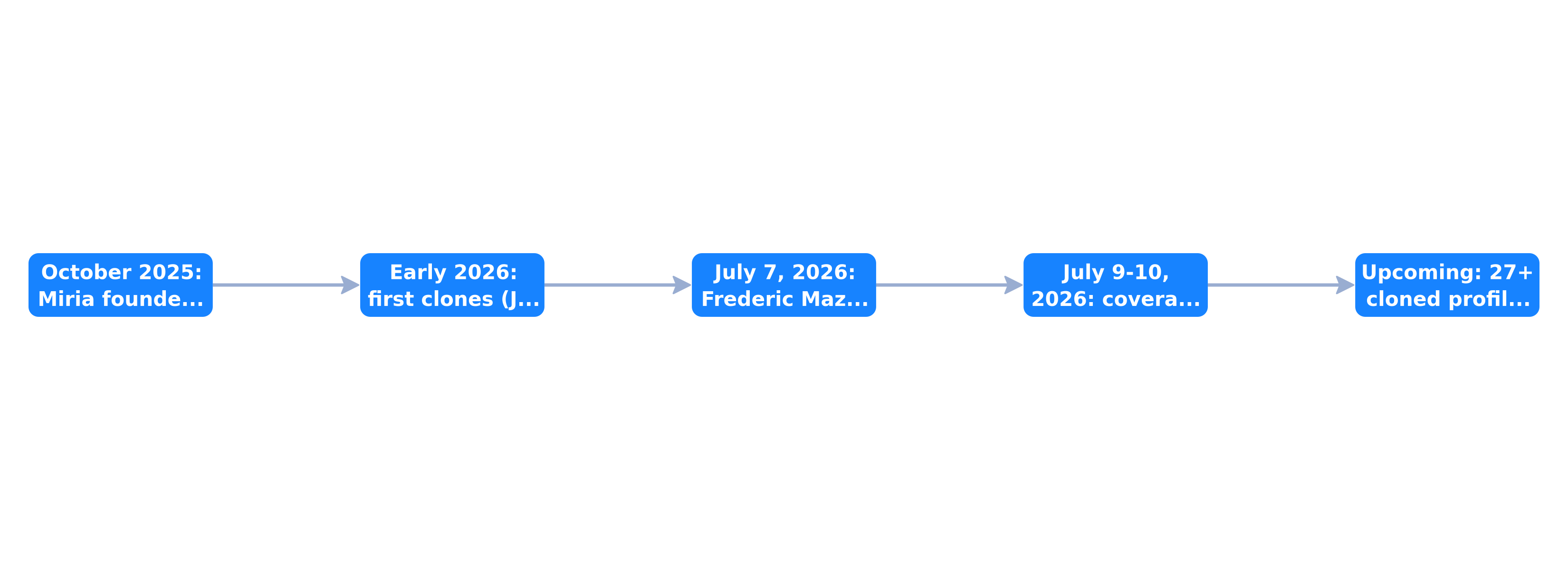 Timeline: Miria founded in October 2025, first clones in early 2026, Fred24 launch on July 7, 2026, press coverage on July 9-10, catalog expanding
How an entrepreneur AI clone actually works
Not magic, but a precise pipeline
Behind the marketing phrase "digital twin" lies a fairly standard technical pipeline in its broad strokes, even though executing it well requires real expertise. The process starts with source collection: published books, filmed talks, interviews, articles — all the content already produced by the entrepreneur over the course of their career. This raw material is then structured and cleaned to become usable by a language model.
Next comes fine-tuning or advanced prompt engineering on an existing LLM — in Fred24's case, the technology relies on Mistral AI, France's leading language model provider. In parallel, voice synthesis trained on the entrepreneur's real voice is produced, with Fred24 relying on a partnership with Gradium, a French voice synthesis specialist in which Nvidia recently invested.
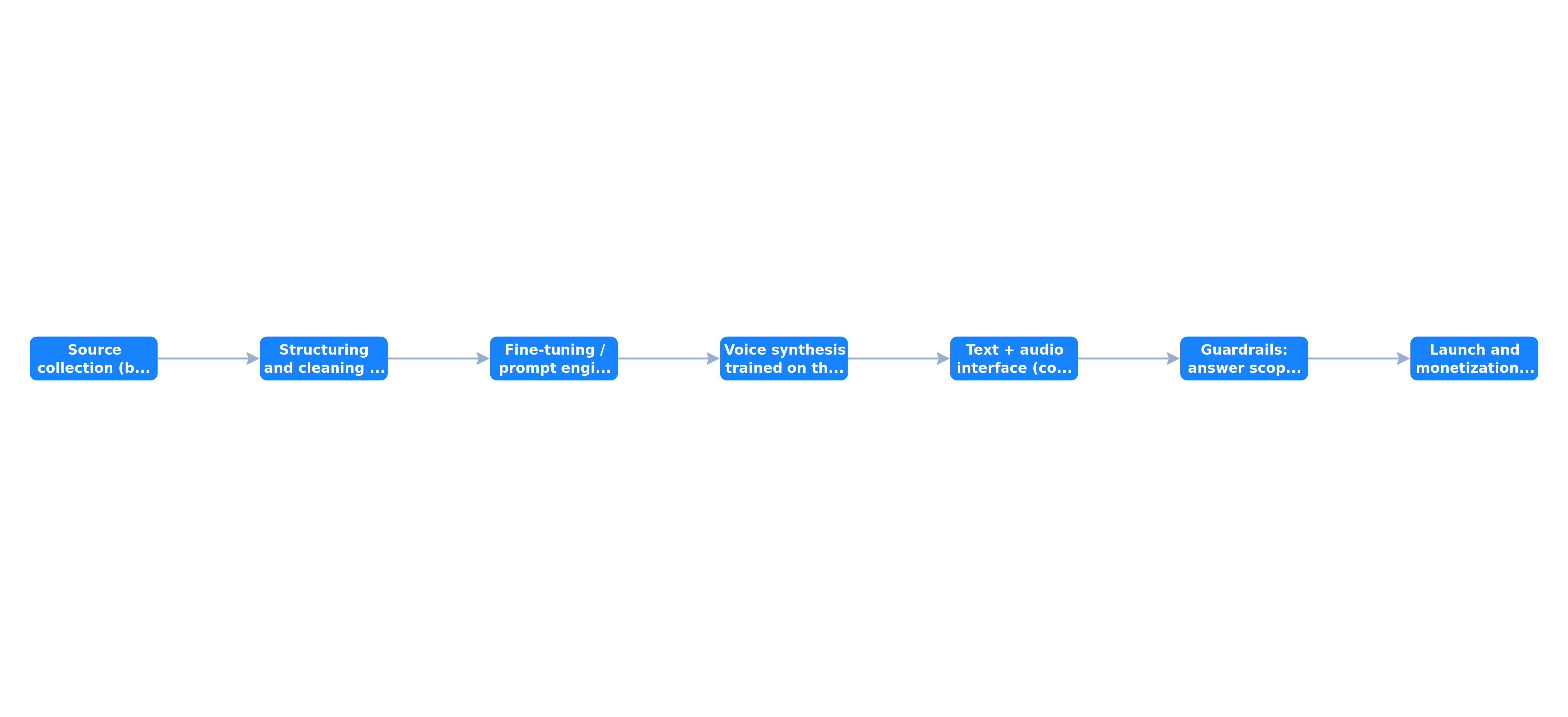 Process: source collection, data structuring, fine-tuning on an LLM like Mistral AI, voice synthesis like Gradium, text and audio interface, scope guardrails, launch and monetization
Guardrails: the least visible but most critical step
The most frequently overlooked step in mainstream presentations of these tools is guardrails: defining an explicit answer scope to prevent the clone from inventing advice outside its creator's real expertise, displaying visible disclaimers to remind the user they're talking to an AI rather than the real person, and providing a clear escalation path to a human for high-stakes questions (fundraising, layoffs, selling a company). Fred24, for instance, offers about ten free questions before switching to a paid tier, which mechanically limits exposure to the risk of an unmanaged conversation drifting too far.
The business model: a new way to monetize expertise
The problem AI clones actually solve
Frederic Mazzella's starting problem is easy to identify and widely shared among successful entrepreneurs: he receives more advice requests than he can honestly handle. His initial response, back in 2022, was to write a book — "Mission BlaBlaCar" — chronicling the behind-the-scenes of his journey. But entrepreneurs kept reaching out directly with questions born from reading it. The AI clone addresses this exact bottleneck: making expertise accessible 24 hours a day, at a volume even the best book can't match, since a book can't answer a specific, contextualized question.
Miria, the startup structuring this new market
Miria, founded in October 2025 by Louis Bordeau, Noe Campo, and Paul Gee, has positioned itself precisely in this niche: building personalized AI for executives, entrepreneurs, experts, and creators. Its offering combines a text and audio interface, with an already rich catalog of about twenty profiles available for conversation, free within a limit and then via a paid subscription. Miria's own business model illustrates a broader trend: rather than selling a raw technical tool, the startup sells an industrialized mentorship experience, with a likely revenue share between the platform and the cloned entrepreneur — a detail neither Miria nor Mazzella has made public so far, but one that necessarily structures this kind of commercial partnership.
How much does building an AI clone actually cost
Three very different budget tiers
The general public tends to assume this kind of technology is reserved for large corporate budgets. That's inaccurate: three budget tiers coexist in 2026, with very different quality and control trade-offs.
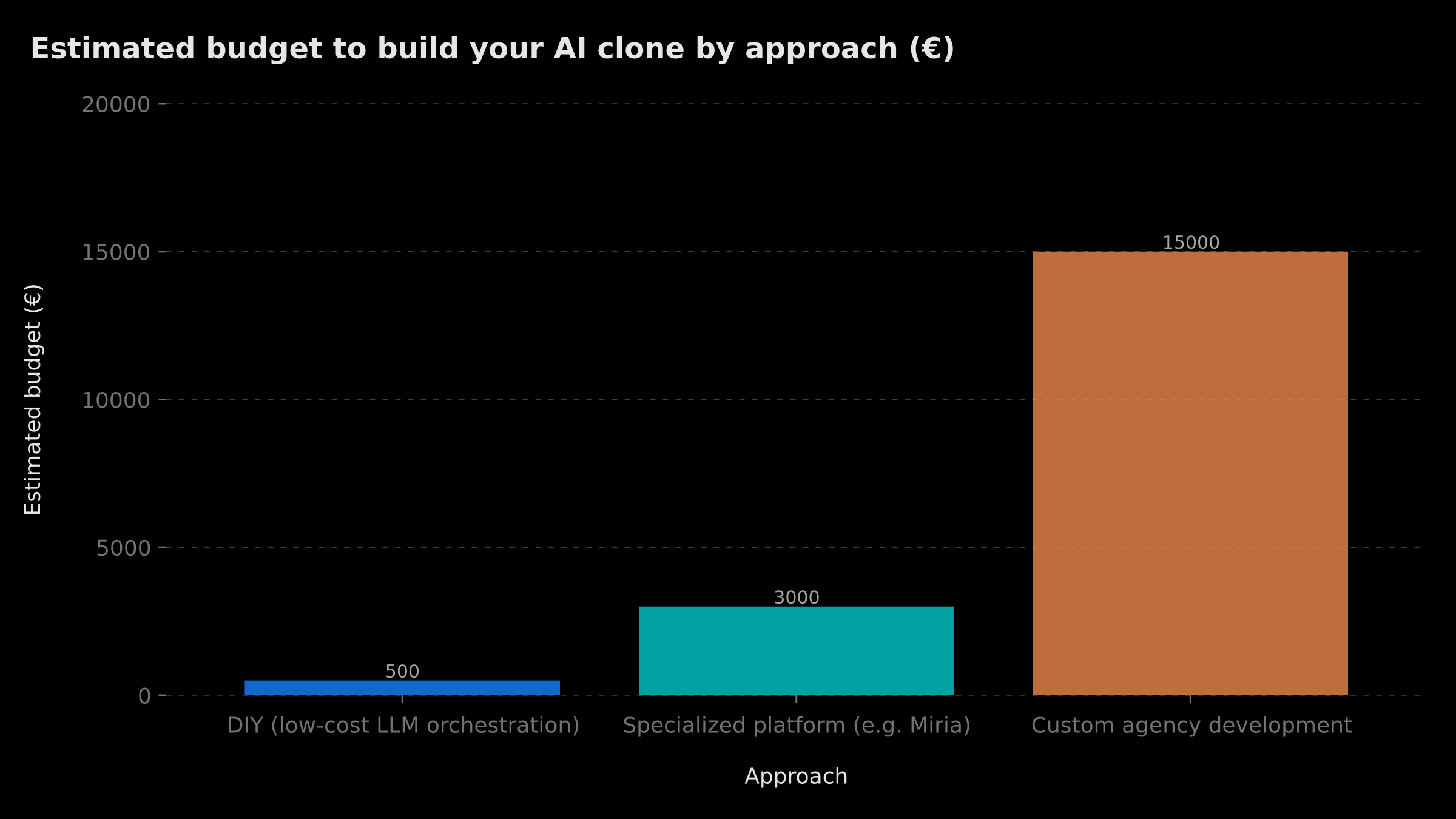 Budget: roughly €500 for a DIY approach with low-cost LLM orchestration, roughly €3,000 for a specialized platform like Miria, roughly €15,000 for custom agency development
The DIY approach, orchestrating low-cost (or free within limited use) language models on your own manually structured content, can cost a few hundred euros — but requires real technical skills and generally produces a less polished result on voice and interface. The specialized platform approach, like Miria, offers an appealing trade-off for an individual entrepreneur: a packaged experience with quality synthetic voice, no technical skills required, for an investment in the low thousands of euros. The custom agency development approach generally exceeds €10,000-15,000 but allows full integration into your existing ecosystem (website, CRM, billing tools) and complete control over guardrails and data ownership.
What this budget doesn't cover
A point often underestimated in cost discussions: producing the initial source content. If you've never written a book, given filmed talks, or documented your client feedback in a structured way, the first expense isn't the clone itself but producing this raw material — several months of work, or an additional writing/production budget that can easily double the total investment.
AI clone, human coaching, generic chatbot: an honest comparison
It's tempting to present the AI clone as a direct substitute for human coaching. The reality, once the criteria are laid side by side, is more nuanced.
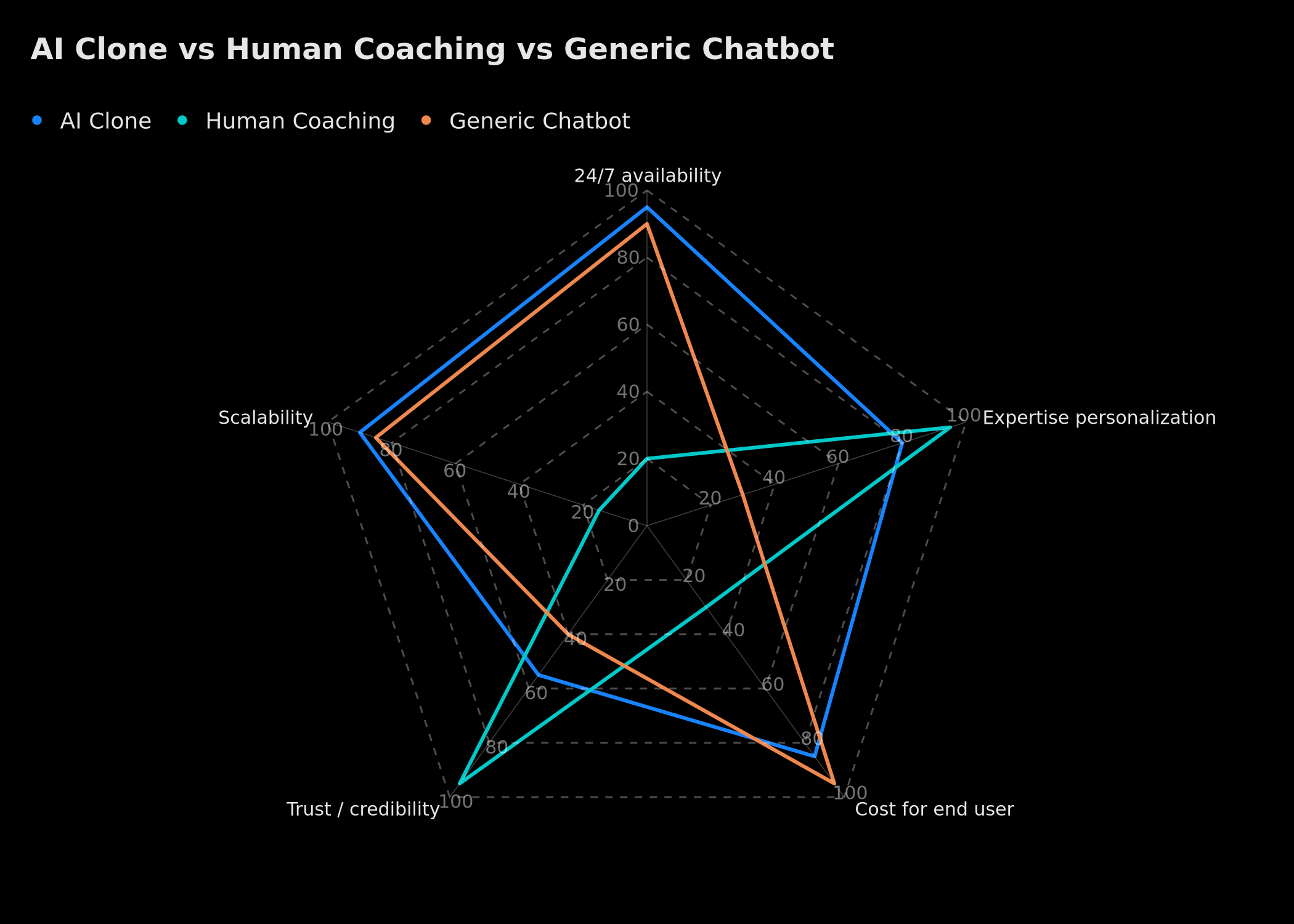 Comparison: the AI clone leads on 24/7 availability (95) and scalability (90), human coaching leads on trust (95) and personalization (95), the generic chatbot is the cheapest (95) but least personalized (30)
This chart reveals the real positioning of an AI clone: it's neither a substitute for human coaching nor a simple generic chatbot, but an intermediate product that optimizes availability and cost at the expense of trust and fine-grained personalization. For an entrepreneur considering building one, the question isn't "will the clone replace my paid one-on-one coaching?" but "can the clone absorb basic, recurring questions to free up time for my high-value coaching?" This is an essential commercial positioning nuance that will directly determine what you can charge for access to the clone.
The risks worth facing head-on
Reputational risk
An AI clone speaks in your name with your voice. If it gives incorrect, off-topic, or simply bad advice in a convincing way, the reputational impact falls directly on you, not on the underlying technical tool. This risk is structurally different from that of a generic corporate chatbot, precisely because the clone mimics a real, identifiable, recognizable person.
Legal risk
If a user follows advice delivered by your clone and suffers documentable economic harm, the question of liability arises with new sharpness — especially since no solid case law yet exists for this kind of arrangement in France or the French-speaking world in 2026. Explicit terms of use, drafted with a specialized lawyer, and visible disclaimers at every interaction provide a minimum level of protection, without guaranteeing full immunity.
Market dilution risk
The third risk is more subtle: if the AI clone market saturates quickly with uneven-quality products — some rushed, trained on insufficient content, with poor-quality synthetic voice — the general perception of the concept risks deteriorating before your own, potentially well-executed clone gets a chance to stand out. This is a timing risk: the very first well-executed clones benefit from a positive novelty effect; later ones, in an already saturated market of poor executions, will have to fight accumulated skepticism.
A fourth, quieter risk: dependency on a single platform
A risk that receives far less attention than the first three: building your clone entirely on a third-party platform like Miria creates a form of dependency similar to the one we discussed regarding agent-native web frameworks in our web development coverage. Your training data, your conversation history with users, and potentially your voice model may live primarily within the platform's infrastructure rather than under your direct control. If the platform changes its pricing, its terms of service, or simply shuts down, migrating your clone elsewhere could prove far more costly and time-consuming than the original setup. Before signing up with any platform, ask explicitly what happens to your data and your trained model if you decide to leave, and get the answer in writing rather than relying on a sales conversation, and treat that written answer as a genuine input into your decision rather than a formality to check off.
How to decide if an AI clone makes sense for your business
A three-question decision framework
Rather than getting swept up in media hype, we recommend honestly answering three questions in order.
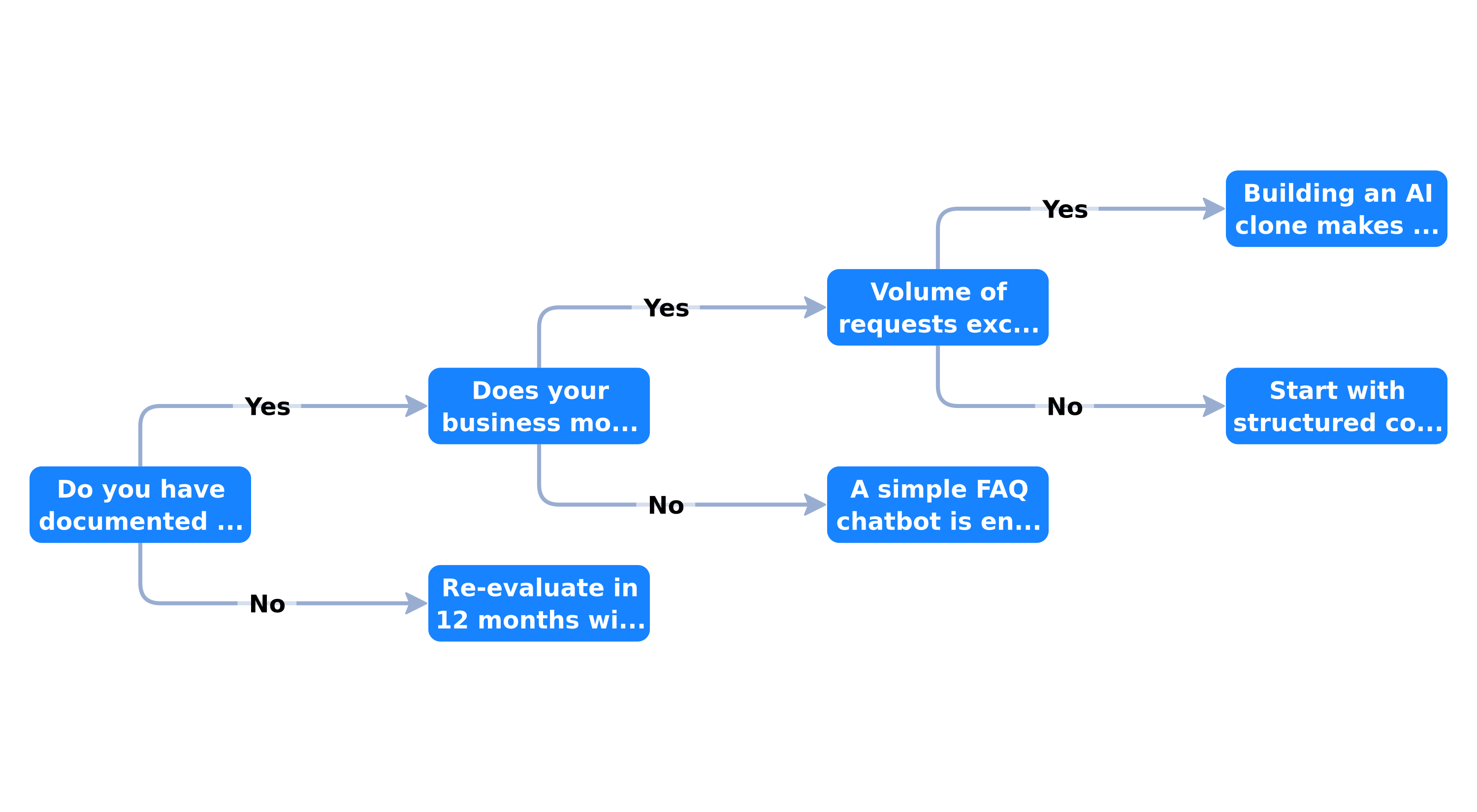 Decision: documented expertise in sufficient volume → business model based on personal expertise → volume of requests exceeding response capacity → building an AI clone makes economic sense, otherwise start with structured content or a simple FAQ chatbot
First question: do you already have documented expertise in sufficient volume — a published book, filmed talks, written client feedback, in-depth articles? A clone trained on insufficient content volume will produce vague or generic answers that don't justify the investment.
Second question: does your business model rely directly on monetizing your personal expertise, rather than on a standardized product or service your clients buy independently of you as a person? A consultant, coach, trainer, or investor selling their network and judgment is in a radically different position from an agency selling a service that a team can reproduce.
Third question: do you already receive a volume of requests that exceeds your individual response capacity? If you effortlessly answer every request you receive today, an AI clone solves a problem you don't yet have.
Our pragmatic recommendation
If all three answers are clearly affirmative, an AI clone makes real economic sense and is worth testing, starting with the least expensive approach (specialized platform rather than custom development) to validate demand before investing further. If any of the three answers is negative, other cheaper and less risky formats — a regular newsletter, a structured book or guide, a simple FAQ chatbot on your site — probably serve your real need better in 2026.
What this means for French-speaking consultants and agencies
A service opportunity worth exploring cautiously
For an agency like BOVO Digital, this movement represents a real service opportunity: helping French-speaking entrepreneurs and consultants build their own AI clone, with appropriate guardrails and careful integration into their existing digital ecosystem. We follow this market with the interest of those who might one day serve it, but also with the caution of those who know a still-young product, without established case law, deserves to be presented to our clients with all the necessary reservations rather than as a miracle solution.
Beyond Fred24: a movement bigger than French Tech
While Frederic Mazzella and Miria concentrate recent French-speaking headlines, the phenomenon of executive AI clones isn't exclusively French. International figures have been experimenting with similar approaches for several months, with varying degrees of sophistication — some limited to a text chatbot trained on public writings, others investing in a full voice and visual replica. What sets the current French wave apart is its temporal concentration: several recognized figures in the ecosystem (Mazzella, De la Rochebrochard, Moubeche) are launching their clones within a few months of each other, creating a bandwagon and peer-validation effect — a classic adoption dynamic in high-visibility entrepreneurial circles, where a recognized peer's action quickly legitimizes a similar action by another.
Why this specific timing, in 2026
It's no coincidence that this movement is gaining traction in 2026 rather than in 2023 or 2024. Three technical and economic conditions converged simultaneously: French-language models of sufficient quality at reasonable cost (Mistral AI leading the way), voice synthesis realistic enough to avoid the "robotic" effect that would have discredited the exercise just two years ago (with players like Gradium), and growing cultural acceptance of the principle of talking to an AI for advice, normalized by the massive use of ChatGPT and Claude since 2023. Without all three conditions in place, the exercise would have remained a technical curiosity rather than a viable commercial product.
A note on cultural fit for French-speaking markets
One nuance worth flagging for our specifically French-speaking audience: the acceptance of AI clones as a legitimate business tool appears to track closely with each market's broader comfort with AI-mediated interactions in professional contexts. French entrepreneurial culture has historically valued direct personal relationships and face-to-face trust-building more heavily than some other markets, which means a clone positioned as "instead of talking to me" may land very differently than one positioned as "before you talk to me, for the basics." The framing you choose when introducing your clone to your existing network is not a minor marketing detail — it directly shapes whether early adopters perceive it as a thoughtful extension of your availability or as a slightly awkward substitute for genuine access to you.
This distinction matters even more for entrepreneurs building an audience across both French-speaking Europe and French-speaking Africa, two markets we work across at BOVO Digital and which don't always share identical expectations around formality, directness, and what counts as an acceptable substitute for a real conversation. A launch message and positioning that works well in Paris won't necessarily translate cleanly to Abidjan or Cotonou without deliberate adaptation, and testing your framing with a small group from each target market before a full public launch is a cheap way to avoid an avoidable early misstep.
A minimal checklist before any public launch
If you decide to move forward, here are the five elements we consider non-negotiable before any public launch of an AI clone, regardless of the technical approach chosen: an explicitly documented and communicated answer scope (which topics the clone handles, which it deliberately refuses); a visible disclaimer at every interaction reminding the user this is an AI, not the real person; a clear escalation mechanism to a human contact for high-stakes questions; a periodic review of conversation transcripts to catch drift or off-topic answers before they cause harm; and terms of use drafted with legal counsel rather than copied from a generic template found online. None of these five elements is optional once the clone is publicly accessible, even in a limited free tier.
The connection to the automation and AI agents we already deploy
An entrepreneur AI clone is, technically, just a special case of a conversational AI agent applied to a very specific domain: personifying an individual's expertise. The technical building blocks — LLM, voice synthesis, guardrails, conversational interface — are largely the same ones we deploy for our clients in different contexts (customer support, sales qualification, internal assistance). If you're considering structuring a consulting or coaching offer around an AI clone, our AI agent creation offering covers exactly this kind of project, with the same methodological rigor as for a classic business agent, guardrails and documented limitations included from the scoping phase rather than bolted on afterward. We also make a point of discussing data portability upfront with any client exploring this space, precisely because of the platform dependency risk described above.
What to watch in the coming months
Three signals seem worth tracking to assess whether this movement turns into a durable market or remains a passing fad lasting a few months. First, the real conversion rate of Fred24 and other clones from free pre-registrations to actual paid subscriptions — three hundred pre-registrations guarantee nothing until a meaningful volume converts to recurring payment. Second, whether a first widely reported incident of incorrect or harmful advice delivered by a clone emerges, which could sharply harden public and regulatory perception of this kind of product — a single bad headline could do more damage to the category than years of careful positioning could repair. Third, whether Miria and competing platforms manage to maintain a minimum quality bar on their catalog, rather than accepting any entrepreneur wanting to clone themselves without verifying the real depth of their source content — this curation discipline will determine whether the concept stays associated with credible figures or quickly dilutes into a mass product with no perceived value, a trade-off we'll watch closely before broadly recommending this approach to our own clients across the French-speaking markets we serve.
Conclusion
The entrepreneur AI clone, illustrated by Frederic Mazzella's Fred24 and Miria's growing catalog, isn't a simple media stunt: it's a concrete response to a real problem — the impossibility for a highly sought-after expert to personally answer every request. But it's not a universal solution either. Its economic relevance depends directly on three objective factors: the volume of already-documented expertise, how central that personal expertise is to your business model, and the real volume of requests you receive today, measured honestly rather than estimated from a handful of memorable LinkedIn messages that happened to stick in your memory. For French-speaking entrepreneurs and consultants who answer yes to all three criteria, 2026 is probably the right time to test a first version, starting with the least expensive approach and explicitly documenting guardrails before any public launch. For everyone else, waiting a few months to see how this still-young market structures itself — and avoiding investing in a product whose real demand isn't yet proven — remains the more reasonable choice, particularly given how quickly the underlying technology and its market perception are both still moving in mid-2026.
Tags
FAQ
What is Fred24, Frederic Mazzella's AI clone?
Fred24 is an AI assistant launched on July 7, 2026 by Frederic Mazzella, co-founder of BlaBlaCar and Dift. It was trained on twenty years of Mazzella's entrepreneurial experience — his book "Mission BlaBlaCar," his private and public talks, his interviews — to answer entrepreneurs' concrete questions in writing or by voice, with a synthetic voice replicating Mazzella's own. The tool was developed with Miria, a French startup specialized in building personalized AI for executives.
How much does building an AI clone actually cost in 2026?
Cost varies significantly depending on the chosen approach. A DIY version, built by orchestrating low-cost LLMs on your own content, can cost a few hundred euros. A specialized platform like Miria sits around several thousand euros for a packaged offer with synthetic voice and a polished interface. A fully custom development by an agency, with guardrails and integration into your existing ecosystem, generally exceeds 10,000-15,000 euros.
Can an AI clone replace a real coach or consultant?
No, not with current technology. An AI clone excels at availability (24/7), cost per interaction, and scalability, but remains clearly behind on the trust and fine-grained personalization that a real human relationship provides. The most honest positioning for an AI clone is as a first level of response for recurring questions, with an explicit escalation to a human for high-stakes decisions.
What are the legal and reputational risks of an AI clone?
Three main risks arise: reputational risk if the clone gives an incorrect or off-scope piece of advice while convincingly impersonating you; legal risk related to liability if a user suffers damage after following bad advice; and brand dilution risk if many clones of uneven quality flood the market and trivialize the concept before yours gets a chance to stand out. Explicit guardrails (answer scope, visible disclaimers, documented human escalation) reduce these risks without eliminating them entirely.
How do I know if building an AI clone makes sense for my business?
Ask yourself three questions in order: do you already have documented expertise in sufficient volume (book, talks, written client feedback)? Does your business model rely directly on monetizing your personal expertise rather than on a standardized product or service? Do you receive a volume of requests that already exceeds your individual response capacity? If all three answers are yes, an AI clone makes real economic sense. If any answer is no, other formats (newsletter, structured content, a simple FAQ chatbot) are probably a better and cheaper fit.
Budget, process, priorities — decided together
Website, chatbot, or automation? We pick the next job that unlocks cash, not the trendy stack.
- 30 min
- Clear priorities
- No commitment

William Aklamavo
Web development and automation expert, passionate about technological innovation and digital entrepreneurship.


