
Agent-Native Web Development in 2026: Next.js, Prisma, and What Changes for Your Stack
Next.js ships an MCP server, Prisma reinvents itself with agent-ready data contracts, new Rust and Zig frameworks emerge. How to choose your web stack in 2026 amid the agent-native wave.

Agent-Native Web Development in 2026: Next.js, Prisma, and What Changes for Your Stack
In a matter of weeks, three distinct announcements — Next.js 16.3, Prisma Next, and a wave of new experimental frameworks on Hacker News — point to the same underlying trend: web development tools are no longer designed for humans alone. Here's what that actually means for choosing your tech stack.
Just a year ago, AI integration into a web framework usually meant an autocomplete plugin or a documentation chatbot bolted on as an afterthought. In 2026, the movement has changed in nature: the creators of some of the world's most widely used frameworks — Vercel with Next.js, the Prisma team with its Prisma Next rewrite — are redesigning their tools on the assumption that a growing share of code will be written, verified, and fixed by autonomous AI agents supervised by humans, rather than typed line by line.
We covered this evolution on the Next.js side in our article on Next.js 16.3, Turbopack, and AI agents. This article takes a step back: it examines the trend across the whole ecosystem — Next.js, Prisma, and a new generation of experimental frameworks — and offers a practical framework for deciding if, when, and how to adapt your tech stack in 2026, without giving in to hype.
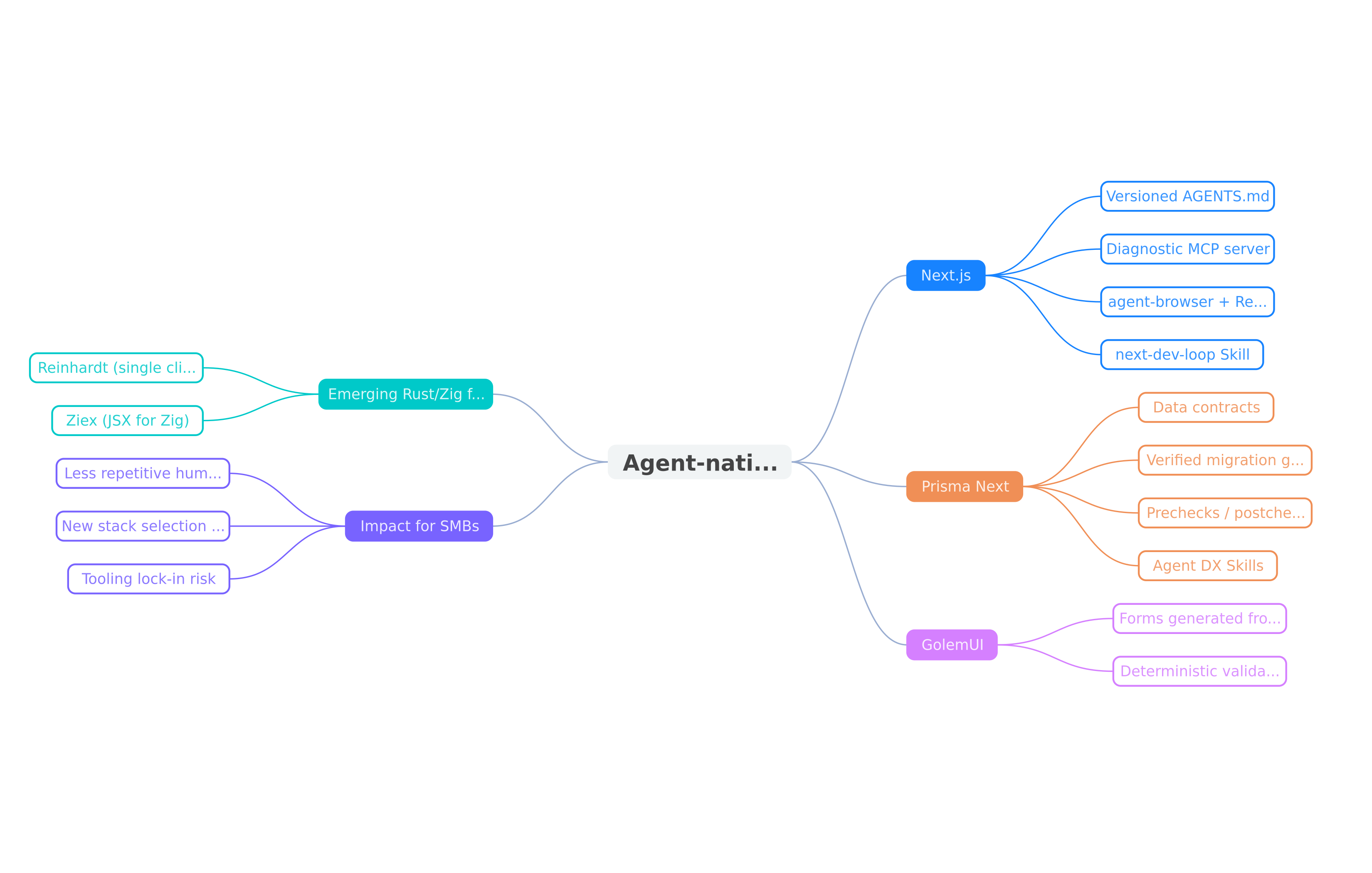 Agent-native ecosystem 2026: Next.js (AGENTS.md, MCP server, agent-browser), Prisma Next (data contracts, migration graphs), GolemUI (JSON forms, deterministic MCP), emerging Rust/Zig frameworks (Reinhardt, Ziex), SMB impact
What makes a framework "agent-native," concretely?
Three traits that show up consistently
Comparing the recent announcements from Next.js, Prisma Next, and GolemUI reveals a consistent pattern. An "agent-native" framework typically shows three traits that distinguish it from its predecessors:
- Documentation that tracks the installed version, rather than generic documentation an agent might have memorized an outdated version of during training. Next.js does this with an embedded, synchronized
AGENTS.md. - Tools exposed through a structured protocol, usually the Model Context Protocol (MCP), rather than an API the agent has to guess from code examples. An agent lists available tools, reads their exact schema, and calls them with validated parameters — no improvised syntax.
- Deterministic verification mechanisms built into the workflow: prechecks before a risky operation, postchecks after execution, explicit contracts between components. The goal isn't to trust the agent's word, but to structure its autonomy with automatically verifiable guardrails.
Why this shift is happening now
This shift isn't arbitrary. It coincides with the growing maturity of autonomous coding agents — Claude Code, Cursor, GitHub Copilot Workspace, and the many agents built on models like GPT-5.6 that we covered in our July 2026 tech recap. When a significant share of a framework's users delegates a growing portion of their work to an agent, it becomes rational for that framework's creators to invest directly in that agent's experience, rather than leaving it to emerge informally through third-party system prompts.
Next.js: the MCP server and verification tooling
A brief recap — the full detail lives elsewhere
We dedicated a full article to this dimension of Next.js 16.3: the AGENTS.md documentation, first-party Skills (next-dev-loop, next-cache-components-adoption), the agent-browser tool with React DevTools introspection, and an MCP server refocused on build diagnostic tools. For the complete technical breakdown, see our article on Next.js 16.3 and AI agents. In this article, we focus on what this evolution means once placed in the broader context of the ecosystem.
What Next.js specifically contributes to the discussion
Next.js's most interesting contribution to this debate isn't a single tool, but an organizational principle: treating compilation and runtime errors as opportunities for automated correction rather than mere notifications. The "Instant Insights" with a "copy prompt" button illustrate this principle — the error itself becomes a structured input for the agent's correction loop, not just a message for a human who would then have to reformulate the problem in their own prompt.
Prisma Next: data contracts and verified migrations
The problem Prisma Next tries to solve
Prisma, the most widely used TypeScript ORM in the Node.js ecosystem, announced a complete rewrite called Prisma Next, currently available in Early Access. The starting problem is easy to state but hard to solve: historically, database migrations are stored as black-box SQL files, difficult for a tool to verify automatically — and even harder to confidently hand over to an autonomous AI agent, where a mistake could irreversibly corrupt production data.
Three new concepts that structure the agent's autonomy
Prisma Next introduces three concepts that, together, make delegation to an agent considerably safer:
- Data contracts: every schema state is described as an explicit, verifiable contract, rather than implicitly inferred from application code.
- Migration graphs: every migration is stored as a structured
ops.jsonfile, accompanied by a human-reviewable TypeScript file, rather than as an opaque SQL script. - Systematic prechecks and postchecks: every migration operation verifies its preconditions before execution, then verifies success and idempotency afterward. The migration promises to move the schema from contract A to contract B, and that result is verified before the migration is committed.
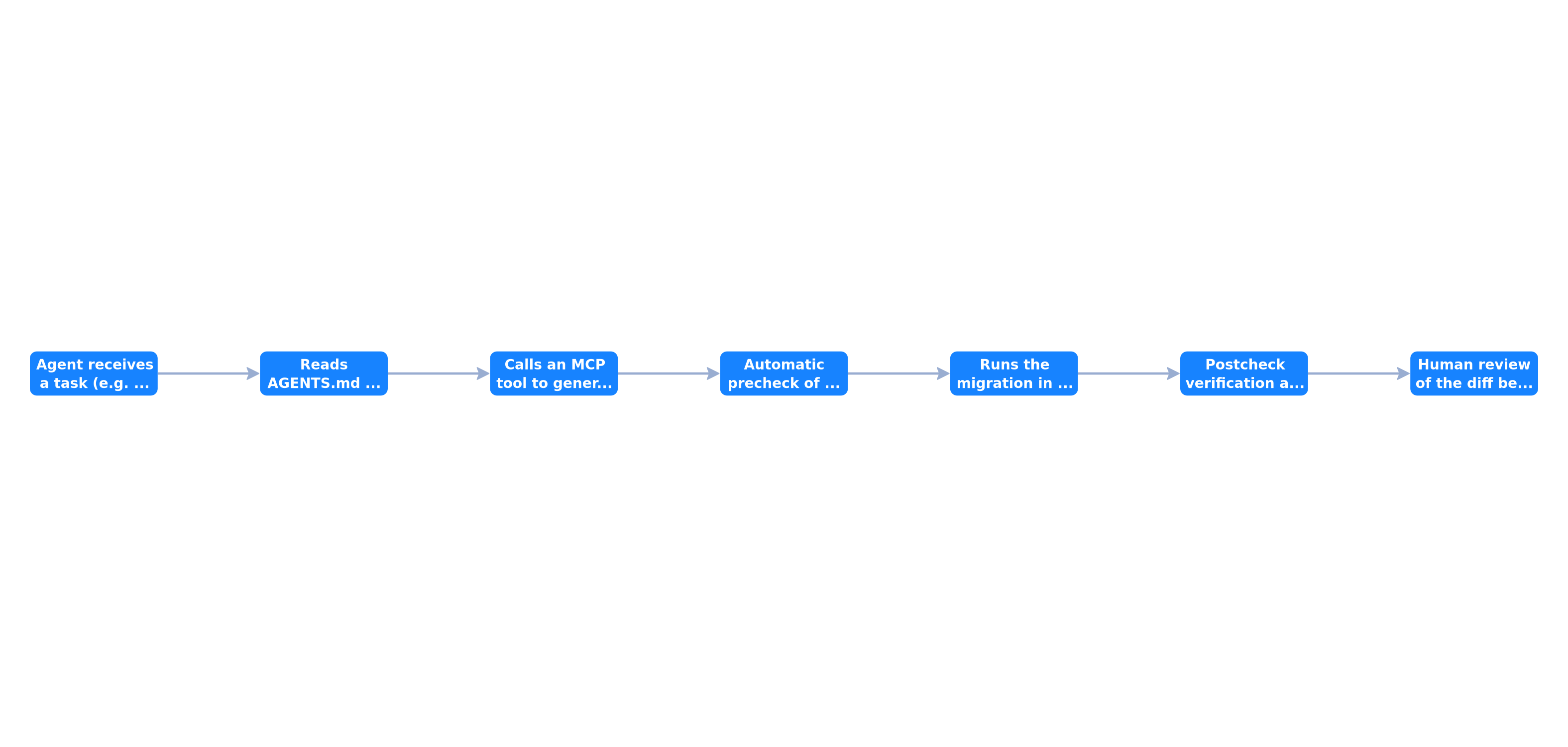 Cycle: the agent receives a task, reads AGENTS.md and data contracts, calls an MCP tool to generate the migration graph, runs a precheck, migrates in an isolated environment, verifies via postcheck, then a human reviews the diff before merging
What this actually changes for a development team
The Prisma team sums up the intent directly: provide a set of reliable, predictable tools with guardrails on every operation, so the human team can focus on building the product instead of constantly double-checking what its agent is doing. This is an important shift in posture: instead of treating agent autonomy as a risk to minimize by shrinking its scope of action, Prisma Next treats verifiability as the lever that lets you safely expand that scope.
GolemUI and deterministic UI generation
Less publicized than Next.js or Prisma, GolemUI illustrates another facet of the same trend: an engine that generates forms from JSON definitions, with a typed layer to make authoring easier, and crucially a deterministic MCP server whose specific role is to validate a language model's output, generate JSON or code, and guarantee that the definition returned by an LLM is always valid before being used to render an actual interface. The same definition can then be rendered in React, Angular, Vue, Lit, or vanilla JavaScript — an approach that decouples AI-assisted generation from the choice of final rendering framework, a problem few mainstream tools solved before 2026.
Experimental frameworks: signal or noise?
A flurry of new approaches on Hacker News
In recent weeks, several "Show HN" projects have drawn attention with radically different architectures. Reinhardt, a Rust framework in the spirit of Django, compiles a single component DSL to both client-side WASM and server-side rendering, eliminating type duplication between client and server — a problem full-stack TypeScript developers know well when maintaining consistent types between an API and its consumer. Ziex applies a similar principle to the Zig ecosystem, with JSX-like syntax, file-system routing, and client component compilation to WASM.
Why caution is warranted before investing
It would be tempting to see these as the natural successors to React and Next.js. That would be premature. As of this writing, these projects are at alpha or release-candidate stage, with a plugin ecosystem, contributor community, and documentation base far behind established frameworks. Their real value today is serving as an architectural idea lab — eliminating type duplication via a single DSL, going garbage-collector-free in a web context — rather than being a credible option for a client project in production in 2026.
Traditional vs agent-native framework: the comparison
To objectively summarize the trade-offs at play, we compared a typical traditional framework against a typical agent-native framework across five dimensions.
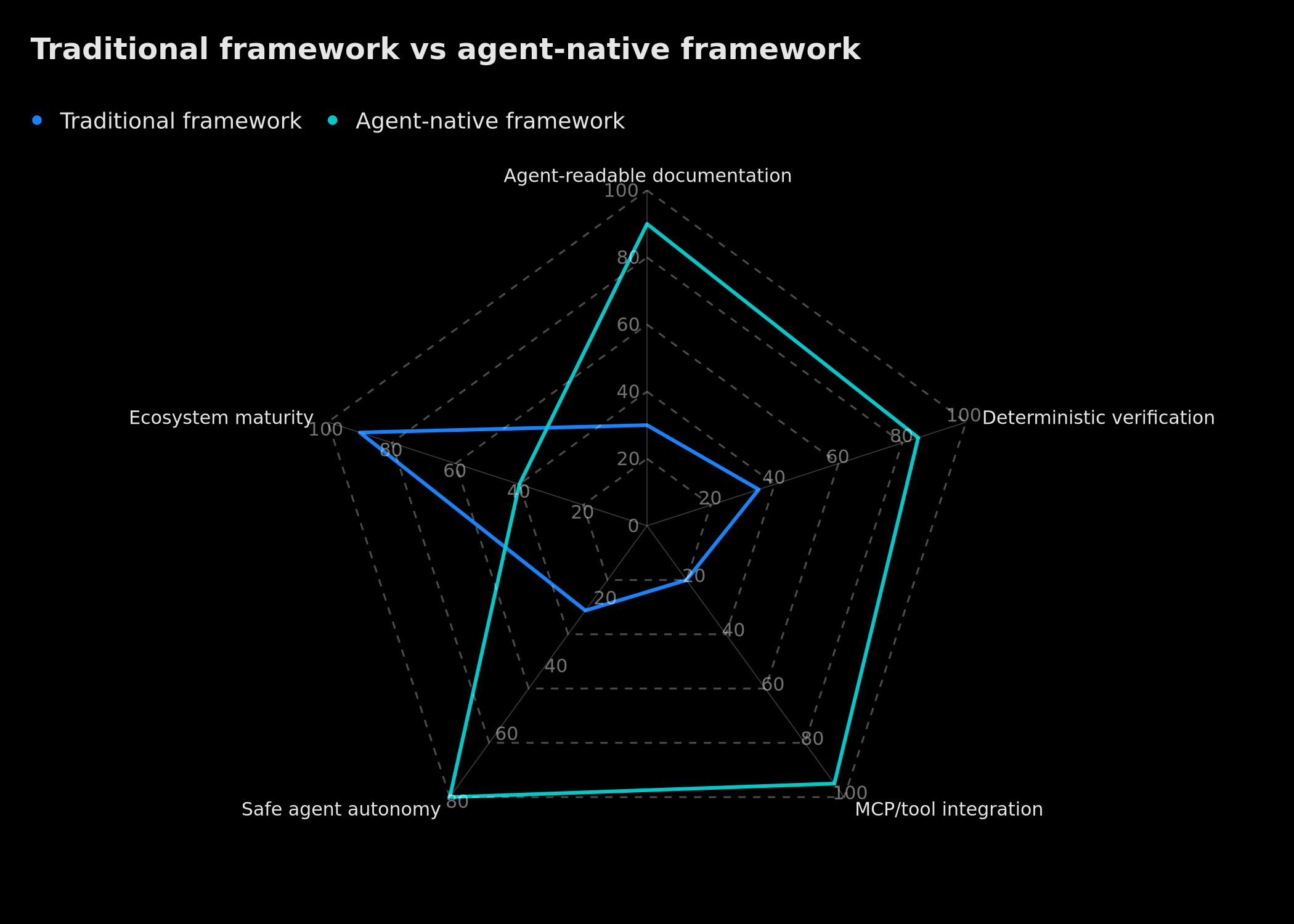 Comparison: the agent-native framework leads on agent-readable documentation (90), MCP integration (95), and deterministic verification (85), but lags on ecosystem maturity (40) compared to the traditional framework (90)
This chart illustrates the central trade-off of 2026: agent-native frameworks are significantly ahead on AI-oriented tooling, but lag on overall ecosystem maturity — community documentation, plugin base, depth of production experience. This is precisely why Next.js, which combines a growing agent-native foundation with an already mature ecosystem, occupies a particularly strong position compared to entirely new projects like Reinhardt or Ziex.
A clearly accelerating trend
The scale of this movement can also be measured in the number of announcements. Our estimate, built from tracking public announcements from major web development frameworks and tools over the past eighteen months, shows a marked acceleration.
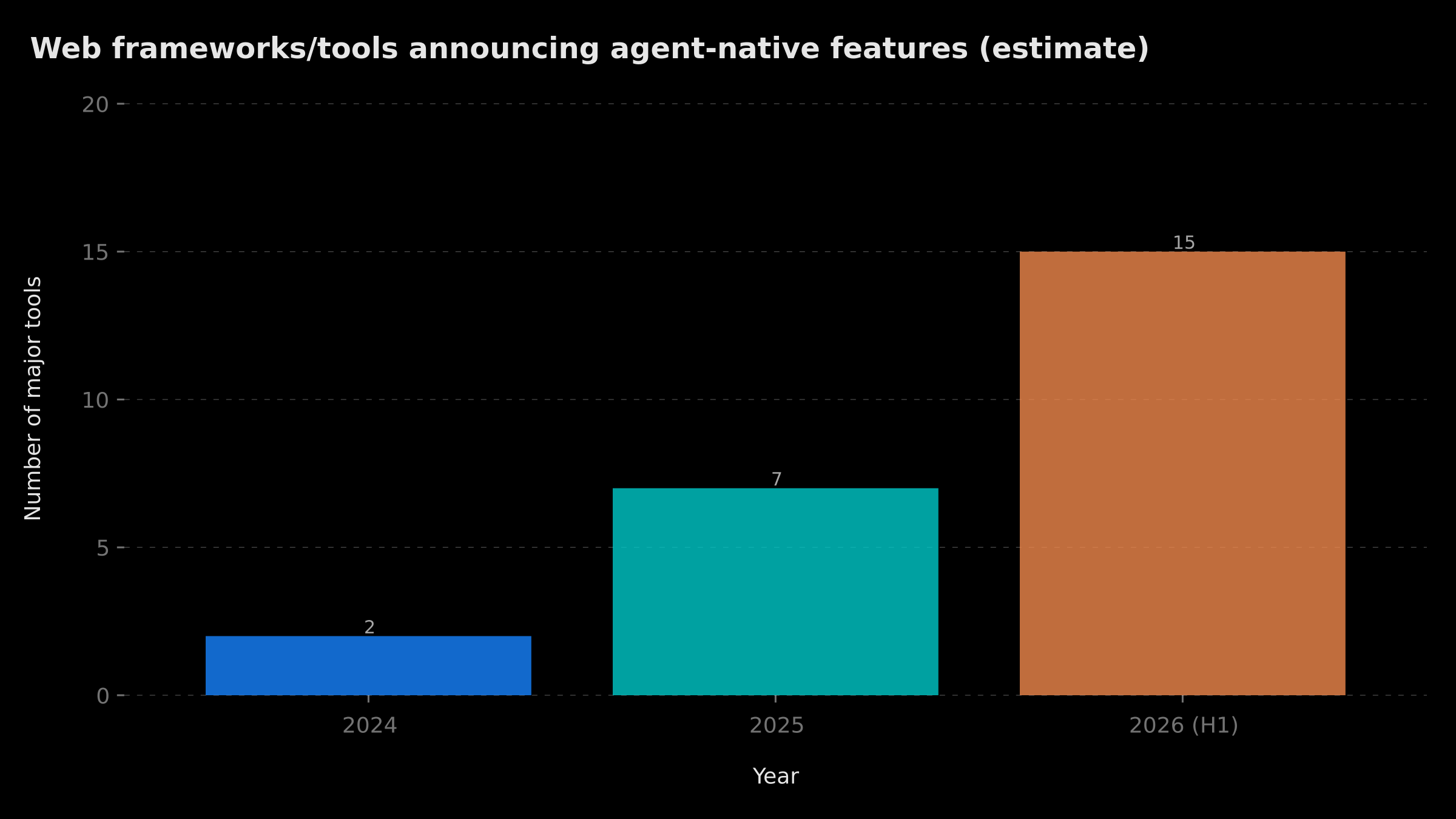 Number of major tools announcing agent-native features: roughly 2 in 2024, 7 in 2025, 15 in the first half of 2026
This acceleration confirms that we're no longer looking at an isolated Vercel experiment, but at a structural movement that is progressively reaching the entire web development toolchain: frameworks, ORMs, UI libraries, and probably soon testing and deployment tools as well.
What this means for the developer profession
Verification becomes a core skill
One side effect of this shift deserves to be named clearly: as AI agents take on a growing share of code writing, the most sought-after skill for a senior developer is gradually shifting from producing code to structurally verifying what an agent produces. Knowing how to read a Prisma Next migration graph, understanding what a precheck actually verifies, or interpreting the output of an MCP diagnostic tool is becoming as important as knowing how to hand-write an optimized SQL query — arguably more important, since a developer who can't verify an agent's output effectively becomes a bottleneck rather than a multiplier on the agent's productivity. For agencies and SMBs hiring developers in 2026, this criterion deserves explicit evaluation in interviews, alongside classic technical proficiency.
A complacency risk worth actively watching
The opposite is also true and deserves to be said plainly: the proliferation of automatic guardrails (prechecks, postchecks, data contracts) can create a false sense of security that pushes a team to lower its human vigilance more than it should. A precheck verifies what it was programmed to verify — not the full set of edge cases specific to your business context. Human review of the diff before merging, illustrated in our cycle diagram above, remains a non-negotiable step, regardless of how sophisticated the upstream automated verification tooling becomes. Teams that treat automated guardrails as a replacement for review, rather than a filter that makes review faster and more focused, tend to discover their blind spots at the worst possible moment — in production, after the fact, rather than in a pull request.
How to choose your stack in 2026: a practical framework
The question to ask before anything else
Before asking whether you should adopt Prisma Next or test agent-browser, ask yourself a more fundamental question: does your team already use AI coding agents daily, in a structured way? If the answer is no, the immediate value of all this agent-native tooling is limited for you — there's no point adopting tools designed for a use case you don't yet have.
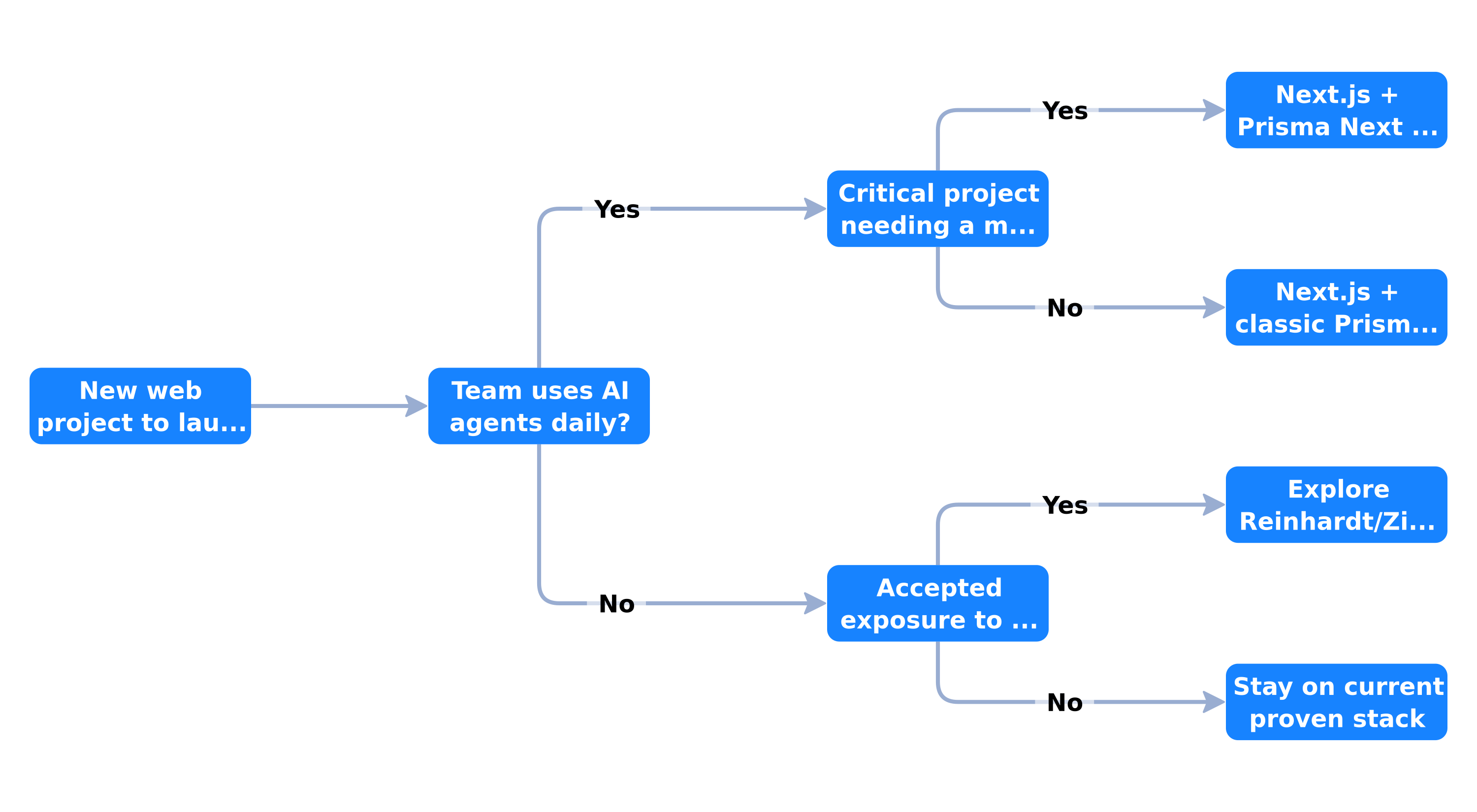 Decision: team using AI agents daily and critical project → Next.js + Prisma Next, team without daily AI use and low risk tolerance → current proven stack, tolerance for experimental risk → internal R&D on Reinhardt/Ziex
Our recommendation for three team profiles
- Team already using AI agents daily, on a critical project: adopt Next.js's agent-native features progressively, test Prisma Next on a non-critical module before generalizing, relying on the overall maturity of the Next.js/classic Prisma ecosystem as a safety net.
- Team without structured AI usage today, with low risk tolerance: stay on your current proven stack. Track these tools to anticipate changes, but don't migrate purely to follow a media trend.
- Team in an R&D phase with a dedicated exploration budget: experimental frameworks like Reinhardt or Ziex can be a legitimate learning ground on internal projects with no direct commercial stake, provided you never position them in production for a client without a clear warning about their experimental status.
The often-underestimated risk: tooling lock-in
A point few analyses emphasize enough: agent-native tooling creates a new form of dependency, different from traditional cloud lock-in. If your team builds entire workflows around a specific MCP server, proprietary Skills, and a tool like agent-browser, these investments aren't necessarily portable to another framework if you change stacks in two or three years. This isn't a reason to avoid these tools, but a reason to explicitly document this dependency in your architecture decisions, the same way you'd document a dependency on a proprietary cloud service.
This concern isn't hypothetical. We've already seen this pattern play out with earlier generations of framework-specific tooling — proprietary CLI plugins, vendor-specific deployment integrations, custom DevTools extensions — where teams that invested heavily in one ecosystem's unique tooling faced a real migration tax years later when business needs required switching. Agent-native tooling raises the stakes further because it touches your team's core development workflow, not just a peripheral integration, meaning the switching cost compounds across every engineer who has internalized those specific tools and conventions. Budgeting for this eventual switching cost upfront, even as a rough estimate in your project's risk register, is a small effort that pays off considerably if your stack ever needs to change under time pressure.
A four-point checklist before deciding
To make the decision objective rather than relying on a general impression, we recommend answering four questions in writing before any stack change driven by agent-native tooling: how much development time does your team currently spend on repetitive, verifiable tasks that an agent could take over with appropriate guardrails? What is the real cost, in training time, for your team to properly adopt the new tools rather than using them superficially? What is the probability that the project will survive more than three years, a horizon beyond which today's experimental tooling will have either matured or disappeared? And finally, has your client or leadership been explicitly informed of the trade-offs involved if you choose an option still in preview or Early Access? An honest answer to these four questions rules out most decisions made purely out of technological enthusiasm.
What to watch in the coming months
Three signals seem particularly telling for where this trend goes next. First, Next.js 16.3 moving to a stable release, which will give a first objective measure of real adoption of agent-native tooling beyond early enthusiastic testers. Second, Prisma Next exiting its Early Access status, which will indicate whether data contracts and verified migration graphs deliver on their safety promises at scale, on complex production schemas rather than demos. Third, whether a shared standard for agent-facing documentation emerges across frameworks, rather than a proliferation of incompatible proprietary conventions between Next.js, Prisma, and the future tools that follow this movement. This last point will probably be the most decisive factor in determining whether this wave of agent-native tooling benefits the ecosystem as a whole or fragments into competing silos — and it's the single question we'll be watching most closely before recommending any of these tools as a default choice for new client projects.
Our position at BOVO Digital
At BOVO Digital, we actively track this trend because we apply it to our own practice: our developers work daily with AI coding agents, and we concretely measure where this tooling delivers a real productivity gain and where it remains more experimental than promised. Our approach for client projects stays pragmatic: we systematically recommend the most mature combination that stays aligned with the project's real needs, never imposing a trendy technical novelty on a client just because it's fashionable.
For a custom web project, our website expert offering builds this continuous technical monitoring directly into our architecture recommendations. For businesses that want to structure the use of AI agents in their own software development process — not just in their end products — our AI agent creation offering directly applies to this kind of internal need. And if you're planning to build a SaaS product on a Next.js architecture designed to stay adaptable in a fast-moving technical landscape, our SaaS development offering explicitly starts from this assumption of continuous change rather than locking in a stack for the next five years.
In practice, this means every architecture proposal we write includes an explicit section on which parts of the stack are "boring and proven" versus "new and worth monitoring," so a client always knows exactly which decisions carry more risk and why we made them anyway — or chose not to. That transparency, more than any specific tool choice, is what actually protects a client's investment over a project's full lifetime, and it is exactly the kind of practical, unglamorous discipline that tends to get skipped when a release cycle moves as fast as this one has in 2026.
Conclusion
Web development in 2026 is going through a structural transition, not a passing fad: the world's most widely used frameworks are actively redesigning their tooling to treat AI coding agents as first-class users. Next.js with its MCP server and AGENTS.md, Prisma Next with its verifiable data contracts, GolemUI with its deterministic validation, illustrate three complementary approaches to the same problem: how to delegate more work to an autonomous agent without sacrificing the reliability of what reaches production. Experimental frameworks like Reinhardt or Ziex, meanwhile, remain idea labs worth watching rather than production options. For an SMB or agency choosing its stack in 2026, the best decision is still the one grounded in your team's actual current usage, not the latest announcement — with particular vigilance about the tooling lock-in risk this new generation of tools quietly introduces, and a clear-eyed acknowledgment that today's cutting edge will, within a couple of release cycles, either become tomorrow's boring default or quietly fade from relevance.
Tags
FAQ
What is an "agent-native" framework?
An agent-native framework is designed from the ground up to be used effectively by an autonomous AI coding agent, not just by a human developer. In practice, this shows up as embedded, version-synced documentation (like AGENTS.md), tools exposed via the Model Context Protocol (MCP), deterministic verification mechanisms (prechecks, postchecks, data contracts), and error messages written to be read and fixed automatically by an agent rather than simply displayed to a human.
What is the Model Context Protocol (MCP)?
The Model Context Protocol is an open standard that lets an AI model discover and invoke external tools in a structured way, rather than guessing an API's syntax from its training documentation. An MCP server exposes a set of tools with a precise schema; an AI agent can list these tools, read their schema, and call them with validated parameters. Both Next.js and Prisma Next expose dedicated MCP servers for their specific needs.
Does Prisma Next fully replace the classic Prisma ORM?
Not immediately. Prisma Next is a complete TypeScript rewrite, currently in Early Access, introducing data contracts and verified migration graphs. Classic Prisma remains actively maintained and is still the safer choice for a production project. Prisma Next primarily targets teams that want to experiment early with tooling built for safe delegation to AI agents.
Do these new Rust and Zig frameworks threaten Next.js and React?
Not in the short term. Projects like Reinhardt (Rust) or Ziex (Zig) are experimental, with a plugin ecosystem, contributor community, and documentation base far behind those of Next.js and React. Their real value today is demonstrating interesting alternative architectures — a single DSL compiled to both client and server, no garbage collector in a web context — rather than being a credible production option for an SMB in 2026.
How should I choose my tech stack in 2026 without rushing?
Evaluate three criteria independently of the AI hype cycle: the real maturity of the ecosystem (plugins, documentation, developer hiring pool), your team's actual current usage of AI agents, and how critical the project is. For a client project in production, always favor the most mature option, testing agent-native features on the margins rather than building on them as a foundation. Reserve experimental frameworks for internal projects or proofs of concept with no direct commercial stake.
Does your site book meetings — or just present you?
We open your URL together, mark the 3 leaks, and tell you whether a fix is enough or a rebuild is required.
- 30 min
- No commitment
- Action plan

Singbo Davy AGONMA
Fullstack Developer & AI Expert. n8n automation specialist, Laravel/Flutter development and AI agent integration. Master CS — IFRI.


