
Flutter web + Wasm: when your business app must run in the browser
Flutter web Wasm 2026: dart2wasm and skwasm deliver 2x frame time, but iOS Safari doesn't follow. SME migration guide, real benchmarks, and the three cases where Wasm is not your problem.

Updated

Flutter web + Wasm: when your business app must run in the browser
Wasm does not transform a brochure site. It accelerates a dashboard that janks.
On August 17, 2026, Flutter launched WebAssembly Week with a headline number: up to 2x to 5x faster by compiling to Wasm. The Flutter blog cites Chrome 151, M4 Pro, 48 GB, frame time 17.4 ms vs 34.5 ms in JS.
That is a lab. Not your back office.
This article does not repeat the Flutter docs. It answers one precise question: should your Flutter web app compile to Wasm this week? We walk through real benchmarks, iOS pitfalls, mandatory headers, and the three cases where Wasm is not your problem.
Wasm in 30 seconds
Flutter web can compile Dart in two ways:
| dart2js (default) | dart2wasm + skwasm | |
|---|---|---|
| Compilation | Dart to JavaScript | Dart to WebAssembly + WasmGC |
| Rendering | CanvasKit on main thread | CanvasKit on dedicated Web Worker |
| Frame time (lab) | 34.5 ms | 17.4 ms (2x) |
| Widget build | 29.3 ms | 11.4 ms (2.5x) |
| Jitter | +/-1.5 ms | +/-0.5 ms (3x) |
| Total bundle | baseline | +<=5% (wasm + js fallback) |
| iOS Safari | Full | JS Fallback |
Two technologies hide behind the --wasm flag:
- dart2wasm: the Dart compiler produces native WebAssembly, executed via WasmGC. No JIT warmup, no JS parsing. Code runs as native machine code.
- skwasm: the canvas raster thread (which paints pixels) is offloaded to a Web Worker. The main thread only handles widget builds (state, layout, paint). Native parallelism.
The gain is real but uneven. It depends on how much time your app spends on Dart compute (build, filter, sort, chart redraw) versus network (API calls, images).
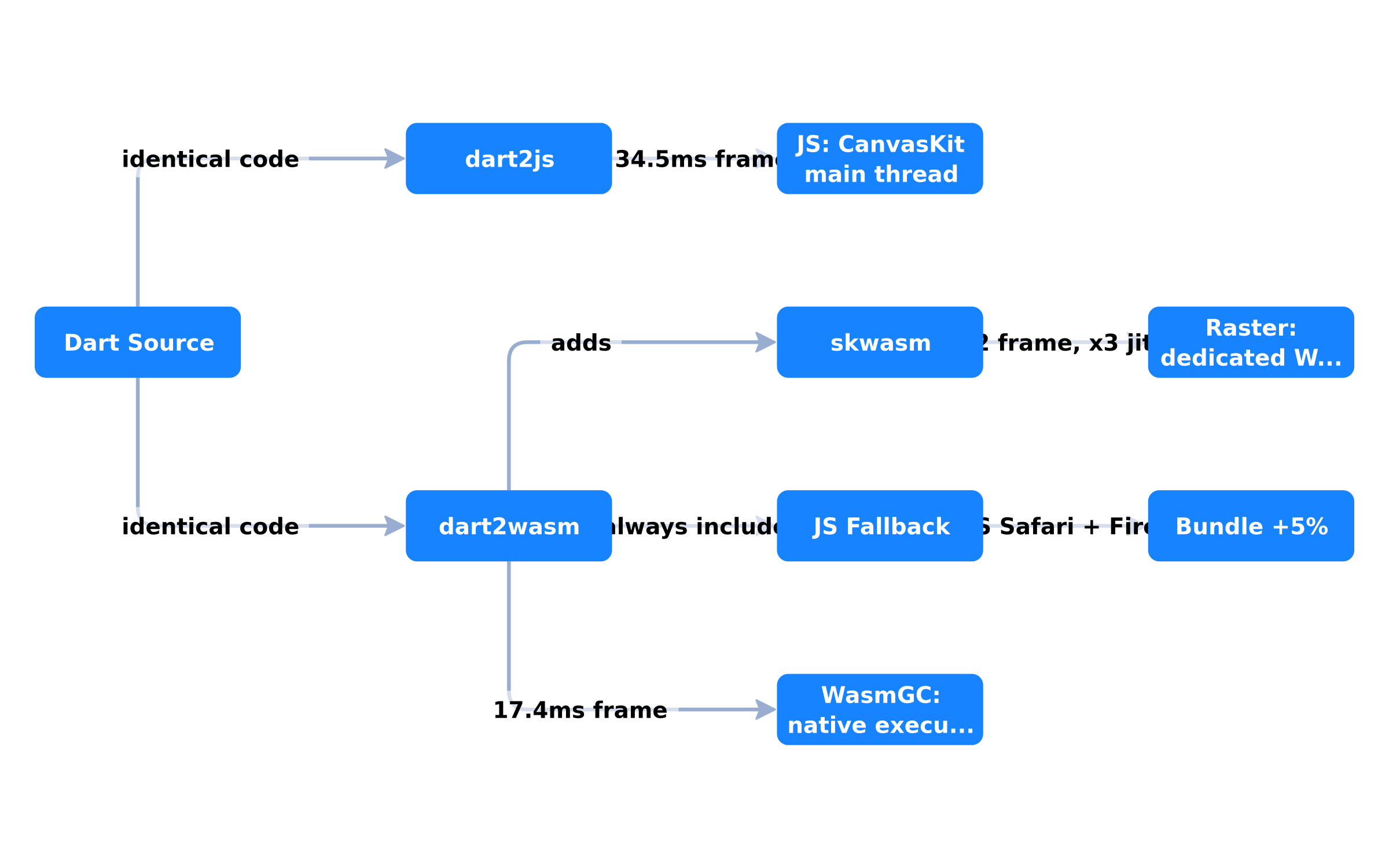 dart2js produces JS, dart2wasm produces WebAssembly. skwasm adds multithread rendering via Web Worker.
Benchmarks: lab vs production
Official Flutter numbers (August 17, 2026)
The Flutter blog shows results on a "medium stress" test (200 animated churn nodes):
| Metric | JS (dart2js) | Wasm (dart2wasm + skwasm) | Gain |
|---|---|---|---|
| Total frame time | 34.5 ms | 17.4 ms | 2x |
| Widget build time | 29.3 ms | 11.4 ms | 2.5x |
| Frame jitter (sigma) | +/-1.5 ms | +/-0.5 ms | 3x |
| Compressed bundle size | baseline | <=+5% | +5% |
Measured on Chrome 151, MacBook Pro M4 Pro (48 GB), macOS Sequoia 15.7.7, 60 Hz display.
Third-party benchmarks: three production apps
Flutter Studio migrated three real apps from CanvasKit/JS to Skwasm/Wasm (same machine, same Chrome, 5 runs, cache cleared):
Fintech App (charts, data aggregation):
| Metric | JS | Wasm | Delta |
|---|---|---|---|
| Time to first paint | 3.2 s | 2.1 s | -34% |
| Time to interactive | 4.8 s | 3.0 s | -38% |
| Chart redraw (200 pts) | 180 ms | 95 ms | -47% |
| List scroll (10K items) | 42 fps | 58 fps | +38% |
Logistics App (map, filters, 5K records):
| Metric | JS | Wasm | Delta |
|---|---|---|---|
| Time to first paint | 2.6 s | 1.8 s | -31% |
| Time to interactive | 3.5 s | 2.4 s | -31% |
| Map render (500 markers) | 320 ms | 210 ms | -34% |
| Filter 5K records | 85 ms | 45 ms | -47% |
| Steady state memory | 112 MB | 98 MB | -13% |
Inventory App (tables, barcode scanning):
| Metric | JS | Wasm | Delta |
|---|---|---|---|
| Time to first paint | 1.9 s | 1.4 s | -26% |
| Data table sort (2K rows) | 65 ms | 38 ms | -42% |
| Barcode scan + lookup | 140 ms | 90 ms | -36% |
| Steady state memory | 85 MB | 76 MB | -11% |
The constant: 25-40% faster at load, 30-47% on compute, 10-13% less memory. The highest-gain apps are those with the most Dart computation (charts, filters, sorting). Text-heavy pages show less improvement because the bottleneck is network and fonts.
FluxBoard (public demo, Andrea Della Porta)
While scrolling a 5,000-row table with animated charts:
| JS | Wasm | |
|---|---|---|
| Average FPS | ~34 fps | ~60 fps |
| Build time | ~26 ms | ~16.5 ms |
| Dropped frames | ~89 | 0 |
The gain is ~1.6x on build time -- enough to cross the 60 fps threshold. The demo is public on GitHub (FluxBoard).
iOS trap: the WebKit wall
Here is the number no "Flutter Wasm ready" article highlights: iOS does not support WasmGC.
- All iOS browsers use WebKit (mandated by Apple).
- WebKit does not support WasmGC.
- Flutter on iOS Safari always uses the JS fallback (dart2js).
- Chrome on iOS also uses WebKit (not Chromium). No WasmGC either.
Consequences:
- If your sales team uses iPads in the field, they do not benefit from the Wasm gain. The app works (JS fallback), but the 2x frame time does not apply.
- Firefox 120+ declares WasmGC stable, but a bug prevents Flutter rendering. Firefox falls back to JS too.
- In practice, Wasm truly runs faster only on Chrome and Edge as of August 2026.
Check your user base before pitching Wasm as a "major improvement for everyone."
dart:html is dead for Wasm
Condition number one for compiling with --wasm: zero imports of dart:html or package:js. The Flutter docs state this explicitly. The reason is technical: dart:html depends on legacy JS interop, incompatible with WasmGC.
Migration to package:web
| Old (legacy) | New (Wasm-ready) |
|---|---|
import 'dart:html' | import 'package:web/web.dart' |
import 'dart:js' | import 'dart:js_interop' |
@JS() from package:js | @JS() from dart:js_interop |
Diagnostics
# Dry-run (shows warnings without --wasm)
flutter build web

# Wasm build (fails if dart:html present)
flutter build web --wasm
The dry-run shows:
Wasm dry run failed:
Found incompatibilities with WebAssembly.
package:my_app/main.dart 1:1 - dart:html unsupported (0)
The failed build shows a structured dependency tree:
Context: The unavailable library 'dart:html' is imported through these packages:
    main.dart => package:my_app => dart:html
Estimated time
| dart:html surface | Estimated migration |
|---|---|
| Zero (already package:web) | Immediate |
| 1-3 third-party packages | 1-3 days |
| Custom interop | 3-7 days |
| Complete wrapper | 1-2 weeks |
The conditional import exists for progressive migration:
import 'fallback.dart'
  if (dart.library.js) 'legacy_web_interop.dart'
  if (dart.library.js_interop) 'wasm_web_interop.dart';
Not a hack. Official Dart mechanism.
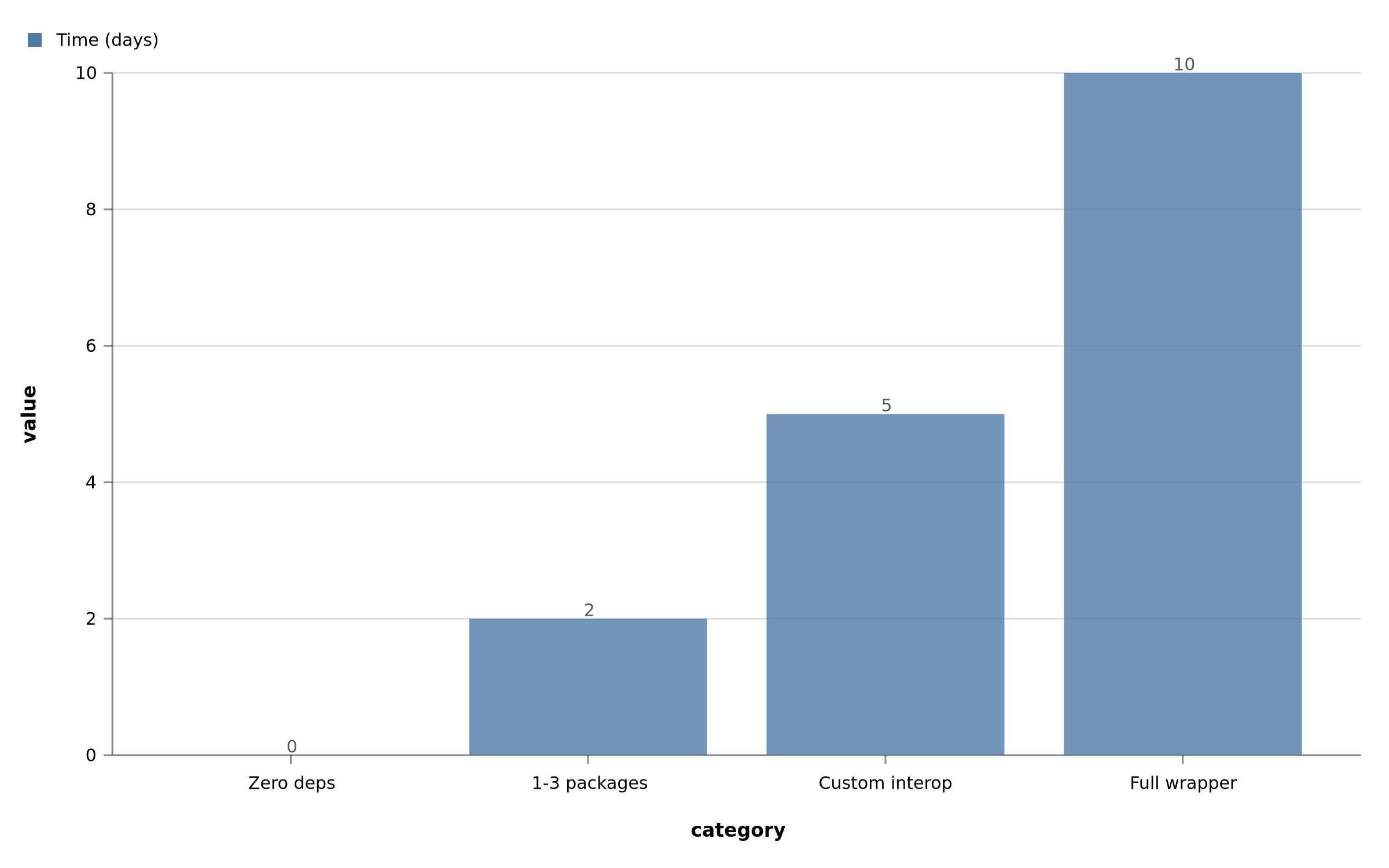 dart:html to package:web. The dry-run tells you exactly what to fix.
COOP/COEP: mandatory headers for multithread
For skwasm to run in multithread (raster on Web Worker), the browser requires a cross-origin isolated environment. Two HTTP headers:
| Header | Accepted value |
|---|---|
Cross-Origin-Embedder-Policy | credentialless or require-corp |
Cross-Origin-Opener-Policy | same-origin |
Without these headers
- Flutter runs single-thread. Build and raster run on the same thread.
- The dart2wasm gain persists (compiling to wasm is still faster than dart2js), but raster is no longer parallel.
- You lose the 3x jitter factor.
Configuration per hosting provider
| Provider | How |
|---|---|
| Vercel | vercel.json > headers array |
| Nginx | add_header Cross-Origin-Embedder-Policy "credentialless"; |
| Firebase Hosting | firebase.json > headers |
| Cloudflare Pages | _headers file at root |
| Netlify | _headers file at root |
| Hostinger | .htaccess or control panel |
Verification
Chrome DevTools > Application tab > check Cross-Origin-Isolation.
COEP + third-party iframes trap
If your app embeds third-party iframes (Stripe, Cal.com embed, Google Maps), credentialless may block them. credentialless is more permissive than require-corp. Use credentialless unless your iframe needs credentials.
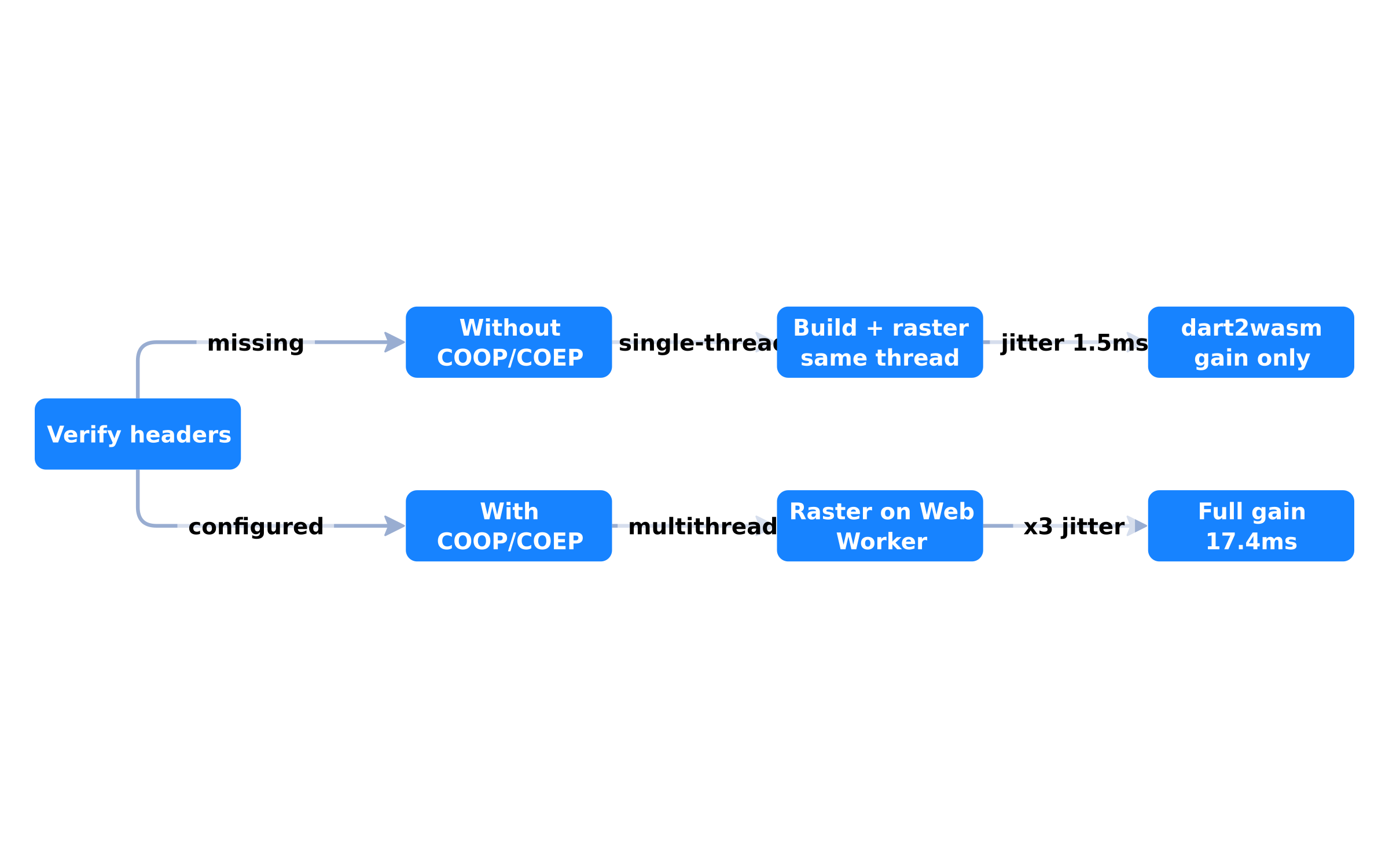 Without COOP/COEP: single-thread. With: raster on Web Worker. Jitter drops 3x.
The bundle grows, not shrinks
Counter-intuitive point: the --wasm build produces two files:
main.dart.wasm(for WasmGC browsers)main.dart.js(fallback for others)
The browser chooses at runtime. Total bundle is +<=5% compressed (official Flutter figure). Third-party measurements: +200 to 500 KB.
The advantage is not size but execution speed. If you optimize for 3G bandwidth, code splitting and image optimization remain your priorities.
Debug flags
# Production: source maps for Sentry/Datadog
flutter build web --wasm --source-maps

# Staging: function names in console
flutter build web --wasm --no-strip-wasm
--source-maps produces main.dart.wasm.map. --no-strip-wasm keeps function names but adds ~47% to Wasm binary size. Never use --no-strip-wasm in production.
Runtime detection
const isRunningWithWasm = bool.fromEnvironment('dart.tool.dart2wasm');
Useful for logging, analytics, or conditional branching.
The SEO trade-off (independent of Wasm)
Flutter web is an SPA. The HTML returned is nearly empty. Google crawls JavaScript but not all crawlers execute it. Wasm changes nothing about SEO: crawling depends on JS execution, not compilation format.
- dart2js crawled as JS.
- dart2wasm crawled as JS (the browser executes wasm like JS).
If you need indexable pages with content, SSR is required. Flutter has no mature SSR in 2026 (Frog is experimental). For indexable content sites, Next.js remains the most robust choice.
Wasm is not an argument for migrating a brochure site to Flutter.
Three cases, three decisions
1. Internal back-office (dashboard, business tool, production tracking)
Migrate. Compute-heavy app, controlled browser environment (Chrome on internal stations), no SEO. The 25-40% gain is measurable by users.
Steps: flutter upgrade > dry-run > package:web > --wasm staging > COOP/COEP > DevTools comparison > prod.
Risk: a sales rep on iPad Safari won't see the gain. Accept it or standardize Chrome.
2. Public app (accessible on the internet)
Test, don't promise. Heterogeneous user base (Safari, Firefox, Chrome). JS fallback covers everyone, but the Wasm gain only applies to Chrome/Edge.
Before migrating: GA4 > browsers. If >50% Chrome/Edge, Wasm is relevant. If >40% Safari, the gain is diluted.
SEO risk: Wasm doesn't solve the crawl problem. Content remains JS for search engines.
3. No Flutter web app
Ignore. Wasm doesn't transform Next.js. It doesn't speed up WordPress. It doesn't build a brochure site. The Flutter blog on August 17 speaks to teams who already have Flutter web in production.
If your need is a site that takes bookings, look at brochure site vs booking system. If it's a mobile app, look at Flutter vs React Native.
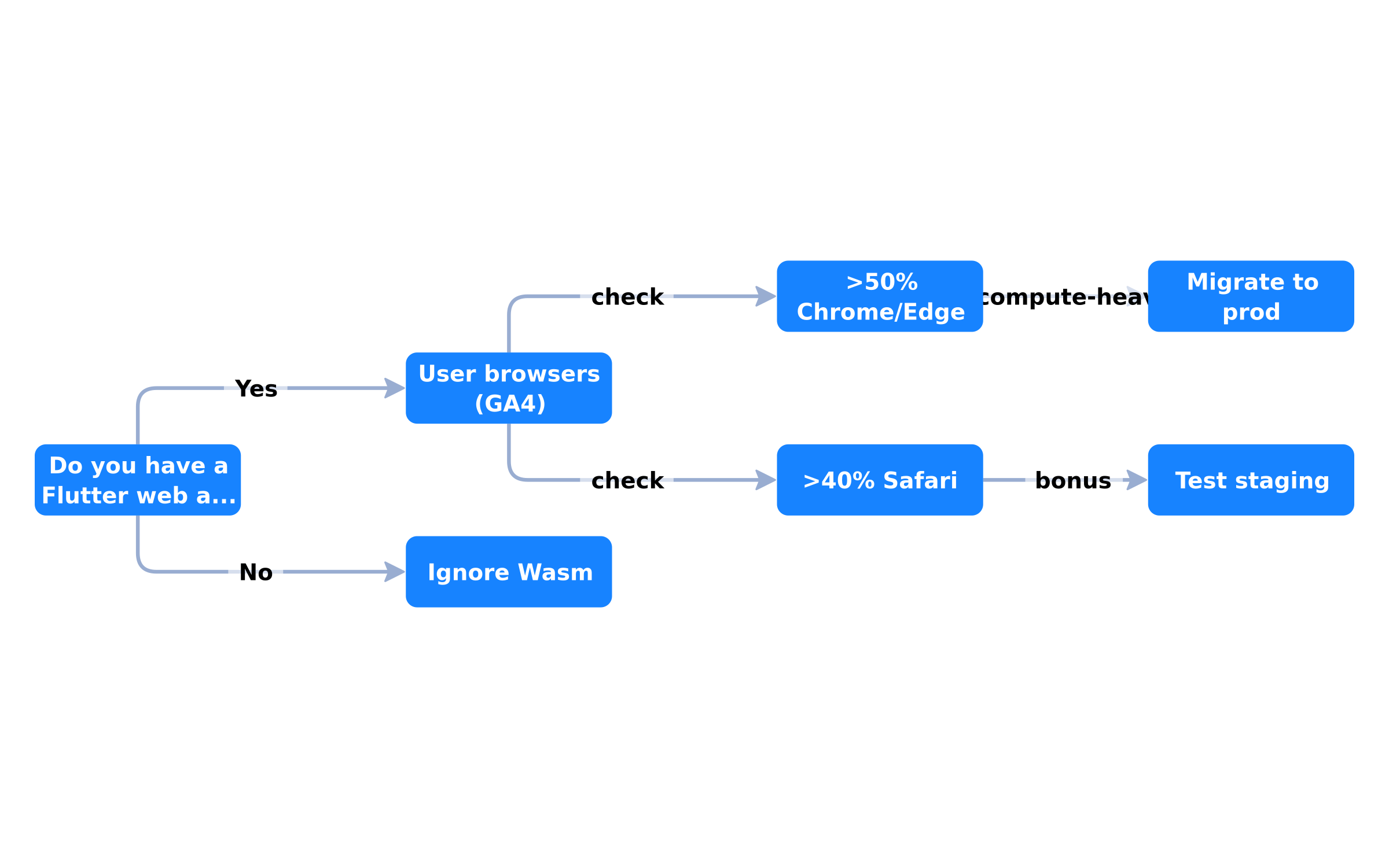 Internal dashboard Chrome > migrate. Public app > test. No Flutter web > ignore.
Migration checklist
flutter upgradeto 3.47+flutter build web(without--wasm) > read dry-run warnings- If dart:html > migrate to
package:web flutter build web --wasm> if fails, read dependency tree- Configure COOP same-origin + COEP credentialless
- DevTools > Application > Cross-Origin-Isolation > verify
- Measure: Performance tab > frame time, jank, build time
- Compare with JS build on the same page
- If gain > 20% on compute-heavy pages > production candidate
- If gain < 10% > app is not compute-heavy > stay on JS
- Test Safari iOS (JS fallback) and Firefox (JS fallback)
- If user base > 40% Safari > Wasm is a bonus, not a requirement
What Wasm does NOT do
- Speed up the network. A 500 ms API call stays at 500 ms. Wasm is not a CDN.
- Improve SEO. Crawlers still cannot see Dart content. SSR remains separate.
- Reduce the bundle. The bundle grows ~5% (wasm + js fallback).
- Run on iOS Safari. WasmGC is not supported on WebKit. JS fallback only.
- Fix Dart architecture. If your app rebuilds everything on setState, Wasm accelerates but does not refactor.
- Replace a redesign. Wasm is a render optimizer, not a UX designer.
FAQ
Is Flutter web Wasm production-ready in 2026?
Yes, with caveats. WasmGC has been stable since Flutter 3.22 (May 2024). 58% of existing Flutter web apps compile to Wasm with zero code changes. Chrome 119+ supports WasmGC. Firefox 120+ declares WasmGC stable but a bug blocks Flutter rendering. Safari supports WasmGC but a similar bug blocks Flutter. All iOS browsers use WebKit, no WasmGC. The JS fallback is always included.
Are COOP/COEP headers required for Flutter web Wasm?
Yes, for multithread rendering via skwasm. Without COEP credentialless + COOP same-origin, Flutter runs single-thread. Performance is still better than dart2js but the parallel raster on Web Worker is disabled. Configure them on your hosting provider and verify in Chrome DevTools.
Is the Wasm bundle smaller than the JS bundle?
No. The --wasm build produces main.dart.wasm AND main.dart.js (fallback). Total bundle ~5% larger compressed (+200 to 500 KB). The gain is in execution speed (25-40%), not size.
Where should my team start if we have a Flutter web app?
flutter upgradeto 3.47+. 2)flutter build webwithout--wasmto read warnings. 3) Fix dart:html topackage:web. 4)flutter build web --wasmon staging. 5) Configure COOP/COEP. 6) Measure with Chrome DevTools. 7) Compare frame times. 8) If gain > 20% ship it. If < 10% stay on JS.
What if we're still on Flutter 3.22?
WasmGC has been stable since 3.22. But skwasm optimizations and header fixes have evolved since. Update to staging first. The dry-run works on 3.22.
Conclusion
Flutter web Wasm in 2026 is not a universal revolution. It is a targeted performance tool. The gains are real (25-40% at load, 2x frame time, 3x jitter) but limited to compute-heavy apps, on Chrome/Edge, with the right headers.
If your Flutter web app is a Chrome back office, migration is relevant this week. If it is a public app, test first. If you don't have a Flutter web app, this week doesn't concern you.
30 minutes are enough for a verdict: flutter build web > read warnings > flutter build web --wasm > DevTools comparison. If the gain is < 10%, Wasm is not your priority.
Free audit of your Flutter code
30 min -- we open your repo, check Wasm compatibility, dart:html dependencies, and your hosting provider's headers. No commitment.
References: Flutter WebAssembly Week (flutter.dev/blog) / Flutter Wasm docs (docs.flutter.dev) / Flutter Studio benchmarks (flutterstudio.dev) / FluxBoard demo (GitHub) / flutter-wasm-compare (GitHub)
Tags
FAQ
Is Flutter web Wasm production-ready in 2026?
Yes, with caveats. WasmGC has been stable since Flutter 3.22 (May 2024). The Flutter blog on August 17, 2026 reports that 58% of existing Flutter web apps compile to Wasm with zero code changes. Chrome 119+ supports WasmGC. Firefox 120+ declares WasmGC stable but a bug prevents Flutter rendering. Safari supports WasmGC but a similar bug blocks Flutter. All iOS browsers use WebKit and do not support WasmGC. The JS fallback is always included.
Are COOP/COEP headers required for Flutter web Wasm?
Yes, for multithread rendering via skwasm. Without COEP credentialless and COOP same-origin, Flutter runs single-thread. Performance is still better than dart2js but you lose the parallel raster on Web Worker.
Is the Wasm bundle smaller than the JS bundle?
No. The --wasm build produces main.dart.wasm AND main.dart.js (fallback). Total bundle is ~5% larger compressed (+200 to 500 KB). The gain is in execution speed (25-40%), not size.
Where should my team start if we have a Flutter web app?
1) flutter upgrade to 3.47+. 2) flutter build web without --wasm to see dry-run warnings. 3) Fix dart:html imports to package:web. 4) flutter build web --wasm on staging. 5) Configure COOP/COEP. 6) Measure with Chrome DevTools. 7) Compare frame times. 8) If gain > 20% ship it, otherwise stay on JS.
Does your site book meetings — or just present you?
We open your URL together, mark the 3 leaks, and tell you whether a fix is enough or a rebuild is required.
- 30 min
- No commitment
- Action plan
William Aklamavo
Web development and automation expert, passionate about technological innovation and digital entrepreneurship.


