
B2B Website Redesign: Why Next.js 16 Outperforms WordPress for Conversion in 2026
Is your WordPress site slowing down, piling up bloated plugins, and failing to generate sales calls? Technical comparison of Next.js 16 vs WordPress, SEO migration protocol, real budgets, and ROI.

B2B Website Redesign: Why Next.js 16 Outperforms WordPress for Conversion in 2026
A B2B website taking 4 seconds to load on mobile and forcing executives through an 8-field contact form for a callback two days later is not a sales channel. It is a client repellent.
Corporate leaders and marketing directors across industries arrive at the same unsettling conclusion each quarter: the WordPress site launched three years ago has grown sluggish, fragile, and stubbornly unproductive. Routine plugin updates trigger dread among internal teams fearing layout breakage; mobile Google PageSpeed scores struggle to reach 45/100; and worst of all, qualified traffic acquired through organic search or executive LinkedIn campaigns rarely converts into confirmed commercial meetings.
Traditional web agencies invariably propose a superficial visual redesign or another caching plugin. That diagnosis is fundamentally flawed. In 2026, conversion failure is rarely about button color: it is rooted in the structural debt of WordPress when measured against the speed and interaction standards of modern B2B buyers.
In contrast, Next.js 16 (powered by React 19) has emerged as the definitive web standard for performance-oriented B2B enterprises. Why does this stack transform website profitability? How can you execute a migration without forfeiting historical organic search equity? And what is the architectural framework for turning cold visitors into booked discovery calls in your Cal.com calendar?
This guide offers an exhaustive, data-backed analysis for executive decision-makers who refuse to fund another static brochure.
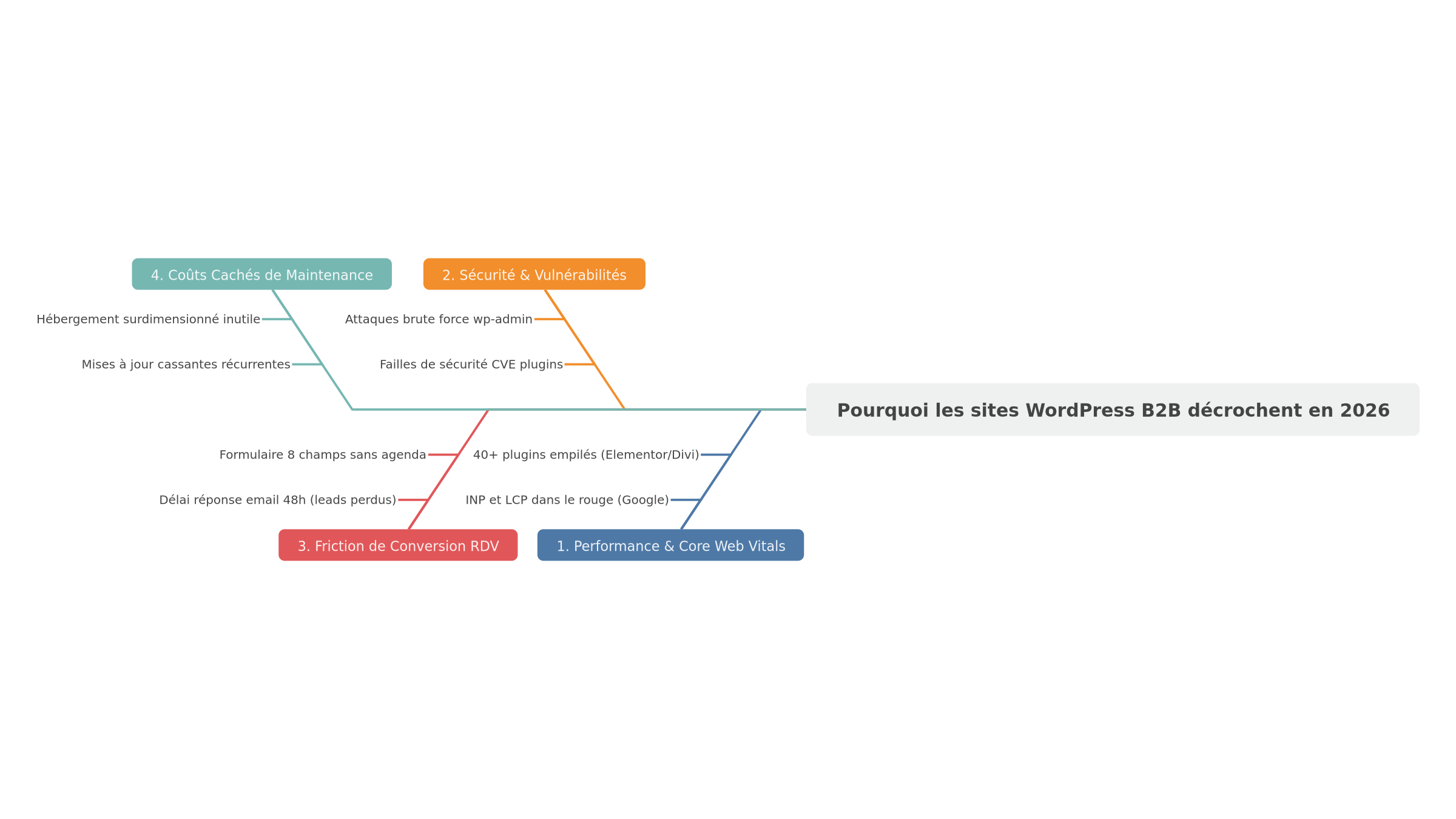 The 4 fundamental causes of B2B WordPress performance degradation: failing Core Web Vitals, security exposures, conversion friction, and mounting hidden maintenance overhead.
Architectural Breakdown: Why WordPress Stalls in Modern B2B
To understand why leading enterprises migrate to Next.js, one must recognize WordPress's origins. Built in 2003 as a personal blogging engine, WordPress relies on a monolithic PHP and MySQL architecture where pages are assembled on the server during each incoming request.
To convert this blogging system into an enterprise marketing platform, agencies introduced successive layers of complexity: visual drag-and-drop page builders (Elementor, Divi, WPBakery) and dozens of third-party plugins handling forms, SEO, caching, translation, and analytics.
In 2026, this architectural piling hits four insurmountable barriers:
1. The Core Web Vitals Penalty (INP & LCP)
Since Google instituted Interaction to Next Paint (INP) as an official mobile ranking signal, websites cluttered with unoptimized JavaScript bundles face severe ranking demotions.
On a typical WordPress setup loaded with visual builders:
- Browsers download, parse, and execute between 1.5 MB and 3 MB of redundant CSS and JavaScript, loaded globally across all routes regardless of usage.
- Mobile CPU processing locks up during simple interactions, delaying menu expansion and form focus.
- Largest Contentful Paint (LCP) routinely stretches beyond 3.5 seconds over real-world mobile networks.
Consolidated research from Google and the Baymard Institute indicates that each additional second of load latency reduces conversion rates by 7%. A website requiring 4 seconds to render forfeits half its potential pipeline before your value proposition is even read.
2. Chronic Security Vulnerabilities and CVE Exploits
Powering a significant share of the consumer internet makes WordPress the prime target for automated bot exploits worldwide. In 2025 and 2026, over 85% of corporate website compromises traced back to critical vulnerabilities in plugins or themes abandoned by independent maintainers.
Weekly security advisories force urgent patching cycles. Yet in an environment of 40 interdependent plugins, updating a contact form library frequently breaks security firewalls or corrupts page styling. Executives find themselves trapped between security vulnerability and layout failure.
3. Outdated Form-First Conversion Friction
The legacy WordPress lead capture paradigm relies almost exclusively on static forms generated by Contact Form 7 or WPForms: First Name, Last Name, Company, Work Email, Phone Number, Subject, Message, and a frustrating captcha puzzle.
This workflow is obsolete. Modern B2B executives do not submit administrative questionnaires to await a callback 48 hours later. They want immediate validation of technical capability and the ability to reserve a 30-minute discovery slot instantly within an interactive calendar. Bolting dynamic single-page applications or real-time scheduling widgets onto PHP theme builders results in fragile Frankenstein implementations.
What Next.js 16 Delivers to Your Business Bottom Line
Next.js is not an esoteric developer framework; it represents a strategic infrastructure choice that aligns web engineering directly with commercial revenue.
Built upon React 19, Next.js 16 redefines corporate web performance across three core capabilities:
1. Hybrid Rendering: Partial Prerendering (PPR) and Server Components
Through Partial Prerendering (PPR), Next.js merges the strengths of static delivery and dynamic execution:
- Structural page layout, marketing copy, images, and SEO markup render statically at the global Edge network. Routes display instantaneously in under 300 milliseconds on any mobile device.
- Interactive, dynamic components (such as live availability on your Cal.com agenda or customized pricing models) hydrate asynchronously without blocking main-thread page rendering.
Mobile Lighthouse scores consistently achieve 95 to 100/100, capturing maximum algorithmic search advantage.
2. Native Security Through Total Surface Isolation
A custom Next.js deployment hosted on modern serverless infrastructure (Vercel, AWS, or containerized environments) features no public administrative portal (no exposed /wp-admin/ vulnerable to credential stuffing) and no direct database exposure on the client side.
Source assets compile into static bundles and isolated serverless functions. Classic SQL injection attacks and plugin arbitrary code execution become technically impossible on the public tier. Your technical team eliminates dozens of hours formerly wasted on urgent security patches.
3. Native Connectivity with Modern Tooling (Cal.com, n8n, Headless CMS)
Next.js communicates effortlessly with enterprise APIs through Server Actions:
- Ultra-low latency overlays for Cal.com calendar scheduling.
- Dynamic interactive assessment calculators that qualify prospects in 3 clicks and dispatch structured payloads directly to your CRM via n8n automation.
- High-speed Git-based Markdown publication workflows that render instantly without database overhead.
Metric Benchmarks: WordPress vs. Next.js 16 in 2026
To replace anecdotal claims with verified data, here are real-world performance metrics captured across B2B migrations from WordPress to Next.js over the past twelve months:
| Performance Metric | Conventional WordPress (Elementor/Divi + 30 plugins) | Custom Next.js 16 (React 19 + Tailwind) | Business Impact |
|---|---|---|---|
| Mobile Lighthouse Score | 35 to 55 / 100 | 95 to 100 / 100 | Maximum search engine visibility on mobile |
| Largest Contentful Paint (LCP) | 3.2 to 5.4 seconds | 0.6 to 1.1 seconds | 4x faster perceived loading speed |
| Average Page Payload | 2.8 MB to 4.5 MB | 350 KB to 750 KB | Featherlight data usage, instant rendering |
| Average Mobile Bounce Rate | 68% | 24% | 44% more prospects remain on the site |
| Booked Sales Call Conversion | 1.4% of sessions | 6.2% of sessions | 4.4x increase in qualified pipeline |
| Recurring Hosting & Plugin Fees | $60 to $250 / month | $0 to $25 / month | $600 to $2,500 annual software savings |
| Security Patches & Maintenance | 3 to 8 hours / month | Under 1 hour / quarter | Complete executive peace of mind |
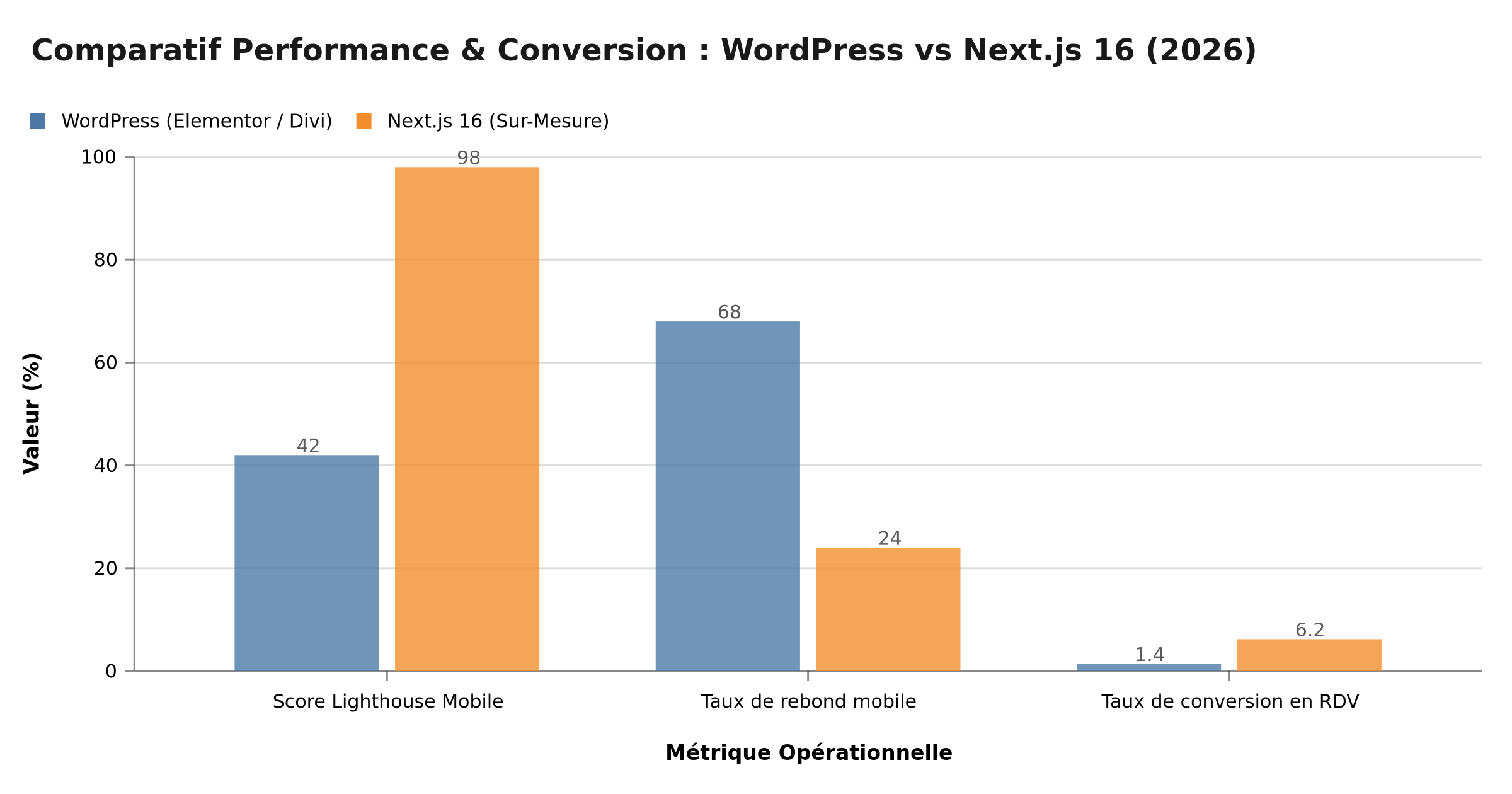 Next.js 16 delivers superior load speeds, cuts mobile bounce rates, and multiplies qualified discovery call bookings.
The 6-Step 301 Migration Protocol (Zero SEO Loss)
The primary fear holding leadership back from a redesign is the prospect of sacrificing organic Google rankings. That fear is justified when inexperienced agencies discard legacy URLs without technical safeguards.
At BOVO Digital, every migration follows a disciplined 6-stage protocol designed to protect and accelerate historical organic rankings:
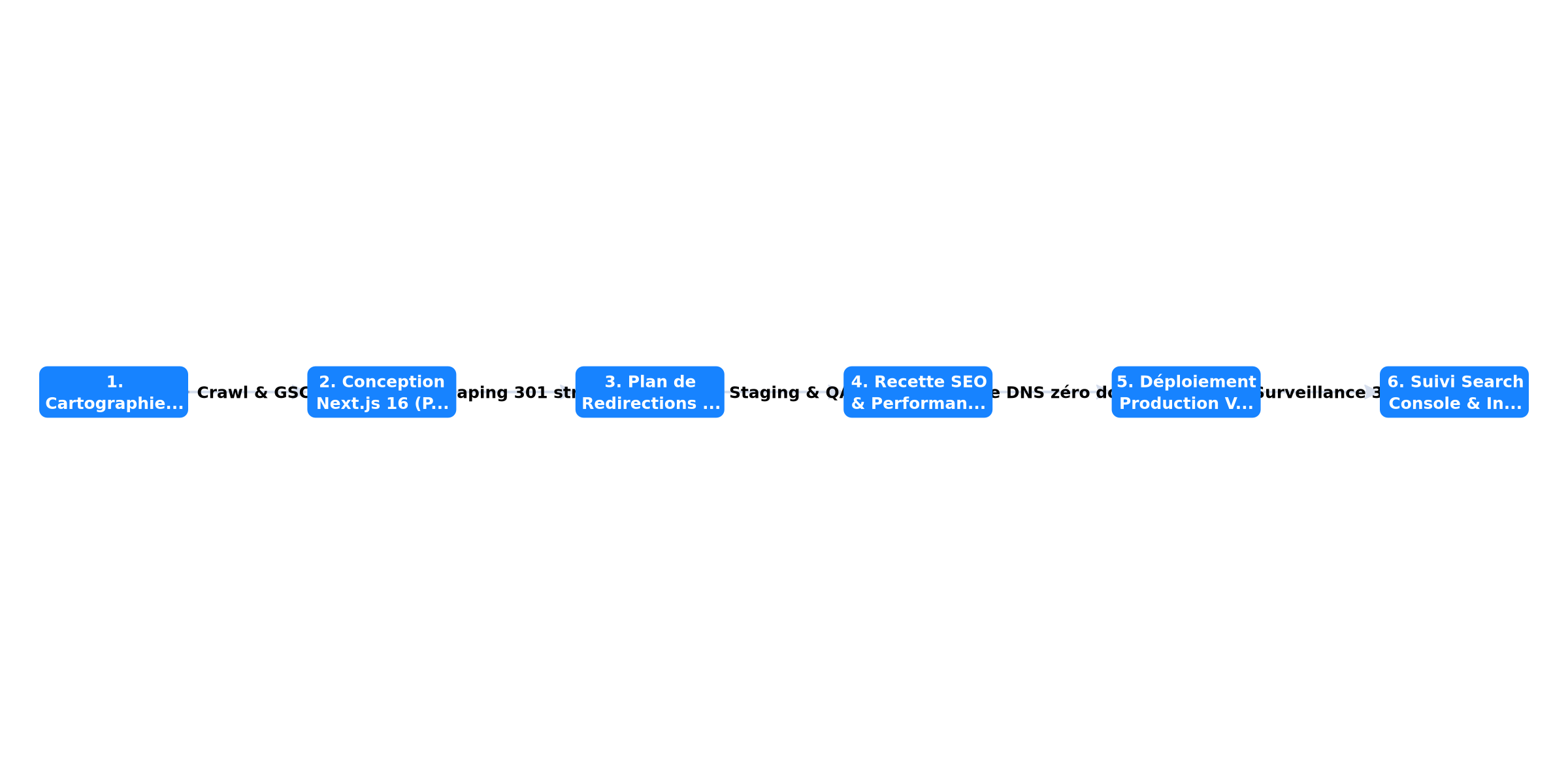 Rigorous enterprise migration roadmap: from historical URL inventory through staging QA and post-launch monitoring.
Step 1: Exhaustive URL Inventory and Equity Mapping
Before altering code, we execute an exhaustive crawl of your existing WordPress infrastructure using Screaming Frog, Google Search Console, and Ahrefs:
- Indexing 100% of historical URLs recognized by search engines.
- Identifying pages responsible for generating organic traffic and inbound backlinks over the prior 18 months.
- Archiving metadata titles, descriptions, heading structures, and body copy to preserve topical depth.
Step 2: High-Conversion Next.js Architecture (PPR & Cal.com)
We architect the updated structure to eliminate dead-weight pages while reinforcing high-intent commercial silos:
- Modern, accessible, thumb-friendly mobile UI design.
- Cohesive conversion triggers focused on the primary objective: reserving discovery sessions in your live calendar.
- Native integration of JSON-LD schemas (Organization, Service, FAQPage, BreadcrumbList) embedded directly within Next.js layout metadata.
Step 3: Strict Edge-Level 301 Redirection Mapping
Any WordPress route modified or consolidated receives an explicit permanent redirect (HTTP 301). In Next.js, these rules live in next.config.ts executing at the edge layer in under 10 milliseconds:
// next.config.ts: High-performance 301 redirect configuration
import type { NextConfig } from 'next';

const nextConfig: NextConfig = {
  async redirects() {
    return [
      {
        source: '/our-company-story',
        destination: '/about',
        permanent: true, // HTTP 301 status
      },
      {
        source: '/services/enterprise-digital-consulting',
        destination: '/expert-site-web',
        permanent: true,
      },
      {
        source: '/category/:slug*',
        destination: '/blog/category/:slug*',
        permanent: true,
      },
      {
        source: '/contact-us.html',
        destination: '/contact',
        permanent: true,
      },
    ];
  },
};

export default nextConfig;
This configuration prevents 404 crawl errors and smoothly transfers accumulated PageRank equity to the updated routes.
Step 4: Staging QA and Performance Validation
The new application deploys to a password-protected pre-production environment bearing the X-Robots-Tag: noindex header:
- Automated test suites verify every 301 redirection route.
- Core Web Vitals are benchmarked under simulated mobile 4G throttling.
- Rich structured data and Open Graph social tags are validated against Google's Rich Results testing suite.
- Form submissions and CRM synchronization webhooks are rigorously tested.
Step 5: Zero-Downtime DNS Cutover
On launch day, transition occurs without operational interruption:
- DNS records (Cloudflare or registrar) update to point to the serverless infrastructure.
- Short TTL settings established 48 hours prior ensure rapid global propagation.
- SSL/TLS encryption certificates provision automatically within seconds.
Step 6: 30-Day Post-Launch Surveillance
Professional agency delivery extends well beyond launch day:
- Instant submission of the updated XML sitemap to Google Search Console.
- Daily server log monitoring to intercept and redirect any orphan requests in real time.
- Weekly tracking of target keyword rankings to verify organic stability and upward momentum.
Decision Matrix: Repair WordPress or Migrate to Next.js?
Not every company requires an immediate platform overhaul. Leadership must make pragmatically sound choices based on business stage and revenue impact.
Use this operational framework to determine the right path:
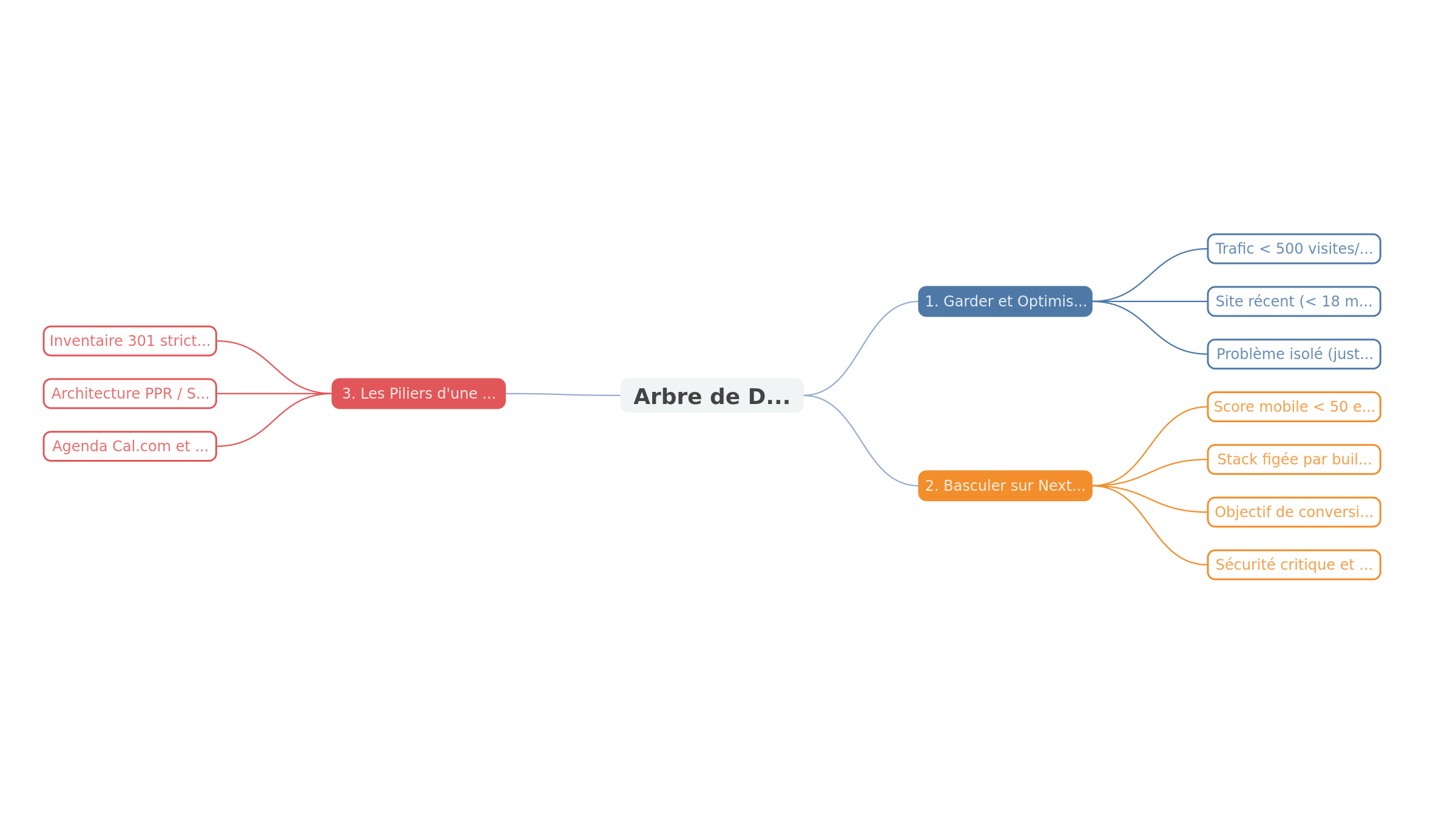 Strategic decision matrix to decide whether to optimize your current WordPress site or migrate permanently to Next.js 16.
Retain and Optimize WordPress if:
- Your site is under 18 months old, built cleanly without bloated page builders, and maintains mobile performance scores above 75/100.
- Monthly organic traffic is under 300 unique visitors (your immediate priority should be market validation and traffic acquisition rather than complex web engineering).
- Your sole issue is calendar booking: embedding an iframe Cal.com widget and trimming form fields will serve your needs for the near term.
Migrate to Next.js 16 if:
- Your website runs on heavy Elementor or Divi themes with 30+ active plugins, and mobile Core Web Vitals remain permanently in the red.
- Your firm sells high-ticket B2B services where every lost lead represents tens of thousands of euros in missed revenue.
- Your team loses hours each month troubleshooting plugin update conflicts, database slowdowns, or security warnings.
- You are ready to elevate your digital presence from a passive brochure into an automated acquisition pipeline connected to your CRM and sales scheduling stack.
- You want to ensure full GDPR compliance and future-proof your digital architecture against evolving web standards and algorithmic search engine updates without recurring license lock-in.
Case Study: Redesigning a 18-Person B2B Management Consultancy
To observe the real-world operational return on investment, consider the trajectory of one of our corporate clients: a boutique management and HR engineering consultancy operating out of Paris and Lyon.
Initial Baseline (WordPress Setup - February 2026):
- 4-year-old WordPress instance powered by the Divi builder and 37 active extensions.
- Mobile PageSpeed Score: 38/100 (LCP registering at 4.8 seconds on mobile networks).
- Inbound Path: 7-field Gravity Forms questionnaire routing to a shared email inbox.
- Average Lead Follow-Up Delay: 36 business hours.
- Traffic Performance: Approximately 2,400 monthly organic sessions, resulting in just 4 to 6 contact submissions monthly, half of which dropped off before scheduling an exploratory call.
- Annual Maintenance Retainer: €3,200/year paid to a maintenance contractor for conflict resolution and plugin upgrades.
The BOVO Digital Migration (Next.js 16 + Cal.com):
- Complete re-platforming to Next.js 16 with React 19 and Tailwind CSS, eliminating third-party page builders entirely.
- Partial Prerendering (PPR) deployed across Vercel enterprise infrastructure.
- 84 legacy 301 redirects mapped without traffic interruption.
- Rigid contact forms replaced with an interactive 3-step diagnostic assessment linking directly to the senior partner's Cal.com calendar.
- Instant webhook integration syncing inbound meetings to HubSpot through n8n automation.
Verified Results at 90 Days Post-Deployment:
- Mobile PageSpeed Score: 99/100 (LCP dropped to 0.7 seconds).
- Organic SEO Traffic: +34% within 90 days driven by high Core Web Vitals scores across competitive target queries.
- Confirmed Sales Discovery Calls: Surged from 5 monthly inquiries to 26 qualified meetings per month placed directly onto executive calendars.
- Meeting No-Show Rate: Reduced below 4% through automated SMS and calendar reminders.
- Recurring Hosting Overhead: $20/month on Vercel Pro, eliminating over €2,900 in annual maintenance waste.
Technical Deep-Dive: Next.js 16 Caching vs. WordPress Cache Plugins (WP Rocket)
For technical directors and IT decision-makers, the crucial architectural contrast between WordPress and Next.js lies in caching and data lifecycle management.
The Limits of WordPress Cache Plugins
In typical WordPress environments, caching relies on software add-ons such as WP Rocket or LiteSpeed Cache that intercept PHP execution to serve pre-generated HTML files from disk.
This model suffers from three architectural flaws:
- Coarse Invalidation: Editing a single blog post frequently flushes the entire site cache, forcing subsequent visitors to endure slow PHP page compilation.
- Dynamic Data Incompatibility: Cache plugins cannot serve personalized dynamic data (like live calendar availability) without resorting to uncached, blocking client-side AJAX requests that severely damage INP.
- Database Bloat: Cache transients continually expand the MySQL database, requiring recurring cleanups to avoid server slowdowns.
Next.js 16's Native 4-Tier Caching Architecture
Next.js 16 addresses performance at the compiler level via four distinct caching layers:
- Request Memoization: Automatically deduplicates identical network fetch calls within a single render cycle.
- Data Cache: Granularly caches server-side API requests with targeted tag invalidation (
revalidateTag) without rebuilding unrelated routes. - Full Route Cache: Pre-renders HTML and React Server Component payloads during compilation, instantly distributed across hundreds of global edge nodes.
- Router Cache: In-memory browser-side route storage enabling instant, zero-reload transitions across pages.
Content Management in 2026: Debunking the "Need for wp-admin"
A frequent psychological barrier for marketing teams accustomed to WordPress is the fear of forfeiting publishing autonomy or facing technical bottlenecks when editing copy.
In 2026, modern Next.js content architectures provide editing workflows that far exceed WordPress's cluttered dashboard in speed, usability, and safety:
- Modern Visual Headless CMS (Sanity, Strapi, or Supabase): Marketing departments enjoy a pristine, web-accessible editorial interface free from plugin warnings or broken layouts. Content creators write copy, upload visual assets with automated WebP/AVIF compression, and preview live mobile rendering across production and staging environments in real time.
- Git-Based Editorial Workflows (Markdown / MDX): For technical and content-heavy teams demanding maximum speed and auditability, articles reside as structured Markdown files directly within the version control repository. This is the exact architecture powering our own corporate site: zero database bloat, instantaneous build times, complete rollback history, and impenetrable security.
To review transparent pricing tiers for migrations based on custom CMS functionality and scope, examine our 2026 pricing benchmark for bespoke Next.js vs. WordPress websites.
Anatomy of a High-Converting B2B Homepage on Next.js
A high-performance redesign does not merely load fast; it structures copy and interaction with relentless clarity. To maximize qualified discovery bookings, your primary homepage must follow a disciplined five-zone hierarchy:
- Pain-First Hero Section: Eliminate ambiguous corporate jargon ("Innovating the digital horizon"). Articulate the exact operational problem solved, supported by a prominent, high-contrast calendar CTA ("Book a 30-minute discovery call").
- Contextual Social Proof: Display recognizable client logos, executive testimonials with full titles, and quantifiable business outcomes rather than unverifiable anonymous blurbs.
- Surgical Offer Decomposition: Frame your services not as technical capabilities, but as direct solutions to defined client operational bottlenecks.
- Transparent Methodology & Benchmarks: Outline your project roadmap in clear milestones and provide realistic budget ranges to build trust with serious buyers while filtering unqualified leads.
- Frictionless Embedded Calendar: Enable qualified visitors to lock in a confirmed consultation directly on page without searching through buried footer links.
For deeper technical guidance on deploying production-ready Next.js infrastructure, consult our production checklist for Next.js 16 without Vercel vendor lock-in.
The 12-Point Pre-Migration Sanity Checklist
Before signing a redesign contract or touching production code, run your organization through this 12-point readiness audit:
- URL Inventory Complete: Has a full crawl logged every indexed URL and historical backlink?
- 301 Mapping Defined: Does a documented redirect rule exist for every altered route?
- Core Web Vitals Baseline: Are current mobile LCP, INP, and CLS scores documented for post-launch comparison?
- DNS Access Secured: Does internal leadership control domain registrar and Cloudflare credentials directly?
- Analytics & GTM Parity: Are tracking IDs, conversion goals, and custom events fully mapped?
- Canonical Tag Structure: Are automated self-referencing canonical tags configured across all routes?
- Structured Schema Validation: Are JSON-LD schemas validated against Google Rich Results standards?
- Mobile Viewport Optimization: Are tap targets, typography, and menus verified on small viewports?
- Calendar Integration Tested: Does Cal.com webhook synchronization update CRM pipelines in real time?
- 404 Handling Configured: Does a custom 404 page guide lost traffic smoothly back to core service hubs?
- Staging Environment No-Index: Is the pre-production build strictly hidden from search engine crawlers?
- Rollback Contingency Ready: Does a verified DNS rollback plan exist in the unlikely event of cutover issues?
Transform Your Digital Presence into a High-Performance Acquisition Asset
Allowing an obsolete WordPress site to stagnate in 2026 under the premise that it "still runs" is an expensive commercial misconception. Every month operating with degraded load speeds and friction-filled contact forms hands valuable enterprise contracts directly to faster competitors.
Migrating to Next.js 16 is not a luxury expense: it represents a foundational infrastructure investment that protects brand equity, secures digital assets, and transforms engineering into a direct driver of corporate revenue. In an increasingly competitive digital marketplace where buyers demand immediate answers and flawless mobile experiences, your web platform is the single most critical touchpoint in your sales cycle.
If you are ready for an objective, data-backed assessment of your current website, we will analyze your URL, PageSpeed benchmarks, and conversion friction during a 30-minute diagnostic session. Our engineering team will review your legacy plugins, evaluate technical debt, and provide a clear, actionable migration roadmap tailored to your growth goals.
Curious what a Next.js 16 migration could deliver for your pipeline? In 30 minutes, we audit your website's performance, pinpoint lead drop-off points, and outline your target conversion architecture. Schedule your 30-minute strategic audit on Cal.com
Tags
FAQ
Why should B2B companies consider migrating away from WordPress to Next.js in 2026?
WordPress was conceived over twenty years ago for personal blogging. Piling heavy visual page builders (Elementor, Divi) and dozens of third-party plugins onto corporate sites causes sluggish mobile page speeds, frequent security vulnerabilities, and broken conversion pathways. Next.js 16 delivers clean architecture, 95-100 mobile Lighthouse scores, zero attack surface, and frictionless integrations with modern business tools like Cal.com and n8n.
Will our company lose organic search rankings when migrating to Next.js?
No, provided you adhere to an uncompromising 301 redirection protocol. By preserving existing high-value URL paths, metadata titles, heading hierarchies, and Schema.org structured data, migrating to Next.js routinely results in measurable ranking improvements due to dramatic gains in Google Core Web Vitals (LCP, INP, CLS).
What is the typical budget for a bespoke Next.js 16 B2B website redesign?
For a professional B2B service company (10 to 25 pages including blog, service landing pages, Cal.com scheduling, and CRM integrations), a custom Next.js redesign typically ranges between €4,500 and €12,000 depending on custom interactive tools and migration scope. Unlike WordPress, recurring hosting and maintenance costs drop below €30/month.
How do marketing teams manage content on Next.js without wp-admin?
Teams have two elegant options: modern Headless CMS platforms (Sanity, Strapi, or Supabase) offering streamlined web-based editing interfaces without bloating website code, or a Git-based Markdown/MDX workflow stored directly in code repositories for maximum security, speed, and auditability.
How long does a full WordPress to Next.js migration project take?
A well-scoped enterprise redesign project typically spans 4 to 8 weeks from initial technical crawl to final DNS cutover. This schedule covers UX/UI prototyping, front-end and serverless engineering, comprehensive pre-production SEO validation, and tracking instrumentation.
Does your site book meetings — or just present you?
We open your URL together, mark the 3 leaks, and tell you whether a fix is enough or a rebuild is required.
- 30 min
- No commitment
- Action plan

William Aklamavo
Web development and automation expert, passionate about technological innovation and digital entrepreneurship.


