
Custom Website Cost in 2026: How Much Should You Budget?
Brochure site, booking site, online store or SaaS: 2026 prices by project type, WordPress vs Next.js vs Webflow, and the yearly costs to plan for.

Updated

Custom website cost in 2026: how much should you budget?
You do not compare website quotes by the total at the bottom. You compare scope, yearly costs and what you own at the end.
A custom website cost in 2026 ranges from a few thousand euros to well over €40,000. According to the La Fabrique du Net barometer (1,312 budgets reported by 175 French agencies, July 2026), the median website costs €5,200. A brochure site sits around €3,500, an online store around €10,000, and custom development around €18,000. US guides published in 2026, such as Gilzor, quote $5,000–$20,000 for a professionally built small business site.
At BOVO Digital, a custom Next.js first version starts at €2,000 (SaaS MVP offer, delivered in 3–4 weeks). This guide gives you prices by project type, compares WordPress, Next.js and Webflow, prices the yearly costs with dated official rates, and lists the quote traps we see when prospects show us competing offers.
How much does a website cost in 2026? The answer by project type
Here is the short answer. "Market" figures come from the La Fabrique du Net barometer (France, July 2026). BOVO prices are the ones published on our custom website development page.
| Project type | Market budget (French agencies) | At BOVO Digital | BOVO lead time |
|---|---|---|---|
| Brochure site (5–10 pages) | median €3,500, half between €2,000 and €8,000 | from €2,000 (SaaS MVP) | 3–4 weeks |
| Brochure site + online booking | same base + booking tool subscription | from €2,000 (SaaS MVP) | 3–4 weeks |
| Online store | median €10,000, half between €3,000 and €40,000 | from €3,500 (SaaS Standard, payments included) or custom quote | 5–7 weeks |
| SaaS, platform, web app | custom: median €18,000, half between €6,000 and €45,000 | €2,000, €3,500 or €5,000 depending on screen count | 3–12 weeks |
Why are our prices below the market median? Because each offer has a closed scope: a number of screens, a feature list and a lead time. We work on a standardized stack (Next.js, Supabase or Firebase, Vercel deployment) and fully remote. If your project goes beyond the scope, we say so during scoping and price the gap. That is how we reached 118 delivered projects and 82 five-star reviews on ComeUp without piling up change orders.
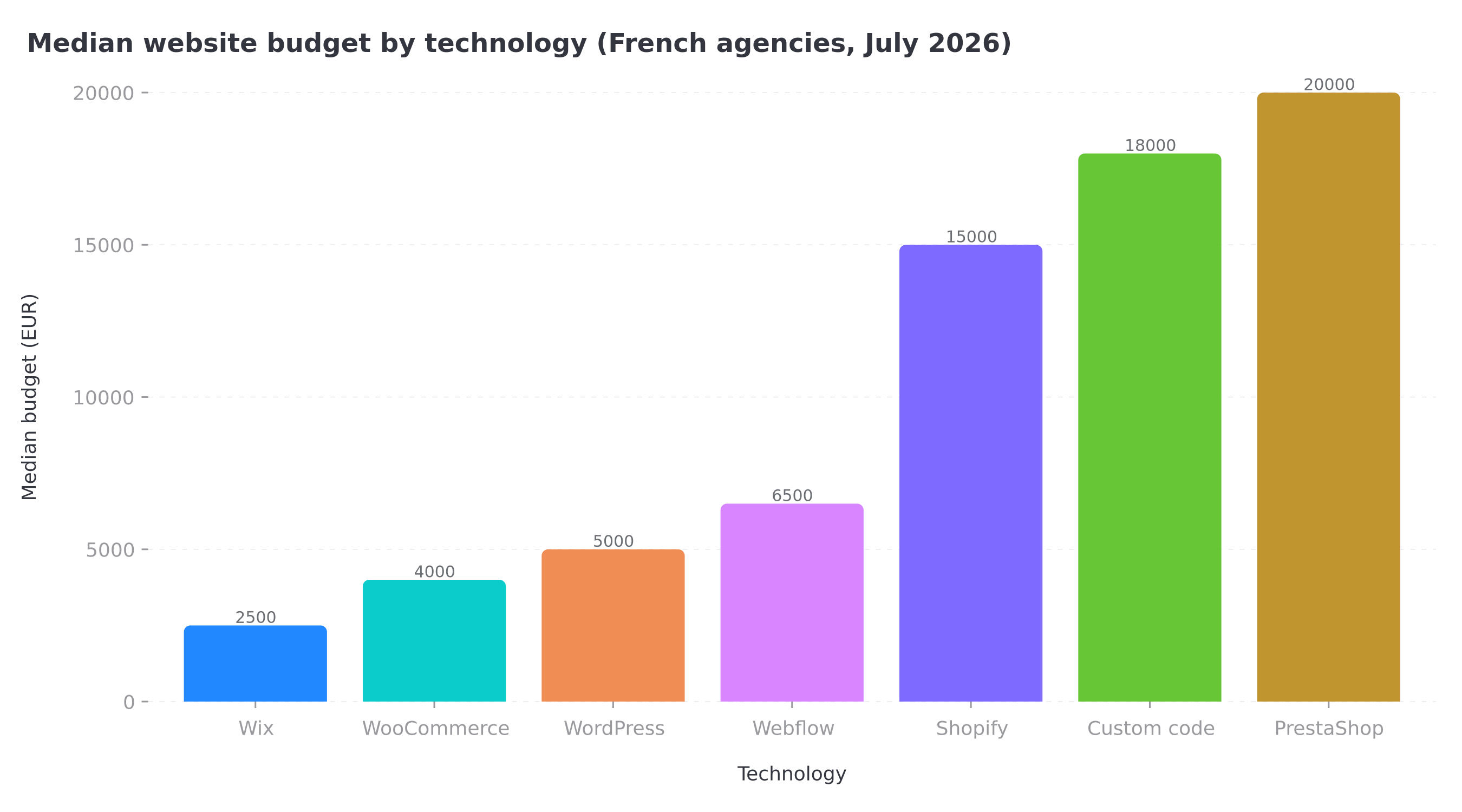 Median budget of a website built by a French agency, by technology: from €2,500 on Wix to €18,000 for custom code (La Fabrique du Net, July 2026)
How much does a brochure website cost?
A brochure site presents your business: home, services, about, work, contact. In France, half of agency projects cost between €2,000 and €8,000 (La Fabrique du Net, July 2026).
What moves a brochure site from €2,000 to €8,000:
- Design. An adapted theme costs less than a mockup designed for you. The difference shows mostly on mobile and in how clear the journey is.
- Copy. If you supply it, the price drops. If the agency writes it with SEO in mind, treat that work as a separate line.
- Number of templates. Ten pages built on two templates cost less than six pages that all differ.
At BOVO, we do not ship an isolated brochure site with nothing behind it. Our entry point, the SaaS MVP at €2,000, includes a marketing landing page, up to 6 screens, a database, an admin area and deployment on your domain. For a founder who also needs to handle requests or a client area, that is usually more useful than an online leaflet.
How much does a website with online booking cost?
For a service business (practice, coach, tradesperson, B2B agency), the site has one job: get a confirmed slot. A contact form opens an email thread. An online calendar books the meeting while the visitor is still motivated.
In our experience, the extra cost stays low when you plug in an existing tool (Cal.com, Calendly) instead of building a custom calendar. The work is in the integration, the journey and the automatic reminders. This usually fits within our SaaS MVP at €2,000. We break down the journey difference in brochure site vs booking site.
The common trap: a quote that prices a "custom booking module" for a need an existing scheduling tool handles very well. Always ask why an existing tool would not do.
How much does an ecommerce website cost?
An online store costs €10,000 at the median when built by an agency, and half of projects fall between €3,000 and €40,000 (La Fabrique du Net, July 2026). The gap comes from catalog size, product variants, shipping options and links to logistics or accounting.
On top of the build, you pay on every sale. At Stripe (France rates checked in October 2026), a standard European card costs 1.5% + €0.25, a premium card 2.8% + €0.25. On a €60 basket, the standard card costs you €1.15. If you choose Shopify, add the monthly platform subscription.
Two scenarios with us:
- Small catalog, simple checkout: our SaaS Standard at €3,500 includes up to 15 screens and built-in payments (Stripe or PayPal).
- Large catalog: WooCommerce, PrestaShop or Shopify remain a better fit. We quote after scoping. For example, we automated the import of 585 products and all their variants into WooCommerce for a client, with no manual entry.
How much does a SaaS or web app MVP cost?
A web app has logged-in users, data, roles and often a subscription. It is the most expensive segment: €18,000 at the median for custom development in France, with a quarter of projects above €45,000 (La Fabrique du Net, July 2026).
An MVP (minimum viable product) is the first version that lets you test your idea with real users. It only contains the screens you cannot live without. It is the best way to avoid spending €40,000 before your first paying customer.
Our three offers, detailed on our custom SaaS development page:
- SaaS MVP, €2,000: up to 6 screens, email or Google sign-in, basic admin, 3–4 weeks.
- SaaS Standard, €3,500: up to 15 screens, Stripe payments, advanced admin, API, 5–7 weeks.
- SaaS Premium, €5,000: 30+ screens, multi-tenant, custom dashboard, 8–12 weeks.
WordPress vs Next.js vs Webflow: which costs less?
They are different things. WordPress is a CMS: content management software with themes and plugins. Next.js is a development framework: the site is coded for you, with no third-party plugins. Webflow is a hosted no-code tool: you pay a subscription per site.
| Criterion | WordPress | Next.js (custom) | Webflow (no-code) |
|---|---|---|---|
| Agency build cost (France) | median €5,000 | median €18,000 (custom) | median €6,500 |
| Hosting | shared, about €6/month | Vercel Pro $20/month, or your own server | $15–$25/month yearly, included |
| Maintenance | core and plugin updates | low, no third-party plugins | handled by Webflow |
| Performance | depends on theme and plugins | very good if well built | good |
| Editorial autonomy | very high | via a connected CMS or admin | high |
| Lock-in | low, open source | low, the code is yours | high, limited export |
Build costs: La Fabrique du Net, July 2026. Hosting: OVHcloud, Vercel and Webflow public pricing checked in October 2026.
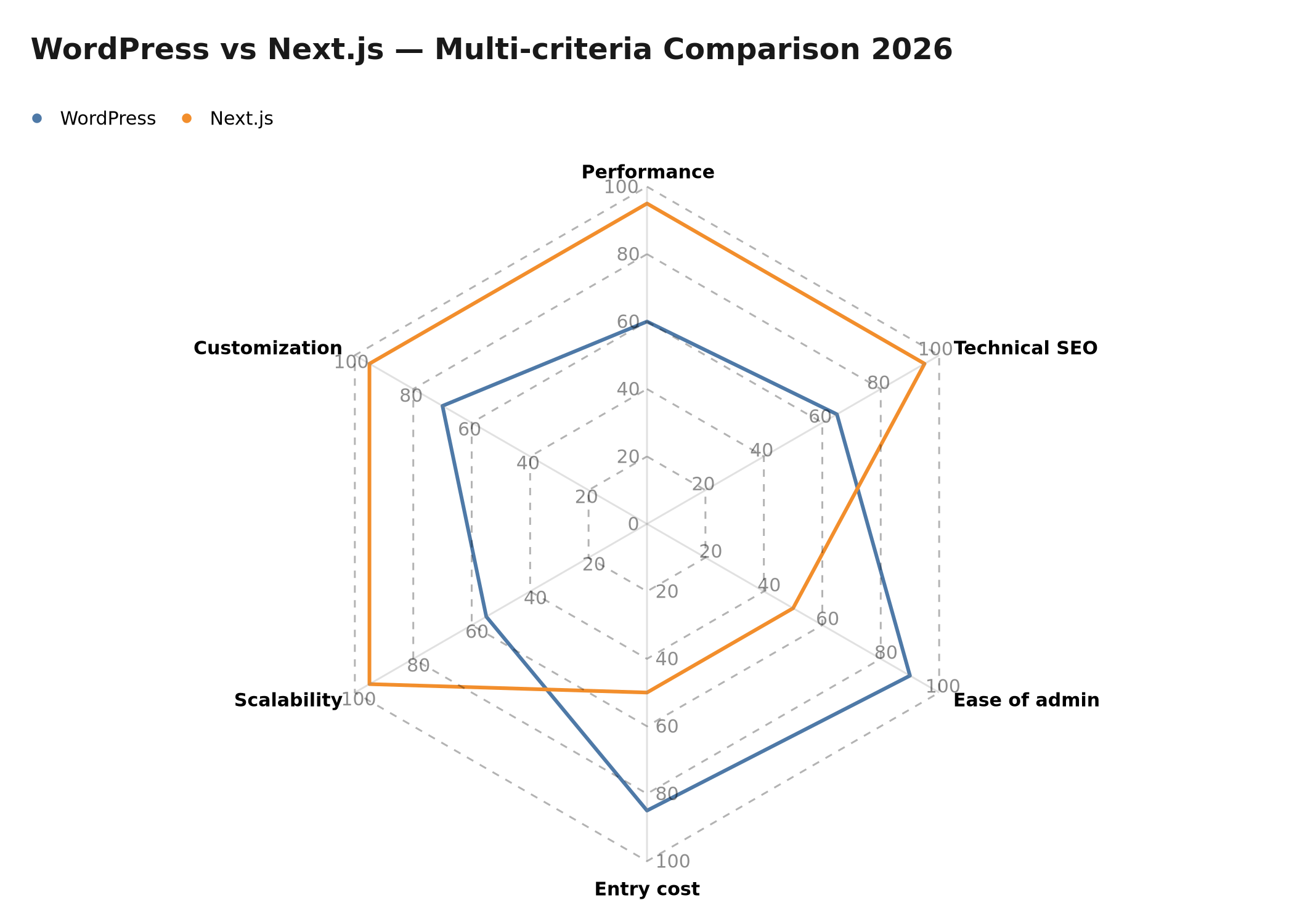 Our team's qualitative assessment: Next.js wins on performance, technical SEO and scalability; WordPress on entry cost and ease of administration
Our take after dozens of projects:
- WordPress is the right call for a content site, an active blog, or a marketing team publishing weekly without a developer. The hidden cost is maintenance: every plugin is an update to track and a potential vulnerability.
- Next.js is the right call once the site does more than inform: client area, payments, business tool, speed requirements. Most agencies quote it higher upfront, but it costs less to maintain. We cover migration costs in B2B website redesign: Next.js vs WordPress.
- Webflow suits a polished marketing site run by a non-technical team. Note that since 13 May 2026, the Basic plan costs $15/month billed yearly ($25 monthly) and the Premium plan, required for a blog, $25/month yearly ($39 monthly), according to Webflow. You pay that subscription for as long as the site exists.
One point many quotes miss: the free Hobby plan on Vercel is for personal, non-commercial use only. A business site on Next.js and Vercel needs the Pro plan at $20 per month (checked in October 2026).
How much does a website cost per month? Recurring costs
The build price is not the whole story. A site is paid for every year as well. Here are the lines, with public rates you can check.
| Cost line | Published rate | Frequency |
|---|---|---|
| .com domain | €7.99 excl. VAT first year, then €13.49 (OVHcloud, Oct 2026) | per year |
| .fr domain | €4.99 excl. VAT first year, then €7.79 (OVHcloud, Oct 2026) | per year |
| Shared WordPress hosting | €5.99 excl. VAT on renewal (OVHcloud Perso, reported by La Fabrique du Net, 2026) | per month |
| Next.js hosting | Vercel Pro $20, with $20 usage credit included (Vercel, Oct 2026) | per month |
| Webflow subscription | Basic $15 or Premium $25 billed yearly (Webflow, May 2026) | per month |
| HTTPS certificate | included with most hosts, Let's Encrypt is free | — |
| Online payments | 1.5% + €0.25 per standard European card (Stripe, Oct 2026) | per sale |
| WordPress maintenance | €200–€500 per year (Codeur.com, cited by Milléweb, 2026) | per year |
Always look at the renewal price, not the promo price. A .fr at OVHcloud goes from €4.99 to €7.79 excl. VAT after year one.
Three-year example for a brochure site. On shared WordPress hosting: about €72 of hosting and €8 of domain per year, plus €200–€500 of maintenance. That is €280–€580 a year, or €840–€1,740 over three years, before any change. On Next.js with Vercel Pro: $240 a year of hosting plus the domain, but almost no security maintenance. Changes (a new page, a new feature) are billed by the developer in both cases.
Our offers include a support period: 30 days on SaaS MVP, 60 days on Standard, 90 days plus 6 months of proactive maintenance on Premium.
What affects the price of a website?
Two quotes for "a 10-page website" can differ by a factor of four. The real variables:
- Number of distinct screens. That is the unit that matters, not page count. A product page repeated 200 times is still one template. That is why our offers are expressed in screens.
- Features. User sign-in, payments, booking, multiple languages, admin area: each one is a small project to design, build and test.
- Integrations. Connecting a CRM, an ERP or a partner API means understanding the tool on the other side. It is often the most underestimated line.
- Content. Copy, photos, video. If nobody planned them, the site waits.
- Migration and SEO. A redesign without a redirect plan can wipe out the traffic you already have. That work must appear in the quote.
- Revisions. How many rounds on the mockups? Our SaaS Standard includes three.
Which website quote traps should you avoid?
These are the mistakes we see most often when a prospect shows us a competing quote or a site to take over.
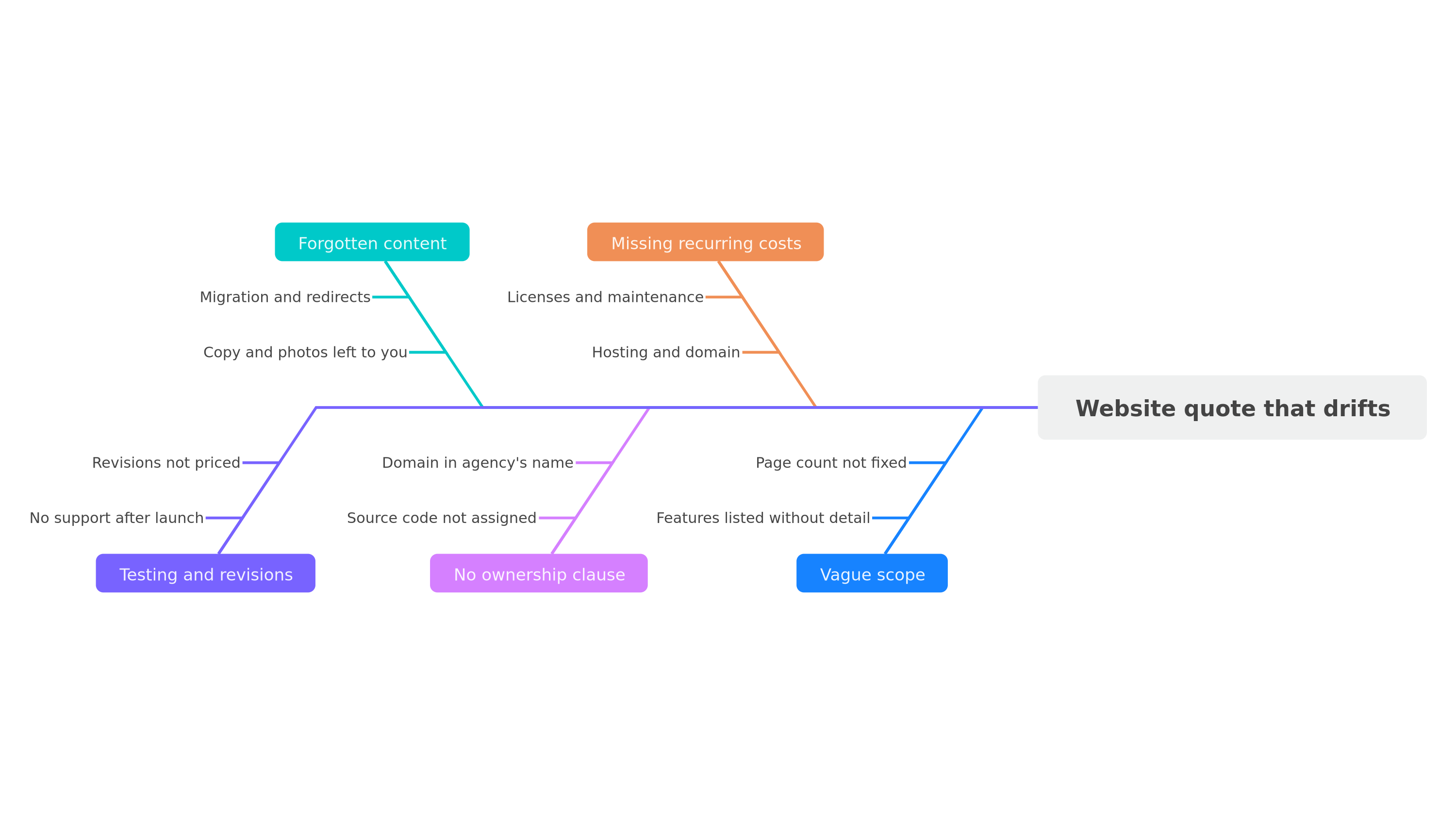 Five causes of drift: vague scope, missing recurring costs, no ownership clause, forgotten content, unpriced testing and revisions
- Domain registered to the agency. If the relationship ends, you lose your address. Require the domain and hosting in your name.
- Source code not assigned. The quote must state the IP assignment and the code handover.
- "Complete website" with no list. A serious quote lists pages, features and deliverables. Otherwise every request becomes a change order.
- No line for yearly costs. Hosting, licenses, maintenance: if they are not written down, they will show up later.
- A very low price with no schedule. An undated deadline is a deadline that slips.
- No support after launch. The first bugs appear with the first real users. Ask how many days of fixes are included.
BOVO Digital pricing for a website or web app
Our prices are public and match the website expert page.
| Offer | Price | What is included | Lead time |
|---|---|---|---|
| SaaS MVP | €2,000 | Next.js app up to 6 screens, email + Google sign-in, database, basic admin, landing page, deployment on your domain, 1.5h training, 30 days of support | 3–4 weeks |
| SaaS Standard | €3,500 | up to 15 screens, user / admin roles, Stripe or PayPal payments, advanced admin + analytics, SEO landing page, REST API, daily backups, 3 revisions, 60 days of support | 5–7 weeks |
| SaaS Premium | €5,000 | 30+ screens, multi-tenant, API + webhooks, custom dashboard, CRM and email integrations, security audit + GDPR, uptime monitoring, 90 days of support + 6 months of maintenance | 8–12 weeks |
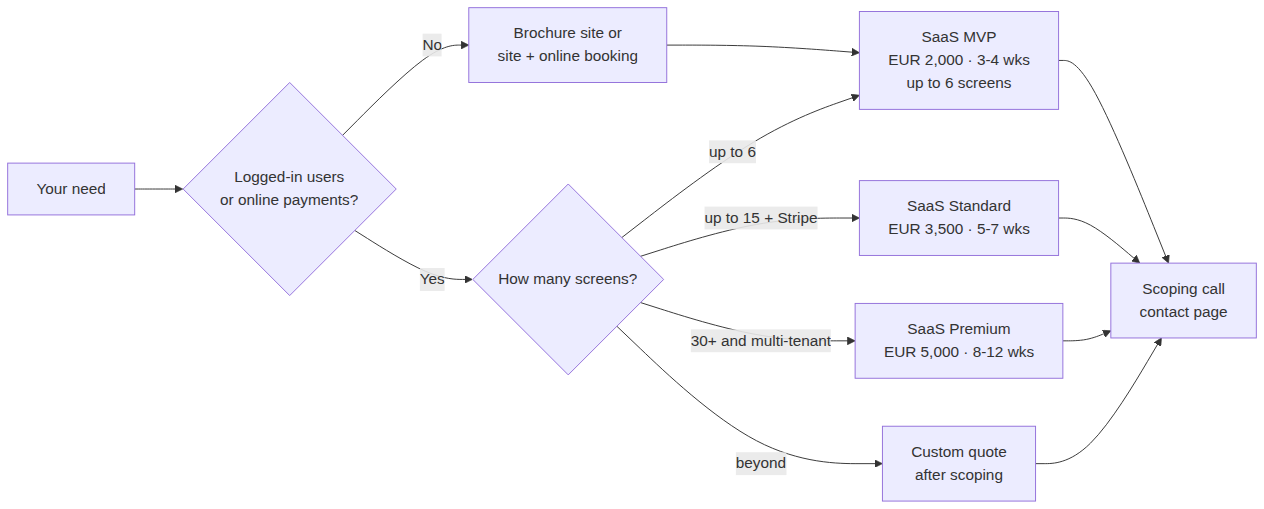 From need to offer: with no user accounts or payments, SaaS MVP is enough; beyond that, screen count points to Standard, Premium or a custom quote
Want a firm price for your project? Describe your need in a few lines on our contact page. We reply within 24 hours with the right offer, or a detailed quote if your project goes beyond the packages. Full details are on custom website development.
Web projects we have delivered
These projects show what a "custom website" covers in practice. Each one is described in our portfolio.
- An online quote calculator for a security systems installer. Visitors configure their installation, see a live estimate and leave their details. The site becomes a lead generation tool. See the project.
- A WordPress plugin that sends callback requests to a partner. The site form pushes each request straight into the partner's system, with a sending log. A case where keeping WordPress was the right call. See the project.
- An online learning platform for Aura Academy. Courses, quizzes, badges, progress tracking, structured data for Google. Built with Next.js 15 and live on Vercel. See the project.
- A photo album creation app for professionals. PDF templates, QR codes, separate and secured client accounts. See the project.
- The website of a solidarity savings association (tontine). Brochure site, member area and back office with role-based permissions, replacing spreadsheets and WhatsApp groups. See the project.
Method: how we built this guide
Market prices come from dated public sources: the La Fabrique du Net barometer (1,312 budgets, July 2026), the Gilzor 2026 guide for US ranges, and the OVHcloud, Vercel, Webflow and Stripe pricing pages checked in October 2026. BOVO prices are our public offers as of 13 October 2026.
Limits: market budgets are reported by French agencies and do not cover freelancers. We do not publish per-client project prices: the examples above show the delivered scope, not the amount invoiced. Out of scope: hosting promotions and bundled offers.
Key takeaways
- A brochure site often costs €2,000–€8,000 with an agency, a store €3,000–€40,000, a custom app €6,000–€45,000 (France, July 2026).
- Also plan €280–€580 a year for a hosted and maintained WordPress brochure site.
- WordPress is cheaper to build, Next.js cheaper to run, Webflow is a subscription for life.
- A good quote lists screens, separates build from yearly costs and leaves you owning the domain and the code.
At BOVO Digital, a custom website or web app starts at €2,000 with a written scope and a dated timeline. Tell us about your project and get an estimate within 24 hours.
Tags
FAQ
How much does a custom website cost in 2026?
In France, the La Fabrique du Net barometer (1,312 agency budgets, July 2026) puts the median website at €5,200: about €3,500 for a brochure site, €10,000 for an online store and €18,000 for custom development. US guides quote $5,000–$20,000 for a small business site. At BOVO Digital, a custom Next.js first version starts at €2,000 (SaaS MVP, up to 6 screens, 3–4 weeks).
How much does a small business website cost?
Half of French agency brochure sites cost between €2,000 and €8,000 (median €3,500, La Fabrique du Net, July 2026). The gap comes from page count, design and copywriting. Adding online booking stays in that range if you plug in an existing tool such as Cal.com.
How much does a website cost per month?
Before maintenance, a few euros to a few dozen: a .com renews at €13.49 excl. VAT per year at OVHcloud, shared WordPress hosting is about €6 per month, Webflow is $15–$25 per month billed yearly, Vercel Pro is $20 per month. WordPress maintenance often adds €200–€500 per year.
Next.js or WordPress: which is cheaper?
WordPress is usually cheaper to build for a standard content site. Next.js is usually cheaper to run: no plugins to update and fewer known vulnerabilities to watch. Over three years, the gap is decided by maintenance and changes, not by the first quote.
How much does an ecommerce website cost?
Half of French agency-built stores cost between €3,000 and €40,000 (median €10,000, La Fabrique du Net, July 2026). Add payment fees: 1.5% + €0.25 per standard European card at Stripe, plus the platform subscription if you use Shopify.
Are domain and hosting included in the website price?
Not always. They are yearly costs and should be in your name. Ask for a separate quote line with the renewal price, not the first-year promo.
How long does it take to build a custom website?
At BOVO Digital: 3–4 weeks for a SaaS MVP (6 screens), 5–7 weeks for SaaS Standard (15 screens and payments), 8–12 weeks for SaaS Premium (30+ screens). Timing mostly depends on how fast mockups are approved and content is delivered.
Does your site book meetings — or just present you?
We open your URL together, mark the 3 leaks, and tell you whether a fix is enough or a rebuild is required.
- 30 min
- No commitment
- Action plan
Vicentia Bonou
Full Stack Developer & Web/Mobile Specialist. Committed to transforming your ideas into intuitive applications and custom websites.


