
How to Choose a Mobile App Agency: 10 Criteria to Check
Published apps, code and store accounts in your name, a detailed quote and real-device testing: 10 criteria to choose a mobile agency without a mistake.

Updated

How to Choose a Mobile App Agency: 10 Criteria to Check
The right provider turns an idea into an app people use. The wrong one turns a budget into an app that is never published.
To choose a mobile development agency, do not start from the price. Start from three checks that eliminate most bad choices: has the agency got apps published on the stores that you can download? Does the contract make you the owner of the code and of the Apple and Google accounts? Is the quote broken down by batch? If one answer is no, move on to the next agency.
This guide gives you the 10 criteria to check, the questions to ask in a meeting, the warning signs and an honest comparison between an agency, a freelancer and offshore. We wrote it from what we see at BOVO Digital, a Flutter agency: clients who arrive with an app stuck at a previous provider, store accounts to recover, quotes that cannot be compared.
How to choose a mobile app agency: the short answer
The 10 criteria can be checked in under an hour per agency, if you know where to look. The table below is the reading grid. The first three are knockout criteria.
| # | Criterion | How to check it | Warning sign |
|---|---|---|---|
| 1 | Apps published on the stores | Download 2 or 3 portfolio apps | Mockups only |
| 2 | Code and store accounts in your name | A written clause in the contract | "We keep the code until the balance, then we'll see" |
| 3 | Detailed quote, staged payment | Lines by batch, a schedule | One lump sum, 100% upfront |
| 4 | Scoping before coding | A validated list of screens and journeys | A quote sent with no questions |
| 5 | A justified technology | An explanation tied to your project | The same stack for everyone, with no reason |
| 6 | Tests on real phones | A test plan, a test build | "We test at the end" |
| 7 | Knowledge of store rules | Examples of rejections they have fixed | No idea of review timelines |
| 8 | Maintenance after launch | A written support period | "We'll see after delivery" |
| 9 | Communication | One contact, regular demos | Replies that take several days |
| 10 | Experience on a similar case | An app with similar features | No comparable example |
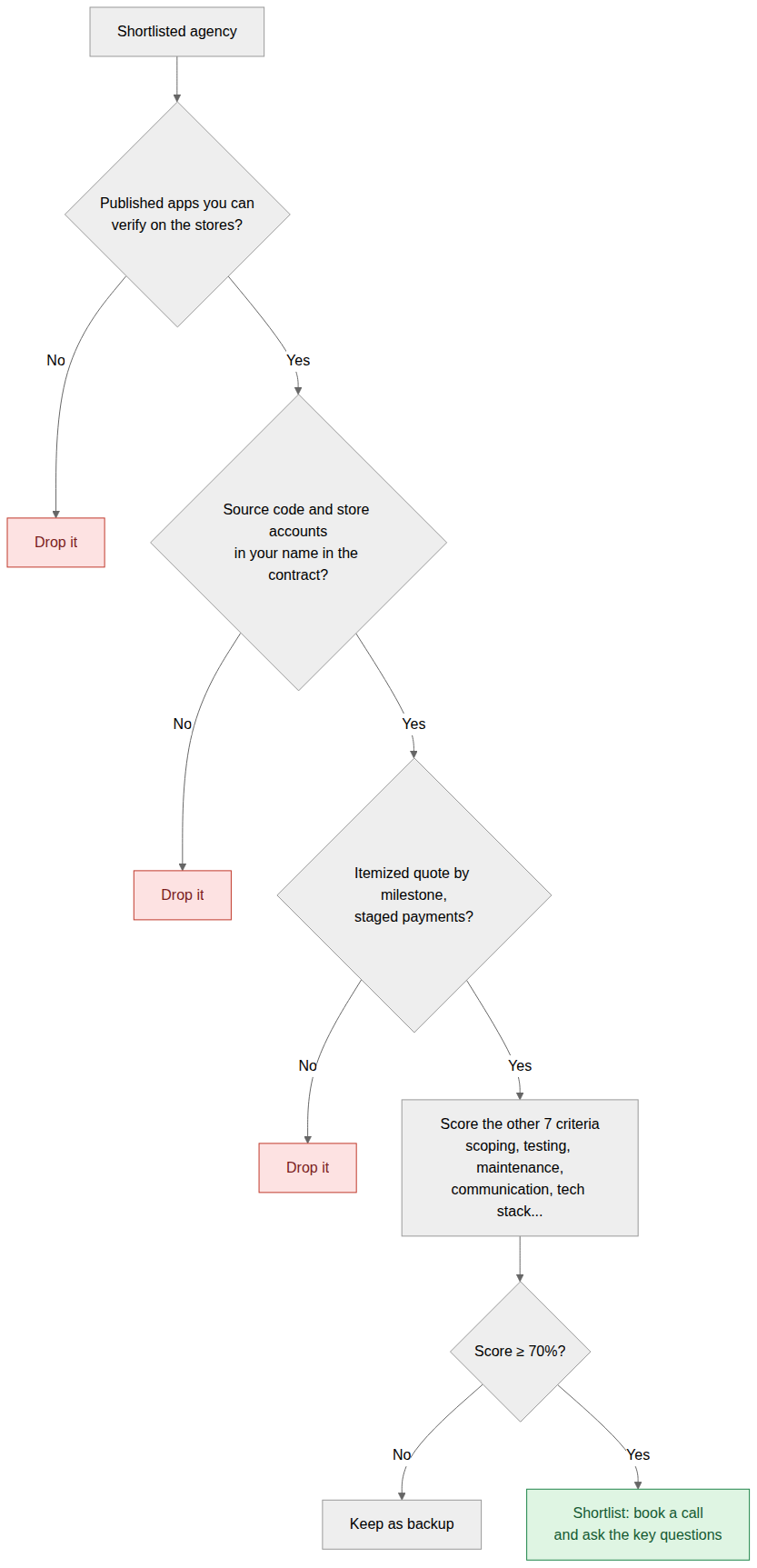 Three criteria eliminate first: published apps, ownership of the code and accounts, a detailed quote. The other seven are scored afterwards.
The 10 criteria for choosing a mobile development agency
1. Does the agency have apps published on the stores?
A Figma mockup is not an app. A published app proves the team has passed Apple or Google review, handled real users and fixed real bugs.
How to check, in practice:
- Download two or three portfolio apps onto your phone.
- Look at the last update date on the store listing. An app that has not been updated for a long time may have been abandoned.
- Read the negative reviews: crashes, login failures, slowness.
- Look at the developer name on the listing. If it is the agency's name and not the client's, the agency may be keeping its clients' accounts. Ask.
At our end, for example, Tontineo, a Flutter app for managing tontines, is available on Google Play. You can install it and judge for yourself. The project page details what was delivered.
2. Will the source code and the store accounts be in your name?
This is the most important criterion, and the one most often forgotten. We regularly see founders who can no longer update their app because the previous provider kept the Google Play account or the code repository.
Require in writing:
- The source code on a Git repository (GitHub, GitLab) that you own.
- A transfer of rights on the code at the end of the project, with no retention clause.
- The Apple Developer account ($99 a year) and the Google Play Console account ($25 once) opened in your company's name, according to the official Apple and Google pages checked in October 2026. For an Apple organisation account, plan for a D-U-N-S number.
- Access to the back end (Firebase, database, API keys) in your name.
The agency is invited as a team member on your accounts. It is never the owner. Without that, changing provider can force you to republish the app under another account and start again from zero with the reviews.
3. Is the quote detailed, and is payment staged?
A serious quote reads like a shopping list. It separates design, app development, the back office, store release and recurring costs (hosting, third-party services, maintenance).
Payment follows deliveries: a deposit, then validated stages. Paying 100% on order removes every lever you have. To place the amounts, our analysis of the cost of a Flutter mobile app in 2026 details the ranges by project type.
4. How does the agency scope the project before coding?
Scoping is the step where you write what the app will actually do: user profiles, the list of screens, the main journeys, what is out of scope. Without that document, every disagreement becomes a change order.
Be wary of a quote received thirty minutes after a first call, with no question about your users or your business model. A good agency challenges you, and sometimes says no.
5. Which technology does it propose, and why?
Three options dominate in 2026 for a professional app:
| Option | When it fits | Watch-out |
|---|---|---|
| Flutter | One codebase for iOS and Android, a custom interface | Choose a team that also handles native integrations |
| React Native | Your in-house team already works in JavaScript or React | A stronger dependence on third-party libraries |
| Native (Swift, Kotlin) | Heavy use of the hardware, or two dedicated teams | Two codebases, so a higher cost and a longer timeline |
A good agency justifies its choice by your project, not by habit. We detailed that choice in our Flutter vs React Native comparison. For a business app or an MVP, Flutter is often the best cost-and-time compromise, and it is our speciality on the Flutter agency page.
6. How is the app tested?
Ask how the agency tests, not only whether it tests. Good answers look like this:
- Tests on real phones, Android and iPhone, not only on an emulator.
- A test build you can install during the project, so you can validate as it goes.
- A written checklist (acceptance) before delivery.
- Automated tests on the sensitive parts: login, payment, calculations.
A concrete example: FocusLock, a focus app we built in Flutter, blocks other apps on Android during a session. That kind of feature depends on system permissions. It can only be validated on real devices, with a documented acceptance checklist. See the FocusLock page.
7. Does the agency know the store publishing rules?
Publishing is not a formality. Two checks you can verify:
- On Google Play, a personal developer account created after 13 November 2023 must have the app tested in closed testing by at least 12 testers for 14 consecutive days before it can go to production (official Play Console help, checked in October 2026). An agency that does not know this will promise you an impossible release date.
- On Apple, an app must not require an account for features that do not need one. For Tontineo, we planned a discovery mode without an account to meet that requirement, on top of Google and Apple sign-in.
Ask the agency to tell you about a store rejection it has already had to fix. The answer says a lot.
8. What happens after launch?
An app starts its life on the day it is published. Apple and Google ship major iOS and Android versions every year that can break an unmaintained app.
Check the quote for: the corrective support period included, the price of a maintenance package afterwards, and the response time for a blocking bug. If the agency says "we'll see after delivery", that item is not under control. To understand why this cost weighs so much, read why an app costs more to maintain than to build.
9. How does the agency communicate during the project?
You should never have to chase your agency to know where your app stands. Expect:
- One named contact, who replies within one business day.
- Regular demos of the app as it progresses, not only written reports.
- A working language you are comfortable with, in writing and on calls.
Watch the first exchange. A team that dodges a hard question in a meeting will do the same in the middle of the project.
10. Has it already solved a problem close to yours?
An agency that has already built an app with features close to yours knows the traps. If your project connects two types of users, look for that kind of experience.
PaniGaspi is one example: a Flutter and Firebase anti-waste app with two interfaces, one for shops publishing unsold food, one for customers reserving it from a map. Availability updates in real time. See the PaniGaspi page.
What questions should you ask a mobile agency in a meeting?
A one-hour meeting reveals what a quote does not say. Ask these questions and compare the answers.
| Question to ask | A good answer | An answer that should warn you |
|---|---|---|
| Can you show me three published apps? | Store links, a client contact | "Our clients are all under NDA" for every project |
| Who will own the code and the store accounts? | You, from the start, in writing | "We manage them for you" |
| How do you scope the project? | A list of screens and journeys validated before code | "We adapt as we go" |
| What exactly is in the quote? | Separate lines, recurring costs priced | One lump sum |
| How do you test the app? | Real devices, a test build for you | "We test at the end" |
| What happens if I change a feature? | A written process, a price before you agree | "No problem" with no further detail |
| Who will be my contact? | A name, a response time | "The team" |
| What happens after launch? | Support included, then a known package | "We'll see" |
What are the warning signs at a mobile development agency?
Not all signs are equal. Some show a lack of rigour. Others show a wish to make you dependent.
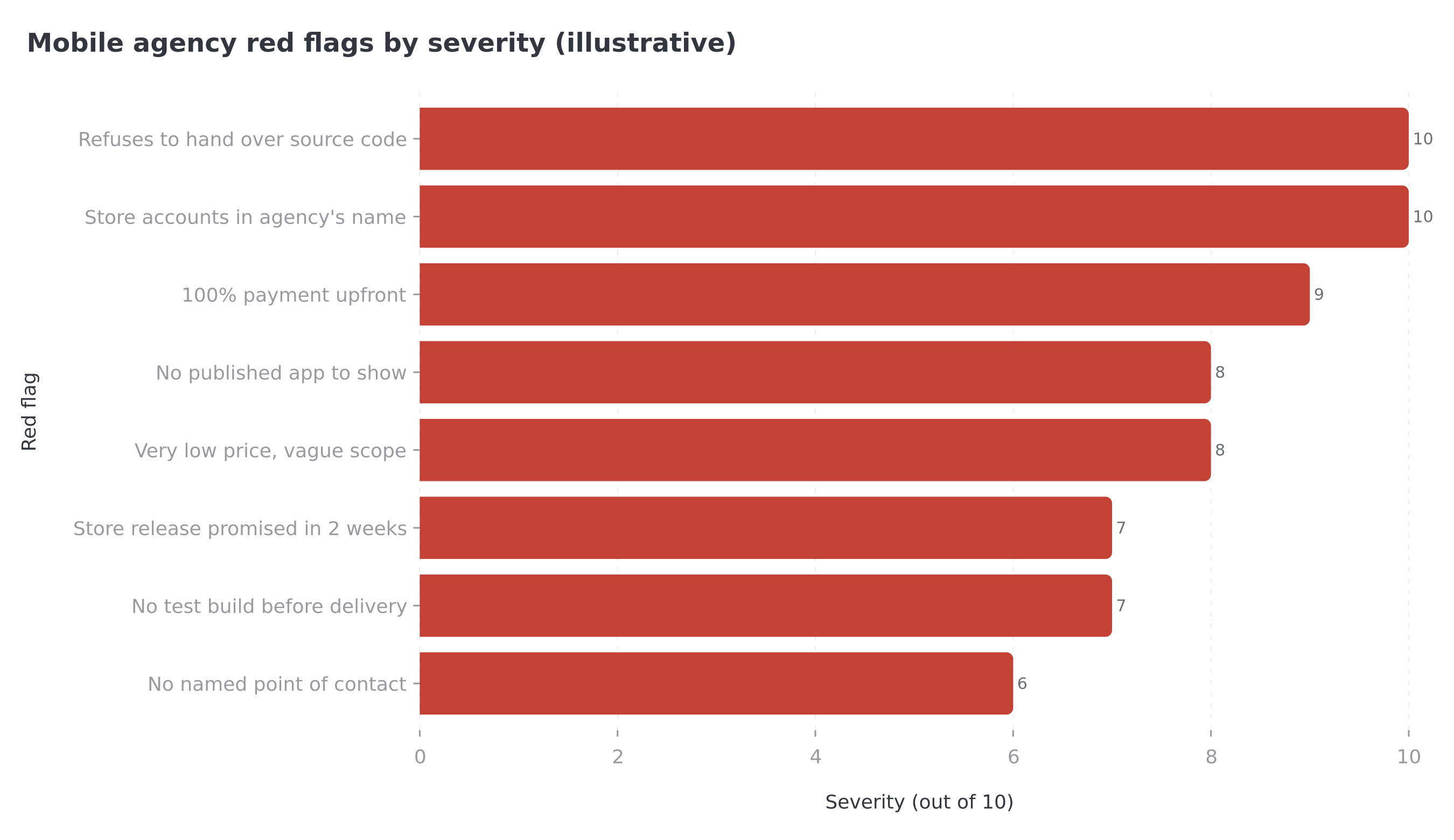 The most frequent warning signs, ranked by severity from our experience: ownership of the code and the accounts comes first
One of these signs is enough to rule an agency out:
- It refuses to transfer the source code to you.
- It wants to open the store accounts in its own name.
- It requires 100% of the payment on order.
These should make you dig:
- A price far below the other quotes, with no explanation of the scope.
- No published app to show.
- A promise to publish a real app in two weeks.
- No test build before the final delivery.
How do you compare quotes from several mobile agencies?
Comparing three quotes only makes sense if they cover the same thing. The classic mistake: picking the cheapest, which is often simply the least complete.
 The same brief, aligned scope, recurring costs added: a very low quote must be justified
- Send the same brief to three agencies.
- Check that each quote covers design, the iOS and Android app, the back office and publishing.
- Add the recurring costs over two years: hosting, third-party services, maintenance.
- If one quote is far below the others, ask what is not included.
- Choose on value and trust, not on price alone.
Fixed price or time and materials: which model?
A fixed price sets the price for a defined scope. It fits a well-scoped MVP. Time and materials bills the time spent. It fits products that evolve with user feedback. Many projects start on a fixed price for the first version, then move to time and materials or a maintenance package.
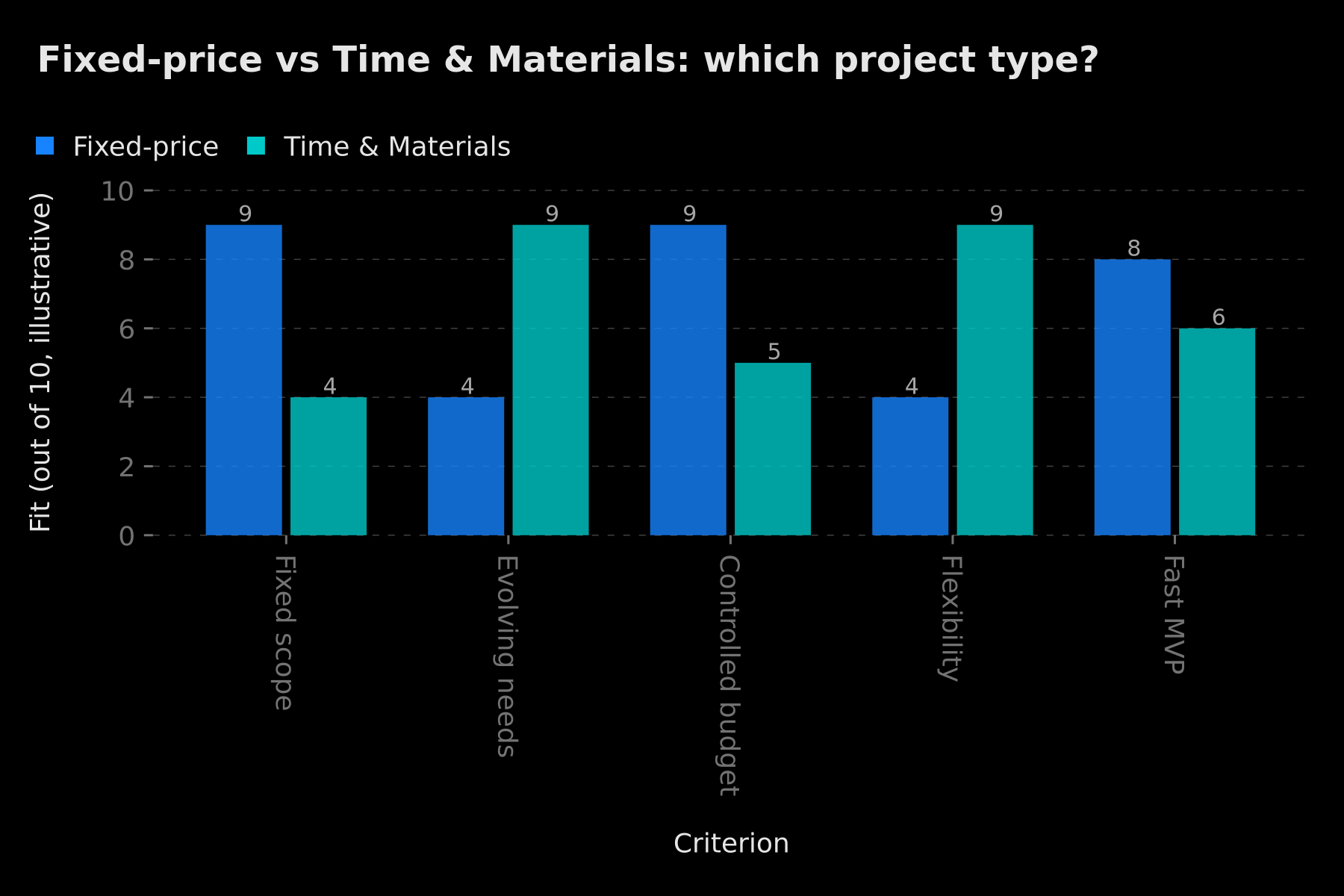 Fixed price or time and materials: fit by project type, an illustrative guide from our experience
Agency, freelancer or offshore: what should you choose?
There is no universal right answer. Here is an honest comparison.
| Option | Who it is for | Advantages | Limits |
|---|---|---|---|
| Freelancer | A simple app, a founder comfortable with the technical side | Often a lower cost, direct contact | Depends on one person, design and testing sometimes missing |
| Local agency | A need for in-person meetings, a large project | Proximity, people on site | Generally higher rates |
| Remote French-speaking agency | French-speaking SMEs and founders | The same language, more accessible rates, a full team | Video calls, no in-person meetings |
| Non-French-speaking offshore | Teams already used to running projects in English | Often low rates | Language, time zone, understanding of the need |
Let us be transparent about our own case. BOVO Digital is based in Benin and works in French for French-speaking clients, in Africa and in Europe. Exchanges happen remotely, on video and in writing. Benin is on UTC+1, the same time as Paris in winter and one hour behind in summer. If you absolutely need to meet your team in person every week, a local agency will suit you better.
Checklist: 10 checks before you sign
Print this list and tick it for each agency.
- I have downloaded at least two apps published by the agency.
- The contract states that the source code and the rights come back to me.
- The Apple Developer and Google Play accounts are in my name.
- The quote separates design, development, back office, publishing and recurring costs.
- Payment is staged against validated deliveries.
- The list of screens and journeys is written before development.
- The agency explained its technical choice for my project.
- I will receive a test build during the project.
- The support period after launch is written down.
- I know my contact and their response time.
Want this checklist in a printable version with the scoring grid? Ask for it here, and we will send it.
How BOVO Digital applies these criteria
We apply the grid above to our own projects. The code and the store accounts are in your name, the quote is detailed and the offers are public.
 From scoping to support: a detailed quote, validated screens, regular demos, publishing on accounts in your name
| Flutter offer | Price | Main content | Stated timeline | Support included |
|---|---|---|---|---|
| MVP Ecosystem | €2,000 | Flutter app up to 10 screens, Firebase, landing page, Google Play release | 4 to 5 weeks | 30 days |
| Standard Ecosystem | €3,500 | Up to 20 screens, web admin, notifications, Google Play and App Store | 6 to 9 weeks | 60 days |
| Premium Ecosystem | €5,000 | 40 screens and more, in-app payments, multi-role admin | 10 to 14 weeks | 90 days |
BOVO Digital has delivered 118 projects and received 82 five-star reviews on ComeUp, across all services.
Comparing agencies for your app? Describe your project: we tell you which offer fits, or why none of them does. See the Flutter agency or talk about your project.
What to remember
To choose a mobile development agency, check published apps, ownership of the code and the accounts, and the detail of the quote first. Then score the other seven criteria, ask the questions from the table in the meeting and compare quotes built on the same brief. Two weeks spent comparing three agencies costs far less than an app you have to rebuild.
Methodology: how we built this guide
This guide is based on our mobile projects documented in our public portfolio (including Tontineo, PaniGaspi and FocusLock), on requests from clients who are changing provider, and on an analysis of the pages that rank for this query in October 2026. The store rules cited come from the official Apple and Google pages. Limits: the severity and fixed-price charts are guides from our experience, not statistics. The prices cited are our public offers, not a market average.
Tags
FAQ
How do you choose a mobile app development agency?
Start with three knockout checks: published apps you can download from the stores, a contract that makes you the owner of the code and of the Apple and Google accounts, and a quote broken down by batch with staged payments. Then score scoping, testing, maintenance, communication, the technology they propose, knowledge of store rules and experience on a project close to yours.
How much does an agency-built mobile app cost?
It depends on the number of screens, the back office and payments. As a reference, BOVO Digital's public Flutter offers are the MVP Ecosystem at €2,000 (up to 10 screens, 4 to 5 weeks), the Standard Ecosystem at €3,500 (up to 20 screens and a web admin, 6 to 9 weeks) and the Premium Ecosystem at €5,000 (40 screens and more, payments, 10 to 14 weeks).
Agency or freelancer for a mobile app?
A freelancer fits a simple app when you know how to run a technical project. An agency is safer as soon as the app combines a back office, payments and release on two stores, because it covers design, development, testing and maintenance, and does not depend on one person.
Who should own the Google Play and Apple Developer accounts?
You. The Apple Developer account ($99 a year) and the Google Play Console account ($25 once) must be opened in your company's name. The agency is invited as a team member, never as the owner. Otherwise, changing provider can force you to republish the app and lose your reviews.
What questions should you ask a mobile development agency?
Ask for three published apps to download, who will own the code and the store accounts, how scoping works, exactly what the quote contains, how the app is tested, what happens after launch and who your day-to-day contact will be.
How long does it take to build a mobile app?
Budget 4 to 5 weeks for an MVP of about ten screens, 6 to 9 weeks for an app with a back office, and 10 to 14 weeks for a richer app with payments. Add store review time and, for a new personal Google Play account, 14 days of mandatory closed testing.
Budget, process, priorities — decided together
Website, chatbot, or automation? We pick the next job that unlocks cash, not the trendy stack.
- 30 min
- Clear priorities
- No commitment
Vicentia Bonou
Full Stack Developer & Web/Mobile Specialist. Committed to transforming your ideas into intuitive applications and custom websites.


