
Flutter App Development Cost in 2026: Real Prices and Budgets
What a Flutter iOS + Android app costs in 2026: prices by app type, full cost breakdown, store fees, maintenance and fixed packages starting at €2,000.

Updated

Flutter App Development Cost in 2026: Real Prices and Budgets
Two quotes for "the same app" can range from €2,000 to €80,000. The gap almost never comes from Flutter. It comes from the scope and from how the work is billed.
Flutter app development cost in 2026 depends first on what the app has to do. Here is the short answer. At a typical French agency, an iOS + Android MVP costs €15,000–€30,000 excl. VAT. An app with accounts, payments and a back office costs €30,000–€80,000. Those rate cards were collected in August 2026 by Le Point. EU-wide ranges published by Samioda are in the same band, and US onshore agencies typically quote 2 to 2.5 times more (Gilzor). At BOVO Digital, we sell fixed-scope Flutter packages: €2,000, €3,500 or €5,000, for iOS and Android.
This guide gives you what you need to estimate your budget on your own. It breaks down every cost item and lists the official store fees. It also covers post-launch costs and the factors that push a quote up. It ends with a quick budget estimator. It draws on 118 delivered projects and 82 five-star reviews on ComeUp, including several published Flutter apps.
How much does a mobile app cost in 2026?
The table below compares two market realities. On the left, rate cards from agencies that bill by the day. On the right, our Flutter agency packages, with a scope defined in the offer.
| App type | Agencies in France (excl. VAT, Aug. 2026) | BOVO Digital package | BOVO timeline |
|---|---|---|---|
| iOS + Android MVP (one core flow, up to 10 screens) | €15,000 – €30,000 | MVP Ecosystem: €2,000 | 4–5 weeks |
| Business app with a web admin (up to 20 screens) | €30,000 – €80,000 | Standard Ecosystem: €3,500 | 6–9 weeks |
| App with payments, marketplace, multiple roles (40+ screens) | €80,000 – €200,000+ | Premium Ecosystem: €5,000 | 10–14 weeks |
| Advanced AI, health or banking compliance, high volumes | Custom quote | Custom quote | After scoping |
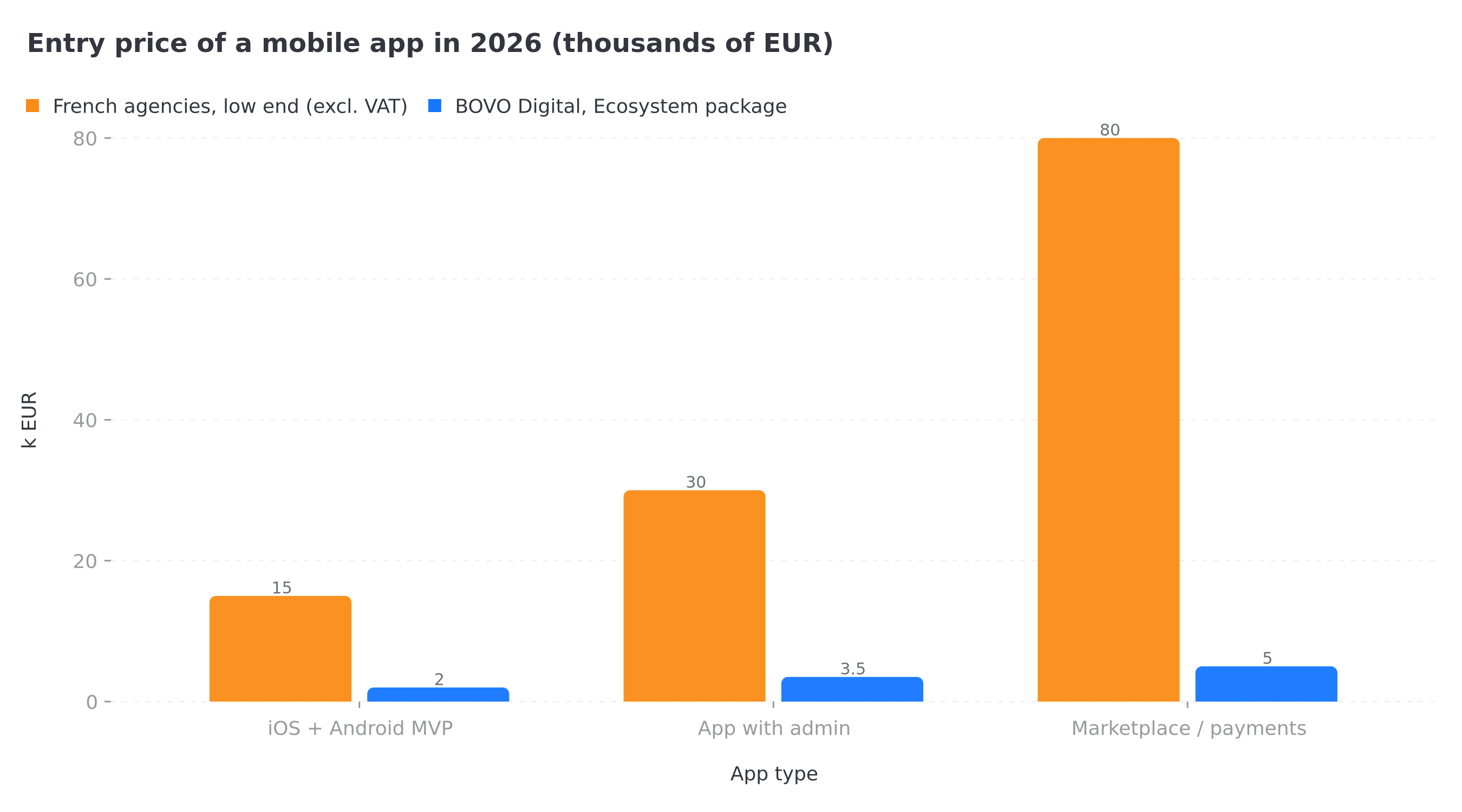 Low end of French agency rate cards (collected in August 2026) compared with BOVO Ecosystem packages, in thousands of euros
Why do two quotes differ so much?
A classic agency quote works like this: number of days × day rate. In France, that day rate sits around €400–€800 according to the same source. A €15,000 MVP therefore means roughly 20 to 37 billed days of work.
Our packages follow a different logic. The scope is fixed before we start: number of screens, included features, target stores. We reuse proven building blocks (sign-in, notifications, admin). The back end runs on Firebase, a managed service, so there is no server to code from scratch. Our team is based in Cotonou, Benin, and works remotely, with a cost structure unlike a Paris or London agency.
A low package price is not magic, though. Anything outside the scope is priced separately. That is why a good quote also lists what is not included.
What goes into the cost of a Flutter app?
A mobile app is not just "code". Here are the six stages we follow on every project, and what each one really costs.
 From scoping to support: every stage has a cost, and store release is one of them
Scoping and UX/UI design
Scoping fixes the screen list and the core user flow. It is the cheapest stage and the one with the best return. One hour of scoping often saves a week of rework.
UX/UI design turns that list into mockups. A fully custom design costs more than one built on an existing UI kit. If you already have brand guidelines, the budget goes down.
Flutter development for iOS and Android
This is the bulk of the budget. Flutter, Google's open-source framework, produces both apps from a single codebase written in Dart. Cost is driven by the number of screens and, above all, by their states. A form screen must handle loading, errors, no connection and permissions.
Back end: Firebase or Supabase
The back end stores data, manages accounts and sends notifications. Two options dominate for an MVP in 2026:
- Firebase (Google): the Spark plan is free, no card required. The Blaze plan is pay-as-you-go beyond free quotas (Firebase pricing, checked in October 2026).
- Supabase: the Free plan costs nothing, but an inactive project is paused after one week. The Pro plan starts at 25 USD per month (Supabase pricing, checked in October 2026).
For most apps we ship, hosting costs stay close to zero at launch. They grow with active users, storage and traffic.
Testing on real phones
An app that works on the emulator can crash on an old Android phone. Testing covers several screen sizes, OS versions and error cases. On an app with payments, this stage takes longer: every failure scenario has to be checked.
Publishing on the App Store and Google Play
Store fees are public and easy to verify:
| Store | Official fee | Source (checked in October 2026) |
|---|---|---|
| Apple App Store | 99 USD per year | Apple Developer Program |
| Google Play | 25 USD, one time | Play Console Help |
Two traps come up often:
- Google's mandatory closed test. A personal developer account created after 13 November 2023 must have the app tested by at least 12 testers for 14 consecutive days before going to production (Google Play rule). Build those two weeks into the schedule, or open an organisation account.
- Store commissions. Apple and Google take a commission on digital goods sold inside the app (subscriptions, premium features). It is 15% for eligible small developers under 1 million dollars in yearly revenue. Physical goods and services go through a payment provider such as Stripe instead.
Open the store accounts in your own name. The app belongs to you, not to the agency.
How much does an app cost after launch?
The budget does not stop at release. This is the blind spot of most quotes.
 Stores, hosting, maintenance and third-party services: the four items to budget every year
- Maintenance: agencies commonly advise 15–20% of the initial build per year (Le Point, August 2026; similar figures from adevs). It covers bug fixes, security and small improvements.
- iOS and Android updates: every year, Apple and Google ship a new OS version. The stores then require builds made with recent tooling. An app that is never updated eventually cannot ship a new version.
- Hosting: free or nearly free at first (Firebase Spark, Supabase Free), then usage-based.
- Third-party services: SMS, transactional email, maps, payment fees.
- Stores: 99 USD per year for Apple; nothing more for Google after sign-up.
Our packages include a support period: 30 days for the MVP Ecosystem, 60 days for Standard, 90 days for Premium. Premium adds 6 months of proactive maintenance. After that, a monthly maintenance contract takes over.
First-year example for an MVP: MVP Ecosystem package at €2,000, Google Play account at 25 USD, Firebase on the free plan. If you add the App Store later, add 99 USD per year. The real budget then depends on the improvements you decide to make.
An app built badly to save money upfront often costs more later. We explain why in our article on technical debt.
Why is Flutter cheaper than two native apps?
With native development, the iOS app is written in Swift and the Android app in Kotlin. That means two projects, two teams, two test cycles and two maintenance tracks. With Flutter, one codebase produces both apps.
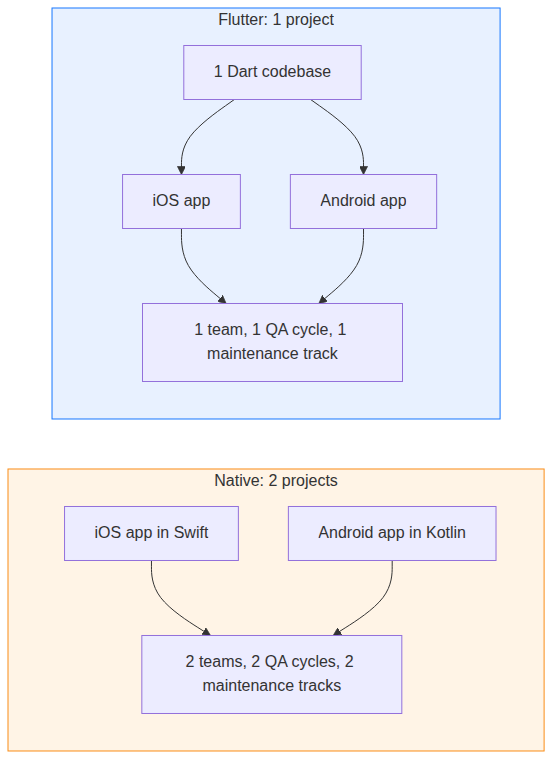 Native means two parallel projects; Flutter shares the code, the testing and the maintenance
How much do you save? Agencies do not agree, and that is normal. Estimates published in 2026 range from 20–30% (Gilzor) to 25–45% (Samioda), with 30–40% in between (hafencity.dev). The saving comes from shared code, not from lower quality. It repeats with every update, since only one codebase needs fixing.
The advantage shrinks when the app depends on phone hardware. We saw it on FocusLock, a focus app. Blocking other Android apps required specific native integrations that had to be written for Android only. For demanding 3D games or augmented reality, native is sometimes still the right call.
Torn between Flutter and React Native? Our Flutter vs React Native 2026 comparison covers both options for an MVP.
What factors change the cost of a mobile app?
These are the levers that really move a quote, from the most common to the most expensive.
- Number of screens and their states. A static home screen has nothing in common with a payment form.
- Number of user roles. An app with a customer side and a merchant side is almost two apps in one. Permissions double.
- Payments. Each payment method adds failure cases, refunds and tests.
- Real time and geolocation. A map that updates live needs a carefully designed data model.
- Native features. Bluetooth, app blocking, sensors: these parts are written platform by platform.
- Offline mode. Data must sync when the network returns, without losing anything.
- Languages. An English/French app needs copy, tests and store listings in each language.
- Store rules and compliance. GDPR, age checks, legal documents: all of it must be ready before submission.
- Design. Existing UI kit, supplied brand guidelines or a fully custom design.
To prioritise your first user flow, also read how to create a mobile app in 2026.
BOVO Ecosystem Flutter packages: what is included
We do not ship an isolated app. Each package includes the iOS + Android app plus what keeps it running: landing page, back end and training.
| MVP Ecosystem | Standard Ecosystem | Premium Ecosystem | |
|---|---|---|---|
| Price | €2,000 | €3,500 | €5,000 |
| Timeline | 4–5 weeks | 6–9 weeks | 10–14 weeks |
| Screens | Up to 10 | Up to 20 | 40+ |
| Back end and accounts | Firebase (Firestore + Auth), email + Google sign-in | Automatic daily backups | Advanced user area + backups |
| Web admin | Not included | Yes (content, users) | Full admin, multi-role moderation |
| Push notifications | Not included | Yes, segmented | Yes, real time |
| In-app payments | Not included | Not included | Yes |
| Geolocation | Not included | Not included | Yes |
| Dashboard | Not included | Product analytics | Custom BI (KPIs, cohorts) |
| Landing page | Yes | Yes, SEO-optimised | Yes, SEO + legal pages |
| Stores | Google Play | Google Play + App Store | Google Play + App Store |
| Extras | Custom icon + splash screen, 1.5 h training | 3 h team training + videos, 3 revision rounds | CRM, analytics and CI/CD integrations |
| Support | 30 days | 60 days, priority | 90 days + 6 months of proactive maintenance |
Full details are on our Flutter agency page.
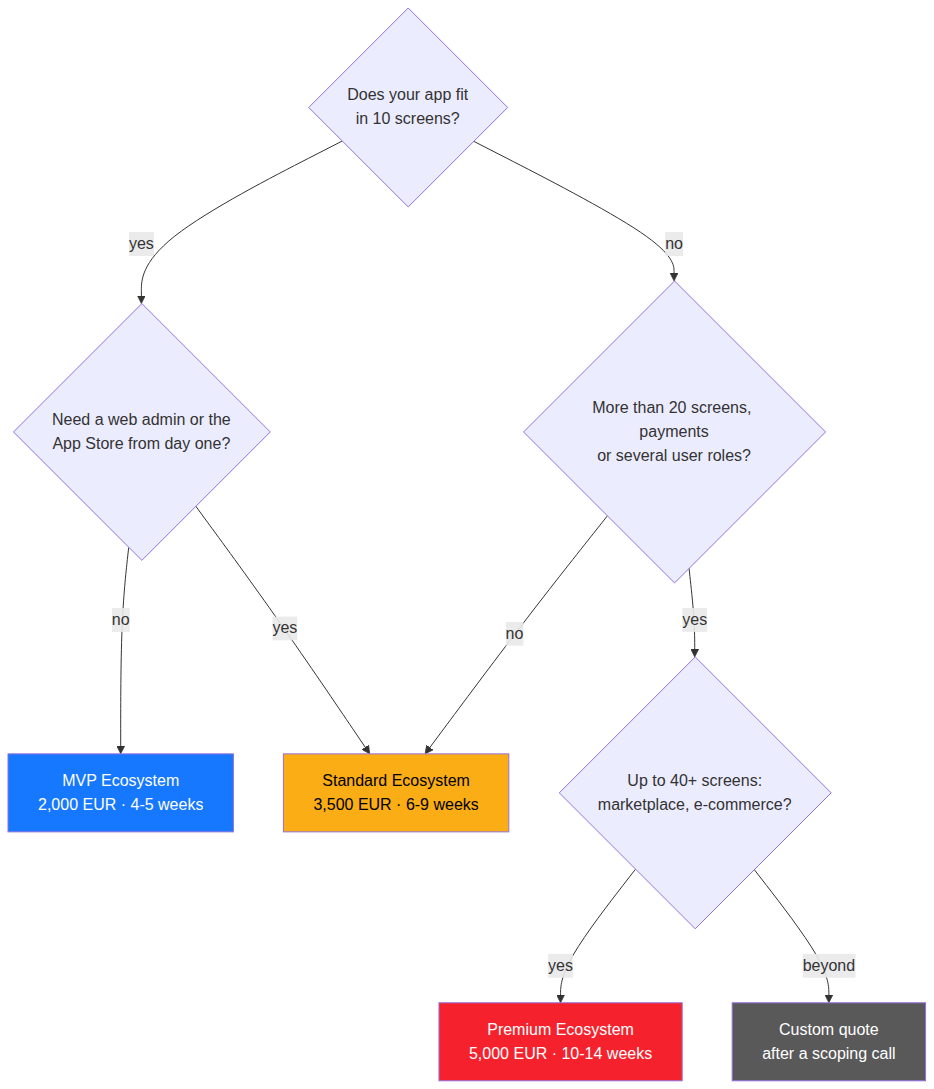 Four questions tell you whether your app fits the MVP, Standard or Premium package, or needs a custom quote
Does your project fit one of these packages? Describe your app in a few lines. We reply with the right package, the list of included screens and a schedule. Request a Flutter quote or explore our Flutter agency offers.
Real examples: three Flutter apps shipped by BOVO
These three projects are featured in our portfolio. We do not publish the price each client paid. We do show what was delivered, so you can compare it with your own needs.
Tontineo, a digital savings-group app. Users create or join a rotating savings group (a "tontine"), pick the payout order and track contributions. The app includes Stripe payments, group chat, Google and Apple sign-in, GDPR compliance and an age check. A guest mode lets people explore the app without an account, which Apple requires. With payments, groups and chat, this kind of scope matches today's Premium Ecosystem. See the Tontineo project.
PANIGASPI, an anti-food-waste app. Local shops post their unsold food baskets at the end of the day. Customers find them on a map and reserve them in one tap. Two roles, two interfaces, and real-time stock sync with Firebase. iOS and Android come from one codebase. Two roles, a map and real time: again, a Premium-level scope. See the PANIGASPI project.
FocusLock, a focus app. Onboarding, session setup, timer, 7-day statistics, badges, light and dark themes, English and French. On Android, the app blocks other apps during a session. That native part required the most platform-specific work. See the FocusLock project.
The common lesson: price follows the number of roles, payments and native features, far more than the industry.
Estimator: size your app budget
Tick every row that matches your project. Your package is the highest one among the rows you ticked.
| Your need | Starting package |
|---|---|
| Up to 10 screens, email or Google sign-in, online data | MVP Ecosystem (€2,000) |
| Google Play only at launch | MVP Ecosystem (€2,000) |
| App Store release on top of Google Play | Standard Ecosystem (€3,500) |
| A web admin to manage content and users | Standard Ecosystem (€3,500) |
| Targeted push notifications, usage analytics | Standard Ecosystem (€3,500) |
| Between 11 and 20 screens | Standard Ecosystem (€3,500) |
| In-app payments | Premium Ecosystem (€5,000) |
| Geolocation, maps, real-time updates | Premium Ecosystem (€5,000) |
| Several roles (customer, seller, moderator) | Premium Ecosystem (€5,000) |
| 40+ screens: marketplace, social network, e-commerce | Premium Ecosystem (€5,000) |
| Advanced AI, live video, health or banking data, ERP integration | Custom quote |
Then add the side costs: 99 USD per year for Apple, a one-time 25 USD for Google, usage-based hosting and a maintenance budget.
Agency, freelancer or in-house team: how does it affect the price?
Who builds the app changes the risk as much as the price. A solo freelancer costs less but creates a continuity risk if they become unavailable. An in-house team gives you control, with a fixed payroll cost. An agency brings scoping, several profiles and long-term follow-up.
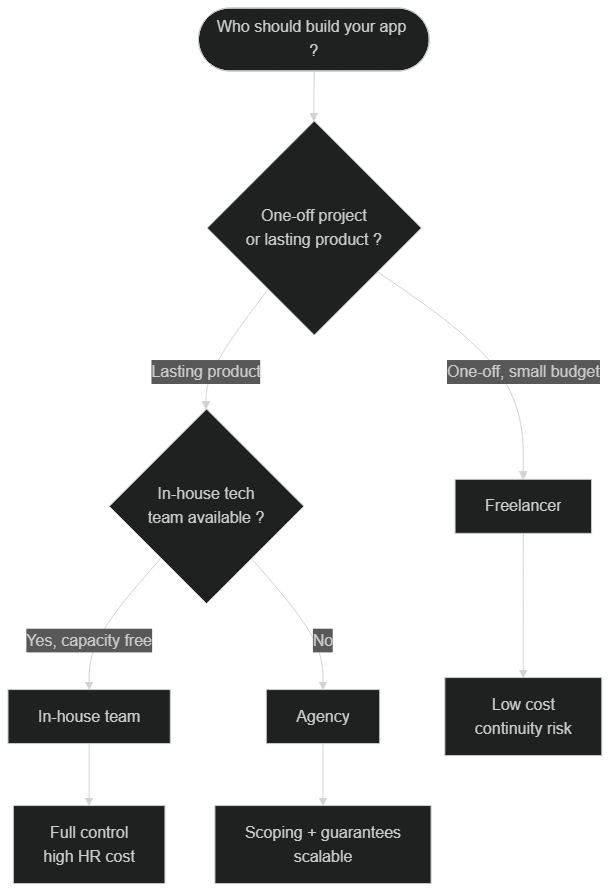 One-off project or lasting product: the right provider depends on the project and on your in-house tech resources
To compare providers (portfolio, code ownership, guarantees), follow our guide on how to choose a mobile app development agency.
How do you get a reliable mobile app quote?
Before signing, check that the quote includes these five items:
- The list of included and excluded screens. Without it, every request becomes an extra.
- Verifiable delivery milestones. You should be able to test the app on your phone during the project.
- What you need to supply. Copy, images, brand guidelines, access to existing tools.
- Recurring costs kept separate from the build price. Stores, hosting, maintenance.
- Ownership of the code and store accounts. They must be in your name.
At BOVO Digital, scoping happens during a free 30-minute call. Contact us with a short description of your app: you get a package or a detailed quote, with a schedule.
Method: how we built this guide
BOVO prices come from our offers in force on 13 October 2026, published on the Flutter agency page. Market ranges come from dated external sources: Le Point (French agency rate cards collected in August 2026), Samioda, Gilzor and hafencity.dev for Flutter-versus-native savings. Store and back-end fees were checked on the official Apple, Google, Firebase and Supabase websites in October 2026.
Out of scope and limits: the three examples (Tontineo, PANIGASPI, FocusLock) describe what was delivered, not the price of each engagement. Market ranges are averages reported by other agencies, not quotes we have seen. Dollar prices are those displayed by Apple and Google; they may vary by country.
Conclusion
In 2026, Flutter app development cost ranges from a few thousand euros for a well-scoped MVP to more than €80,000 for a complex platform at a classic agency. The real lever is not the technology: it is how clear the scope is. List your screens, roles, payments and stores. Add the side costs: 99 USD a year for Apple, 25 USD for Google, hosting and maintenance. You then have a reliable budget.
If your project fits an Ecosystem package, it can be live in 4 to 14 weeks. Tell us about your app or see our offers on the Flutter agency page.
Tags
FAQ
How much does it cost to build a mobile app in 2026?
Agency rate cards collected in France in August 2026 put an iOS + Android MVP at €15,000–€30,000 excl. VAT, an app with accounts, payments and a back office at €30,000–€80,000, and a complex platform above €80,000. EU ranges published by other agencies are similar. At BOVO Digital, our Flutter packages run from €2,000 (MVP Ecosystem) to €5,000 (Premium Ecosystem) for a scope fixed upfront.
How much does a Flutter app for iOS and Android cost?
The price depends mostly on the number of screens, user roles, payments and the back end. One Flutter codebase serves both platforms, so you do not pay for two apps. Our packages cover iOS and Android: €2,000 for up to 10 screens, €3,500 for up to 20 screens with a web admin, €5,000 for 40+ screens with payments.
Can you build a mobile app for €2,000?
Yes, if the scope stays at MVP level: up to 10 screens, email and Google sign-in, a Firebase back end, a landing page and Google Play release, delivered in 4–5 weeks. Payments, a web admin or 40 screens belong to the Standard or Premium packages.
How much does it cost to publish on the App Store and Google Play?
Apple charges 99 USD per year for the Apple Developer Program. Google Play charges a one-time 25 USD registration fee. The app owner pays these fees on their own account. Both stores also take a commission on digital goods sold inside the app.
What is the yearly maintenance cost of a mobile app?
Agencies commonly advise budgeting 15–20% of the initial build per year for bug fixes, iOS and Android updates and small improvements. Add hosting (often free at first on Firebase or Supabase) and third-party services such as SMS.
Is Flutter cheaper than native development?
Yes for most business, booking or commerce apps: one codebase replaces two Swift and Kotlin projects. Estimates published in 2026 range from 20% to 45% savings depending on the source. The gap narrows when the app relies heavily on phone hardware.
How long does it take to develop a mobile app?
At BOVO Digital, plan 4–5 weeks for an MVP, 6–9 weeks for an app with a web admin and 10–14 weeks for a marketplace or an app with payments. Add at least 14 days of closed testing if the Google Play account is a recent personal account.
Does your site book meetings — or just present you?
We open your URL together, mark the 3 leaks, and tell you whether a fix is enough or a rebuild is required.
- 30 min
- No commitment
- Action plan
William Aklamavo
Web development and automation expert, passionate about technological innovation and digital entrepreneurship.


