
Access Management and Abuse Prevention for Generative AI (Echo AI)
JWT auth, IP verification, and per-user credit management in one n8n workflow — the security backbone that keeps the Echo AI platform abuse-free and scalable.
Discuss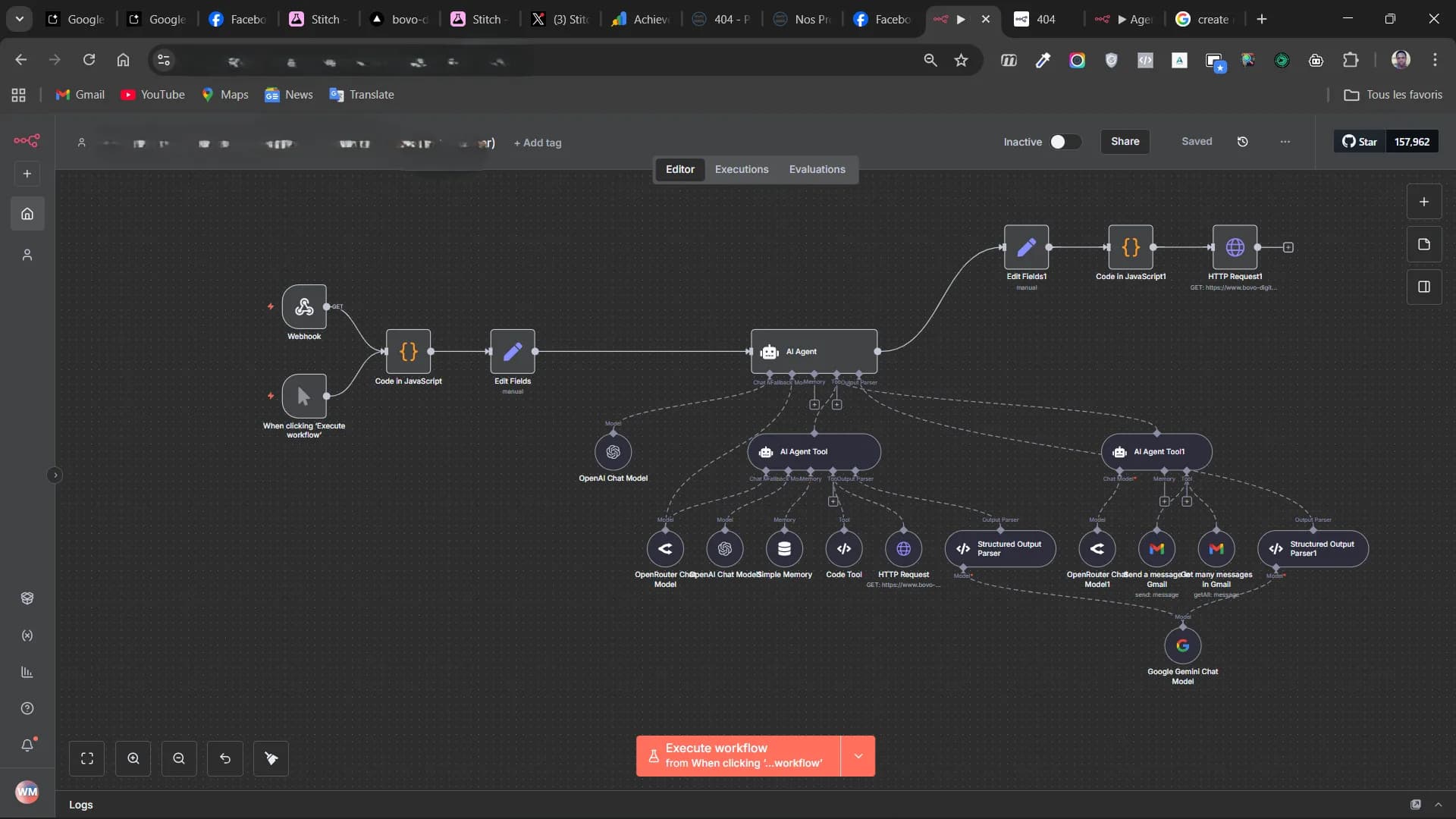
About this project
The invisible backbone that keeps a generative-AI SaaS from being drained by abuse
Generative AI applications have a quietly brutal economic problem: every request costs real money, and without the right infrastructure a handful of malicious or careless users can burn through a month's budget in hours. For Echo AI — an innovative product that turns a product photo and an inspiration image into a professional creative brief for advertising, merging style and product into impactful visuals — this risk was existential. My role was to build the security and access-control layer that makes the whole thing sustainable.
The project context
Echo AI's user experience is effortless by design: upload a product image, upload an inspiration image, get a polished creative brief ready to drive paid-ad production. Behind that simplicity sits a sophisticated pipeline of AI calls, each of them consuming compute credits. Opening the door to that kind of backend without proper guardrails would have invited abuse within days.
The challenge
The objective was to implement a sophisticated access-control system that would:
- Prevent abusive and unauthorized use of the application.
- Enforce credit quotas per user so that free-tier, trial, and paid users each get exactly what they were allocated — no more, no less.
- Absorb traffic spikes without breaking or manually scaling.
- Remain modular so the product team could evolve policies later without rearchitecting anything.
Without such a system, the Echo AI infrastructure would have been overwhelmed by malicious or excessive requests, leading to unpredictable costs and degraded experience for legitimate users.
The implemented solution
I designed and deployed a powerful automation workflow built on n8n, acting as the intelligent gatekeeper in front of every sensitive endpoint. The workflow integrates several mechanisms, each of them handling a specific class of threat.
Credit management Precise per-user tracking of credit consumption. Every generation request is checked against the user's remaining quota before any AI call is made. When the quota is exhausted, the user is informed cleanly and pointed to upgrade paths, rather than being silently cut off.
IP address verification IP-based controls identify and rate-limit suspicious or excessive traffic sources. Known abuse patterns are blocked upstream, before they ever reach the expensive AI layer. Geographic anomalies, sudden bursts, and VPN/proxy misuse all have their own detection rules.
JWT authentication Every request is authenticated via JSON Web Tokens. Only properly signed, non-expired, non-revoked tokens from authenticated users are processed. The token layer also carries the user's plan and quota information, so downstream nodes do not have to re-query the database on every request.
Robust data storage Integration with Google Sheets for dynamic, easily accessible management of user data and security configurations. This choice is intentional: non-technical operators on the Echo AI team can adjust thresholds, whitelists, and quota policies directly, without touching code or redeploying. A lightweight admin UX, essentially, built on a tool the team already masters.
Webhooks and integrations The workflow leverages webhooks for low-latency communication between the application and the security layer. Real-time responsiveness is critical — an access check cannot take 2 seconds, or the UX of Echo AI becomes unusable. The architecture is engineered to keep checks under a tight latency budget.
The impact and results
- Abuse neutralized: significant reduction in suspicious and malicious request volume.
- Predictable costs: per-user quotas enforce the company's unit economics. No more open-ended bills.
- Fair user experience: legitimate users are never throttled unfairly, because the rules are deterministic and transparent.
- Operational flexibility: thanks to the modular n8n architecture and the Google Sheets configuration layer, the product team can evolve access policies in minutes, not weeks.
- Scale-ready foundation: as Echo AI grows, this layer grows with it, because every rule is parameterized rather than hard-coded.
Why this kind of infrastructure is worth building properly
For any generative-AI SaaS, access control is not an optional feature — it is the spine. Build it poorly, and the business becomes financially uncontrollable. Build it properly, and every other feature can scale without fear.
Technology stack
- n8n for the full workflow orchestration and gatekeeper logic.
- JWT (JSON Web Tokens) for stateless, secure authentication.
- Google Sheets as the dynamic configuration and user-data layer.
- Webhooks for low-latency synchronous checks.
- IP verification rules for upstream abuse prevention.
Ready to automate your business? Discover our AI Automation service →
Technologies used
Similar projects
Explore other case studies in the same category.
%2Fuploads%2Fmedia%2Fpicture%2Fb773fffa-0add-4042-97b8-161f859aad9a%2Ftmp%2Fprojects%2Fb773fffa-0add-4042-97b8-161f859aad9a%2Ffrom-notion-to-image-generation-n8n-dev-05-06-2025-06-25-am-68199e9151e01.jpg&w=3840&q=75)
Orchestrated AI Image Workflow
Turn a Notion idea into 3 AI-generated image variations in seconds — a fully automated n8n workflow that eliminates manual image sourcing forever.
View project%2Fuploads%2Fmedia%2Fpicture%2Fb773fffa-0add-4042-97b8-161f859aad9a%2Ftmp%2Fprojects%2Fb773fffa-0add-4042-97b8-161f859aad9a%2Fwoocommerce-vers-pinterest-avec-plusieurs-images-6815dfd654fec.jpg&w=3840&q=75)
WooCommerce to Pinterest Automation
Drive hands-free evergreen Pinterest traffic from your WooCommerce catalog — automated pinning 24/7 with smart duplicate prevention and daily quota management.
View project%3Ano_upscale()%2Fuploads%2Fmedia%2Fpicture%2Fb773fffa-0add-4042-97b8-161f859aad9a%2Ftmp%2Fprojects%2Fb773fffa-0add-4042-97b8-161f859aad9a%2Fgeneration-de-contenu-via-google-docs-et-chatgpt-67fe345907458.jpg&w=3840&q=75)
Multi-Platform Content Automation
One Google Doc, three publishing channels — a Make.com + ChatGPT pipeline that auto-generates a blog article, Instagram post, and LinkedIn post from a single source.
View projectRelated blog articles
Dive deeper into the topic with our guides and tutorials.

Supabase vs Google Sheets: Why SMEs Are Migrating in 2026
Google Sheets is every beginner's favorite automation tool — and the leading cause of production disasters. Rate limits, corrupted data, zero security: here's why Supabase changes everything, and how to decide which tool to use in your context.
Read article
Customer-service and quoting automation: a 2026 ROI hypothesis
Quote and support ROI: a hypothesis, not a median. Cases 24-26 as illustrations (segment under 5). Formula, 25 files, public card. Dated 13 September 2026.
Read article
n8n connects 70 MCP servers: what changes for an SMB
On 10 August 2026 n8n opened about 70 MCP servers with a single OAuth click. Three SMB workflows, node versus MCP, and the wall where DIY actually stops.
Read article