
Intelligent WhatsApp Response Processing
Every WhatsApp reply is instantly captured, the lead identified, and routed to the exact AI scenario — no manual sorting, no missed opportunities.
Discuss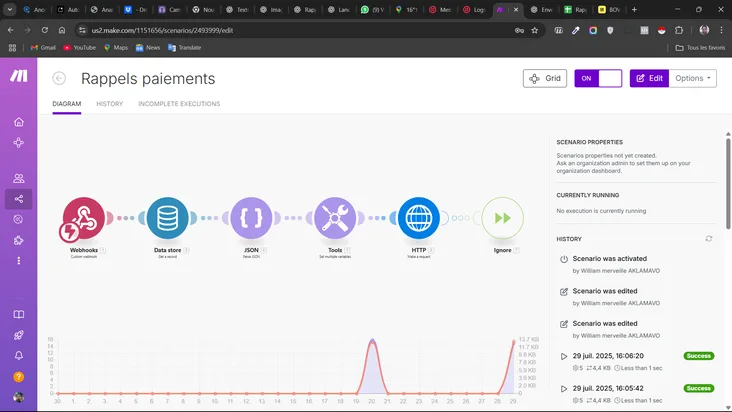
About this project
Every WhatsApp reply identified, qualified, and routed to the right AI scenario
In a multi-prospect automated funnel, an incoming WhatsApp reply is never a generic event. The same message — "Tell me more" — can mean completely different things depending on where the prospect is in the journey: is it a brand-new lead curious about your offer? A qualified prospect asking for the demo link? A booked client about to cancel? The value of this automation is to understand the context in real time and route the message to the exact AI scenario designed to handle it — no human triage required.
What this workflow does
Webhook-based reception Every incoming WhatsApp message fires a Make.com webhook in real time. There is no polling, no delay, no batch job. The scenario activates within seconds of the prospect pressing send, which is critical for conversion — prospects expect near-instant replies on WhatsApp.
Contact identification The system queries the Google Sheets CRM to identify who this prospect is, at which stage of the funnel they currently sit, which scenario they came from, and which closer (if any) is assigned to them. This contextual lookup is what makes the rest of the workflow work: without it, the AI would be forced to restart the conversation from scratch each time.
Smart routing to the right scenario Based on the prospect's current status, the reply is routed to a specific downstream Make.com scenario:
- Qualification if the lead is new and in the middle of the NEPQ flow.
- Objection handling if the lead is qualified but hesitant.
- Appointment booking if the lead is ready and needs the Calendly link.
- Reminder / reschedule if the lead already has a booking coming up.
- Human escalation if the case is flagged complex or commercially sensitive.
Each route is a separate scenario with its own prompts, its own tone, and its own next steps. One router, many specialists.
GPT-4 intent analysis The message content is analyzed by GPT-4 to detect intent: interest, objection, question, confusion, cancellation, booking confirmation, and so on. The classification is injected into the downstream scenario so the AI responds in the right register — not a canned reply, but one tuned to the real emotional state of the prospect in that moment.
Why this architecture matters
Without this router, your inbound WhatsApp stream becomes noise: a single flat queue where every message is treated the same way. With the router, every inbound message enters the funnel as a labeled, identified, contextualized event. The rest of the system can then behave like a team of specialists instead of a single overwhelmed junior agent.
This is the kind of infrastructure choice that separates a toy WhatsApp automation from a real commercial system capable of handling thousands of concurrent conversations without dropping a single lead.
Technology stack
- Make.com as the routing backbone and scenario orchestrator.
- Twilio WhatsApp for the messaging channel.
- Google Sheets as the live CRM and routing table.
- OpenAI GPT-4 for intent detection and classification.
- Webhooks for the real-time trigger layer.
Ready to automate your business? Discover our AI Automation service →
Technologies used
Similar projects
Explore other case studies in the same category.
%2Fuploads%2Fmedia%2Fpicture%2Fb773fffa-0add-4042-97b8-161f859aad9a%2Ftmp%2Fprojects%2Fb773fffa-0add-4042-97b8-161f859aad9a%2Ffrom-notion-to-image-generation-n8n-dev-05-06-2025-06-25-am-68199e9151e01.jpg&w=3840&q=75)
Orchestrated AI Image Workflow
Turn a Notion idea into 3 AI-generated image variations in seconds — a fully automated n8n workflow that eliminates manual image sourcing forever.
View project%2Fuploads%2Fmedia%2Fpicture%2Fb773fffa-0add-4042-97b8-161f859aad9a%2Ftmp%2Fprojects%2Fb773fffa-0add-4042-97b8-161f859aad9a%2Fwoocommerce-vers-pinterest-avec-plusieurs-images-6815dfd654fec.jpg&w=3840&q=75)
WooCommerce to Pinterest Automation
Drive hands-free evergreen Pinterest traffic from your WooCommerce catalog — automated pinning 24/7 with smart duplicate prevention and daily quota management.
View project%3Ano_upscale()%2Fuploads%2Fmedia%2Fpicture%2Fb773fffa-0add-4042-97b8-161f859aad9a%2Ftmp%2Fprojects%2Fb773fffa-0add-4042-97b8-161f859aad9a%2Fgeneration-de-contenu-via-google-docs-et-chatgpt-67fe345907458.jpg&w=3840&q=75)
Multi-Platform Content Automation
One Google Doc, three publishing channels — a Make.com + ChatGPT pipeline that auto-generates a blog article, Instagram post, and LinkedIn post from a single source.
View projectRelated blog articles
Dive deeper into the topic with our guides and tutorials.

Make.com AI Agents vs n8n: Which to Choose for Automation in 2026?
Make.com launched its AI Agents in February 2026. n8n 2.15 responds with 400+ integrations and Ollama compatibility. The match is tight — but the answer depends on your profile. Here's the honest comparison.
Read article
171% ROI on Production AI Agents: Why 89% of Enterprises Stay Stuck in POC
Gartner forecasts 40% of enterprise applications with AI agents by end of 2026. Measured production ROI: 171% on average, up to 540% over 18 months. Yet only 11% of enterprises actually shipped to production. Inside the gap between testing and deploying.
Read article
Stable MCP + A2A Protocol: The New Standard for Connecting Your AI Agents
In April 2026, two standards are changing the game for automation: the Model Context Protocol (MCP) reaches maturity, and the Agent2Agent (A2A) protocol emerges to enable agents to collaborate with each other. Here's what it changes for your workflows.
Read article